


- Tight Raw Spread pricing
- Regulated across multiple jurisdictions
- Supports MT4, MT5 & cTrader
- Strong algo trading & FIX API support
- Full-featured mobile trading access
- No proprietary trading platform
- Leverage varies by region
- Investor protection varies by entity
- Offshore clients get weaker regulatory recourse
- Trading conditions differ by jurisdiction
IC Markets is a Forex and CFD broker founded in Sydney, serving retail and institutional traders through multiple regulated entities worldwide. This review examines its regulatory status, account structure, fees, and platform offering ahead of 2026 to help traders decide if it fits their needs.
IC Markets operates under multiple regulatory licenses spanning both tier-1 and offshore jurisdictions, with client funds held under segregated accounts that vary in oversight strength depending on the regulator. This multi-jurisdictional setup means the level of investor protection varies depending on which entity a trader is onboarded under.
IC Markets offers Raw Spread and Standard accounts, with Raw accounts featuring tighter spreads plus a commission per lot, while Standard accounts embed costs into wider spreads instead of charging a separate commission. Leverage limits differ by regulator, with tighter caps applied to clients under stricter jurisdictions.
IC Markets supports MetaTrader 4, MetaTrader 5, and cTrader, alongside deposit and withdrawal methods such as bank transfer, cards, and e-wallets, though availability depends on the trader’s country. Forex Bit breaks down these details further, starting with what IC Markets is and whether it qualifies as a trustworthy broker.
What Is IC Markets and Is It a Legitimate Forex Broker?
IC Markets is a Forex and CFD broker founded in Sydney, serving retail and institutional traders through multiple regulated entities worldwide.
The broker’s legitimacy ties directly to the identity established at inception and its subsequent growth into a multi-entity operation. IC Markets built its reputation primarily around low-cost trading conditions, deep liquidity, and fast execution speeds aimed at active traders, scalpers, and algorithmic strategies. Its client base spans beginners opening their first account, intermediate traders scaling position sizes, and experienced professionals running high-frequency systems that depend on tight spreads.
IC Markets carries a generally positive market reputation among retail traders, largely attributed to its execution quality and broad platform support, though its overall trustworthiness depends on which regulated entity a trader signs up under.
This distinction matters because oversight strength differs across its tier-1 and offshore licenses. Traders evaluating IC Markets should weigh which regional entity applies to their account before relying solely on the brand’s global standing.
Is IC Markets Regulated and Safe for Trading in 2026?
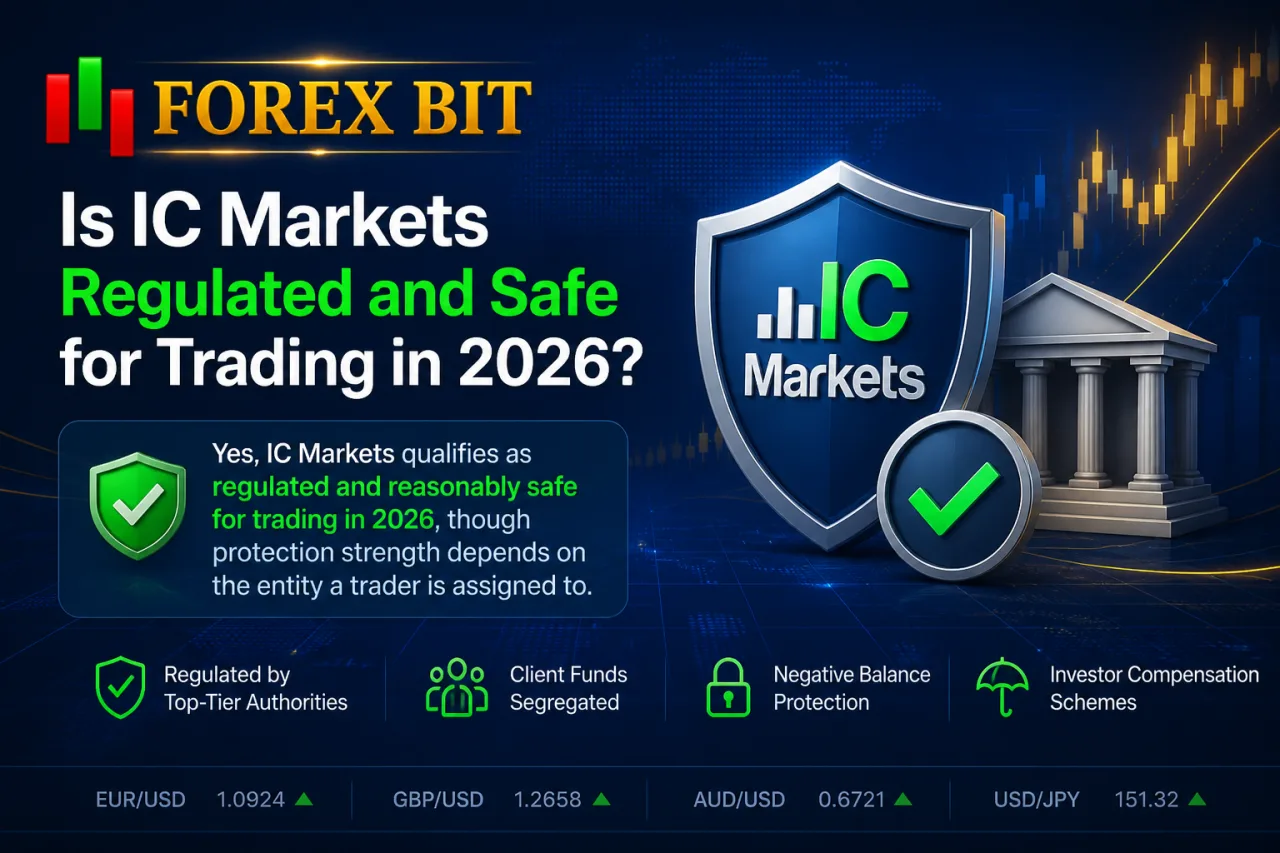
Yes, IC Markets qualifies as regulated and reasonably safe for trading in 2026, though protection strength depends on the entity a trader is assigned to. Its licensed status rests on oversight from multiple regulators, fund segregation practices, and balance protection policies that differ across jurisdictions. The sections below outline the specific licenses, compensation schemes, and safety measures that shape this assessment.
Which Regulatory Entities Oversee IC Markets by Region?
IC Markets operates through several regionally licensed entities, each tied to a specific regulator and protection standard rather than a single global license. This structure directly determines which safeguards apply to a trader’s account based on country of residence.
IC Markets International Pty Ltd holds an ASIC license in Australia, and this entity is subject to stricter leverage caps and mandatory client money rules under Australian regulation.
International Capital Markets Pty Ltd operates under a CySEC license covering clients across the European Economic Area, with negative balance protection and compensation fund access included, though traders should verify the specific license number and coverage details directly with CySEC before opening an account.
IC Markets Global operates under a Seychelles-based license, which typically serves traders outside tier-1 jurisdictions with higher leverage allowances but weaker regulatory recourse compared to its Australian or European entities.
Traders based in restricted or unlisted regions are typically routed to whichever offshore entity IC Markets designates for their country, which affects dispute resolution options and fund protection strength.
What Account Types Does IC Markets Offer?
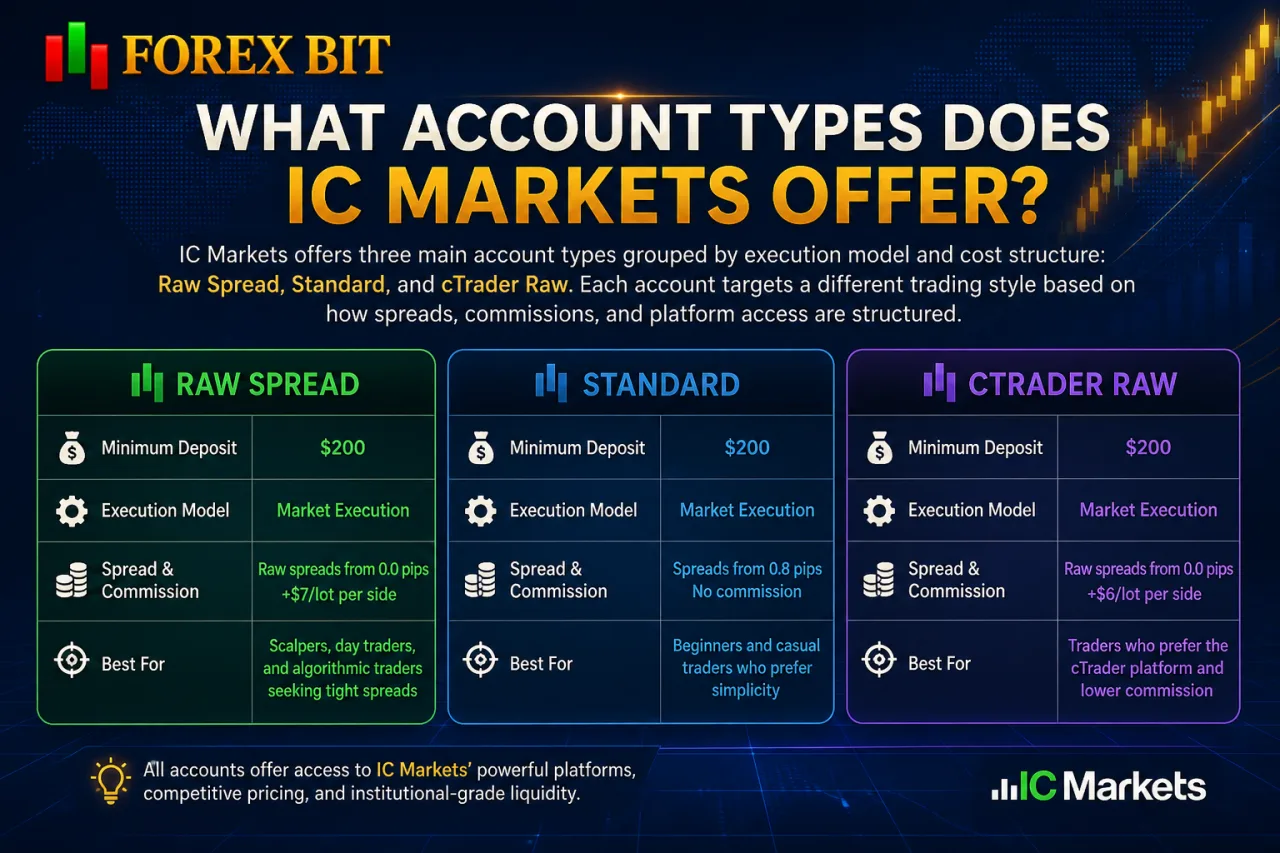
IC Markets offers three main account types grouped by execution model and cost structure: Raw Spread, Standard, and cTrader Raw. Each account targets a different trading style based on how spreads, commissions, and platform access are structured. The following breakdown covers minimum deposits, execution model, and suitability for each account.
Raw Spread vs Standard Account: Which One Should You Choose?
Raw Spread wins on cost efficiency for high-volume trading, while Standard suits traders who prefer commission-free pricing without tracking a separate fee per lot. The choice depends on trading frequency, strategy type, and how each account structures spreads versus commissions.
Raw Spread accounts typically offer tighter spreads than Standard accounts on major pairs, with a commission charged per lot traded on each side of the position.
Standard accounts remove the separate commission and instead widen the spread to cover execution costs, making the all-in cost easier to estimate before placing a trade.
This cost structure difference shapes which trader profile benefits most from each account:
- Scalpers and high-frequency traders benefit from Raw Spread pricing, since tighter spreads reduce the cost impact of frequent entries and exits.
- Casual or swing traders benefit from Standard accounts, since fewer trades mean the wider spread has less cumulative effect on overall cost.
- Algorithmic strategies with large trade volumes benefit from Raw Spread’s lower per-trade cost once commission is factored against spread savings.
Traders running strategies with wide profit targets and low trade frequency generally find Standard pricing sufficient, while active traders scaling volume tend to favor Raw Spread for its tighter effective cost.
How Much Does It Cost to Trade with IC Markets?
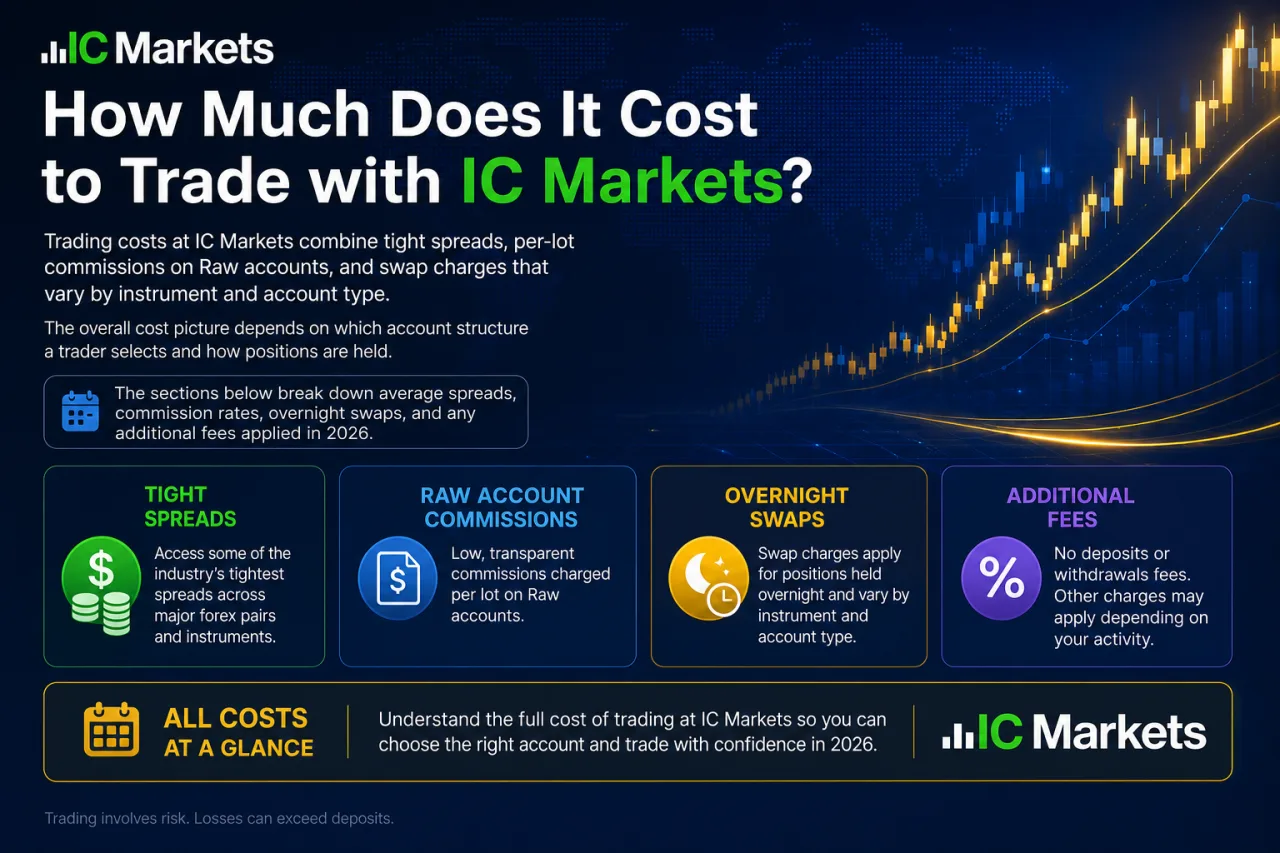
Trading costs at IC Markets combine tight spreads, per-lot commissions on Raw accounts, and swap charges that vary by instrument and account type. The overall cost picture depends on which account structure a trader selects and how positions are held. The sections below break down average spreads, commission rates, overnight swaps, and any additional fees applied in 2026.
What Is the Maximum Leverage Offered by IC Markets?
IC Markets caps leverage at different levels depending on client classification and regulatory entity, with tier-1 jurisdictions imposing tighter limits than offshore licensing. This leverage structure directly follows from the multi-entity setup outlined earlier for IC Markets International, International Capital Markets, and IC Markets Global.
Retail clients under the ASIC-regulated entity face leverage limits well below those offered offshore, reflecting Australia’s retail client protection rules on major currency pairs.
Clients under the CySEC-regulated entity operate under leverage restrictions for retail accounts, generally consistent with the framework applied across the European Economic Area, though traders should verify the exact current cap directly with CySEC before opening an account.
Professional clients meeting income, asset, or experience thresholds under either regulated entity can qualify for higher leverage than standard retail accounts, though the exact caps and eligibility criteria should be confirmed directly with the broker.
Clients onboarded under IC Markets Global in Seychelles generally have access to significantly higher leverage than under the broker’s tier-1 regulated entities, with the exact maximum ratio subject to change and best confirmed directly with the broker.
Leverage assignment therefore depends less on account type and more on which regulatory entity processes the client’s application.
Which Trading Platforms Does IC Markets Support?
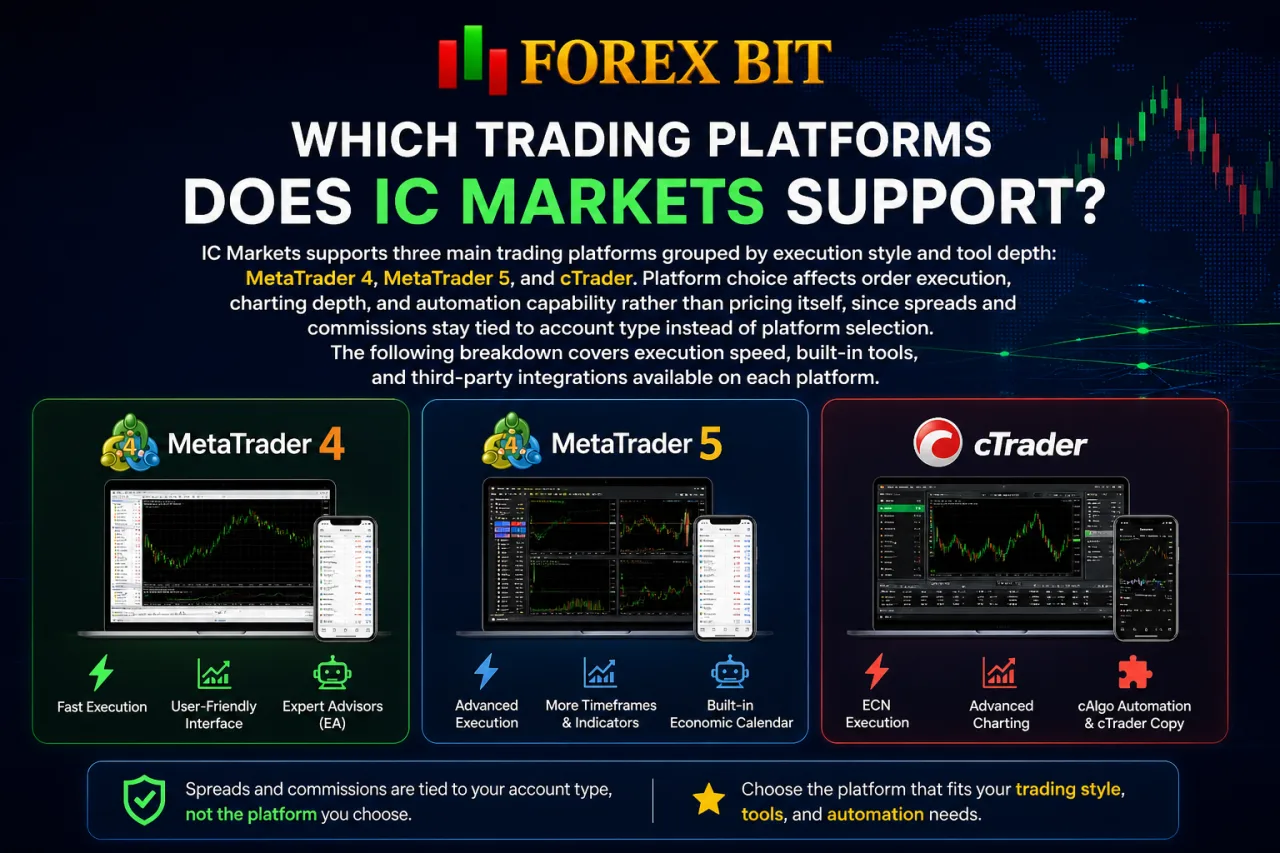
IC Markets supports three main trading platforms grouped by execution style and tool depth: MetaTrader 4, MetaTrader 5, and cTrader. Platform choice affects order execution, charting depth, and automation capability rather than pricing itself, since spreads and commissions stay tied to account type instead of platform selection. The following breakdown covers execution speed, built-in tools, and third-party integrations available on each platform.
MT4 vs MT5 vs cTrader: Which Platform Is Best on IC Markets?
cTrader wins on order execution and depth-of-market transparency, MT5 leads on charting depth and multi-asset structure, while MT4 stays strongest on automation compatibility through its widely supported scripting language. Each platform serves a distinct trading style rather than one clearly outperforming the others across every metric.
MT4 remains the default choice for traders relying on Expert Advisors, since its scripting language has the broadest library of existing indicators and automated strategies built up over years of third-party development. MT5 extends this foundation with additional order types, more built-in timeframes, and an integrated economic calendar, making it better suited to traders handling multiple asset classes from one interface.
cTrader differentiates itself through Level II pricing and a cleaner order execution model, giving discretionary traders and scalpers a clearer view of market depth before entering a position. Its native support for cAlgo also allows automation without relying on MQL syntax.
- MT4 favors traders running established Expert Advisors and simple charting needs.
- MT5 favors traders needing broader instrument coverage and advanced order types.
- cTrader favors traders prioritizing execution transparency and depth-of-market data.
Platform selection ultimately depends on whether automation history, charting breadth, or execution clarity matters most to the trader’s strategy.
Does IC Markets Offer a Mobile Trading App?
Yes, IC Markets offers a mobile trading app, extending MT4, MT5, and cTrader functionality to smartphones and tablets across iOS and Android devices. This mobile availability follows the same platform lineup already covered above, just adapted for on-the-go access rather than desktop use.
Each platform’s mobile version retains core trading functions rather than a stripped-down feature set. Traders open and close positions, monitor live charts, set pending orders, and manage account balances directly from a mobile device.
- Placing and modifying market or pending orders works the same as on desktop terminals.
- Viewing real-time quotes and multi-timeframe charts stays available without a wired connection.
- Receiving push notifications for price alerts and order execution keeps traders updated away from a desk.
- Managing multiple accounts and switching between them applies across MT4, MT5, and cTrader mobile apps.
Execution speed and connection stability on mobile depend partly on network conditions rather than the app itself, so traders running latency-sensitive strategies still tend to favor desktop terminals for primary execution.
What Markets and Instruments Can You Trade with IC Markets?
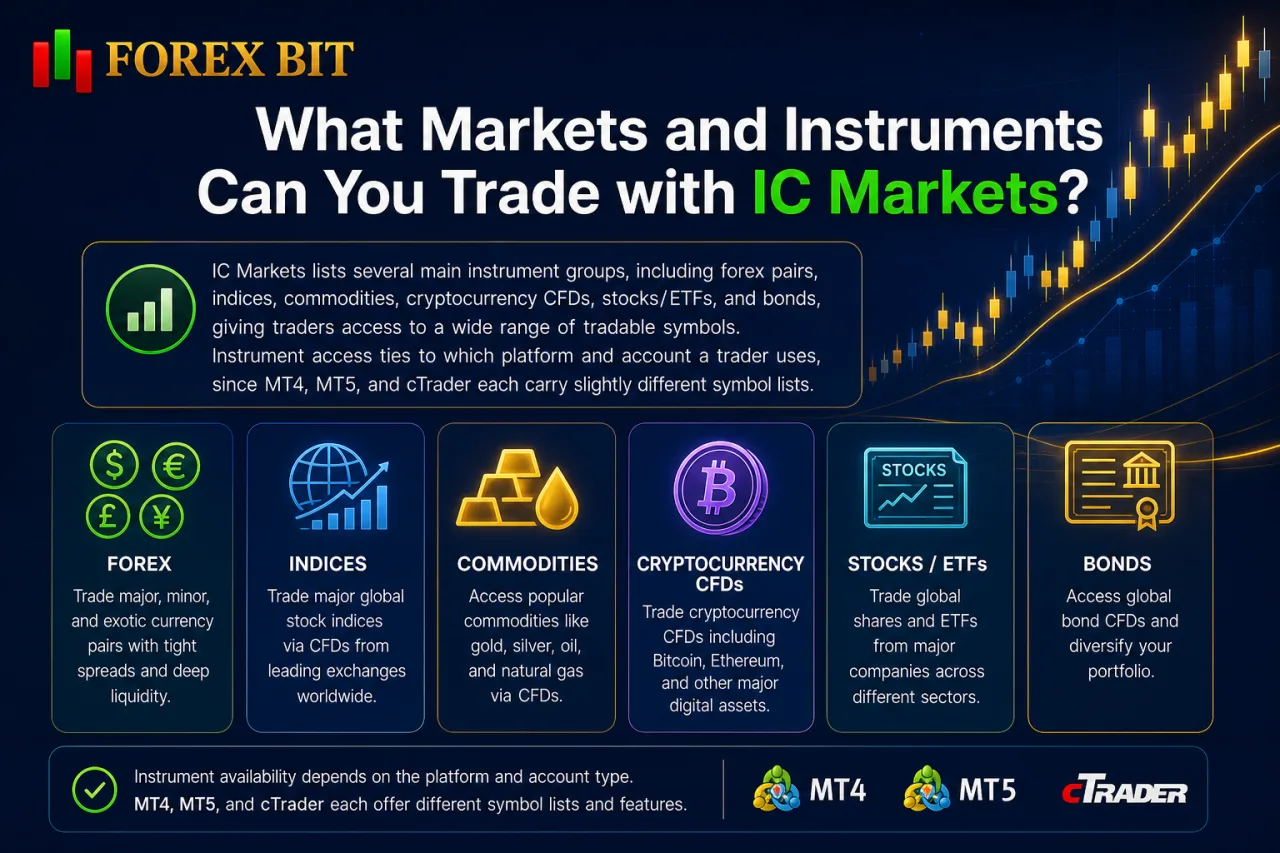
IC Markets lists several main instrument groups, including forex pairs, indices, commodities, cryptocurrency CFDs, stocks/ETFs, and bonds, giving traders access to a wide range of tradable symbols. Instrument access ties to which platform and account a trader uses, since MT4, MT5, and cTrader each carry slightly different symbol lists.
Forex trading covers major, minor, and exotic currency pairs, forming the core of IC Markets’ liquidity and pricing focus.
Indices CFDs track major global stock indices, giving traders exposure to broad equity market movements without holding individual shares.
Commodities are typically offered as CFDs covering energy products and metals, with pricing derived from underlying futures markets.
Cryptocurrency CFDs let traders speculate on digital asset price movements against fiat currencies without owning the underlying coins.
Stocks and ETFs cover shares and fund CFDs from major international exchanges, while bond CFDs give exposure to government debt instruments.
Availability across these groups can vary by regulated entity and account type, so confirming the current instrument list directly with IC Markets remains necessary before trading.
How Do You Deposit and Withdraw Funds with IC Markets?
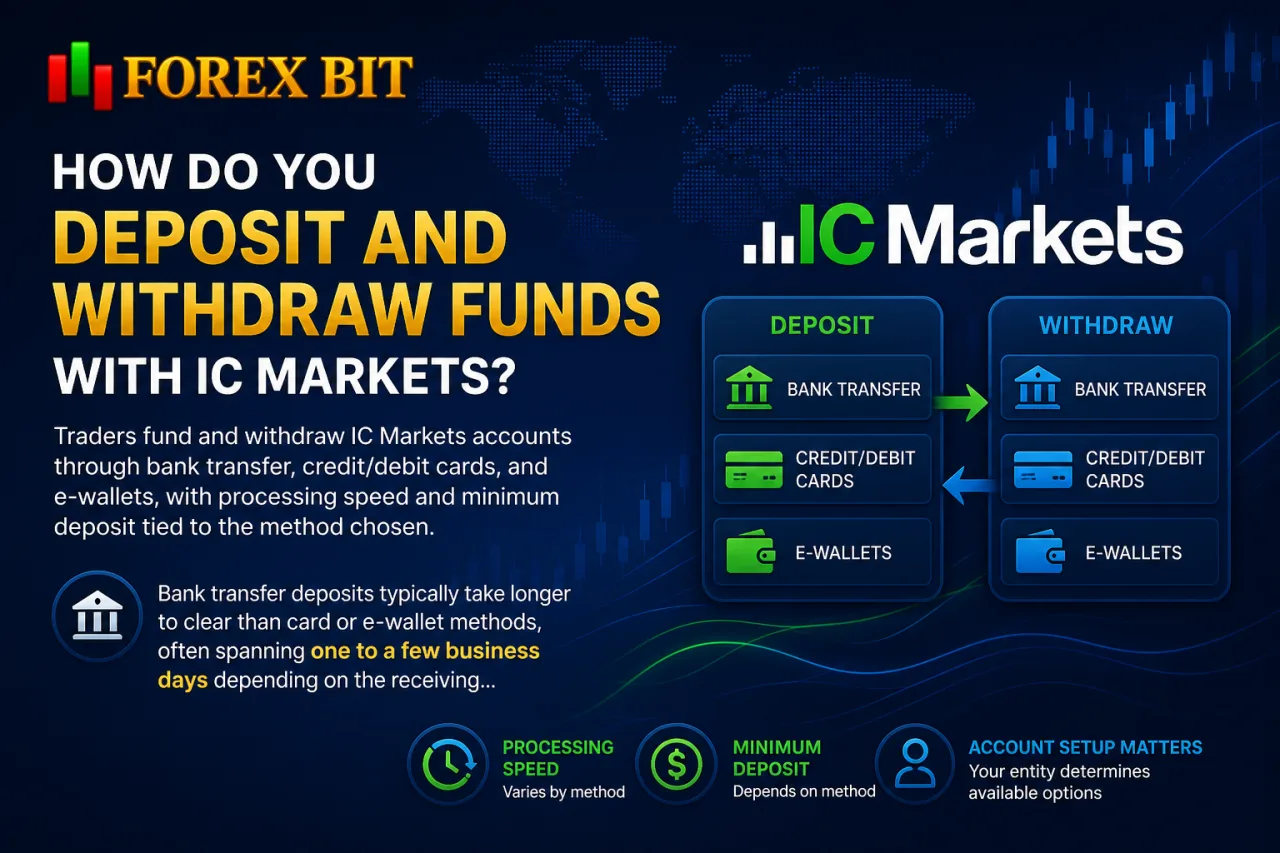
Traders fund and withdraw IC Markets accounts through bank transfer, credit/debit cards, and e-wallets, with processing speed and minimum deposit tied to the method chosen. This funding structure follows the account setup already covered, since the entity a trader is onboarded under can affect which payment options actually appear at checkout.
Bank transfer deposits typically take longer to clear than card or e-wallet methods, often spanning one to a few business days depending on the receiving bank.
Card and e-wallet deposits usually credit the trading account faster than bank transfers, often within minutes once the payment provider confirms the transaction.
The minimum deposit required to open an account sits at a set threshold that IC Markets applies across most of its account types, though traders should confirm the exact current figure directly with the broker before funding an account.
IC Markets does not charge a fee on most deposit methods, though withdrawal processing and any third-party charges depend on the payment provider and the trader’s country, so traders should confirm current details directly with the broker.
Withdrawal requests generally return funds through the same method used for the original deposit, a common anti-fraud practice among regulated brokers. Confirming exact processing windows and any provider-side charges directly with IC Markets before transacting remains the safest step, since terms can shift by region and payment partner.
Is IC Markets Available in Your Country?
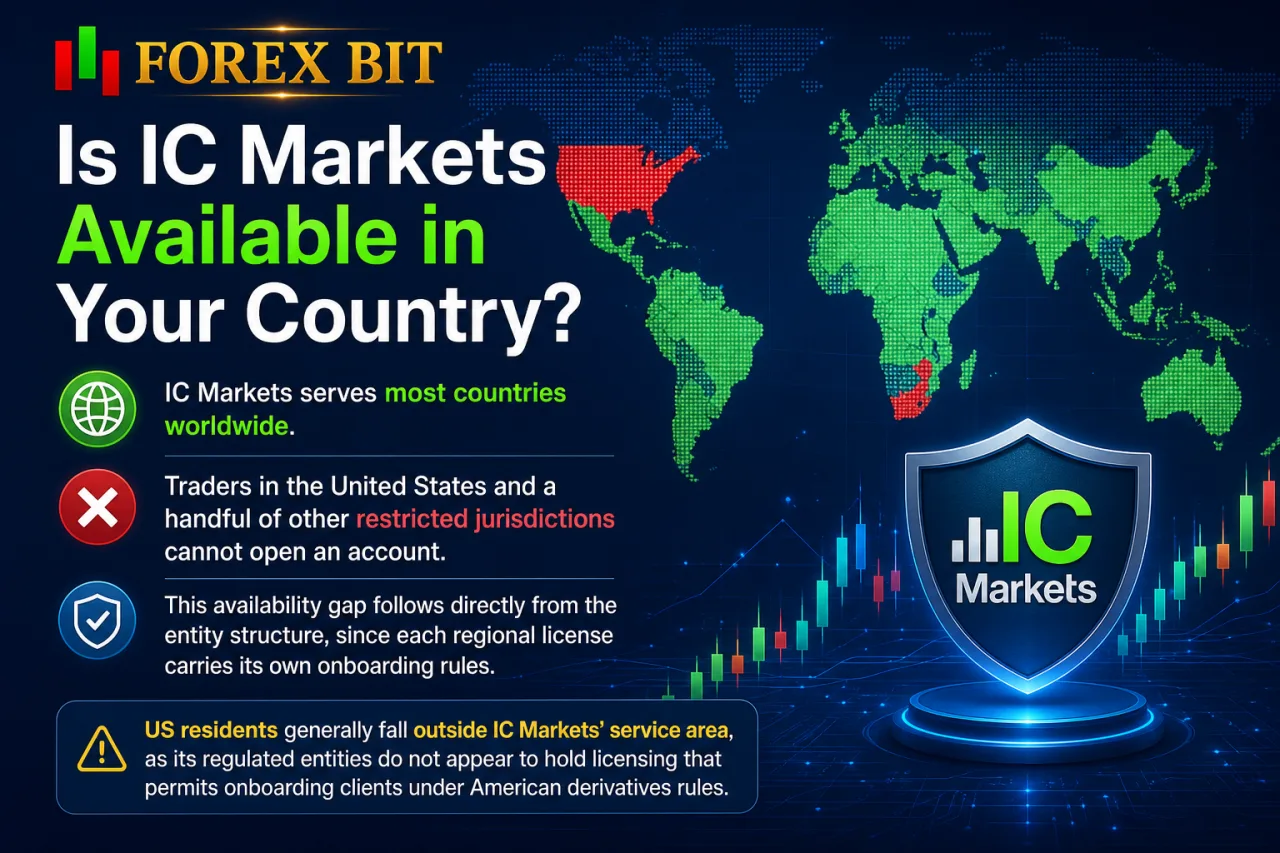
IC Markets serves most countries worldwide, though traders in the United States and a handful of other restricted jurisdictions cannot open an account. This availability gap follows directly from the entity structure already covered above, since each regional license carries its own onboarding rules.
US residents generally fall outside IC Markets’ service area, as its regulated entities do not appear to hold licensing that permits onboarding clients under American derivatives rules, though traders should confirm current eligibility directly with the broker.
Beyond the US, other jurisdictions with strict local trading rules or sanctions may also appear on IC Markets’ excluded list, though the exact roster shifts periodically as compliance requirements change. Aside from these exclusions, traders elsewhere get automatically routed toward whichever entity IC Markets designates for their country:
- Residents of Australia typically onboard under the ASIC-regulated entity.
- Residents of the European Economic Area typically onboard under the CySEC-regulated entity.
- Residents of most other eligible regions typically onboard under IC Markets Global in Seychelles.
Confirming current country eligibility and entity assignment directly with IC Markets before registering remains the most reliable step, since restricted-country lists and entity routing can change without extensive public notice.
How Reliable Is IC Markets’ Customer Support?
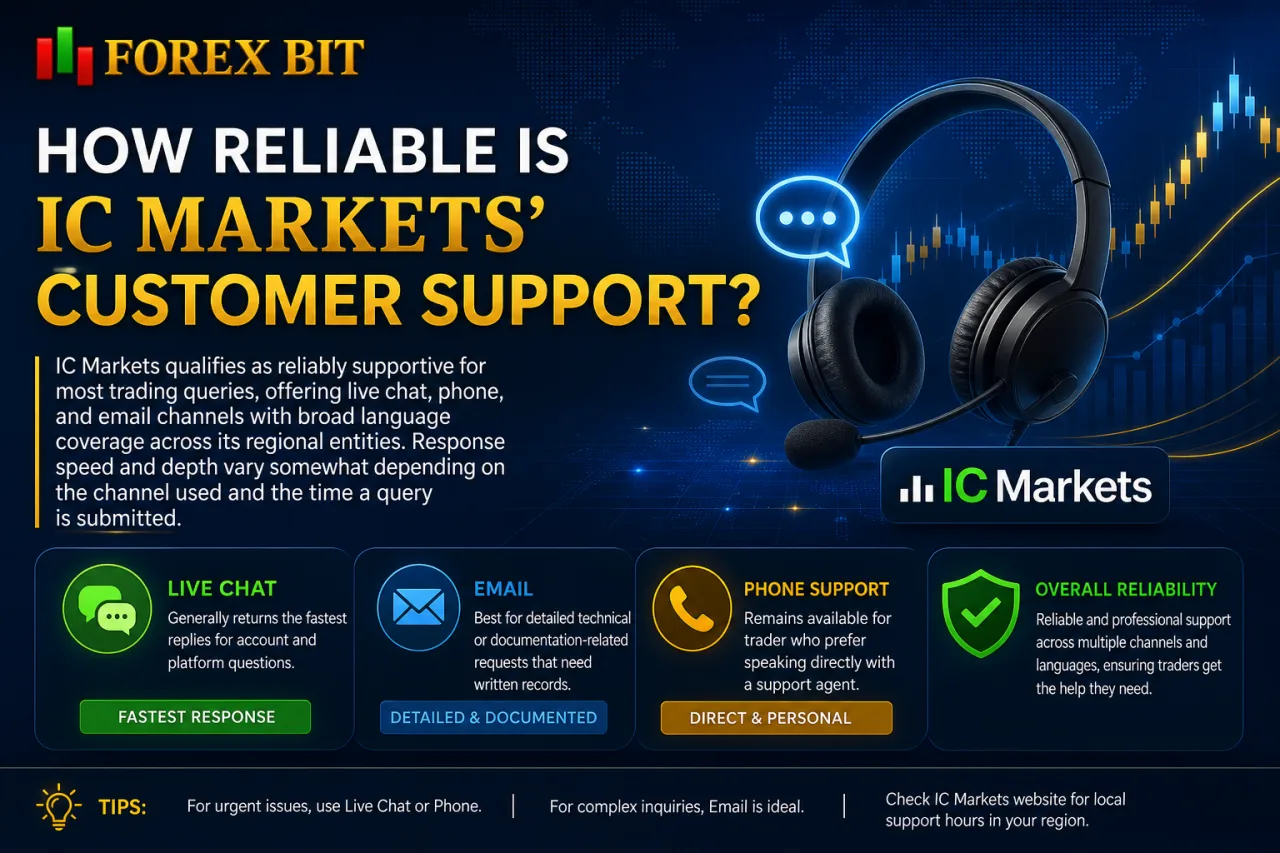
IC Markets qualifies as reliably supportive for most trading queries, offering live chat, phone, and email channels with broad language coverage across its regional entities. Response speed and depth vary somewhat depending on the channel used and the time a query is submitted.
Live chat generally returns the fastest replies for account and platform questions, while email suits more detailed technical or documentation-related requests that need written records. Phone support remains available for traders who prefer direct verbal troubleshooting, particularly around urgent execution or funding issues.
- Offering live chat for quick account, deposit, and platform questions.
- Providing phone lines for traders needing direct verbal assistance.
- Maintaining email support for detailed or documentation-heavy requests.
- Covering multiple languages to serve its international client base across regions.
IC Markets provides customer support aligned with global trading sessions, though traders should confirm exact current hours and days of operation directly with the broker.
Trader feedback generally points toward consistent responsiveness on live chat, with phone and email response times depending on query complexity and regional support team load.
What Are the Main Strengths and Weaknesses of IC Markets?
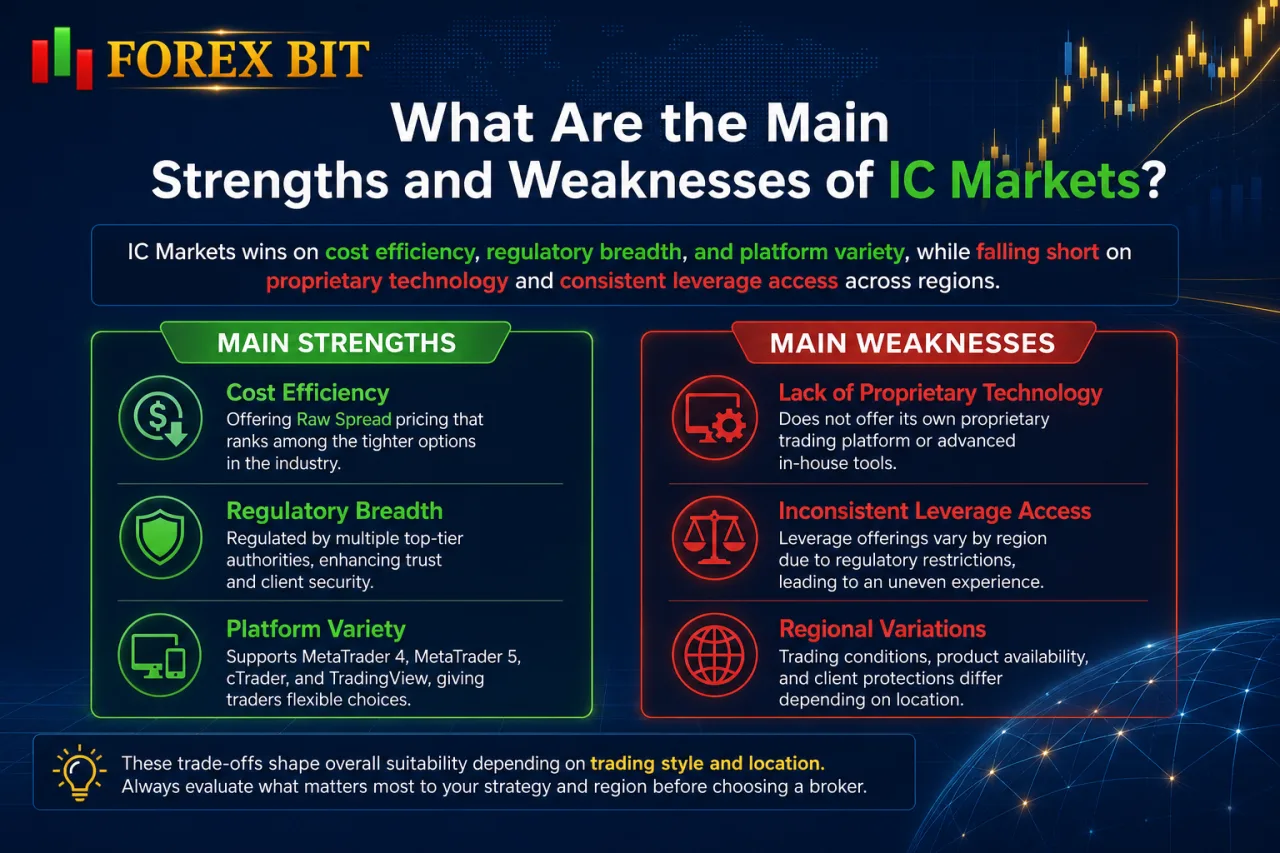
IC Markets wins on cost efficiency, regulatory breadth, and platform variety, while falling short on proprietary technology and consistent leverage access across regions. These trade-offs shape overall suitability depending on trading style and location, with the following breakdown covering specific advantages against limitations.
On the advantage side, IC Markets brings together several factors that appeal to active traders:
- Offering Raw Spread pricing that ranks among the tighter options for high-volume strategies.
- Holding licenses across multiple regulators, spreading oversight rather than relying on one jurisdiction alone.
- Supporting three distinct platforms (MT4, MT5, cTrader), covering automation, multi-asset trading, and execution transparency in one broker.
- Extending full trading functionality to mobile apps without stripping core order and charting features.
On the limitation side, a few structural constraints carry over from earlier sections:
- Lacking a proprietary trading platform, leaving traders dependent entirely on third-party software for execution and charting.
- Applying region-specific leverage caps, meaning the same account type offers different maximum ratios depending on which regulated entity onboards the client.
- Varying investor protection strength across its tier-1 and offshore entities, requiring traders to check their assigned jurisdiction before assuming a uniform safety standard.
Taken together, IC Markets suits cost-conscious and technically capable traders more than those seeking a single unified account experience, since much of what defines the broker’s conditions traces back to entity assignment rather than a fixed global offer.
What Unique Tools and Programs Does IC Markets Offer Beyond Standard Trading?
IC Markets extends beyond standard trading through four value-added offerings: free VPS hosting, FIX API access, Autochartist integration, and an introducing broker/affiliate program. These tools target distinct trader profiles, from latency-sensitive algorithmic strategies to discretionary traders seeking automated pattern recognition, plus a separate revenue stream for partners referring clients.
Does IC Markets Support Algorithmic and Copy Trading?
Yes, IC Markets supports both algorithmic and copy trading, spanning Expert Advisors, cAlgo/cBots, FIX API access, and third-party social trading integrations. This ecosystem extends the platform variety already covered for MT4, MT5, and cTrader into automated and social trading use cases.
- Running Expert Advisors on MT4 and MT5 through the standard MQL scripting environment.
- Building cBots on cTrader’s native cAlgo framework for algorithmic strategy deployment.
- Connecting low-latency systems directly through FIX API for institutional-grade order routing.
- Linking third-party copy trading and social trading platforms for signal-following clients.
Availability of specific copy trading integrations depends on the regulated entity and account type a trader holds, so confirming exact supported services directly with IC Markets remains necessary before setup.
Conclusion
IC Markets earns its standing as a legitimate, multi-regulated broker built around low-cost Raw Spread pricing, broad platform support across MT4, MT5, and cTrader, and instrument coverage spanning forex, indices, commodities, crypto CFDs, stocks, and bonds. Its regulatory structure spreads oversight across ASIC, CySEC, and Seychelles entities, meaning fund protection, leverage limits, and even payment options shift depending on which jurisdiction onboards a trader.
The absence of a proprietary platform is offset by strong third-party tool support, VPS hosting, FIX API access, and Autochartist. For traders weighing IC Markets, the deciding factor rests less on the brand overall and more on confirming exact terms under their assigned regional entity before opening an account.
Thomas Dite is the Best Forex Brokers Research Manager at Forex Bit, specializing in researching, comparing, and editing broker-related content for different trader needs. He focuses on evaluating trading platforms, costs, regulation, account conditions, and other key factors to help readers make more informed broker comparisons.
Email: [email protected]