









Pepperstone, IC Markets, XM, and XTB are widely recognized as strong forex broker options, with comparisons typically based on regulation, trading costs, platform quality, and account conditions. Each broker suits a slightly different trader profile, which makes direct comparison essential before opening a live account.
Pepperstone, IC Markets, XM, and XTB differ mainly in platform choice, cost structure, and target trader type. Pepperstone and IC Markets focus on raw-spread execution for active traders, while XM and XTB place more emphasis on accessibility and platform usability.
XM is often noted for combining a low minimum deposit with broad MetaTrader platform support, making it accessible for beginner traders. This combination reduces the entry barrier while still giving new traders access to familiar MT4 and MT5 tools.
Regulation, spreads, and overall trading costs vary across Pepperstone, IC Markets, XM, and XTB depending on the entity and account type used. Comparing these factors side by side reveals which broker offers genuine cost efficiency rather than just an advertised minimum spread.
IC Markets is generally considered strong for scalping, XM for copy trading accessibility, and XTB or Pepperstone for platform variety including cTrader and TradingView. Forex Bit evaluates these distinctions based on verified trading conditions rather than general reputation. The comparison below starts with an overview of which brokers perform best overall in 2026.
Which Forex Brokers Are the Best Overall in 2026?
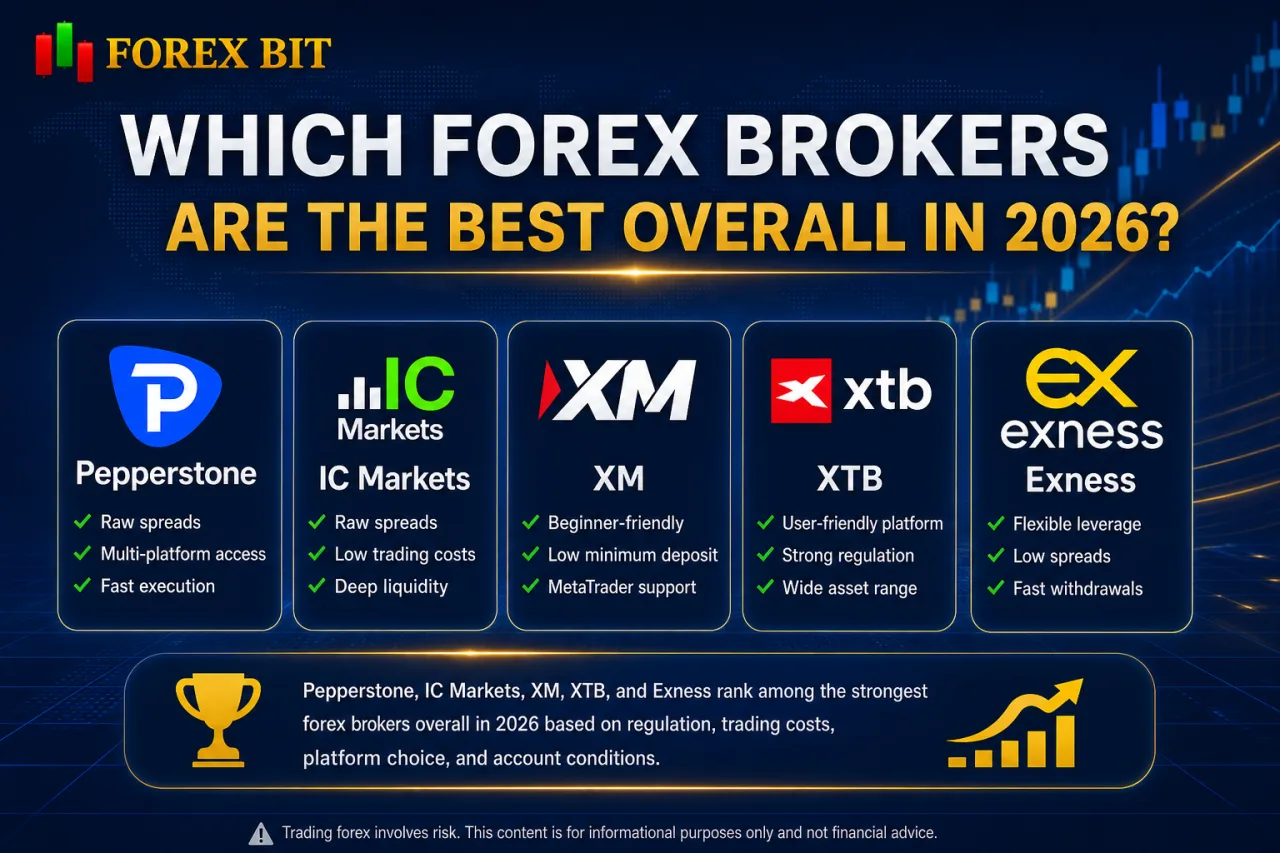
Pepperstone, IC Markets, XM, XTB, and Exness rank among the strongest forex brokers overall in 2026 based on regulation, trading costs, platform choice, and account conditions. Each broker earns its position for different reasons rather than a single combined score.
Pepperstone and IC Markets stand out for raw-spread pricing and multi-platform access, appealing to cost-sensitive and active traders. XM remains a common pick for beginners due to its accessible entry requirements and MetaTrader focus. XTB adds a proprietary platform option for traders who prefer built-in tools over third-party software, while Exness is frequently noted for flexible account structures and deposit conditions across multiple regulated entities.
The sections that follow break down how these five brokers compare directly across cost, regulation, and platform criteria, starting with a side-by-side comparison table.
How Do Pepperstone, IC Markets, XM, XTB, and Exness Compare at a Glance?
Pepperstone, IC Markets, XM, XTB, and Exness differ mainly in minimum deposit, spread structure, and platform support, with no single broker leading every category. The table below summarizes each broker’s general trading conditions for a fast side-by-side view before the detailed breakdown. Exact figures change over time and vary by account type and legal entity, so traders confirm current terms directly on each broker’s official website before opening an account.
| Broker | Best For | Regulation | Minimum Deposit | Spreads/Fees | Trading Platforms |
|---|---|---|---|---|---|
| Pepperstone | Platform variety and low-cost execution | Multiple tier-1 regulators including FCA and ASIC | Check official site for current requirement | Raw-spread pricing plus commission on eligible account types | MT4, MT5, cTrader, TradingView |
| IC Markets | Scalping and raw-spread trading | Multiple regulators including ASIC and CySEC | Check official site for current requirement | Raw-spread pricing plus commission on eligible account types | MT4, MT5, cTrader, TradingView |
| XM | Beginners and copy trading | Multiple regulators including FCA and ASIC | Check official site for current requirement | Variable spreads depending on account type, commission-free on standard offerings | MT4, MT5 |
| XTB | Proprietary platform users | Multiple regulators including FCA and CySEC | Check official site for current requirement | Variable spreads depending on instrument and account type | xStation, MT4 |
| Exness | Flexible account structures | Multiple regulators including FCA and CySEC | Check official site for current requirement | Variable spreads depending on account type | MT4, MT5 |
These figures vary by account type and legal entity, and the detailed sections below explain how each condition applies depending on where a trader registers.
What Methodology Does Forex Bit Use to Rank These Brokers?
Forex Bit ranks brokers using six weighted criteria: regulation and trust, trading costs, platform quality, trading conditions, deposits and withdrawals, and user experience. No single factor determines a broker’s position, since a low-cost broker with weak regulation or poor withdrawal reliability scores lower overall than a fully regulated broker with average spreads.
Applying this methodology to Pepperstone, IC Markets, XM, XTB, and Exness keeps the ranking transparent rather than based on brand recognition alone. Regulation and trust weighs licensing bodies, legal entity structure, fund segregation, and negative balance protection. Trading costs compares spreads, commissions, swap fees, and non-trading charges across account types rather than relying on advertised minimum spreads alone.
Platform quality evaluates support for MT4, MT5, cTrader, TradingView, and proprietary platforms such as xStation. Trading conditions cover execution speed, leverage limits, minimum deposit, instrument range, and scalping or hedging policies. Deposits and withdrawals assess payment method availability, processing fees, and withdrawal consistency, while user experience factors in customer support quality, educational resources, and account management tools.
Each broker section below applies these same six criteria consistently, allowing direct comparison rather than isolated broker descriptions.
Pepperstone vs IC Markets vs XM vs XTB: How Do the Top Brokers Differ?
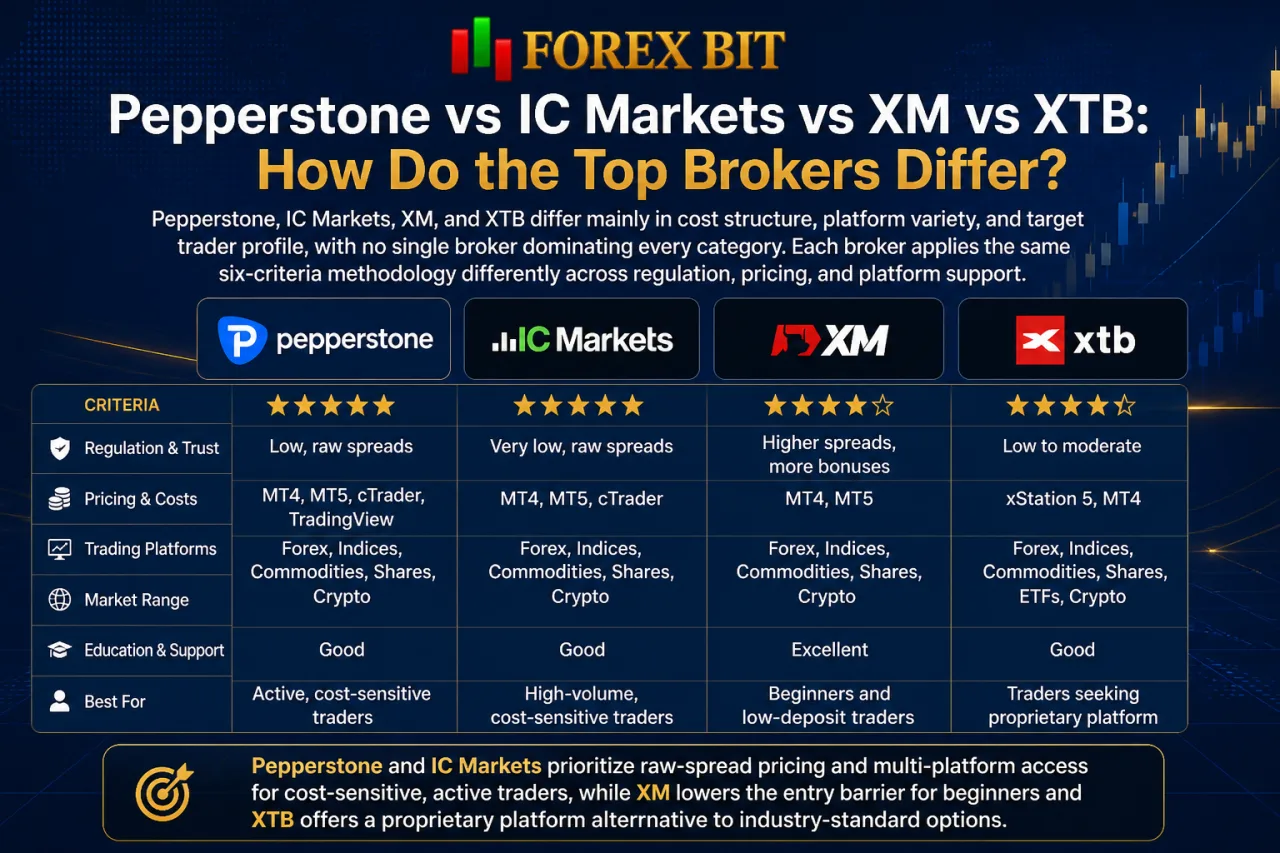
Pepperstone, IC Markets, XM, and XTB differ mainly in cost structure, platform variety, and target trader profile, with no single broker dominating every category. Each broker applies the same six-criteria methodology differently across regulation, pricing, and platform support.
Pepperstone and IC Markets prioritize raw-spread pricing and multi-platform access for cost-sensitive, active traders, while XM lowers the entry barrier for beginners and XTB offers a proprietary platform alternative to third-party software. The breakdown below covers each broker individually before comparing the direct trade-offs between them.
Pepperstone – Why Is It Best for Low-Cost, Platform-Flexible Trading?
Pepperstone earns its low-cost, platform-flexible position through raw-spread pricing paired with support for MT4, MT5, cTrader, and TradingView. This combination lets traders pick a platform based on execution style rather than being locked into a single software option.
Pepperstone operates under FCA, ASIC, and CySEC licenses, with account terms depending on which entity a trader registers under. Razor accounts generally charge a low spread plus a separate commission per lot, while Standard accounts typically build trading costs into a wider spread without charging a separate commission.
Account types split mainly between these two structures, giving cost-sensitive traders a raw-spread option and simpler-fee traders a commission-free alternative. Pepperstone does not require a fixed minimum deposit, though practical account funding still depends on the payment method used.
Main advantages include broad platform choice and competitive Razor account pricing for active traders. Limitations include a lack of proprietary platform tools compared to XTB and less beginner-oriented guidance than XM. This profile suits traders who value execution flexibility and cost transparency over built-in platform features.
IC Markets – Why Is It Best for Raw Spreads and Scalping?
IC Markets earns its raw-spread and scalping position through True ECN pricing, fast execution, and an explicit scalping-friendly policy across MT4, MT5, and cTrader. This combination targets active traders who rely on tight spreads and consistent order execution rather than platform simplicity.
IC Markets operates under ASIC, CySEC, and FSA licenses, with the applicable entity determining leverage limits and investor protection for a given trader. Raw Spread accounts typically charge a low variable spread plus a separate commission per lot, separating pricing transparently from execution cost.
Execution speed matters directly for scalping strategies, since delayed order fills erode the thin margins that raw-spread trading depends on. IC Markets states support for scalping and hedging without restriction, which distinguishes it from brokers that limit high-frequency order activity.
Main advantages include consistently tight spreads and unrestricted scalping and hedging rules. Limitations include less beginner guidance than XM and no proprietary platform comparable to XTB’s xStation. This profile suits active traders and scalpers prioritizing execution speed and raw pricing over platform simplicity or entry-level accessibility.
XM – Why Is It Best for Beginners?
XM earns its beginner-friendly position through a low minimum deposit, full MT4 and MT5 support, and structured educational resources aimed at new traders. This combination lowers both the financial and technical barrier to opening a first live account.
XM operates under CySEC, ASIC, and FSC licenses, with leverage limits and investor protection depending on the entity a trader registers under. Micro and Standard accounts are generally positioned as low-barrier account types, keeping entry costs low for first-time traders.
Beginners gain practical exposure through a demo account that mirrors live market conditions without financial risk, alongside webinars, tutorials, and market analysis built specifically for new traders. Micro accounts also allow smaller trade sizes, letting beginners practice with reduced exposure per position.
Main advantages include low entry requirements, MetaTrader familiarity, and structured learning content. Limitations include a narrower platform selection compared to Pepperstone’s cTrader and TradingView access, and wider spreads than IC Markets’ raw-pricing accounts. This profile suits traders opening their first live account who prioritize guidance and simplicity over raw-spread execution.
XTB – Why Is It Best for a Proprietary Trading Platform?
XTB earns its proprietary platform position through xStation, an in-house platform offering integrated charting, market sentiment data, and a streamlined order execution flow not available on standard MetaTrader setups. This built-in design removes the need for third-party plugins to access advanced charting or research tools.
XTB operates under FCA, CySEC, and KNF licenses, with leverage limits and investor protection depending on the entity a trader registers under. Spreads on major forex pairs vary depending on the instrument and account conditions used.
xStation covers forex, indices, commodities, and stock CFDs alongside MT4 for traders who prefer familiar MetaTrader tools. XTB does not require a fixed minimum deposit, though funding still depends on the payment method selected.
Main advantages include an integrated research and charting environment plus a mobile app built around the same xStation interface. Limitations include narrower third-party platform support compared to Pepperstone’s cTrader and TradingView access. This profile suits traders who prioritize an all-in-one platform experience over multi-platform flexibility.
Which Broker Is Best for Beginners with a Low Minimum Deposit and MetaTrader Support?
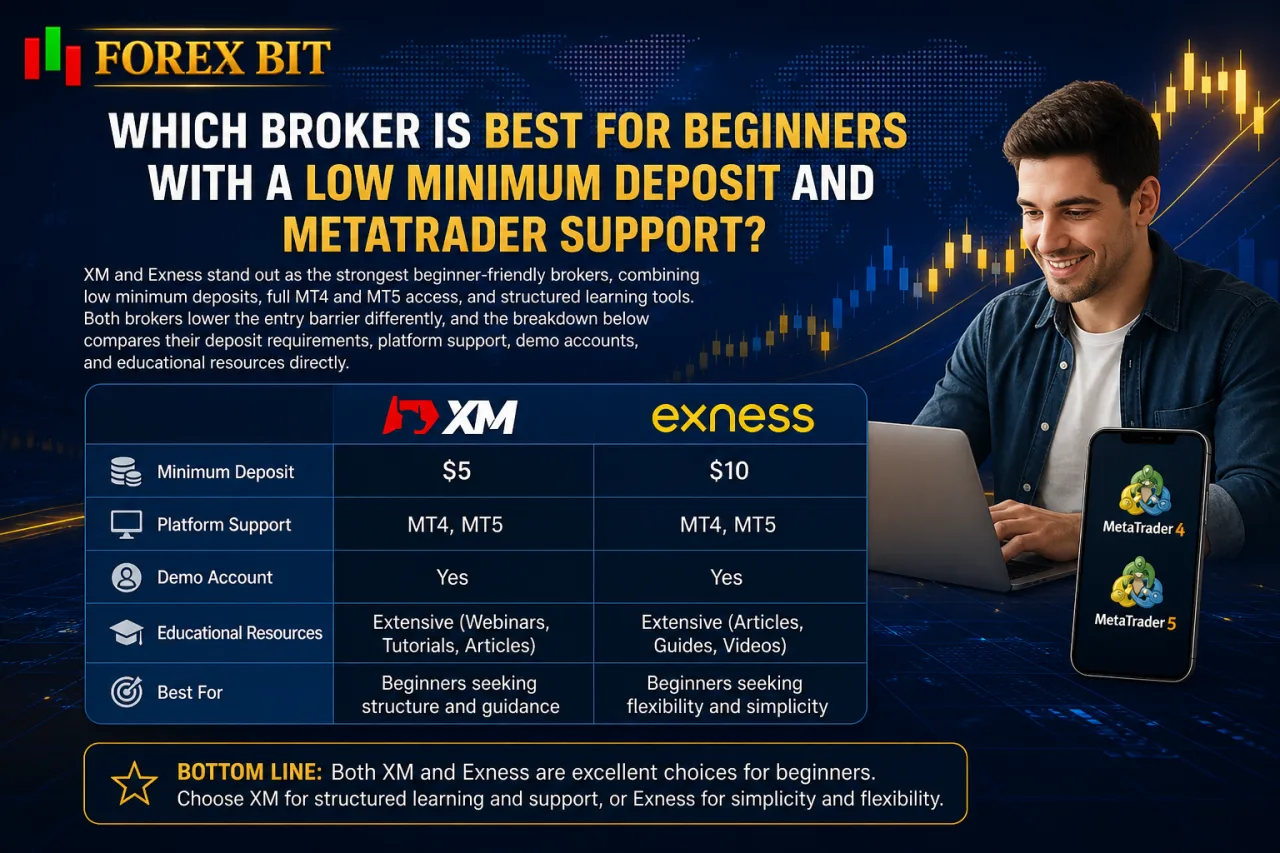
XM and Exness stand out as the strongest beginner-friendly brokers, combining low minimum deposits, full MT4 and MT5 access, and structured learning tools. Both brokers lower the entry barrier differently, and the breakdown below compares their deposit requirements, platform support, demo accounts, and educational resources directly.
XM vs Exness: Which Offers a Better Entry Point for New Traders?
XM offers a lower entry barrier for opening an account, while Exness allows a smaller minimum deposit on its Standard account, making both viable starting points depending on which factor matters more. Comparing account opening ease, demo access, and educational support clarifies which broker fits a first-time trader better.
XM and Exness are both known for offering low entry barriers, with minimum deposit requirements on their Micro and Standard accounts kept accessible for beginner traders, though exact amounts can vary by entity and should be confirmed on each broker’s official site before opening an account. Both brokers keep the account opening process straightforward, with verification typically completed online without requiring an in-person step.
Demo accounts are available on both platforms, letting new traders test strategies on MT4 or MT5 under simulated market conditions before funding a live account.
XM places stronger emphasis on structured educational content, including webinars, tutorials, and market analysis built specifically for beginners. Exness offers account flexibility and instant execution features across multiple regulated entities, which suits traders prioritizing deposit size over guided learning. Traders who value low-cost entry and account flexibility lean toward Exness, while those seeking structured guidance and familiar MetaTrader tools may find XM more suitable for a first live account.
How Do Forex Brokers Compare on Regulation, Safety, Spreads, and Trading Costs?
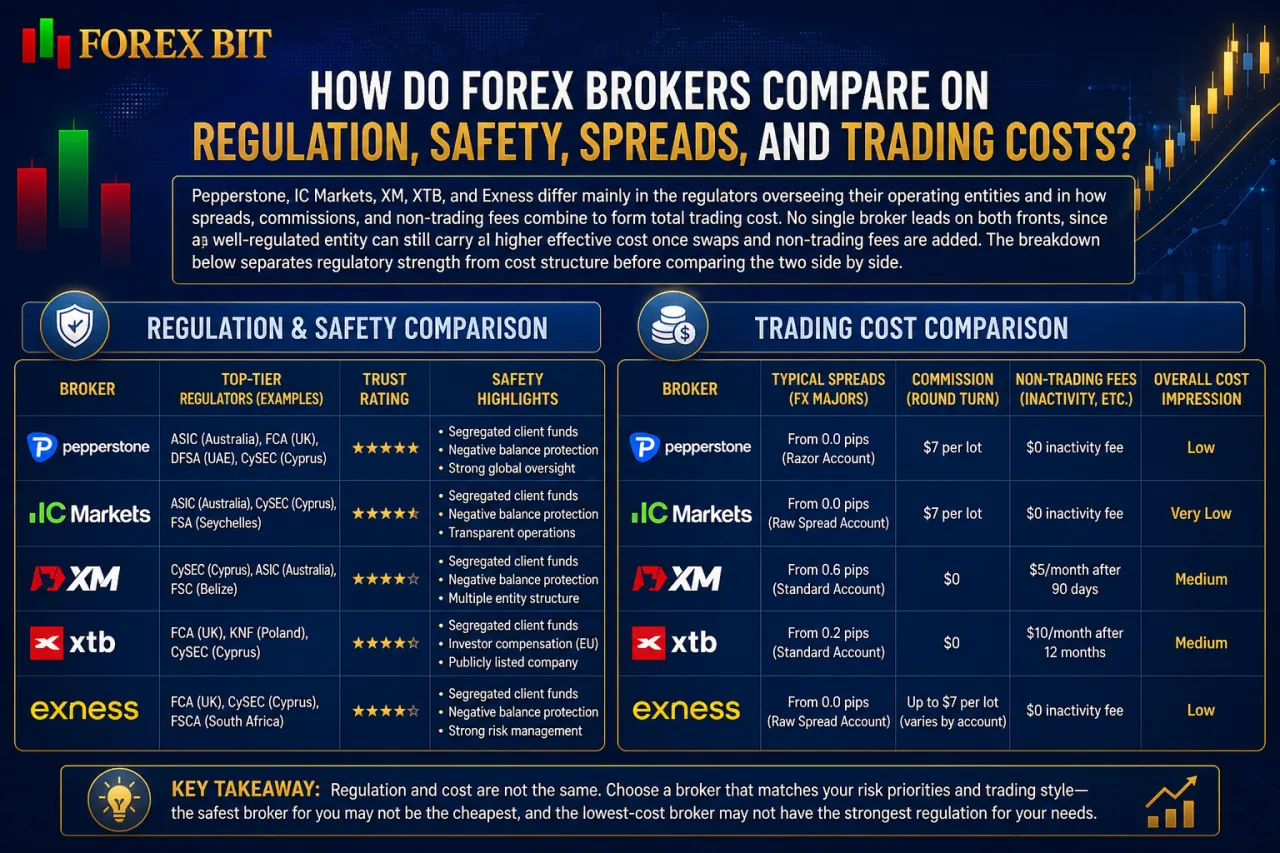
Pepperstone, IC Markets, XM, XTB, and Exness differ mainly in the regulators overseeing their operating entities and in how spreads, commissions, and non-trading fees combine to form total trading cost. No single broker leads on both fronts, since a well-regulated entity can still carry a higher effective cost once swaps and non-trading fees are added. The breakdown below separates regulatory strength from cost structure before comparing the two side by side.
Which Brokers Are the Safest Based on Regulation and Legal Entity?
Protection level depends on the legal entity a trader registers under, not just the broker’s overall license count. Pepperstone, IC Markets, XM, and XTB all hold licenses from top-tier regulators. This distinction matters because the same broker name can operate under stricter or looser rules depending on the client’s country of residence.
Pepperstone UK operates under FCA authorization with negative balance protection and segregated client funds, while Pepperstone Australia operates under ASIC rules, which involve different leverage limits and compensation scheme arrangements; traders should confirm the exact terms applicable to their entity on Pepperstone’s official site. A trader onboarded through the FCA entity typically gains access to the UK’s Financial Services Compensation Scheme, a protection not automatically extended to clients registered under the Australian or Seychelles entities.
The same entity-based split applies to IC Markets, XM, and XTB, where clients registering under a CySEC or ASIC entity may receive different leverage limits, deposit protection, and dispute resolution access than those under an FCA entity. XM’s different regulatory entities operate under separate investor protection frameworks, with compensation scheme participation and coverage terms varying by entity; traders should confirm the exact conditions applicable to their entity on XM’s official site. Traders should confirm the exact entity offered at signup rather than assuming the broker’s strongest license applies to their account.
Which Broker Has the Lowest Real Trading Costs?
IC Markets typically delivers the lowest real trading cost among the four brokers. Comparing typical rather than advertised-minimum figures across all four brokers clarifies which pricing structure actually reduces cost per trade.
- IC Markets (Raw Spread): Combines low spreads on major pairs with a separate fixed commission per lot, delivering the lowest total cost per trade among the four. Exact figures vary and should be confirmed on the broker’s official site.
- Pepperstone (Razor): Follows a similarly structured spread-plus-commission model, running close behind IC Markets on total cost. Exact figures vary and should be confirmed on the broker’s official site.
- XM (Standard): Builds cost into a wider spread without a separate commission, resulting in a higher effective cost than the raw-pricing accounts above.
- XTB: Prices major forex pairs through a similar spread-only model rather than commission-based pricing, carrying a higher effective cost as well. Exact spread figures vary and should be confirmed on the broker’s official site.
Swap fees add another layer to total cost. They vary by instrument, direction, and account type across all four brokers rather than following a fixed rate.
- Overnight positions held on IC Markets, Pepperstone, XM, and XTB accrue swap charges that differ by broker and currency pair.
- Traders comparing long-term holding costs check each broker’s live swap rates rather than relying on spread comparisons alone.
Scalpers and high-frequency traders generally gain more from IC Markets’ or Pepperstone’s raw-pricing accounts. Traders prioritizing simplicity over marginal cost differences find XM’s or XTB’s spread-only structure easier to track.
Which Broker Is Best for Scalping, Copy Trading, or a Specific Platform Like MT4/MT5/cTrader?
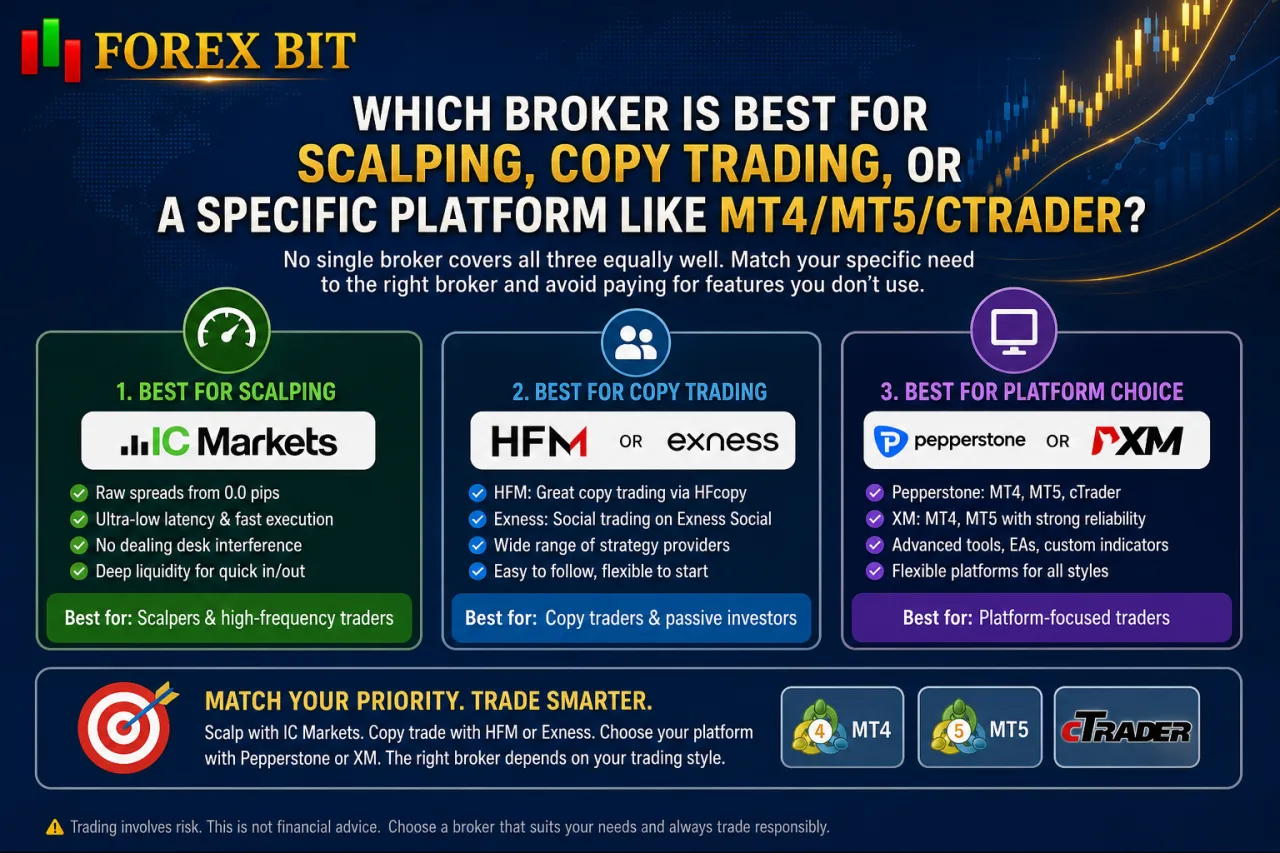
Trader needs split into three main categories: scalping, copy trading, and platform preference, with IC Markets, HFM or Exness, and Pepperstone or XM addressing each need differently. No single broker covers all three equally well, so matching the specific need to the right broker avoids paying for features that go unused. The breakdown below separates scalping requirements, copy trading access, and platform-specific priorities before comparing how each broker fits its category.
Which Broker Is Best for Scalping and Hedging Strategies?
IC Markets is the strongest choice for scalping and hedging, offering True ECN pricing with no restrictions on high-frequency trading. Its explicit permission for both practices places fewer restrictions on high-frequency order activity than most competing brokers, building directly on the raw-spread execution model already discussed for active traders.
Scalping depends on both tight pricing and fast order fills. IC Markets combines low variable spreads with commission-based pricing on MT4, MT5, and cTrader to support rapid entry and exit across these platforms.
Hedging is permitted without added restriction, letting traders hold offsetting positions on the same instrument within one account. Pepperstone offers a comparable raw-spread structure across similar platforms, though its scalping and hedging terms depend on which entity a trader registers under.
XM and XTB do not appear to publicly restrict scalping, but their spread-only pricing on Standard accounts tends to make commission-based Raw Spread or Razor-type models more cost-efficient for high-frequency strategies; traders should confirm each broker’s exact scalping and pricing policies on its official site.
Traders running frequent short-term trades or offsetting positions generally find IC Markets’ policy and execution speed better suited to that trading style than brokers built primarily around beginner accessibility.
Which Broker Offers the Best Copy Trading Features?
HFM and Exness offer the strongest copy trading features through built-in social trading platforms.Both brokers combine these platforms with broker-level account controls that most third-party solutions lack. This positioning follows directly from how each broker structures its trading conditions across account types.
HFM operates HFcopy, a built-in copy trading platform allowing traders to follow strategy providers directly through their MT4 or MT5 account without installing external software.Exness similarly offers a social trading feature within its account infrastructure, allowing followers to allocate capital to selected strategy providers while keeping funds within their own Exness account.
Third-party copy trading solutions, by contrast, typically require linking an external platform to a broker account, adding an extra layer of account management and sometimes additional subscription fees. Pepperstone, IC Markets, and XTB do not advertise a comparable native copy trading platform, making them less suited to traders whose main priority is built-in social trading rather than raw execution or platform variety.
Traders prioritizing an integrated, single-account copy trading experience generally find HFM or Exness more practical than combining a separate third-party service with a broker built around manual or algorithmic trading.
Note: Fee structures, minimum funding requirements, and specific program terms for copy trading features mentioned throughout this article vary by broker and account type. Readers are encouraged to verify current details directly on each broker’s official website before opening an account.
MT4 vs MT5 vs cTrader: Which Brokers Support Which Platforms?
MT4 and cTrader see the widest broker support among the platforms compared here, with Pepperstone and IC Markets offering all three plus TradingView, while XM and Exness limit access to MT4 and MT5. A broker is a company holding regulatory licenses and client accounts, while MT4, MT5, cTrader, and TradingView remain separate software applications that connect to those accounts, so pairing the wrong platform with a broker’s actual support list wastes setup time before a single trade is placed.
Pepperstone supports MT4, MT5, cTrader, and TradingView, giving traders a choice between MetaTrader’s Expert Advisor ecosystem and cTrader’s or TradingView’s charting-focused interface.IC Markets matches this same four-platform lineup, which suits scalpers who prefer cTrader’s Depth of Market tool over MetaTrader’s standard order window.
XM and Exness restrict platform access to MT4 and MT5, without offering cTrader or TradingView integration. This narrower selection still covers the two most widely used retail trading platforms, but it removes the third-party charting and social-trading layout that cTrader or TradingView users may expect. XTB supports xStation alongside MT4, skipping cTrader entirely in favor of its own proprietary charting environment.
Traders who value Expert Advisor automation or algorithmic strategies generally lean toward MT4 or MT5, available across all five brokers, while those prioritizing raw order-book visibility or web-based charting fit better with Pepperstone or IC Markets’ cTrader and TradingView access.
Which Broker Is Best for You Based on Your Trading Needs?
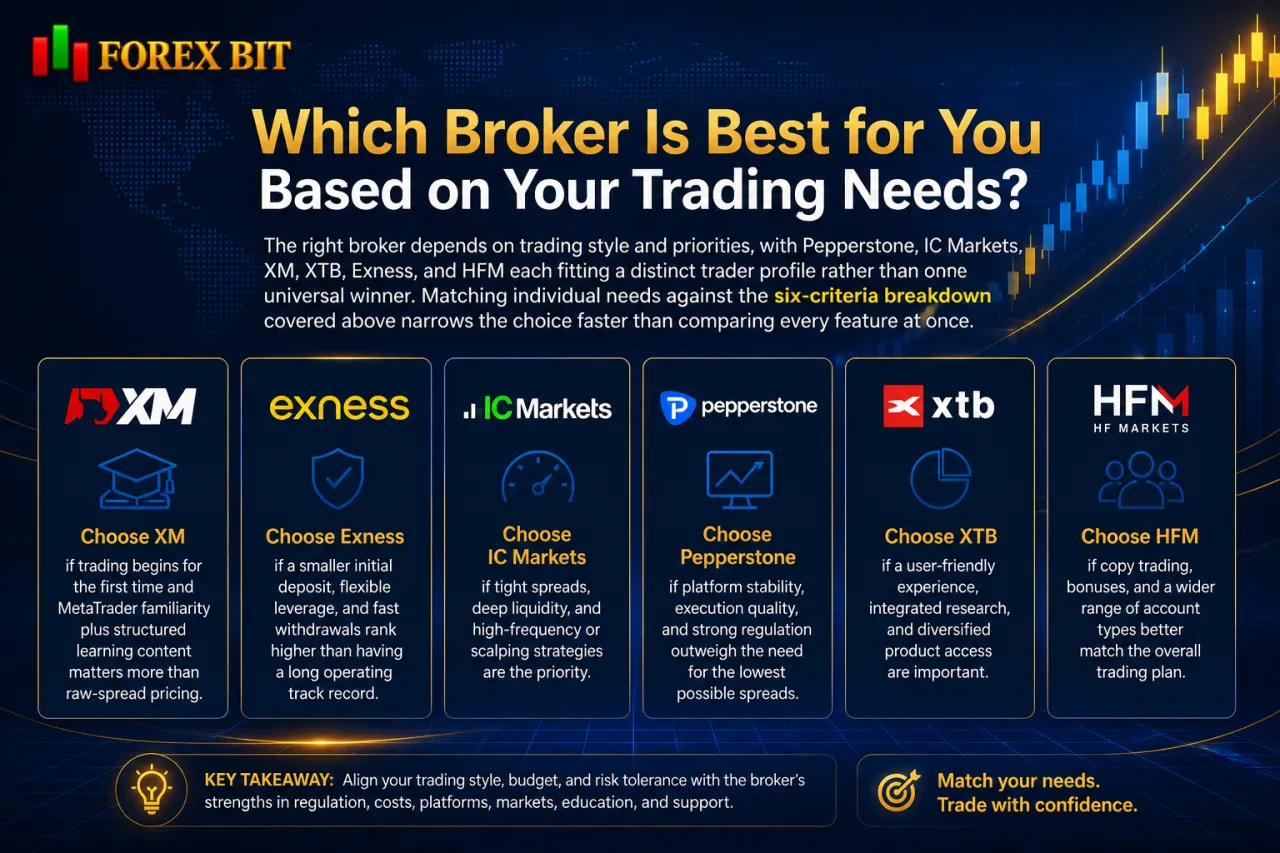
The right broker depends on trading style and priorities, with Pepperstone, IC Markets, XM, XTB, Exness, and HFM each fitting a distinct trader profile rather than one universal winner. Matching individual needs against the six-criteria breakdown covered above narrows the choice faster than comparing every feature at once.
Choose XM if this is a first live trading account and MetaTrader familiarity plus structured learning content matter more than raw-spread pricing. Choose Exness if a smaller minimum deposit and flexible account structure across multiple regulated entities outweighs built-in educational tools.
Choose Pepperstone if platform variety across MT4, MT5, cTrader, and TradingView combines with Razor-account cost efficiency for active trading. Choose IC Markets if scalping or hedging strategies depend on True ECN execution and unrestricted high-frequency order activity.
Choose XTB if an integrated proprietary platform like xStation outweighs the need for third-party charting tools such as cTrader. Choose HFM if built-in copy trading through HFcopy matters more than raw-spread execution or platform variety.
These trade-offs place cost-sensitive active traders toward Pepperstone or IC Markets, beginners toward XM or Exness, platform-focused traders toward XTB, and social-trading followers toward HFM.
What Additional Factors Set Top Forex Brokers Apart in 2026?
Beyond core criteria, proprietary research tools, VPS hosting, API or algo trading access, and multi-asset expansion beyond forex separate a smaller group of brokers from the rest of the field in 2026. These differentiators rarely decide a beginner’s first broker choice, but they matter for traders running automated strategies, low-latency execution setups, or portfolios that extend past currency pairs. The subsections below cover each factor individually across Pepperstone, IC Markets, XM, XTB, and Exness.
Do Any Brokers Offer Free VPS Hosting or API Access for Automated Trading?
IC Markets and Pepperstone both offer free VPS hosting for clients who meet certain account or trading volume conditions, and each also provides FIX API access for algorithmic traders running high-frequency strategies, though the exact qualifying thresholds vary and should be confirmed on each broker’s official site. This positioning extends the raw-spread, scalping-friendly profile already established for both brokers.
IC Markets offers free VPS hosting to clients who meet certain account or trading volume conditions, which can help reduce latency between order execution and its ECN pricing feed, though the exact qualifying threshold should be confirmed on IC Markets’ official site.Pepperstone also offers free VPS hosting for clients who meet certain account or trading volume conditions on its Razor accounts, though the exact qualifying threshold should be confirmed on Pepperstone’s official site.
FIX API access on both brokers connects institutional-grade order execution directly to custom trading systems, bypassing standard MT4 or MT5 terminals entirely. XM, XTB, and Exness do not advertise a comparable FIX API program, making IC Markets and Pepperstone the more practical choice for developers building automated or algorithmic trading infrastructure.
Which Brokers Provide the Most Advanced Research and Analysis Tools?
XTB provides the most developed proprietary research offering through xStation’s built-in market commentary, while Pepperstone, XM, and Exness rely mainly on third-party integrations such as Trading Central and Autochartist for chart pattern recognition and trade idea generation. This split separates brokers building analysis directly into their platform from brokers layering research tools on top of MetaTrader.
XTB’s xStation includes in-house market analysis and commentary tied directly to its proprietary charting environment rather than a licensed third-party feed, though traders should confirm the exact name and scope of this research tool on XTB’s official site.
Pepperstone and XM both integrate third-party market analysis tools such as Autochartist and Trading Central for pattern recognition and guided trade idea reports, though exact availability and features may vary by account type and should be confirmed on each broker’s official site.
IC Markets offers Trading Central access on select account types, while Exness does not advertise a comparable proprietary or licensed research suite. Traders relying on chart-based signal tools generally find Pepperstone or XM’s third-party integrations sufficient, while those preferring analysis built into the platform itself lean toward XTB’s xStation.
Conclusion
Selecting a top forex broker for 2026 comes down to matching trading style with the right cost structure, platform, and regulatory entity rather than picking a single universal winner. Pepperstone and IC Markets fit cost-sensitive, active traders seeking raw spreads, scalping flexibility, and multi-platform access including cTrader and TradingView.
XM and Exness suit beginners through lower entry requirements, MetaTrader support, and accessible account structures, while XTB serves traders who value an integrated proprietary platform and HFM stands out for built-in copy trading. Weighing regulation, real trading costs beyond advertised spreads, platform support, and account conditions side by side gives traders a clear basis for choosing the broker that fits their specific goals before opening a live account.