








eToro, Pepperstone, IC Markets, XM, and AvaTrade rank among the best forex copy trading brokers in 2026. Brokers best suited for copy trading in 2026 tend to stand out based on platform reliability, fee transparency, and regulated strategy provider access. Each broker supports different copy trading models, from proprietary social trading tools to third-party integrations like MetaTrader’s Signals or ZuluTrade.
Forex copy trading allows a trader to automatically replicate the positions of an experienced strategy provider in real time, typically in exchange for a performance fee or spread markup. Risks include drawdown exposure from the copied trader and platform-specific execution delays, both of which vary by broker.
Copy trading platforms tend to differ mainly in minimum investment thresholds, fee structures, and available strategy filters. Some brokers charge a fixed spread markup, while others apply performance-based fees tied to profitable copied trades.
Regulated brokers offering copy trading suited for beginners typically hold licenses from well-known financial authorities. Forex Bit prioritizes these regulatory credentials when comparing platforms for new traders entering copy trading. The next section breaks down which brokers are the best for forex copy trading in 2026 and why they stand out.
Which Brokers Are the Best for Forex Copy Trading in 2026?
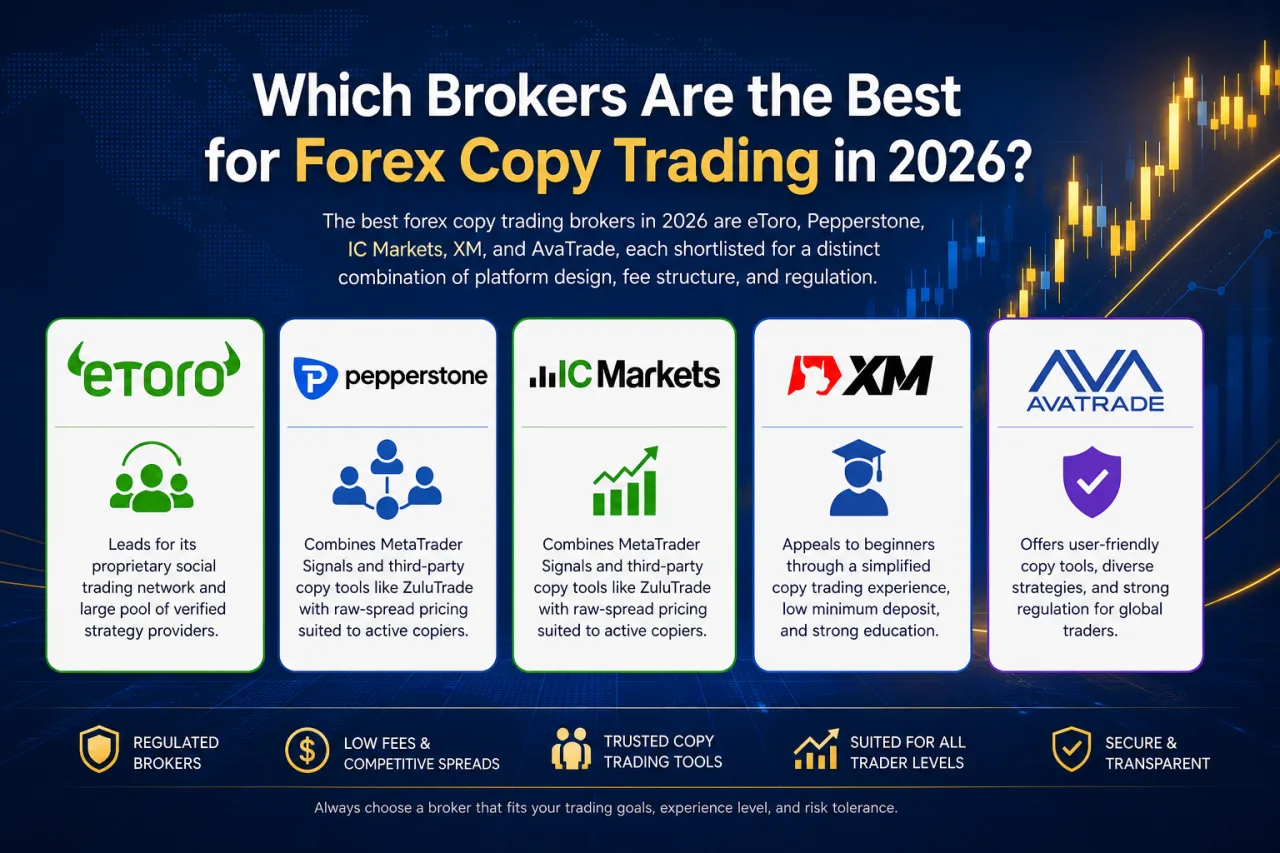
The best forex copy trading brokers in 2026 are eToro, Pepperstone, IC Markets, XM, and AvaTrade, each shortlisted for a distinct combination of platform design, fee structure, and regulation. eToro leads for its proprietary social trading network and large pool of verified strategy providers. Pepperstone and IC Markets stand out for combining MetaTrader Signals and third-party copy tools like ZuluTrade with raw-spread pricing suited to active copiers. XM appeals to beginners through a simplified copy trading interface layered on standard account conditions, while AvaTrade offers AvaSocial and DupliTrade as regulated, broker-integrated alternatives.
Each broker on this list satisfies the core selection criteria applied across this comparison: transparent fee disclosure, licensing from recognized regulators, and functional copy trading infrastructure rather than third-party plugins alone.
- Regulation strength across multiple jurisdictions
- Fee transparency for spread markups or performance charges
- Platform reliability for real-time trade replication
- Access to verified, filterable strategy providers
IC Markets and Pepperstone differ from eToro mainly in execution model, since both route copy trades through MetaTrader infrastructure rather than a proprietary social feed. XM and AvaTrade sit closer to the beginner-friendly end, prioritizing simplified account setup over advanced provider filtering.
How Do the Top Copy Trading Brokers Compare Side by Side?
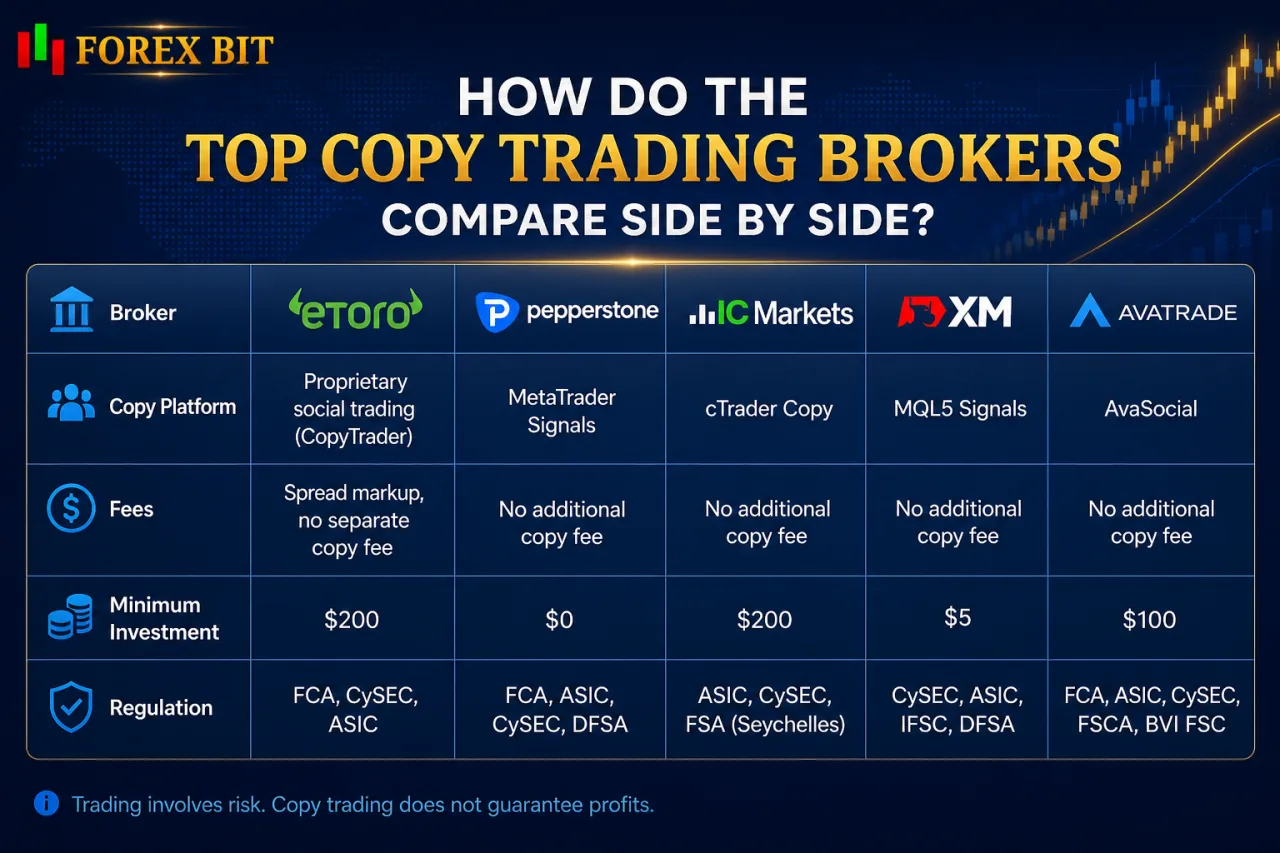
eToro, Pepperstone, IC Markets, XM, and AvaTrade differ mainly in copy platform type, fee structure, minimum investment, and regulatory scope, as summarized below. The comparison table matches the detailed selection criteria already outlined for each broker.
| Broker | Copy Platform | Fees | Minimum Investment | Regulation |
|---|---|---|---|---|
| eToro | Proprietary social trading (CopyTrader) | Spread markup, no separate copy fee | $200 | FCA, CySEC, ASIC |
| Pepperstone | MetaTrader Signals, third-party (ZuluTrade, Myfxbook AutoTrade) | Spread markup plus signal provider fees | Varies by signal provider | FCA, ASIC, CySEC, DFSA |
| IC Markets | MetaTrader Signals, ZuluTrade | Raw spread plus commission, provider fees vary | Varies by signal provider | ASIC, CySEC, FSA (Seychelles) |
| XM | XM copy trading via MT4/MT5 integrations | Spread-based, no fixed platform fee | Standard account minimum deposit | CySEC, ASIC, FSC |
| AvaTrade | AvaSocial, DupliTrade | Spread markup, no separate performance fee | Standard account minimum deposit | Central Bank of Ireland, ASIC, FSCA |
eToro tends to require a higher disclosed minimum investment than the other brokers compared, while Pepperstone and IC Markets leave minimums dependent on the individual signal provider chosen through ZuluTrade or MetaTrader Signals.
XM and AvaTrade rely on standard account deposit minimums rather than a separate copy trading threshold, keeping entry costs closer to conventional trading accounts.
What Is Forex Copy Trading and How Does It Work?
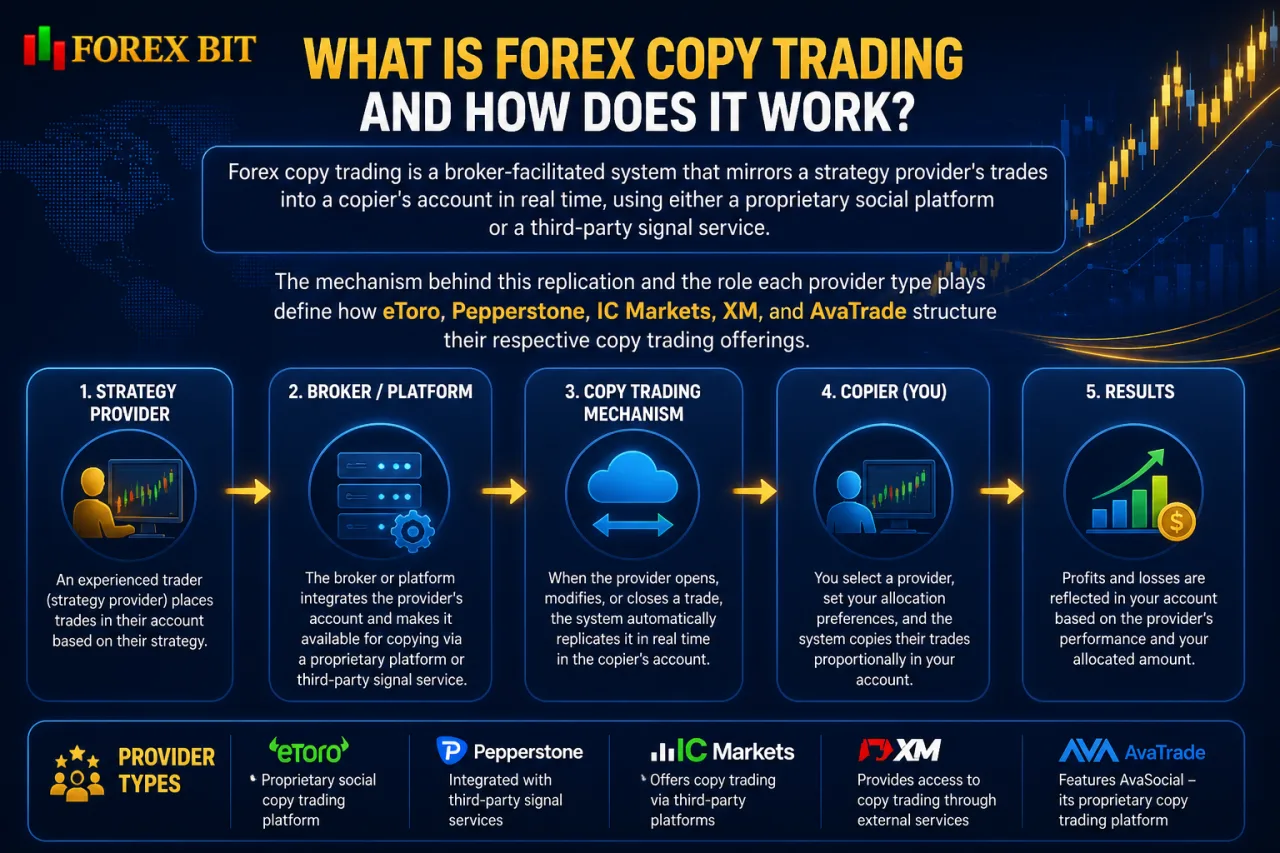
Forex copy trading is a broker-facilitated system that mirrors a strategy provider’s trades into a copier’s account in real time, using either a proprietary social platform or a third-party signal service.
The mirroring mechanism works by linking a copier’s account to a chosen strategy provider so that every trade the provider opens, adjusts, or closes is automatically replicated in the copier’s account, scaled to the copier’s allocated capital. This happens through the broker’s own trading infrastructure or through an external service that connects to the broker via API.
Proprietary copy platforms, such as eToro’s CopyTrader, run entirely inside the broker’s own ecosystem. The broker hosts the social feed, ranks strategy providers, and executes the trade mirroring internally without relying on outside software.
Third-party copy platforms, such as ZuluTrade or Myfxbook AutoTrade, operate independently of any single broker and connect to multiple brokers through bridging technology. These services aggregate signal providers from various sources and route their trades into copier accounts held at partner brokers.
In both models, the strategy provider (also called a signal provider) is the trader whose positions are copied, while the copier is the passive participant whose account reflects those trades. Pepperstone, IC Markets, XM, and AvaTrade each support one or both of these models, which shapes how their copy trading offerings are structured.
What Are the Main Risks and Fees Involved in Copy Trading?
Copy trading fees include spread markups, performance fees, and management fees, while the main risks are drawdown exposure, provider risk, and slippage. Fee structures vary by broker rather than following a single industry standard.
- eToro applies a spread markup with no separate performance fee on copied positions.
- Pepperstone and IC Markets combine standard spreads or commissions with signal provider fees that vary by the chosen ZuluTrade or MetaTrader Signals provider.
- AvaTrade charges a spread markup through AvaSocial and DupliTrade without an added performance fee.
- XM applies its standard spreads and commissions to copy trading activity, and traders should check the current fee schedule on XM’s official platform for the exact structure tied to each signal provider.
Risk factors operate independently of fee structure. Drawdown risk reflects losses inherited directly from the copied strategy provider’s trading decisions.
Provider risk arises when a signal provider changes strategy, stops trading, or performs inconsistently with past results. Slippage risk occurs when execution delays between the provider’s trade and the copier’s account cause price differences, a factor more pronounced on third-party platforms like ZuluTrade than on proprietary systems like eToro’s CopyTrader.
Which Broker Is Best for Each Type of Copy Trading Need?
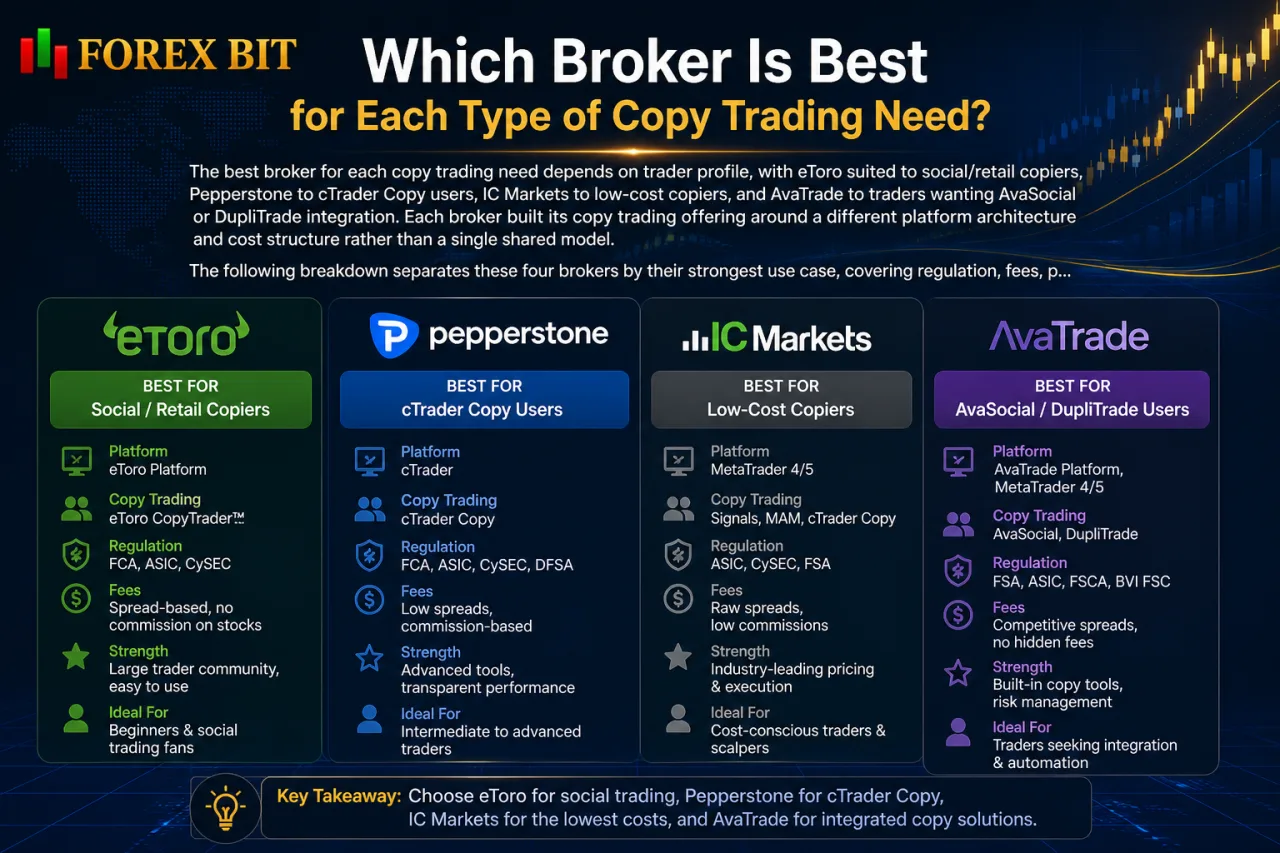
The best broker depends on trader profile: eToro suits social/retail copiers, Pepperstone suits cTrader Copy users, IC Markets suits low-cost copiers, and AvaTrade suits traders wanting AvaSocial or DupliTrade integration. Each broker built its copy trading offering around a different platform architecture and cost structure rather than a single shared model.
The following breakdown separates these four brokers by their strongest use case, covering regulation, fees, platforms, minimum deposit, strengths and limitations, and the trader type each setup fits best.
eToro: Best for Social and Retail Copiers
eToro operates under regulators including CySEC, FCA, and ASIC, and runs on its own proprietary social trading platform rather than MetaTrader or cTrader. Fees are built into spreads, and the minimum deposit varies by region.
Its strength is the large, active community of traders available to copy directly through the platform’s social feed. The limitation is less flexibility for traders who prefer MetaTrader-based tools or algorithmic strategies. eToro fits retail traders and beginners who want a simple, social-driven copy trading experience.
Pepperstone: Best for cTrader Copy Users
Pepperstone is regulated by bodies such as the FCA, ASIC, and CySEC, and supports copy trading through cTrader Copy alongside MetaTrader 4 and 5. Fees are based on competitive spreads and commissions, with a minimum deposit that is generally accessible to most traders.
Its strength lies in tight spreads and fast execution suited to active strategy copiers. The limitation is that its copy trading tools depend on third-party platform integration rather than an in-house social network. Pepperstone fits traders who already use or prefer cTrader Copy for automated strategy replication.
IC Markets: Best for Low-Cost Copiers
IC Markets is regulated by ASIC and CySEC, offering raw spread accounts with low commissions through MetaTrader and cTrader. The minimum deposit is kept low, supporting cost-conscious traders.
Its strength is the combination of low trading costs and access to third-party copy trading services layered on top of its platforms. The limitation is that copy trading itself is not a native built-in feature, requiring external tools. IC Markets fits traders prioritizing low fees above built-in social features.
AvaTrade: Best for AvaSocial or DupliTrade Integration
AvaTrade holds multiple regulatory licenses across regions and provides copy trading through its own AvaSocial app as well as DupliTrade integration. Fees are spread-based, and the minimum deposit is set at an accessible entry level.
Its strength is offering two distinct copy trading routes, a proprietary app and a third-party integration, giving traders flexibility in style. The limitation is that some features are split between these two systems rather than unified in one interface. AvaTrade fits traders who want dedicated copy trading apps rather than relying on a broker’s core trading platform alone.
How Do These Brokers Differ in Minimum Investment, Fees, and Features?
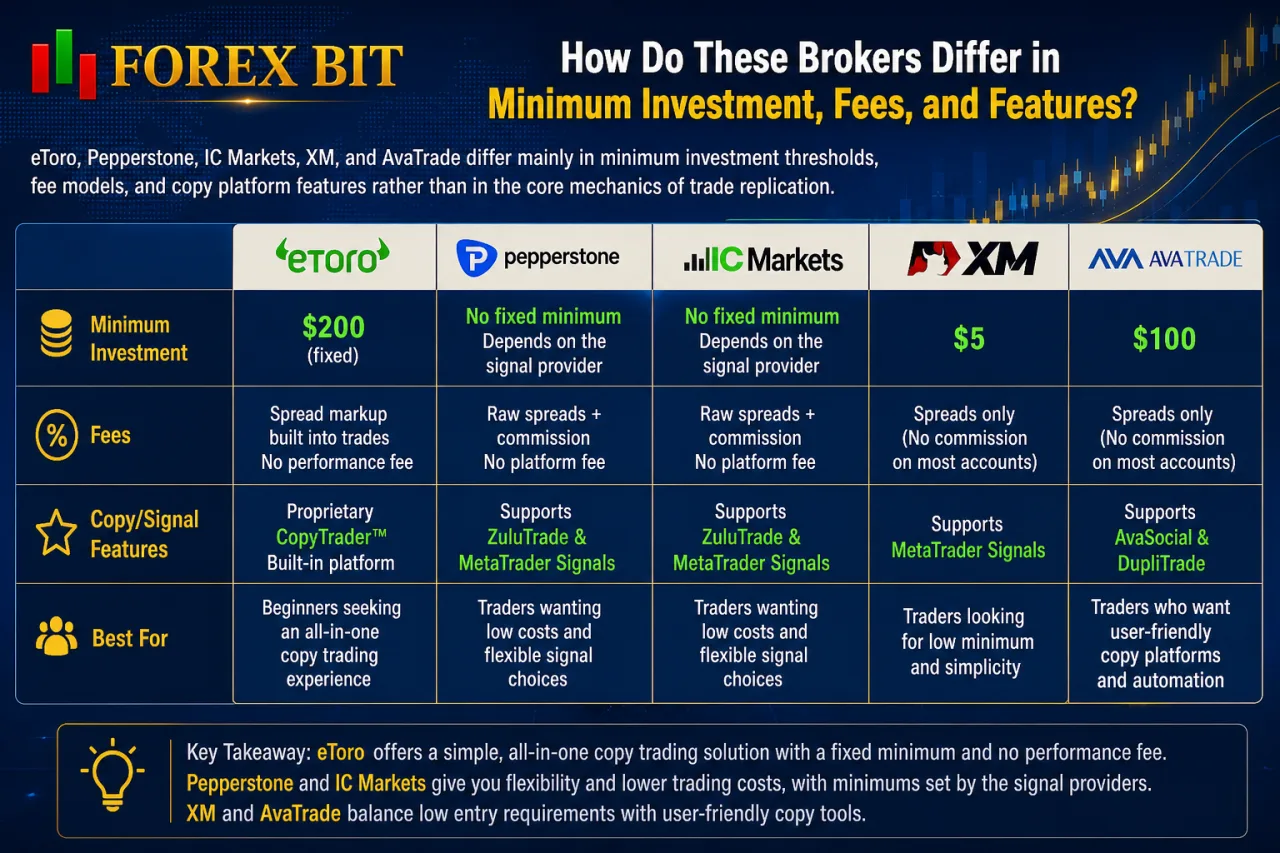
eToro, Pepperstone, IC Markets, XM, and AvaTrade differ mainly in minimum investment thresholds, fee models, and copy platform features rather than in the core mechanics of trade replication. eToro’s proprietary CopyTrader sets a fixed minimum investment and applies a spread markup, giving beginners a predictable entry cost without a separate performance fee. Pepperstone and IC Markets leave minimum investment to the individual signal provider chosen through ZuluTrade or MetaTrader Signals, which suits traders comfortable evaluating provider-specific terms rather than a single broker-wide threshold.
XM and AvaTrade tie their copy trading entry cost to standard account minimum deposits, avoiding a dedicated copy trading fee tier altogether. On features, eToro offers built-in social discovery and provider filtering within one interface, while Pepperstone’s access to cTrader Copy and MetaTrader Signals appeals to traders wanting raw-spread pricing and algorithm-driven strategy selection.
eToro may suit beginners wanting social discovery, while Pepperstone’s cTrader Copy appeals to traders wanting raw spreads and algo-driven strategies. IC Markets fits cost-focused copiers willing to manage provider fees separately, and AvaTrade’s AvaSocial and DupliTrade integration suits traders preferring a broker-bundled copy solution over third-party plugins.
Are These Copy Trading Brokers Properly Regulated for Beginners?
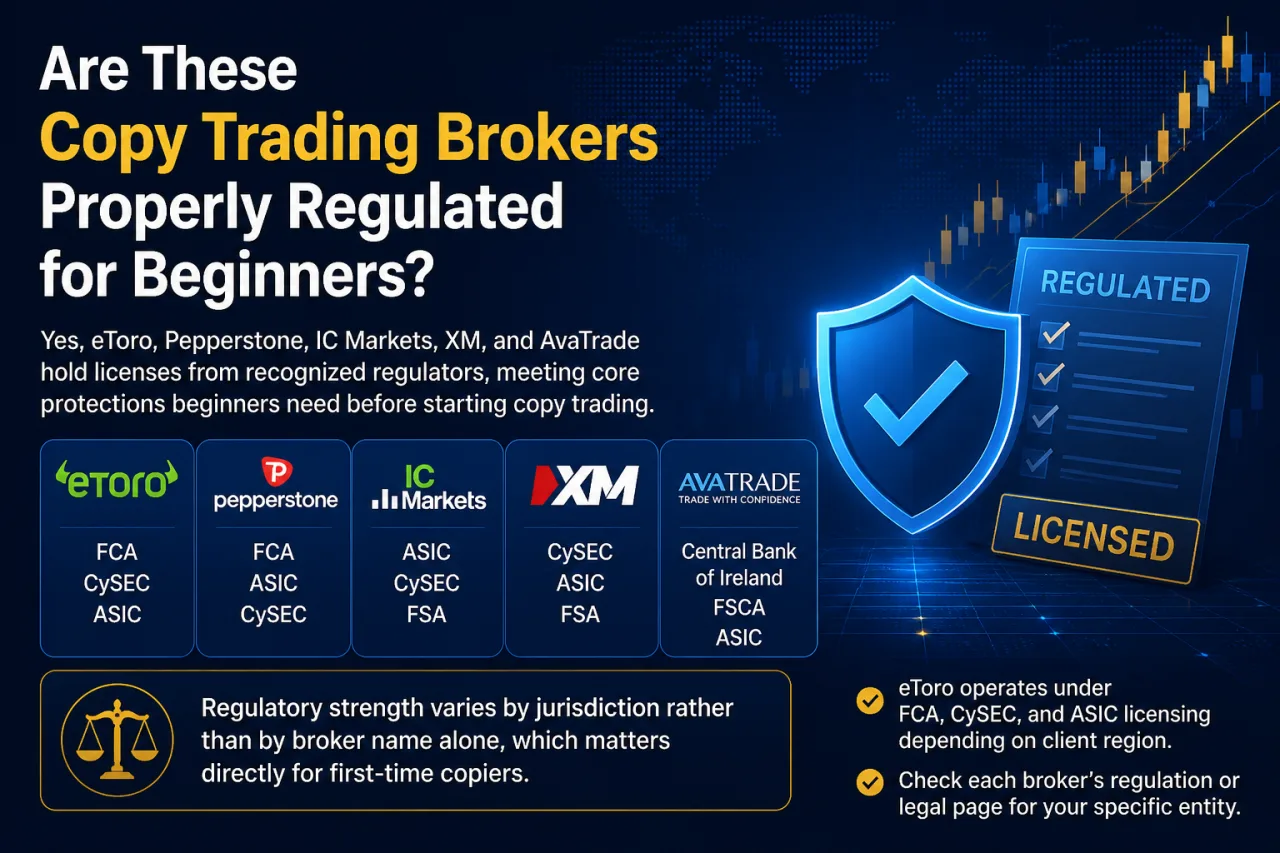
Yes, eToro, Pepperstone, IC Markets, XM, and AvaTrade hold licenses from recognized regulators, meeting core protections beginners need before starting copy trading. Each broker discloses licensing details on its regulation or legal pages rather than through a single unified global entity.
Regulatory strength varies by jurisdiction rather than by broker name alone, which matters directly for first-time copiers.
- eToro operates under FCA, CySEC, and ASIC licensing depending on client region.
- Pepperstone holds FCA, ASIC, CySEC, and DFSA authorization across its regional entities.
- IC Markets is regulated by ASIC, CySEC, and the FSA in Seychelles.
- XM carries CySEC, ASIC, and FSC licensing across its different entities.
- AvaTrade is authorized by the Central Bank of Ireland, ASIC, and the FSCA.
Segregated client funds and negative balance protection are policies commonly applied across regulated entities of these five brokers. The exact scope of these protections is tied to the specific regulator overseeing the entity a trader is onboarded under, with FCA and ASIC entities generally applying the strictest fund segregation and negative balance rules, while offshore entities such as those under FSA Seychelles or FSC apply lighter requirements.
Demo account availability supports beginner readiness before copying live strategies. eToro, Pepperstone, IC Markets, XM, and AvaTrade all offer demo environments where new copiers can test provider selection and platform navigation without funding a live account first.
How Does Forex Bit Select and Rank Copy Trading Brokers?
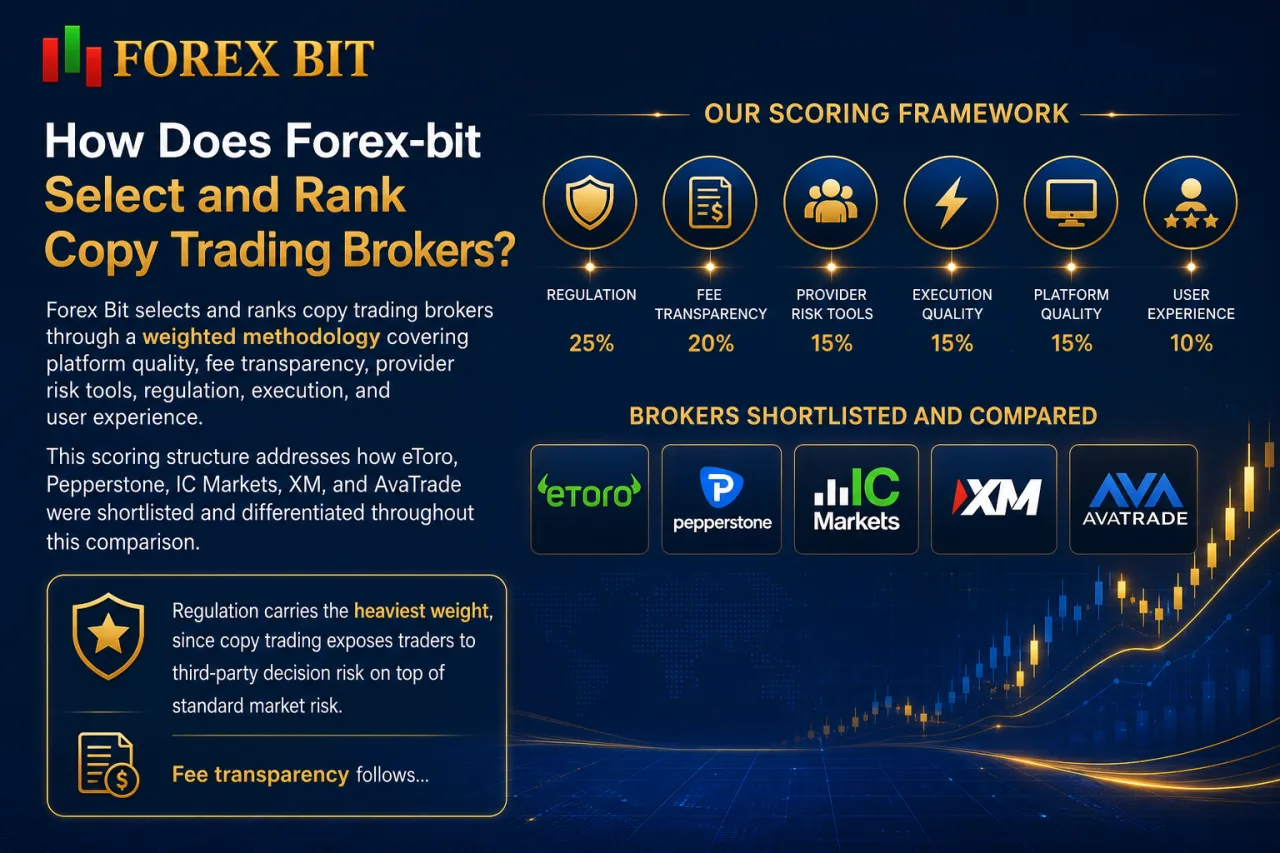
Forex Bit selects and ranks copy trading brokers through a weighted methodology covering platform quality, fee transparency, provider risk tools, regulation, execution, and user experience. This scoring structure addresses how eToro, Pepperstone, IC Markets, XM, and AvaTrade were shortlisted and differentiated throughout this comparison.
Regulation carries the heaviest weight, since copy trading exposes traders to third-party decision risk on top of standard market risk. Fee transparency follows closely, distinguishing brokers like eToro that disclose a single spread markup from those like Pepperstone and IC Markets whose costs vary by signal provider.
Platform quality and execution reliability determine how closely a copier’s account mirrors the strategy provider’s trades in real time. Provider risk tools, such as filterable performance history and drawdown data, factor into scoring where brokers expose this information directly on their copy platforms.
User experience closes the methodology, reflecting how easily a beginner navigates provider selection, demo testing, and account setup across each broker’s interface.
What Are the Most Common Questions About Copy Trading Brokers?

The most common questions about copy trading brokers cover minimum investment amounts, profitability, loss risk, and cost comparison between eToro, Pepperstone, IC Markets, XM, and AvaTrade. These questions repeat across trader searches because fee structure and risk exposure differ by broker rather than following one shared standard.
Is copy trading profitable?
Profitability depends entirely on the copied strategy provider’s performance, not on the broker itself. A copier can lose money even on a broker with low fees.
Can a trader lose more than the amount invested in copy trading?
No. Standard copy trading through eToro, Pepperstone, IC Markets, XM, and AvaTrade limits losses to the allocated copy amount under normal account conditions, since negative balance protection applies across their regulated entities.
What is the minimum investment for copy trading?
eToro requires a fixed $200 minimum. Pepperstone and IC Markets leave minimums to the individual signal provider, while XM and AvaTrade tie entry cost to standard account deposits.
Which broker is cheapest for copy trading?
eToro and AvaTrade apply a spread markup without a separate performance fee, making cost comparison simpler. Pepperstone and IC Markets fees vary by chosen provider, so comparison depends on the specific signal followed.
What Advanced Copy Trading Tools Do Leading Brokers Offer Beyond Basic Mirroring?
Leading copy trading brokers extend beyond basic mirroring through cTrader Algo integration, risk-management controls on copied trades, transparent performance statistics, mobile-only copy apps, and distinct proprietary versus third-party marketplace structures. These advanced features separate platforms like Pepperstone and IC Markets, which lean on algorithmic and third-party marketplaces, from eToro and AvaTrade, which build proprietary social layers directly into their broker infrastructure. The sections below break down each tool category individually.
How Can Traders Verify a Strategy Provider’s Performance Before Copying?
Traders verify a strategy provider’s performance by checking verified track records, risk scores, and drawdown history directly through broker-provided transparency tools before allocating any copy amount. This verification process addresses the accuracy problem behind provider claims raised earlier regarding provider risk and inconsistent past results.
Verification tools differ by broker rather than following one shared format.
- eToro displays Popular Investor statistics, showing risk score, historical gain, and copier count for each provider.
- ZuluTrade applies ZuluRank, a scoring system weighing consistency, drawdown, and risk exposure across signal providers.
- Pepperstone and IC Markets expose provider-level statistics through ZuluTrade or Myfxbook AutoTrade rather than a proprietary ranking tool.
XM and AvaTrade structure their copy trading offering around third-party platforms rather than an in-house standalone risk-scoring dashboard, so provider verification for these two brokers runs through the connected platform’s own statistics and ranking system.
Drawdown history and risk score together indicate how a provider’s strategy behaved during losing periods, information that raw profit figures alone do not reveal.
Conclusion
Selecting among eToro, Pepperstone, IC Markets, XM, and AvaTrade comes down to matching platform architecture and cost structure to individual trading habits rather than picking a single universal winner. eToro fits traders wanting built-in social discovery and a fixed, transparent entry cost. Pepperstone and IC Markets serve copiers comfortable managing provider-specific fees through ZuluTrade or MetaTrader Signals in exchange for raw-spread pricing.
XM offers a straightforward path for beginners tied to standard account minimums, while AvaTrade’s AvaSocial and DupliTrade integration suits traders preferring a broker-bundled alternative to third-party plugins. Regulation, fee clarity, and demo access remain consistent baseline safeguards across all five.