










A forex broker is a regulated intermediary that connects traders to the currency market through a trading platform, executing buy and sell orders on the trader’s behalf. Understanding how brokers operate, generate revenue, and manage client funds forms the foundation for evaluating safety, costs, accounts, and platforms covered in this guide.
A forex broker’s safety depends on verifiable regulation from recognized financial authorities and segregation of client funds from company operating capital. A broker’s safety is commonly assessed by checking whether it holds a license from a recognized financial regulatory authority, such as those overseeing markets in major financial jurisdictions. Checking licence numbers directly on regulator databases and confirming investor compensation schemes reduces exposure to unregulated or offshore entities.
Trading costs at forex brokers consist mainly of spreads, commissions, overnight swap fees, and occasional account or withdrawal charges. These costs vary between account types and instruments, directly affecting overall trading profitability over time.
Opening a forex trading account involves completing identity verification, selecting an account type, and choosing a compatible trading platform such as MT4, MT5, or cTrader. Account management then covers deposits, withdrawals, leverage settings, and monitoring open positions through the chosen platform.
Forex Bit breaks down each of these areas in detail, starting with the fundamentals of how a forex broker actually works.
What Is a Forex Broker and How Does It Work?
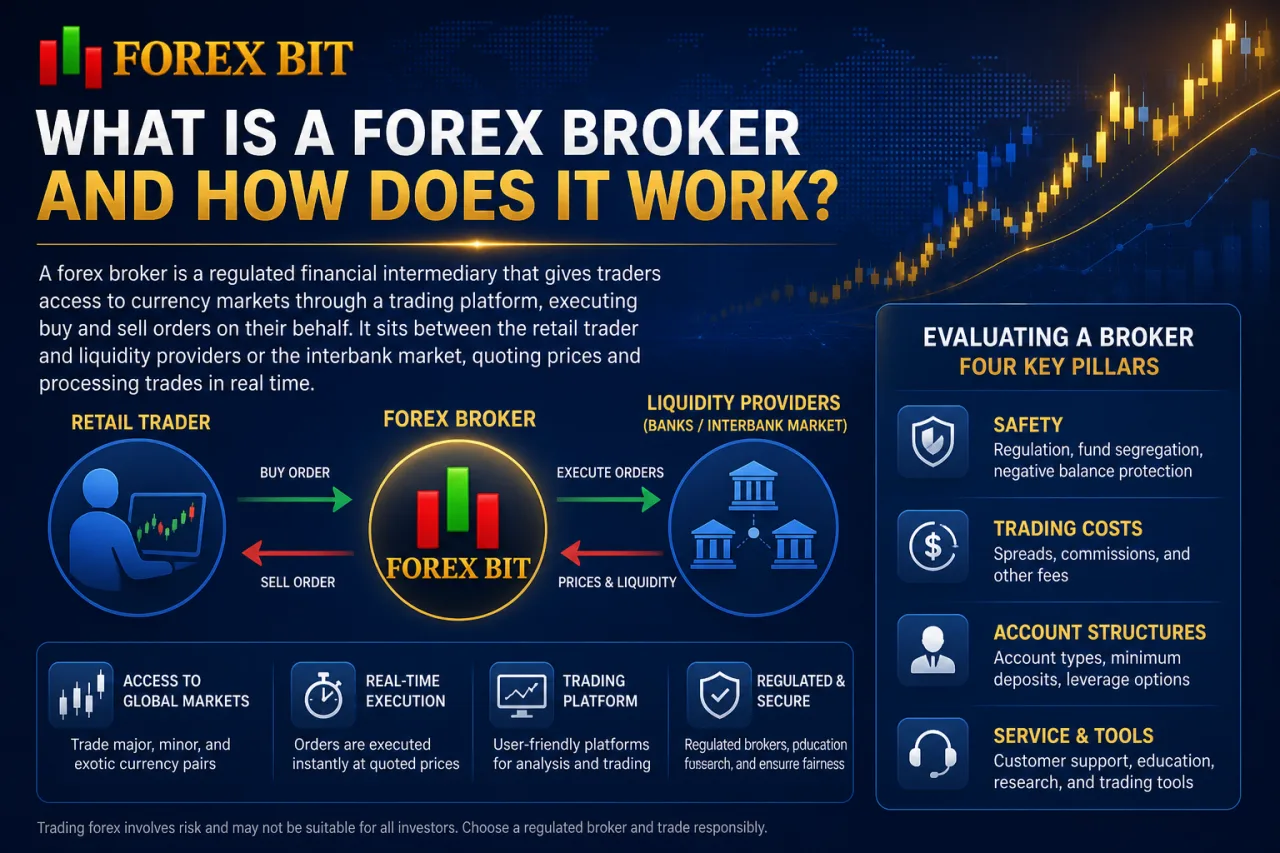
A forex broker is a regulated financial intermediary that gives traders access to currency markets through a trading platform, executing buy and sell orders on their behalf. It sits between the retail trader and liquidity providers or the interbank market, quoting prices and processing trades in real time. Evaluating a broker properly rests on four pillars: safety through regulation and fund segregation, trading costs across spreads and fees, account structures suited to different trader types, and platform functionality for executing strategies. The sections that follow break down each of these pillars individually.
What Are the Different Types of Forex Brokers?
Forex brokers fall into three main execution models: Market Maker, ECN (Electronic Communication Network), and STP (Straight Through Processing). These categories describe how a broker fills client orders and where the counterparty risk sits in the transaction.
Understanding this distinction clarifies the actual trading relationship a client enters with a broker, since each model affects pricing, execution speed, and potential conflicts of interest differently.
- Market Maker brokers create an internal market by taking the opposite side of client trades, quoting fixed or variable spreads without routing orders externally.
- ECN brokers connect traders directly to a network of liquidity providers, banks, and other participants, displaying real market depth and charging a separate commission.
- STP brokers route client orders straight to liquidity providers without internal dealing, often blending features of both market making and ECN access.
Each model shifts the nature of the trader-broker relationship: Market Maker execution places the broker as counterparty, while ECN and STP models position the broker mainly as an intermediary passing orders to external liquidity sources. Some brokers operate hybrid setups combining elements of these models across different account types.
How Do You Know If a Forex Broker Is Safe and Regulated?
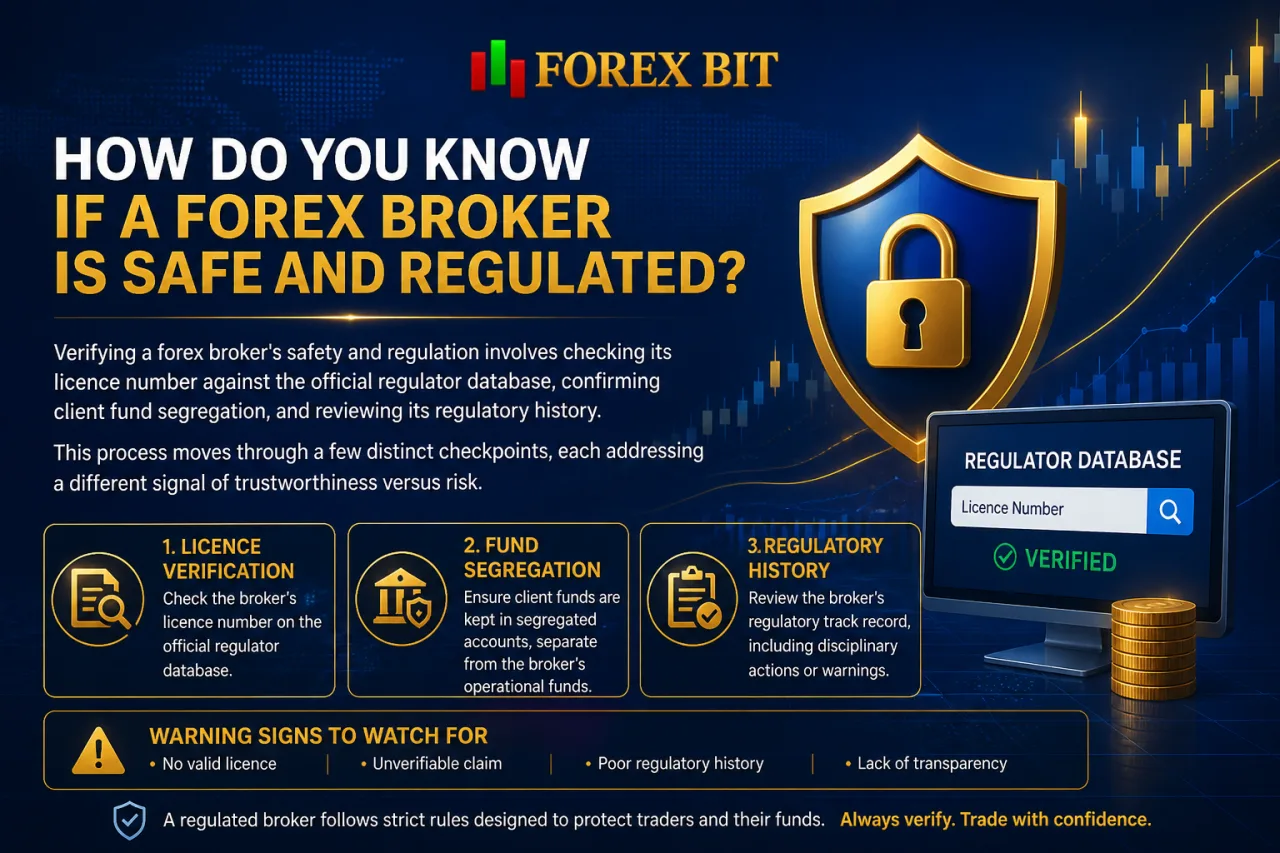
Verifying a forex broker’s safety and regulation involves checking its licence number against the official regulator database, confirming client fund segregation, and reviewing its regulatory history. This process moves through a few distinct checkpoints, each addressing a different signal of trustworthiness versus risk.
The following breakdown covers how licence verification, regulator registers, and warning signs work together to confirm whether a broker operates under genuine oversight or presents a higher-risk profile for traders.
What Do Forex Regulators Actually Do?
Financial regulators oversee forex brokers to enforce capital requirements, protect client funds, and ensure fair, transparent trading conduct. This oversight addresses the same safety concern raised when checking a broker’s licence: whether the entity operates under genuine, enforceable supervision rather than nominal registration.
Regulatory bodies generally perform a consistent set of functions regardless of jurisdiction:
- Setting minimum capital and liquidity requirements brokers must maintain to operate.
- Mandating segregation of client funds from company operating accounts.
- Auditing brokers periodically for compliance with reporting and conduct standards.
- Investigating client complaints and enforcing penalties for violations.
- Publishing licence status and disciplinary actions on public registers.
Regulators also require brokers to disclose risks clearly to clients before they trade leveraged products. Compensation schemes tied to some regulatory regimes offer partial protection if a regulated broker becomes insolvent. Compensation limits and enforcement powers vary between regulatory authorities worldwide.
These combined functions form the practical basis for treating regulation as a core safety indicator when assessing any forex broker.
Why Does Fund Segregation Matter for Trader Safety?
Fund segregation matters for trader safety because it keeps client deposits in accounts separate from a broker’s own operating capital, preventing company funds from being used to cover business expenses or losses. This directly extends the safety checkpoint of confirming client fund segregation raised earlier: segregated accounts determine what happens to a trader’s money if the broker faces financial distress.
Segregated accounts hold client money at approved banking institutions, distinct from the funds a broker uses to pay staff, cover operational costs, or absorb trading losses on its own book. Without this separation, client deposits become part of the broker’s general assets, exposed to creditor claims if the firm becomes insolvent.
Three practical consequences follow from this distinction:
- Recovery of client funds becomes more feasible during insolvency proceedings when segregation is verified and enforced by the regulator.
- Misuse of client deposits for operational expenses or proprietary trading becomes restricted under segregation requirements.
- Transparency around fund handling increases when regulators mandate regular audits of segregated accounts.
Regulators overseeing licensed brokers typically require this separation as a standard condition of maintaining a licence, reinforcing why checking for it forms a core part of assessing broker safety.
What Are the Warning Signs of an Unregulated or Unsafe Broker?
Common warning signs of an unregulated or unsafe broker include unclear or unverifiable licensing, unrealistic profit promises, and a lack of transparency around fees or fund handling. This extends the safety checkpoints covered above, since these red flags typically surface once a broker fails the licence verification or fund segregation checks already discussed.
Traders scanning a broker’s website or marketing material can watch for these recurring patterns:
- Missing or unverifiable licence numbers that do not match any entry on a recognized regulator’s public register.
- Guaranteed returns or “risk-free” trading promises that misrepresent the inherent risk of leveraged forex products.
- Vague ownership and company information, including no verifiable physical address or unclear corporate structure.
- Pressure tactics from account managers pushing larger deposits or discouraging withdrawal requests.
- Withdrawal delays or unexplained fees applied inconsistently outside of stated terms.
- Absence of segregated client accounts or refusal to disclose which bank holds client funds.
Any single sign warrants closer scrutiny, though multiple signs appearing together point strongly toward an unregulated or high-risk broker.
What Trading Costs and Fees Do Forex Brokers Charge?
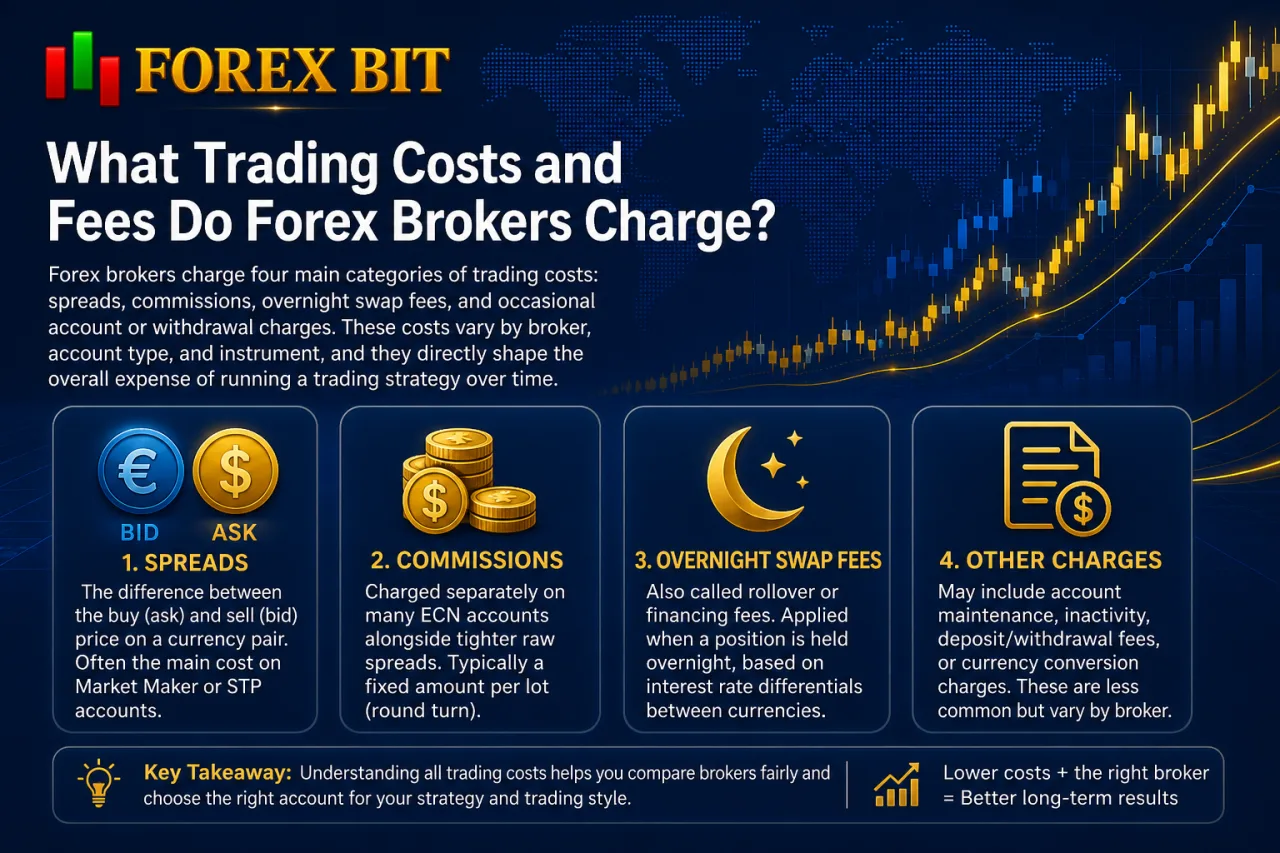
Forex brokers charge four main categories of trading costs: spreads, commissions, overnight swap fees, and occasional account or withdrawal charges. These costs vary by broker, account type, and instrument, and they directly shape the overall expense of running a trading strategy over time.
Spreads represent the gap between the buy and sell price on a currency pair, often the main cost on Market Maker or STP accounts. Commissions apply separately on many ECN accounts alongside tighter raw spreads. Swap fees accrue on positions held overnight, reflecting interest rate differentials between the two currencies traded. Account or withdrawal charges appear less consistently, often tied to inactivity, payment method, or currency conversion. The following sections break down how each of these cost components works in practice.
Spread vs Commission: What Is the Difference?
Spread-based pricing embeds the cost inside the buy-sell price gap, while commission-based pricing charges a separate fixed fee per trade on top of a tighter raw spread. This distinction directly affects how total trading cost gets calculated on Market Maker versus ECN accounts discussed earlier.
Spread-only pricing folds the broker’s compensation into the difference between bid and ask, so the quoted spread already represents the full transaction cost. Commission-based pricing separates the two components: the spread narrows toward raw interbank pricing, and the broker adds a fixed charge per lot traded, billed independently of the spread.
Cost comparison between the two models depends on trading style and volume:
- High-frequency traders often benefit from commission accounts, since tight raw spreads reduce cost accumulation across many trades.
- Occasional traders sometimes find spread-only accounts simpler, since one number represents the entire cost without a separate line-item fee.
- Total cost transparency favors commission models, since the spread and fee appear as distinct figures rather than one blended markup.
Neither model produces a universally lower cost, since actual expense depends on the specific spread, commission rate, and trading frequency applied by the broker.
What Are Swap or Overnight Fees?
Swap or overnight fees are charges applied when a forex position stays open past the broker’s daily rollover cutoff, reflecting the interest rate differential between the two currencies in the pair. This directly extends the trading cost categories outlined earlier, since swap fees form one of the four main charges alongside spreads, commissions, and account-related fees.
Rollover typically occurs once per trading day, at which point any position still open incurs either a debit or a credit depending on direction and currency pair. Long positions and short positions do not carry the same swap treatment, since each side of a trade references a different interest rate within the pair.
- Long positions accrue swap based on the rate differential when buying the higher-yielding currency against the lower-yielding one, or the reverse.
- Short positions accrue the opposite exposure, since selling a currency reverses which rate applies to the trader’s side of the position.
- Triple swap days: Some brokers apply triple swap charges on Wednesdays to account for weekend settlement, charging three times the standard overnight rate on that session.
Swap fees do not apply to positions closed before the daily rollover time, making them relevant mainly to traders holding positions overnight or longer.
Are There Other Hidden Fees to Watch For?
Yes, forex brokers apply additional hidden fees beyond spreads, commissions, and swaps, mainly through inactivity charges, withdrawal fees, and currency conversion costs. This extends the trading cost breakdown covered earlier, since these charges often sit outside the headline pricing a broker advertises.
Inactivity fees apply when an account stays dormant past a period set in the broker’s terms, deducting a fixed amount periodically until the trader resumes activity or the balance reaches zero. Withdrawal fees vary by payment method, with bank wire transfers commonly carrying higher charges than e-wallet or card withdrawals. Currency conversion fees arise when a deposit or withdrawal currency differs from the account’s base currency, adding a markup on the exchange rate applied, and some brokers also charge a fee for converting an account’s base currency after opening.
Checking the fee schedule in a broker’s official terms and conditions before opening an account confirms which of these charges apply. Fee schedules typically disclose:
- Inactivity thresholds and the fixed charge applied per period.
- Withdrawal costs broken down by payment method.
- Currency conversion markups applied on cross-currency transactions.
Reviewing this documentation directly avoids relying on marketing pages that often omit these charges.
How Do You Open and Manage a Forex Trading Account?
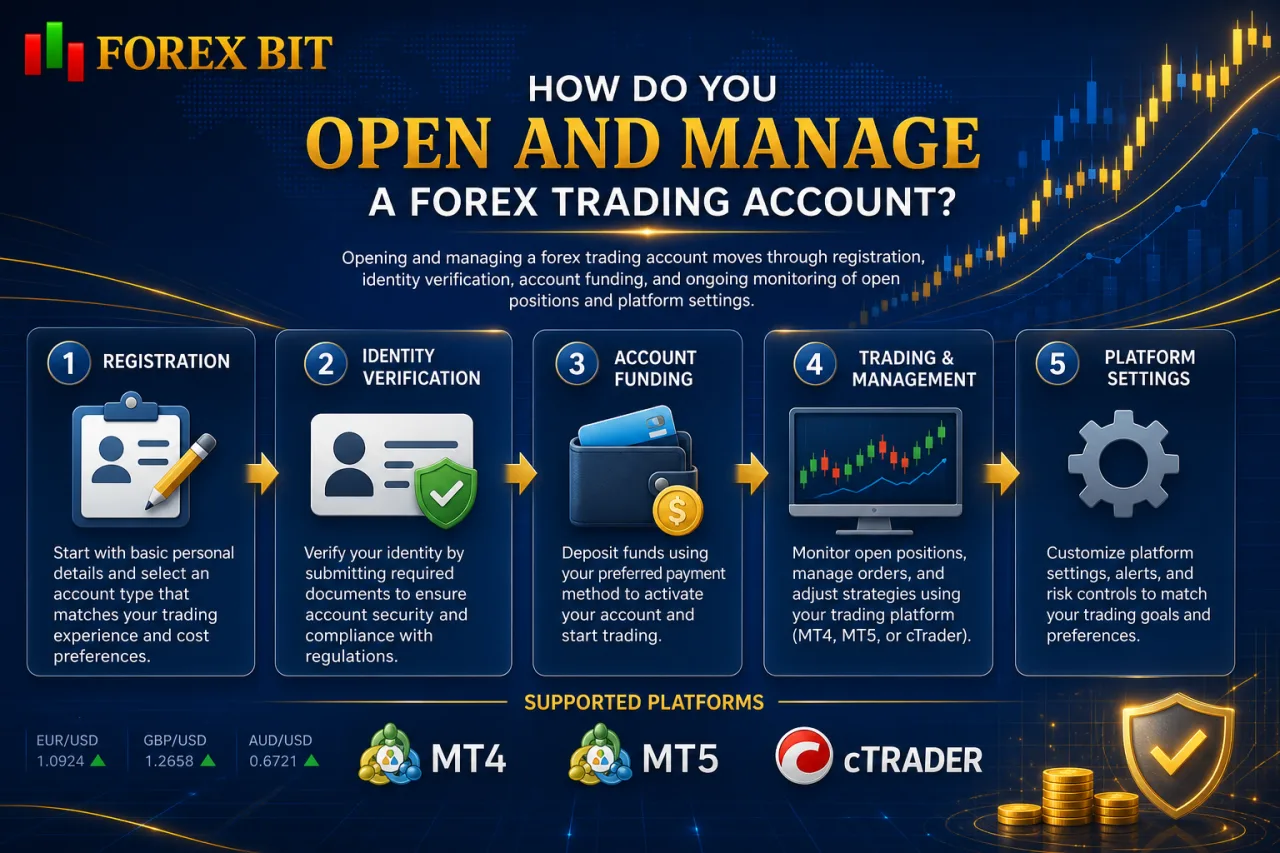
Opening and managing a forex trading account moves through registration, identity verification, account funding, and ongoing monitoring of open positions and platform settings. This process picks up directly from the account and platform fundamentals outlined earlier, since choosing a compatible platform such as MT4, MT5, or cTrader forms part of the initial setup itself.
The full process breaks down into four core stages, each building on the previous one:
- Registration: Starts with basic personal details and an account type selection matching the trader’s experience and cost preference.
- Verification: Confirms identity and address through submitted documents before trading access activates.
- Funding: Follows through the broker’s supported deposit methods.
- Management: Continues afterward through adjusting leverage, tracking margin, and executing withdrawals as needed.
The next sections walk through each of these stages individually.
What Types of Trading Accounts Do Brokers Offer?
Forex brokers commonly offer four account categories: Standard, ECN, Islamic (swap-free), and Demo accounts, each serving a distinct trading purpose. This continues the registration and account selection process outlined above, since choosing among these categories forms the first practical decision a trader makes when opening a live account.
Each account type addresses a different trading need or requirement:
- Standard accounts suit general retail trading, typically bundling costs into the spread rather than charging a separate commission.
- ECN accounts target traders seeking tighter raw spreads paired with a separate commission per lot, reflecting the direct market access structure described earlier.
- Islamic accounts remove overnight swap charges, replacing them with an alternative fee structure to comply with religious restrictions on interest.
- Demo accounts provide simulated trading environments funded with virtual balances, allowing practice on the broker’s platform without financial risk.
Availability and naming of these categories vary by broker, though most regulated brokers offer at least a Standard and Demo option alongside ECN or Islamic variants depending on their client base.
Why Should You Start With a Demo Account?
Starting with a demo account matters because it lets a trader test strategies and platform tools using virtual funds before risking real capital. This directly extends the account categories outlined above, since Demo accounts sit alongside Standard, ECN, and Islamic accounts as a distinct, risk-free entry point into trading.
A few practical reasons support beginning here rather than funding a live account immediately:
- Familiarization with the trading platform’s order types, charting tools, and execution speed happens without financial consequence.
- Testing of a strategy across different market conditions confirms whether its logic holds up before committing deposited funds.
- Calibration of position sizing, leverage settings, and risk parameters occurs in a controlled environment first.
- Comparison between brokers becomes possible, since demo accounts often mirror the same pricing and execution model used on live accounts.
Demo balances remain virtual throughout, so gains or losses recorded carry no financial weight. Traders typically transition to a live Standard or ECN account once demo results align with their intended strategy and risk tolerance.
How Do Deposits and Withdrawals Work?
Deposits and withdrawals move through the broker’s approved payment methods, requiring the transaction to originate from and return to an account matching the trader’s verified identity. This connects directly to the funding and account management stage outlined earlier, since moving money in and out of a trading account carries its own security checkpoints beyond the initial registration and verification steps.
Deposits typically process faster than withdrawals, since incoming funds require only method verification while outgoing funds trigger additional compliance checks. Brokers commonly support several funding channels:
- Bank transfers clear slower but suit larger deposit amounts.
- Cards process instantly for most standard deposit sizes.
- E-wallets offer quicker turnaround on both deposits and withdrawals.
Withdrawal requests generally return funds through the same method and account used for the original deposit, a policy tied directly to anti-money-laundering compliance. Processing times for withdrawals vary by broker and payment method, often taking longer than deposits. Reviewing a broker’s payment policy page before funding an account confirms which methods apply and what documentation a withdrawal request requires.
What Are the Main Types of Forex Trading Platforms?
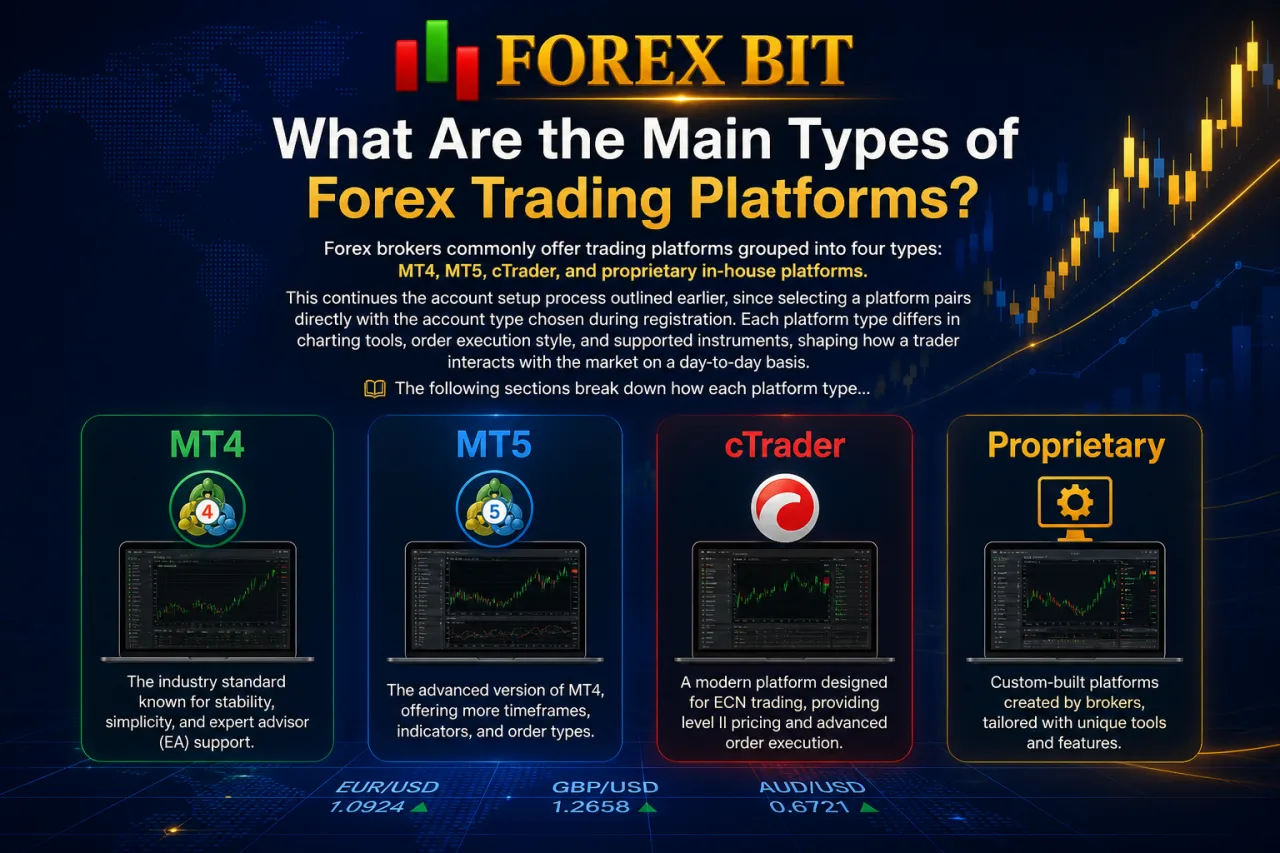
Forex brokers commonly offer trading platforms grouped into four types: MT4, MT5, cTrader, and proprietary in-house platforms. This continues the account setup process outlined earlier, since selecting a platform pairs directly with the account type chosen during registration. Each platform type differs in charting tools, order execution style, and supported instruments, shaping how a trader interacts with the market on a day-to-day basis. The following sections break down how each platform type functions individually.
MT4 vs MT5: What Is the Difference?
MT5 wins on order types and asset range, while MT4 remains dominant for forex-specific charting simplicity and third-party expert advisor availability. This comparison follows directly from the four platform types outlined above, since MT4 and MT5 represent the two most widely offered options across regulated brokers.
MT5 offers more pending order types than MT4, alongside an integrated economic calendar and a built-in depth of market feature absent from the older platform.
MT4 concentrates almost entirely on forex and CFD trading, while MT5 extends to stocks, futures, and broader multi-asset instruments depending on what the broker enables. Typical use cases split along this line: traders focused purely on forex with a preference for established custom indicators often stay on MT4, while traders wanting multi-asset access, additional timeframes, or a built-in strategy tester with more order types tend to choose MT5.
Both platforms run on nearly identical account types across most brokers, so the choice usually comes down to instrument range and tool preference rather than cost or execution model.
What Should You Check Before Choosing a Trading Platform?
Checking a trading platform before committing means evaluating usability, device compatibility, charting tools, and order execution reliability side by side. This follows directly from the MT4 versus MT5 comparison above, since these four factors determine whether a chosen platform actually fits daily trading needs beyond raw feature lists.
- Usability covers how intuitively a trader places orders, sets stop-loss levels, and navigates menus without a steep learning curve.
- Device compatibility confirms the platform runs consistently across desktop, web browser, and mobile app versions for traders switching between devices.
- Charting tools determine the range of technical indicators, drawing tools, and timeframes available for market analysis.
- Order execution reliability reflects how consistently the platform fills orders at quoted prices without slippage or requotes during volatile conditions.
Testing these factors on a demo account before funding a live account confirms whether the platform matches a trader’s specific strategy and workflow.
What Advanced Considerations Go Beyond the Basics of Broker Safety and Trading Tools?
Advanced considerations beyond basic broker safety and trading tools group into three areas: negative balance protection, copy trading access, and API connectivity. These attributes rarely appear in standard broker guide checklists focused on regulation, spreads, and platform choice, yet experienced traders weigh them once the fundamentals covered earlier are already confirmed. Each addresses a different layer of risk management or trading flexibility beyond the basics already established for evaluating a forex broker.
What Is Negative Balance Protection and Why Does It Matter?
Negative balance protection is a broker policy that automatically resets a trader’s account to zero instead of leaving a debt when losses exceed the deposited balance. This feature ties directly into the risk management layer sitting above standard safety and platform checks already covered.
Leveraged forex positions can move against a trader faster than a stop-loss order fills, particularly during high volatility or a market gap. Without this protection, a trader owes the broker the shortfall beyond their deposit. With it, the broker absorbs that shortfall instead of passing it to the client.
This policy signals a trader-focused approach for a few reasons:
- Caps total possible loss at the deposited amount, removing open-ended debt exposure.
- Reflects: Some jurisdictions require brokers to offer this protection for retail clients by regulation.
- Signals a broker prioritizing client outcomes over recovering losses through client debt collection.
Confirming this policy in a broker’s terms before opening a live account clarifies actual downside exposure during extreme market moves.
What Is Copy Trading and How Does It Work Through a Broker?
Copy trading is a broker-supported feature that automatically replicates a chosen trader’s open positions into a follower’s own account in real time. This connects experienced traders offering their strategy publicly with novice traders who lack the time or confidence to place trades independently, extending the platform and account choices already established for a forex broker.
The mechanism works through a dedicated marketplace or platform integration where signal providers display verifiable performance history, risk scores, and fee structures. Followers allocate a portion of their account balance to a chosen provider, and trades open or close on the follower’s account proportionally as the provider trades.
A few considerations apply before using this feature:
- Verifying the signal provider’s track record length and drawdown history reduces reliance on short-term results.
- Confirming the fee structure, since providers commonly charge a performance fee or profit share on copied trades.
- Setting a maximum allocation or stop-loss limit to cap exposure to any single provider’s strategy.
Availability of copy trading varies by broker and regulatory jurisdiction. Some regulators impose additional disclosure requirements on brokers offering copy trading to retail clients.
Conclusion
Evaluating a forex broker comes down to four interlocking pillars covered throughout this guide: confirmed regulation with segregated client funds, a clear picture of spreads, commissions, swaps, and hidden charges, an account structure matched to trading experience and goals, and a platform capable of executing a chosen strategy reliably.
Cross-checking licence numbers on regulator registers, comparing fee schedules before funding an account, testing a demo account before going live, and matching platform features like MT4, MT5, or cTrader to actual trading needs turns these categories into a repeatable evaluation process. Applying this framework consistently equips any trader to judge broker safety, costs, accounts, and platforms with confidence rather than relying on marketing claims.