
Is IC Markets a scam or a regulated broker? See the latest facts on licenses, complaints, and trader safety before you decide.
IC Markets Scam Warning: Is This Broker Safe or Risky?

IC Markets is not classified as a scam broker, as it operates under multiple financial regulators rather than as an unregulated entity. Ongoing scrutiny still exists because online complaints and scam-related search queries continue to surface among retail traders.
IC Markets holds regulatory licenses from multiple financial authorities across different jurisdictions, which supports its classification as a regulated broker rather than a scam. Each license carries different client protection standards, which directly affects fund safety depending on the entity a trader is registered under.
Common complaints associated with IC Markets tend to involve delayed withdrawals, account verification issues, and disputes over slippage during high-volatility events. These reports appear across trading forums and review platforms rather than formal regulatory sanctions.
IC Markets maintains safety standards broadly in line with other ASIC and CySEC-regulated brokers, particularly in terms of license tier and fund segregation practices. The sections below break down each safety aspect of IC Markets in detail, covering its legitimacy status, regulatory licenses, and the specific complaints traders report most frequently.
Forex Bit examines the key safety and regulatory aspects of IC Markets below, helping traders understand its regulatory status, client protections, and the common concerns reported by retail traders.
Is IC Markets a Scam or a Legitimate Broker?
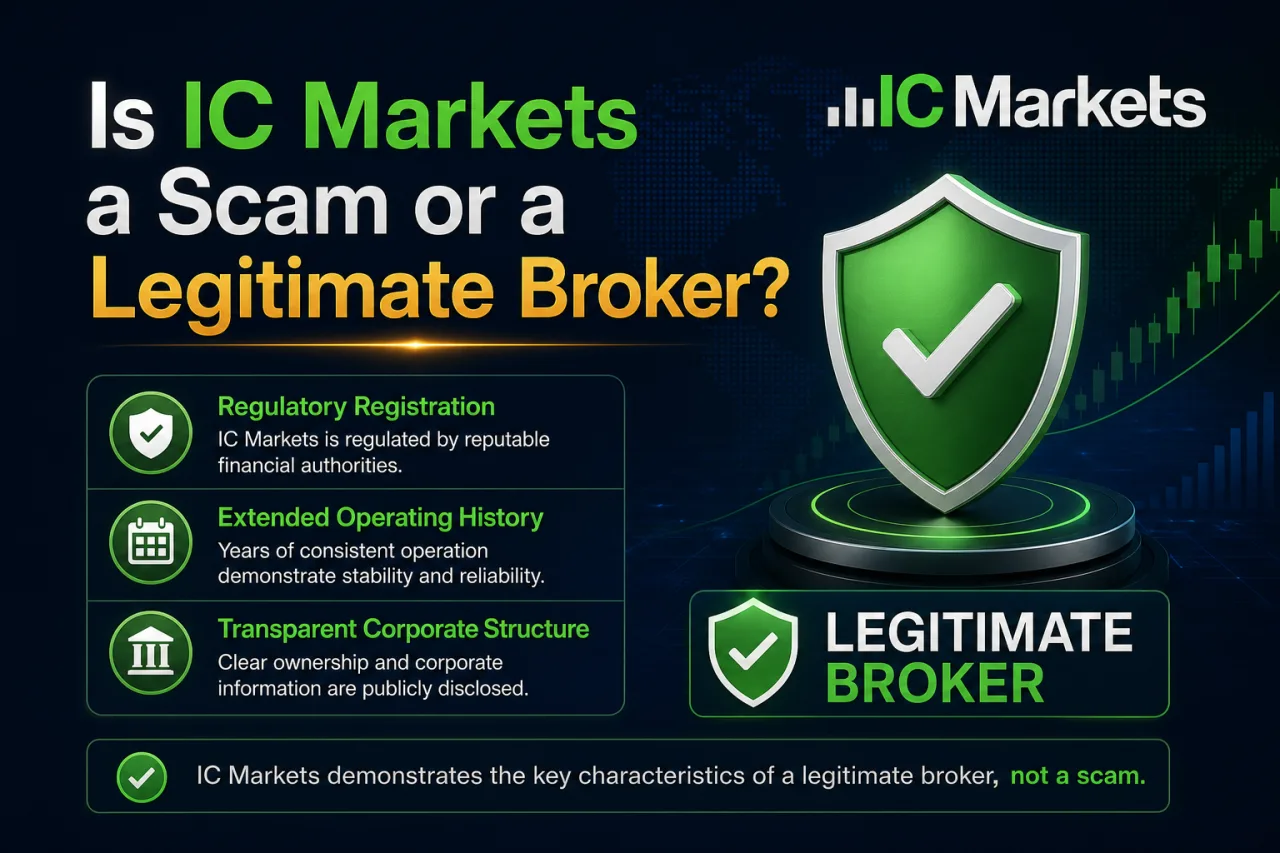
IC Markets qualifies as a legitimate broker rather than a scam, based on its active regulatory registrations, extended operating history, and disclosed corporate structure. This assessment addresses the core concern behind the heading directly, ahead of the evidence outlined next.
Three factors support this classification. Regulatory registration places IC Markets under supervision from authorities that impose capital and conduct requirements on the firm. Extended operating history distinguishes IC Markets from short-lived unregulated entities commonly flagged in scam warnings. Verifiable corporate structure allows traders to confirm which legal entity holds their account and which regulator applies to it.
IC Markets has operated as a forex and CFD broker for a number of years.
None of these factors eliminate individual trader disputes over withdrawals, verification, or execution during volatile markets, which remain separate from the question of overall legitimacy. The regulatory licenses, fund protection measures, and complaint patterns referenced above each carry distinct implications for account safety depending on the specific IC Markets entity a trader signs up with.
What Regulatory Licenses Does IC Markets Hold?
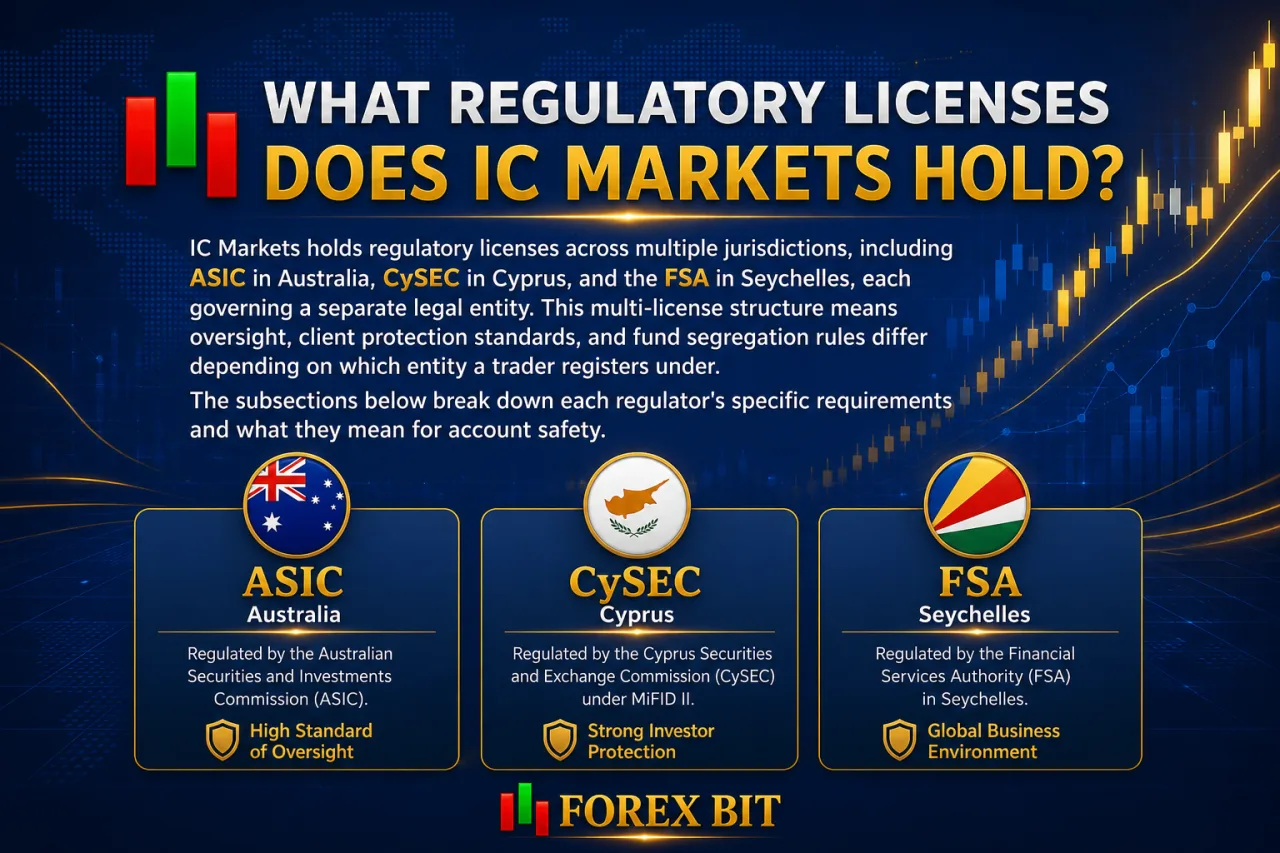
IC Markets holds regulatory licenses across multiple jurisdictions, including ASIC in Australia, CySEC in Cyprus, and the FSA in Seychelles, each governing a separate legal entity. This multi-license structure means oversight, client protection standards, and fund segregation rules differ depending on which entity a trader registers under. The subsections below break down each regulator’s specific requirements and what they mean for account safety.
Which IC Markets Entity Handles Your Account Based on Location?
IC Markets assigns client accounts to different legal entities based on residency, primarily IC Markets Australia, IC Markets Global (Seychelles), and IC Markets Europe (Cyprus). This structure determines the heading question directly before the regulatory differences are outlined.
Each entity applies its own licensing framework and client protection scope. Traders from Australia typically register under IC Markets Australia, which operates under ASIC oversight. Clients from Europe generally fall under IC Markets Europe, regulated by CySEC, while traders from regions outside these jurisdictions are commonly onboarded through IC Markets Global under Seychelles FSA registration.
The entity assigned affects leverage limits, negative balance protection, and access to compensation schemes, since these protections stem from the regulator governing the specific entity rather than IC Markets as a single global company. Traders confirm their assigned entity through the account opening agreement and terms disclosed at registration, since this document identifies the legal entity holding the account and the regulator with jurisdiction over it.
What Are the Most Common Complaints Traders Report About IC Markets?
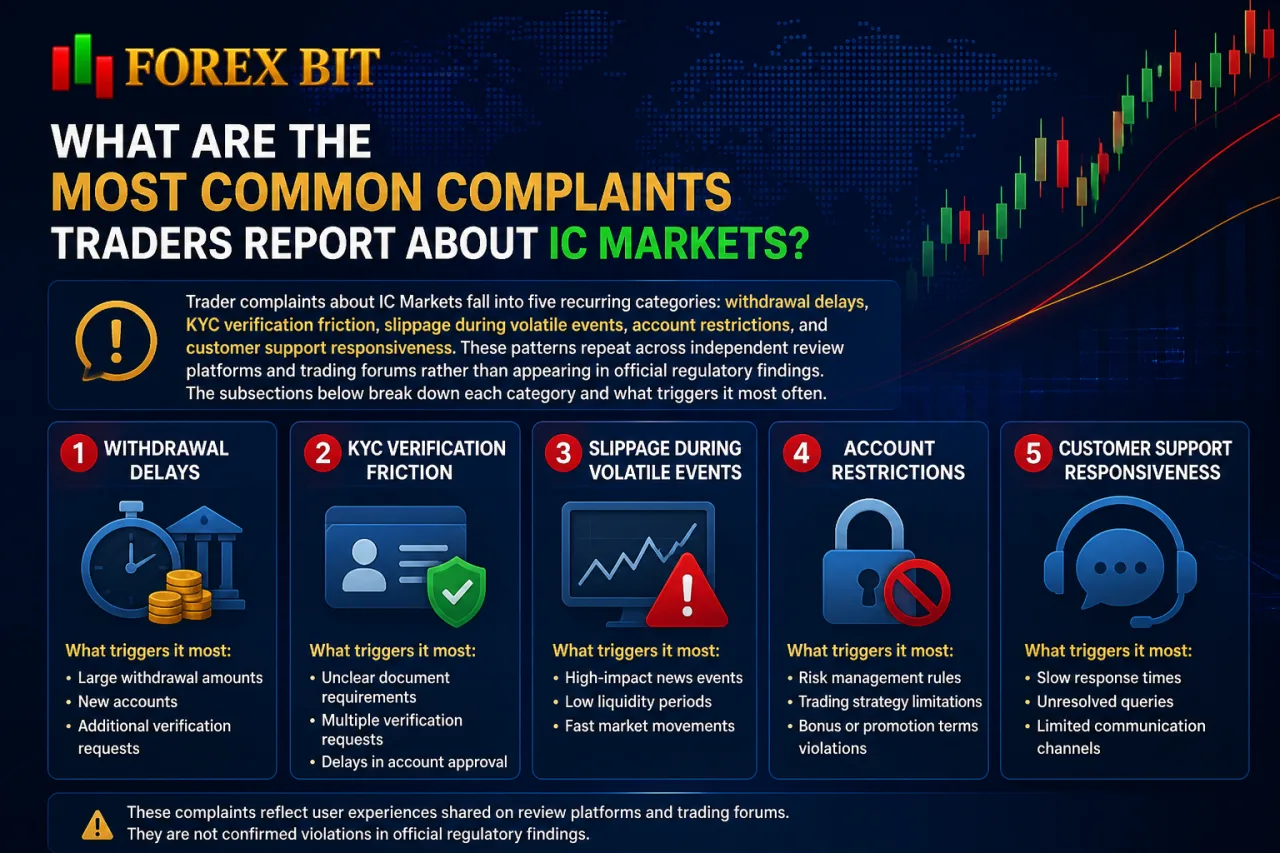
Trader complaints about IC Markets fall into five recurring categories: withdrawal delays, KYC verification friction, slippage during volatile events, account restrictions, and customer support responsiveness. These patterns repeat across independent review platforms and trading forums rather than appearing in official regulatory findings.
Slippage complaints tend to surface during high-impact news events or periods of thin liquidity, when execution prices move away from the requested rate faster than some traders expect. Account restriction complaints generally involve trading style disputes, such as accounts flagged for scalping or arbitrage patterns that the broker’s terms treat differently from standard trading. Customer support responsiveness complaints mostly center on response time during high-volume periods rather than a lack of support channels altogether.
The subsections below break down the two most frequently documented categories, withdrawal delays and KYC verification, and what triggers them most often.
Are Withdrawal Delays at IC Markets a Sign of Fraud?
Withdrawal delays at IC Markets do not automatically indicate fraud, since most reported cases trace back to KYC/AML verification checks or third-party payment processor limits rather than deliberate fund withholding. This distinction matters directly for the withdrawal issue raised in the heading.
Regulated brokers, including entities operating under ASIC, CySEC, and FSA licensing, apply anti-money laundering checks before releasing withdrawals, particularly when a payout method differs from the original deposit method or when account details require updated verification. Payment processors and banking intermediaries also impose their own processing windows, which extend timelines beyond what IC Markets controls directly.
Genuine malpractice would involve a pattern of unresolved, unexplained fund withholding confirmed through regulatory action rather than isolated forum posts. No public regulatory sanction against IC Markets for withdrawal fraud currently exists on ASIC or CySEC registers. Some trader complaints cite unresponsive support during delayed cases, which raises legitimate service concerns separate from fraud allegations.
Traders distinguish verified complaints from unsubstantiated claims by checking whether the delay stems from documentation requests, processor cutoffs, or an unexplained refusal to pay.
Why Do Some Traders Report Account Verification (KYC) Problems?
Account verification problems at IC Markets stem mainly from standard KYC/AML document checks rather than deliberate account restrictions. This directly addresses the friction traders describe when opening or funding accounts.
IC Markets requires proof of identity and proof of address, matched against the details submitted at registration, before releasing withdrawals or lifting account limits. Standard documentation includes a government-issued ID, a recent utility bill or bank statement confirming address, and in some cases a selfie verification step tied to the submitted ID.
Friction typically arises when submitted documents are outdated, mismatched in name or address, or of poor image quality, requiring resubmission and extending processing time. Traders funding accounts through methods not registered in their own name also trigger additional verification requests, since regulators require deposit and payout sources to match the account holder.
These checks tend to apply across ASIC, CySEC, and FSA-regulated entities alike, since anti-money laundering obligations are generally a licensing requirement rather than a discretionary broker policy.
Verification delays therefore reflect compliance procedure rather than an attempt to withhold trader funds.
How Does IC Markets’ Safety Compare to Other Regulated Brokers?
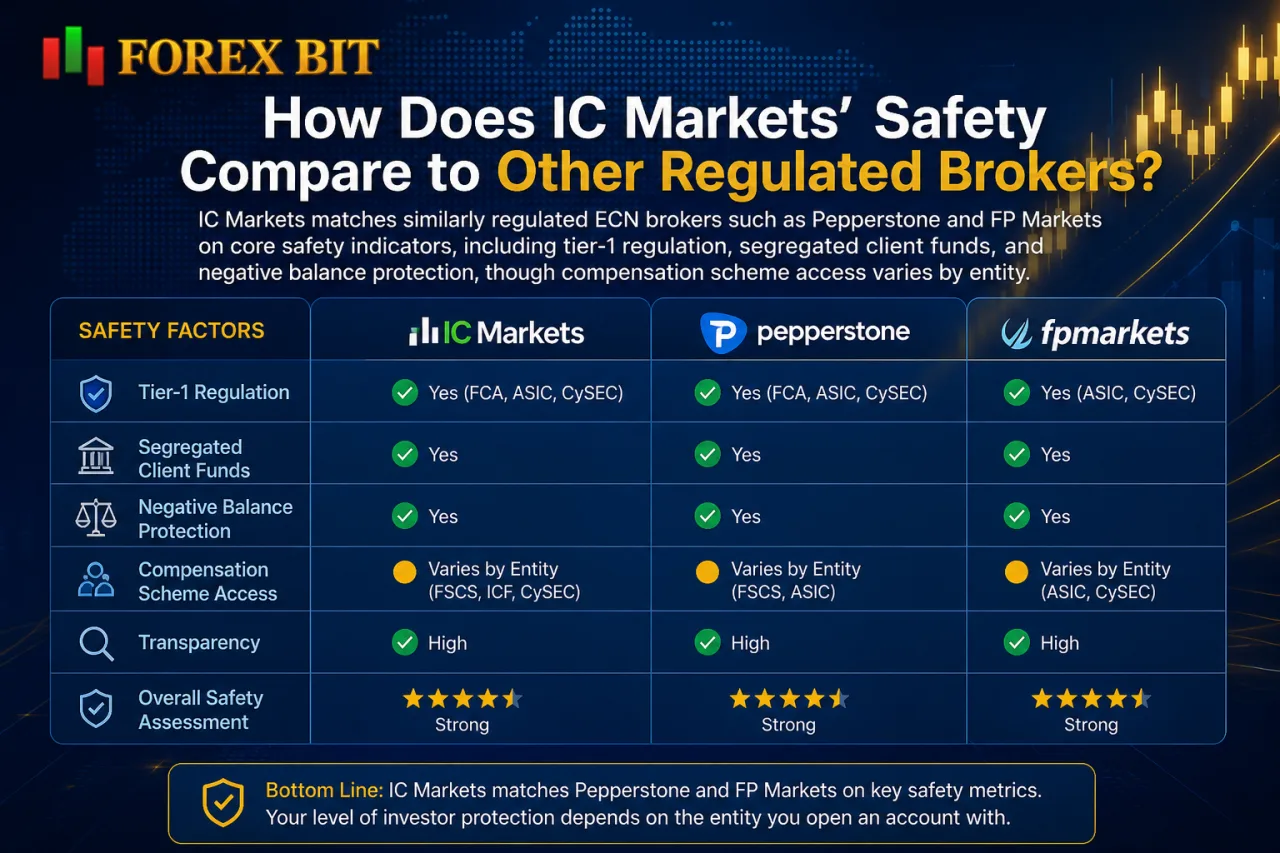
IC Markets matches similarly regulated ECN brokers such as Pepperstone and FP Markets on core safety indicators, including tier-1 regulation, segregated client funds, and negative balance protection, though compensation scheme access varies by entity. This comparison addresses the safety benchmarking question raised in the heading directly.
Since all three brokers register under overlapping regulators, most differences show up at the entity level rather than the brand level. The subsections below break down tier-1 regulatory standing, fund segregation practices, negative balance protection scope, and compensation scheme eligibility across these ECN brokers.
Does IC Markets Offer Negative Balance Protection and Fund Segregation?
IC Markets confirms both practices, segregating client funds from company operating funds and providing negative balance protection, though the exact scope depends on the entity holding the account. This directly answers the client fund protection question raised in the heading.
Fund segregation and negative balance protection apply across IC Markets Australia, IC Markets Global, and IC Markets Europe, but the regulatory basis for each varies by jurisdiction.
- Segregation keeps client deposits in accounts separate from IC Markets’ corporate funds, held with regulated banking institutions under each entity’s licensing terms.
- Negative balance protection prevents a trading account from carrying a deficit balance beyond deposited funds, particularly relevant during extreme volatility or gapping events.
- CySEC-regulated entities, including IC Markets Europe, apply negative balance protection for retail clients in line with European regulatory requirements.
- ASIC and FSA-regulated entities disclose segregation and balance protection terms separately in their client agreements, which traders confirm before funding an account.
Traders verify these protections directly through the account terms and disclosure documents tied to their registered IC Markets entity rather than assuming uniform coverage across the brand globally.
How Can Traders Verify IC Markets’ Regulatory Status Themselves?
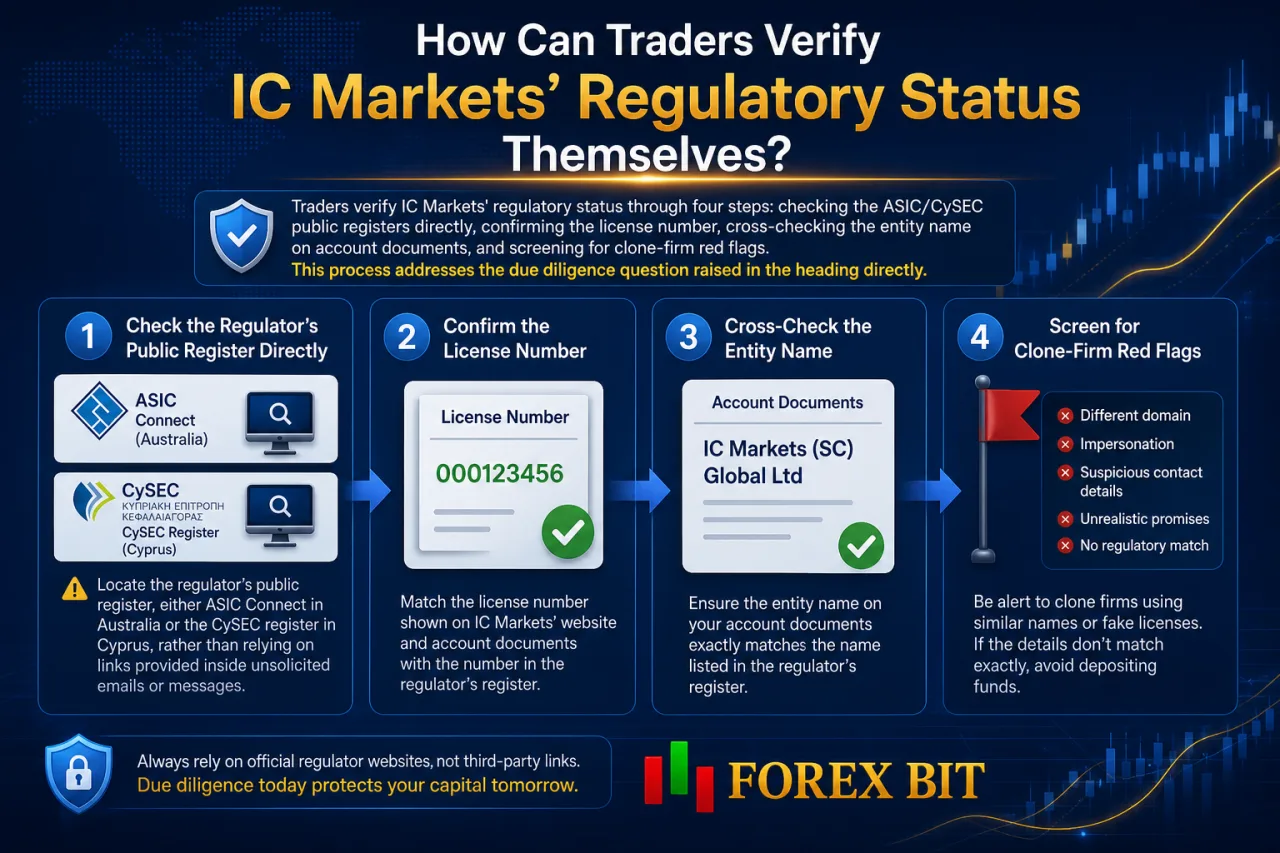
Traders verify IC Markets’ regulatory status through four steps: checking the ASIC/CySEC public registers directly, confirming the license number, cross-checking the entity name on account documents, and screening for clone-firm red flags. This process addresses the due diligence question raised in the heading directly.
- Locate the regulator’s public register, either ASIC Connect in Australia or the CySEC register in Cyprus, rather than relying on links provided inside unsolicited emails or messages.
- Search the exact legal entity name printed on the trading agreement, such as the IC Markets entity tied to the account, instead of searching only the brand name “IC Markets.”
- Match the license number shown on the register against the number disclosed in the account opening documents or the broker’s official regulatory disclosures page.
- Compare the registered business address and contact details on the register against those listed on the account agreement, since mismatches often indicate an unauthorized clone.
Clone firms typically copy a legitimate broker’s name and license number while operating under a different, unauthorized website or contact channel. Regulators including ASIC and CySEC periodically publish warnings about unauthorized entities that impersonate regulated brokers, a practice that can also affect firms like IC Markets. Traders treat any mismatch between the register listing and the account documents as a red flag warranting further verification before depositing funds.
What Unique Risk-Management Features Set IC Markets Apart from Typical Brokers?
IC Markets sets itself apart through three infrastructure-level features: raw ECN pricing routed via Equinix-hosted servers, third-party liquidity aggregation from multiple banks, and independent third-party auditing of its execution and financial reporting. These elements sit above baseline regulatory compliance, addressing execution transparency and pricing integrity rather than fund protection alone. The subsections below break down how each feature functions and why it matters for trade execution quality.
Does IC Markets Provide Independent Trade Execution Audits or Reports?
Beyond standard regulatory disclosure requirements, some brokers, including IC Markets, reference execution-related statistics such as slippage and speed, though these are not equivalent to independent third-party execution audits. This directly answers whether the broker shares verifiable execution data rather than only marketing claims.
These reports typically break down the share of orders filled at requested price, with positive slippage, and with negative slippage, alongside benchmark execution time figures. This level of reporting is not standard across most retail forex and CFD brokers, which makes it a less common practice within the industry.
Traders use these published figures to cross-check the broker’s advertised execution quality against independently verifiable data rather than relying solely on account statements or anecdotal forum reports.
Conclusion
The evidence points to IC Markets operating as a regulated, legitimate broker rather than a scam, backed by active ASIC, CySEC, and FSA licenses, a long operating history, and disclosed corporate entities. Trader complaints center on withdrawal delays, KYC friction, and slippage disputes, patterns tied to compliance procedure and market volatility rather than fraud confirmed through regulatory action.
Fund segregation, negative balance protection, and execution transparency measures further align IC Markets with other tier-1 regulated ECN brokers. Traders confirming their specific entity and cross-checking registers gain a clear, verifiable answer to the safety question behind the scam search.
William Johnson is a Forex & Broker News Analyst at Forex Bit, focusing on broker updates, regulatory developments, payment changes, and security-related news. His work helps readers stay informed about important industry developments and understand how these changes may affect broker services and trading conditions.
Email: [email protected]


Best Brokers

Trade with the world’s largest retail broker and benefit from better - than - market conditions.

We offer a superior trading environment that puts traders in the best position to profit.

Trade with the best trading conditions. WIN THE BEST TRADING ACCOUNT AWARD.

Trade global markets with Interactive Brokers – a highly regulated multi-asset broker built for active and professional investors.






Forex Bit provides independent forex broker reviews, comparisons, guides, and industry news to help traders make informed decisions.
Best Brokers
Metatrader 5 Brokers
Metatrader 4 Brokers
Lowest Spread Forex Broker
Regulated Forex Brokers
Forex Copy Trading
Ctrader Brokers
Best Forex Broker For Beginners