



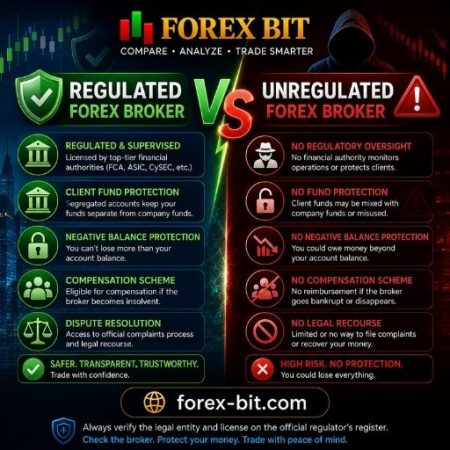
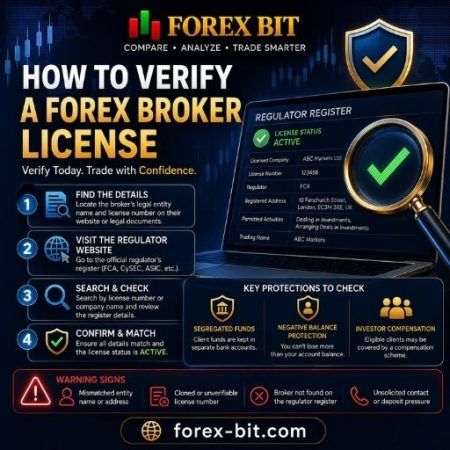
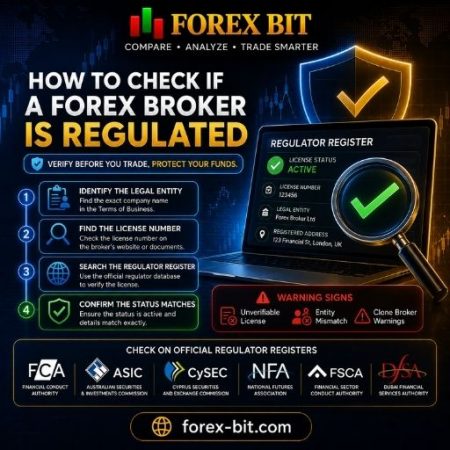
A safe forex broker is verified by confirming active regulatory licences, segregated client funds, and transparent legal entity details. These factors together determine whether a broker meets recognised safety standards before any trading account is opened.
A broker’s regulation and licence status can be checked directly on the relevant regulator’s public register by searching the firm’s name or registration/licence number. This confirms whether the entity offering services is actually authorised, rather than relying on claims made on the broker’s own website.
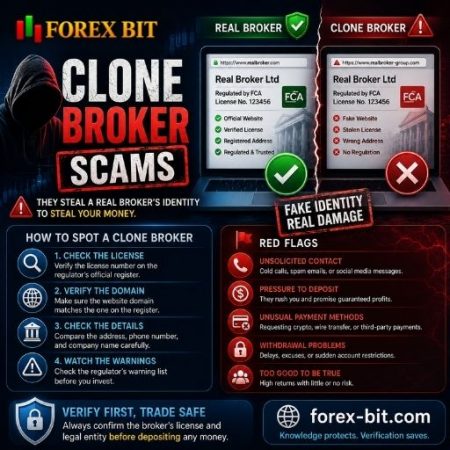
Scam brokers are often identified through common warning signs such as being unregulated, promising guaranteed profits, and imposing withdrawal restrictions. Recognising these patterns early prevents exposure to unlicensed or fraudulent operators.
Client fund protection and negative balance protection are typically confirmed by checking a broker’s use of segregated client accounts and reviewing its official policy disclosures. These safeguards limit losses beyond deposited capital and protect funds if a broker becomes insolvent.
Forex Bit outlines each of these verification steps in detail below, starting with how to confirm overall broker safety before checking regulation, licensing, and common scam indicators.
How to Verify If a Forex Broker Is Safe?
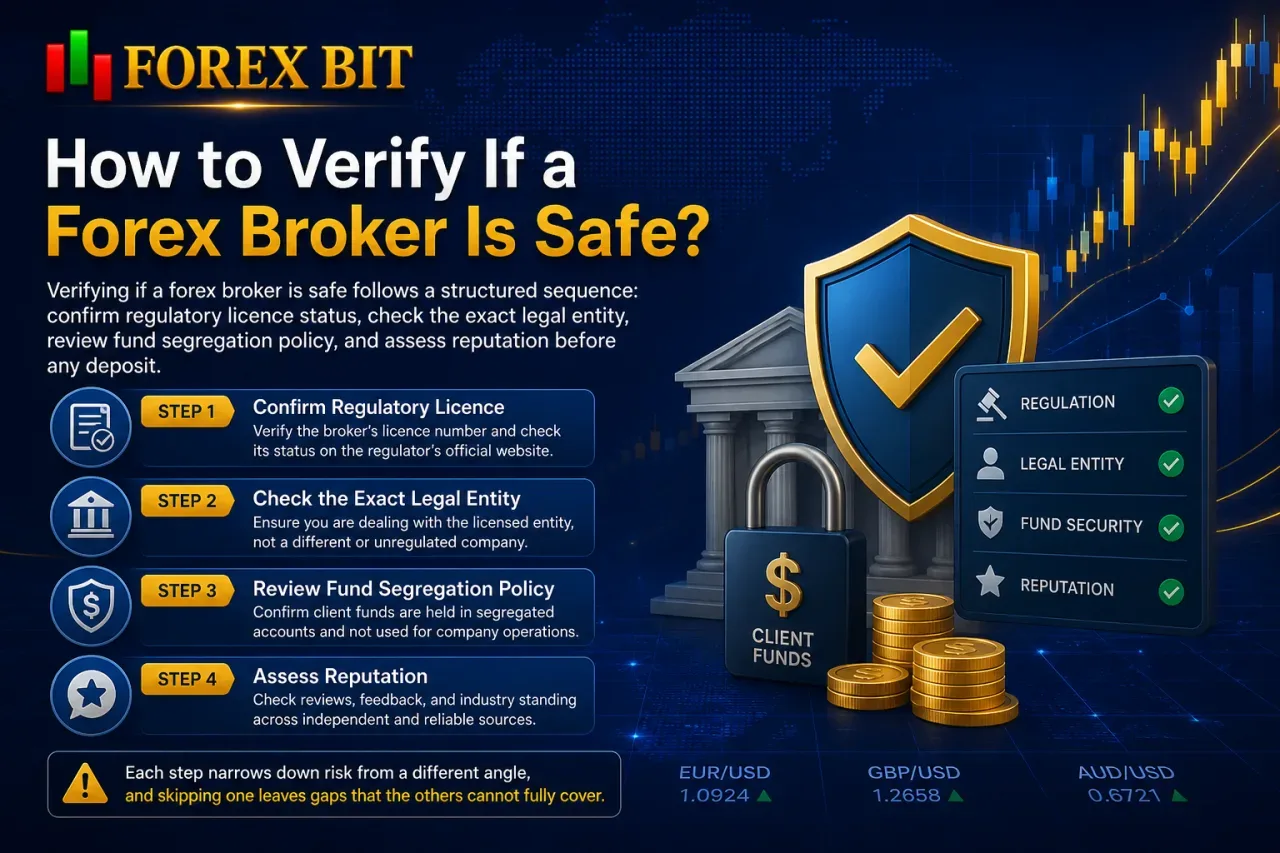
Verifying if a forex broker is safe follows a structured sequence: confirm regulatory licence status, check the exact legal entity, review fund segregation policy, and assess reputation before any deposit. This process turns the individual safety factors already outlined into a practical checklist rather than a single isolated check.
Each step narrows down risk from a different angle, and skipping one leaves gaps that the others cannot fully cover.
- Confirming the broker’s licence number appears on the regulator’s official register under the same entity name.
- Matching the legal entity named in account terms with the one actually holding the licence, since brokers often operate multiple entities across jurisdictions.
- Reviewing whether client funds sit in segregated accounts separate from the broker’s operating capital.
- Checking public reputation sources, complaint records, and disciplinary history tied to the same regulated entity.
- Testing withdrawal reliability and support responsiveness with a smaller deposit before committing larger capital.
For beginner traders, this sequence works best as a fixed order followed every time before opening a new account. For more experienced traders comparing multiple brokers, the same steps apply but are often run in parallel across a shortlist to save time. No single step replaces the others, since regulation confirms legal oversight while fund segregation and reputation checks address practical safety once trading begins.
How to Check a Broker’s Regulation and Licence Status?
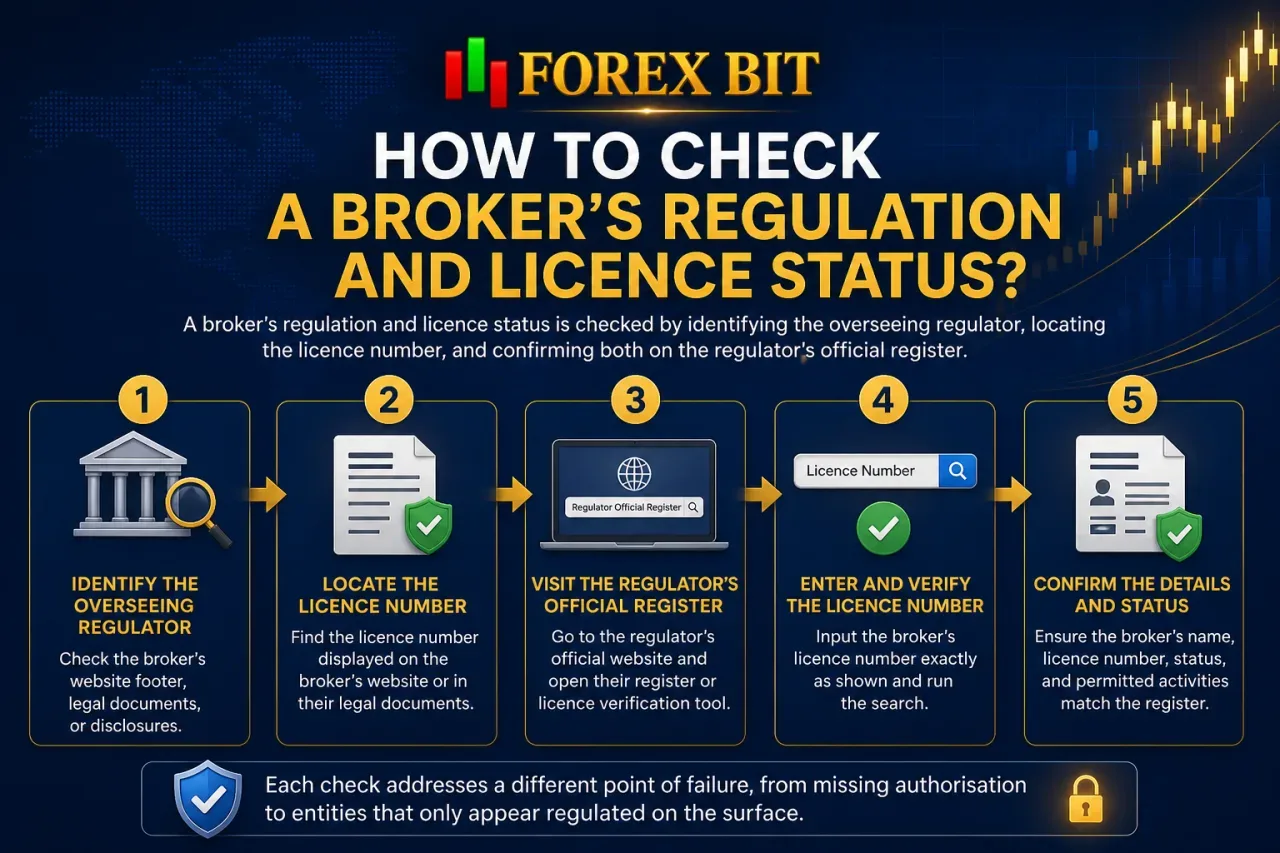
A broker’s regulation and licence status is checked by identifying the overseeing regulator, locating the licence number, and confirming both on the regulator’s official register. This verification process narrows down to a few concrete checks rather than a single lookup, covered individually below.
Each check addresses a different point of failure, from missing authorisation to entities that only appear regulated on the surface.
What Are the Signs of a Properly Regulated Broker?
A properly regulated broker shows five consistent signs: oversight from a tier-1 regulator, a publicly verifiable licence number, a matching legal entity, transparent company disclosures, and clear jurisdiction information. These indicators build directly on the licence and entity checks already outlined, giving a fuller picture of regulatory credibility rather than a single pass/fail check.
Each sign confirms a different part of the same oversight structure, and a broker missing several of them raises doubt about its actual regulatory standing.
- Oversight from a tier-1 regulator known for strict capital, conduct, and reporting requirements.
- Verifiable licence number that matches the exact entity listed on the regulator’s public register.
- Matching legal entity name across the website, account terms, and regulatory filing.
- Transparent disclosures covering company ownership, registered address, and financial reporting.
- Clear jurisdiction information stating which country’s rules govern client accounts and disputes.
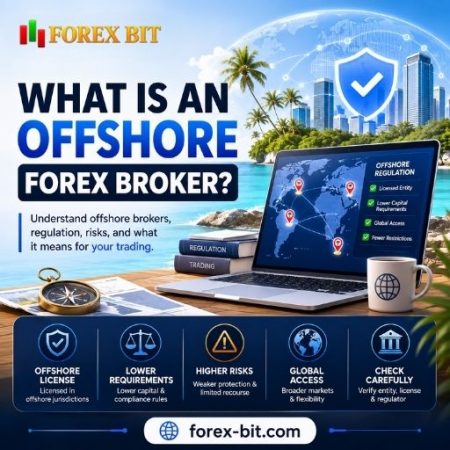
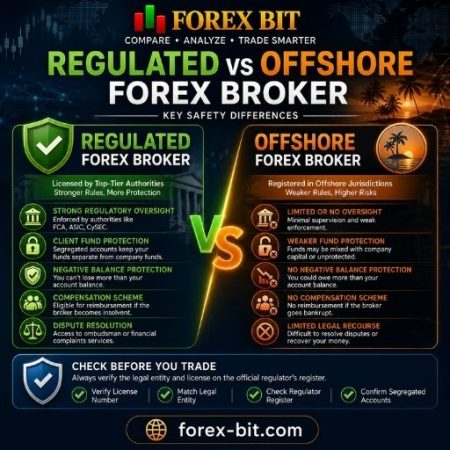
Brokers regulated only in offshore jurisdictions with limited enforcement typically display fewer of these signs, while those holding tier-1 authorisation tend to publish licence details openly rather than burying them in disclaimers.
Why Does the Broker’s Legal Entity and Jurisdiction Matter?
A broker’s legal entity and jurisdiction matter because they determine which regulator holds authority and which client protections legally apply to the account. Brands often operate several entities across different jurisdictions, and signing up with one entity rather than another under the same brand name changes the actual level of oversight and recourse available.
This directly follows from the entity-matching check already outlined, since a mismatch between the marketed brand and the licensed entity often signals weaker protection.
- Confirming which entity holds the account determines which regulator has enforcement power over disputes.
- Identifying the jurisdiction clarifies whether compensation schemes or investor protection funds apply.
- Checking the governing entity shows whether client fund segregation rules are legally enforceable or merely stated as policy.
- Reviewing the entity named in account terms reveals if a tier-1 licensed brand routes clients through an offshore affiliate with lighter rules.
A trader onboarded under an offshore entity of an otherwise well-regulated brand typically holds fewer legal protections than one onboarded under the tier-1 regulated entity of that same brand, even though the trading platform and marketing appear identical.
How to Identify Scam Brokers and Warning Signs?
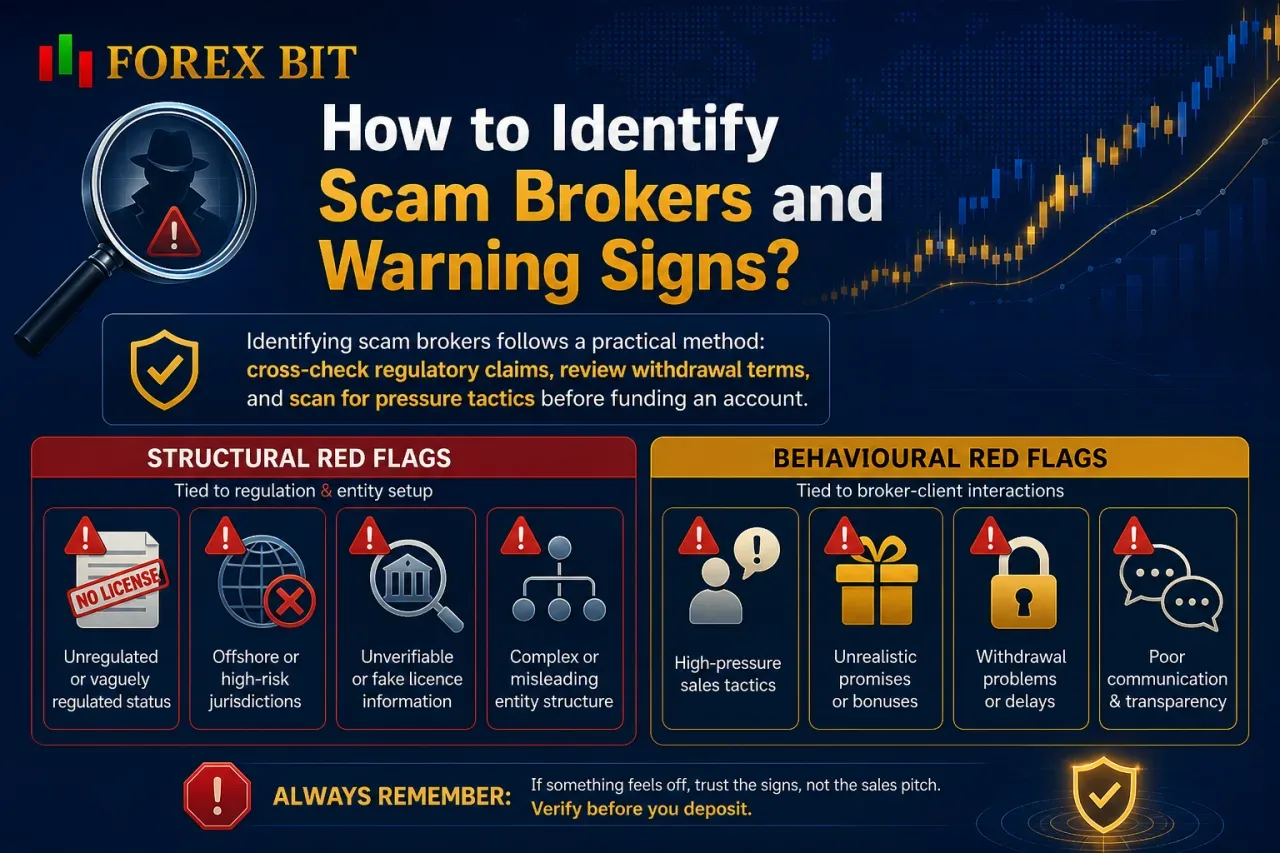
Identifying scam brokers follows a practical method: cross-check regulatory claims, review withdrawal terms, and scan for pressure tactics before funding an account. This method extends the licence and entity checks already outlined into a set of concrete warning signs traders can spot early.
Two groups of signals matter most: structural red flags tied to regulation and entity setup, and behavioural red flags tied to how a broker interacts with clients.
- Unregulated or vaguely regulated status, with no verifiable licence number on any official register.
- Mismatched legal entity names between marketing pages, account terms, and any licence claimed.
- Guaranteed profit promises or risk-free trading claims made through account managers or ads.
- Withdrawal restrictions such as unexplained delays, extra fees, or demands for further deposits before payout.
- Aggressive recruitment tactics, including cold calls, high-pressure upselling, or bonus offers tied to lock-in conditions.
A newer trader benefits most from treating any single one of these signs as reason enough to stop onboarding, since scam operations rarely show only one issue in isolation. A trader already holding funds with a suspicious broker instead prioritises testing a small withdrawal first, since that single action often confirms or dismisses the concern faster than further research alone.
What Are the Common Warning Signs of an Unsafe Broker?
The common warning signs of an unsafe broker fall into six categories: unregulated offshore entities, unrealistic profit promises, withdrawal difficulties, aggressive sales tactics, fake reviews, and unclear contact information. These signs extend the scam-identification method already outlined into a fuller checklist for spotting risk before funding an account.
Each category flags a different part of a broker’s operation, from legal setup to day-to-day client treatment.
- Operating through unregulated offshore entities with no licence number listed on any official register.
- Promising unrealistic profits or guaranteed returns regardless of market conditions.
- Delaying or blocking withdrawals through unexplained holds, extra fees, or added deposit demands.
- Pushing aggressive sales tactics such as cold calls, high-pressure upselling, or locked-in bonus conditions.
- Displaying fake or overly uniform reviews that avoid any specific detail about account experience.
- Hiding transparent contact information, including a verifiable physical address, phone line, or support email.
A trader spotting two or more of these signs together treats them as a stronger warning than any single issue in isolation, since genuine brokers rarely combine several of these behaviours at once.
Is an Unregulated Broker Always a Scam?
No, an unregulated broker is not automatically a scam, but it removes the licence-based safeguards already outlined and significantly raises risk while cutting off formal recourse. Without a regulator overseeing the entity, a trader has no licence number to verify, no compensation scheme to fall back on, and no enforcement body to escalate disputes to if funds get stuck or terms change unexpectedly.
This distinction matters because regulation and legitimacy are not the same thing, even though the two often overlap in practice.
- Operating without oversight from any recognised regulator, which removes standard capital and conduct requirements.
- Offering no verifiable licence number on a public register, unlike the properly regulated brokers described earlier.
- Providing no compensation scheme or independent dispute body if a payout dispute or insolvency occurs.
- Relying solely on the broker’s own claims about fund safety, with no external body confirming segregation practices.
A trader considering an unregulated broker treats it with added caution rather than automatic rejection, running the same entity, fund segregation, and reputation checks described earlier with extra weight placed on withdrawal testing before committing meaningful capital.
How Do Client Fund Protection and Negative Balance Protection Work?
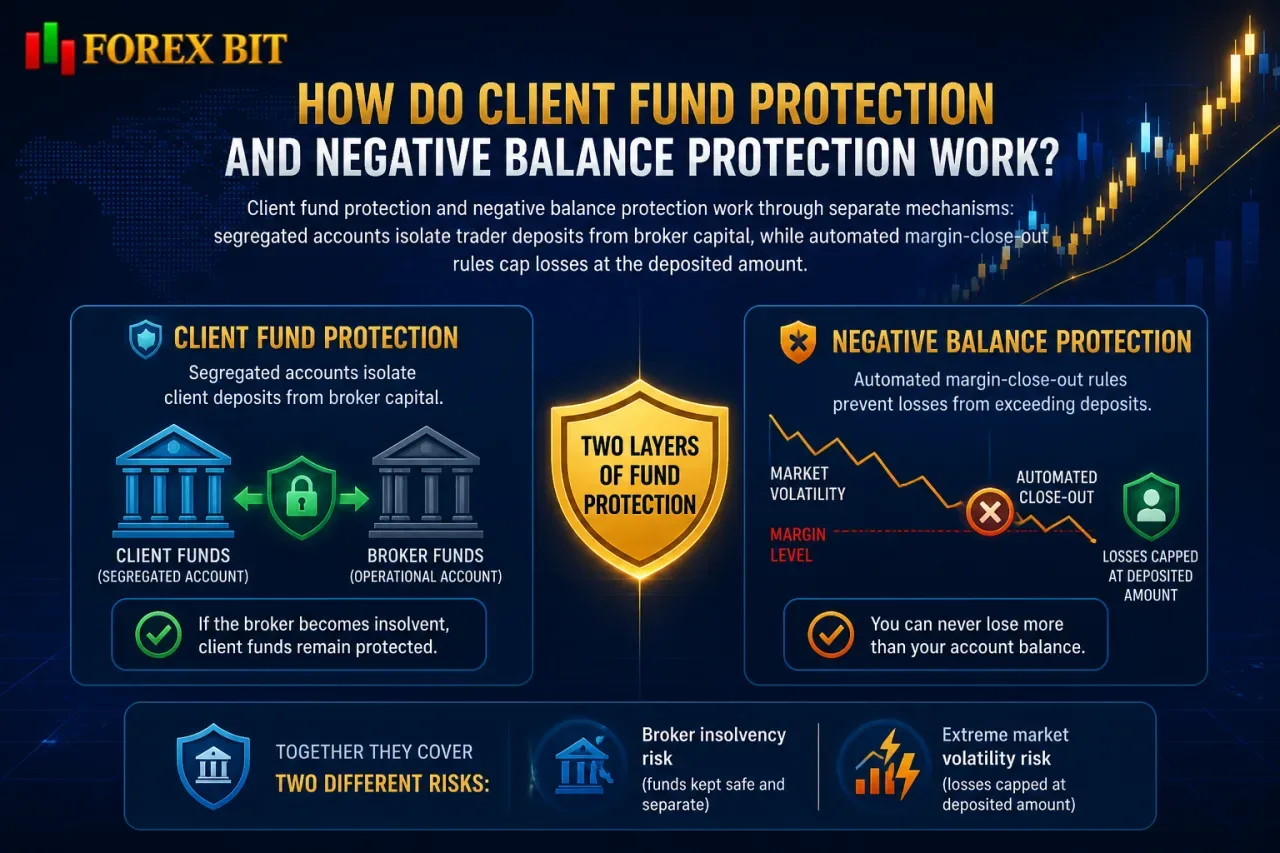
Client fund protection and negative balance protection work through separate mechanisms: segregated accounts isolate trader deposits from broker capital, while automated margin-close-out rules cap losses at the deposited amount. Both mechanisms extend the fund-safeguard checks already outlined into concrete operational protections rather than abstract policy statements.
Together they cover two different risks: broker insolvency on one side, and extreme market volatility wiping out more than a trading account holds on the other. The sections below break down how each mechanism functions, where compensation schemes fit in, and why regulators treat both as core trust indicators.
What Is Segregated Client Fund Protection?
Segregated client fund protection is a regulatory requirement that forces a broker to hold client deposits in bank accounts separate from its own operating capital. This separation directly extends the fund-safeguard checks already outlined, turning a broker’s policy claim into a mechanism that regulators actively enforce rather than a promise left to trust.
The core function stays consistent across regulators that mandate it: client money never mixes with company funds used for salaries, marketing, or day-to-day operating costs.
- Holding client deposits in designated bank accounts labelled separately from company assets.
- Restricting the broker from using client funds to cover its own operating expenses or debts.
- Requiring regular reconciliation between client account balances and segregated fund holdings.
- Protecting trader deposits from creditor claims if the broker becomes insolvent.
Certain tier-1 regulators mandate strict segregation rules with regular audits, while other jurisdictions leave segregation as a broker policy rather than a legal obligation. This gap ties back to the entity and jurisdiction check covered earlier, since the same brand may enforce segregation strictly under one licensed entity and only loosely under another.
What Is Negative Balance Protection and Why Does It Matter?
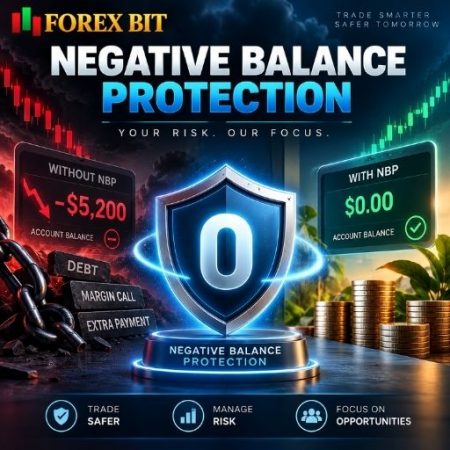
Negative balance protection is a broker safeguard that automatically closes losing positions before an account balance drops below zero, capping losses at deposited capital. This mechanism works alongside segregated fund protection already outlined, addressing market-risk exposure rather than broker insolvency risk.
The safeguard functions through automated margin-close-out systems that liquidate open positions once equity reaches a set threshold, preventing a trading account from carrying debt into negative territory even during extreme price gaps or sudden volatility spikes.
- Triggering automatic position closure once account equity falls to a defined margin level.
- Resetting any residual negative balance back to zero rather than leaving the trader owing the broker.
- Applying uniformly across leveraged positions, since higher leverage raises the chance of rapid equity swings.
- Serving as a benchmark attribute when comparing brokers, alongside licence status and fund segregation.
Some regulators mandate negative balance protection for retail clients, while other jurisdictions leave it as an optional broker policy. A broker offering this protection as a stated, verifiable policy rather than a vague marketing claim matches the same transparency standard already covered under regulatory disclosures.
What Other Due-Diligence Checks Help Confirm a Broker’s Long-Term Safety?
Extended due-diligence beyond core regulation checks groups into four areas: audited financial statements, parent company history, regulator enforcement records, and sanction-free operating history. These checks build on the licence, entity, and fund-protection reviews already outlined, adding a longer-term view of stability rather than a one-time verification snapshot.
How Can Regulator Enforcement History Reveal a Broker’s Reliability?
Regulator enforcement history reveals a broker’s reliability by exposing past fines, licence suspensions, or disciplinary orders that marketing pages never disclose. This check extends the entity and jurisdiction verification already outlined, since the same regulator holding licensing power over an entity also publishes its enforcement actions against that entity.
Public enforcement registers list a different layer of information than promotional claims, showing how a broker actually behaved once regulators intervened.
- Listing fines or sanctions issued against the specific licensed entity, not just the broader brand name.
- Recording licence suspensions or revocations tied to compliance failures, client fund mishandling, or reporting breaches.
- Noting repeated warnings issued for the same violation, which signals unresolved compliance patterns rather than isolated incidents.
- Documenting formal complaints escalated to disciplinary hearings, distinct from informal client disputes discussed online.
A trader finding a clean enforcement record treats it as a supporting signal alongside licence status and fund segregation, while a broker with repeated disciplinary actions warrants added scrutiny before funding an account, even if its marketing materials present no such history.
Why Should Traders Review a Broker’s Corporate Ownership Structure?
Traders review a broker’s corporate ownership structure because the parent company and group entities behind a licence determine who ultimately controls client funds and bears responsibility if problems arise. This check extends the entity and jurisdiction verification already outlined, since a single brand often sits under a holding company that also owns other regulated and unregulated entities in separate markets.
Ownership transparency matters because a licence alone confirms oversight of one entity, not the financial health or intentions of the group controlling it.
- Revealing whether the licensed entity operates independently or answers to a parent company based in a weaker jurisdiction.
- Showing whether profits or client-related liabilities move between group entities in ways that affect the licensed entity’s stability.
- Indicating whether the same ownership group has faced regulatory action under a different brand name elsewhere.
- Clarifying who actually holds accountability if the licensed entity faces insolvency or a dispute escalates.
A trader checking ownership alongside the licence and fund segregation reviews already covered gets a fuller view of long-term stability rather than relying on a single point-in-time licence check.
Conclusion
Confirming a safe forex broker rests on a clear sequence: verify the licence on the regulator’s official register, match the exact legal entity behind the account, confirm segregated funds and negative balance protection, then screen for scam warning signs before depositing capital. Extended checks on enforcement history and corporate ownership add a longer-term safety view beyond a single verification pass.
Applied together, these steps turn broker safety from a vague trust exercise into a concrete, repeatable checklist that any trader, beginner or experienced, can run before opening or funding an account.