
Learn how negative balance protection stops you owing more than your deposit, which regulators require it, and how to check if your broker offers it.
Negative Balance Protection Explained for Forex Traders

Negative balance protection prevents a forex or CFD trader from losing more money than the funds held in their trading account. This safeguard stops brokers from demanding extra payment after extreme losses, capping downside risk at the account balance itself.
Brokers offering this protection credit back any deficit, resetting the account balance to zero rather than leaving it negative. This process typically applies without requiring the trader to file a claim.
Sharp market volatility or overnight price gaps can push losses past a trader’s deposited margin, particularly during major news events. Negative balance protection absorbs this shortfall so the trader’s account never falls below zero.
Regulators in major jurisdictions generally require brokers serving retail clients to offer negative balance protection, while many offshore regulators impose no such requirement. This distinction makes broker regulation status a direct factor in a trader’s financial exposure. This description reflects a general summary of regulatory practice across jurisdictions rather than a citation of specific figures from any single regulatory document.
Regulated brokers generally guarantee this protection by policy, whereas unregulated or loosely regulated brokers may leave traders exposed to debt beyond their deposit. Forex Bit breaks down how this protection works in practice, starting with what negative balance protection actually means in forex trading.
What Is Negative Balance Protection in Forex Trading?
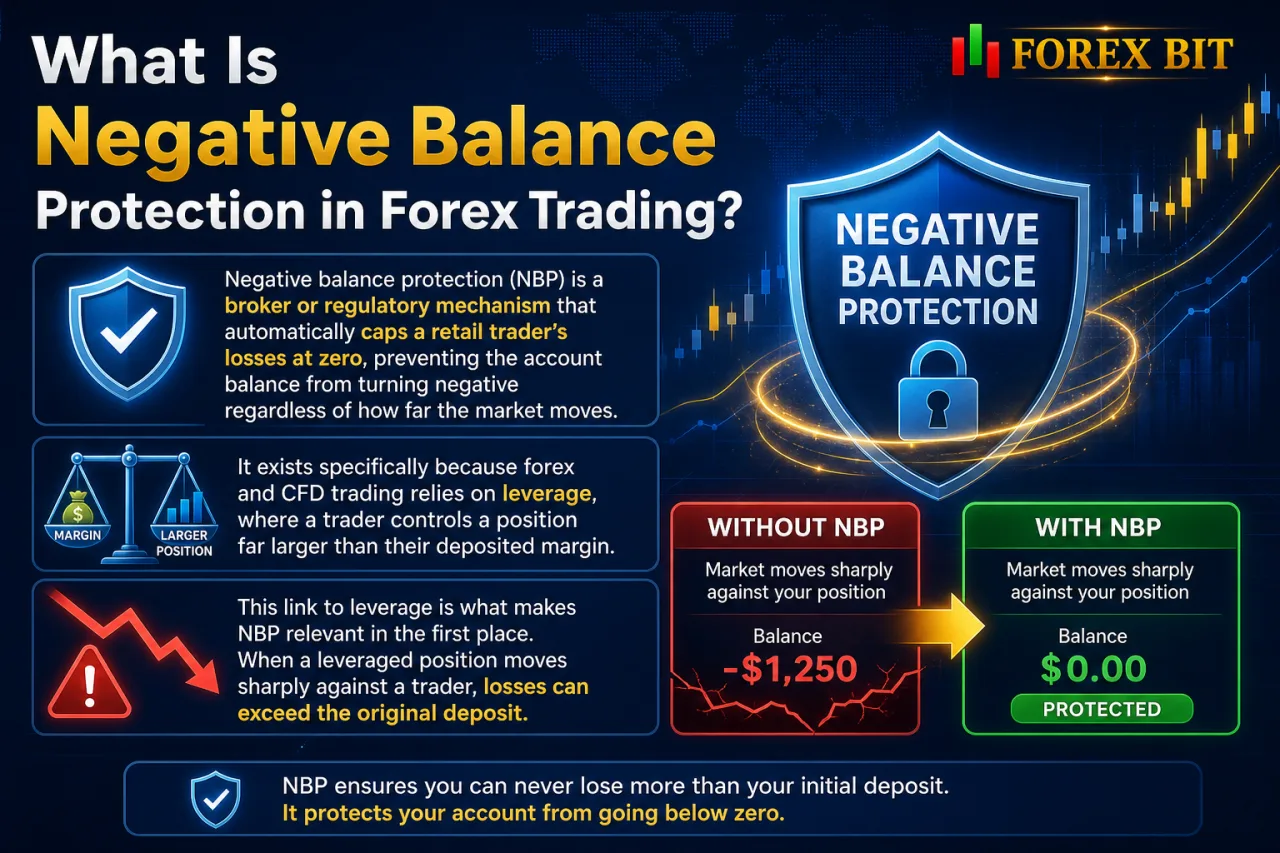
Negative balance protection (NBP) is a broker or regulatory mechanism that automatically caps a retail trader’s losses at zero, preventing the account balance from turning negative regardless of how far the market moves. It exists specifically because forex and CFD trading relies on leverage, where a trader controls a position far larger than their deposited margin.
This link to leverage is what makes NBP relevant in the first place. When a leveraged position moves sharply against a trader, losses can theoretically exceed the margin on deposit, creating a debt owed back to the broker. NBP removes that debt scenario entirely.
Without this safeguard, a trader could end an extreme trade owing money beyond their original deposit, since leverage magnifies both gains and losses on the underlying instrument.
With NBP active, the broker absorbs any deficit once the balance reaches zero, so the account simply stops at zero instead of going further into negative territory.
This matters most for retail clients. They typically trade with less capital and higher relative leverage than institutional accounts, which leaves them more exposed to margin shortfalls during volatile price swings.
How Does Negative Balance Protection Work During Market Volatility or Price Gaps?
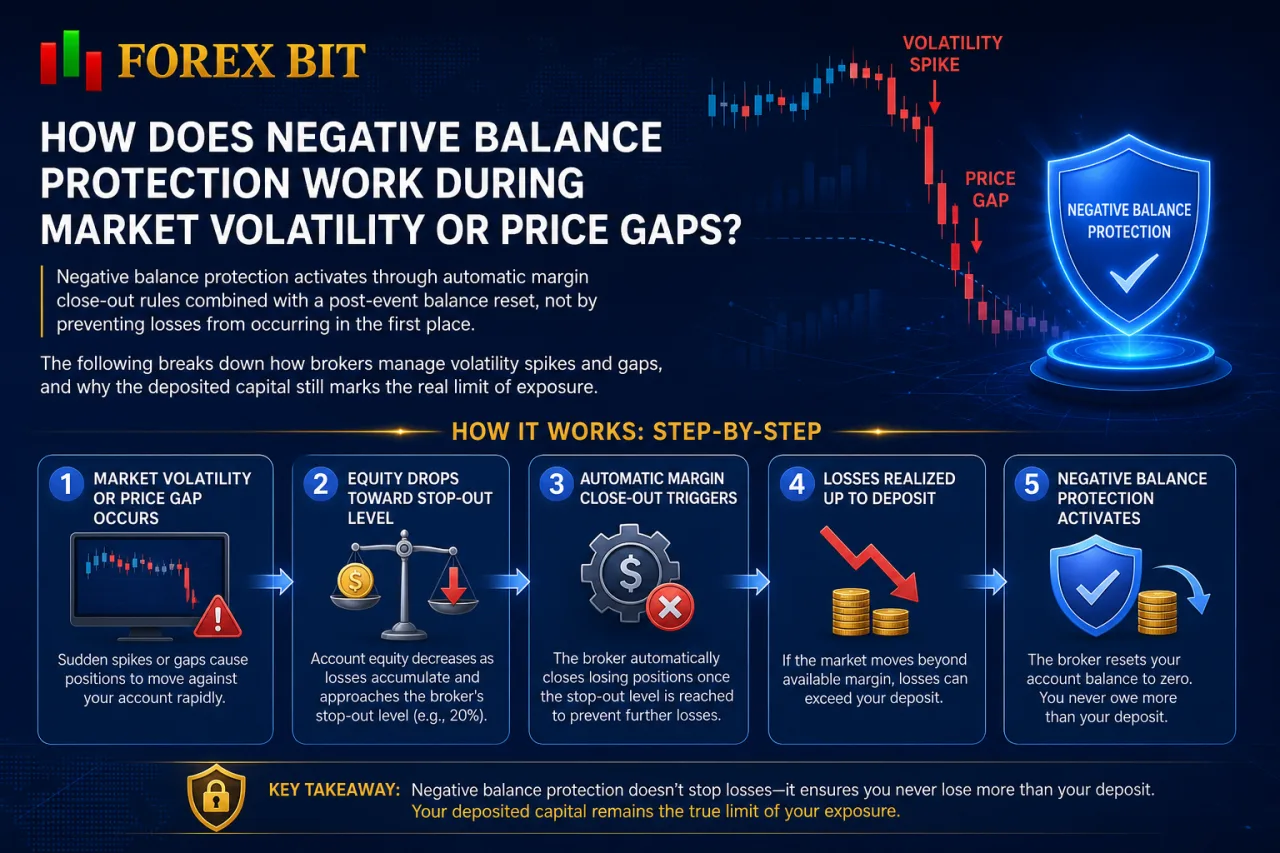
Negative balance protection activates through automatic margin close-out rules combined with a post-event balance reset, not by preventing losses from occurring in the first place. The following breaks down how brokers manage volatility spikes and gaps, and why the deposited capital still marks the real limit of exposure.
Brokers enforce a stop-out level that closes losing positions automatically once account equity falls to a defined percentage of used margin. This stop-out level halts losses before they reach zero under normal market conditions. This mechanism works reliably in normal market conditions with continuous pricing.
Weekend gaps and major news releases disrupt this safety net because prices can jump straight past the stop-out level without trading through it, a phenomenon known as slippage. In these cases, the closing order executes at the next available price, which may already sit below zero equity.
NBP applies after this shortfall occurs, crediting the negative amount back to bring the balance to exactly zero. The trader still absorbs the full loss of deposited funds; the protection only removes the additional debt beyond that deposit, leaving the account balance floor fixed at the trader’s own capital rather than below it.
What Happens When a Trading Account Goes Negative Without NBP?
Without negative balance protection, a trader owes the broker the deficit amount whenever losses exceed the account balance, turning the account into a debt obligation. This shifts the risk floor from the deposited capital to an open-ended liability tied to how far the market moved past the stop-out level.
That debt scenario becomes real risk rather than a theoretical one during sudden, extreme volatility events.
A widely cited example is the 2015 Swiss franc flash crash, when a sudden central bank policy shift caused the EUR/CHF pair to move sharply beyond what stop-out mechanisms could contain, leaving some brokers and traders exposed to negative balances and unpaid debts. This event is commonly referenced in the industry as a case illustrating the danger of trading without NBP, rather than a precisely documented figure.
In cases like this, brokers without NBP policies issue a debit balance to the trader’s account and may pursue collection for the shortfall. Some brokers choose to waive these debts as a goodwill gesture, though this remains a discretionary business decision rather than a guaranteed protection. Traders holding accounts with brokers operating outside jurisdictions that mandate NBP carry this uncapped downside risk whenever leverage amplifies a sharp, gapping price move.
Which Regulators Require Brokers to Offer Negative Balance Protection?
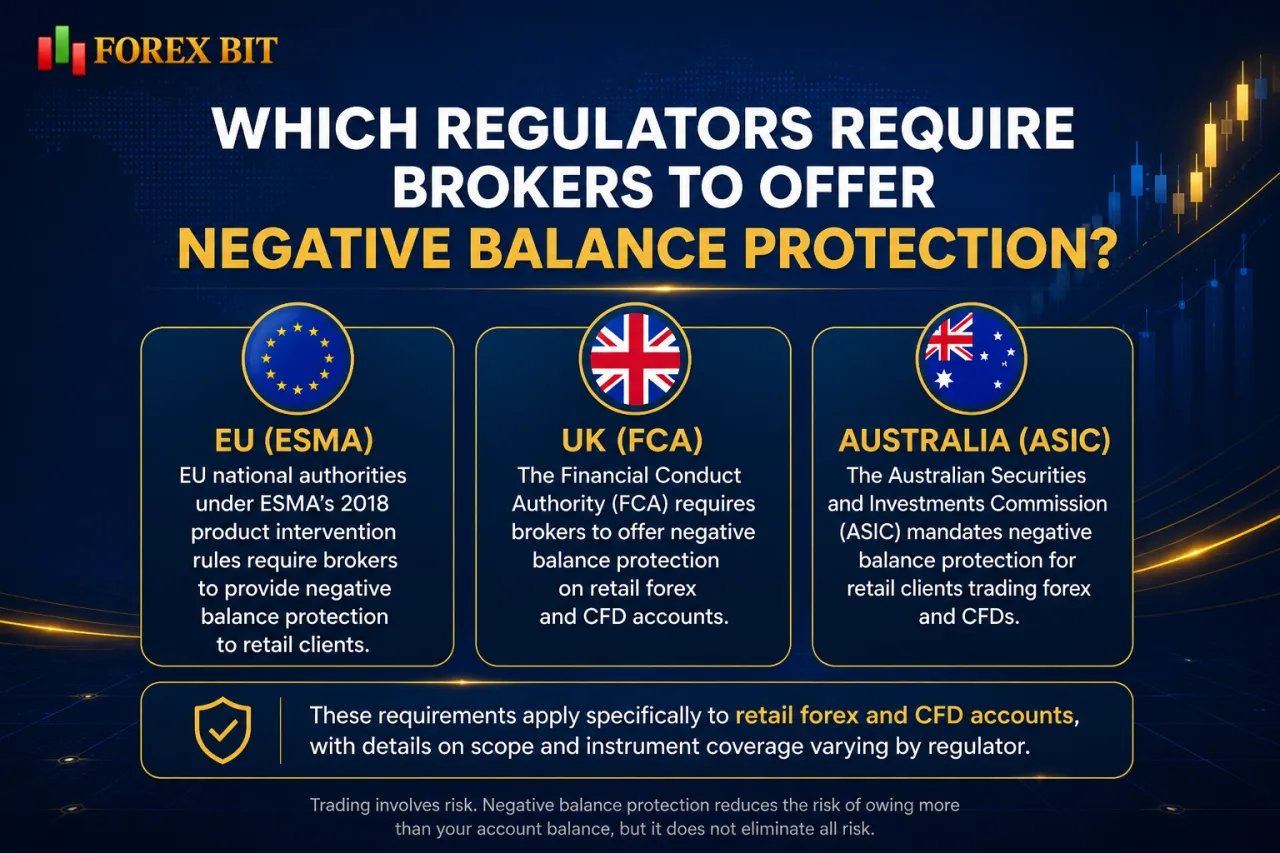
Several major regulators mandate negative balance protection for retail clients, including EU national authorities under ESMA’s 2018 product intervention rules, the UK’s FCA, and Australia’s ASIC. These requirements apply specifically to retail forex and CFD accounts, with details on scope and instrument coverage varying by regulator.
Do All Legal Entities of the Same Broker Offer the Same Negative Balance Protection?
No, negative balance protection does not carry over automatically across every legal entity of the same broker, since each entity registers under a separate regulator with its own client-money rules. A single brand often runs an EU-regulated entity, a UK FCA entity, and an offshore entity in parallel, and the account opening terms determine which entity actually holds a trader’s funds.
This entity structure explains why the same broker name can offer different protection depending on where the account sits.
- Entities regulated under ESMA-aligned rules or by the FCA and ASIC typically guarantee NBP for retail clients by regulatory mandate.
- Offshore entities operating under lighter-touch or unregulated licenses may offer NBP only as a discretionary policy, not a legal requirement.
- Marketing pages referencing “negative balance protection” for the brand overall may not specify which entity that guarantee legally binds.
Traders assess the specific legal entity named in the account agreement, terms and conditions, and client agreement document, rather than assuming brand-wide consistency. Checking the registered jurisdiction and license reference tied to that exact entity clarifies whether NBP applies as an enforceable regulatory obligation or as a broker-discretionary practice that can change without notice.
Regulated vs Unregulated Brokers: How Does Negative Balance Protection Guarantee Differ?
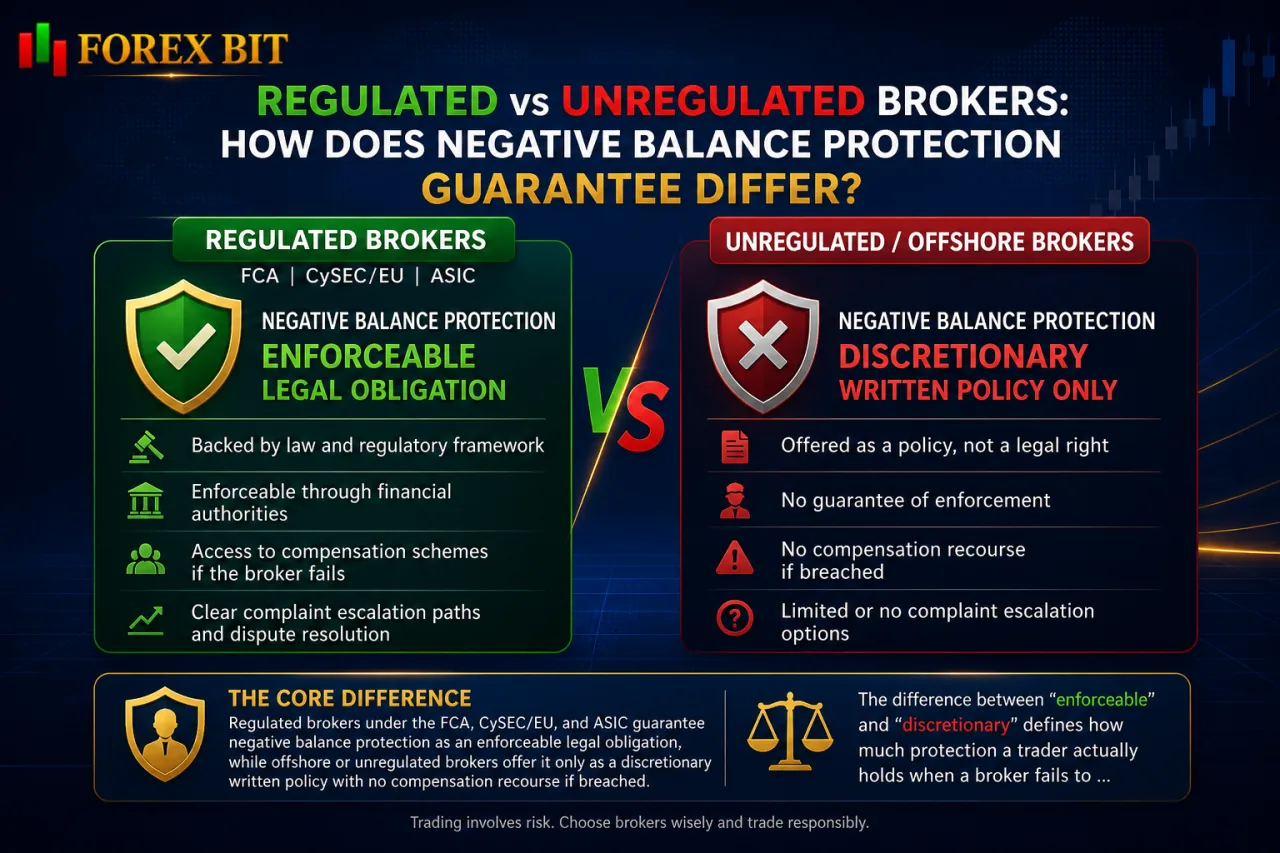
Regulated brokers under the FCA, CySEC/EU, and ASIC guarantee negative balance protection as an enforceable legal obligation, while offshore or unregulated brokers offer it only as a discretionary written policy with no compensation recourse if breached. This gap comes down to enforcement mechanisms and complaint escalation paths tied to each regulatory framework.
The difference between “enforceable” and “discretionary” defines how much protection a trader actually holds when a broker fails to honor its NBP claim.
- Regulated entities face binding conduct rules, so failing to reset a negative balance to zero exposes the broker to regulatory sanctions, fines, or license action.
- Regulated entities also grant traders formal complaint routes through the regulator or an ombudsman if NBP is not applied correctly.
- Offshore entities publish NBP as a marketing statement or terms-and-conditions clause, which the broker can amend or withdraw without regulatory pre-approval.
- Offshore entities leave traders with no external body to escalate a dispute to if the broker refuses to waive a negative balance.
A written NBP policy on a broker’s website carries no legal weight equivalent to a regulator-mandated rule, since the regulator, not the broker’s own terms, ultimately enforces the guarantee for regulated entities.
How Can Traders Verify If a Broker’s Negative Balance Protection Claim Is Legally Enforceable?
Traders verify enforceability by cross-checking three sources: the broker’s client agreement, its regulatory disclosure documents, and the regulator’s public register for that specific legal entity, rather than the marketing page alone. This process confirms whether an NBP claim carries legal weight or functions only as a discretionary statement.
Marketing pages describe NBP in general terms without naming the entity bound by it, so the terms and conditions document remains the first checkpoint, since it names the exact legal entity holding the trader’s account and the jurisdiction that entity operates under.
The regulator’s public register then confirms whether that named entity actually holds an active license under a framework that mandates NBP, such as the FCA, CySEC, or ASIC.
- Locating the entity name printed at the bottom of the account agreement or client terms document
- Searching that exact entity name, not the brand name, on the relevant regulator’s public register
- Confirming the license status shows as active rather than revoked, expired, or unauthorized
- Reading the risk disclosure section of the legal documents for explicit NBP wording tied to that entity
A mismatch between the entity named on the marketing page and the entity named in the signed account agreement signals that the advertised NBP guarantee may not legally apply to the account being opened.
What Are the Limitations and Exceptions of Negative Balance Protection?
Negative balance protection carries several notable exceptions: it typically excludes professional or elective professional clients, excludes certain account types depending on broker policy, and offers no guarantee if the broker itself becomes insolvent. These edge cases sit outside the retail-client scenarios covered so far and shift depending on client classification, account structure, and broker-specific reset timing.
Client classification marks the first exception. Traders reclassified as professional or elective professional clients under frameworks like ESMA-aligned rules generally lose the mandatory NBP guarantee, since regulators reserve this protection for retail clients specifically.
Account type introduces further variation:
- Institutional accounts often fall outside standard retail NBP terms.
- Islamic swap-free accounts carry different balance-reset conditions depending on broker policy.
- Certain specialized account tiers exclude NBP entirely per the broker’s own client agreement.
Broker insolvency represents the most severe gap, since NBP guarantees a zero balance floor but does not guarantee fund recovery if the broker collapses financially. Reset timing also differs, as some brokers apply NBP per individual position while others calculate it per overall account, changing the outcome in mixed open-position scenarios. Traders read the specific broker’s client agreement to confirm exact scope, since these exceptions rarely appear on marketing pages.
Does Negative Balance Protection Apply to Professional or Institutional Trading Accounts?
No, mandatory negative balance protection does not apply to professional or institutional trading accounts, since regulators reserve this guarantee specifically for retail clients. This distinction extends the client classification exclusion already noted, and it carries three practical consequences for traders considering a switch in account status.
- Professional clients who opt out of retail protections under ESMA-aligned or FCA frameworks lose the automatic NBP guarantee along with other retail safeguards.
- Institutional accounts sit outside retail-focused regulatory frameworks entirely, so brokers treat them under separate commercial terms rather than mandated consumer protections.
- Higher leverage limits offered to professional clients often come paired with this loss of NBP, creating a direct tradeoff between flexibility and downside coverage.
Traders holding or considering professional status confirm this tradeoff directly in their client agreement, since the reclassification removes a regulatory floor that retail terms guarantee by default.
What Happens to Negative Balance Protection If a Broker Becomes Insolvent?
No, negative balance protection does not guarantee fund recovery if a broker becomes insolvent, since NBP caps trading losses while insolvency risk affects the trader’s entire deposited balance. These sit as two separate risks: one governs how far a losing trade can run, the other governs whether the broker can return client money at all.
NBP functions as a broker policy or regulatory obligation tied to trade outcomes, distinct from investor compensation schemes that address broker failure itself.
- Recovering a zero or positive balance after insolvency depends on whether client funds sat in segregated accounts, not on the NBP guarantee.
- Compensation scheme coverage, where applicable, may reimburse a limited amount per client, subject to jurisdiction-specific caps and eligibility rules that vary by regulator.
- Enforcing an NBP claim against an insolvent broker follows local insolvency procedures, which vary by jurisdiction and entity type.
Traders research the specific compensation scheme and insolvency framework tied to their broker’s legal entity individually, since NBP alone offers no insolvency-related recourse.
Conclusion
Negative balance protection sets a hard floor at zero, so a retail trader’s losses stop at deposited capital rather than turning into owed debt after a gap or volatility spike closes positions late. This floor holds as a legal guarantee under regulators like the FCA, CySEC/EU, and ASIC, but only as a discretionary policy under offshore or unregulated entities, and it disappears entirely for professional or institutional accounts.
It also stops short of protecting against broker insolvency, a separate risk tied to fund segregation and compensation schemes. Confirming the exact legal entity, its regulatory status, and the client agreement wording remains the only reliable way to know whether an NBP claim actually holds legal weight.
Isabella Brown is the Forex Trading Guide Manager at Forex Bit, focusing on educational content about broker safety, trading costs, account types, platforms, and key Forex/CFD concepts. Her work helps readers understand trading terms, broker conditions, and practical checks before evaluating or using a brokerage service.
Email: [email protected]



Best Brokers

Trade with the world’s largest retail broker and benefit from better - than - market conditions.

We offer a superior trading environment that puts traders in the best position to profit.

Trade with the best trading conditions. WIN THE BEST TRADING ACCOUNT AWARD.

Trade global markets with Interactive Brokers – a highly regulated multi-asset broker built for active and professional investors.






Forex Bit provides independent forex broker reviews, comparisons, guides, and industry news to help traders make informed decisions.
Best Brokers
Metatrader 5 Brokers
Metatrader 4 Brokers
Lowest Spread Forex Broker
Regulated Forex Brokers
Forex Copy Trading
Ctrader Brokers
Best Forex Broker For Beginners