
Spot forex broker scam warning signs early—learn how to verify licenses, fund safety, and regulation before you trade. Read the full safety guide now.
Forex Broker Scam Warning Signs Every Trader Must Know

The most common warning signs of a forex broker scam include unrealistic profit guarantees, pressure to deposit more funds, withdrawal delays, and unverifiable regulatory claims. These red flags often appear before a trader loses access to their own capital, making early recognition critical.
A broker’s license and regulation status is verified by checking the official regulator’s public register against the exact legal entity name and license number listed in the broker’s terms. Mismatched entity names or unlisted numbers signal a fraudulent or unregulated setup.
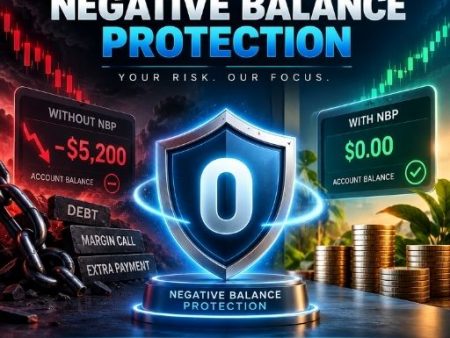
Client fund protection depends on segregated accounts that keep trader deposits separate from company operating funds, while negative balance protection is designed to stop an account balance from falling below zero. Both safeguards only apply when a broker operates under the specific regulated entity offering them, not automatically across all its global branches.
Regulators in the United Kingdom, Australia, and the European Union maintain strict oversight frameworks for forex brokers, including licensing requirements and enforcement powers intended to protect traders. Protection levels still vary by jurisdiction, so traders should not assume equal treatment across every regulated region.
Forex Bit breaks down these risks in detail, starting with the specific patterns that expose a scam broker before real money is at stake.
What Are the Most Common Warning Signs of a Forex Broker Scam?
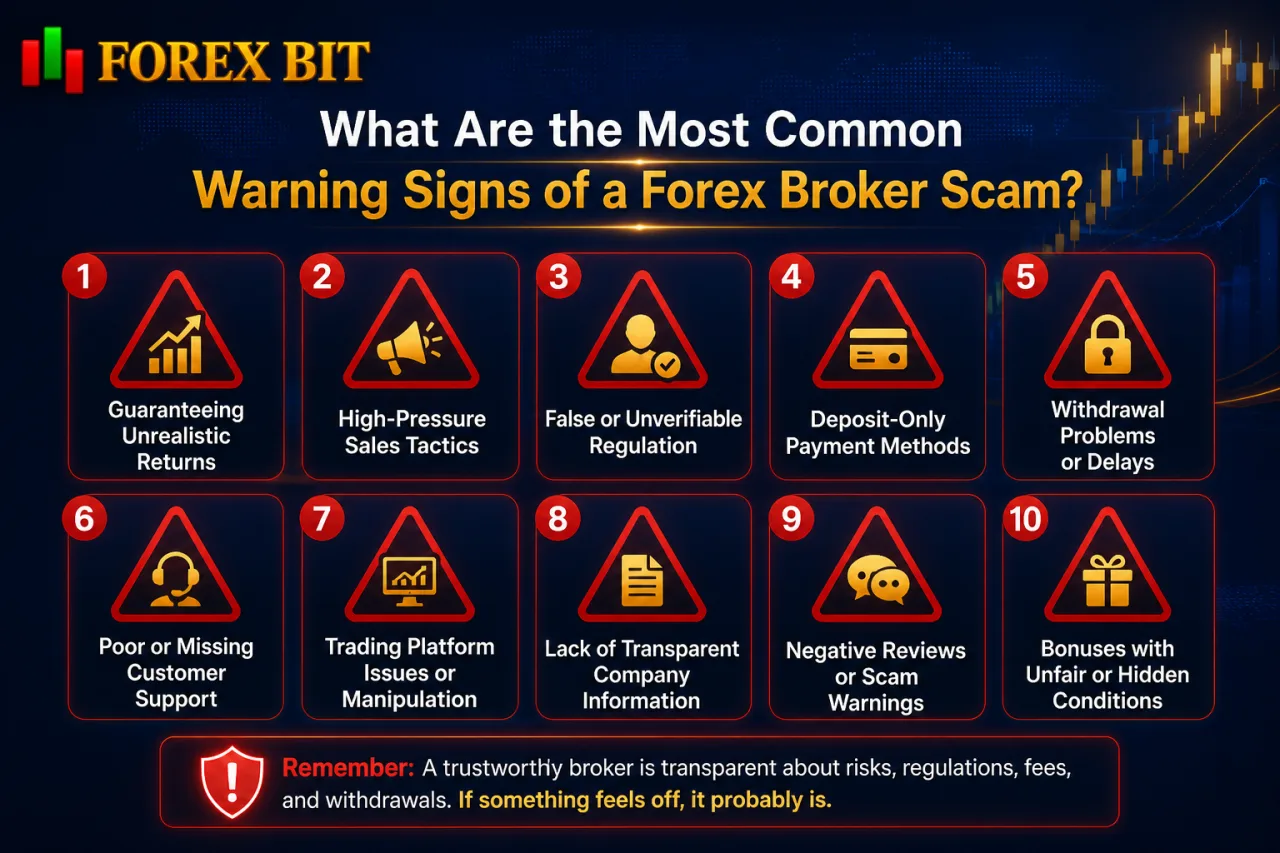
A forex broker scam typically shows itself through a cluster of ten recurring warning signs rather than one isolated mistake. These signs generally span how a broker markets itself, handles money, and responds once a trader tries to withdraw funds.
Reviewing them together builds a clearer risk picture than judging any single detail alone. The categories below cover the most consistently reported red flags across trading communities and regulatory warnings.
- Guaranteeing unrealistic or fixed profit returns regardless of market conditions
- Pushing traders to deposit more funds quickly, often through urgency or bonus offers
- Contacting traders through unsolicited calls, emails, or messages promoting trading opportunities
- Refusing or repeatedly delaying withdrawal requests without clear explanation
- Operating under an unclear, unnamed, or frequently changed legal entity
- Displaying license numbers or regulator names that cannot be matched on official registers
- Omitting any mention of segregated client accounts in legal documents
- Excluding negative balance protection from the account terms
- Showing a pattern of poor, deleted, or clearly fabricated customer reviews
- Recruiting clients aggressively through social media groups or messaging apps like Telegram and WhatsApp
Each sign alone does not confirm fraud, but overlapping signs strengthen the case for treating a broker with caution.
Why Do Withdrawal Problems Signal a Scam Broker?
Withdrawal problems signal a scam broker because they directly block a trader’s access to their own money, which is the core function a broker must guarantee. Delayed transfers, denied requests, and sudden new conditions attached to a payout expose a broker’s true intentions once profit no longer favors keeping the client engaged.
This pattern generally develops in stages rather than all at once:
- Postponing a withdrawal repeatedly with vague explanations about processing or verification
- Denying a withdrawal outright by citing unclear terms not previously disclosed
- Charging hidden fees only revealed at the moment of payout
- Demanding an additional deposit before releasing existing funds
- Requiring extra document submissions beyond standard identity checks used at account opening
A legitimately regulated broker generally processes withdrawals under fixed timeframes disclosed in its client agreement, and any deviation from those stated terms without explanation raises a valid concern. Traders who face escalating conditions after requesting a payout are experiencing one of the clearest indicators that separates a legitimate operational delay from an intentional scam pattern.
Why Are Guaranteed Profit Promises a Red Flag?
Yes, guaranteed profit promises are a red flag because forex trading carries inherent market risk that no broker or signal provider can eliminate through a fixed or assured return. This concern connects directly to the withdrawal issues above, since promised returns are often the bait used to keep a trader depositing funds before payout problems appear.
Genuine trading outcomes fluctuate with currency price movements, so any claim of a fixed percentage return misrepresents how the market actually works. This misrepresentation typically shows up through a few consistent patterns:
- Promising a fixed monthly or weekly return regardless of market direction
- Claiming a “guaranteed” or “risk-free” trading signal or strategy
- Presenting past results as a certain indicator of future performance
- Avoiding any mention of potential losses in marketing materials
A licensed broker’s official risk disclosure generally states that losses are possible and that past performance does not predict future results. Any entity that omits standard risk disclosure language while promising fixed returns is operating outside how regulated forex trading is legitimately marketed.
How Does Aggressive or Unsolicited Marketing Indicate Fraud?
Yes, aggressive or unsolicited marketing indicates fraud because legitimate regulated brokers generally rely on licensed channels rather than cold outreach to acquire clients. This tactic connects directly to the recruitment pattern noted earlier, where unregulated entities push contact through social platforms instead of transparent advertising.
Unsolicited contact typically appears through a consistent set of channels and tactics:
- Calling traders directly without any prior account inquiry or registration
- Messaging traders through Instagram, Telegram, or WhatsApp with unsolicited trading offers
- Posing as an experienced “trading guru” showcasing screenshots of profits to attract followers
- Pressuring a quick deposit decision by citing a limited-time bonus or closing opportunity window
- Steering conversations toward a specific unregulated platform instead of an established broker
A regulated broker generally acquires clients through its own website, verified advertising, or referral programs disclosed in its terms, not through direct messages from anonymous accounts. Traders receiving unsolicited investment pitches from strangers online face a pattern consistently linked to unregulated or fraudulent operations rather than standard industry practice.
How Can You Verify If a Broker’s License and Regulation Status Are Genuine?
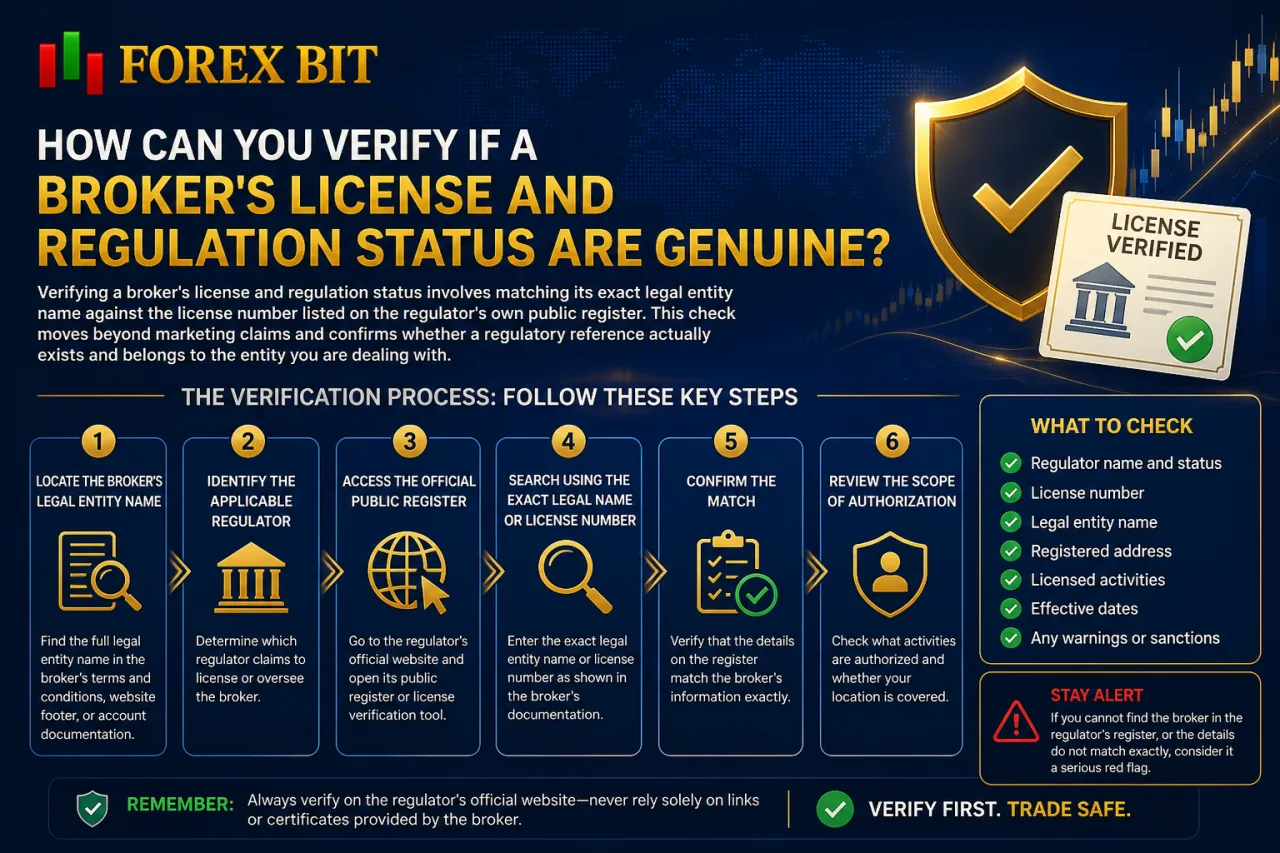
Verifying a broker’s license and regulation status involves matching its exact legal entity name against the license number listed on the regulator’s own public register. This check moves beyond marketing claims seen in the warning signs above and confirms whether a regulatory reference actually exists and belongs to the entity a trader is dealing with.
The process generally follows a consistent sequence across jurisdictions:
- Locating the broker’s full legal entity name in its terms and conditions or footer disclosures
- Searching that entity name directly on the relevant regulator’s register, such as the FCA Register, CySEC register, ASIC Connect, or the FSCA FSP register
- Comparing the registered company name, address, and license number against what appears on the broker’s website and account-opening documents
- Checking for any clone firm alert or warning notice the regulator has published against similarly named entities
A genuine license listing shows an exact name and number match with no discrepancy in registered address or license category. Regulators periodically publish clone firm warnings when fraudulent operators copy a real license number or entity name to appear legitimate, so a match found through a search engine rather than the regulator’s own database does not confirm authenticity. Traders relying on a link sent by the broker instead of navigating to the register independently risk viewing a fabricated confirmation page rather than the regulator’s actual record.
What Is the Difference Between a Genuine License Number and a Fake or Cloned One?
A genuine license number matches the exact legal entity name, registered address, and license category listed on the regulator’s own public register, while a fake or cloned one copies real credentials from an authorized firm to disguise an unrelated or unregulated operator. This distinction extends the register-matching check described earlier into a specific fraud pattern regulators actively track and publish warnings about.
Cloning generally works through a consistent method rather than random guessing:
- Copying a license number belonging to a genuinely authorized firm and displaying it on an unrelated website
- Using a name nearly identical to a licensed entity, changing only a minor detail such as a suffix or spelling
- Listing a registered address that matches the authorized firm on paper but has no connection to the entity actually contacting the trader
- Directing traders to a lookalike domain that mimics the real broker’s branding and layout
Regulators including the FCA, CySEC, and ASIC generally maintain warning lists that flag clone firms and unauthorized firms once such patterns are identified. Checking a broker’s name against these warning lists, not only the main register, distinguishes a genuine license from a cloned one that reused real regulatory details without authorization.
Which Legal Entity of a Broker Are You Actually Trading With?
The legal entity holding a trader’s account is the specific licensed company named in the account-opening agreement, not the parent brand name displayed across the broker’s marketing. A single global brand often registers separate entities in different jurisdictions, and each entity carries its own license, its own regulator, and its own set of investor protections.
This distinction matters directly because the license verification process described earlier only confirms one entity at a time, not an entire global brand.
- Reviewing the account-opening agreement or terms of business for the exact company name assigned to the trading account
- Identifying the jurisdiction stated next to that entity, since offshore entities under the same brand typically carry lighter oversight than an FCA or ASIC-regulated counterpart
- Confirming that the entity named in the agreement matches the one listed on the regulator’s public register, following the same lookup method used for license verification
- Checking whether client fund segregation and negative balance protection are stated for that specific entity, since these terms do not automatically extend across a brand’s other regional entities
A trader who opens an account expecting FCA-level protection while actually being onboarded under an offshore entity of the same brand receives the protection level tied to that offshore entity, not the regulator implied by the brand’s general reputation. Reading the client agreement’s governing entity clause remains the only reliable way to confirm this.
How Do Client Fund Protection and Negative Balance Protection Actually Work?
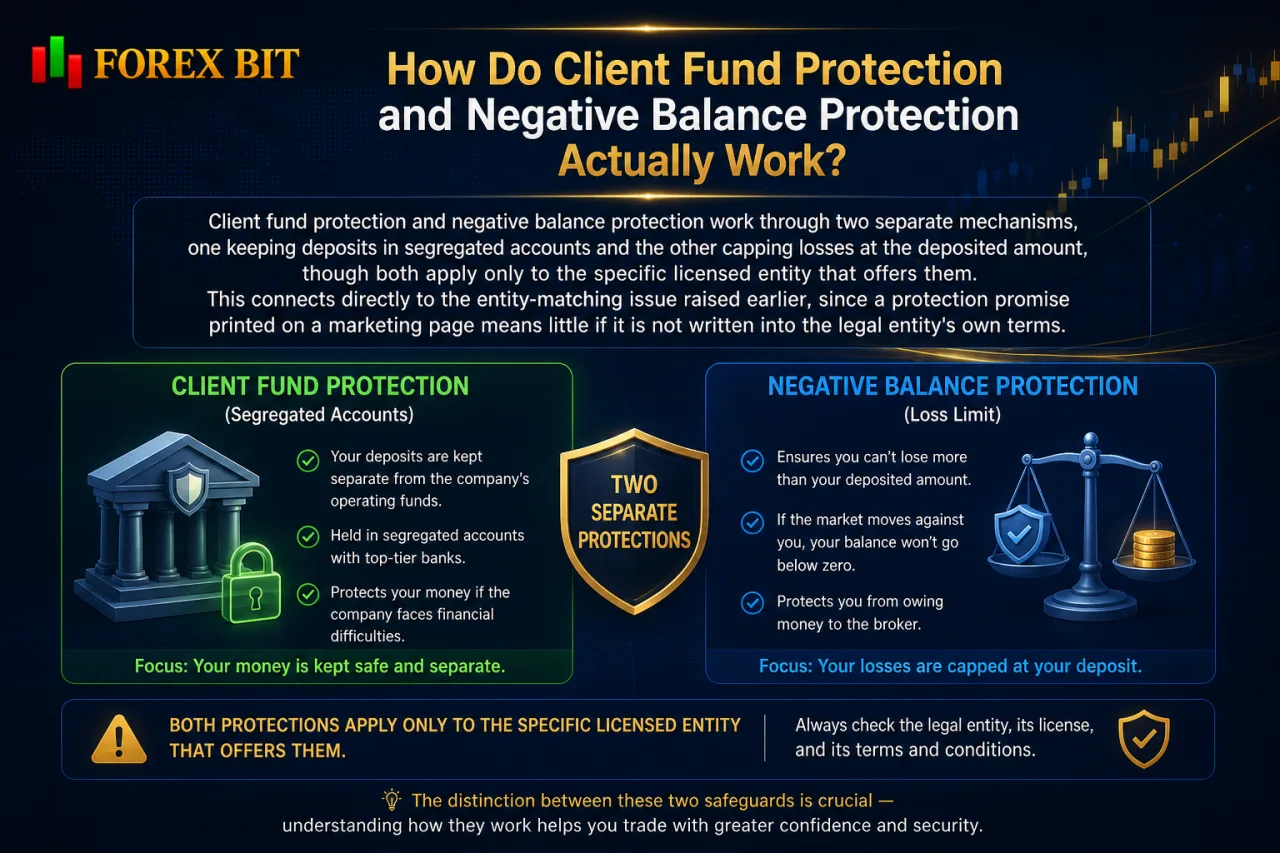
Client fund protection and negative balance protection work through two separate mechanisms, one keeping deposits in segregated accounts and the other capping losses at the deposited amount, though both apply only to the specific licensed entity that offers them. This connects directly to the entity-matching issue raised earlier, since a protection promise printed on a marketing page means little if it is not written into the legal entity’s own terms.
The distinction between these two safeguards, and where each one stops applying, becomes clearer once broken down by mechanism.
What Is a Segregated Account and Why Does It Matter?
A segregated account is a bank account structure that keeps client deposits legally separate from a broker’s own operating capital, so the funds cannot be used to cover the company’s business expenses. This mechanism reduces the risk of fund misuse rather than eliminating it, which extends the entity-specific protection issue raised earlier.
The mechanism works through a straightforward separation of custody:
- Holding client deposits in a designated bank account distinct from the broker’s corporate accounts
- Preventing the broker from using client money to pay salaries, marketing, or operational costs
- Restricting access to segregated funds for trading-related settlement purposes tied to the client’s own positions
- Requiring regular reconciliation between client balances and the segregated account total under most regulatory frameworks
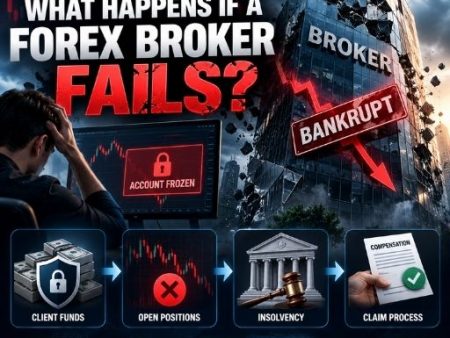
Segregation alone does not guarantee compensation if a broker becomes insolvent, since recovering funds still depends on how cleanly the broker separated accounts in practice and whether a compensation scheme covers that specific entity. A broker that mislabels or partially commingles funds despite claiming segregation leaves traders exposed during liquidation. Confirming segregation applies specifically to the licensed entity named in the account agreement remains the only way to treat this safeguard as meaningful.
Do All Regulated Brokers Offer Negative Balance Protection?
No, not all regulated brokers offer negative balance protection, since the requirement depends on the specific jurisdiction and client classification tied to the trading entity. This directly extends the entity-specific protection issue raised earlier, since a safeguard mandated in one region does not automatically transfer to a broker’s other licensed branches.
The mandate splits along three consistent lines:
- Mandating negative balance protection for retail clients under ESMA-aligned rules across the European Union
- Requiring the same protection for retail clients under FCA rules in the United Kingdom
- Leaving negative balance protection optional or unregulated for offshore entities operating outside these frameworks
- Excluding professional-client accounts from mandatory protection even within the EU or UK, since the classification carries fewer regulatory safeguards in exchange for fewer trading restrictions
A trader reclassified as a professional client under an EU or UK entity generally loses the automatic negative balance guarantee that applies to retail accounts. Offshore entities of the same global brand generally decide whether to offer this protection voluntarily, so the terms of business for that exact entity remain the only reliable confirmation rather than the brand’s general marketing claims.
Which Countries and Regulators Offer the Strongest Investor Protection?
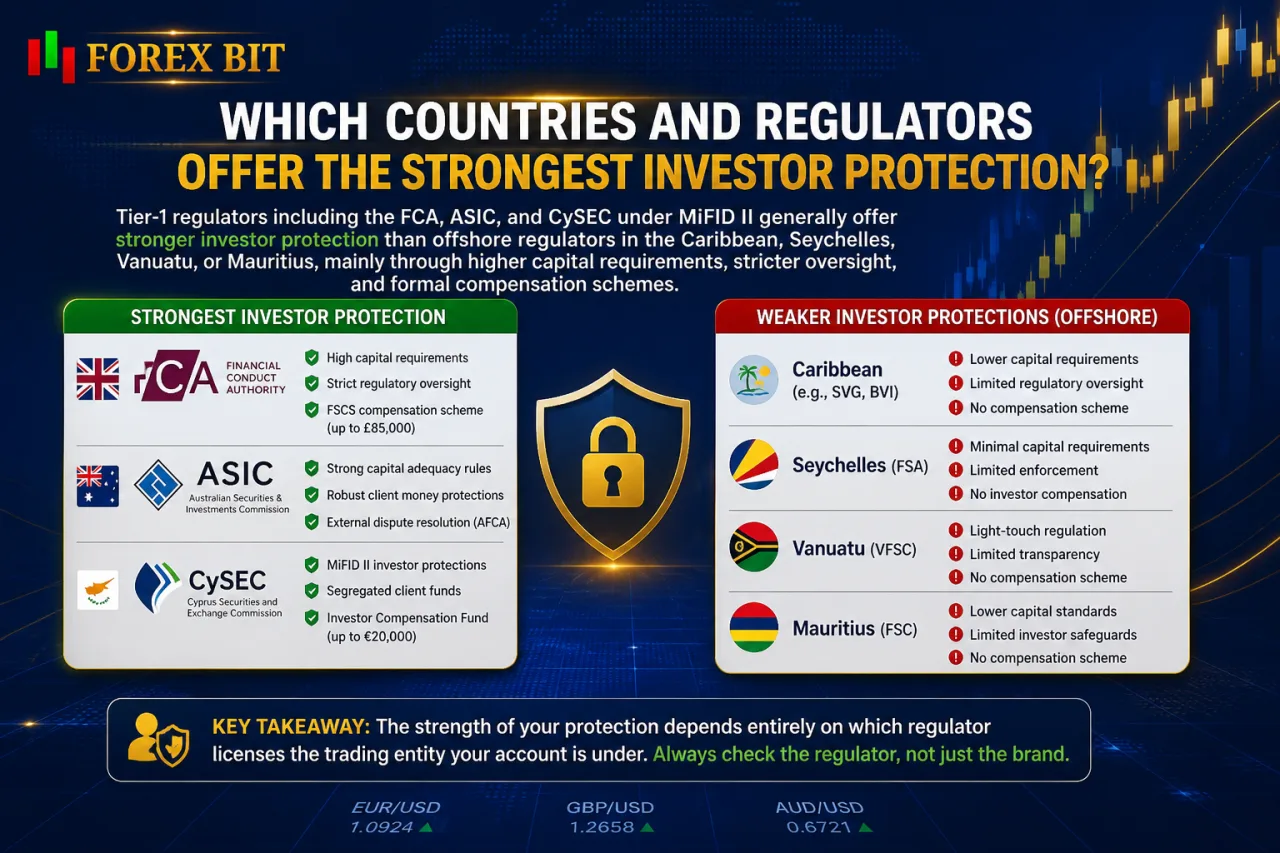
Tier-1 regulators including the FCA, ASIC, and CySEC under MiFID II generally offer stronger investor protection than offshore regulators in the Caribbean, Seychelles, Vanuatu, or Mauritius, mainly through higher capital requirements, stricter oversight, and formal compensation schemes. This gap connects directly to the entity-specific protections discussed earlier, since the strength of a safeguard depends entirely on which regulator actually licenses the trading entity a client account sits under. The comparison generally breaks down across capital adequacy rules, day-to-day supervisory enforcement, and whether a compensation scheme exists at all for client losses in insolvency. Offshore jurisdictions typically impose lighter capital thresholds and conduct less frequent audits, which reduces the financial buffer available if a broker fails. The sections below compare these tiers directly against specific compensation mechanisms and explain why offshore licenses generally leave traders with limited recourse.
What Are Compensation Schemes and Do They Cover Forex Trading Losses?
Compensation schemes are government-backed or industry-funded protection funds that reimburse eligible clients up to a capped amount if a regulated broker becomes insolvent or commits fraud, not a safeguard against normal trading losses. This distinction extends directly from the tiered regulatory comparison raised earlier, since a compensation scheme only exists where the specific licensed entity holding a trader’s account falls under a regulator that funds one.
Coverage generally follows a consistent boundary across the regulators that offer it:
- Reimbursing client funds left unpaid when a regulated broker enters insolvency or default
- Covering losses caused by broker fraud or misappropriation of segregated client money
- Excluding losses resulting from normal market movement, poor trading decisions, or leveraged positions moving against the client
- Capping payouts at a fixed monetary limit set by each individual scheme, such as the UK’s Financial Services Compensation Scheme or Cyprus’s Investor Compensation Fund, with exact limits varying by scheme and subject to periodic revision
- Applying eligibility rules that vary by client classification and residency under each scheme’s own regulator
Offshore-licensed entities in jurisdictions such as the Caribbean, Seychelles, or Vanuatu generally offer no formal compensation scheme at all, leaving traders without a fallback if that entity fails. Confirming whether a compensation scheme applies to the exact entity named in the account agreement remains the only reliable way to assess this protection, since the scheme tied to a broker’s UK or EU entity does not extend to its offshore counterpart under the same brand.
Which Restricted or High-Risk Countries Do Regulated Brokers Avoid?
Regulated brokers generally exclude residents of jurisdictions where they hold no license, most commonly retail clients in the United States and individuals in countries under active financial sanctions. This exclusion connects directly to the entity-specific licensing issue raised earlier, since a broker’s authorization only covers the exact scope its regulator grants, not every market where its brand happens to be visible.
The restriction pattern generally follows a consistent logic across most regulated brokers:
- Blocking US retail clients for most non-US brokers, since offering leveraged forex products there requires registration with US regulators such as the CFTC and NFA
- Excluding individuals residing in countries subject to international financial sanctions
- Restricting onboarding in jurisdictions where the broker holds no local license or regulatory permission
- Limiting access for residents of countries flagged by regulators for weak anti-money-laundering enforcement
A trader who bypasses these restrictions by opening an account outside a broker’s licensed jurisdiction receives no legal protection from that broker’s regulator, since the license simply does not extend to unauthorized markets. Any dispute in that scenario falls outside the regulator’s enforcement reach entirely.
What Should You Do If You Suspect or Have Been a Victim of a Forex Broker Scam?
A trader who suspects or has fallen victim to a forex broker scam stops depositing funds immediately, then moves through evidence collection, regulator and law enforcement reporting, and bank dispute steps before considering any recovery service. This sequence connects directly to the withdrawal and fund-protection issues discussed earlier, since each step addresses a different point of loss once a broker stops honoring its own terms. The subsections below break this response into its distinct action stages.
How Do You Report a Suspected Scam Broker to a Regulator?
Reporting a suspected scam broker to a regulator involves filing a complaint through that regulator’s dedicated online portal using the exact entity name and license number identified during verification. This step follows directly from the license-matching process covered earlier, since the regulator needs the precise legal entity name to locate the correct record.
Most tier-1 regulators maintain a specific channel for this purpose rather than a general contact form:
- Submitting a report through the FCA’s dedicated scam and unauthorized firm reporting page in the United Kingdom
- Filing a complaint via ASIC’s online reporting form for misconduct in Australia
- Using CySEC’s investor complaint procedure for entities licensed in Cyprus
- Checking each regulator’s public warning list, which flags unauthorized and clone firms already identified
Traders also contribute to these warning lists by submitting details of an unlicensed or suspicious entity even before losing funds. Filing early adds the entity to a public record that helps other traders avoid the same broker.
Are Forex Recovery or ‘Chargeback’ Services Trustworthy?
No, forex recovery or “chargeback” services are generally not trustworthy, since many of these agencies target scam victims a second time rather than genuinely retrieving lost funds. This pattern extends directly from the withdrawal and reporting issues covered earlier, where a trader already stripped of capital becomes a repeat target once their contact details circulate among fraud networks.
These agencies typically follow a recognizable pattern:
- Contacting victims shortly after a scam complaint appears on a public forum or regulator warning list
- Demanding an upfront “recovery fee” before performing any verified action
- Claiming insider access to a regulator or legal process that does not require such a fee
- Disappearing after payment without producing any documented recovery outcome
Verifying legitimacy through official banking or legal channels, such as a bank’s chargeback department or a licensed law firm, remains the only reliable path, since these routes do not require prepayment to “unlock” a refund.
Conclusion
Spotting a scam broker comes down to reading patterns rather than isolated incidents: guaranteed returns, unsolicited pitches, withdrawal delays, and unverifiable licensing details all point toward the same underlying risk. Matching the exact legal entity name against a regulator’s public register, confirming segregated accounts and negative balance protection apply to that specific entity, and checking whether a compensation scheme actually backs it turns a marketing claim into a verified fact.
Tier-1 jurisdictions like the UK, Australia, and the EU provide stronger recourse than offshore setups, but none of it applies automatically across a brand’s global entities. Verifying these details before depositing funds remains the most reliable defense against a forex broker scam.
Isabella Brown is the Forex Trading Guide Manager at Forex Bit, focusing on educational content about broker safety, trading costs, account types, platforms, and key Forex/CFD concepts. Her work helps readers understand trading terms, broker conditions, and practical checks before evaluating or using a brokerage service.
Email: [email protected]

Best Brokers

Trade with the world’s largest retail broker and benefit from better - than - market conditions.

We offer a superior trading environment that puts traders in the best position to profit.

Trade with the best trading conditions. WIN THE BEST TRADING ACCOUNT AWARD.

Trade global markets with Interactive Brokers – a highly regulated multi-asset broker built for active and professional investors.






Forex Bit provides independent forex broker reviews, comparisons, guides, and industry news to help traders make informed decisions.
Best Brokers
Metatrader 5 Brokers
Metatrader 4 Brokers
Lowest Spread Forex Broker
Regulated Forex Brokers
Forex Copy Trading
Ctrader Brokers
Best Forex Broker For Beginners