









IC Markets, Pepperstone, and RoboForex rank among the lowest spread forex brokers in 2026Broker rankings in this comparison are based on raw account pricing and total cost after commission. These brokers combine tight raw spreads with transparent commission structures rather than relying on marketing-only pricing claims.
Real EUR/USD spreads on raw accounts tend to be very tight, while standard accounts typically run higher once markups are included. Comparing live spread data, not advertised minimums, reveals which brokers actually deliver lower trading costs.
Raw or ECN accounts generally offer lower total trading costs than standard accounts once the fixed commission per lot is added to the spread. Standard accounts avoid commission fees but embed a wider spread markup, which can raise overall costs for active traders.
Regulation and minimum deposit requirements affect which low-spread accounts are realistically accessible to traders. Checking licensing from authorities such as ASIC or CySEC alongside deposit thresholds prevents traders from choosing a broker based on cost alone.
Forex Bit compares these factors directly to show which forex brokers offer the lowest spreads in 2026, starting with a full breakdown of pricing across major providers.
Which Forex Brokers Offer the Lowest Spreads in 2026?

Five brokers stand out as the lowest spread forex brokers in 2026: IC Markets, Pepperstone, RoboForex, FP Markets, and Tickmill, based on a general review of raw spread and commission structures across their ECN or raw pricing accounts. Each broker qualifies for different reasons tied to actual cost, not marketing minimums. The figures discussed below are approximate, drawn from publicly available broker information at the time of writing, and are not pulled from a single verified dataset with a fixed audit date.
IC Markets and Pepperstone lead on raw account pricing, pairing tight typical EUR/USD spreads with a fixed commission per lot that keeps total cost transparent. IC Markets Raw and Pepperstone Razor accounts are generally known for offering some of the tightest average EUR/USD spreads in the industry, typically combined with a separate commission per lot.
RoboForex and Tickmill compete through low commission-per-lot rates combined with tight raw spreads. FP Markets offers comparable ECN pricing with broader instrument coverage. Minimum deposit requirements differ across these five brokers, which affects account accessibility rather than pricing itself.
The table below summarizes approximate, commonly cited figures for each broker’s raw or ECN-style account. These numbers are general estimates rather than fixed values, and traders should confirm current spreads, commissions, and minimum deposits directly on each broker’s official pricing page before opening an account.
| Broker | Account | Typical EUR/USD Spread (approx.) | Commission | Minimum Deposit (approx.) |
|---|---|---|---|---|
| IC Markets | Raw | Around 0.1 pips on average | Yes, per lot | Around $200 |
| Pepperstone | Razor | Around 0.1 pips on average | Yes, per lot | Around $0 |
| RoboForex | ECN | Around 0.2 pips on average | Yes, per lot | Around $10 |
| FP Markets | Raw | Around 0.1 pips on average | Yes, per lot | Around $100 |
| Tickmill | Pro | Around 0.2 pips on average | Yes, per lot | Around $100 |
The figures above reflect general, commonly reported average spreads rather than the absolute lowest values quoted in marketing materials or figures verified against a specific official source. Actual spreads and deposit terms fluctuate with market conditions and change over time, so checking each broker’s official fee schedule remains the only reliable way to confirm current terms.
These five brokers set the pricing benchmark examined throughout the remaining cost and account comparisons in this article.
How Do Real EUR/USD and Raw Spreads Compare Across Brokers?
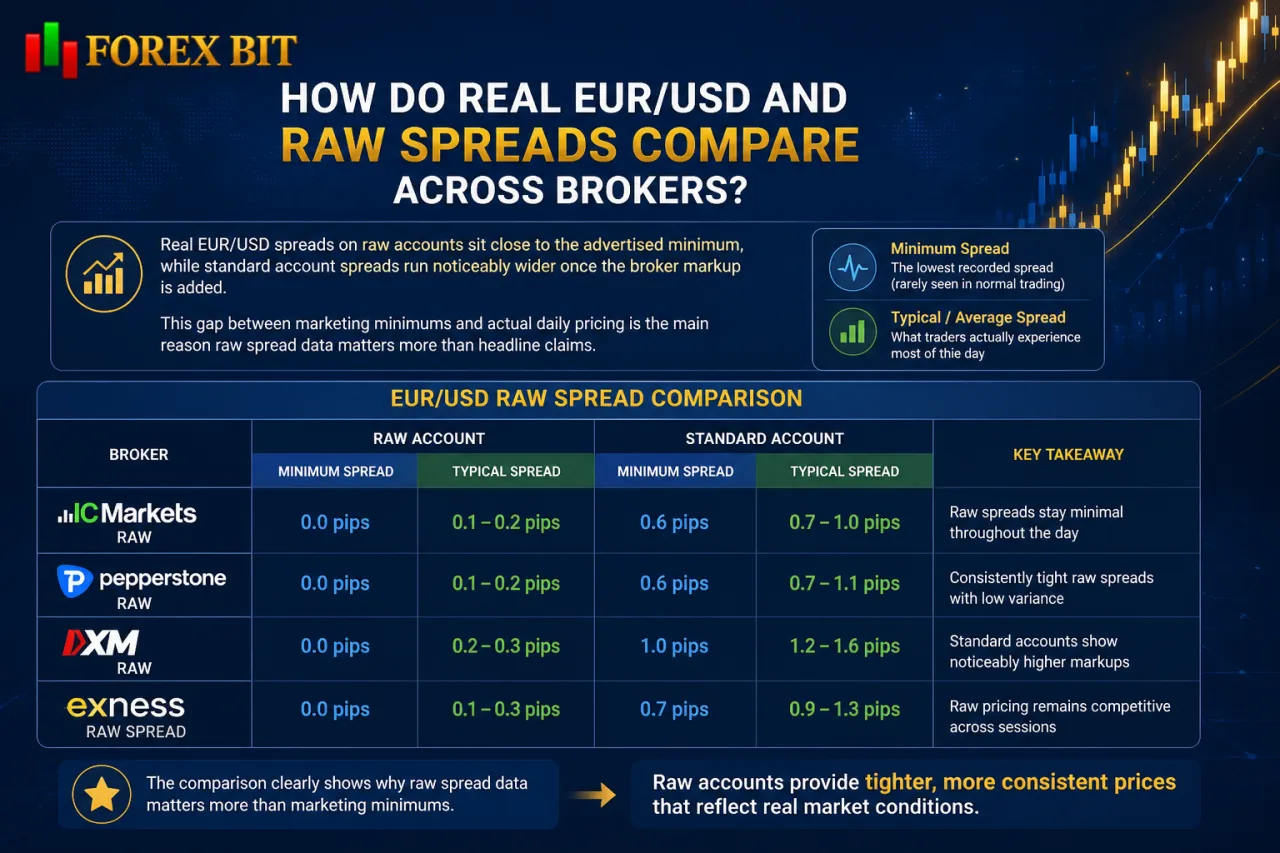
Real EUR/USD spreads on raw accounts sit close to the advertised minimum, while standard account spreads run noticeably wider once the broker markup is added. This gap between marketing minimums and actual daily pricing is the main reason raw spread data matters more than headline claims.
The comparison below separates minimum spread from typical or average spread, since a broker’s lowest recorded tick differs from what traders experience across a normal session.
- IC Markets Raw and Pepperstone Razor: average EUR/USD spreads consistently sit in the low single-digit pip fraction range on official fee pages, with occasional prints at or near zero during peak liquidity.
- RoboForex ECN and Tickmill Pro: average EUR/USD spreads run slightly wider than those seen on IC Markets and Pepperstone.
- FP Markets Raw: typical EUR/USD spread tracks closely with IC Markets and Pepperstone, though minor differences appear depending on the liquidity window measured.
Traders comparing these figures side by side get a clearer view of real cost than relying on “from 0.0 pips” claims alone.
What Do ‘Spreads From 0.0 Pips’ Claims Actually Mean?
“Spreads from 0.0 pips” refers to the lowest recorded tick a broker has ever posted on a given pair, not the spread a trader experiences during a normal session. This distinction matters directly for identifying lowest spread forex brokers, since headline minimums rarely reflect typical trading cost.
Verifying real average spreads requires checking a broker’s trading statistics or historical spread page rather than the marketing figure on its homepage. IC Markets, Pepperstone, and RoboForex all publish live or historical average spread data for major pairs, which shows the typical cost traders actually pay across a session rather than a single best-case tick.
Comparing this published average against the advertised “from” figure reveals how often the minimum spread actually occurs. A wide gap between the two numbers indicates the “from 0.0” claim represents a rare occurrence rather than a realistic daily average, so relying on broker trading statistics pages gives a more accurate cost picture than advertised minimums alone.
Raw/ECN Account vs Standard Account: Which Offers Lower Total Trading Cost?
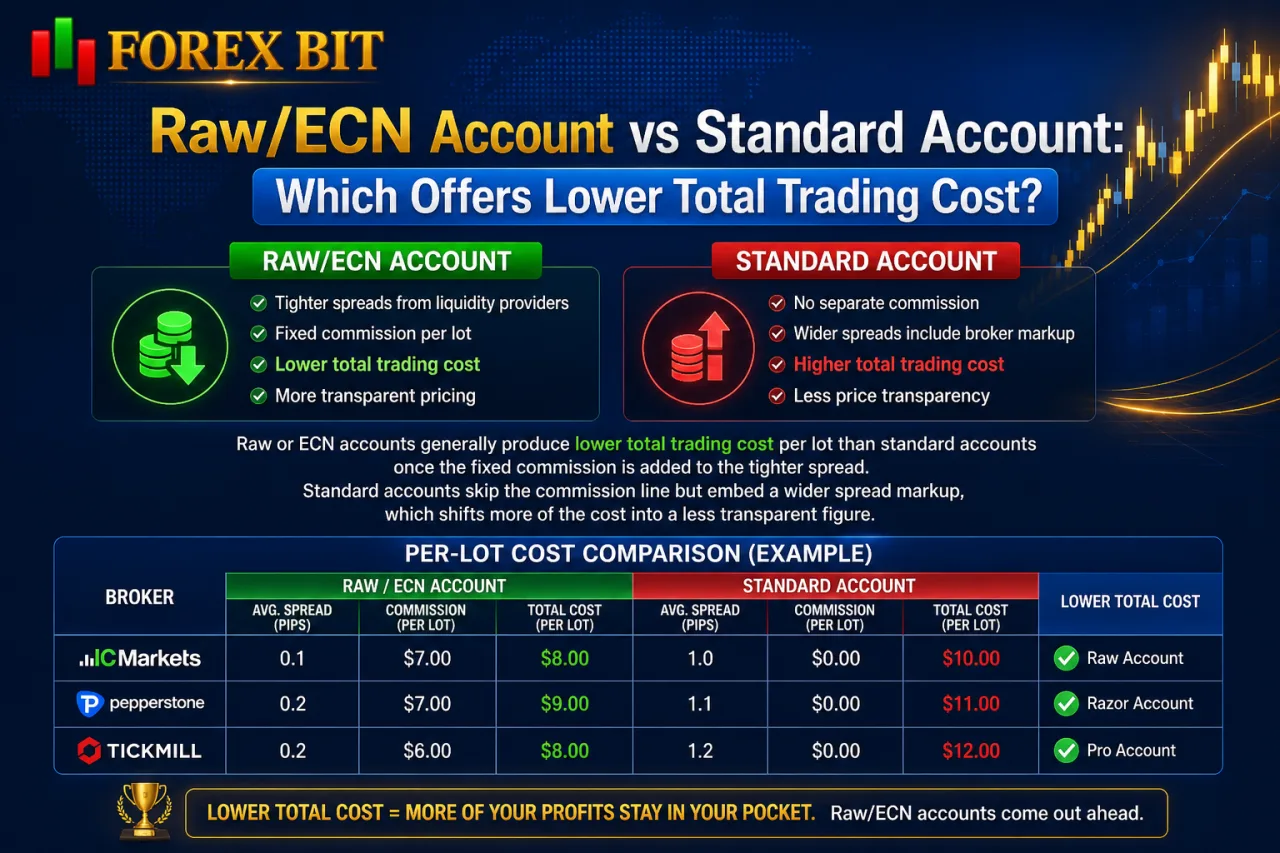
Raw or ECN accounts generally produce lower total trading cost per lot than standard accounts once the fixed commission is added to the tighter spread. Standard accounts skip the commission line but embed a wider spread markup, which shifts more of the cost into a less transparent figure. The comparison below breaks down how IC Markets Raw, Pepperstone Razor, and Tickmill Pro stack up against their standard equivalents on a per-lot basis.
How Is Total Trading Cost Calculated (Spread + Commission Per Lot)?
Total trading cost per lot equals the spread cost in dollars plus the fixed commission charged per lot round turn. Converting the quoted spread into a dollar figure and adding the commission produces the true cost of a trade, rather than looking at the spread or commission in isolation.
For a standard lot on EUR/USD, each pip is worth approximately $10. A 0.1 pip average spread on IC Markets Raw or Pepperstone Razor converts to roughly $1.00 in spread cost. IC Markets and Pepperstone both charge a commission per lot per side on their raw-pricing accounts, which adds to the spread cost on a round-turn basis.
Applying the formula to real examples shows how the total cost builds up:
- IC Markets Raw / Pepperstone Razor: a 0.1 pip spread (about $1.00) plus the round-turn commission published on each broker’s official fee page produces the total cost per standard lot. Traders checking current pricing find the exact commission figure listed there, as rates are subject to change.
- RoboForex ECN / Tickmill Pro: the same spread-plus-commission calculation applies, though the published commission-per-lot figures differ from IC Markets and Pepperstone.
RoboForex and Tickmill list separate commission rates per lot on their official fee pages, which traders add to the live spread to reach the comparable total cost figure.
Applying this spread-plus-commission formula consistently across brokers gives an accurate, comparable total cost per trade instead of relying on spread or commission figures separately.
Does Regulation and Minimum Deposit Matter When Choosing a Low-Spread Broker?
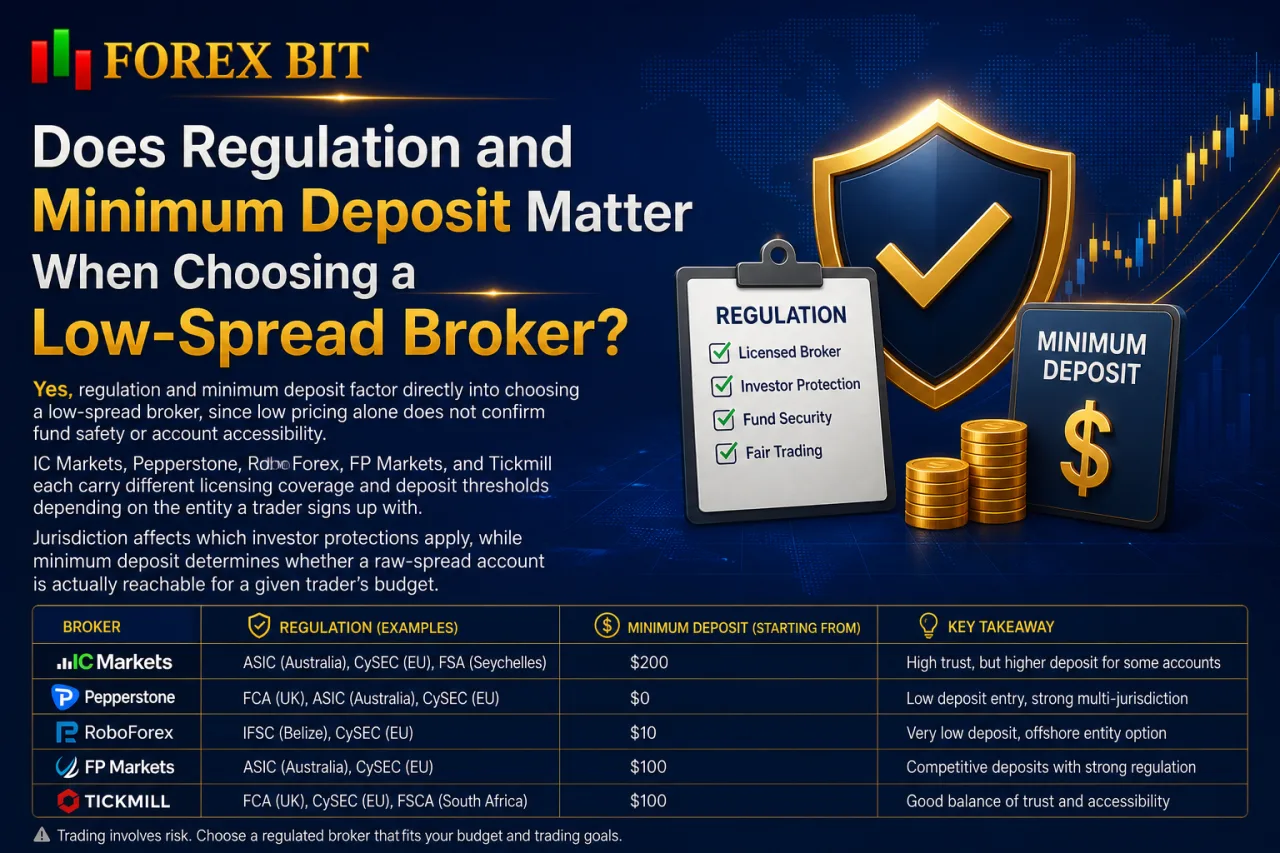
Yes, regulation and minimum deposit factor directly into choosing a low-spread broker, since low pricing alone does not confirm fund safety or account accessibility. IC Markets, Pepperstone, RoboForex, FP Markets, and Tickmill each carry different licensing coverage and deposit thresholds depending on the entity a trader signs up with. Traders prioritizing fund safety choose entities carrying FCA, ASIC, or CySEC coverage over offshore-only registrations. Jurisdiction affects which investor protections apply, while minimum deposit determines whether a raw-spread account is actually reachable for a given trader’s budget.
Which Regulated Brokers Combine Low Spreads With Strong Investor Protection?
Pepperstone and IC Markets combine the lowest spreads with the strongest investor protection, since both operate under multiple top-tier regulators alongside their raw-pricing accounts. Regulation tied to a low-spread account matters because the entity a trader signs up with determines which protections actually apply, not just the pricing displayed.
Pepperstone operates under regulatory licensing from multiple top-tier authorities across its main entities, which places its Razor account within a regulated framework.
IC Markets operates under regulatory licensing from multiple authorities across its main entities, which places its Raw account within a regulated framework.
FP Markets and Tickmill also carry ASIC or FCA-equivalent coverage on select entities, though minimum deposit thresholds shift depending on which regulated entity a trader registers under.
RoboForex’s entities include offshore-regulated structures, and this offshore coverage generally carries a lower level of investor protection compared to top-tier oversight from regulators like the FCA or ASIC.
Traders prioritizing fund safety alongside low pricing generally favor the entities carrying FCA, ASIC, or CySEC coverage over offshore-only registrations, even when spread and commission figures are comparable across brokers.
IC Markets vs Pepperstone vs Tickmill: Which Broker Has the Lowest Overall Trading Cost?
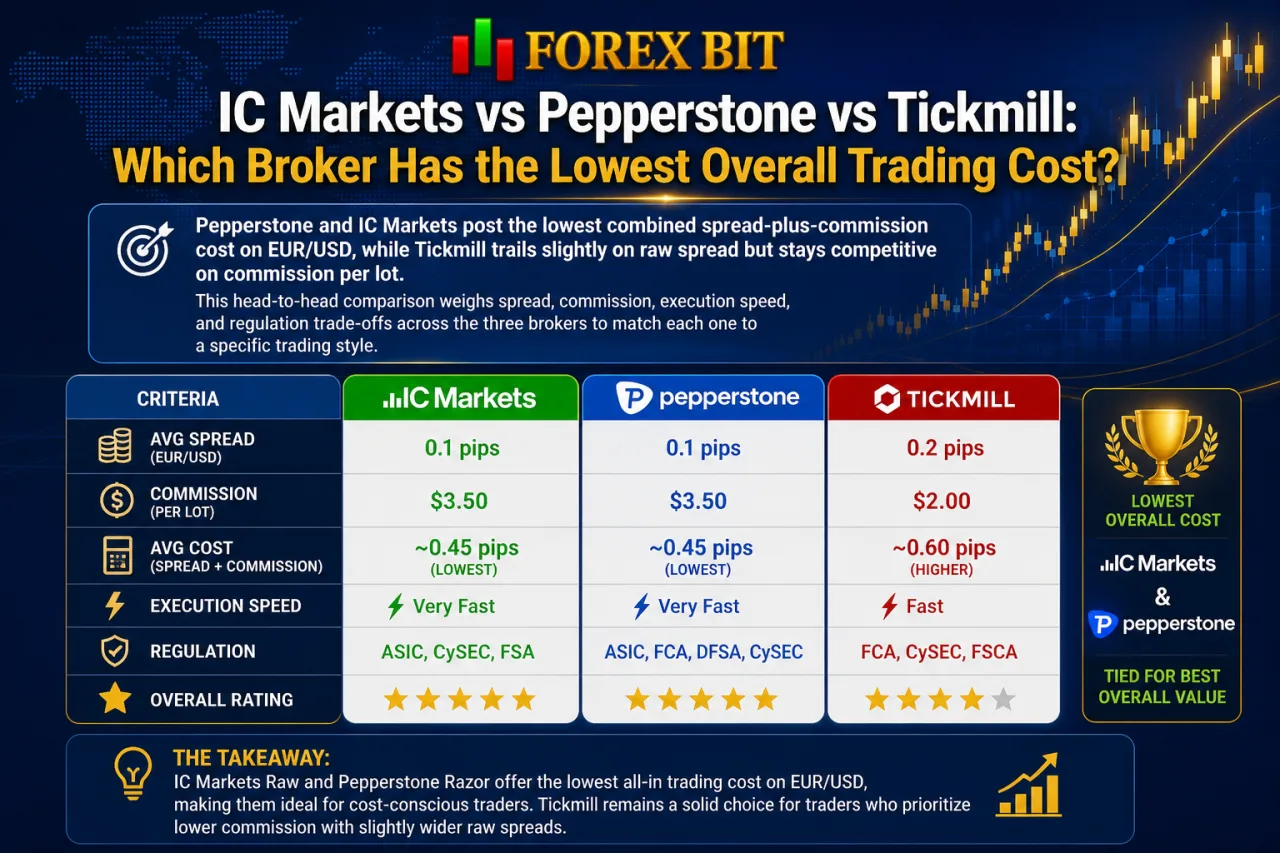
Pepperstone and IC Markets post the lowest combined spread-plus-commission cost on EUR/USD, while Tickmill trails slightly on raw spread but stays competitive on commission per lot. This head-to-head comparison weighs spread, commission, execution speed, and regulation trade-offs across the three brokers to match each one to a specific trading style.
On raw pricing alone, IC Markets Raw and Pepperstone Razor accounts publish tighter average EUR/USD spreads than Tickmill Pro, which narrows the cost gap only after commission is factored in.
- IC Markets suits high-volume traders needing consistently tight spreads paired with fast ECN-style execution.
- Pepperstone suits scalpers prioritizing execution speed and broad platform access across Razor accounts.
- Tickmill suits beginners opening a raw account, since its Pro tier combines a low minimum deposit with transparent commission pricing.
Execution speed differs less than spread and commission figures across these three brokers, though all three route raw-account orders through ECN-style liquidity rather than a dealing desk. Regulation coverage varies by entity: Pepperstone and IC Markets carry broader top-tier licensing across multiple jurisdictions, while Tickmill’s top-tier coverage applies to specific regulated entities rather than uniformly worldwide. Traders weighing cost against oversight generally match volume and strategy to IC Markets or Pepperstone, and account accessibility to Tickmill.
How Did Forex-bit Rank These Low-Spread Brokers?
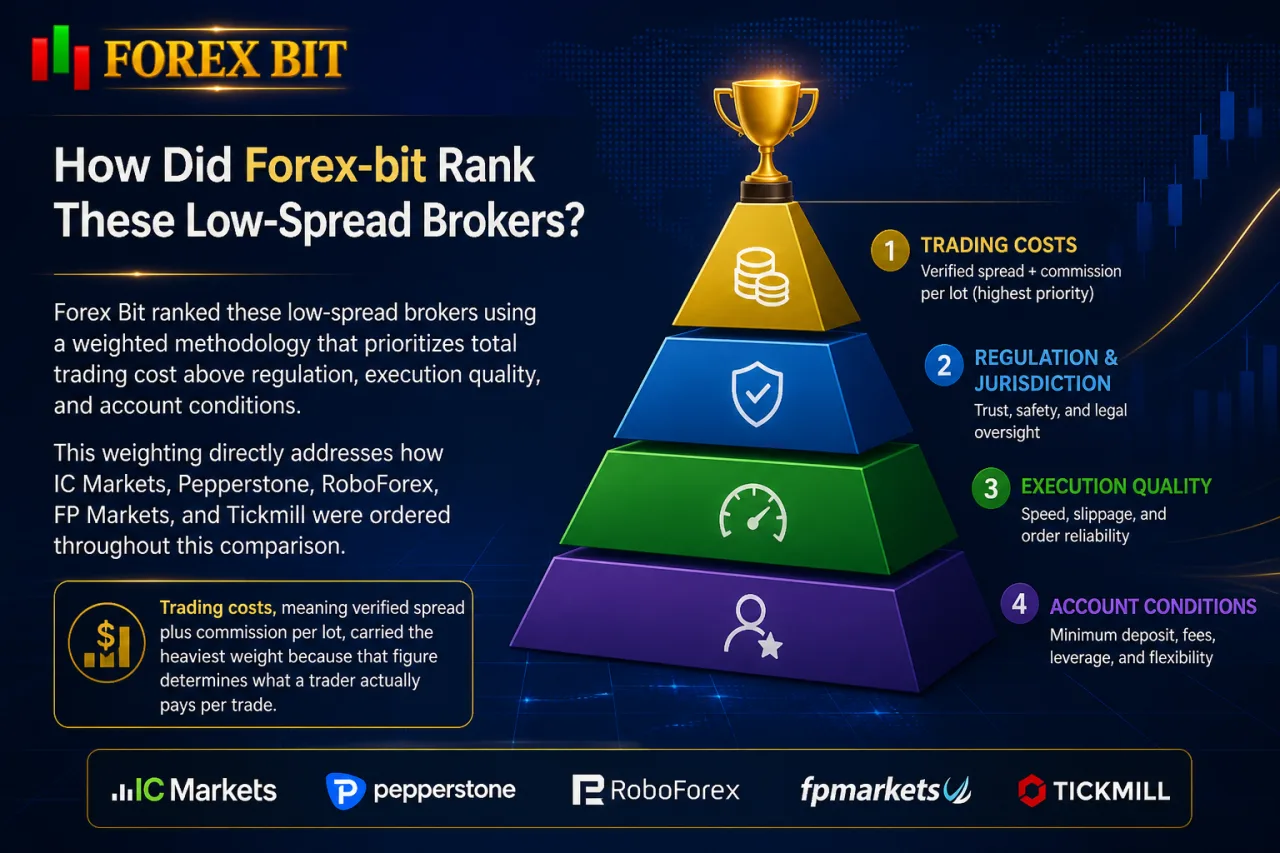
Forex-bit ranked these low-spread brokers using a weighted methodology that prioritizes total trading cost above regulation, execution quality, and account conditions. This weighting directly addresses how IC Markets, Pepperstone, RoboForex, FP Markets, and Tickmill were ordered throughout this comparison.
Trading costs, meaning verified spread plus commission per lot, carried the heaviest weight because that figure determines what a trader actually pays per trade. Regulation and jurisdiction strength ranked second, since low pricing on an unregulated entity does not offset weaker fund protection. Execution quality and account conditions, including minimum deposit and order execution model, filled out the remaining criteria, distinguishing brokers with similar pricing.
Spread and commission figures were pulled from each broker’s official fee schedule and account pages rather than promotional homepage claims. IC Markets, Pepperstone, RoboForex, FP Markets, and Tickmill each publish raw-account pricing information on their official websites, and these published fee pages served as a reference point for this comparison.
FAQs About the Lowest Spread Forex Brokers
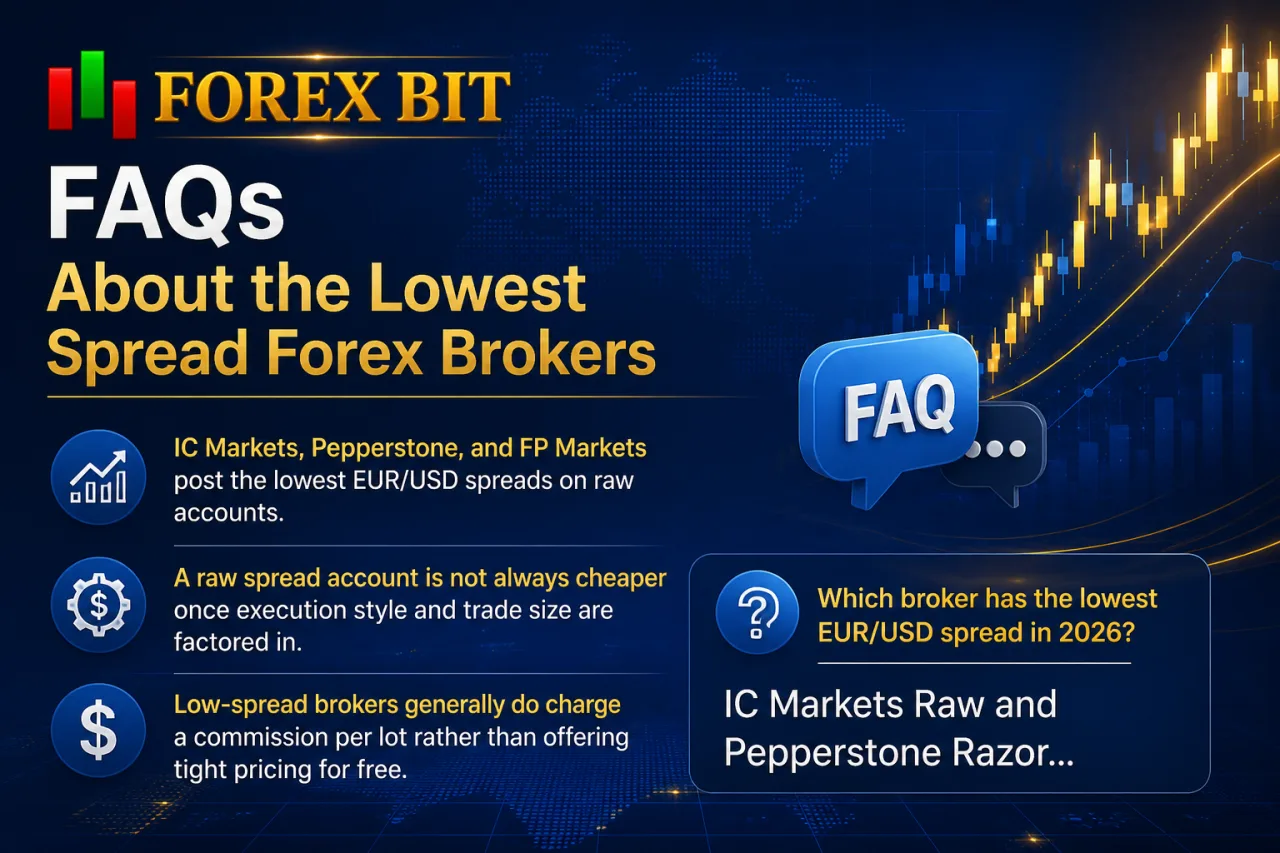
IC Markets, Pepperstone, and FP Markets post the lowest EUR/USD spreads on raw accounts, while a raw spread account is not always cheaper once execution style and trade size are factored in, and low-spread brokers generally do charge a commission per lot rather than offering tight pricing for free. These three questions cover the most common reader concerns on spread costs raised throughout this comparison.
Which broker has the lowest EUR/USD spread in 2026? IC Markets Raw and Pepperstone Razor consistently publish the tightest average EUR/USD spreads among the brokers compared here, with RoboForex ECN and FP Markets Raw close behind.
Is a raw spread account always cheaper? Not always: a raw account lowers cost mainly for traders placing frequent standard-lot trades, since the fixed commission per lot can outweigh the spread savings on very small or infrequent trades.
Do low-spread brokers charge higher commissions? No, IC Markets, Pepperstone, RoboForex, FP Markets, and Tickmill pair tight raw spreads with a modest commission per lot rather than a higher one, which is what keeps their total cost competitive against standard accounts.
What Other Hidden Costs Can Affect a Low-Spread Broker’s True Trading Expense?
Four hidden cost factors affect a low-spread broker’s true trading expense beyond spread and commission: overnight swap rates, inactivity fees, deposit or withdrawal charges, and currency conversion fees. These charges sit outside the core spread-plus-commission calculation covered earlier, yet they still shift the real cost IC Markets, Pepperstone, RoboForex, FP Markets, and Tickmill clients pay over time. Each factor applies unevenly across account types and trading styles, which the following breakdown addresses individually.
How Do Swap Rates Differ Among Low-Spread Brokers?
Swap rates differ among IC Markets, Pepperstone, RoboForex, FP Markets, and Tickmill because each broker sets its own overnight rollover fee per instrument rather than following a shared industry rate.
This overnight cost sits outside the spread-plus-commission figure covered earlier, yet it still shifts total expense for positions held past the daily rollover cutoff. Traders holding a raw-account position overnight pay or receive a swap charge that varies by currency pair and by which side of the trade they hold, long or short.
IC Markets, Pepperstone, RoboForex, FP Markets, and Tickmill each offer a swap-free account option for clients who qualify under Islamic account terms, removing the overnight rollover charge. Eligibility conditions and instrument coverage vary by broker; confirm current terms on each broker’s official account terms page.
Swap-free eligibility and any administrative fee substituted in place of the rollover charge differ by broker and by account type, so traders holding positions long-term check the specific swap-free terms before assuming the raw spread quoted earlier reflects the full holding cost.
Do Any Low-Spread Brokers Charge Deposit or Withdrawal Fees?
Yes, some low-spread brokers charge deposit or withdrawal fees depending on the funding method, while others absorb these costs entirely. This funding fee policy sits outside the spread-plus-commission figure covered earlier, yet it still affects overall cost-effectiveness for traders moving funds frequently.
IC Markets and Pepperstone generally do not charge a fee on standard bank transfer, card, or e-wallet deposits, though third-party payment providers or receiving banks may apply their own charges outside the broker’s control. RoboForex, FP Markets, and Tickmill also publish deposit and withdrawal fee information on their official websites, and charges on certain payment channels or below a minimum withdrawal threshold can vary by broker and by account currency, so traders should confirm current terms directly on each broker’s official fee page.
Currency conversion adds a separate cost when the deposit currency differs from the account base currency, regardless of whether the broker itself waives a direct transfer fee. Traders confirm current terms directly on each broker’s official fee page before assuming a low spread covers full funding costs.
Conclusion
IC Markets and Pepperstone deliver the lowest combined spread-plus-commission cost on raw accounts, making them the top picks for high-volume and scalping traders, while RoboForex and Tickmill offer competitive commission-per-lot pricing with lower entry deposits, and FP Markets rounds out the group with matching ECN pricing and wider instrument access. Standard accounts remain a viable choice only for traders avoiding commission fees, since raw accounts consistently produce lower true trading costs. Regulation still separates these providers, with Pepperstone and IC Markets carrying the broadest top-tier licensing. Matching account type, trading volume, and jurisdiction to these five brokers identifies the most cost-effective choice for any trading style in 2026.