


- Multi-jurisdiction regulation
- Supports MT4, MT5 & FXTM Trader
- Low entry cost for beginners
- Strong educational resources
- Suitable for both beginners and pros
- Regional restrictions apply
- Fee structure can be complex
- Withdrawal fees may apply
- Leverage varies by jurisdiction
- Investor protection varies by entity
FXTM is a globally regulated broker offering forex, CFDs, and multi-asset trading conditions for 2026, operating under multiple financial regulators that oversee client fund segregation and compensation schemes. These licenses form the basis for evaluating whether FXTM is a safe and trustworthy broker in 2026.
FXTM offers several account types tailored to different trading styles, including options with fixed or variable spreads and varying minimum deposits. Its pricing structure includes spreads starting from a low floating rate on its ECN-style accounts alongside a separate commission per lot, directly affecting overall trading profitability across account types.
FXTM suits both beginners seeking educational resources and experienced traders needing tighter spreads and higher leverage. Forex Bit examines these distinctions further to clarify which trader profile benefits most, starting with FXTM’s regulatory safety in 2026.
Is FXTM a Safe and Trustworthy Broker in 2026?
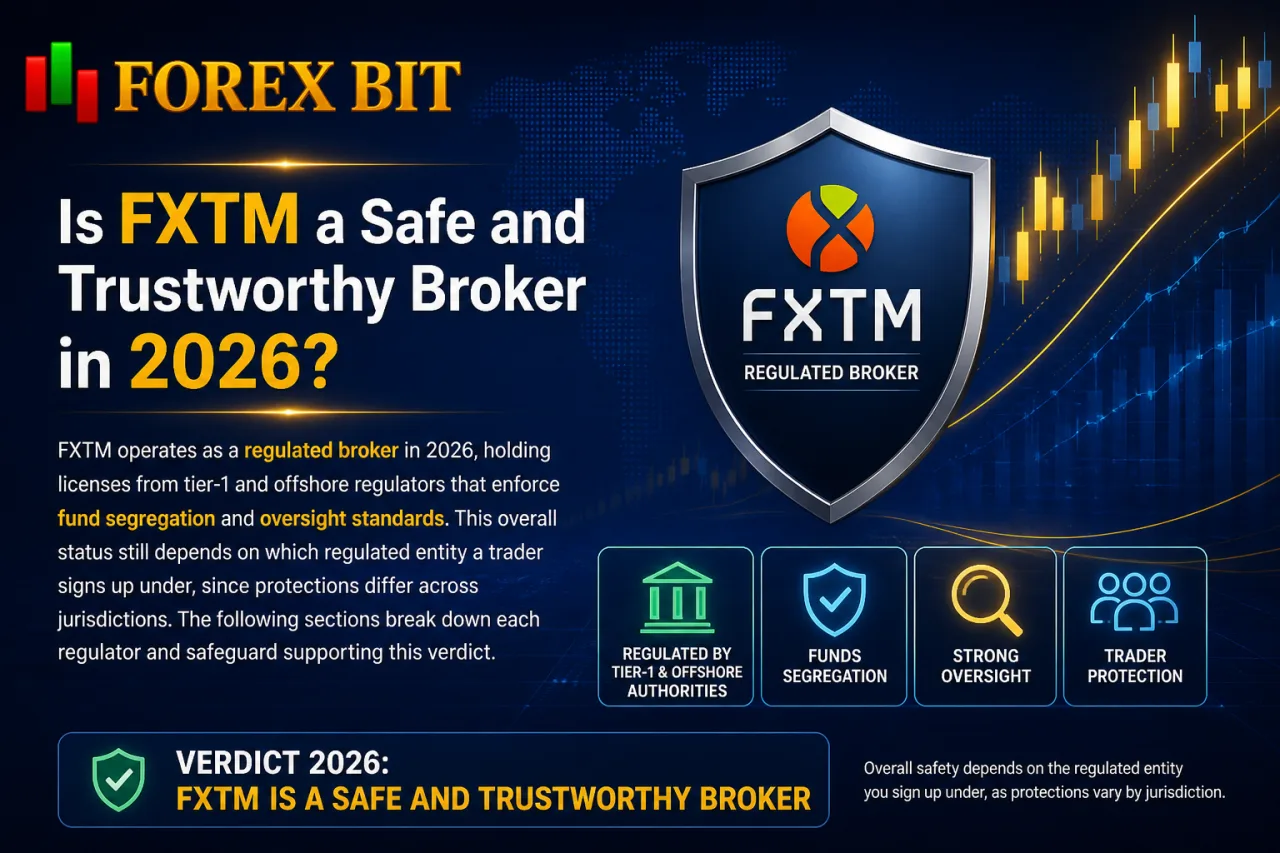
FXTM operates as a regulated broker in 2026, holding licenses from tier-1 and offshore regulators that enforce fund segregation and oversight standards. This overall status still depends on which regulated entity a trader signs up under, since protections differ across jurisdictions. The following sections break down each regulator and safeguard supporting this verdict.
What Licenses and Regulatory Bodies Oversee FXTM?
FXTM operates under several core regulatory licenses, including regulators such as the UK’s FCA, Cyprus’s CySEC, South Africa’s FSCA, and the Mauritius FSC, with each authority overseeing a separate legal entity within the group. This licensing structure defines which entity a trader signs up with and which jurisdiction’s rules apply to their account.
Each regulator covers a distinct client base and compliance standard:
- UK FCAThe FCA oversees ForexTime UK Limited, applying strict capital adequacy and conduct rules for clients onboarded through the UK entity.
- Cyprus CySECCySEC regulates ForexTime Ltd (also referred to as FXTM EU), granting passporting rights across the European Economic Area.
- South Africa FSCAThe FSCA licenses FXTM’s South African entity, covering clients across the region.
- Mauritius FSCauthorizes ForexTime Limited, the entity typically serving clients in regions outside the EU, UK, and South Africa.
Traders registering under the FCA or CySEC entities generally access stronger investor compensation protections than those under the Mauritius entity.
How Does FXTM Protect Client Funds?
FXTM protects client funds through segregated bank accounts, negative balance protection, and compensation scheme coverage that varies by regulated entity. These layered safeguards address the fund protection question at the core of this section.
Segregation keeps trader deposits apart from FXTM’s operating capital. This structure ensures company funds cannot be used to cover business expenses.
Negative balance protection resets an account to zero after extreme market moves. This mechanism prevents clients from owing FXTM money beyond their deposited balance.
Compensation eligibility depends on which entity a trader is registered under:
- Clients under the CySEC entity qualify for coverage under the Investor Compensation Fund, which covers eligible client claims up to a set limit.
- Clients under the FCA entity are eligible for coverage under the Financial Services Compensation Scheme, subject to its standard protection limits.
- Clients under the FSCA or Mauritius FSC entities generally receive no statutory compensation scheme coverage.
No separate private insurance policy for client funds is publicly disclosed by FXTM beyond these regulatory schemes.
What Account Types Does FXTM Offer?
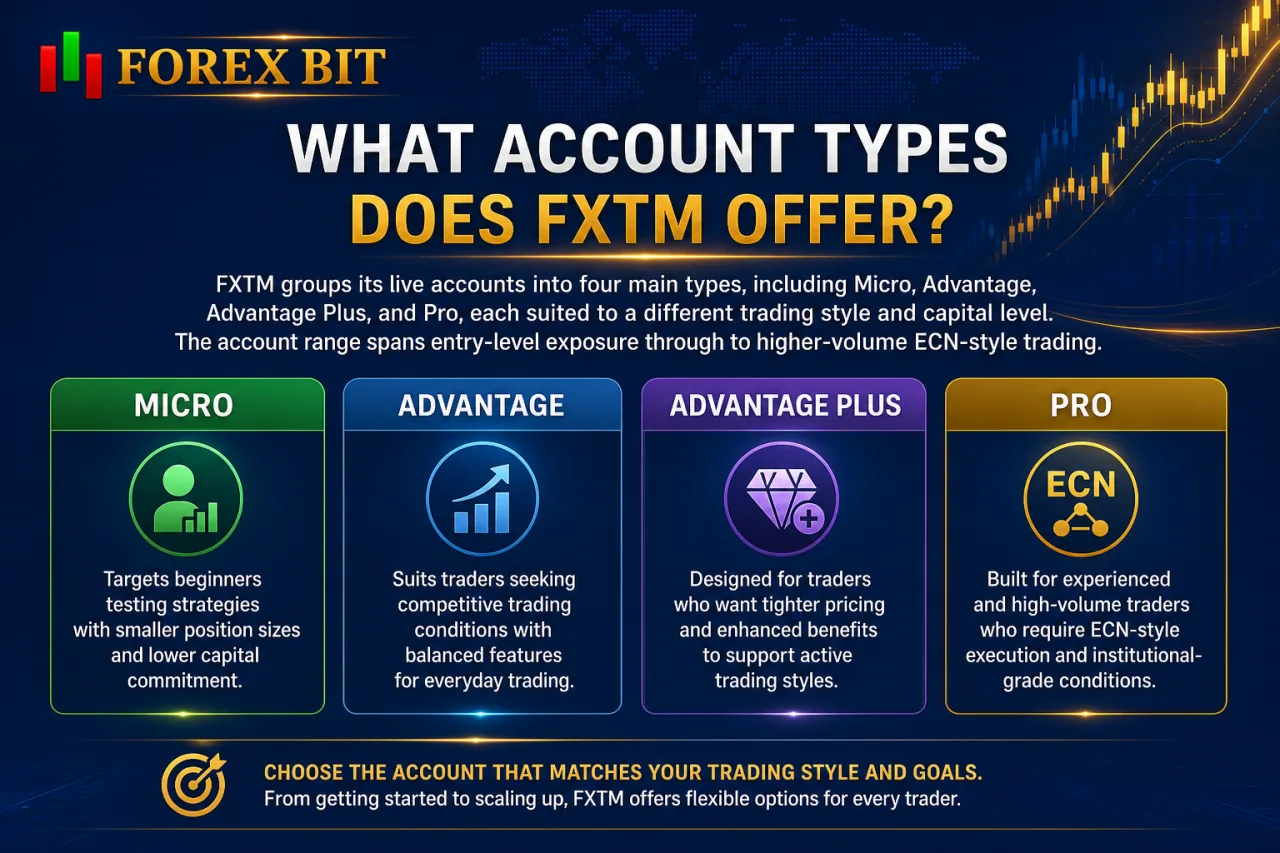
FXTM groups its live accounts into four main types, including Micro, Advantage, Advantage Plus, and Pro, each suited to a different trading style and capital level. This grouping addresses which account category fits a given trader profile before comparing spreads or fees in detail.
The account range spans entry-level exposure through to higher-volume ECN-style trading:
- Micro targets beginners testing strategies with smaller position sizes and lower capital commitment.
- Advantage suits traders wanting market execution with commission-based pricing on standard volumes.
- Advantage Plus fits traders preferring spread-only pricing without a separate per-lot commission.
- Pro serves experienced or high-volume traders seeking tighter raw-style pricing and faster execution.
Selecting among these four depends on trading frequency, position size, and whether a trader prioritizes commission-based or spread-only pricing.
What Are the Minimum Deposit Requirements for Each Account?
FXTM sets minimum deposit requirements that scale with account type, starting from a low entry threshold on the Micro account and rising toward the Pro account.
This deposit range determines the entry cost for each account category outlined earlier.
- Micro requires the lowest opening deposit among the four account types, matching its focus on smaller position sizes.
- Advantage requires a moderate deposit tied to its commission-based, market-execution pricing.
- Advantage Plus requires a similar or slightly higher deposit given its spread-only pricing model.
- Pro requires the highest minimum deposit among the four, reflecting its raw-style pricing and higher-volume orientation.
FXTM accepts multiple base currencies for funding these accounts, with the available options varying depending on the trader’s region.
Choosing a base currency matching the trader’s primary funding source avoids conversion fees on deposits and withdrawals.
Standard Accounts vs Cent Accounts: Which Should You Choose?
Standard accounts suit traders sizing positions in full or fractional lots, while Cent accounts suit beginners practicing with real money at a fraction of standard trade values. This distinction addresses which account structure fits a trader’s capital size and risk comfort before committing to live trading.
The two structures diverge mainly on how position size and account balance are denominated:
- Standard accounts (Micro, Advantage, Advantage Plus, Pro) quote balances and trade sizes in standard base currency units, matching typical lot-based volume.
- Cent accounts quote balances in cents rather than whole currency units, so a deposit appears roughly 100 times larger on screen while representing the same real capital.
- Trade sizes on Cent accounts scale down proportionally, letting new traders open positions with minimal exposure per pip.
- Risk exposure stays lower on Cent accounts, making them suited to testing strategies before moving capital into full-sized Standard accounts.
Traders prioritizing higher-volume execution and tighter raw-style pricing fit better with Standard accounts such as Pro, while those still building confidence with live-market conditions fit better with a Cent account structure.
How Do FXTM’s Spreads, Commissions and Fees Compare?
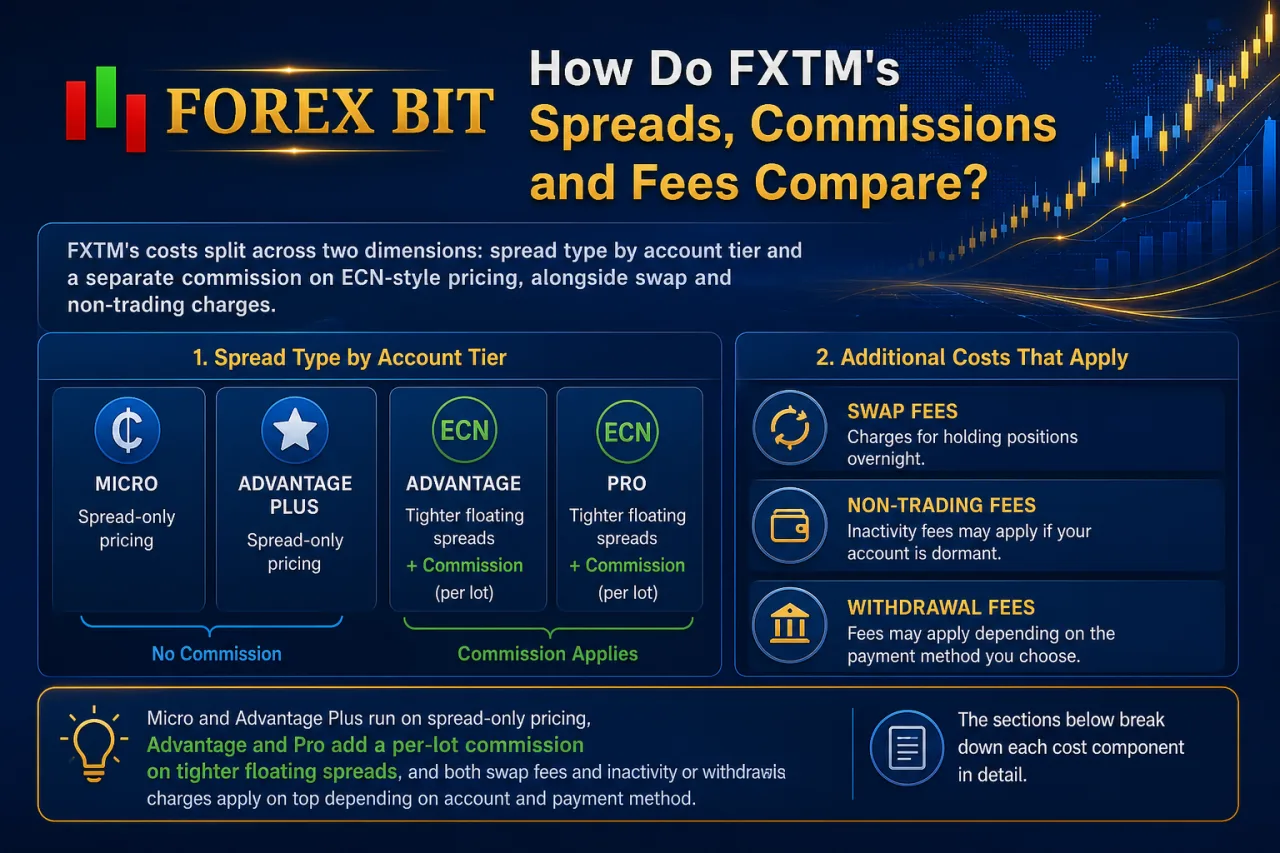
FXTM’s costs split across two dimensions: spread type by account tier and a separate commission on ECN-style pricing, alongside swap and non-trading charges. Micro and Advantage Plus run on spread-only pricing, Advantage and Pro add a per-lot commission on tighter floating spreads, and both swap fees and inactivity or withdrawal charges apply on top depending on account and payment method. The sections below break down each cost component in detail.
Which Account Type Has the Lowest Trading Costs?
Advantage Plus and Micro carry the lowest all-in trading costs for low-frequency traders, while Pro carries the lowest cost for high-volume traders despite its added commission. Spread-only accounts avoid a per-lot fee but quote wider floating spreads, whereas commission-based accounts quote tighter raw spreads plus a fixed charge per lot traded.
For occasional or smaller positions, the spread-only structure on Micro and Advantage Plus keeps the total cost calculation simple, since no separate commission line applies on top of the quoted spread.
For frequent or larger-volume trading, the combined cost on Pro and Advantage can land lower than spread-only pricing as trade size increases, since a narrower raw spread may offset the commission charged per lot.
Scalpers and high-frequency traders generally benefit most from Pro’s raw-style pricing, while swing traders holding fewer positions per month often find Advantage Plus more cost-efficient overall.
Does FXTM Charge Inactivity or Withdrawal Fees?
FXTM does not appear to charge an inactivity fee on dormant accounts, while withdrawal processing charges vary depending on the payment method selected rather than following a flat fee across all channels. This structure clarifies the non-trading cost question beyond spreads and commissions already outlined above.
Charges beyond spreads and swaps split into two categories:
- Dormant account fees do not apply under FXTM’s published fee policy, unlike brokers that deduct a periodic charge after a set period of no trading activity.
- Withdrawal feesvary by method, with bank wire transfers typically carrying processing costs that e-wallets and card withdrawals often avoid or reduce.
- Currency conversion charges apply when a withdrawal currency differs from the account’s base currency, adding an indirect cost outside the stated withdrawal fee.
Traders withdrawing frequently through bank transfer face higher cumulative costs than those using e-wallets, making payment method selection a factor in overall account cost alongside the account type chosen.
What Leverage Does FXTM Provide to Traders?
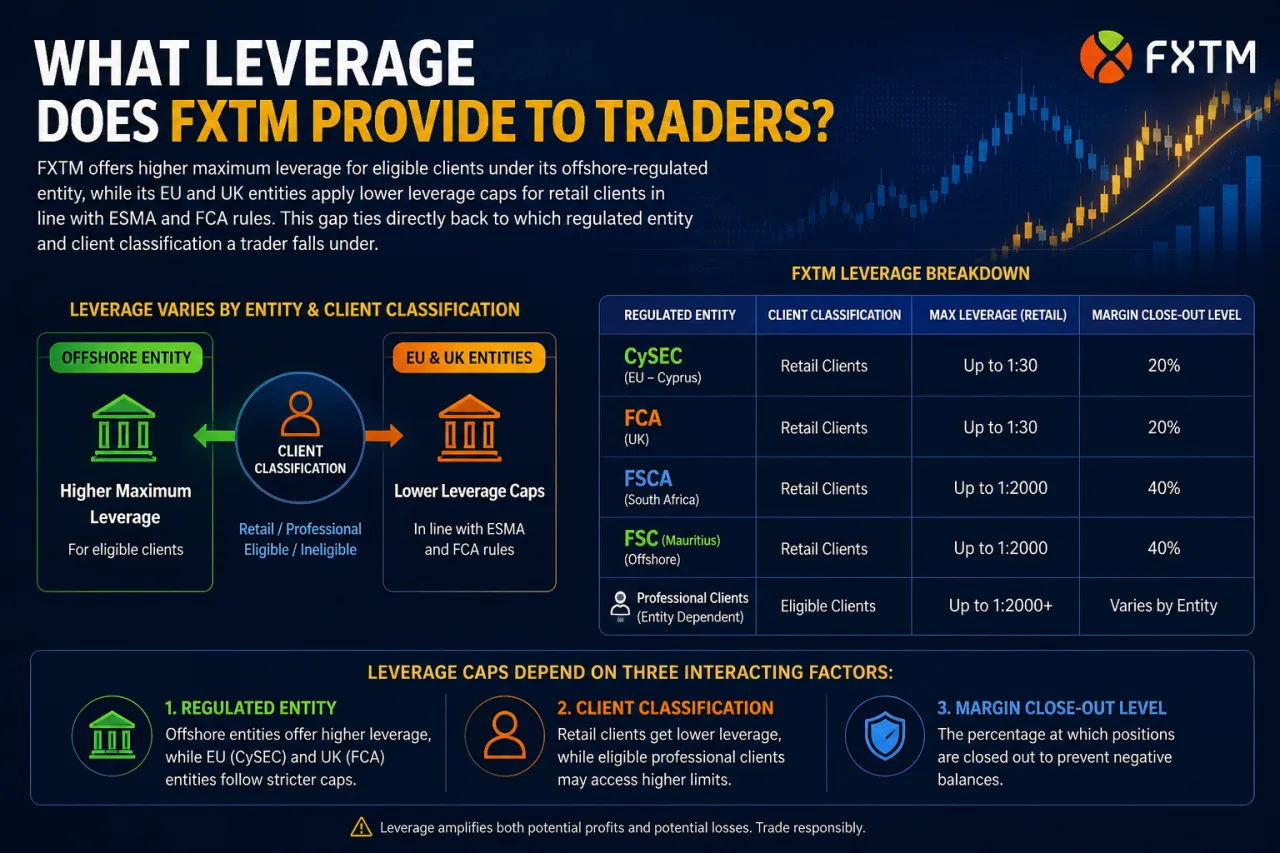
FXTM offers higher maximum leverage for eligible clients under its offshore-regulated entity, while its EU and UK entities apply lower leverage caps for retail clients in line with ESMA and FCA rules. This gap ties directly back to which regulated entity and client classification a trader falls under. The following breakdown clarifies how leverage limits shift by entity, classification, and margin close-out level.
Leverage caps depend on three interacting factors:
- Retail clients under CySEC or FCA entities face capped leverage aligned with European and UK retail protection rules.
- Professional clients meeting qualification criteria under CySEC or FCA access higher leverage tiers than standard retail accounts.
- Clients under the FSCA or Mauritius FSC entities access substantially higher leverage ceilings, since these jurisdictions do not enforce ESMA-style retail caps.
- Margin call and stop-out levels trigger automatic position closures once account margin falls below FXTM’s defined thresholds, protecting against balances going further negative.
Traders registering through a stricter regulated entity trade with lower leverage but stronger investor safeguards, while those under offshore entities access higher leverage alongside fewer statutory protections.
Is FXTM’s Leverage Different for Regulated vs Offshore Entities?
Yes, FXTM’s leverage differs sharply between its regulated and offshore entities, with CySEC and FCA capping retail leverage while the FSC Mauritius entity permits substantially higher ratios. This gap directly reflects the leverage variation by jurisdiction outlined earlier, tied to which legal entity holds a trader’s account.
The comparison breaks down into two clear tiers:
- CySEC and FCA entities restrict retail clients to leverage limits aligned with ESMA and FCA retail protection rules, though qualifying professional clients access higher tiers.
- FSC Mauritius entity offers markedly higher maximum leverage reaching into the thousands-to-one range, since Mauritius does not enforce ESMA-style retail caps, in contrast with the much tighter limit applied under its EU and UK entities.
- FSCA-regulated clients under FXTM’s South African entity also access higher leverage than CySEC or FCA retail accounts, though ceilings can sit below the Mauritius maximum in some configurations.
Traders prioritizing capital efficiency and larger position sizing per margin dollar generally lean toward the Mauritius entity, while those valuing stronger compensation coverage accept the lower capped leverage under CySEC or FCA.
Which Trading Platforms Does FXTM Support?
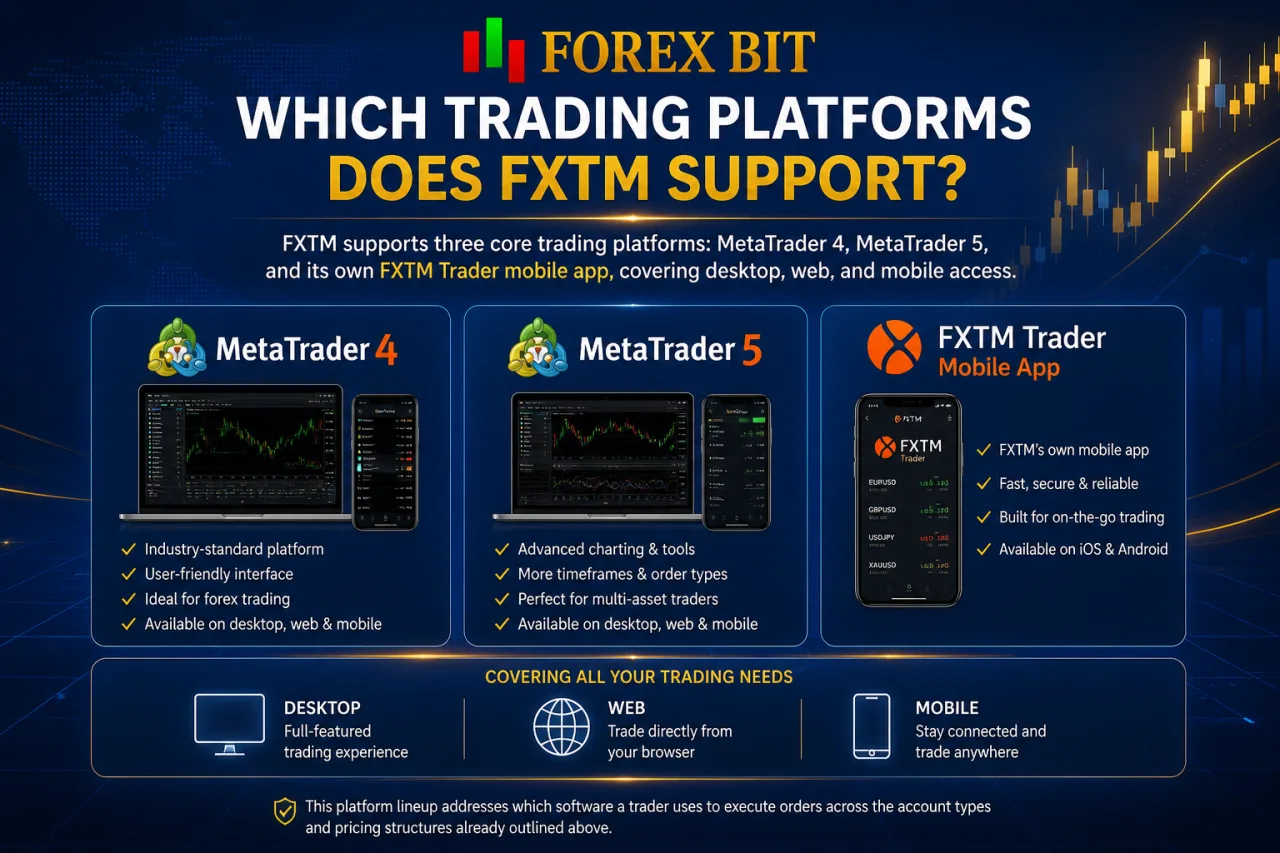
FXTM supports three core trading platforms: MetaTrader 4, MetaTrader 5, and its own FXTM Trader mobile app, covering desktop, web, and mobile access. This platform lineup addresses which software a trader uses to execute orders across the account types and pricing structures already outlined above. The following breakdown clarifies how each platform differs in availability and typical use case.
MT4 vs MT5 on FXTM: What Are the Key Differences?
MT5 wins on instrument coverage and order types, while MT4 remains preferred among traders running legacy Expert Advisors and simpler forex-only strategies. Both platforms run on FXTM’s same account infrastructure, so the choice affects trading tools rather than pricing or leverage already outlined above.
The two platforms diverge across a few technical points:
- Instrument range on MT5 extends beyond forex and CFDs to a broader multi-asset lineup, while MT4 stays focused on forex and CFD trading.
- Order types on MT5 include additional pending order options compared with MT4’s more limited set.
- Timeframes and charting on MT5 offer extra intraday intervals and an economic calendar built into the terminal, absent from MT4’s interface.
- Programming language differs between the two, with MT5 using MQL5 for Expert Advisors and custom indicators versus MT4’s MQL4.
- Depth of Market appears as a built-in feature on MT5, giving visibility into pending buy and sell volumes that MT4 does not display natively.
Traders relying on older MT4-coded Expert Advisors generally stay on MT4 for compatibility, while those wanting a wider asset selection and modern order management tools lean toward MT5.
What Markets and Instruments Can You Trade with FXTM?
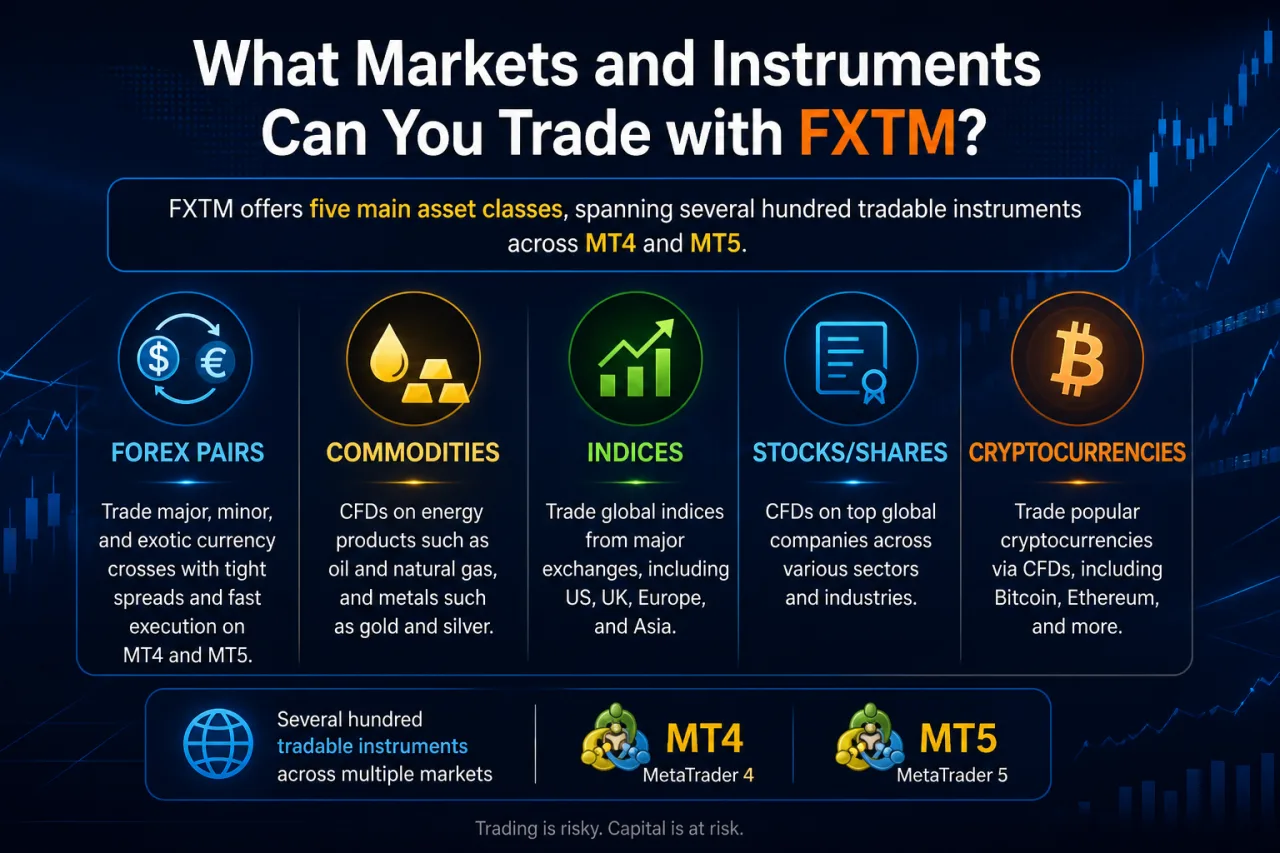
FXTM offers five main asset classes: forex pairs, commodities, indices, stocks/shares, and cryptocurrencies (via CFDs), covering a wide range of tradable instruments across MT4 and MT5. This range determines which markets a trader accesses depending on the account type and platform already outlined above.
- Forex pairs cover major, minor, and exotic currency crosses traded on both MT4 and MT5.
- Commodities include CFDs on energy products such as oil and metals such as gold and silver.
- Indices provide CFD exposure to major global stock market benchmarks without owning the underlying shares.
- Stocks/shares allow CFD trading on individual company equities listed on major exchanges.
- Cryptocurrencies appear as CFDs on major digital coins, subject to regional availability and regulatory restrictions.
FXTM lists a broad range of tradable instruments across these five asset classes, though the exact count varies by account type and regulated entity. Availability of crypto CFDs and certain stock CFDs may differ for clients registered under stricter regulated entities compared with offshore ones.
How Do You Deposit and Withdraw Funds with FXTM?
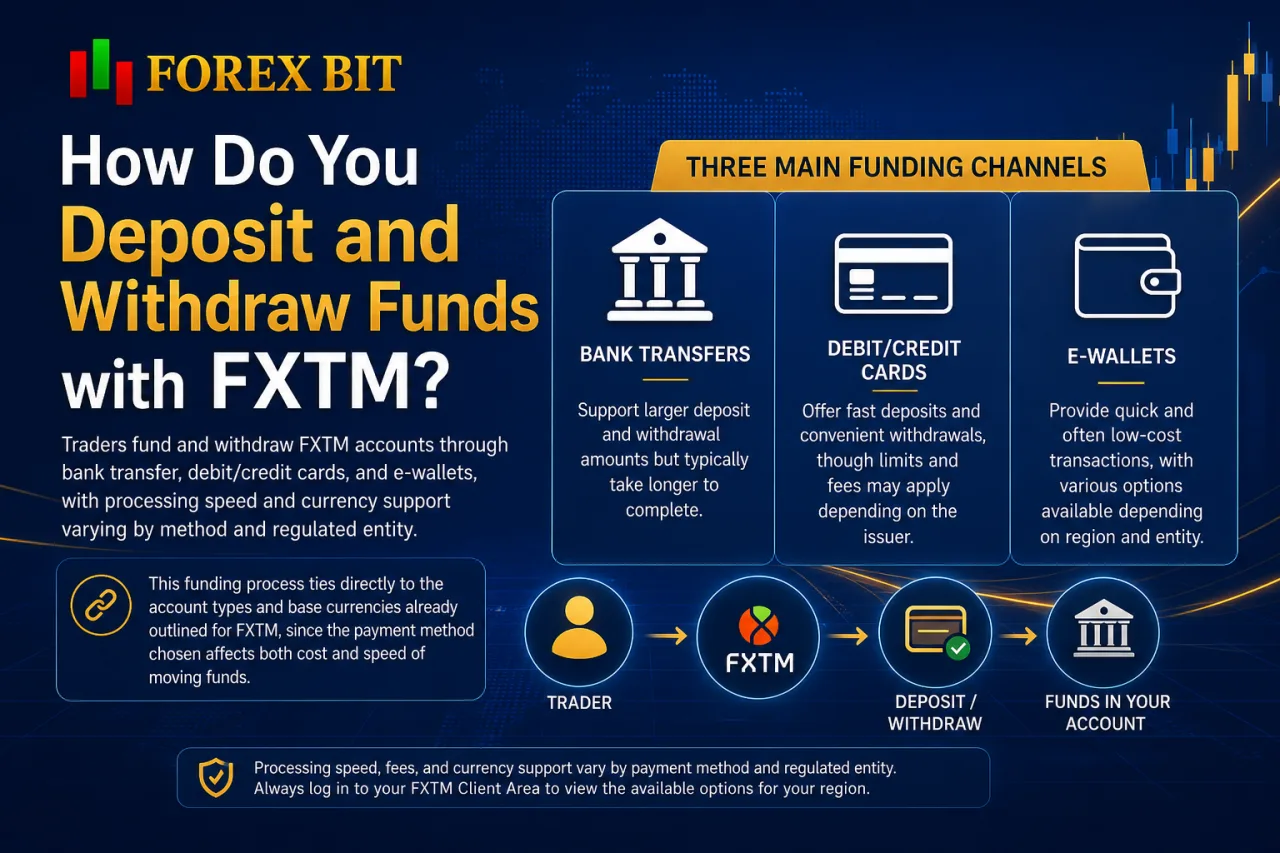
Traders fund and withdraw FXTM accounts through bank transfer, debit/credit cards, and e-wallets, with processing speed and currency support varying by method and regulated entity. This funding process ties directly to the account types and base currencies already outlined for FXTM, since the payment method chosen affects both cost and speed of moving funds.
Coverage splits across three main channels:
- Bank transfers support larger deposit and withdrawal amounts but typically take longer to clear and may carry processing costs on withdrawal, as noted earlier regarding non-trading fees.
- Debit and credit cardsprocess deposits near-instantly, with withdrawals generally returning to the original card within a few business days depending on the issuing bank.
- E-walletssuch as Skrill, Neteller, and similar providers offer fast processing on both deposits and withdrawals, often avoiding the fees applied to bank wire transfers.
Currency support for funding matches the base currencies available on the trader’s account, and mismatched currencies trigger conversion charges as covered earlier under non-trading fees.
What Customer Support Options Does FXTM Offer?
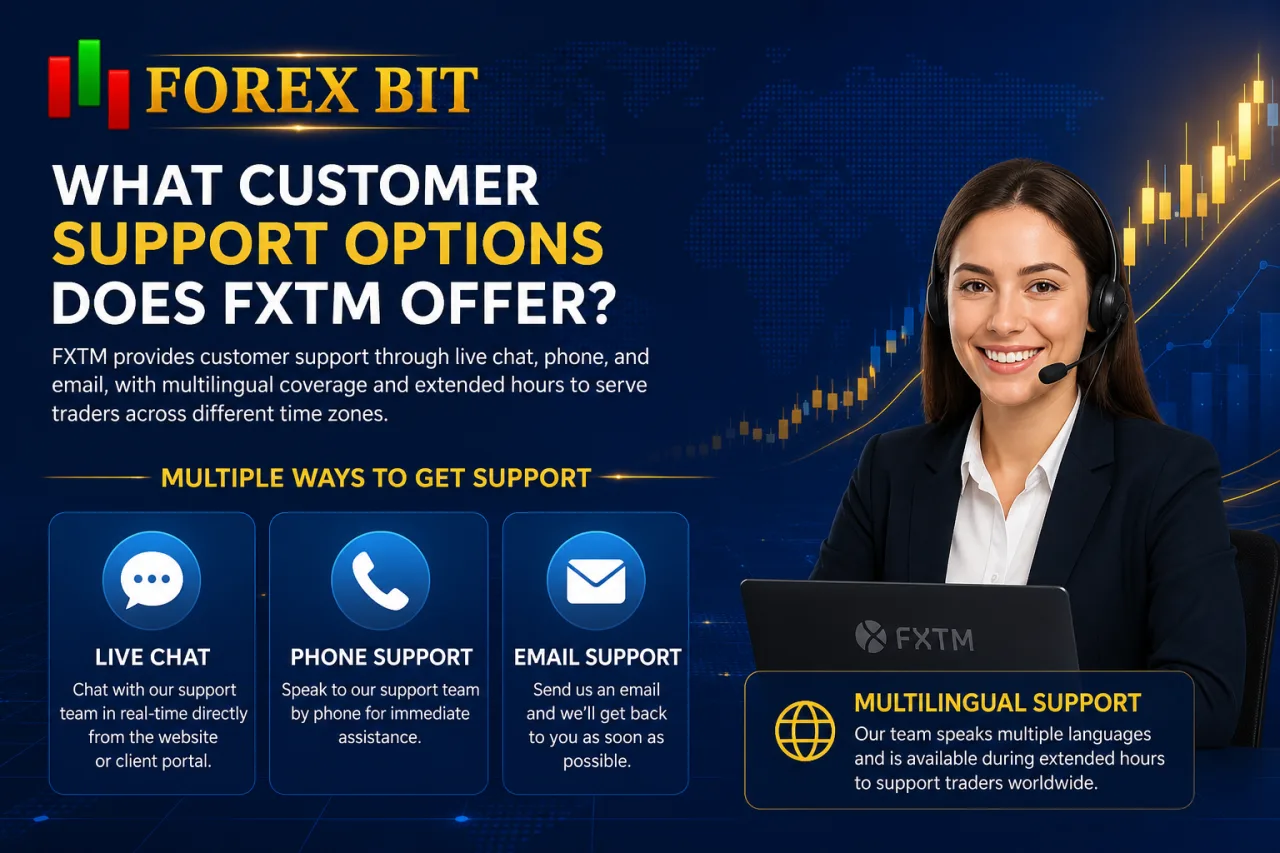
FXTM provides customer support through live chat, phone, and email, with multilingual coverage and extended hours to serve traders across different time zones. This support structure addresses the channel and availability question for traders comparing service quality alongside the regulation, fees, and platform features already outlined for FXTM.
Coverage splits across three main touchpoints:
- Live chat connects traders to support staff directly from the FXTM website or client portal for quick account and platform queries.
- Phone support offers dedicated lines that vary by region, giving traders under different regulated entities a local or regional contact number.
- Email support handles more detailed or documentation-based requests, such as verification issues or withdrawal inquiries.
FXTM staffs its support desks with multilingual teams to match its international client base.
Support hours extend well beyond a standard business day, with several channels operating on an extended or near round-the-clock basis to accommodate traders across overlapping global sessions. Response speed on live chat and phone generally outpaces email, which suits time-sensitive issues like execution disputes or urgent withdrawal delays better than written inquiries.
Is FXTM Suitable for Beginners or Experienced Traders?
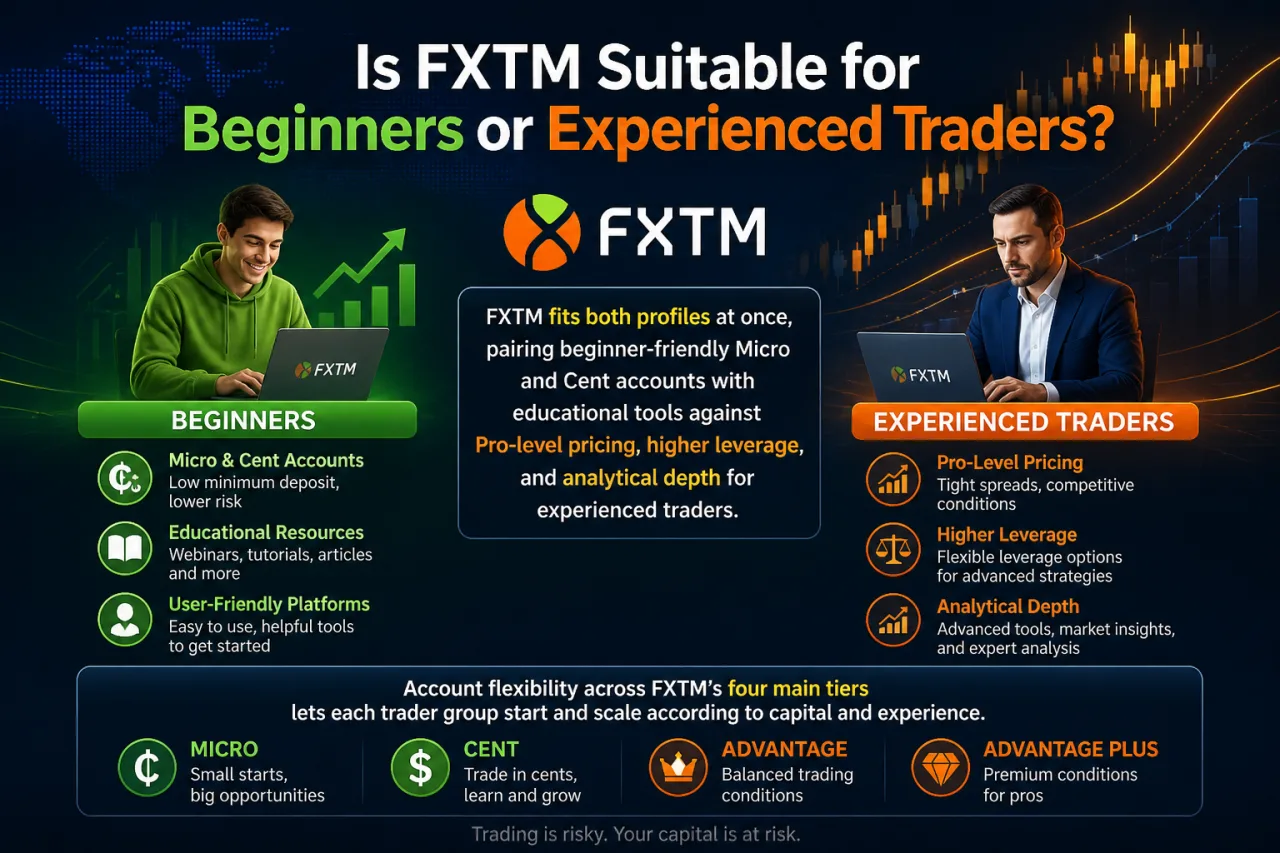
FXTM fits both profiles at once, pairing beginner-friendly Micro and Cent accounts with educational tools against Pro-level pricing, higher leverage, and analytical depth for experienced traders. Account flexibility across FXTM’s four main tiers lets each trader group start and scale according to capital and experience, addressed in the comparison below.
What Are the Main Strengths and Weaknesses of FXTM?
FXTM wins on regulatory breadth, platform variety, and low entry cost, while regional account restrictions and fee complexity across account types stand out as its main drawbacks. This balance addresses which factors weigh in favor of FXTM versus which create friction for traders comparing brokers, drawing on the regulation, account, and pricing details already outlined above.
Strengths include:
- Multi-jurisdiction regulation spanning FCA, CySEC, FSCA, and Mauritius FSC gives traders a choice between stronger compensation coverage and higher offshore leverage.
- Platform variety across MT4, MT5, and the FXTM Trader app covers desktop, web, and mobile execution needs.
- Low minimum deposit on the Micro and Cent account structures lowers the entry barrier for beginners testing live-market conditions.
- Educational resources support newer traders alongside Pro-level pricing for experienced, high-volume clients.
Limitations include:
- Regional restrictions determine which entity, leverage cap, and asset list a trader can access based on residency.
- Fee complexity across four account types with mixed spread-only and commission-based pricing complicates direct cost comparison.
- Withdrawal charges on bank transfers add cost that e-wallet users generally avoid.
Weighing these strengths against the limitations helps traders match FXTM’s account structure to their own regulatory priorities and trading frequency before opening an account.
What Unique Tools and Programs Does FXTM Provide Beyond Standard Trading?
FXTM extends beyond core trading through four supplementary programs: Trading Central market analysis, the FXTM Academy education hub, cashback-style loyalty rewards, and an affiliate/IB partnership network. These additions address what FXTM offers alongside spreads, leverage, and platforms already outlined for FXTM (ForexTime). The sections below break down each program’s function for different trader profiles.
Does FXTM Offer Copy Trading or Social Trading Features?
FXTM does not run its own dedicated copy trading or social trading platform, though its MT4 and MT5 infrastructure supports third-party copy trading and signal services. Traders may connect an FXTM MT4 or MT5 account to external signal providers or copy trading tools rather than relying on a native FXTM-branded feature. No standalone FXTM social trading app or built-in strategy marketplace is publicly disclosed for 2026. Traders seeking automated copy trading generally pair an FXTM Advantage or Pro account with an outside signal service rather than relying on an in-house solution.
What Educational Resources Does FXTM Provide Through FXTM Academy?
FXTM Academy delivers structured trading education through webinars, seminars, market analysis, and tiered courses, distinguishing FXTM from brokers offering only basic guides. This educational ecosystem ties directly into the beginner-to-experienced suitability already outlined for FXTM’s account structure.
The Academy splits content across several formats:
- Webinars run on a scheduled basis, covering technical analysis, risk management, and platform tutorials for MT4 and MT5 users.
- Seminars bring FXTM analysts or partner trainers into in-person or regional events for direct trader interaction.
- Market analysis publishes daily or weekly written and video breakdowns of forex, commodities, and index movements.
- Structured courses progress from beginner fundamentals toward advanced strategy modules, often organized into levels matching a trader’s existing experience.
Beginners on Micro or Cent accounts generally start with foundational courses and recorded webinars, while Advantage and Pro clients draw more value from live market analysis and advanced strategy sessions tied to active trading decisions.
Conclusion
FXTM’s overall profile confirms a broker built on multi-jurisdiction regulation, with FCA and CySEC entities offering stronger compensation coverage and capped leverage, while FSCA and Mauritius FSC entities trade fewer statutory protections for higher leverage ceilings. Fund safety rests on segregated accounts and negative balance protection across all entities, though compensation scheme access depends entirely on the registered entity.
Four account types, dual platform support through MT4 and MT5, broad multi-asset coverage, and FXTM Academy round out a package suited to both beginners and high-volume traders. Fee complexity and withdrawal costs on bank transfers remain the main trade-offs against this regulatory breadth, giving traders a clear basis to judge FXTM’s safety and trading conditions before opening an account.
Thomas Dite is the Best Forex Brokers Research Manager at Forex Bit, specializing in researching, comparing, and editing broker-related content for different trader needs. He focuses on evaluating trading platforms, costs, regulation, account conditions, and other key factors to help readers make more informed broker comparisons.
Email: [email protected]