







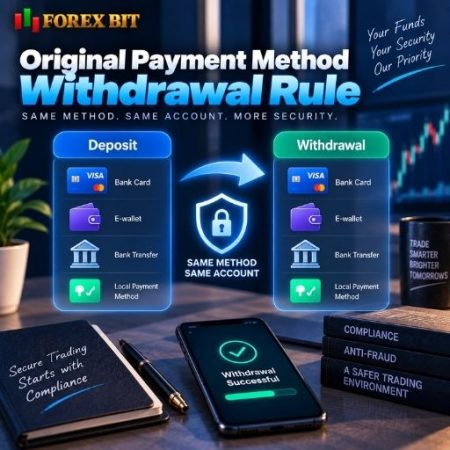


Forex brokers process payments through regulated banking channels, e-wallets, and card networks, separating client funds from company operating capital. Deposit and withdrawal requests pass through internal verification before funds move to or from a trader’s linked payment method, reducing exposure to unauthorized transactions.
Payment methods differ in processing speed and cost, with bank transfers generally taking longer to complete than e-wallets or card payments. Withdrawal fees, minimum thresholds, and currency conversion charges vary by broker and payment provider, directly affecting the total cost of moving funds.
KYC/AML verification typically requires traders to submit identity documents, proof of address, and sometimes proof of payment source before withdrawals are approved. Brokers apply these checks to comply with anti-money laundering regulations and to confirm account ownership.
Payment fraud and cybersecurity risks include phishing emails, fake broker payment pages, and unauthorized withdrawal requests targeting trader accounts. Two-factor authentication, encrypted transactions, and verified withdrawal destinations reduce these risks significantly.
Forex Bit breaks down how deposits and withdrawals actually move through a broker’s payment system before reaching a trader’s account.
How Do Forex Brokers Handle Deposits and Withdrawals?
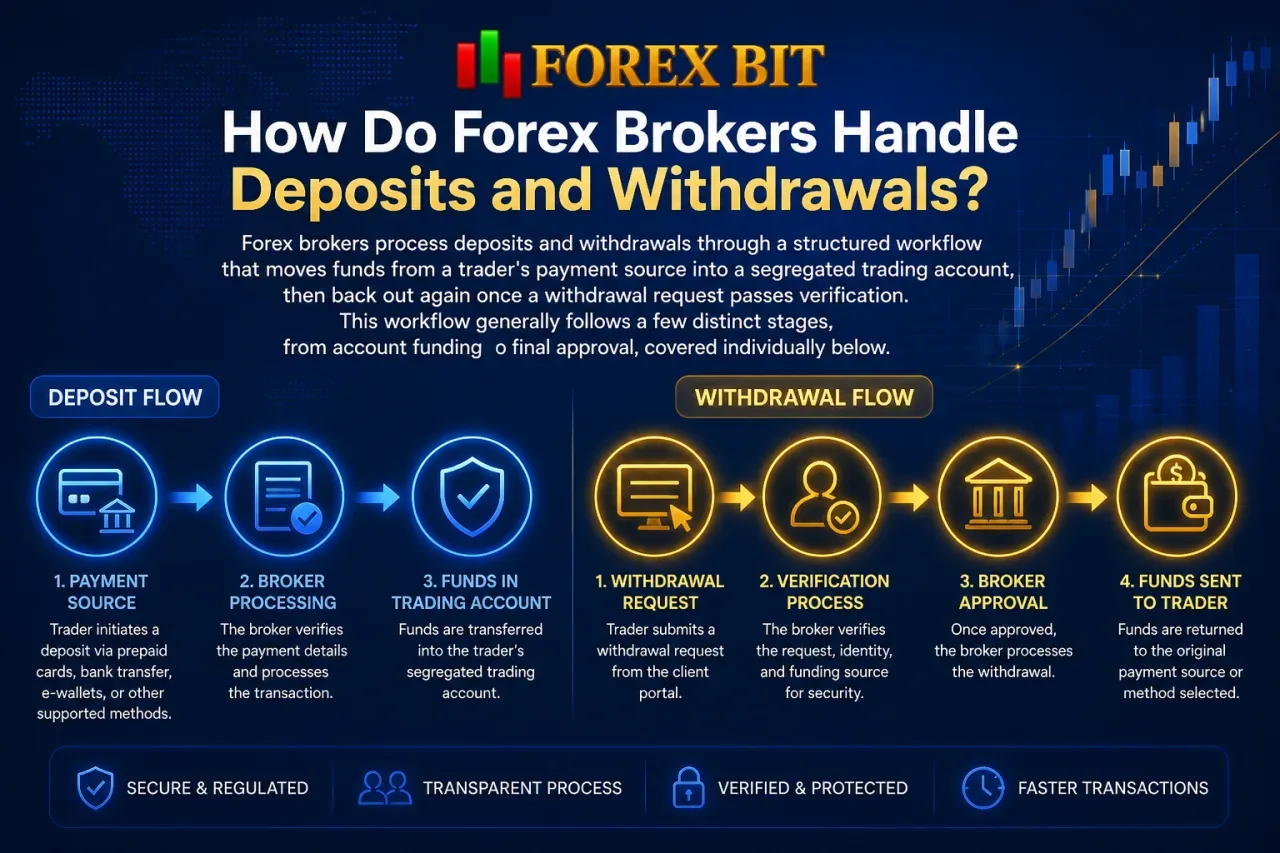
Forex brokers process deposits and withdrawals through a structured workflow that moves funds from a trader’s payment source into a segregated trading account, then back out again once a withdrawal request passes verification. This workflow generally follows a few distinct stages, from account funding to final approval, covered individually below.
What Payment Methods Do Forex Brokers Support?
Forex brokers generally support four categories of payment methods: bank transfers, debit/credit cards, e-wallets, and local or regional payment options. Each category carries distinct processing times, fees, and verification requirements that affect how quickly funds move in and out of a trading account.
- Bank transfers move funds directly between a trader’s bank account and the broker’s segregated account, often used for larger deposits and withdrawals due to higher security but slower settlement.
- Debit and credit cards process deposits almost instantly, though some brokers restrict card withdrawals to the original deposited amount for anti-fraud reasons.
- E-wallets such as Skrill, Neteller, or PayPal offer fast transfers between the trader’s e-wallet balance and the broker account, typically with lower minimum thresholds than bank transfers.
- Local payment options, including regional bank transfer networks and country-specific processors, cater to traders in markets where international payment rails are limited or costly.
Brokers commonly list these methods on their payment or funding page, along with applicable currencies and processing times for each option.
Bank Transfer vs E-Wallet: Which Is Better for Deposits and Withdrawals?
Bank transfers win on security and deposit size, while e-wallets win on speed and convenience for everyday deposits and withdrawals. This split largely determines which method fits a given funding or withdrawal scenario.
Bank transfers route funds directly between a trader’s bank account and the broker’s segregated account, making them a common choice for large deposits or withdrawals where traceability matters more than speed. Processing typically takes longer because the transaction passes through intermediary banking checks, and some banks apply their own transfer or currency conversion fees on top of any broker charge.
E-wallets settle faster because the balance sits within the provider’s own network rather than moving through separate banking systems. Providers such as Skrill, Neteller, or PayPal support lower minimum thresholds, which suits traders who fund or withdraw smaller amounts more frequently.
Availability also separates the two. Bank transfers work almost universally across countries and currencies, while e-wallet availability depends on whether the provider operates in the trader’s region and whether the broker supports that specific wallet.
In practice, traders often keep a bank account linked for larger, less frequent transactions and an e-wallet linked for quicker, routine funding needs.
How Long Do Withdrawals and Deposits Take, and What Fees Apply?
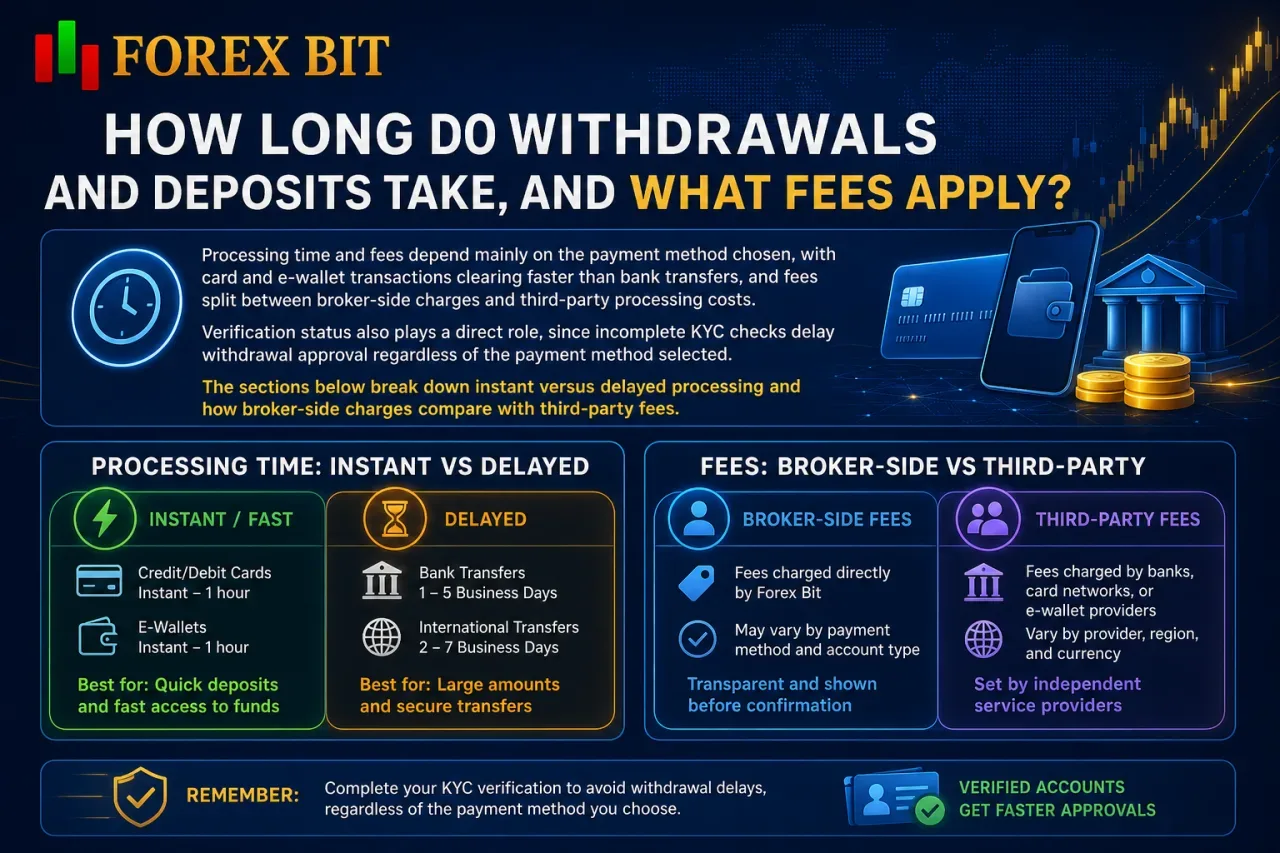
Processing time and fees depend mainly on the payment method chosen, with card and e-wallet transactions clearing faster than bank transfers, and fees split between broker-side charges and third-party processing costs. Verification status also plays a direct role, since incomplete KYC checks delay withdrawal approval regardless of the payment method selected. The sections below break down instant versus delayed processing and how broker-side charges compare with third-party fees.
Why Do Withdrawal Times Vary Between Payment Methods?
Withdrawal times vary because each payment method depends on a different combination of provider rules, broker verification steps, banking hours, and cross-border transfer requirements. These four variables interact differently depending on the payment route selected, which explains why one withdrawal clears same-day while another takes several business days.
Payment provider rules set the baseline speed. E-wallet networks process transactions internally within their own system, while card networks and banks route requests through multiple intermediaries before funds settle.
Broker internal review adds a separate layer of delay independent of the payment method itself. A withdrawal request sits in a queue for compliance and fraud checks before the broker releases funds to the chosen payment channel.
Banking hours restrict processing further. Bank transfers only move during business days and operating hours, so a request submitted outside those windows waits until the next banking session.
Cross-border transfers extend timelines the most. Funds moving between different countries or currencies pass through correspondent banks and currency conversion steps, adding processing days that domestic transfers or same-network e-wallet transfers avoid entirely.
Are There Hidden Costs in Currency Conversion During Deposits or Withdrawals?
Yes, currency conversion during deposits or withdrawals carries hidden costs whenever the trader’s funding source uses a different currency than the trading account’s base currency. This cost stacks on top of any withdrawal fee already charged by the broker or payment provider, so the total deduction often exceeds what the fee schedule alone suggests.
Three factors drive this hidden cost. Brokers or payment processors apply a conversion markup above the interbank exchange rate, meaning the rate used rarely matches the rate quoted on public currency trackers. Card networks and banks add their own separate conversion fee on the same transaction, layering a second charge onto the broker’s markup. Exchange rate fluctuations between the request time and the settlement time shift the final converted amount, so the withdrawal received can differ slightly from the amount calculated at submission.
Traders holding an account denominated in their local currency avoid repeated conversion charges on routine deposits and withdrawals, since the funding source and account currency already match.
What Is KYC/AML Verification and Why Do Brokers Require It?
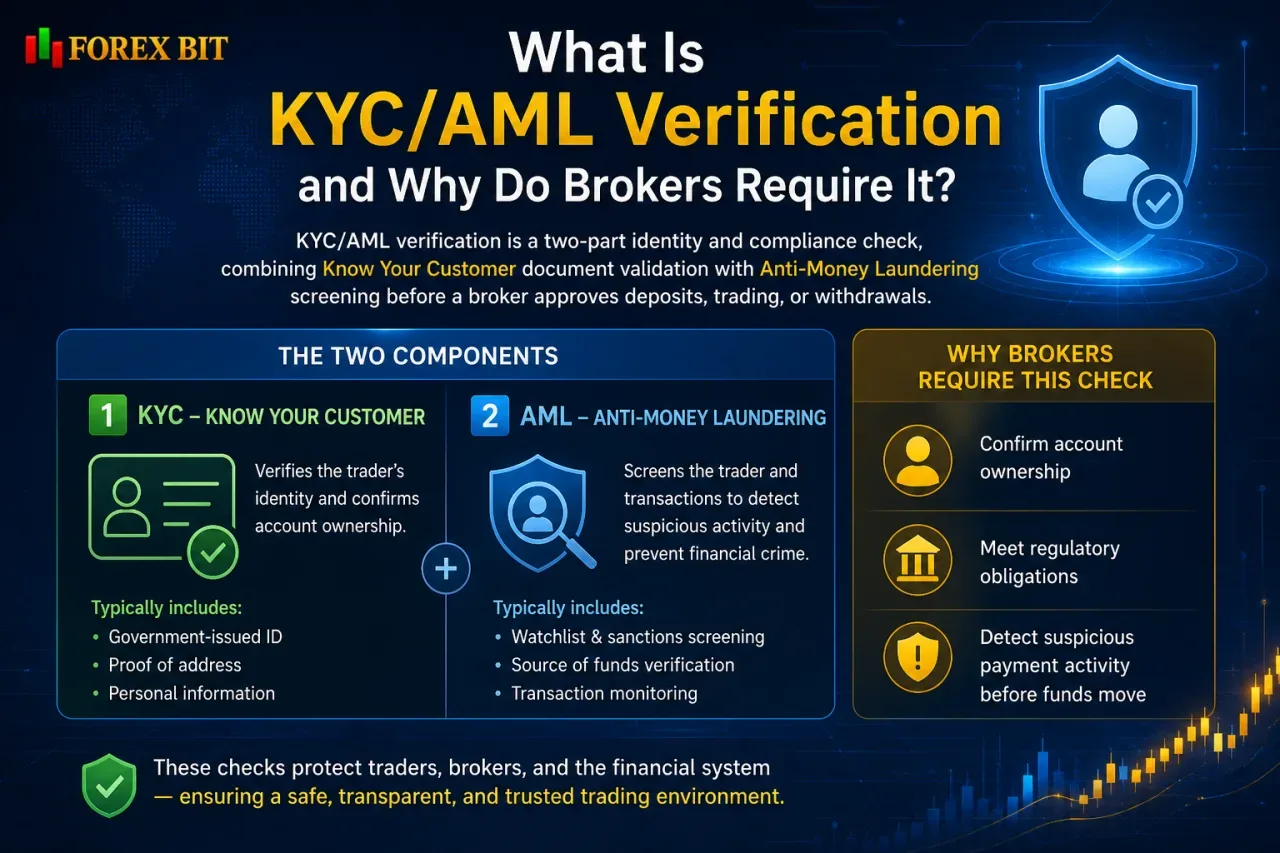
KYC/AML verification is a two-part identity and compliance check, combining Know Your Customer document validation with Anti-Money Laundering screening before a broker approves deposits, trading, or withdrawals. Brokers require this check to confirm account ownership, meet regulatory obligations, and detect suspicious payment activity before funds move through the trading account.
The two components serve distinct purposes within the same verification workflow. KYC confirms the trader’s identity and address through submitted documents, linking the trading account to a real, verifiable individual rather than an anonymous payment source. AML screening checks the funding pattern and payment source against anti-money laundering rules, flagging transactions that suggest fund layering or the use of an account by someone other than the verified owner.
Regulated brokers apply these checks at defined points in the account lifecycle, most commonly before the first withdrawal, above certain deposit thresholds, or when a payment method changes. This timing keeps unverified funds from moving out of the trading account undetected, while still allowing basic account setup and demo access before full verification completes.
What Documents Are Needed to Complete KYC Verification?
KYC verification generally requires three categories of documents: proof of identity, proof of address, and proof of payment source. This grouping covers the individual, their physical location, and the funds moving through the trading account.
Proof of identity confirms the trader is a real, verifiable person behind the account. Brokers typically accept a passport, national ID card, or driver’s licence showing a clear photo, full name, and expiry date.
Proof of address confirms the trader’s registered residential location for compliance purposes. Accepted documents usually include a recent utility bill, bank statement, or government-issued letter dated within a broker-defined recency window.
Proof of payment source links the funding method to the verified account holder, particularly for card deposits or bank transfers. Brokers commonly request a screenshot or statement showing the card’s last digits, the account holder’s name, or the originating bank account details.
Some brokers also request a selfie holding the identity document, adding a live verification step against submitted paperwork.
How Does KYC Verification Affect Deposit and Withdrawal Speed?
Completed KYC verification allows withdrawals to process without added delay, while incomplete verification blocks or pauses the transaction until a broker reviews missing documents. This status check applies at the withdrawal stage rather than at deposit, since most brokers allow funding before full identity confirmation.
A verified account skips the manual document review step, so the withdrawal moves directly into the standard payment processing queue tied to the chosen method. An unverified or partially verified account triggers a compliance hold, where the broker requests outstanding documents before releasing funds, adding processing days on top of the payment method’s normal settlement time.
Traders reduce this delay by preparing documents before submitting a withdrawal request rather than after. Uploading a valid proof of identity, a current proof of address, and any payment source documentation during account setup lets the broker complete verification well ahead of the first withdrawal request. Checking document expiry dates and file quality in advance also avoids rejected uploads, which otherwise restart the review process and extend the wait beyond the payment method’s typical timeline.
How Can Traders Identify Payment Fraud and Cybersecurity Risks?
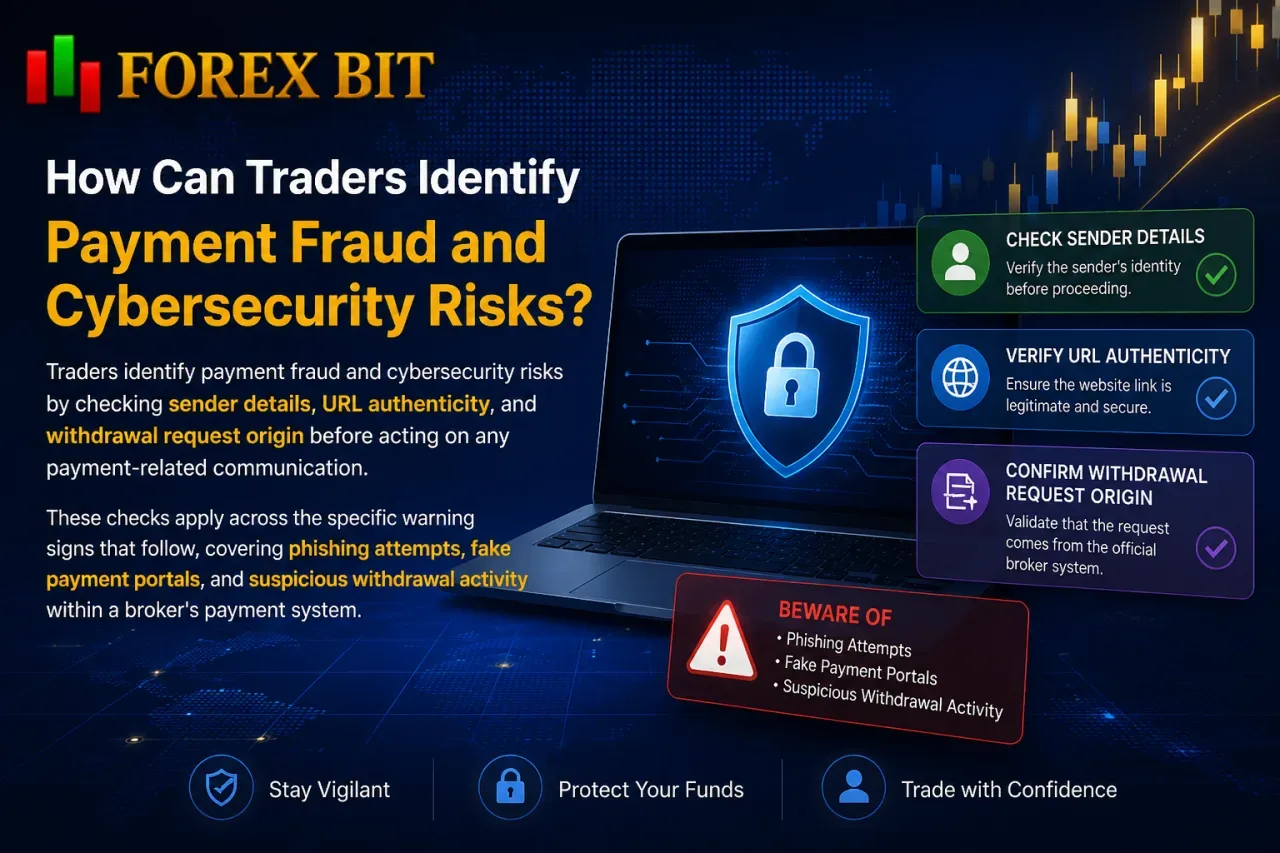
Traders identify payment fraud and cybersecurity risks by checking sender details, URL authenticity, and withdrawal request origin before acting on any payment-related communication. These checks apply across the specific warning signs that follow, covering phishing attempts, fake payment portals, and suspicious withdrawal activity within a broker’s payment system.
What Are the Common Types of Payment Fraud Targeting Traders?
Common payment fraud targeting traders falls into four categories: phishing emails, fake broker payment pages, social engineering scams, and unauthorized account access attempts. Each category exploits a different point in the deposit or withdrawal process, from the initial contact method to the final transaction step.
- Phishing emails imitate broker notifications, prompting traders to click a fraudulent link or enter login credentials on a spoofed page.
- Fake broker payment pages copy a legitimate broker’s deposit interface, redirecting funds to an account outside the broker’s actual payment system.
- Social engineering scams involve a fraudster posing as broker support staff, pressuring a trader to share verification codes, account passwords, or remote access to their device.
- Unauthorized account access attempts use stolen or guessed credentials to log into a trading account and submit withdrawal requests toward an unfamiliar destination.
Recognizing which category a suspicious message or page fits into narrows down the correct verification step, whether that means confirming the sender’s domain, checking the URL against the broker’s official site, or contacting support through a verified channel before responding.
How Can Traders Prevent Payment Fraud and Protect Account Security?
Traders prevent payment fraud and protect account security through four core practices: enabling two-factor authentication, verifying official payment channels, monitoring account activity, and avoiding shared credentials. This set of controls addresses the phishing, fake payment pages, and unauthorized access attempts described earlier, closing off the entry points those fraud types rely on.
- Enabling two-factor authentication adds a second verification step beyond the account password, blocking login attempts made with stolen credentials alone.
- Verifying official payment channels means confirming a broker’s payment page URL and deposit instructions directly through the broker’s verified website or app before entering any card or bank details.
- Monitoring account activity involves reviewing login history and withdrawal requests regularly, catching unauthorized transactions before further funds move out of the account.
- Avoiding shared credentials means never providing a password, verification code, or remote device access to anyone claiming to represent broker support.
Combining these four practices closes the main gaps that phishing emails, spoofed payment pages, and social engineering attempts typically exploit, since each control targets a different stage of the deposit or withdrawal process where unauthorized access could otherwise occur.
What Advanced Security Layers Do Brokers Use to Protect Payment Data?
Brokers and payment providers protect payment data through four advanced layers: encryption protocols, tokenized payment processing, segregated client fund accounts, and fraud-detection monitoring systems. These layers operate mostly behind the visible deposit and withdrawal interface, working together rather than as isolated safeguards. The subsections below break down how each layer functions within a broker’s payment infrastructure.
What Is Payment Tokenization and How Does It Secure Broker Transactions?
Payment tokenization is a security technique that replaces sensitive card or bank details with a unique, randomly generated token before a transaction reaches the broker’s payment system. The token carries no usable financial information on its own, so intercepted data during a deposit or withdrawal offers no direct route to the original account details.
This technique secures broker transactions by keeping actual card and bank numbers off the broker’s servers entirely. Payment processors store the original details in a separate secure vault, issuing only the token for repeat transactions such as future deposits from the same card. Even if a broker’s transaction records get exposed, the tokens stored there remain useless without access to that separate vault, limiting the damage from a data breach.
How Do Brokers Use Segregated Accounts to Secure Client Payments?
Brokers use segregated accounts by holding client payment funds in bank accounts entirely separate from the company’s own operating capital. This separation adds a financial security layer distinct from the fraud-prevention controls covered earlier, protecting deposited funds regardless of the broker’s business performance.
Segregation works by routing client deposits into a designated account held with a bank, rather than mixing that money with funds used for salaries, marketing, or other operating expenses. A regulated broker cannot draw on client funds to cover its own liabilities, since the segregated account exists outside the company’s general balance sheet. If the broker faces financial difficulty or insolvency, segregated client funds remain identifiable and separate from company creditors’ claims. Some regulators mandate segregated accounts as a licensing condition, requiring regular reconciliation between recorded client balances and the actual segregated bank balance.
Conclusion
Fund safety in forex trading rests on understanding how a broker moves money and how that process gets protected at each stage. Payment method choice determines processing speed and fee structure, KYC/AML verification confirms account ownership before withdrawals clear, and layered defenses including two-factor authentication, tokenization, and segregated accounts guard both data and capital.
Traders who match their funding method to their priorities, keep verification documents ready in advance, and confirm payment channels through official sources close off the main gaps that fraud and delays typically exploit, giving them direct control over how securely their funds travel to and from a trading account.