
Learn how source of funds verification forex checks work, required documents, timing, and what to prepare before your broker approves withdrawals.
Source of Funds Verification in Forex: Full Guide

Source of funds verification in forex trading is the process brokers use to confirm that deposited money comes from a legitimate, traceable origin, such as employment income, business earnings, savings, or investment returns. Brokers request this check to comply with anti-money laundering obligations and to confirm account holders are not using illicit funds for trading.
Payslips, bank statements, tax returns, and employment letters are commonly accepted documents used as proof of source of funds. Additional documents like sale agreements or inheritance letters may be required for larger or irregular deposits.
Brokers tend to request source of funds checks when deposit amounts are unusually large, withdrawal patterns look inconsistent, or a client’s risk profile changes. Regulatory bodies overseeing the broker often mandate these triggers as part of standard compliance monitoring.
Verification generally takes a few business days once complete documents are submitted, though incomplete or unclear paperwork can extend the timeline. Failed verification can result in restricted withdrawals, frozen accounts, or account closure until compliance requirements are satisfied.
Forex Bit breaks down exactly how this verification process works, starting with a clear definition of what source of funds checks involve in forex trading accounts.
What Is Source of Funds Verification in Forex Trading?
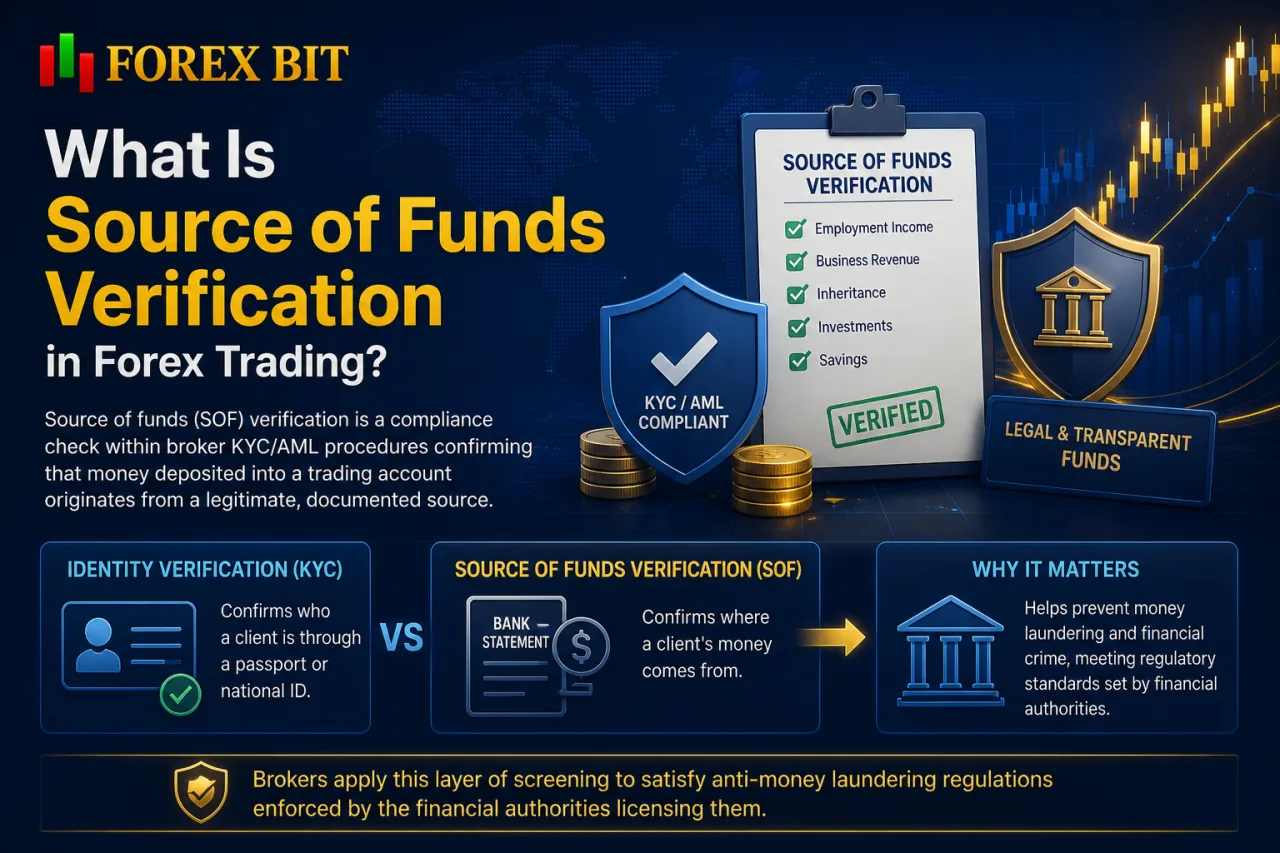
Source of funds (SOF) verification is a compliance check within broker KYC/AML procedures confirming that money deposited into a trading account originates from a legitimate, documented source. It differs from standard identity verification, which only confirms who a client is through a passport or national ID, while SOF confirms where a client’s money comes from. Brokers apply this layer of screening to satisfy anti-money laundering regulations enforced by the financial authorities licensing them, rather than as a one-time onboarding formality.
Within the account lifecycle, SOF checks typically surface after initial identity and address verification are complete, and often resurface later when deposit or withdrawal activity triggers additional review. This positions SOF as an ongoing compliance layer rather than a single early-stage step, with the following sections outlining how brokers apply it in practice.
How Is Source of Funds Different from Source of Wealth?
Source of funds refers to the origin of one specific deposit, while source of wealth refers to how a client accumulated their overall net worth over time. A SOF check on a single transfer asks where that particular sum came from, such as a salary payment or a property sale, whereas a source of wealth review looks at the broader financial history behind a client’s total assets, including past income, investments, inheritance, or business ownership accumulated over years.
Brokers request both when a deposit is large relative to a client’s declared profile or when risk scoring flags the account for enhanced due diligence. In these cases, confirming a single deposit is not enough to satisfy compliance obligations, since regulators expect brokers to understand whether the client’s overall wealth level is consistent with the trading activity on the account. A high-net-worth client depositing a large sum may need to show source of wealth documentation, such as business ownership records or long-term investment statements, in addition to proof for that specific deposit. Standard retail accounts with modest, consistent deposits typically only face source of funds checks, without the added requirement of a full wealth history review.
How Does the Source of Funds Verification Process Work?
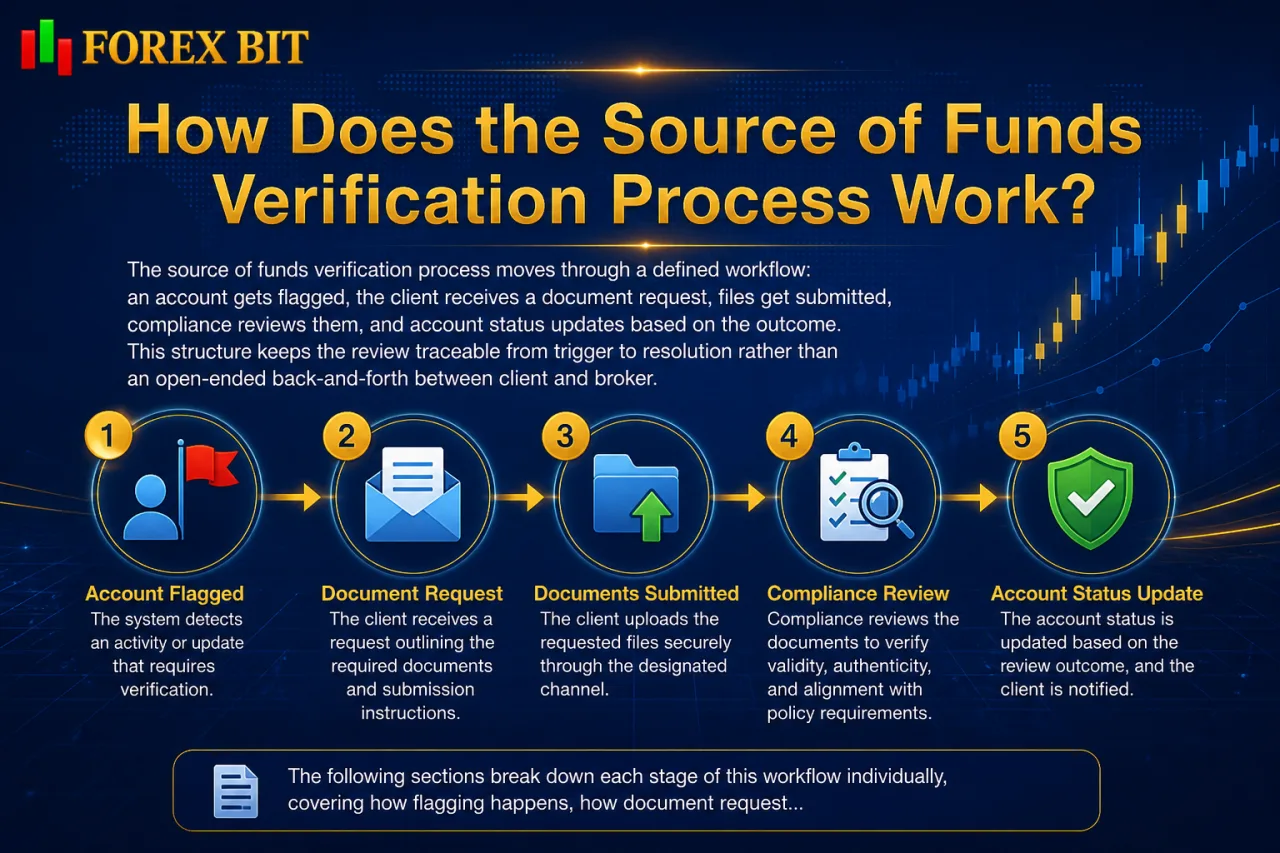
The source of funds verification process moves through a defined workflow: an account gets flagged, the client receives a document request, files get submitted, compliance reviews them, and account status updates based on the outcome. This structure keeps the review traceable from trigger to resolution rather than an open-ended back-and-forth between client and broker.
The following sections break down each stage of this workflow individually, covering how flagging happens, how document requests reach clients, and what compliance review typically involves before an account status is finalized.
What Are the Typical Verification Steps a Trader Must Follow?
A trader follows a sequence of six steps during a source of funds check: notification, document collection, submission, compliance review, possible additional requests, and final confirmation. This sequence keeps the interaction between client and broker structured rather than open-ended.
The process starts once the trigger discussed above places an account under review, and each stage builds on the previous one until compliance closes the case.
- Notification: the broker informs the client through email or an account dashboard message specifying which documents are required.
- Document collection: the client gathers files such as bank statements, payslips, or tax returns matching the deposit under review.
- Submission: the client uploads documents through the broker’s secure portal or client area.
- Compliance review: the internal team cross-checks submitted files against account details and transaction history.
- Possible additional requests: compliance asks for clarifying documents if initial files are incomplete or inconsistent.
- Confirmation: the broker updates account status once the review closes, restoring full account functionality.
Accuracy and consistency matter throughout this sequence, since names, addresses, and figures on submitted documents must match the account registration details exactly. Mismatched information at any stage extends the review timeline or triggers a fresh request for clarification.
What Information Does the Broker Ask For During Review?
Brokers request five categories of data during a source of funds review: employment status, income range, nature of the deposited funds, transaction history, and the relationship between the account holder and the payment method owner. This follow-up question builds directly on the document collection and submission steps outlined earlier, since compliance teams use these data points to interpret the files a client uploads.
- Employment status: current job title, employer name, and length of employment, confirmed through an employment letter or contract.
- Income range: approximate salary or business earnings bracket, cross-checked against payslips or tax filings.
- Nature of deposited funds: whether the money originates from salary, business revenue, savings, an asset sale, or a gift or inheritance.
- Transaction history: the flow of funds from the originating account to the trading account, traced through bank statements.
- Relationship between account holder and payment method owner: verification that a card, wallet, or bank account used for deposit belongs to the client or, if not, documentation explaining the connection to a third party.
Compliance teams request these data points together because each one supports the others when tracing whether a deposit matches the client’s declared financial profile.
Which Documents Are Accepted as Proof of Source of Funds?
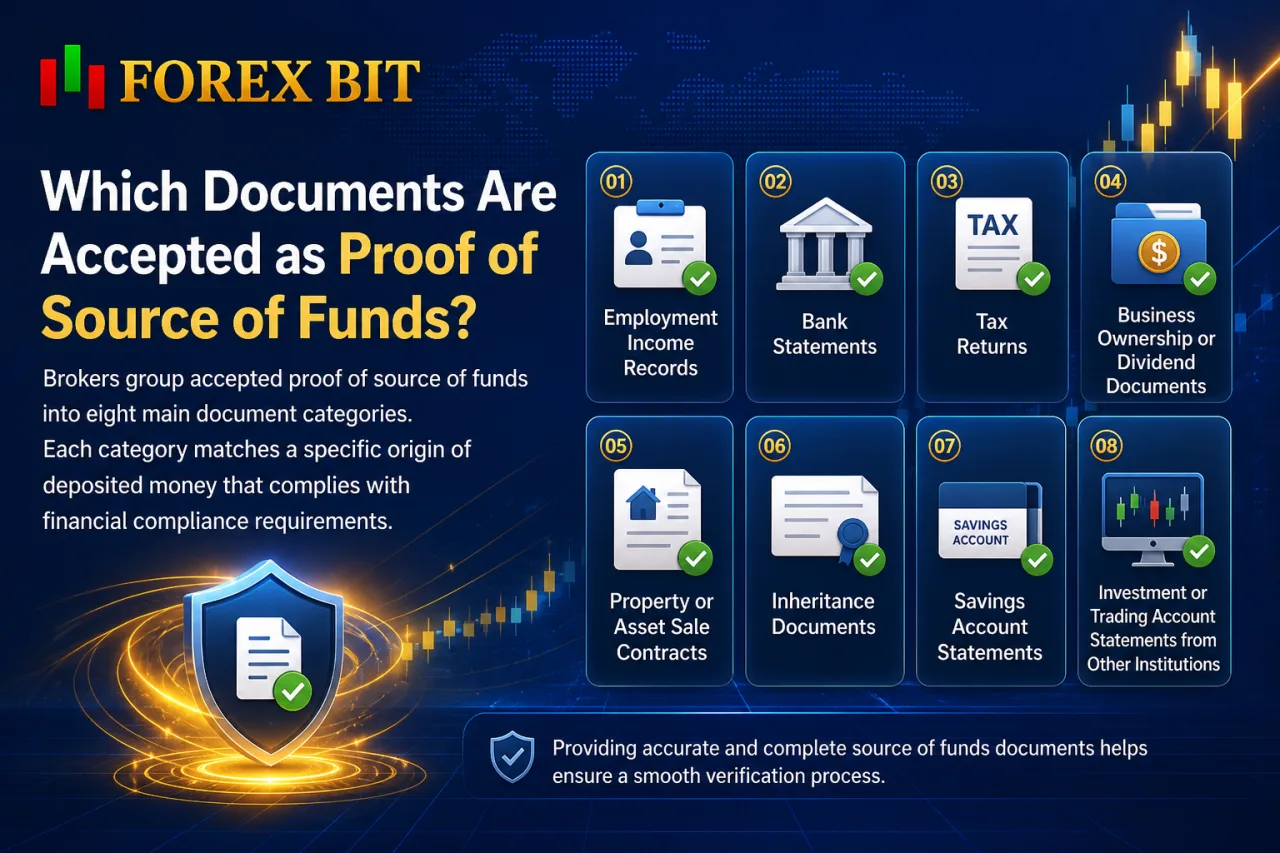
Brokers group accepted proof of source of funds into eight main document categories: employment income records, bank statements, tax returns, business ownership or dividend documents, property or asset sale contracts, inheritance documents, savings account statements, and investment or trading account statements from other institutions. This follow-up connects directly to the document collection step described earlier, since each category matches a specific origin of deposited money that compliance teams need to trace.
The categories broken down individually cover the following document types.
- Employment income records: payslips and employment letters confirming salary as the deposit source.
- Bank statements: account records showing the flow of funds prior to the trading deposit.
- Tax returns: filed tax documents corroborating declared income levels.
- Business ownership or dividend documents: company registration papers, shareholder records, or dividend statements for self-employed or business-owning clients.
- Property or asset sale contracts: signed sale agreements when a deposit originates from selling real estate or another asset.
- Inheritance documents: probate papers or inheritance letters for funds received through a bequest.
- Savings account statements: records showing accumulated personal savings used to fund the account.
- Investment or trading account statements: statements from other financial institutions when funds come from external portfolios or trading profits.
Each category applies according to the client’s declared origin of the deposit, and mismatched or missing documentation extends the review discussed in the compliance workflow above.
What Documents Prove Employment or Business Income?
Employment or business income gets proven through four core document types: payslips, employment contracts, tax filings, and business registration certificates paired with audited financial statements for self-employed traders. This follow-up builds on the employment income category outlined in the document groupings above, narrowing focus specifically on how salaried and self-employed clients each substantiate their income source.
Salaried clients typically rely on a payslip showing recent earnings alongside an employment contract confirming job title and employer details. Tax filings reinforce this by cross-referencing declared income against official government records for the relevant assessment period.
Self-employed traders or business owners face a different documentation path. Compliance teams request:
- Business registration certificates confirming the company legally exists and the client holds an ownership or operating role.
- Audited financial statements demonstrating revenue and profit figures consistent with the declared deposit amount.
- Tax filings covering business income, submitted alongside personal tax returns where applicable.
Each document category matches the client’s employment status, and mismatched figures between payslips, contracts, and tax filings extend the compliance review discussed earlier in the verification workflow.
What Documents Prove Non-Employment Income Sources?
Non-employment income sources get proven through six document types: inheritance letters, gift declarations, property sale agreements, pension statements, dividend or investment income statements, and cryptocurrency wallet transaction history where the broker accepts digital assets as a funding origin. This follow-up connects to the document groupings covered earlier, narrowing focus on clients funding an account from sources other than a salary or business.
Each document type matches a distinct origin of the deposit under review.
- Inheritance letters: probate documents or bank confirmations showing funds transferred from a deceased person’s estate.
- Gift declarations: signed statements from the gift-giver confirming the transfer, sometimes paired with the giver’s own bank statement.
- Property sale agreements: signed contracts and settlement statements confirming proceeds from a real estate or asset sale.
- Pension statements: retirement fund or annuity records confirming periodic or lump-sum pension income.
- Dividend or investment income statements: brokerage or fund statements showing returns paid out from shares, bonds, or managed portfolios.
- Cryptocurrency wallet transaction history: exchange records or wallet logs tracing crypto-to-fiat conversion, accepted only where the broker permits crypto-linked deposits.
Some brokers accept cryptocurrency wallet history as proof of source of funds, but only where crypto-linked deposits are permitted, and such documentation typically receives additional scrutiny. Documents must show the account holder’s name matching the trading account registration, consistent with the accuracy requirement discussed in the verification steps above.
Why Do Forex Brokers Request Source of Funds Checks and When Are They Triggered?
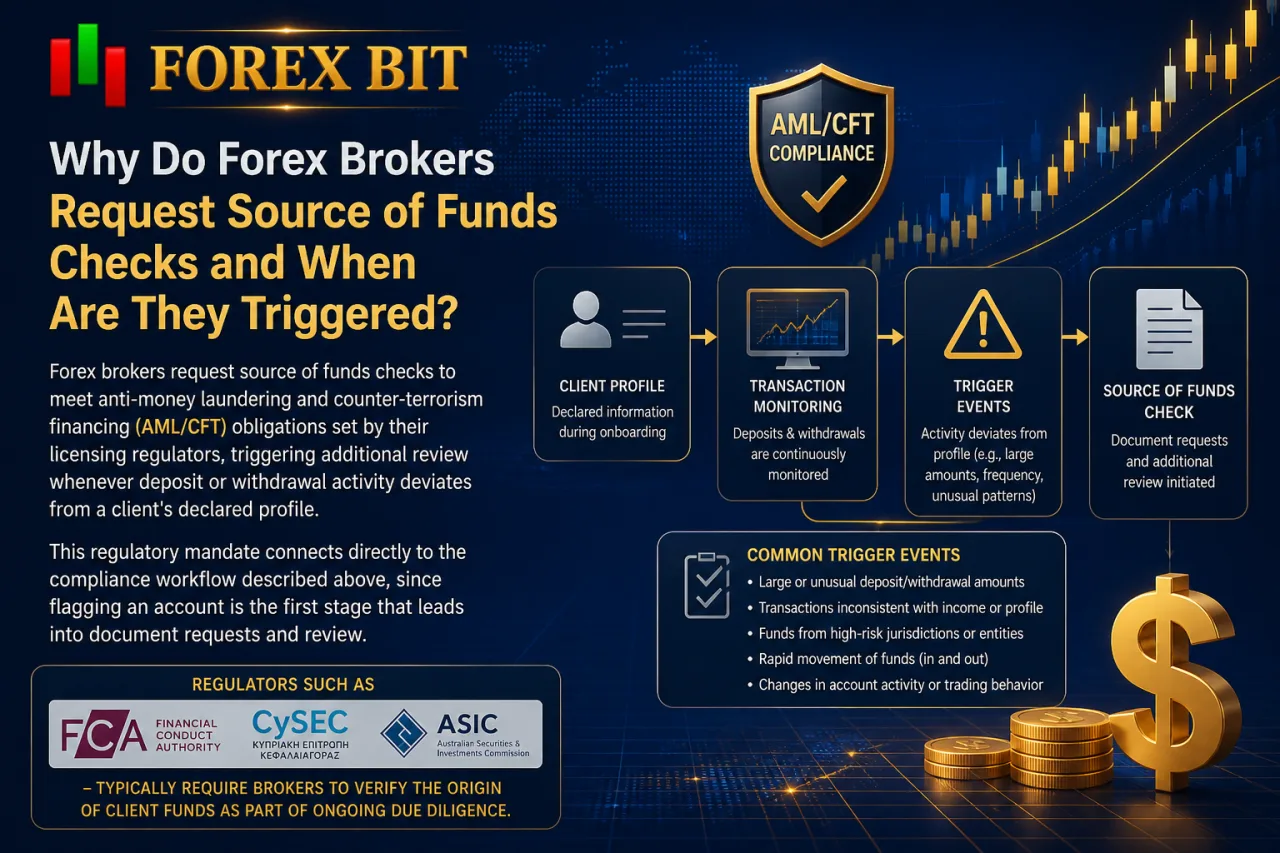
Forex brokers request source of funds checks to meet anti-money laundering and counter-terrorism financing (AML/CFT) obligations set by their licensing regulators, triggering additional review whenever deposit or withdrawal activity deviates from a client’s declared profile. This regulatory mandate connects directly to the compliance workflow described above, since flagging an account is the first stage that leads into document requests and review.
Regulators such as the FCA, CySEC, and ASIC-type authorities require licensed brokers to monitor client transactions on an ongoing basis, not only at onboarding. This obligation places the responsibility for detecting suspicious patterns on the broker rather than leaving it to a one-time identity check.
Several conditions commonly trigger a source of funds request:
- Large deposits relative to a client’s declared income or account history.
- Unusual transaction patterns, such as rapid deposit-and-withdrawal cycles.
- High-value withdrawals following a period of limited trading activity.
- Mismatched payment methods, where the funding source does not match the account holder’s name.
- Third-party transfers coming from accounts not registered under the client.
- Sudden changes in trading volume that diverge from the client’s typical activity.
Each trigger prompts the same downstream workflow: notification, document collection, and compliance review, as outlined in the verification steps discussed earlier.
What Deposit or Withdrawal Amounts Usually Trigger a Review?
There is no universal deposit or withdrawal amount that automatically triggers a source of funds review, since brokers set internal thresholds that can vary by jurisdiction, license, and individual risk model. This question connects directly to the trigger conditions discussed earlier, since amount-based thresholds sit alongside pattern-based flags in a broker’s monitoring system.
A single large transaction is not the only path to review. Cumulative activity over a period, such as multiple moderate deposits that add up to a significant sum, can prompt the same compliance check as one oversized transfer.
- Single-transaction thresholds: set internally by each broker and rarely published in full detail.
- Cumulative thresholds: calculated across weeks or months rather than one isolated deposit.
- Jurisdictional differences: brokers regulated under stricter AML regimes tend to apply lower internal thresholds.
- Risk-based adjustments: a client’s account history and declared profile shift where the threshold sits for that individual.
Because these figures stay largely undisclosed, traders cannot rely on a fixed number to predict when a check activates, consistent with the broader trigger conditions outlined above.
Does Trading Activity or Account Behavior Affect Verification Requests?
Yes, trading activity and account behavior affect verification requests, since brokers monitor transaction patterns rather than deposit size alone. This connects directly to the trigger conditions outlined above, since behavioral signals sit alongside amount-based thresholds in a broker’s compliance monitoring system.
Several behavioral patterns commonly prompt additional review:
- Cycling funds through rapid deposit-and-withdrawal sequences with minimal trading in between.
- Funding an account from inconsistent sources across separate transactions, such as alternating banks or payment providers without explanation.
- Using third-party payment methods where the card, wallet, or bank account does not match the registered account holder’s name.
- Shifting trading volume suddenly after a period of low or inactive account usage.
- Withdrawing large sums shortly after a deposit clears, without corresponding trading history.
Each pattern feeds into the same compliance workflow discussed earlier, moving from flagging to document requests once behavior deviates from the client’s declared profile.
How Long Does Source of Funds Verification Take and What Happens If It Fails?
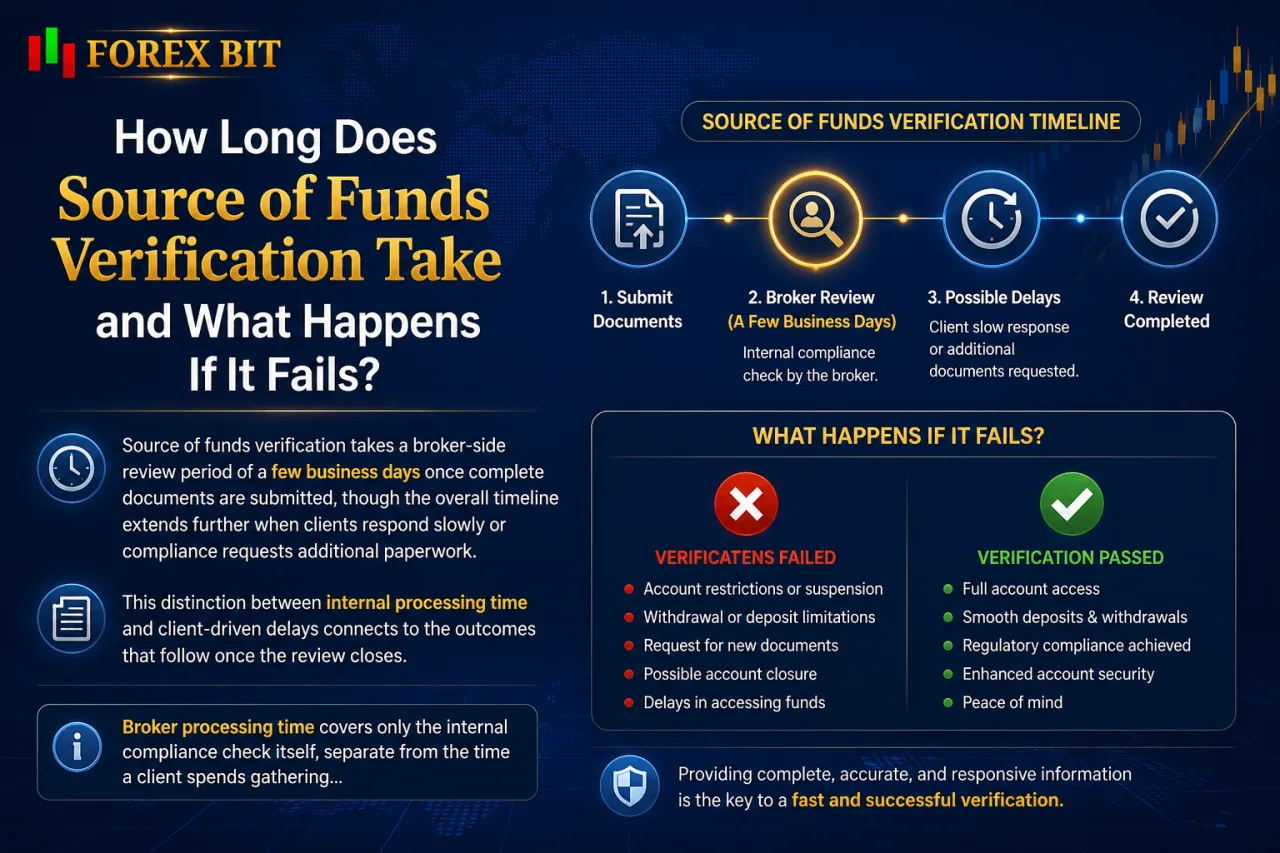
Source of funds verification takes a broker-side review period of a few business days once complete documents are submitted, though the overall timeline extends further when clients respond slowly or compliance requests additional paperwork. This distinction between internal processing time and client-driven delays connects to the outcomes that follow once the review closes.
Broker processing time covers only the internal compliance check itself, separate from the time a client spends gathering payslips, bank statements, or ownership records before submission. A single round of additional document requests, discussed earlier in the verification steps, restarts part of that internal clock rather than adding to it linearly.
Four outcomes follow a completed review:
- Approval: the broker restores full account functionality once submitted documents match the declared deposit origin.
- Temporary account restriction: the broker limits trading or new deposits until outstanding documents arrive.
- Withdrawal hold: the broker pauses fund withdrawals specifically while compliance confirms the deposit’s legitimacy.
- Account closure: the broker closes the account when documentation fails to establish a legitimate, traceable source of funds.
Each outcome maps directly to how completely and consistently a client satisfies the document requests outlined earlier in the compliance workflow.
What Happens If a Trader Fails to Provide Sufficient Proof?
Failing to provide sufficient proof of source of funds results in restricted trading, blocked withdrawals, funds returned to their original payment method, and potential account suspension or closure. This outcome extends the compliance workflow discussed earlier, since an unresolved document request moves the account from “under review” to an active restriction rather than leaving the case open indefinitely.
Several consequences follow when documentation remains incomplete or unverifiable:
- Restricting trading activity by limiting new positions or capping account access until compliance closes the case.
- Blocking withdrawals specifically, so deposited funds stay locked on the account regardless of trading balance.
- Returning funds to the original payment method when the broker cannot confirm a legitimate deposit source, rather than releasing cash to an alternate destination.
- Suspending or closing the account entirely if a client fails to submit adequate documentation within the broker’s compliance deadline.
- Reporting the case internally to a regulator or financial intelligence unit when the broker suspects money laundering under its AML obligations.
Each consequence maps to how a broker’s compliance team assesses the gap between requested documents and what a client actually submits, consistent with the review workflow described earlier in this guide.
Are There Regional Differences in Source of Funds Requirements?
Yes, source of funds requirements differ regionally, since tier-1 regulated brokers under the FCA or ASIC apply stricter AML thresholds than offshore-regulated entities with lighter documentation demands. This regulatory jurisdiction variance connects directly to the trigger conditions and thresholds discussed earlier, since the same deposit pattern can prompt different responses depending on which authority licenses the broker. The following breakdown separates how tier-1 oversight compares against offshore licensing before addressing specific directive-driven rules.
Tier-1 brokers regulated by the FCA in the UK or ASIC in Australia operate under comprehensive AML frameworks that mandate detailed source of funds checks at lower deposit thresholds and with more frequent re-verification cycles. These regulators require brokers to maintain documented risk assessments for each client and to escalate reviews whenever deposit patterns deviate from a client’s declared profile.
EU and UK brokers in particular apply stricter AML thresholds due to directives like AMLD5, which expands the scope of enhanced due diligence and lowers the transaction thresholds that trigger mandatory source of funds verification. This directive-driven approach means clients trading with EU or UK regulated entities encounter verification requests earlier and more consistently than clients using less regulated jurisdictions.
Offshore-regulated brokers, by contrast, typically operate under lighter AML regimes with fewer mandatory checkpoints and higher deposit thresholds before documentation is requested. While this can mean faster onboarding, it also reflects reduced regulatory oversight compared to tier-1 jurisdictions.
How Do High-Net-Worth or Professional Trader Accounts Differ in Verification Depth?
High-net-worth and professional trader accounts face deeper verification through mandatory source-of-wealth reviews, asset declarations, and enhanced due diligence, while standard retail accounts typically clear source of funds checks with basic income documentation alone. This account tier variance connects directly to the source of wealth distinction discussed earlier in this guide, since higher deposit thresholds and trading volumes push compliance teams beyond confirming a single transaction toward assessing a client’s entire financial standing.
Several factors separate the depth of review applied to these account tiers:
- Requesting full asset declarations covering property, investment portfolios, and business holdings rather than a single deposit source.
- Applying enhanced due diligence procedures that extend beyond standard identity and address checks.
- Reviewing recurring high-volume transactions as an ongoing pattern rather than isolated events.
- Cross-referencing declared wealth against professional or accredited investor status where applicable.
Standard retail accounts rarely trigger this expanded scope unless deposit size or behavior deviates sharply from the declared profile discussed in the earlier trigger conditions.
Conclusion
Source of funds verification in forex trading exists to confirm that deposited money traces back to a legitimate origin, moving through notification, document collection, compliance review, and a final account status update. Traders satisfy this process by matching their documentation, payslips, bank statements, tax filings, or sale agreements, to the exact origin they declare, since consistency between figures and names determines how smoothly the review closes.
Deposit size, transaction patterns, and jurisdictional rules all shape how deep a check goes, with high-net-worth or professional accounts facing broader source-of-wealth scrutiny. Preparing accurate, complete records before a review starts remains the clearest way to avoid restricted withdrawals or account suspension.
William Johnson is a Forex & Broker News Analyst at Forex Bit, focusing on broker updates, regulatory developments, payment changes, and security-related news. His work helps readers stay informed about important industry developments and understand how these changes may affect broker services and trading conditions.
Email: [email protected]



Best Brokers

Trade with the world’s largest retail broker and benefit from better - than - market conditions.

We offer a superior trading environment that puts traders in the best position to profit.

Invest and trade global markets with eToro – a Nasdaq-listed multi-asset platform built around social investing and CopyTrader.

Trade with the best trading conditions. WIN THE BEST TRADING ACCOUNT AWARD.






Forex Bit provides independent forex broker reviews, comparisons, guides, and industry news to help traders make informed decisions.
Best Brokers
Metatrader 5 Brokers
Metatrader 4 Brokers
Lowest Spread Forex Broker
Regulated Forex Brokers
Forex Copy Trading
Ctrader Brokers
Best Forex Broker For Beginners