









IG, Pepperstone, XTB, XM, Saxo Bank, and FOREX.com rank among the best regulated forex brokers in 2026. These brokers are regulated by top-tier authorities, including the FCA and ASIC. Each broker holds multiple licenses across jurisdictions, giving traders a verified layer of legal protection before depositing funds.
Rankings in this comparison are based on regulatory strength, the safeguards brokers put in place for client funds, and the legal protections available to traders in different regions. Brokers licensed by stricter regulators generally hold a stronger position on this list.
Forex Bit compares these regulatory details to help identify which brokers meet the highest safety standards for 2026. The following section breaks down the top regulated brokers and the licenses behind their rankings.
Which Brokers Are the Best Regulated Forex Brokers in 2026?
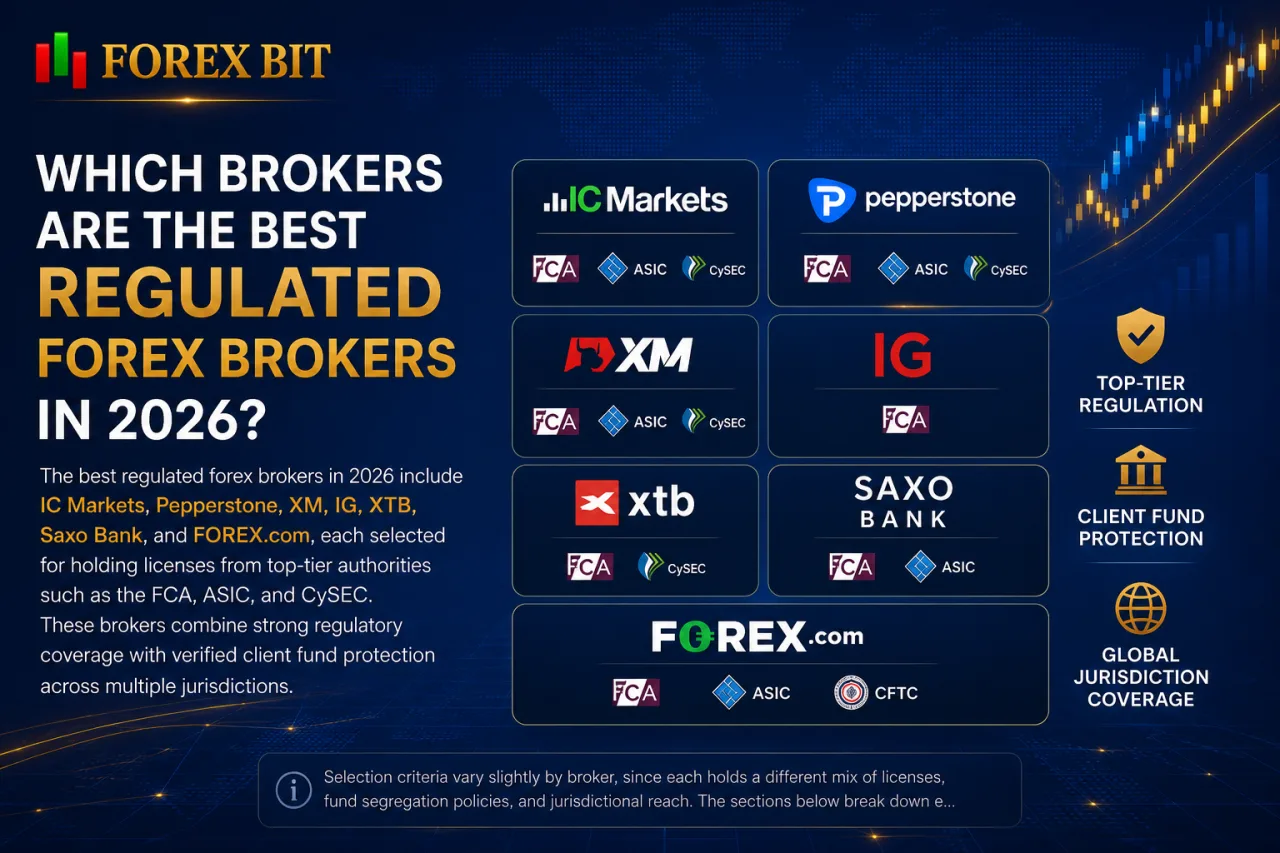
The best regulated forex brokers in 2026 include IG, Pepperstone, XTB, XM, Saxo Bank, and FOREX.com, each selected for holding licenses from top-tier authorities such as the FCA, ASIC, and CySEC. These brokers combine strong regulatory coverage with verified client fund protection across multiple jurisdictions.
Selection criteria vary slightly by broker, since each holds a different mix of licenses, fund segregation policies, and jurisdictional reach. The sections below break down each broker individually, comparing their specific regulators, legal entities, and client protection standards.
How Do These Regulated Brokers Compare Side by Side?
Pepperstone, XM, and XTB lead on multi-jurisdiction licensing. IG, Saxo Bank, and FOREX.com stand out for holding regulatory approval in stricter single markets such as the UK and the US. The table below places regulators, jurisdiction, and client protection side by side for direct comparison before the detailed broker sections.
| Broker | Regulators | Jurisdiction | Client Protection |
|---|---|---|---|
| Pepperstone | FCA, ASIC, CySEC, DFSA | UK, Australia, Cyprus, UAE | Segregated funds, negative balance protection, FSCS coverage (UK entity) |
| XM | CySEC, ASIC, IFSC | Cyprus, Australia, Belize | Segregated funds, negative balance protection |
| IG | FCA, ASIC, MAS | UK, Australia, Singapore | Segregated funds, FSCS coverage (UK entity) |
| XTB | FCA, CySEC, KNF | UK, Cyprus, Poland | Segregated funds, negative balance protection, FSCS coverage (UK entity) |
| Saxo Bank | FCA, DFSA, MAS | UK, UAE, Singapore | Segregated funds, FSCS coverage (UK entity) |
| FOREX.com | FCA, NFA/CFTC, ASIC | UK, US, Australia | Segregated funds, SIPC-style coverage (US entity) |
Client protection under FCA regulation generally includes coverage through the Financial Services Compensation Scheme, which reimburses eligible clients up to a set limit if a broker fails.
Coverage under CySEC and ASIC licenses does not include FSCS protection, since that scheme applies only to UK-regulated entities. Traders opening accounts under an offshore entity of any listed broker typically lose access to the compensation scheme tied to the stricter jurisdiction.
What Makes a Forex Broker Officially Regulated?
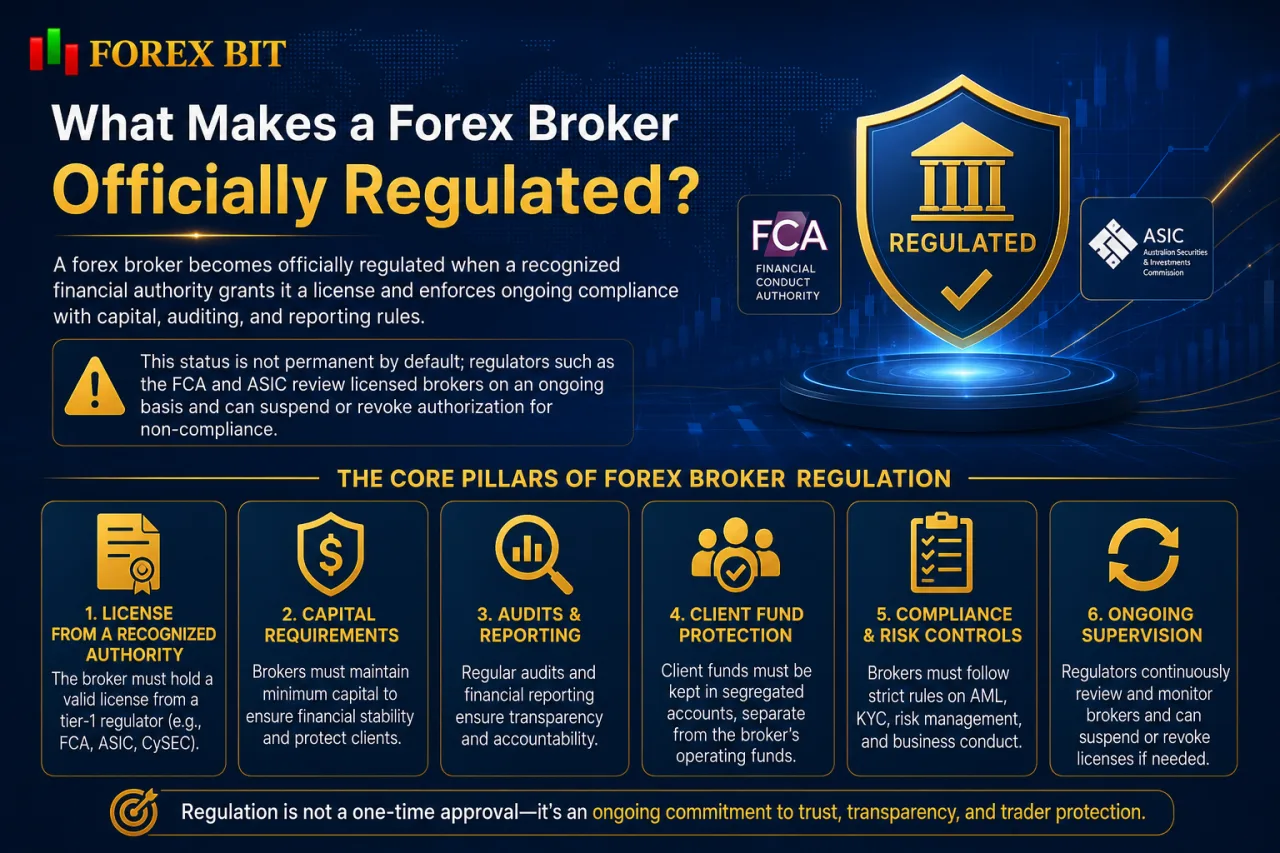
A forex broker becomes officially regulated when a recognized financial authority grants it a license and enforces ongoing compliance with capital, auditing, and reporting rules. This status is not permanent by default; regulators such as the FCA and ASIC review licensed brokers on an ongoing basis and can suspend or revoke authorization for non-compliance.
Regulation of a broker like IC Markets or Pepperstone rests on a few core pillars rather than a single approval step. The main components include:
- A formal license issued by the relevant authority.
- Minimum capital requirements to absorb financial shocks.
- Independent auditing of company accounts.
- Periodic reporting obligations to the regulator.
- Legal accountability that allows clients to file complaints through official channels.
A single broker often operates under multiple legal entities, each licensed in a different jurisdiction with a different strength of oversight. The entity a trader is assigned depends on their country of residence, which means two clients of the same broker name can hold accounts with different regulatory protections.
FCA vs ASIC vs CySEC: Which Regulator Offers the Strongest Oversight?
The FCA and ASIC outrank CySEC in oversight strength, based on higher capital requirements, stricter leverage limits, and more active enforcement records. This ranking directly affects how much protection a trading account actually carries once regulation is compared broker by broker.
Capital requirements differ across the three regulators. The FCA maintains strict minimum capital requirements among major forex regulators, requiring licensed brokers to hold substantial reserves before client trading even begins.
Leverage limits also separate top-tier from mid-tier oversight. FCA and ASIC both cap retail leverage at levels lower than many offshore regulators allow. CySEC operates under MiFID II rules, which apply similar retail leverage restrictions across the EU but with a lighter enforcement track record than the FCA or ASIC.
Enforcement history reinforces this gap. The FCA and ASIC have each pursued disciplinary actions and license revocations against non-compliant brokers, while CySEC’s enforcement activity is generally considered less aggressive despite meeting baseline MiFID II standards. This combination of capital strength, leverage discipline, and enforcement consistency places CySEC in a mid-tier category relative to the FCA and ASIC.
Does the Broker’s License Apply to Every Client Worldwide?
No, a broker’s license does not automatically apply to every client worldwide, since brokers like IC Markets, Pepperstone, and XM operate through multiple legal entities registered in different jurisdictions. Each entity carries its own regulatory scope and protection level, and only the entity a client is actually onboarded under determines which rules apply to that account.
This directly affects the jurisdiction and legal entity questions raised earlier about IC Markets, Pepperstone, and XM. A trader based in the UK typically opens an account under a broker’s FCA-regulated entity, while a client from a region outside the FCA, ASIC, or CySEC coverage area is often onboarded under an offshore entity, such as one licensed by the FSC Mauritius or the Vanuatu FSC.
Offshore entities generally carry lighter capital requirements and weaker enforcement oversight compared to FCA or ASIC entities. Client protections such as negative balance protection or FSCS coverage do not necessarily transfer between a broker’s regulated and offshore entities.
Traders confirm their assigned entity by checking the terms and conditions or legal disclaimers listed on the account opening page before depositing funds.
Do These Brokers Offer Client Fund Segregation and Negative Balance Protection?
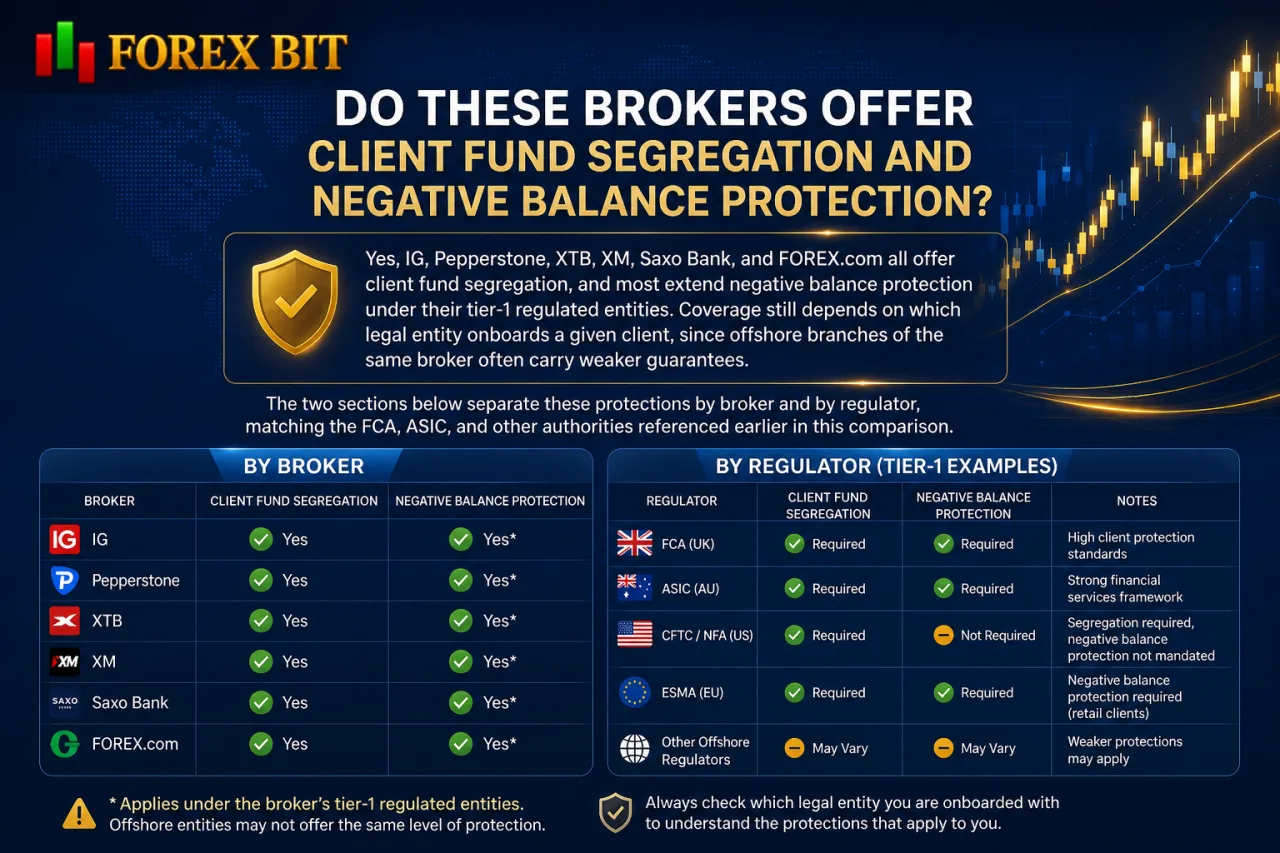
Yes, IG, Pepperstone, XTB, XM, Saxo Bank, and FOREX.com all offer client fund segregation, and most extend negative balance protection under their tier-1 regulated entities. Coverage still depends on which legal entity onboards a given client, since offshore branches of the same broker often carry weaker guarantees.
The two sections below separate these protections by broker and by regulator, matching the FCA, ASIC, and other authorities referenced earlier in this comparison.
IC Markets vs Pepperstone: Which Offers Stronger Regulatory-Backed Protection?
Pepperstone offers broader retail protection through its FCA-regulated UK entity and FSCS coverage, while IC Markets relies on ASIC oversight paired with negative balance protection but no FSCS-equivalent scheme. This distinction shapes the actual trade-off between the two brokers rather than a simple ranking of one over the other.
IC Markets is brought into this comparison alongside Pepperstone specifically because both are frequently shortlisted by traders evaluating ASIC-regulated and FCA-regulated options side by side, beyond the six brokers covered in the broader overview above.
Both brokers segregate client funds and apply negative balance protection across their regulated entities, matching the baseline standards already outlined for IG, XTB, XM, Saxo Bank, and FOREX.com. The difference emerges in regulator mix and jurisdictional depth.
- Pepperstone holds licenses under the FCA, ASIC, CySEC, and DFSA, giving it exposure to four distinct regulatory frameworks.
- IC Markets operates under ASIC, CySEC, and FSA Seychelles, with its Seychelles entity carrying materially lighter oversight than ASIC or CySEC.
- Pepperstone clients onboarded under the UK entity gain FSCS compensation eligibility, a protection IC Markets does not offer under any of its current licenses.
- IC Markets concentrates its strongest protection under ASIC, which enforces client money rules and negative balance protection at the account level.
Traders assigned to Pepperstone’s UK entity generally hold stronger compensation backing than those placed under IC Markets’ Seychelles entity. Jurisdiction determines which safeguards actually apply.
Which Regulated Broker Is Best for Your Jurisdiction or Trading Needs?
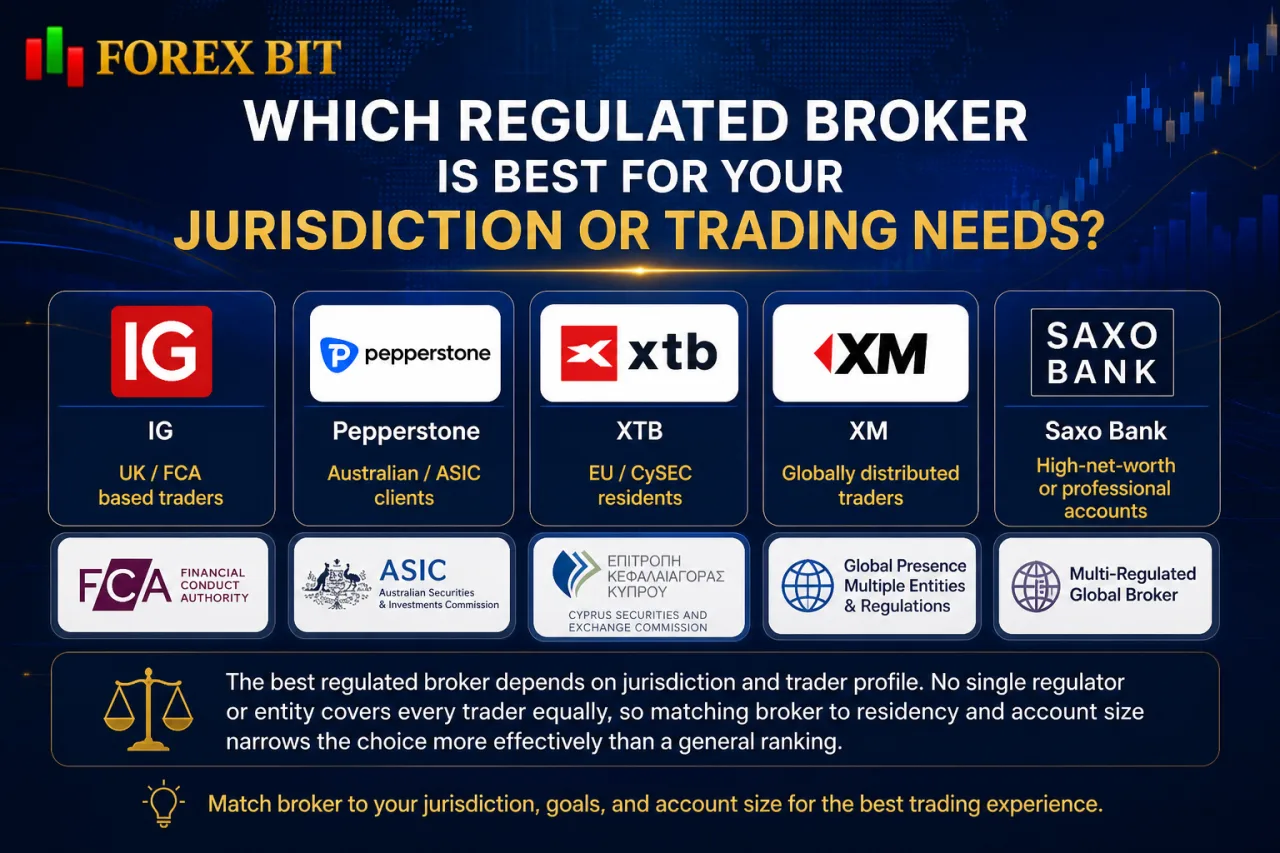
The best regulated broker depends on jurisdiction and trader profile, since IG suits UK/FCA-based traders, Pepperstone fits Australian/ASIC clients, XTB matches EU/CySEC residents, XM serves globally distributed traders, and Saxo Bank targets high-net-worth or professional accounts. No single regulator or entity covers every trader equally, so matching broker to residency and account size narrows the choice more effectively than a general ranking. The sections below group each broker by the jurisdiction and trader type it fits best.
How Did Forex-bit Select and Rank These Regulated Brokers?
Forex Bit ranks regulated brokers by weighting Regulation & Trust as the top criterion, followed by Client Fund Protection, Trading Costs, Platform Quality, Execution, and Customer Support. This weighting reflects the search intent behind a regulated-broker comparison, where legal safety outweighs cost or platform features.
Regulation & Trust carries the heaviest weight because a broker’s license tier, such as FCA or ASIC versus an offshore entity, determines whether any other advantage actually applies to a given trader. Client Fund Protection follows directly, covering segregation policies and negative balance protection across each broker’s regulated entities.
- Trading Costs measure spreads and commissions only after regulatory standing is confirmed.
- Platform Quality evaluates execution tools available under each broker’s licensed entity.
- Execution reviews order fill consistency reported for regulated accounts.
- Customer Support assesses response quality tied to the client’s specific jurisdiction.
This order keeps brokers like IC Markets, Pepperstone, and XM ranked primarily on licensing strength rather than promotional features.
What Are the Lesser-Known Signs of a Truly Trustworthy Regulated Broker?
Trustworthy regulated brokers reveal advanced trust indicators beyond a basic license, including published financial reports, ombudsman access, named tier-1 bank auditors, and public enforcement records. These markers separate brokers like IC Markets, Pepperstone, and XM from firms that hold a license number but offer little beyond it. The sections below break down each indicator on its own.
How Can Traders Verify a Broker’s License Directly with the Regulator?
Traders verify a broker’s license by searching the regulator’s public register, such as the FCA Register, ASIC Connect, or CySEC’s list of regulated entities, using the exact license number listed on the broker’s website. This process confirms both authenticity and current status rather than relying on a badge displayed on the broker’s homepage.
Verifying IC Markets, Pepperstone, or XM directly through a regulator’s database follows a similar sequence across the three authorities referenced earlier.
- Locate the license or registration number on the broker’s official website, usually in the footer or legal disclosures page.
- Open the FCA Register, ASIC Connect, or CySEC’s regulated entities list depending on which regulator issued that license.
- Enter the license number or firm name into the register’s search field.
- Confirm the entity name matches exactly, since a similar name under a different license status often signals a clone firm.
- Check the status field for terms such as “authorized” or “revoked” before depositing funds.
This step distinguishes a genuinely regulated entity from an offshore branch or clone site referenced in the earlier jurisdiction comparison.
Do Regulators Publish Broker Fines or Enforcement Actions Publicly?
Yes, the FCA, ASIC, and CySEC each publish enforcement notices and fines publicly, listing sanctioned firms, penalty amounts, and the specific rule breaches involved. This transparency answers the enforcement-history question raised earlier about verifying a broker beyond its license status alone.
Checking a regulator’s enforcement record adds a layer of insight that a simple “authorized” status cannot provide. A broker holding an active license can still carry a history of fines for client money violations, misleading advertising, or reporting failures.
- Reviewing the FCA’s public enforcement library shows final notices issued against specific firms.
- Searching ASIC’s media releases reveals infringement notices and license conditions imposed on brokers.
- Checking CySEC’s administrative sanctions list confirms whether an entity linked to IC Markets, Pepperstone, or XM has faced penalties.
Cross-referencing this history against the license verification steps described earlier gives traders a fuller reliability picture than checking authorization status in isolation.
Conclusion
Safety in 2026 comes down to matching jurisdiction and entity to the right broker rather than chasing a single top pick. IG and Saxo Bank suit UK-based traders seeking FSCS-backed FCA entities, Pepperstone fits Australian clients needing ASIC oversight paired with negative balance protection, XTB serves EU residents under CySEC and KNF coverage, and XM works for globally distributed traders who accept a mixed regulatory footprint. IC Markets remains solid for ASIC-regulated accounts but lacks an FSCS-equivalent safety net.
The core takeaway stays consistent across every comparison: verify the exact legal entity onboarding an account, since license tier and jurisdiction, not the broker name alone, determine which protections actually apply.