


- Built-in CopyTrader feature
- Top-tier multi-jurisdiction regulation
- Beginner-friendly web & mobile platform
- Zero-commission stock trading
- Strong social trading ecosystem
- Withdrawal fee applies
- Currency conversion charges
- No MT4 or MT5 support
- Limited advanced customization
- Narrower instrument depth in some markets
eToro operates as a multi-asset social trading platform combining copy trading with CFD and real-asset investing. eToro allows users to copy trade across stocks, crypto, forex, and commodities. Traders researching the platform before signing up need to understand how its core features actually function.
eToro holds licenses from multiple financial regulators, including FCA, CySEC, and ASIC. eToro is regulated by multiple financial authorities, with the specific licenses applying to a trader varying by region. This multi-jurisdictional oversight is a key factor in assessing whether the broker is safe and legitimate.
eToro charges no commission on real stock purchases but applies spreads on CFDs and a withdrawal fee. eToro applies a variable spread-based fee model rather than a flat commission structure, so trading costs can vary depending on the asset and market conditions. These costs vary depending on account type and traded instrument.
eToro’s CopyTrader feature allows users to automatically replicate the trades of experienced investors, alongside standard CFD trading on forex, indices, and commodities. Country availability and asset access differ by regulatory region.
Forex Bit examines these details closely to help traders evaluate eToro accurately before opening an account. The following sections break down what eToro is and how it works in 2026, its regulatory standing, and the trading platforms it offers.
What Is eToro and How Does It Work in 2026?
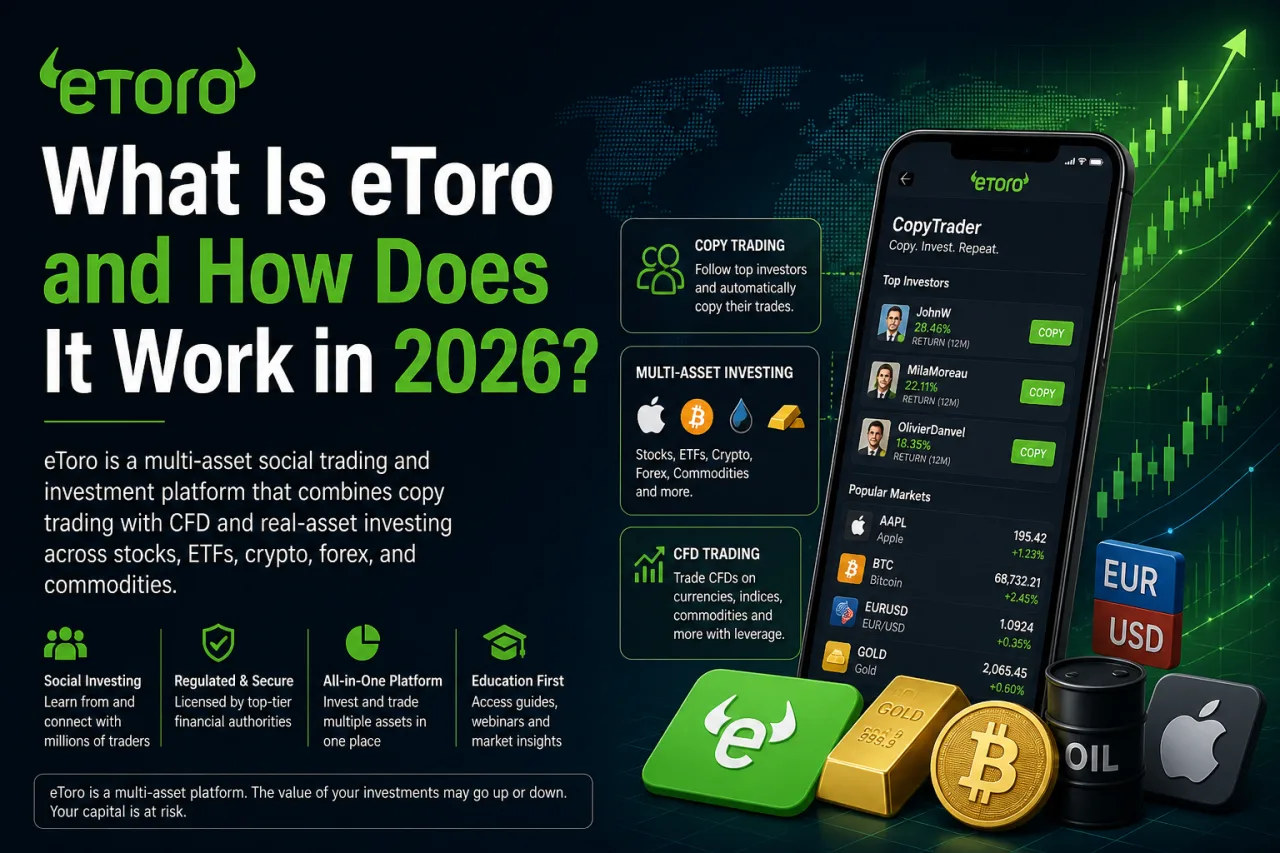
eToro is a multi-asset social trading and investment platform that combines copy trading with CFD and real-asset investing across stocks, ETFs, crypto, forex, and commodities.
The platform’s core value proposition centers on social investing: users view, follow, and automatically replicate the trades of other investors through its CopyTrader feature, rather than relying solely on independent technical or fundamental analysis. Alongside this, eToro operates a conventional CFD offering covering forex pairs, indices, and commodities for traders who prefer direct market exposure.
eToro positions itself among global forex brokers as a hybrid platform rather than a pure forex-only broker, appealing to traders who want both community-driven strategies and traditional leveraged trading in one account. This dual model distinguishes it from brokers that focus exclusively on forex and CFD execution without a social or copy trading layer. The regulatory framework and platform tools that support this business model are outlined in the following sections.
Is eToro Safe, Regulated and Legitimate?
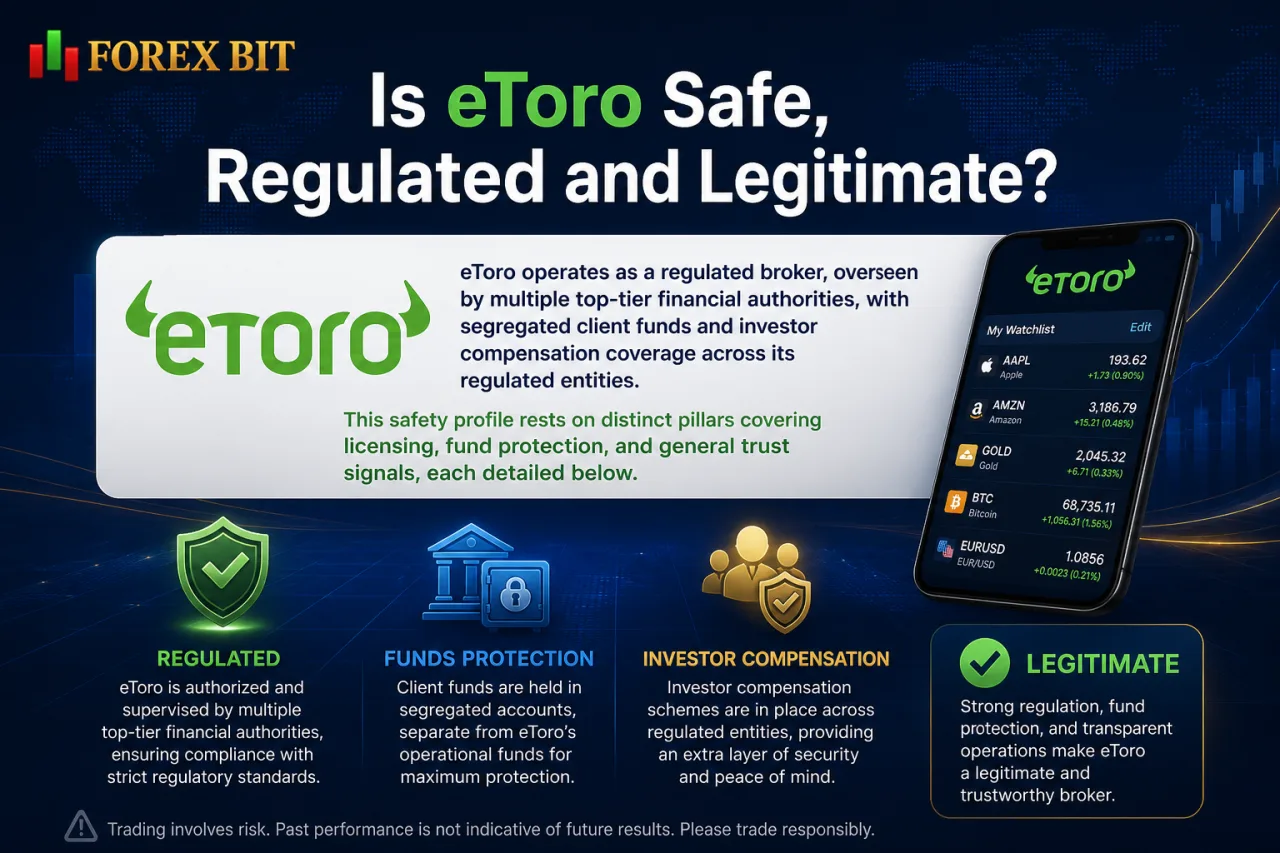
eToro operates as a regulated broker, overseen by multiple top-tier financial authorities, with segregated client funds and investor compensation coverage across its regulated entities. This safety profile rests on distinct pillars covering licensing, fund protection, and general trust signals, each detailed below.
Which Licenses and Regulatory Bodies Oversee eToro?
eToro’s regulatory oversight is split across several entities and regulators, with the specific licensing structure varying depending on the trader’s region.
Which entity a trader falls under depends entirely on their country of residence. This assignment shapes leverage limits, available instruments, and investor protection rules.
- Traders in the United Kingdom fall under eToro (UK) Ltd, supervised by the FCA, with eligibility for the Financial Services Compensation Scheme.
- Traders across the European Economic Area fall under eToro (Europe) Limited, supervised by CySEC, with coverage under the Investor Compensation Fund.
- Traders in Australia fall under eToro AUS Capital Limited, supervised by ASIC, with leverage and CFD rules set by Australian regulation.
- Traders in the United States access a separate eToro USA platform focused on crypto and stock trading rather than CFDs, reflecting stricter domestic derivatives restrictions.
This jurisdiction-based structure means CFD leverage, product access, and negative balance protection differ noticeably depending on where a trader is registered.
The rules are not uniform globally, and traders should check which entity applies to their own country before opening an account.
How Does eToro Protect Client Funds and Data?
eToro protects client funds and data through segregated client accounts, negative balance protection, and encrypted security infrastructure covering account access and transactions. This layered approach addresses fund safety and data protection separately from the licensing framework already outlined above.
Client money sits in segregated bank accounts held apart from eToro’s own operating funds, limiting the risk that company finances could affect trader deposits. Negative balance protection caps a trader’s losses at their account balance, preventing debt beyond deposited funds during volatile CFD price swings.
On the data side, eToro applies encryption protocols to account logins, personal information, and payment processing, alongside two-factor authentication for account access. eToro also monitors trading activity for unusual patterns as part of its broader fraud prevention and account security measures.
These protections apply across eToro’s regulated entities, though exact terms of negative balance protection and compensation coverage still depend on the trader’s assigned regulator.
What Trading Platforms Does eToro Offer?
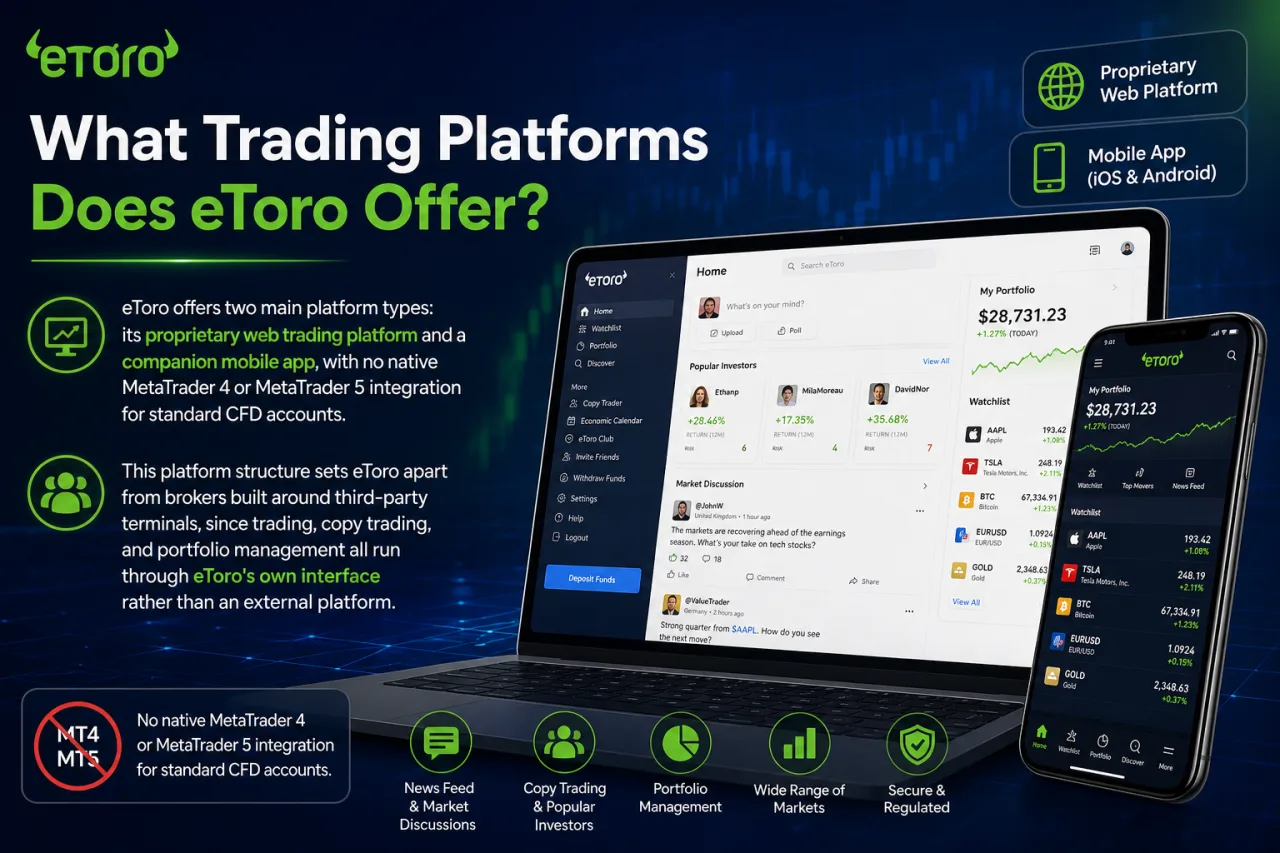
eToro offers two main platform types: its proprietary web trading platform and a companion mobile app, with no native MetaTrader 4 or MetaTrader 5 integration for standard CFD accounts. This platform structure sets eToro apart from brokers built around third-party terminals, since trading, copy trading, and portfolio management all run through eToro’s own interface rather than an external platform.
The web platform centers on a news-feed-style layout showing trader profiles, market discussions, and portfolio performance alongside standard order entry and charting tools. Beginners generally find this layout approachable, since social feeds and CopyTrader profiles sit next to instrument search without requiring separate platform downloads.
Intermediate and experienced traders accessing more advanced charting, custom indicators, or automated strategy scripting outside eToro’s ecosystem find the absence of MetaTrader support a limitation compared to brokers offering multi-platform choice. The mobile app mirrors the web platform’s core functions, covering account monitoring, copy trading, and order execution while on the move.
What Account Types Does eToro Offer?
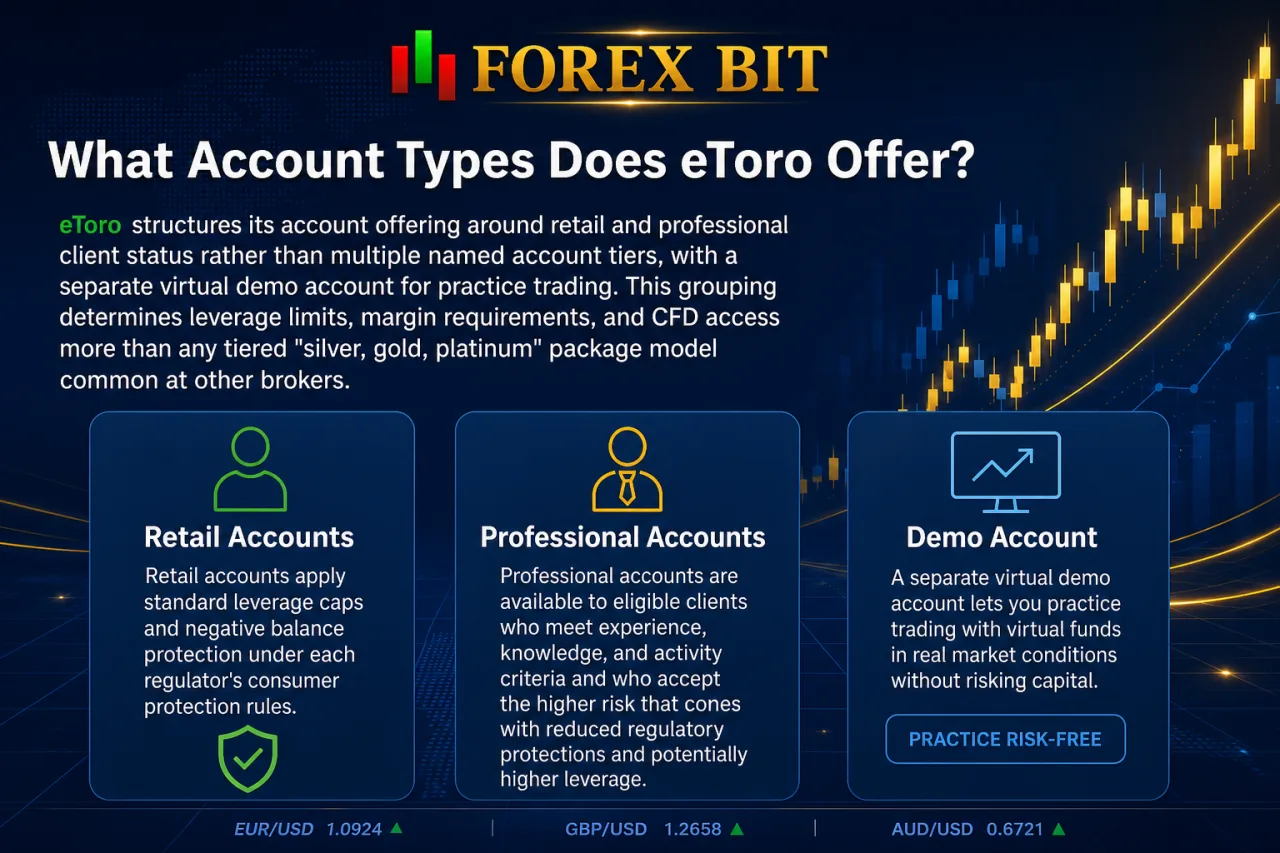
eToro structures its account offering around retail and professional client status rather than multiple named account tiers, with a separate virtual demo account for practice trading. This grouping determines leverage limits, margin requirements, and CFD access more than any tiered “silver, gold, platinum” package model common at other brokers.
- Retail accounts apply standard leverage caps and negative balance protection under each regulator’s consumer protection rules.
- Professional accounts qualify for higher leverage and reduced regulatory safeguards, available only to traders meeting eligibility criteria such as trading experience, portfolio size, or financial sector employment.
- Virtual accounts provide simulated funds for practicing CopyTrader and CFD strategies without risking real capital.
- Club or loyalty status tiers, where offered, adjust perks like dedicated support or reduced fees based on account equity and activity levels.
Detailed eligibility rules and equity thresholds for each status vary by regulatory entity, so traders confirm specifics directly within their eToro account region.
eToro Fees vs Competitors: How Do Spreads and Commissions Compare?
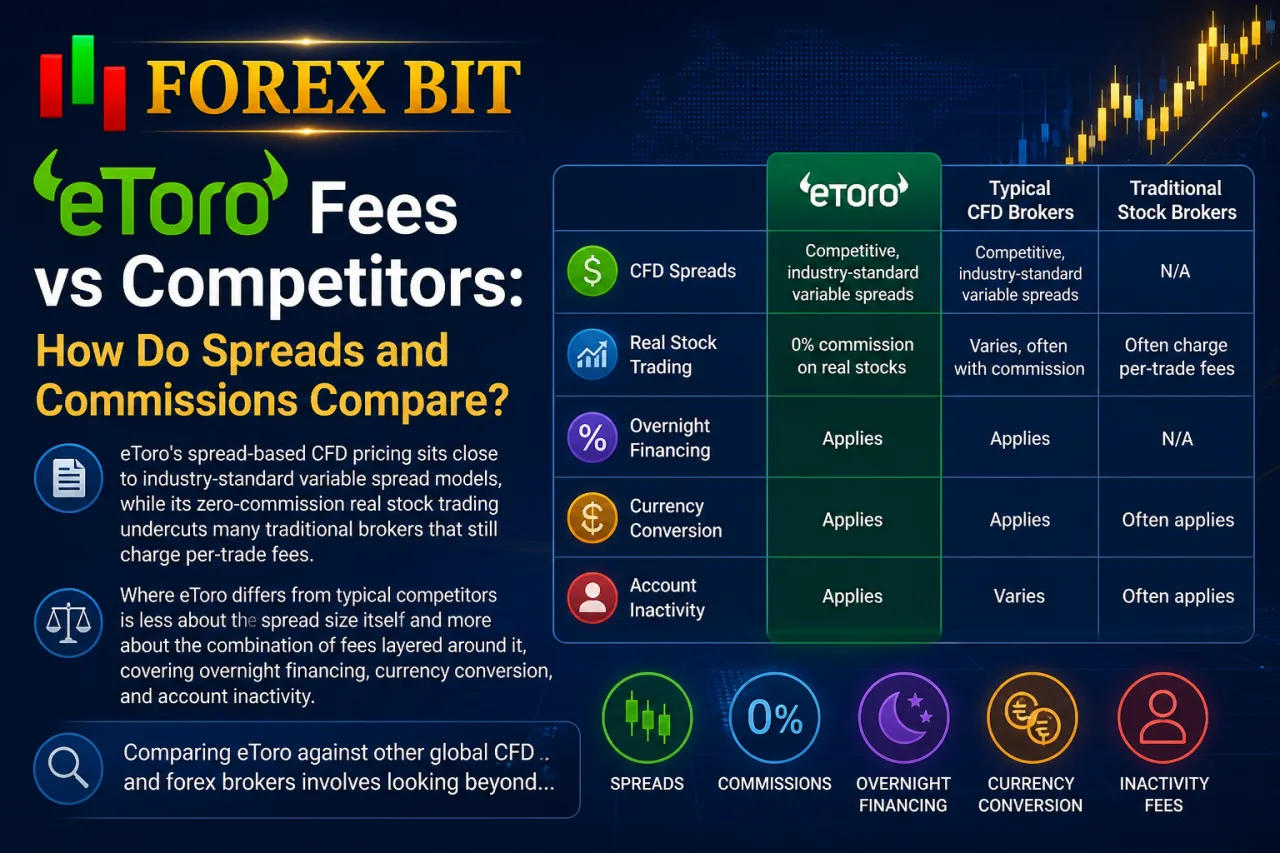
eToro’s spread-based CFD pricing sits close to industry-standard variable spread models, while its zero-commission real stock trading undercuts many traditional brokers that still charge per-trade fees. Where eToro differs from typical competitors is less about the spread size itself and more about the combination of fees layered around it, covering overnight financing, currency conversion, and account inactivity.
Comparing eToro against other global CFD and forex brokers involves looking beyond the headline spread figure toward the full cost stack a trader actually pays.
- Spreads on major forex pairs and popular CFD instruments tend to be wider than the tightest pricing offered by pure ECN-style brokers.
- Overnight fees apply to leveraged positions held past the trading day, a structure common across most CFD brokers rather than unique to eToro.
- Withdrawal fees stand out as less common among competitors, since several global brokers process withdrawals without a flat charge.
- Currency conversion fees apply when a trader’s account currency differs from the instrument or deposit currency, adding a cost layer some brokers avoid through multi-currency accounts.
- Inactivity fees apply to dormant accounts after a set period without login activity, consistent with policies at several other retail brokers.
Traders comparing total cost rather than spread alone weigh these non-trading fees alongside eToro’s zero-commission stock model.
What Is the Minimum Deposit and Which Payment Methods Are Supported?
eToro sets a minimum deposit that varies by country, generally starting at a low entry threshold for most regions and higher for select markets, with deposits accepted via cards, e-wallets, and bank transfer.
This deposit and payment structure shapes how quickly a trader funds an account and starts trading.
- Cards, including major debit and credit brands, process deposits instantly in most cases.
- E-wallets are among the deposit methods that tend to process near-instantly, subject to eToro’s verification checks, though traders should confirm the specific e-wallet providers currently supported directly with eToro.
- Bank transfer deposits generally take longer to clear than card or e-wallet methods, often spanning several business days depending on the sending bank.
- Withdrawals route back to the original payment method where possible, with processing times varying depending on the method and verification status.
Minimum withdrawal amounts and deposit currency conversion rules also differ by regulatory entity, so traders confirm exact figures within their own eToro account before transacting.
What Leverage Does eToro Offer to Traders?
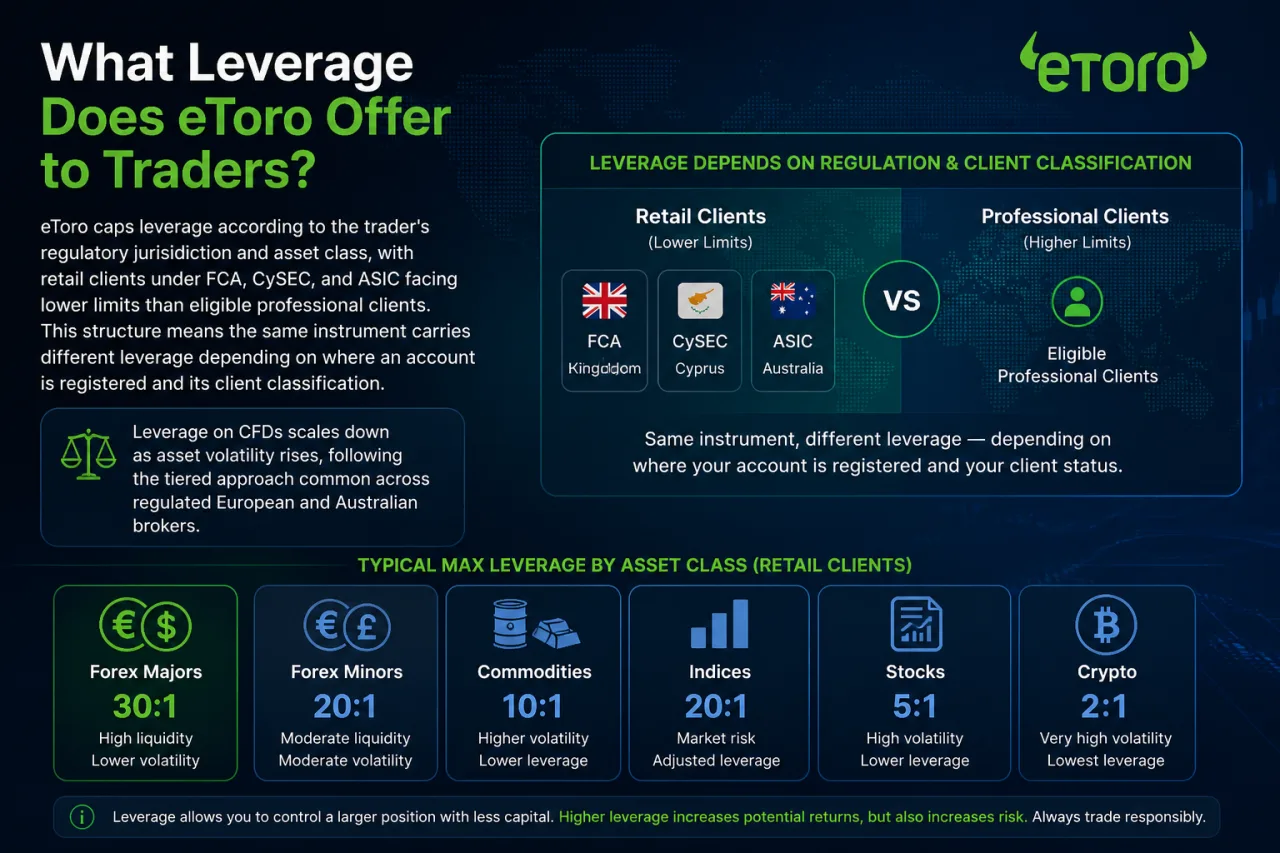
eToro caps leverage according to the trader’s regulatory jurisdiction and asset class, with retail clients under FCA, CySEC, and ASIC facing lower limits than eligible professional clients. This structure means the same instrument carries different leverage depending on where an account is registered and its client classification.
Leverage on CFDs scales down as asset volatility rises, following the tiered approach common across regulated European and Australian brokers.
- Forex majors carry the highest leverage tier among CFD instruments for retail accounts.
- Stock and index CFDs generally carry lower maximum leverage limits than forex pairs, reflecting their typically higher price volatility.
- Crypto CFDs tend to carry lower maximum leverage than other asset classes, reflecting their typically higher price volatility.
- Professional client accounts unlock leverage above retail limits, subject to eligibility criteria such as trading experience or portfolio size.
Traders in the United States access eToro USA’s stock and crypto trading without CFD leverage, since that platform does not offer leveraged derivatives. Confirming the exact leverage tier applicable requires checking the trading conditions inside the specific regional eToro account, since figures differ by regulator and can change with policy updates.
What Markets and Instruments Can You Trade on eToro?
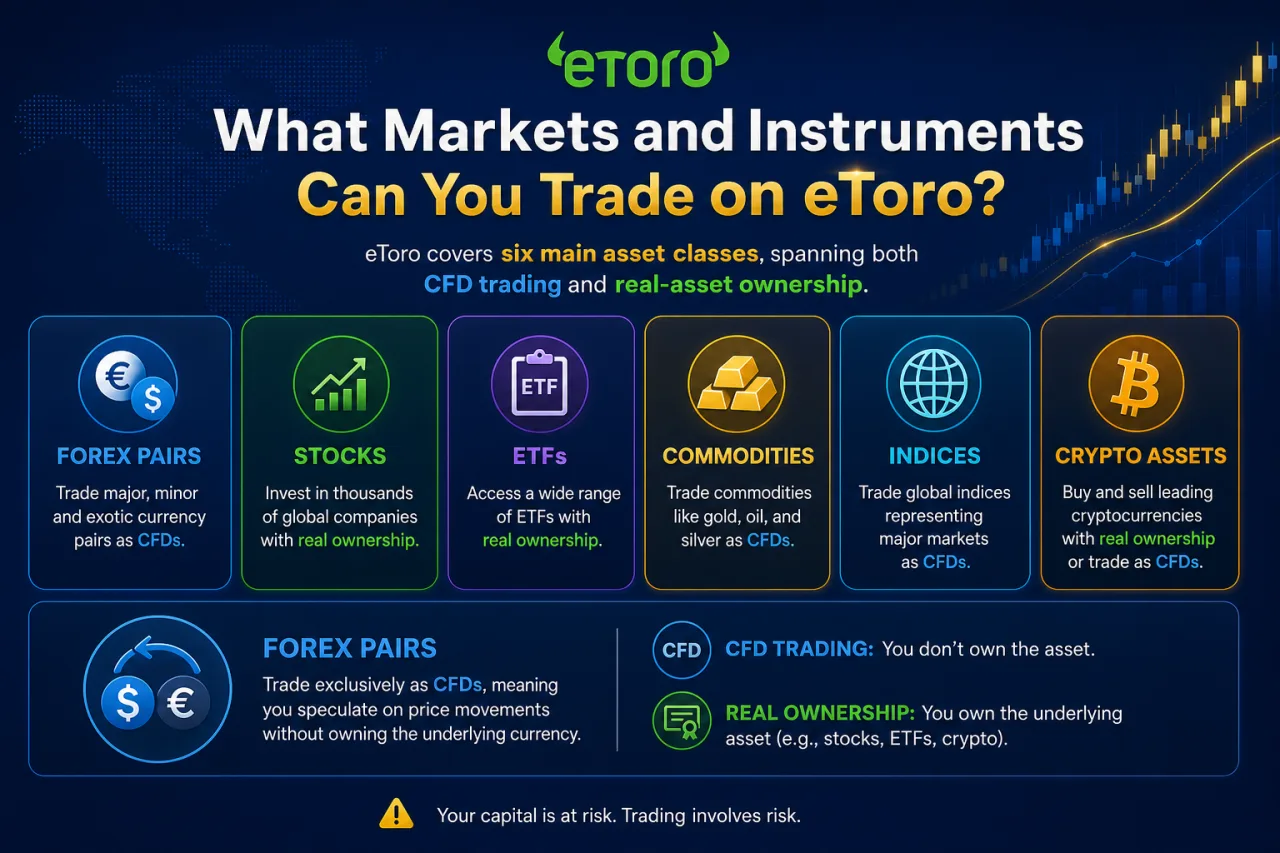
eToro covers six main asset classes: forex pairs, stocks, ETFs, commodities, indices, and crypto assets, spanning both CFD trading and real-asset ownership. This range positions eToro’s market coverage alongside broader multi-asset brokers rather than forex-only platforms already noted in its hybrid business model.
The CFD versus real ownership distinction shapes what a trader actually holds after opening a position.
- Forex pairs trade exclusively as CFDs, meaning traders speculate on price movement without owning underlying currency.
- Stocks and ETFs trade as real assets in most regions, giving traders actual share ownership, alongside a CFD version for leveraged exposure.
- Commodities and indices trade as CFDs only, since physical delivery or direct index ownership is not offered.
- Crypto assets trade either as real underlying holdings or as CFDs, depending on the trader’s region and regulatory classification.
Availability of specific instruments within each asset class differs by country due to regulatory restrictions, so traders confirm exact market access inside their own eToro account before trading.
How Does Copy Trading Work on eToro?
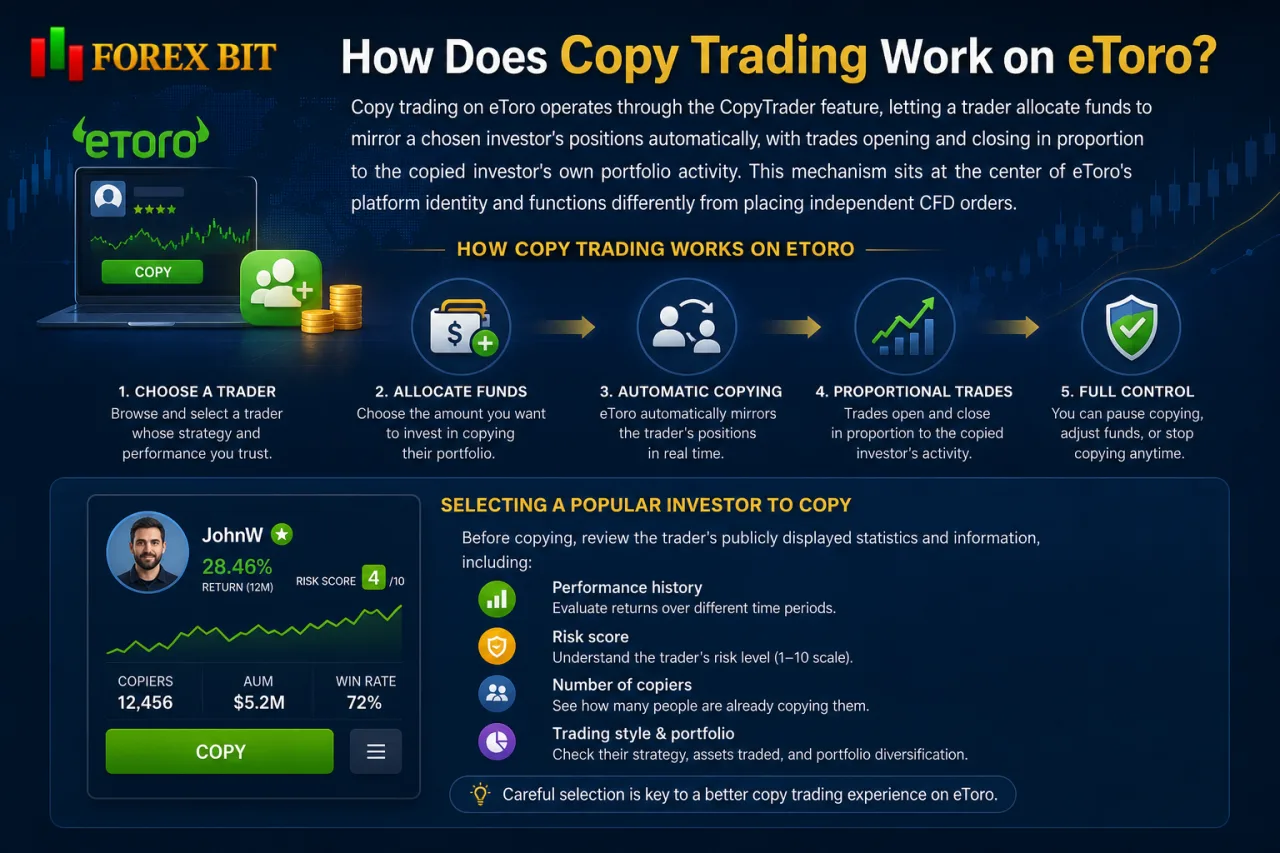
Copy trading on eToro operates through the CopyTrader feature, letting a trader allocate funds to mirror a chosen investor’s positions automatically, with trades opening and closing in proportion to the copied investor’s own portfolio activity. This mechanism sits at the center of eToro’s platform identity already noted above and functions differently from placing independent CFD orders.
Selecting a popular investor to copy involves reviewing publicly displayed performance history, risk score, and portfolio composition before committing funds.eToro assigns each copyable trader a risk score based on trading behavior, giving prospective copiers a reference point beyond raw returns, though traders should confirm the exact methodology and scale directly with eToro.
Risk considerations remain material despite the automated structure. Copying a trader replicates both gains and losses proportionally, so past performance carries no guarantee of future results, and allocating funds across multiple copied investors spreads exposure rather than concentrating risk on a single strategy.
- Allocated funds copy trades proportionally to the account size committed.
- Closing the copy relationship stops future trade replication but does not reverse open positions automatically.
- Diversifying across several copied investors reduces reliance on any single trader’s strategy.
This functional structure remains a defining differentiator setting eToro apart from CFD-only competitors lacking a comparable social layer.
Which Countries Can Access eToro and Are There Restrictions?
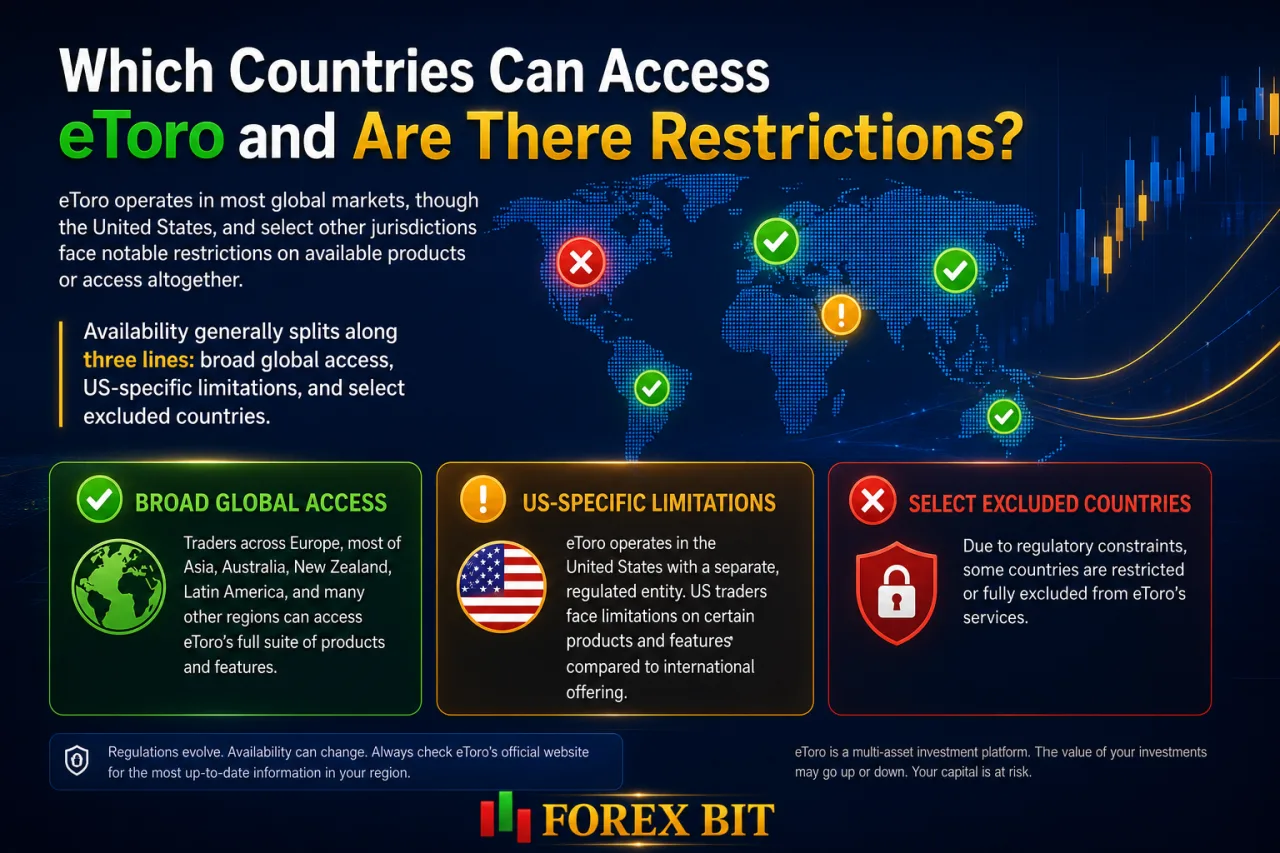
eToro operates in most global markets, though the United States, and select other jurisdictions face notable restrictions on available products or access altogether. This region-based access pattern already surfaces in eToro’s split regulatory structure, and it extends further into which asset classes and account features a trader actually sees.
Availability generally splits along three lines: broad global access, US-specific limitations, and select excluded countries.
- Traders across Europe, the United Kingdom, and Australia access full CFD and real-asset trading under their respective regulated entities.
- Traders in the United States use eToro USA, limited to crypto and stock trading without CFD products due to domestic derivatives restrictions already noted above.
- Traders in certain sanctioned or unsupported countries face outright exclusion from account registration, so prospective users should confirm eligibility for their specific country directly with eToro before attempting to sign up.
- Traders in some regions encounter restricted asset lists, since specific stocks, ETFs, or crypto assets get withheld based on local regulatory rules.
Confirming exact access requires checking eToro’s registration page for the trader’s specific country, since product availability shifts as regulatory policy changes.
What Customer Support Options Does eToro Provide?
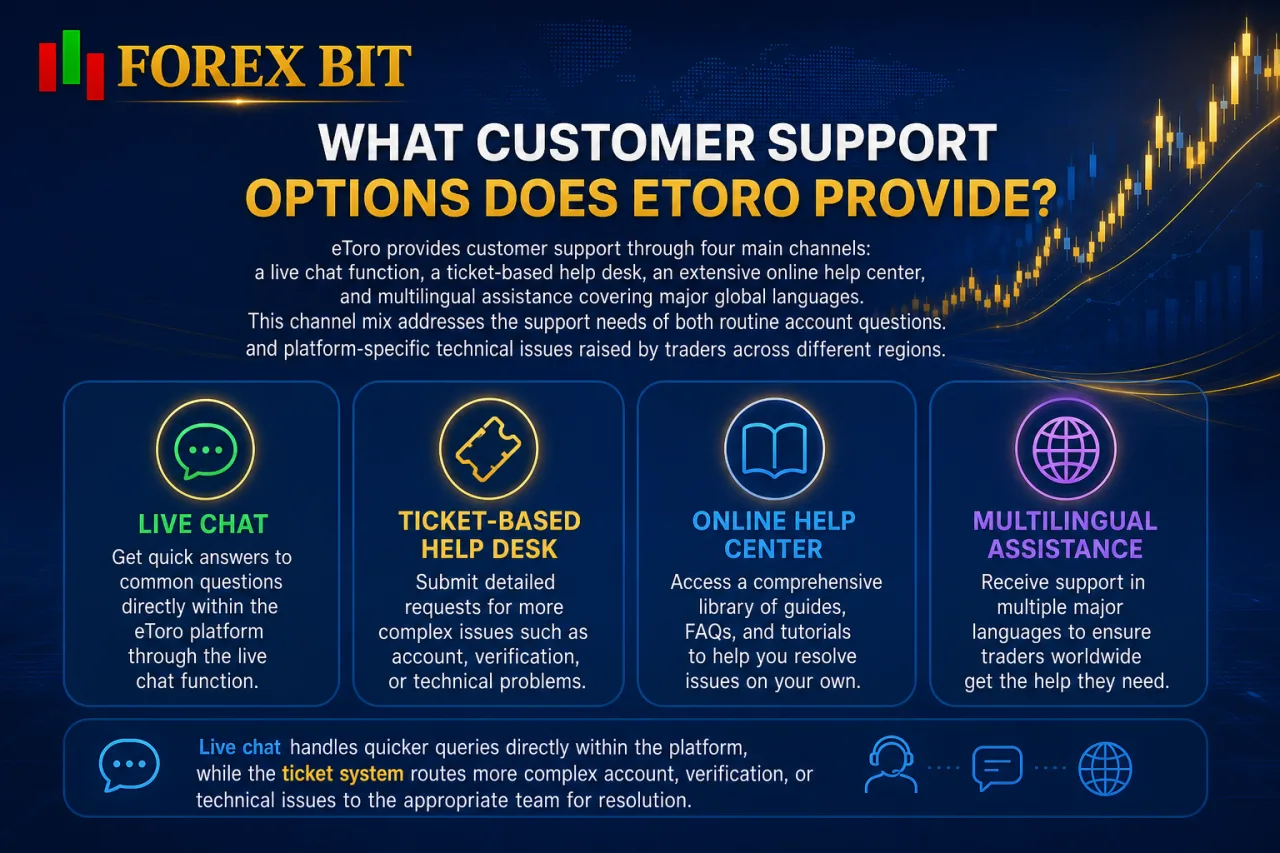
eToro provides customer support through four main channels: a live chat function, a ticket-based help desk, an extensive online help center, and multilingual assistance covering major global languages. This channel mix addresses the support needs of both routine account questions and platform-specific technical issues raised by traders across different regions.
Live chat handles quicker queries directly within the platform, while the ticket system routes more complex account, verification, or trading disputes to specialist support staff for follow-up.
The help center hosts a searchable library of articles covering account setup, deposits, withdrawals, CopyTrader mechanics, and CFD trading rules, letting traders self-resolve common issues without contacting an agent. eToro’s support operates in multiple languages to serve its international trader base, though the exact list of supported languages and live chat availability hours vary by region and should be confirmed directly with eToro.
Responsiveness reputation among traders leans toward faster resolution for account and payment issues handled through live chat, with ticket-based technical queries generally taking longer to close. Club or loyalty tier members typically receive access to a dedicated account manager or priority queue, adding a further layer beyond the standard support channels available to all users.
eToro Pros and Cons: Is It Worth It for Your Trading Style?
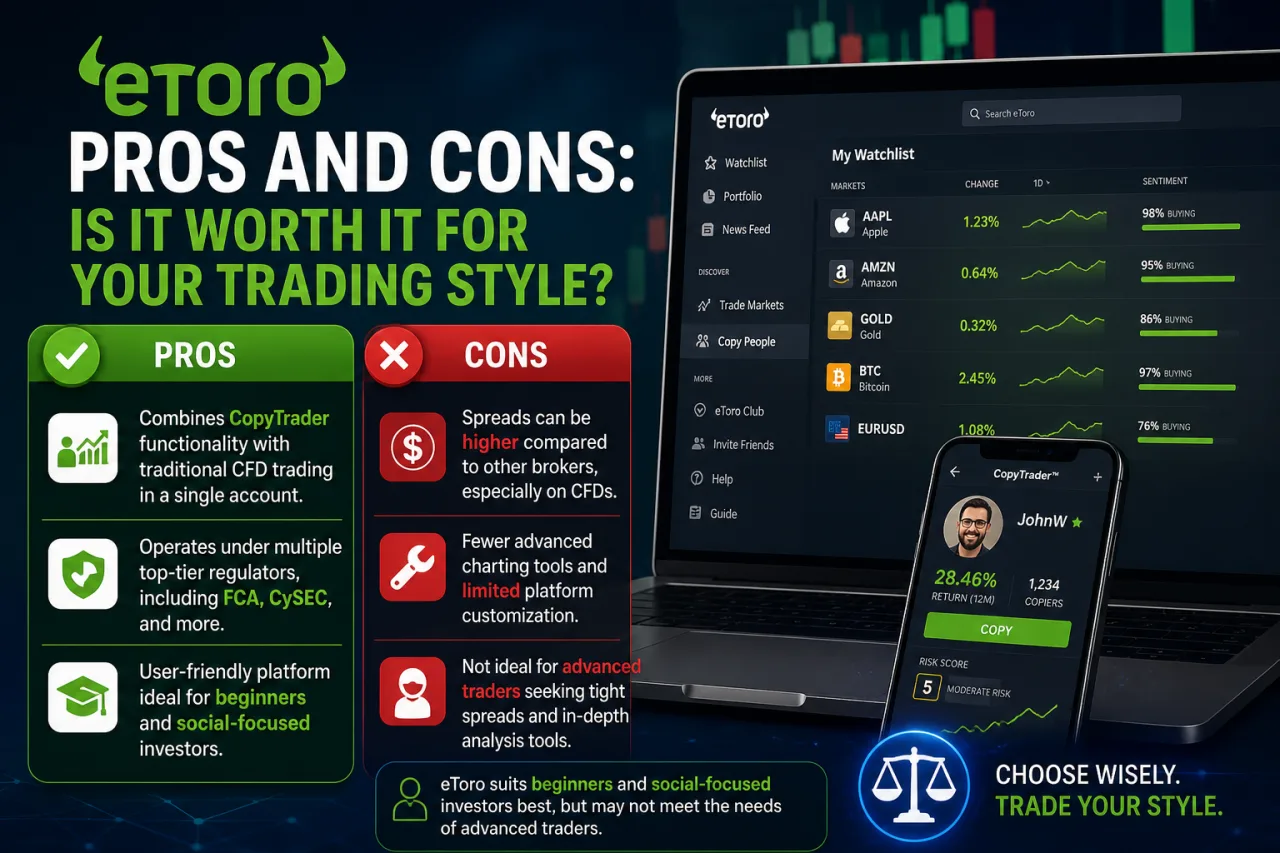
eToro is worth it primarily for beginners and social-focused investors, but less so for advanced traders seeking tight spreads and deep customization. Weighing this trade-off against the platform’s actual features clarifies who benefits most from an eToro account.
On the advantage side, three factors stand out consistently:
- Combines CopyTrader functionality with traditional CFD trading in a single account.
- Operates under multiple top-tier regulators, including FCA, CySEC, and ASIC.
- Presents an approachable web and mobile interface requiring no separate platform download.
- Offers zero-commission real stock trading in eligible regions.
On the limitation side, three factors reduce suitability for certain trader profiles:
- Applies a withdrawal fee and currency conversion charges absent at some competing brokers.
- Lacks native MetaTrader 4 or MetaTrader 5 support for advanced charting and automated strategies.
- Provides less instrument depth in certain asset classes compared to specialist forex-only brokers.
Beginners and traders prioritizing social investing gain the most value from eToro’s CopyTrader model and regulatory backing. Advanced traders relying on custom indicators, algorithmic scripting, or the tightest possible spreads find the platform’s fee structure and lack of third-party terminal support a limiting factor against specialized CFD brokers.
What Unique Tools and Features Set eToro Apart From Other Brokers?
eToro sets itself apart through four distinctive tools beyond core CFD trading: Smart Portfolios, the eToro Money card ecosystem, a social sentiment feed, and eToro Academy. These features extend the platform’s social investing identity into areas most forex-only brokers do not cover, adding depth beyond spreads, platforms, and regulation already outlined above. Each tool serves a different purpose within the broader eToro ecosystem, from thematic investing to financial literacy.
What Is eToro Smart Portfolios and Who Should Use It?
eToro Smart Portfolios are pre-built, thematic investment baskets that group multiple assets or top-performing traders under a single strategy, distinct from copying one individual investor. This structure addresses the heading’s core question of what the feature is and who benefits from choosing it.
Unlike standard CopyTrader, which mirrors one person’s trades, a Smart Portfolio bundles several stocks, crypto assets, or copied traders around a specific theme, such as a sector or investment strategy, and rebalances holdings according to that theme’s methodology rather than manual intervention.
- Diversifies exposure across multiple assets or traders within one allocation.
- Suits traders seeking thematic exposure without picking individual positions.
- Fits passive-minded investors who prefer minimal ongoing portfolio management.
- Requires no active manual trading once funds are allocated.
Availability of specific Smart Portfolios differs by region and eligibility criteria tied to the trader’s regulatory entity. eToro applies a minimum investment threshold to Smart Portfolios that can exceed standard CopyTrader minimums, so traders should confirm the exact current amount directly with eToro before investing.
Does eToro Offer Any Additional Ecosystem Products Like eToro Money?
Yes, eToro offers additional ecosystem products beyond core trading, including the eToro Money app and card, both operating as separate services from the main trading account. eToro Money functions as a standalone e-money app covering currency conversion and card payments, requiring its own registration distinct from the CFD or social trading account. Funds held in eToro Money stay separate from trading balances, so transferring between the two services involves an explicit transfer step rather than shared access. eToro also positions eToro Money primarily within select regions, so availability depends on the trader’s country, and interested users should confirm current eligibility directly with eToro.
Conclusion
eToro’s regulatory backing from FCA, CySEC, and ASIC, combined with segregated funds and negative balance protection, confirms it as a legitimate, safety-conscious platform for global traders. Its hybrid identity, blending CopyTrader functionality, zero-commission real stock investing, and Smart Portfolios with standard CFD trading on forex, indices, and commodities, sets it apart from forex-only competitors.
Costs beyond the spread, including withdrawal and currency conversion fees, and the absence of MetaTrader support, matter most for advanced traders chasing tight pricing and deep customization. Beginners and social-investing traders gain the clearest value, making eToro a credible choice once individual trading style and regional account terms are confirmed directly on the platform.
Thomas Dite is the Best Forex Brokers Research Manager at Forex Bit, specializing in researching, comparing, and editing broker-related content for different trader needs. He focuses on evaluating trading platforms, costs, regulation, account conditions, and other key factors to help readers make more informed broker comparisons.
Email: [email protected]