









XM, Pepperstone, and eToro rank among the best forex brokers for beginners in 2026, based on minimum deposit, demo account quality, platform usability, and regulatory oversight. Each broker combines a simple account structure with accessible educational tools, making the transition from demo to live trading more manageable for new traders.
XM is known for offering a low minimum deposit requirement, making it an accessible option for beginners. A low entry deposit reduces the initial financial commitment, though account safety and platform support still matter more for long-term beginner success.
Pepperstone and IC Markets are generally considered among the safer options for new traders, as both operate under multiple regulatory licenses across different jurisdictions. Strong regulation ensures client fund segregation and adds a layer of protection against broker insolvency.
XM and eToro both offer a range of educational resources, including webinars, trading guides, and demo accounts for practice trading. These tools allow beginners to practice strategies risk-free before committing real capital.
Forex Bit compares these brokers in detail below, starting with a direct ranking of the top beginner-friendly options for 2026.
Which Forex Brokers Are the Best for Beginners in 2026?

XM, Pepperstone, eToro, and IC Markets rank as the best forex brokers for beginners in 2026, selected for combining low entry costs with practical demo accounts and clear regulation. These four brokers stand out because each addresses a different beginner priority without sacrificing safety.
XM and low-cost account access make the transition into live trading less intimidating for traders testing small position sizes. Pepperstone pairs regulatory strength with a straightforward account structure, avoiding the confusion that complex platforms create for new users. eToro adds a social and copy trading layer that lets beginners observe experienced traders before placing independent trades. IC Markets rounds out the group with transparent execution and consistent regulatory oversight across its licensed entities.
The ranking reflects four combined factors rather than any single metric: minimum deposit, demo account quality, platform usability, and regulatory oversight. A broker scoring well on only one factor, such as deposit size, does not automatically qualify as beginner-friendly if its platform or support falls short.
How Do These Beginner-Friendly Brokers Compare at a Glance?
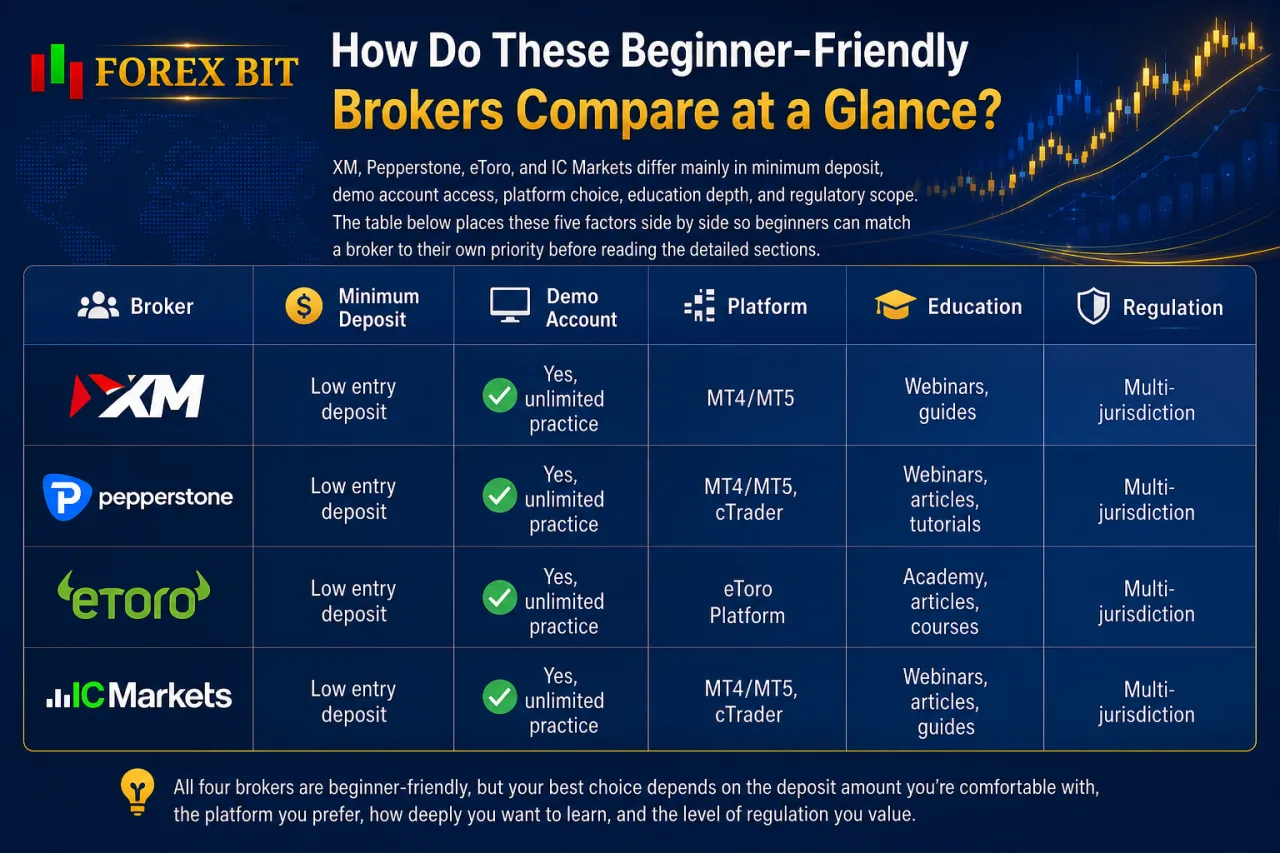
XM, Pepperstone, eToro, and IC Markets differ mainly in minimum deposit, demo account access, platform choice, education depth, and regulatory scope. The table below places these four factors side by side so beginners can match a broker to their own priority before reading the detailed sections.
| Broker | Minimum Deposit | Demo Account | Platform | Education | Regulation |
|---|---|---|---|---|---|
| XM | Low entry deposit | Yes, unlimited practice | MT4/MT5 | Webinars, guides | Licensed under multiple financial regulators across different jurisdictions |
| Pepperstone | Moderate entry deposit | Yes | MT4/MT5, cTrader | Market guides, webinars | Licensed under multiple financial regulators across different jurisdictions |
| eToro | Low entry deposit | Yes | Proprietary platform, copy trading | Social feed, guides | Licensed under multiple financial regulators across different jurisdictions |
| IC Markets | Low entry deposit | Yes | MT4/MT5, cTrader | Trading guides | Licensed under multiple financial regulators across different jurisdictions |
Each row reflects the same four selection criteria used earlier: deposit size, demo quality, usability, and regulatory oversight, so the ranking stays consistent between the table and the individual broker reviews that follow. Exact deposit thresholds and the full list of regulatory licenses vary by region and account type, so traders should verify current figures directly on each broker’s official website before opening an account.
What Criteria Make a Forex Broker Suitable for Beginners?
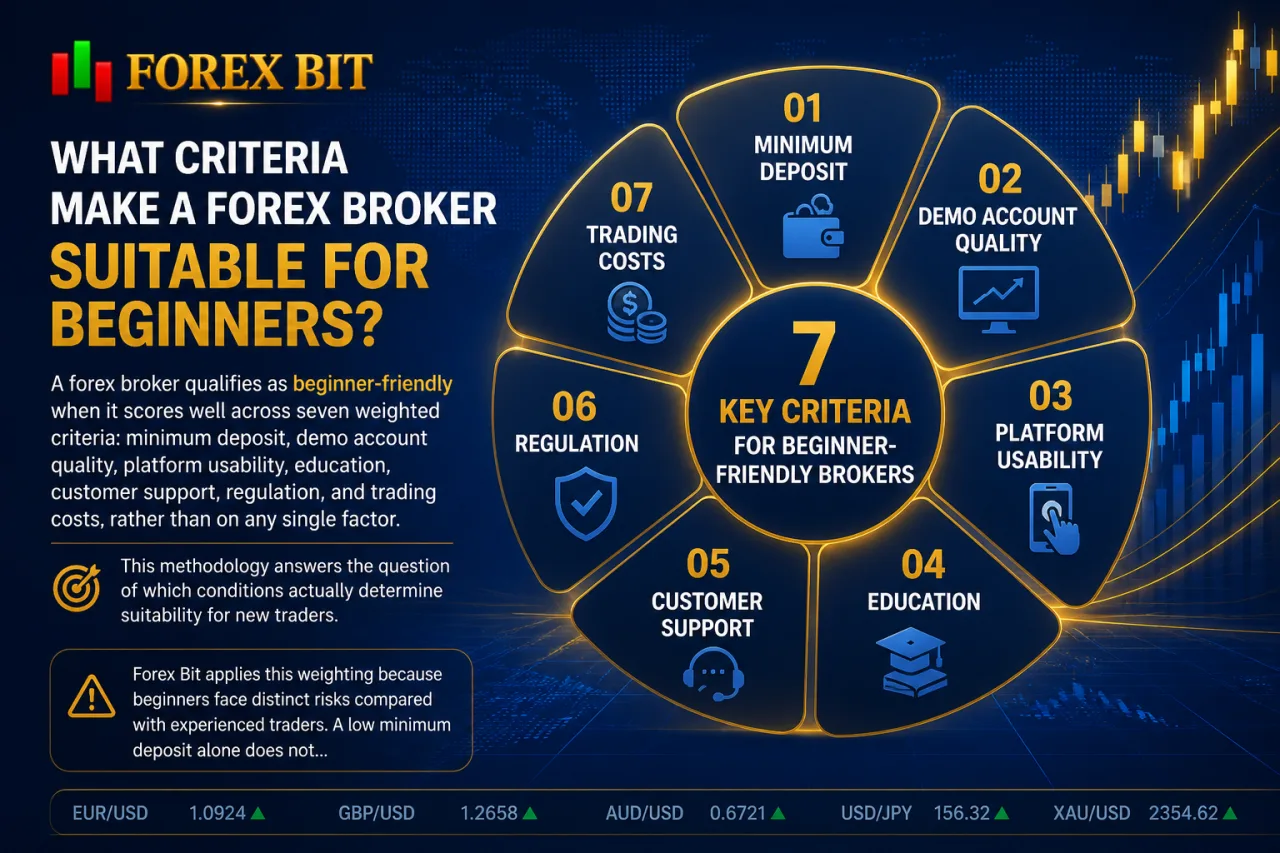
A forex broker qualifies as beginner-friendly when it scores well across seven weighted criteria: minimum deposit, demo account quality, platform usability, education, customer support, regulation, and trading costs, rather than on any single factor. This methodology answers the question of which conditions actually determine suitability for new traders.
Forex Bit applies this weighting because beginners face distinct risks compared with experienced traders. A low minimum deposit alone does not make a broker beginner-friendly, since a small deposit paired with weak regulation or a confusing platform still exposes new traders to unnecessary risk.
The evaluation treats regulation and trading costs as baseline safety filters, since a broker failing either one gets excluded regardless of its deposit size. Platform usability and demo account quality then measure how easily a beginner transitions from practice to live trading, while education and customer support measure ongoing guidance once real capital is at stake.
- Minimum deposit: entry accessibility for small starting capital
- Demo account: risk-free practice before live trading
- Platform usability: interface simplicity for new users
- Education: guides, webinars, and learning materials
- Customer support: responsiveness during account setup and trading issues
- Regulation: licensing and client fund protection
- Trading costs: spreads and commissions relative to account size
This combined scoring keeps the ranking anchored to practical beginner outcomes instead of isolated marketing claims.
What Are the Top Broker Picks for Beginners in 2026?
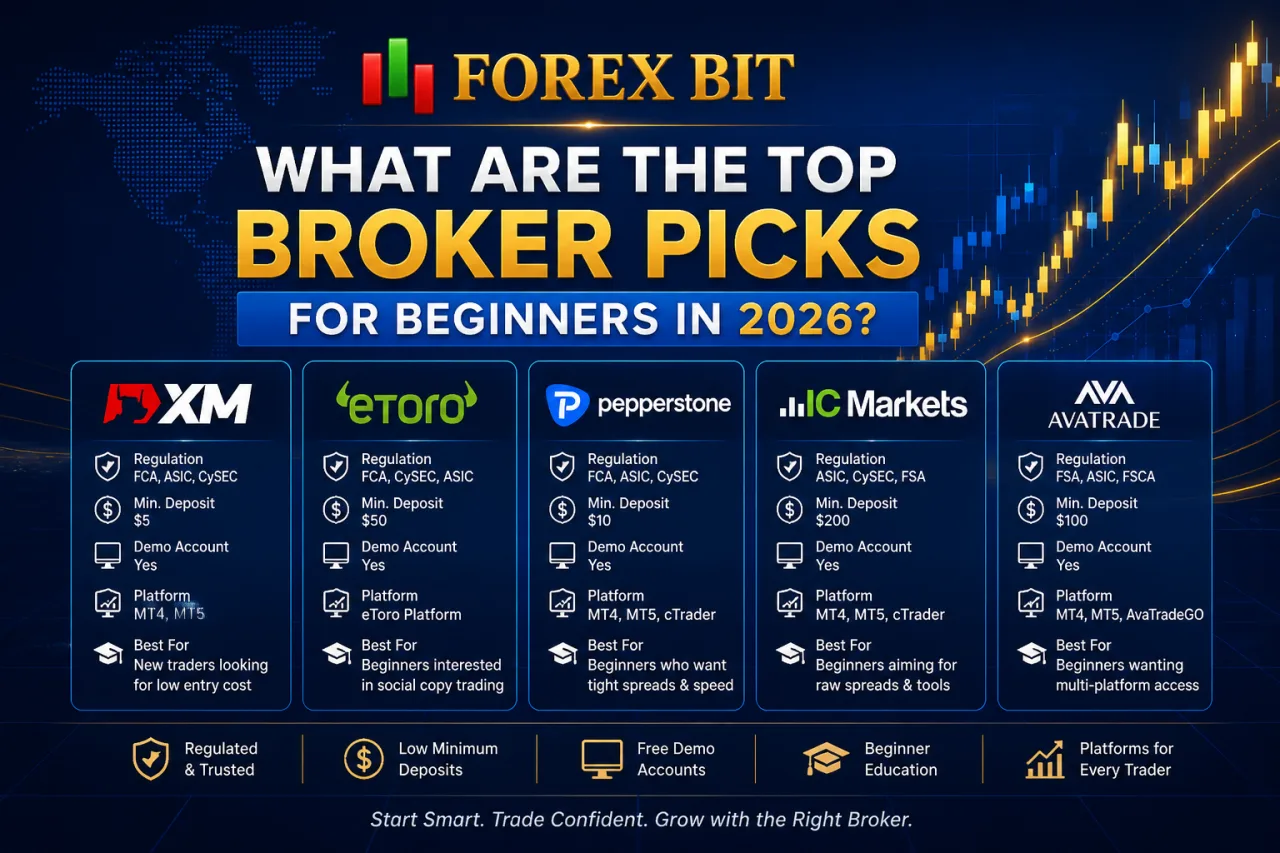
The top beginner broker picks for 2026 group into five individual profiles: XM, eToro, Pepperstone, IC Markets, and AvaTrade, each evaluated on regulation, minimum deposit, demo account, platform, and education. These five names cover distinct beginner priorities, from ultra-low deposits to social copy trading and multi-platform access. Each profile below breaks down regulation status, account entry cost, platform choice, and the trader type each broker suits best.
XM – Best for Low Minimum Deposit and Simple Account Structure
XM is widely regarded as a solid forex broker for beginners, offering a low minimum deposit and a simple account structure, along with regulatory oversight from multiple financial authorities.
This regulatory spread across multiple jurisdictions gives beginners a baseline safety layer while they learn the platform with minimal capital at risk.
XM pairs its low entry deposit with an unlimited demo account, letting new traders rehearse order types and risk sizing before funding a live account. The broker runs on MT4 and MT5, avoiding platform fragmentation that confuses first-time users choosing between multiple proprietary interfaces. Education comes through structured webinars and written trading guides aimed at building foundational skills rather than advanced strategy.
The main strength for beginners is account simplicity: fewer account tiers reduce decision fatigue when opening a first live account. The primary limitation is that XM’s educational content stays general rather than personalized, so traders needing one-on-one coaching find the resources insufficient. XM suits beginners prioritizing low upfront cost and a straightforward setup over advanced platform customization or social trading features.
eToro – Best for Beginner-Friendly Interface and Social/Copy Trading
eToro ranks among the best forex brokers for beginners for its beginner-friendly interface and built-in social and copy trading features, and it operates under regulatory oversight from multiple financial authorities. This regulatory spread across three major jurisdictions gives new traders a comparable safety baseline to XM and Pepperstone while adding a social layer neither broker offers.
eToro pairs a low minimum deposit with a demo account that lets beginners test the platform before committing real funds. The proprietary platform replaces the complexity of MT4/MT5 with a simplified, visually driven interface, reducing the learning curve for traders unfamiliar with order types and charting tools. Its copy trading feature allows beginners to mirror the trades of experienced investors directly, turning the platform into a practical learning tool rather than just an execution venue. Education comes through a social feed and written guides rather than structured webinars.
The main strength for beginners is the combined ease of use and social learning model, which shortens the gap between observation and independent trading. The primary limitation is that heavy reliance on copy trading exposes beginners to the performance risk of the traders they follow rather than developing independent analysis skills. eToro suits beginners who prefer a visual, community-driven approach over a traditional multi-platform setup like Pepperstone or IC Markets.
Pepperstone – Best for Platform Variety and Educational Content
Pepperstone ranks among the best forex brokers for beginners for its combination of platform variety and structured educational content, and it operates under regulatory oversight from multiple financial authorities. This multi-jurisdictional coverage gives beginners a regulatory safety net comparable to XM and eToro, while its platform range sets it apart from eToro’s single proprietary interface.
Pepperstone pairs a moderate minimum deposit with a demo account, letting new traders test order execution before funding a live account. The broker supports MT4, MT5, and cTrader, giving beginners the option to start on a familiar interface and later switch platforms without changing broker. Its education hub delivers market guides and webinars aimed at building trading fundamentals rather than advanced strategy.
The main strength for beginners is platform choice paired with genuine learning material, avoiding the single-platform limitation seen with eToro. The primary limitation is that three platform options can overwhelm a first-time trader still deciding on a trading style. Pepperstone suits beginners who want room to grow into a more advanced platform without switching brokers later.
IC Markets – Best for Low-Cost Trading with Beginner-Accessible Demo
IC Markets ranks among the best forex brokers for beginners for its low-cost trading structure and beginner-accessible demo account, and it operates under regulatory oversight from multiple financial authorities. This multi-jurisdictional coverage matches the regulatory depth seen with Pepperstone and XM, while its cost structure sets it apart from the platform-variety focus covered earlier.
IC Markets pairs a low minimum deposit with an unlimited demo account, letting beginners test order execution and spread behavior before risking live capital. The broker runs on MT4, MT5, and cTrader, giving new traders the same platform flexibility Pepperstone offers. Its raw spread pricing keeps trading costs low relative to standard commission-based accounts, a factor that matters more as beginners increase trade frequency.
Education comes through structured trading guides rather than webinars or a social feed.
The main strength for beginners is the combination of low trading costs and genuine execution transparency, reducing the cost drag on small accounts. The primary limitation is that its educational content stays narrower than XM’s webinar library, leaving newer traders with less guided instruction. IC Markets suits beginners prioritizing low ongoing trading costs over extensive educational support or social trading features.
AvaTrade – Best for Structured Beginner Education and Risk Management Tools
AvaTrade ranks among the best forex brokers for beginners for its structured AvaAcademy education program and built-in risk management tools, and it operates under oversight from multiple financial regulators across the jurisdictions in which it operates. This multi-jurisdictional coverage matches the regulatory depth seen with Pepperstone and IC Markets, while its education and risk tools set it apart from the cost and platform focus covered earlier.
AvaTrade pairs a low minimum deposit with a demo account, letting beginners test order execution before funding a live account. The AvaAcademy hub delivers structured video courses, trading guides, and glossaries organized by skill level, offering a more progressive learning path than the general webinars found at XM. AvaTrade also builds in risk management features such as AvaProtect, which lets traders offset potential losses on a position for a set period, subject to the plan’s specific cost and eligibility terms.
The main strength for beginners is the pairing of structured lessons with practical loss-limiting tools, addressing both knowledge gaps and emotional risk-taking. The primary limitation is that its platform lineup centers on proprietary tools alongside MT4/MT5, which offers less flexibility than the three-platform range at Pepperstone or IC Markets. AvaTrade suits beginners who prioritize guided learning and built-in downside protection over raw trading costs.
XM vs eToro vs Pepperstone: How Do the Top Beginner Brokers Really Differ?
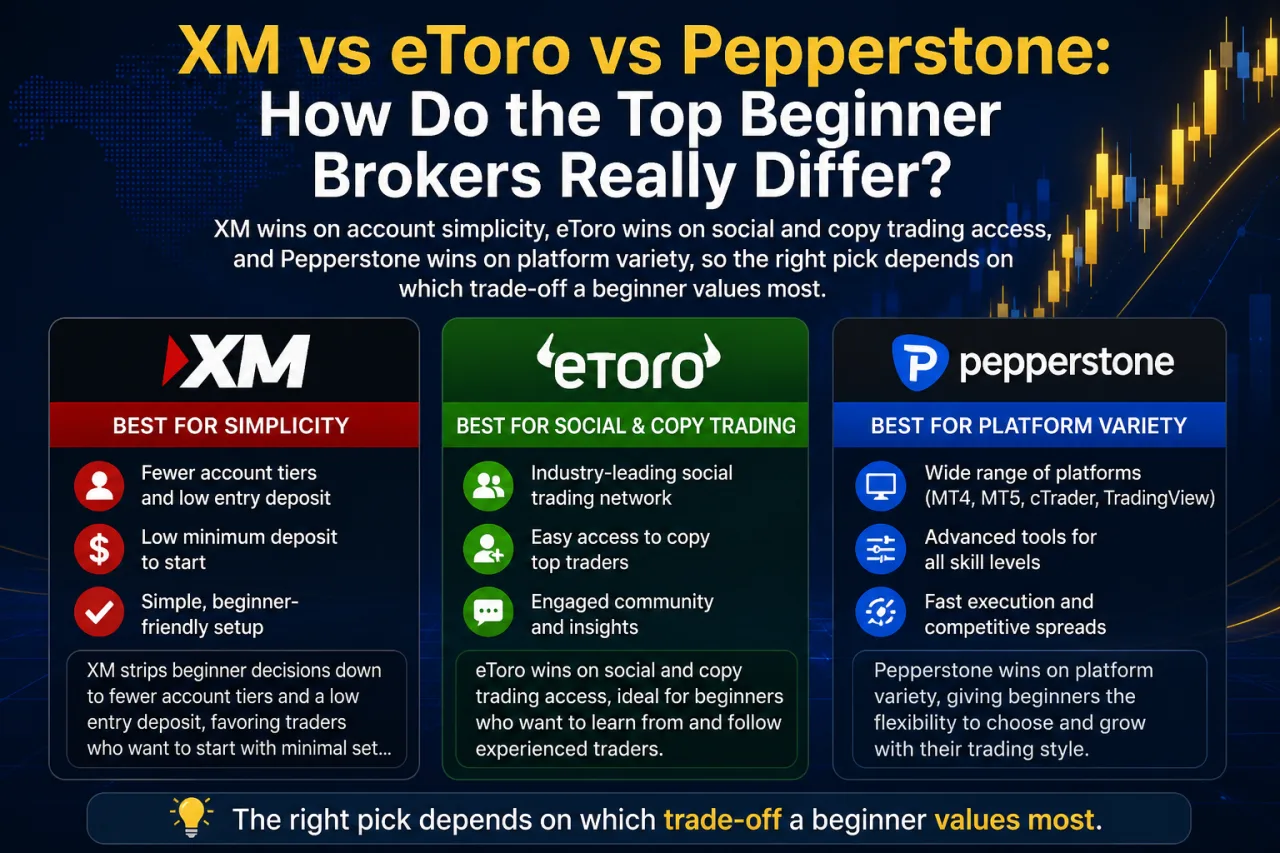
XM wins on account simplicity, eToro wins on social trading, Pepperstone wins on platform variety. The right pick depends on which trade-off a beginner values most. This comparison sets these three brokers side by side directly rather than as separate reviews, isolating the main differentiators a new trader weighs before opening an account.
XM strips beginner decisions down to fewer account tiers and a low entry deposit, favoring traders who want to start with minimal setup friction over platform flexibility. eToro trades that simplicity for a social feed and copy trading, letting beginners mirror experienced traders directly, though this shifts risk toward the performance of the accounts being followed rather than independent skill-building.
Pepperstone sits between the two by offering MT4, MT5, and cTrader on one account, giving beginners room to switch trading styles later without changing broker, at the cost of more upfront choice than XM’s single-path setup.
Regulatory oversight stays comparable across all three, so the deciding factor becomes usability preference rather than safety. A beginner prioritizing a minimal learning curve leans toward XM, one seeking guided social learning leans toward eToro, and one planning to grow into advanced platform tools leans toward Pepperstone.
Which Forex Broker Has the Lowest Minimum Deposit for Beginners?
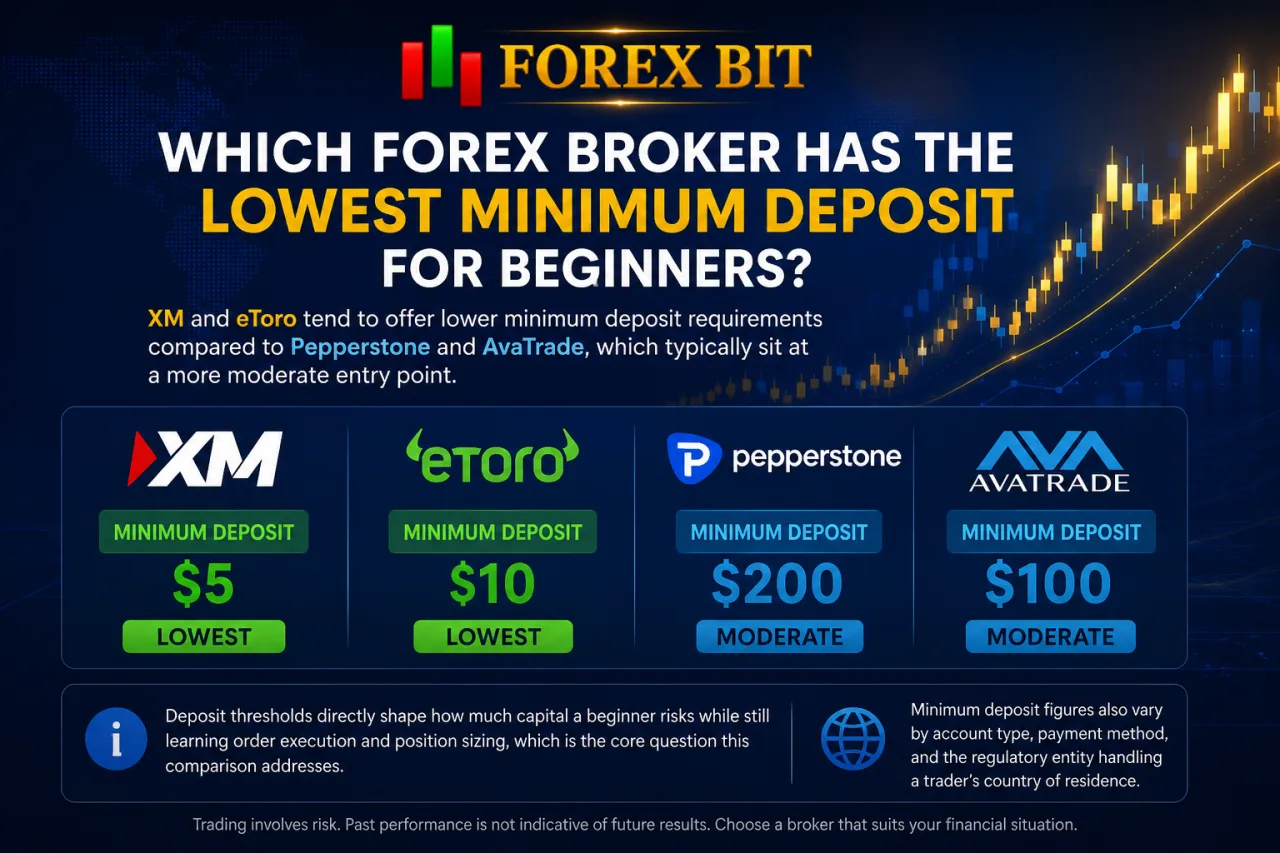
XM offers the lowest minimum deposit among the five featured brokers, followed closely by eToro, while Pepperstone and AvaTrade sit at a more moderate entry point.
Deposit thresholds directly shape how much capital a beginner risks while still learning order execution and position sizing, which is the core question this comparison addresses.
Minimum deposit figures also vary by account type, payment method, and the regulatory entity handling a trader’s country of residence, so the same broker can display different thresholds depending on region.
- XM: low entry deposit across standard account types
- eToro: low entry deposit tied to its proprietary platform
- Pepperstone: moderate entry deposit across MT4/MT5/cTrader accounts
- IC Markets: low entry deposit paired with raw spread pricing
- AvaTrade: low entry deposit paired with AvaAcademy access
A low minimum deposit alone does not determine beginner suitability. XM and IC Markets pair low deposits with strong regulatory oversight and demo access, while a broker offering a minimal deposit without comparable regulation or platform support would expose a beginner to disproportionate risk relative to the small capital involved.
Which Forex Broker Is Safest and Most Regulated for New Traders?
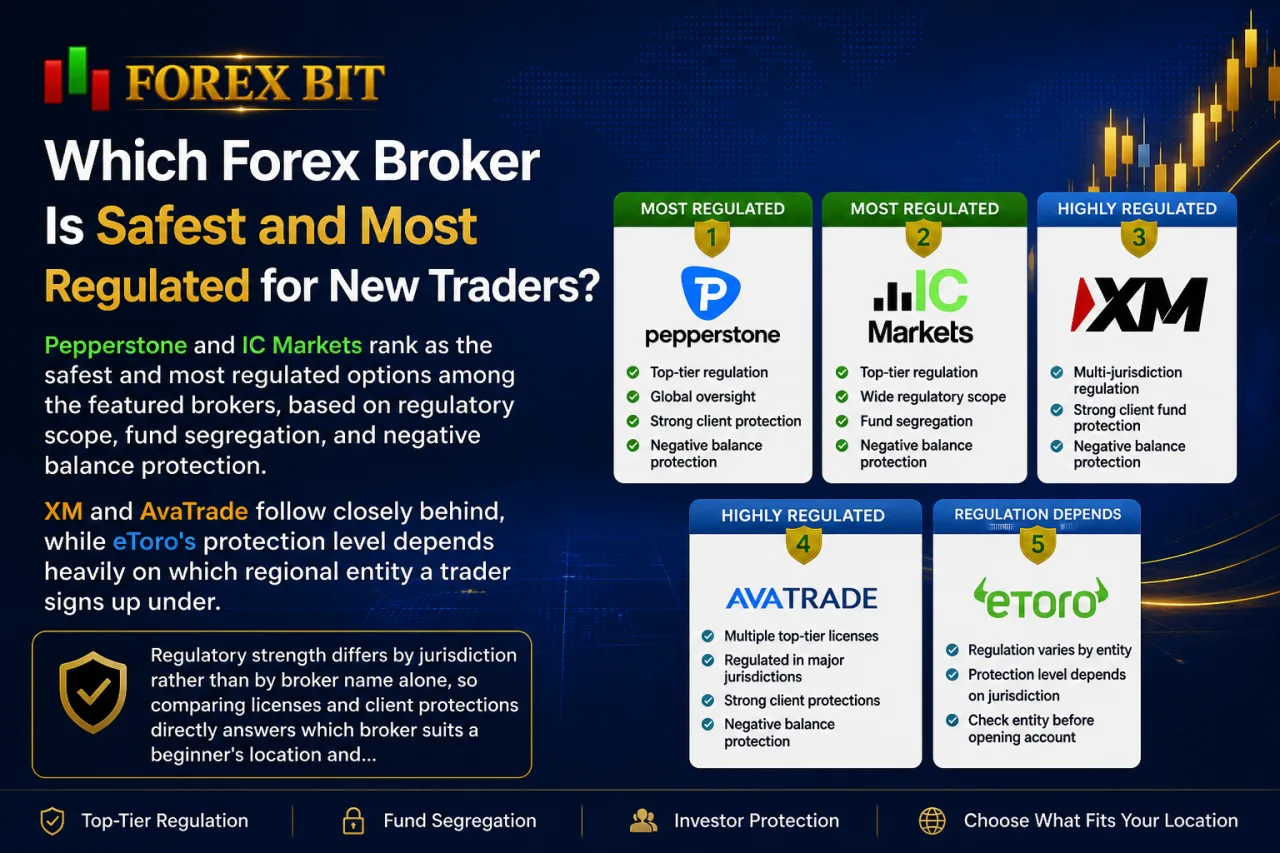
Pepperstone and IC Markets rank as the safest and most regulated options among the featured brokers. This ranking is based on regulatory scope, fund segregation, and negative balance protection. XM and AvaTrade also maintain solid regulatory standing, while eToro’s protection level depends heavily on which regional entity a trader signs up under.
Regulatory strength differs by jurisdiction rather than by broker name alone, so comparing licenses and client protections directly answers which broker suits a beginner’s location and risk tolerance.
- Pepperstone operates under regulatory oversight from multiple financial authorities across the jurisdictions in which it offers services.
- IC Markets operates under oversight from multiple financial regulators and states that client funds are held in segregated accounts at reputable banking institutions.
- XM holds licenses from multiple regulators, and the protections available to clients can vary depending on which regulated entity they are onboarded under.
- AvaTrade operates under licenses from multiple financial regulators, including authorities in Ireland and Australia, with investor compensation protections that vary by jurisdiction and regulated entity.
- eToro’s regulatory coverage varies by client location, and the compensation scheme that applies can differ depending on whether an account is held with its FCA, CySEC, or ASIC-regulated entity.
Negative balance protection and investor compensation schemes apply differently depending on which regulated entity onboards the trader, so beginners confirm their assigned entity before funding an account rather than assuming global coverage.
Which Forex Broker Offers the Best Educational Resources and Demo Accounts for Beginners?
Which Forex Broker Offers the Best Educational Resources and Demo Accounts for Beginners
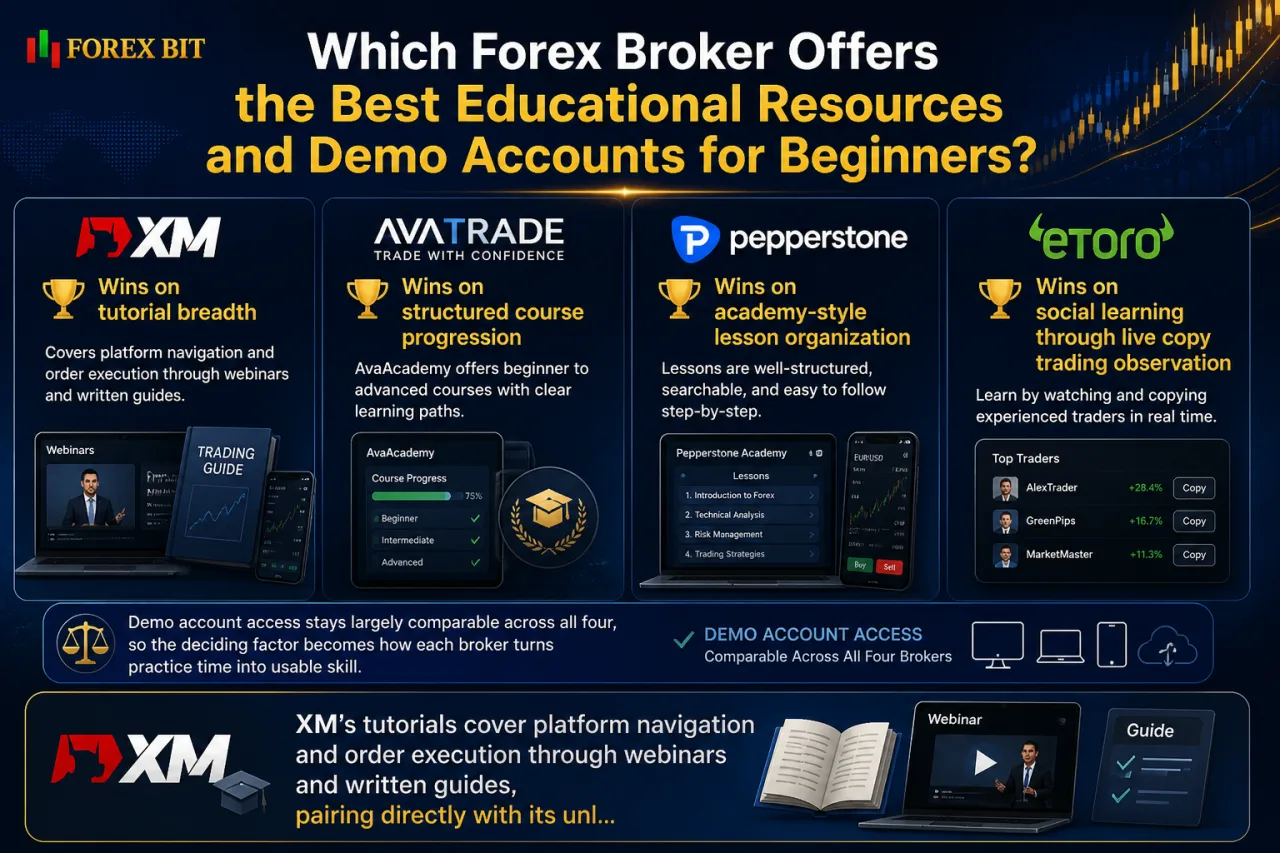
XM wins on tutorial breadth, AvaTrade wins on structured course progression through AvaAcademy, Pepperstone wins on academy-style lesson organization, and eToro wins on social learning through live copy trading observation. Demo account access stays largely comparable across all four, so the deciding factor becomes how each broker turns practice time into usable skill.
XM’s tutorials cover platform navigation and order execution through webinars and written guides, pairing directly with its unlimited demo account for repeated practice. AvaTrade’s AvaAcademy organizes video courses, guides, and glossaries by skill level, giving beginners a progressive path rather than scattered content, which sets it apart from XM’s more general webinar library. Pepperstone’s Trading Academy delivers market guides and webinars structured around trading fundamentals, complementing its multi-platform demo access across MT4, MT5, and cTrader. eToro replaces formal courses with a social feed where beginners observe and copy experienced traders directly, turning demo practice into applied learning rather than isolated tutorial study.
- XM: broad tutorial and webinar library paired with unlimited demo practice
- AvaTrade: AvaAcademy skill-level courses paired with demo-tested risk tools
- Pepperstone: Trading Academy guides paired with multi-platform demo access
- eToro: social feed and copy trading paired with observational learning
Beginners prioritizing structured lessons lean toward AvaTrade or Pepperstone, while those preferring learning by observation lean toward eToro.
How Can Beginners Manage Risk and Get Support When Starting with a Broker?
Beginners manage risk mainly through built-in broker tools such as negative balance protection, risk calculators, and guaranteed stop-loss options, while support quality determines how quickly issues get resolved during live trading. These two factors work together rather than separately, since a risk tool only helps if support explains how to use it correctly.
The sections below break down which featured brokers offer these specific risk controls and how their customer support compares in responsiveness and language coverage.
What Risk Management Tools Do Beginner-Friendly Brokers Provide?
Beginner-friendly brokers provide four core risk management tools: negative balance protection, guaranteed stop-loss orders, margin call alerts, and built-in loss-limiting features such as AvaTrade’s AvaProtect. These tools address the risk question directly by limiting downside exposure before a beginner fully understands position sizing.
Negative balance protection appears across Pepperstone, IC Markets, XM, and AvaTrade, preventing an account balance from going below zero during extreme volatility. Guaranteed stop-loss orders, where offered, lock in an exit price regardless of slippage during fast-moving markets, unlike standard stop-loss orders that fill at the next available price. Margin call alerts notify traders through the platform or account dashboard when equity approaches the required margin threshold, giving beginners a chance to add funds or close positions before automatic liquidation. AvaTrade adds a distinct feature, AvaProtect, which lets a trader offset potential losses on a position for a set period, subject to the plan’s specific cost and eligibility terms.
- Negative balance protection: caps losses at the account balance
- Guaranteed stop-loss orders: fixes exit price during volatile moves
- Margin call alerts: flags low equity before forced liquidation
- AvaProtect: offsets losses on a position for a defined period
Availability of each tool still depends on the specific regulated entity and account type a beginner opens.
How Responsive Is Customer Support for New Traders Across These Brokers?
Pepperstone and IC Markets provide the most responsive support setup for beginners through 24/5 live chat paired with phone access, while eToro’s ticket-based system tends to run slower for time-sensitive trading questions. Support quality matters for beginners specifically during account verification, deposit issues, and order-execution confusion, when delayed answers directly disrupt live trading.
Availability and language coverage differ enough across the five brokers to change how quickly a new trader gets unstuck:
- Pepperstone: live chat and phone support with multilingual coverage during market hours
- IC Markets: live chat and phone support with response times suited to urgent execution questions
- XM: live chat and multilingual phone support paired with a dedicated new-account onboarding team
- AvaTrade: live chat and phone support integrated with AvaAcademy guidance for platform-related questions
- eToro: primarily ticket-based support, with response speed generally slower than the live-chat brokers above, as direct live-chat or phone access is limited compared to competitors
Beginners handling account setup or margin questions in real time benefit more from the live-chat brokers, while eToro’s model suits traders relying more on its social feed than direct support contact.
Conclusion
XM stands out for traders wanting the lowest entry cost and a stripped-down account structure, eToro fits those who prefer learning through social observation and copy trading, Pepperstone suits beginners planning to grow into a multi-platform setup, IC Markets rewards traders focused on minimizing trading costs from day one, and AvaTrade serves those who value structured coursework alongside built-in loss-limiting tools.
Regulatory strength stays broadly comparable among Pepperstone, IC Markets, XM, and AvaTrade, while eToro’s protection depends on the onboarding entity. Matching deposit size, platform style, and support needs to these five profiles answers which broker best fits a first live trading account in 2026.