


- Top-tier multi-jurisdictional regulation
- Segregated client funds
- Wide range of trading markets
- Strong platform & API ecosystem
- Good education and customer support
- Trading costs are not the cheapest
- Inactivity and conversion fees may apply
- Leverage limits vary by jurisdiction
- Product access varies by region
- Some features are region-restricted
IG is a long-established, globally regulated broker, making it a strong option for traders seeking transparency and reliability in 2026. This review breaks down its regulation, costs, platforms, and market range to help traders decide if it fits their strategy.
IG holds licenses from multiple top-tier financial regulators, which oversee its operations across different jurisdictions. This multi-jurisdictional oversight reinforces client fund protection and regulatory accountability across different regions.
IG offers variable spreads on major forex pairs alongside a commission-based share dealing account option. Its account types are designed to serve both CFD traders and long-term investors with varying fee preferences.
IG provides its proprietary web platform alongside MetaTrader 4, giving traders flexibility across a wide range of markets and leverage tiers. The platform choice supports both algorithmic traders and those preferring built-in charting tools. Forex Bit examines these details next, starting with how trustworthy and reliable IG truly is in 2026.
Is IG a Trustworthy and Reliable Broker in 2026?
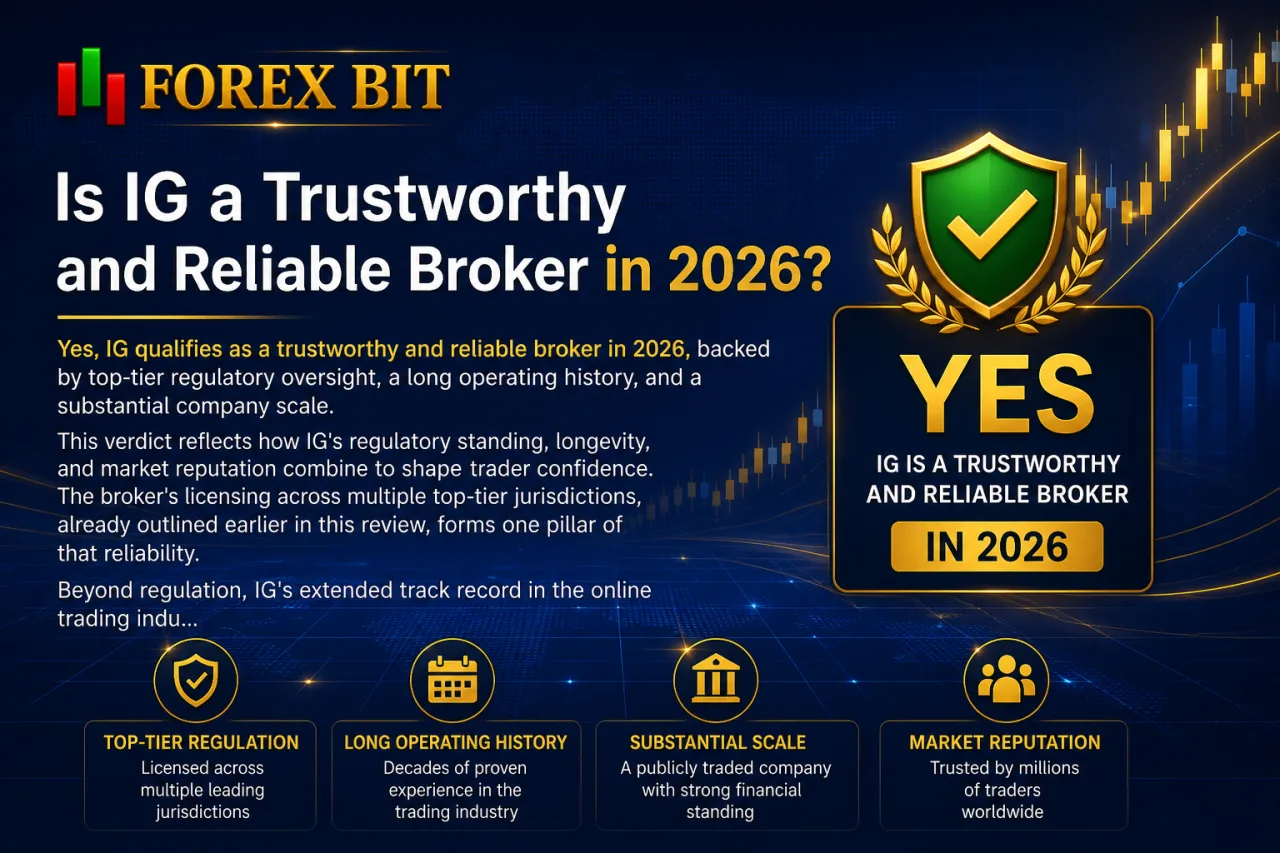
Yes, IG qualifies as a trustworthy and reliable broker in 2026, backed by top-tier regulatory oversight, a long operating history, and a substantial company scale.
This verdict reflects how IG’s regulatory standing, longevity, and market reputation combine to shape trader confidence. The broker’s licensing across multiple top-tier jurisdictions, already outlined earlier in this review, forms one pillar of that reliability. Beyond regulation, IG’s extended track record in the online trading industry and its listing status add further layers of accountability that smaller or newer brokers typically lack.
The sections below break this overall assessment into specific components, examining fund safety measures, regulatory scope, and how IG’s reputation holds up against industry peers.
What Is IG and How Is It Regulated?
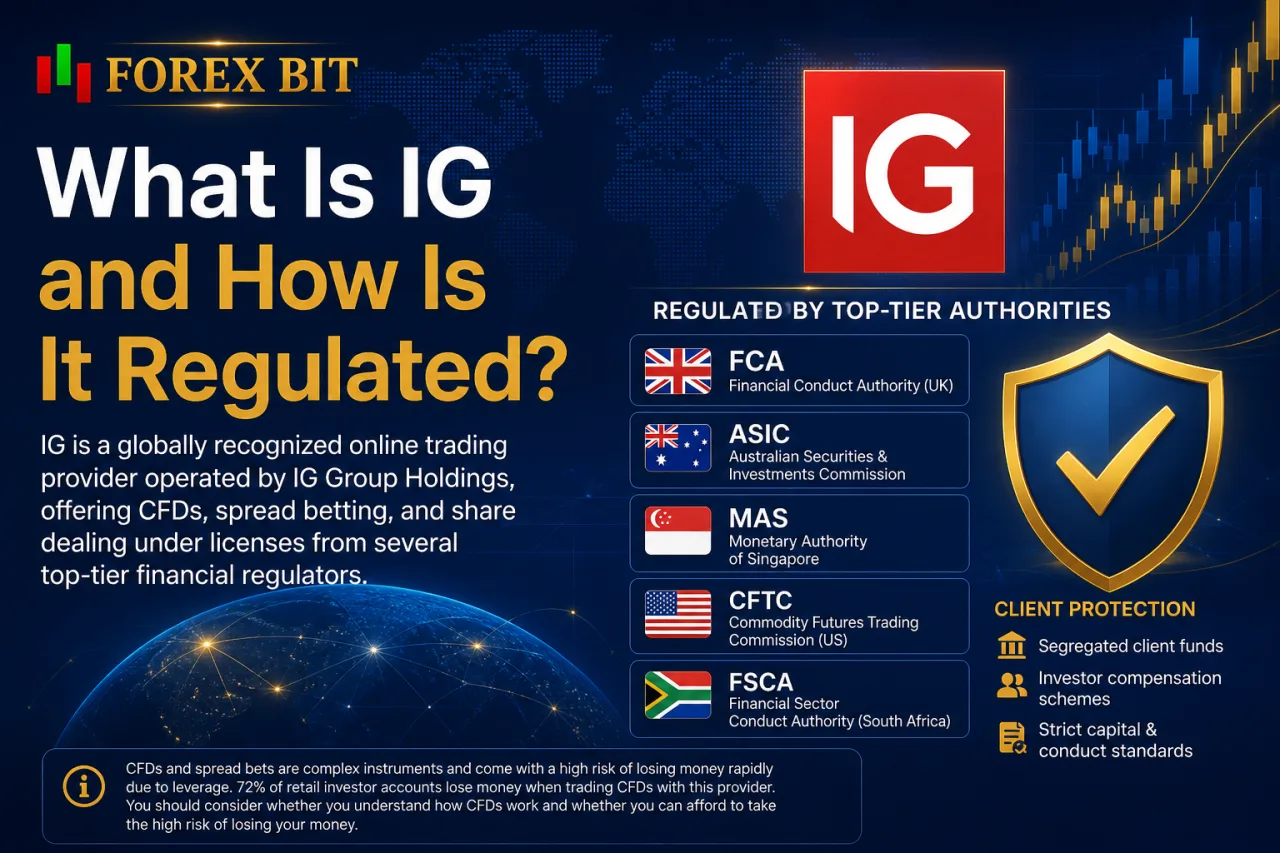
IG is a globally recognized online trading provider operated by IG Group Holdings, offering CFDs, spread betting, and share dealing under licenses from several top-tier financial regulators. This regulatory footprint spans multiple continents, giving IG oversight from authorities recognized for strict capital and conduct standards. The company background and its licensing structure both play a direct role in how client funds are protected and which investor compensation schemes apply. The following sections outline who IG is as a company and break down its regulatory coverage region by region.
Is IG Safe for Traders’ Funds?
Yes, IG safeguards traders’ funds through segregated client accounts, regional negative balance protection, and coverage under top-tier investor compensation schemes, working alongside the multi-jurisdictional regulatory oversight already outlined for IG to give traders a structured framework for fund security.
Client money at IG sits in segregated bank accounts, separate from the company’s own operating funds, so trading capital remains distinct from corporate assets even under financial stress and cannot be used for the broker’s operational expenses.
Negative balance protection availability depends on the entity a trader is registered under, with retail clients in certain regions receiving guaranteed protection against losses exceeding deposited funds, and this coverage varies by region according to local rules.
Compensation schemes add another safety layer, with eligible clients under IG’s UK arm covered by the FSCS and clients under certain other entities covered by comparable investor compensation funds. IG maintains a clean regulatory record overall, though isolated fines or enforcement actions may have occurred across its long operating history.
Which Countries Can Traders Use IG From?
IG accepts traders from a broad set of regions through separate regulated entities, reflecting its presence across major jurisdictions such as the UK, Europe, Australia, Singapore, South Africa, and the United States. This structure connects to the multi-jurisdictional regulatory coverage already described for IG, since account access depends on which regulated entity a trader is onboarded under.
Availability differs by entity because each IG subsidiary operates under its own local license and product scope. IG US, for instance, offers a narrower product range than IG’s UK or Australian entities, focusing mainly on forex and options rather than the full CFD suite.
Certain countries or regions remain restricted or unsupported due to local regulatory requirements or IG’s own market decisions. IG restricts or excludes residents of some jurisdictions from opening accounts, a limitation traders should confirm directly through IG’s official onboarding process before applying.
What Trading Platforms Does IG Offer?
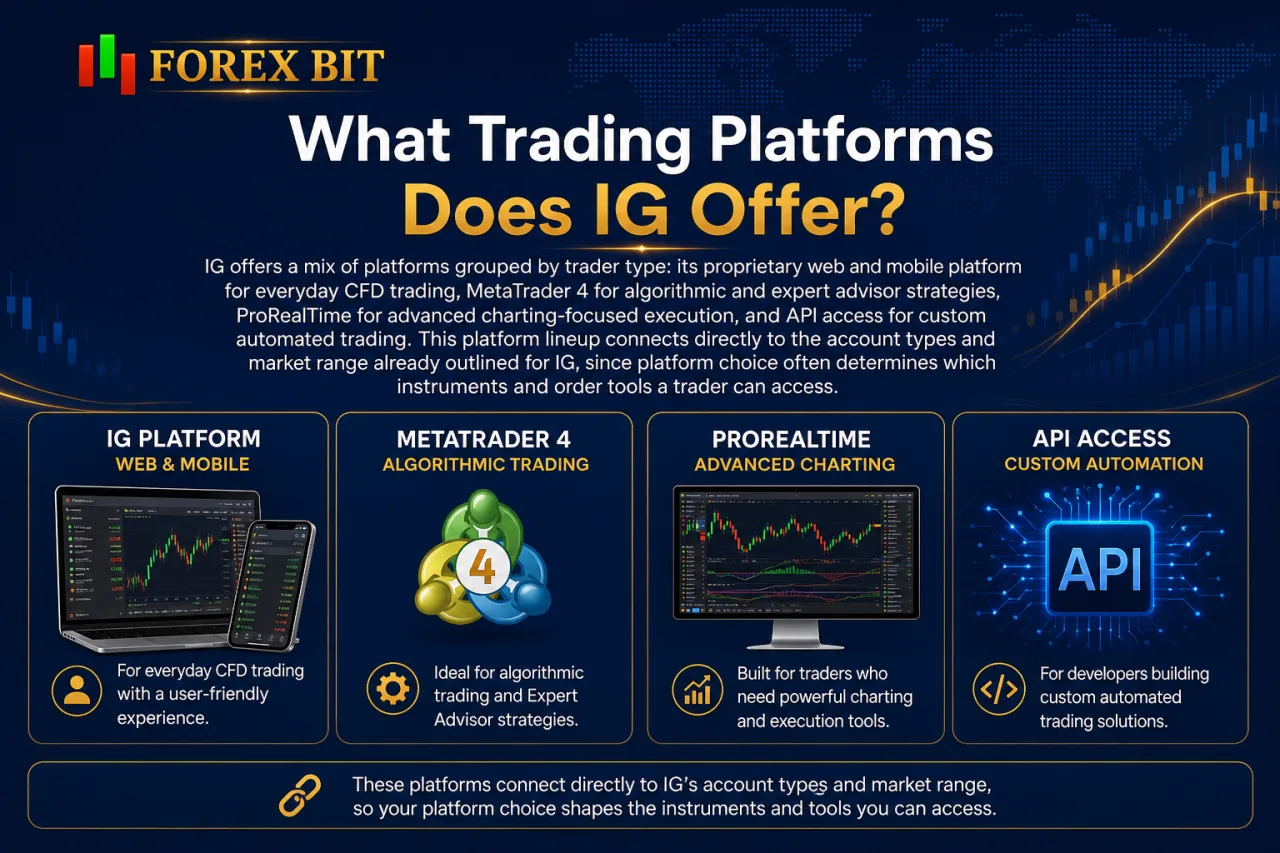
IG offers a mix of platforms grouped by trader type: its proprietary web and mobile platform for everyday CFD trading, MetaTrader 4 for algorithmic and expert advisor strategies, ProRealTime for advanced charting-focused execution, and API access for custom automated trading. This platform lineup connects directly to the account types and market range already outlined for IG, since platform choice often determines which instruments and order tools a trader can access. The sections below break down each platform’s charting depth, order types, and usability for beginners versus experienced traders.
IG’s Own Platform vs MetaTrader 4: Which Should Traders Choose?
IG’s own platform suits beginners and discretionary CFD traders with built-in charting, while MetaTrader 4 fits algorithmic traders relying on expert advisors and custom indicators. This comparison builds on the platform lineup already outlined for IG, weighing execution, charting depth, and automation support to identify the better fit for each trader type.
IG’s proprietary web and mobile platform integrates order tools, market news, and pattern recognition directly into a single interface, reducing the need for third-party add-ons. It targets traders who prefer a guided, all-in-one workspace rather than assembling their own toolkit.
MetaTrader 4, by contrast, prioritizes automation through Expert Advisors and custom scripts, appealing to traders who backtest strategies or run systems without manual intervention. Its charting relies more heavily on external indicators and community-built tools compared to IG’s native charting package.
- Native platform: intuitive layout, integrated research, better suited to manual and beginner traders.
- MetaTrader 4: stronger algorithmic support, broader third-party indicator library, favored by systematic traders.
Execution speed and available markets can differ slightly between the two, so traders comparing spreads or instrument coverage should verify current specifications directly with IG.
What Account Types Does IG Provide?
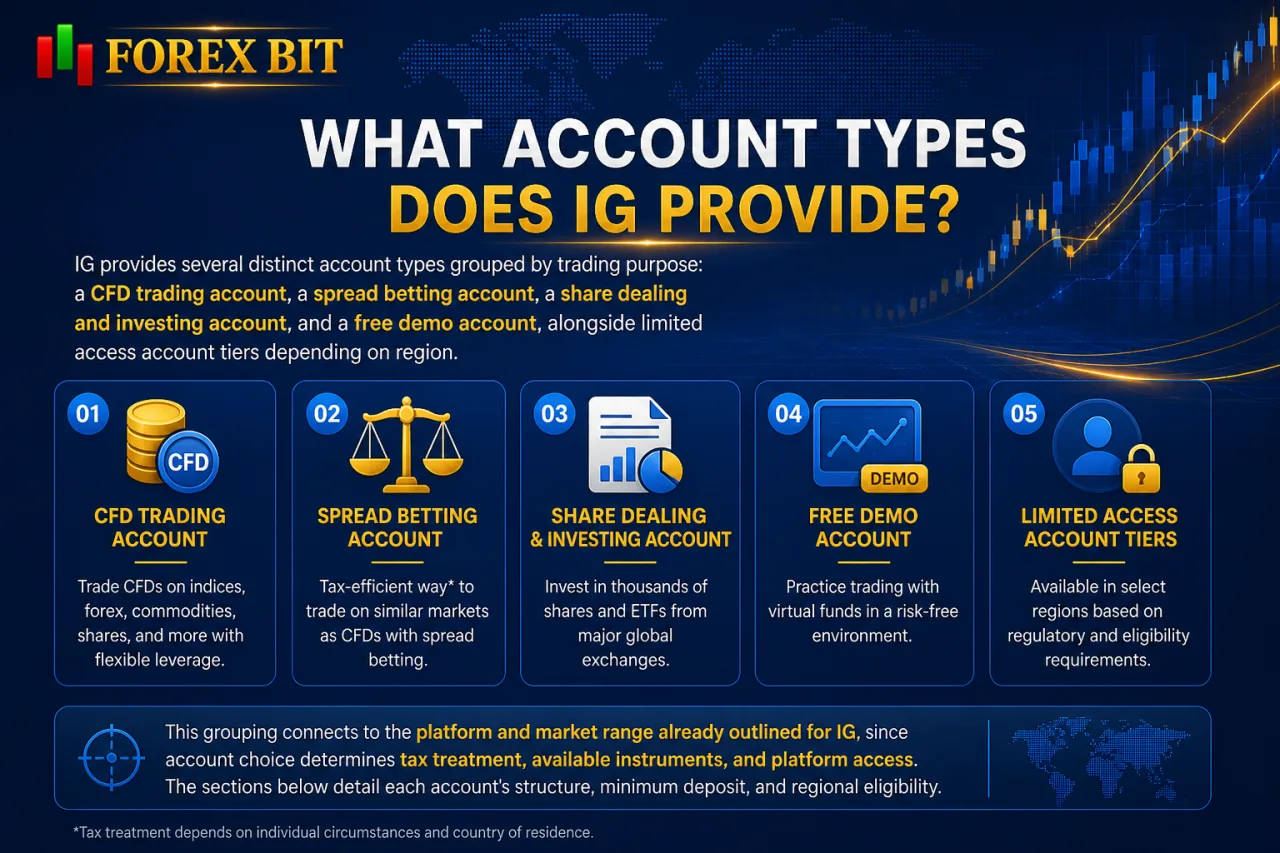
IG provides several distinct account types grouped by trading purpose: a CFD trading account, a spread betting account, a share dealing and investing account, and a free demo account, alongside limited access account tiers depending on region. This grouping connects to the platform and market range already outlined for IG, since account choice determines tax treatment, available instruments, and platform access. The sections below detail each account’s structure, minimum deposit, and regional eligibility.
How to Open an IG Trading Account?
Traders open an IG trading account through a four-step process: online registration, identity verification, funding, and account activation. This process follows directly from the account types already outlined for IG, since the registration flow applies across the CFD, spread betting, and share dealing options.
- Registration: applicants submit personal details, trading experience, and select the relevant account type through IG’s online form.
- Verification: IG runs identity and address checks (KYC), typically requiring a government-issued ID and proof of residence, consistent with standard practices under top-tier regulators.
- Funding: traders deposit through supported payment methods before placing trades, with minimum deposit requirements varying by regulated entity and account type.
- Approval: accounts typically become tradable once verification and funding clear, though exact approval timing can vary depending on document accuracy and the onboarding jurisdiction.
Beginners generally complete onboarding faster by submitting clear identification documents upfront, while traders opening accounts under stricter jurisdictions may face additional compliance checks before their account activates.
How Much Does It Cost to Trade with IG?
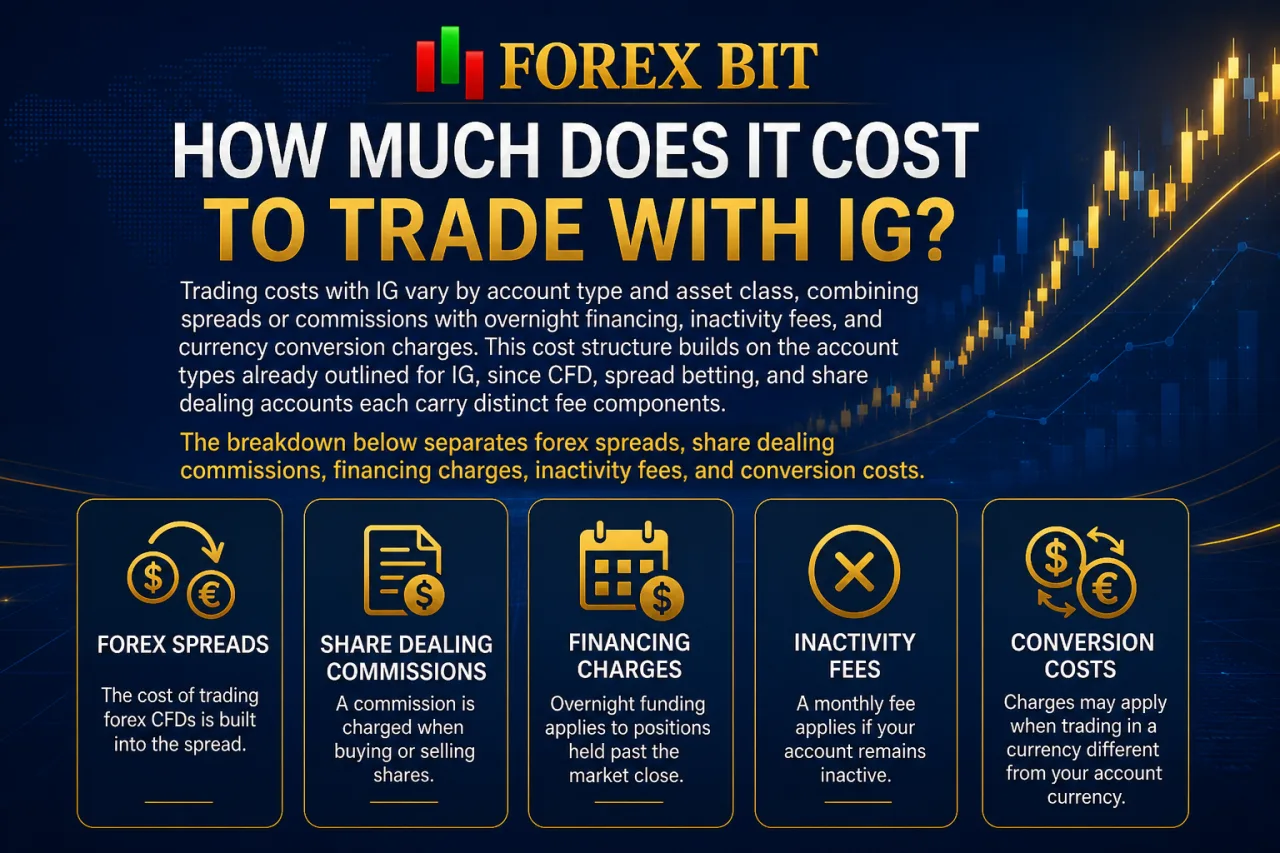
Trading costs with IG vary by account type and asset class, combining spreads or commissions with overnight financing, inactivity fees, and currency conversion charges. This cost structure builds on the account types already outlined for IG, since CFD, spread betting, and share dealing accounts each carry distinct fee components. The breakdown below separates forex spreads, share dealing commissions, financing charges, inactivity fees, and conversion costs.
Are IG’s Spreads Competitive Compared to Other Brokers?
IG’s spreads generally sit within the competitive range for a top-tier regulated broker, though its share dealing commissions and financing charges position it closer to the mid-to-premium tier rather than the cheapest option in the market. This positioning follows the cost structure already outlined for IG, since spreads form only one part of the total trading expense alongside commissions and overnight financing.
On major forex pairs, IG’s variable spreads generally track close to industry averages during normal market hours, widening during low-liquidity periods or high-impact news events, a pattern common across most top-tier regulated brokers rather than unique to IG. Index CFD spreads follow a similar pattern, staying tight on the most heavily traded benchmarks while less liquid indices carry wider pricing.
IG does not typically rank among the absolute lowest-cost brokers in the industry, since its regulatory overhead and platform infrastructure translate into pricing that reflects its established market position rather than a discount-broker model.
Traders prioritizing the lowest possible spread may find leaner-cost brokers elsewhere, while those valuing execution reliability and regulatory strength alongside reasonable pricing find IG’s spread levels justified by its overall service quality.
What Markets and Leverage Does IG Offer?
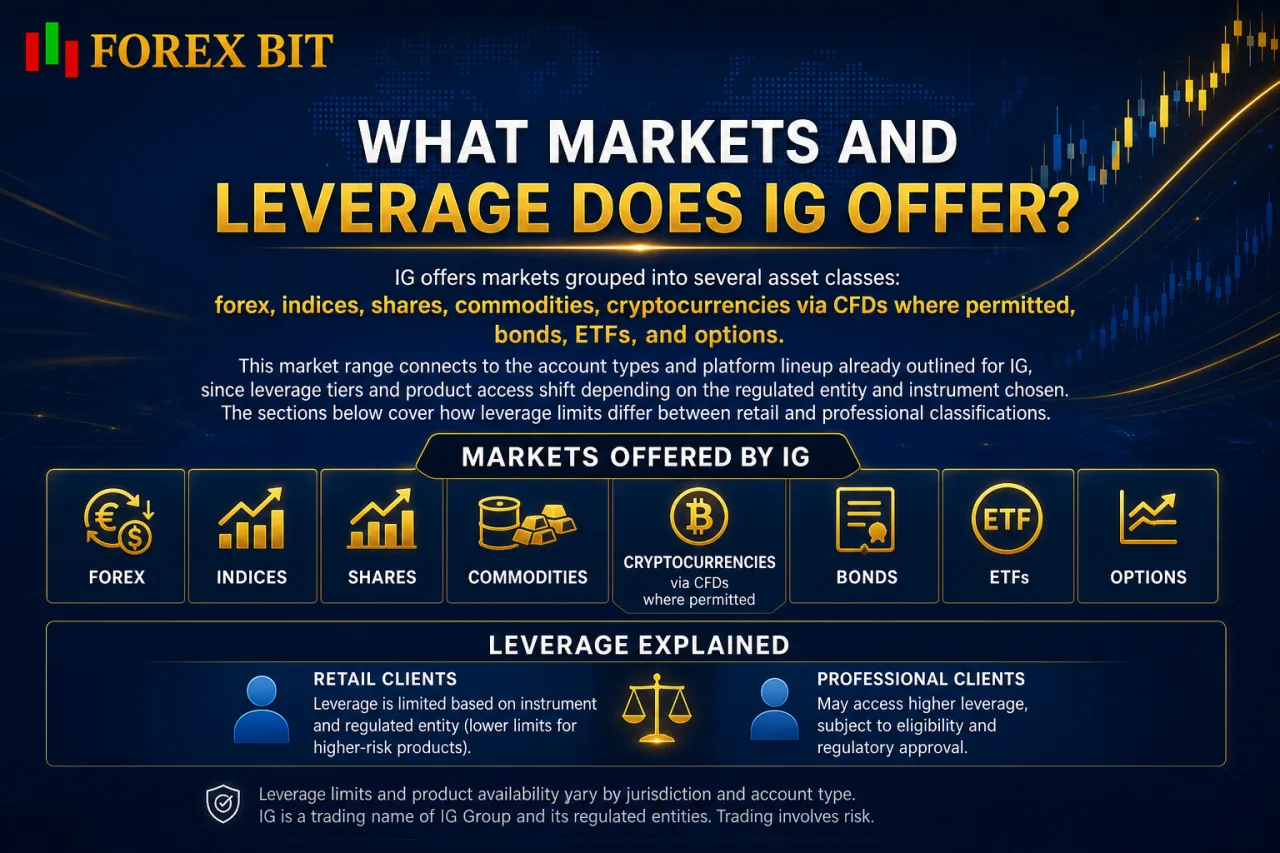
IG offers markets grouped into several asset classes: forex, indices, shares, commodities, cryptocurrencies via CFDs where permitted, bonds, ETFs, and options. This market range connects to the account types and platform lineup already outlined for IG, since leverage tiers and product access shift depending on the regulated entity and instrument chosen. The sections below cover how leverage limits differ between retail and professional classifications.
What Is the Maximum Leverage Available on IG?
Maximum leverage on IG depends on client classification, with professional clients able to access higher ratios than the capped limits applied to retail clients under top-tier regulators. This leverage structure ties directly to the regulated entity a trader opens an account under, since each jurisdiction enforces its own retail leverage ceiling.
Retail clients trading under regulators such as the FCA, ASIC, or ESMA-aligned entities face standardized maximum leverage caps that vary by asset class, with major forex pairs typically allowing higher ratios than indices, shares, or cryptocurrencies. Professional client status, granted only to traders meeting specific qualifying criteria, removes these retail caps and unlocks substantially higher leverage across IG’s markets.
- Retail accounts: capped leverage tiers set by the applicable regulator, differing by instrument type.
- Professional accounts: elevated leverage limits for qualifying traders, with reduced regulatory protections.
- IG US accounts: separate leverage rules under US regulatory requirements, distinct from IG’s UK or Australian entities.
Traders confirm exact leverage figures for their specific account type and region directly through IG’s official platform before trading, since ratios shift depending on jurisdiction and asset class.
How Do Deposits and Withdrawals Work on IG?
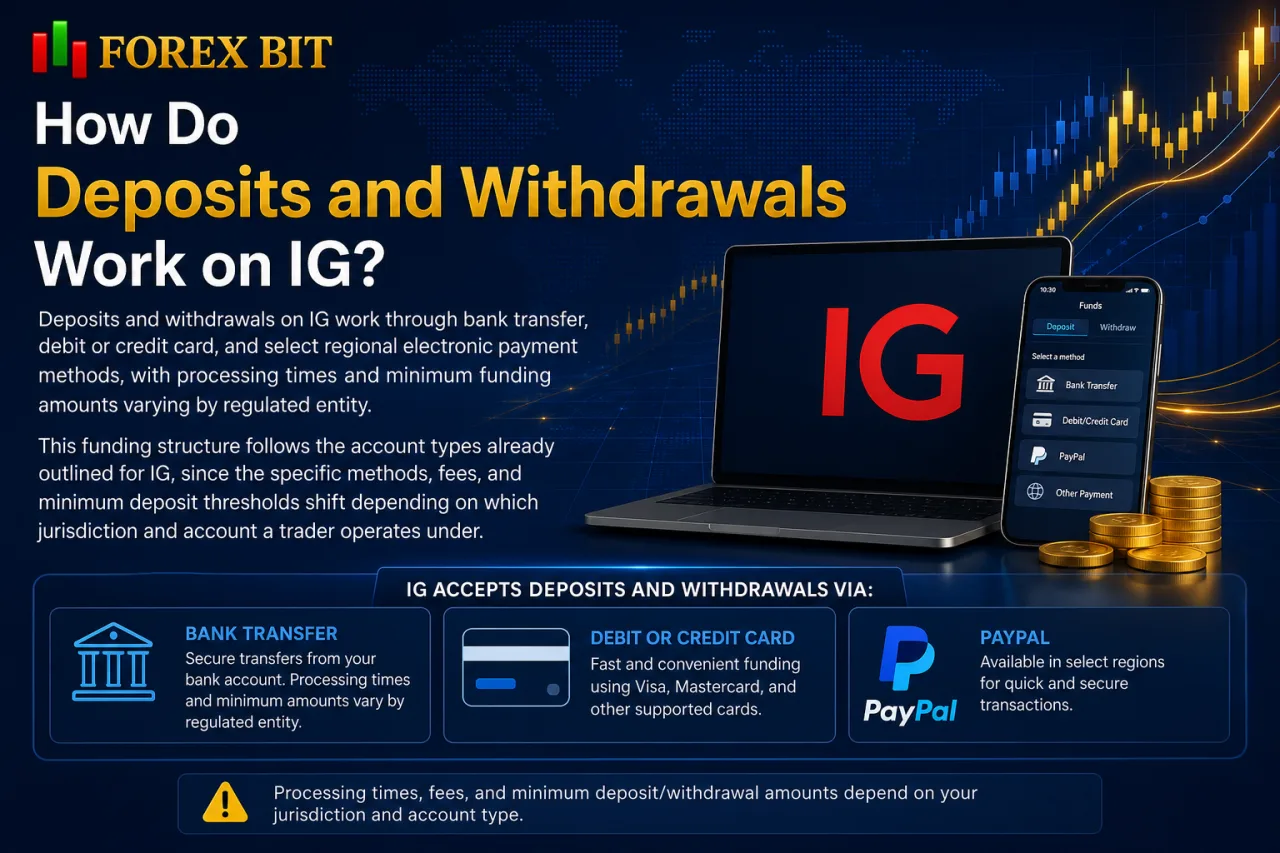
Deposits and withdrawals on IG work through bank transfer, debit or credit card, and select regional electronic payment methods, with processing times and minimum funding amounts varying by regulated entity. This funding structure follows the account types already outlined for IG, since the specific methods, fees, and minimum deposit thresholds shift depending on which jurisdiction and account a trader operates under.
IG accepts bank transfer, debit or credit card, and PayPal in certain regions, though PayPal availability depends on the trader’s country and the regulated entity handling the account.
Card deposits typically reflect in the trading account faster than bank transfers, which often take longer to clear depending on the sending bank and currency route. IG does not appear to charge a direct deposit fee on standard payment methods, though currency conversion charges can apply when funding an account in a currency different from its base currency, so traders should confirm the current fee schedule directly with IG.
- Bank transfer: slower processing, no card-network fees, suited to larger deposit amounts.
- Card payment: faster crediting, subject to issuer or card-network restrictions in some regions.
- PayPal: available only where supported, offering an alternative to card and bank funding.
Minimum deposit amounts and withdrawal processing times differ depending on the country and account type selected during registration, so traders should confirm the exact figures directly through IG’s official account portal before funding an account.
How Good Is IG’s Customer Support?

IG’s customer support qualifies as good, offering multiple contact channels, broad availability, and educational resources that assist traders beyond basic query handling. This assessment builds on the account and platform structure already outlined for IG, since support quality often shapes how efficiently traders resolve platform or funding issues.
Traders reach IG through live chat, phone lines, and email, with response speed generally fastest through live chat for account or platform queries. IG’s phone and chat support generally operate on extended hours aligned with major trading sessions, though exact availability varies by regional entity, so traders should confirm current hours directly with IG.
Language coverage extends across several major languages depending on the regional entity handling the account, reflecting IG’s presence across the UK, Europe, Australia, Singapore, and other markets already described earlier in this review.
Beyond direct support channels, IG Academy provides structured courses, webinars, and market analysis content aimed at both beginners and experienced traders. The free demo account, already noted among IG’s account types, complements this educational layer by letting traders test platform features and strategies without risking real capital.
What Unique Tools and Features Set IG Apart from Other Brokers?
IG separates itself from typical forex brokers through a set of niche tools spanning direct market access, advanced charting, structured education, and a broader investing ecosystem. This grouping builds on the platforms and account types already outlined for IG, since these differentiators extend beyond core forex and CFD execution into areas most retail-focused brokers do not offer. The sections below cover each of these distinct features individually.
What Is IG’s APIs and Algorithmic Trading Support?
IG supports algorithmic trading through a dedicated REST and Streaming API, a feature not commonly offered by many retail forex brokers. This API access extends the platform lineup already outlined for IG beyond MetaTrader 4’s Expert Advisor framework into fully custom automated trading.
IG’s REST API handles order placement, account queries, and market data retrieval, while the Streaming API delivers live price updates for time-sensitive strategies. Developers build custom trading applications, connect proprietary systems, or integrate IG execution into existing infrastructure rather than relying solely on packaged platform tools.
This positions IG closer to institutional-style connectivity than typical retail brokers limited to MetaTrader plugins. Traders running quantitative strategies or requiring direct system integration gain flexibility that IG’s native web platform alone does not provide.
Does IG Offer Spread Betting as an Alternative to CFD Trading?
Yes, IG offers spread betting as a distinct product line separate from CFD trading, though this option is generally available only to traders based in certain regions, such as the UK and Ireland, so eligibility should be confirmed directly with IG.
Spread betting builds on the account types already outlined for IG, sitting alongside the CFD, share dealing, and demo account options as a separate structure with its own tax treatment.
Spread betting profits are generally treated as exempt from capital gains tax for eligible UK and Ireland residents, a tax treatment that does not extend to IG’s CFD accounts, though traders should confirm their personal tax position with a qualified advisor or the relevant tax authority. This tax status makes spread betting a differentiator against many global competitors that offer CFDs only.
Key distinctions from standard CFD trading include:
- Settlement occurs in the account’s base currency per point moved rather than per unit of the underlying asset.
- Eligibility restricts primarily to residents of jurisdictions where spread betting is legally recognized.
- Market access mirrors IG’s CFD offering across forex, indices, shares, and commodities.
Traders outside the UK and Ireland typically default to IG’s CFD account structure instead.
Conclusion
IG earns its standing as a trustworthy broker through top-tier multi-jurisdictional regulation, segregated client funds, and a long operating history that few competitors match. Its platform lineup covers everyday CFD trading, algorithmic strategies via MetaTrader 4, and custom automation through APIs, while account options extend from CFDs and spread betting to share dealing and a risk-free demo.
Costs sit in the mid-to-premium range rather than the cheapest tier, reflecting its regulatory strength and infrastructure. For traders weighing safety, market breadth, and platform flexibility over rock-bottom pricing, IG stands out as a solid, well-rounded choice for 2026.
Thomas Dite is the Best Forex Brokers Research Manager at Forex Bit, specializing in researching, comparing, and editing broker-related content for different trader needs. He focuses on evaluating trading platforms, costs, regulation, account conditions, and other key factors to help readers make more informed broker comparisons.
Email: [email protected]