






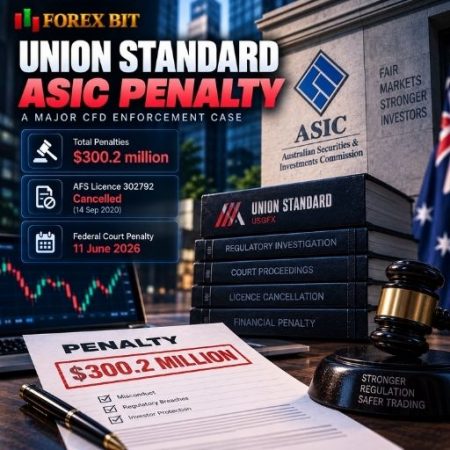


Forex broker news covers regulatory actions, broker updates, and payment or security changes that directly affect trading conditions and fund safety. Staying informed on these developments helps traders react quickly to changes that impact their accounts and strategies.
Broker updates typically include new account types, platform launches, and policy changes announced directly by brokers. These changes can affect trading costs, available instruments, or platform access, making regular monitoring useful for active traders.
New regulations affect the safety of traders’ funds by setting requirements for capital protection, segregation of client accounts, and reporting standards. Changes introduced by financial authorities alter how brokers must handle client money and disclose risks.
Payment and security updates influence how deposits and withdrawals are processed, including changes to payment providers or verification requirements. These updates often follow new compliance rules aimed at reducing fraud and improving transaction transparency.
This overview from Forex Bit outlines the latest developments traders should track, starting with the most important updates currently shaping the forex broker landscape.
What Is the Latest Forex Broker News Traders Should Know?
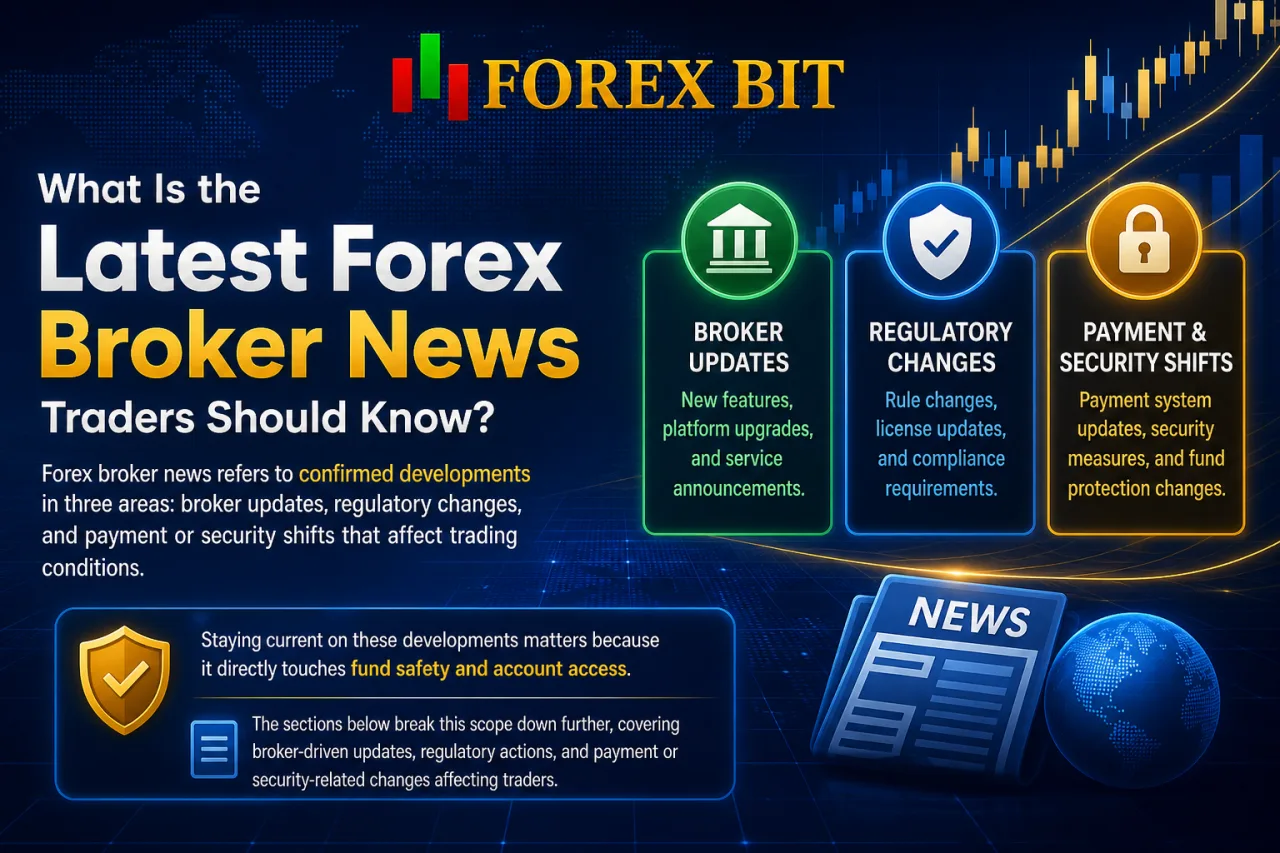
Forex broker news refers to confirmed developments in three areas: broker updates, regulatory changes, and payment or security shifts that affect trading conditions. Each category reflects a different source of change, from decisions made directly by a broker to rules imposed by financial authorities or payment providers.
Staying current on these developments matters because it directly touches fund safety and account access. The sections below break this scope down further, covering broker-driven announcements, regulatory shifts affecting capital protection, and payment or verification changes that alter how traders move money in and out of their accounts.
What Types of Forex Broker News Are Covered?
Forex broker news covers three main categories: broker operational updates, regulatory and licensing news, and payment or security news, grouped by the source of the change. Each category points traders to a different place to check for relevant developments.
Broker operational updates come directly from a broker and cover new account types, platform launches, spread or commission changes, and shifts in available instruments. These announcements typically appear on the broker’s own communication channels and affect trading conditions immediately after rollout.
Regulatory and licensing news originates from financial authorities overseeing broker conduct. This category includes changes to licensing status, capital requirements, client fund segregation rules, and enforcement actions against non-compliant firms.
Payment and security news tracks changes to deposit and withdrawal processes, including new payment providers, updated verification steps, and fraud-prevention measures. These updates often follow compliance requirements set by regulators or payment networks rather than decisions made solely by the broker.
How Often Should Traders Check for Forex Broker Updates?
Traders check for forex broker updates through a mix of scheduled reviews and continuous alerts, checking broker announcements and regulator notices at least once a week while monitoring news feeds daily. This frequency covers the practical habits that keep traders aware of changes affecting their accounts without constant manual searching.
A few habits support this monitoring routine:
- Subscribing to a broker’s official email list or app notifications flags new account types, platform changes, or fee updates as soon as they are published.
- Checking the relevant financial regulator’s website confirms licensing status and reveals enforcement actions or rule changes affecting capital protection.
- Following reputable forex news sources consolidates broker, regulatory, and payment updates in one place, reducing the need to track multiple individual sites.
- Reviewing payment provider notices catches changes to deposit and withdrawal methods before they disrupt fund transfers.
Active traders benefit from daily news checks given how quickly platform or payment changes can affect open positions, while longer-term traders cover most relevant developments with a weekly review cycle.
What Recent Broker Updates Have Been Announced?
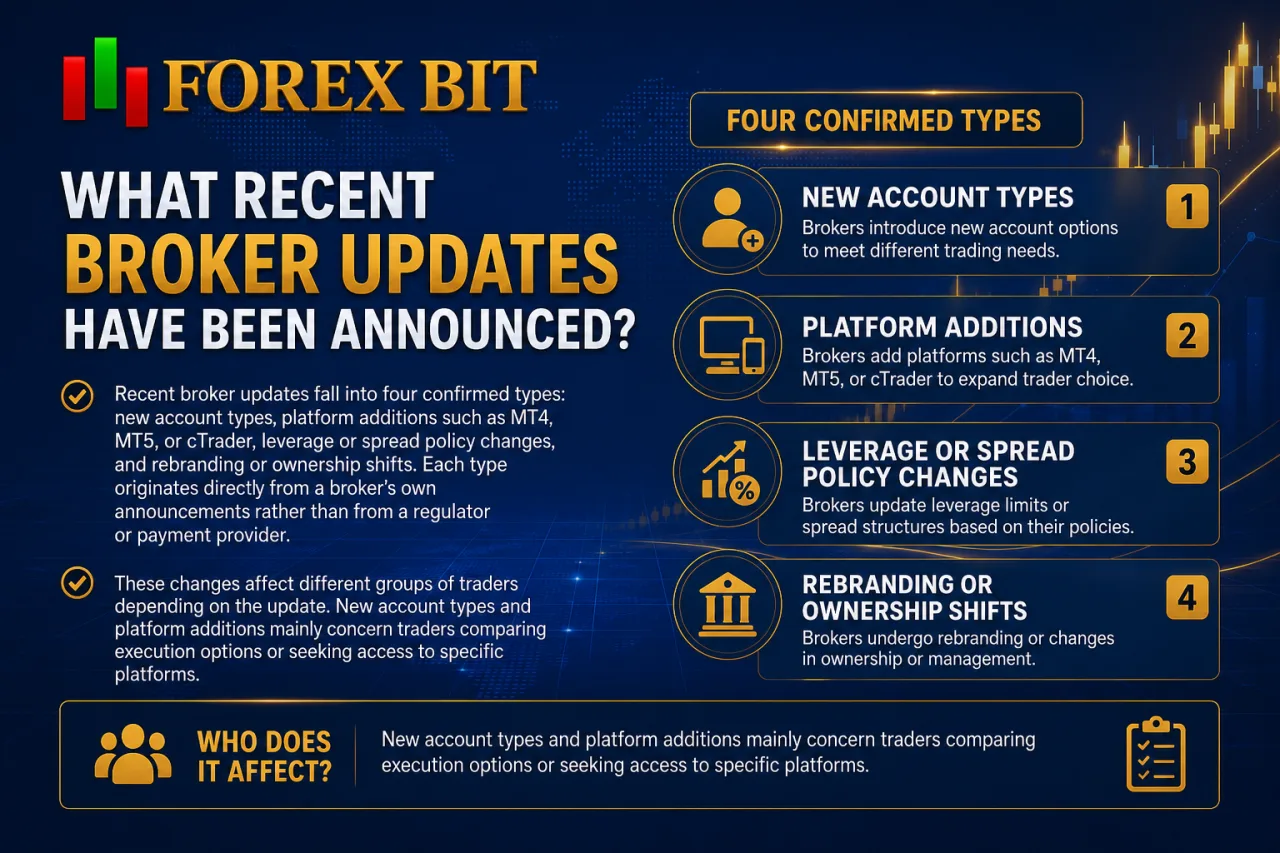
Recent broker updates fall into four confirmed types: new account types, platform additions such as MT4, MT5, or cTrader, leverage or spread policy changes, and rebranding or ownership shifts. Each type originates directly from a broker’s own announcements rather than from a regulator or payment provider.
These changes affect different groups of traders depending on the update. New account types and platform additions mainly concern traders comparing execution options or seeking access to specific tools, while leverage or spread adjustments affect existing clients’ cost structure and risk exposure on open and future positions.
Rebranding or ownership changes carry a different weight, since they can signal a shift in the entity holding client funds or the regulatory licence attached to the account. Traders with existing balances at an affected broker check whether account terms, segregation practices, or licensing details change as a result. The sections below cover each of these update types in turn.
What New Account Types or Platform Launches Have Brokers Introduced?
Brokers have introduced four confirmed types of updates: new account tiers with adjusted minimum deposits or spread structures, added platforms such as MT4, MT5, or cTrader, extra features like copy trading or social trading tools, and expanded instrument lists covering forex pairs, indices, or crypto CFDs. Each update changes trading conditions differently depending on whether a trader already holds an account or is opening one new.
New account tiers typically separate traders by deposit size or spread type, offering fixed or variable pricing alongside different support levels. Existing clients on an older account type check whether switching tiers lowers costs or unlocks features unavailable on their current plan.
Platform launches expand execution options without necessarily changing existing account terms, letting traders choose between MT4’s established tools, MT5’s added asset classes, or cTrader’s order-execution style. New clients weigh these platform choices during broker selection, while existing clients evaluate whether migrating to a newly added platform suits their trading style.
Feature additions such as copy trading or social trading tools broaden strategy options for clients already holding an account, often without a deposit or account-type change. Expanded instrument lists similarly widen access for existing accounts, letting current clients trade newly added markets under their existing terms.
How Do Policy Changes From Brokers Affect Existing Traders?
Policy changes from brokers apply differently depending on the type: fee or spread adjustments typically apply to all clients immediately, while grandfathering clauses sometimes protect existing accounts from new minimum deposit or leverage rules. This distinction determines whether a trader’s current terms hold steady or shift alongside new sign-ups.
Fee and spread changes generally take effect across the entire client base at once, since these adjustments reflect the broker’s updated cost structure rather than a new account tier. Terms and conditions updates, such as changes to margin policy or order execution rules, also tend to apply broadly once published, regardless of when an account was opened.
Minimum deposit changes behave differently in most cases. New minimum deposit thresholds usually target incoming clients, while accounts opened before the change often remain under the original terms unless the broker explicitly states otherwise.
- Checking the broker’s official update notice confirms whether a change applies retroactively or only to new accounts.
- Reviewing the account agreement identifies any grandfathering clause protecting existing terms.
- Contacting support directly clarifies ambiguous cases before a deposit or trade is affected.
How Do New Regulations Affect the Safety of Traders’ Funds?
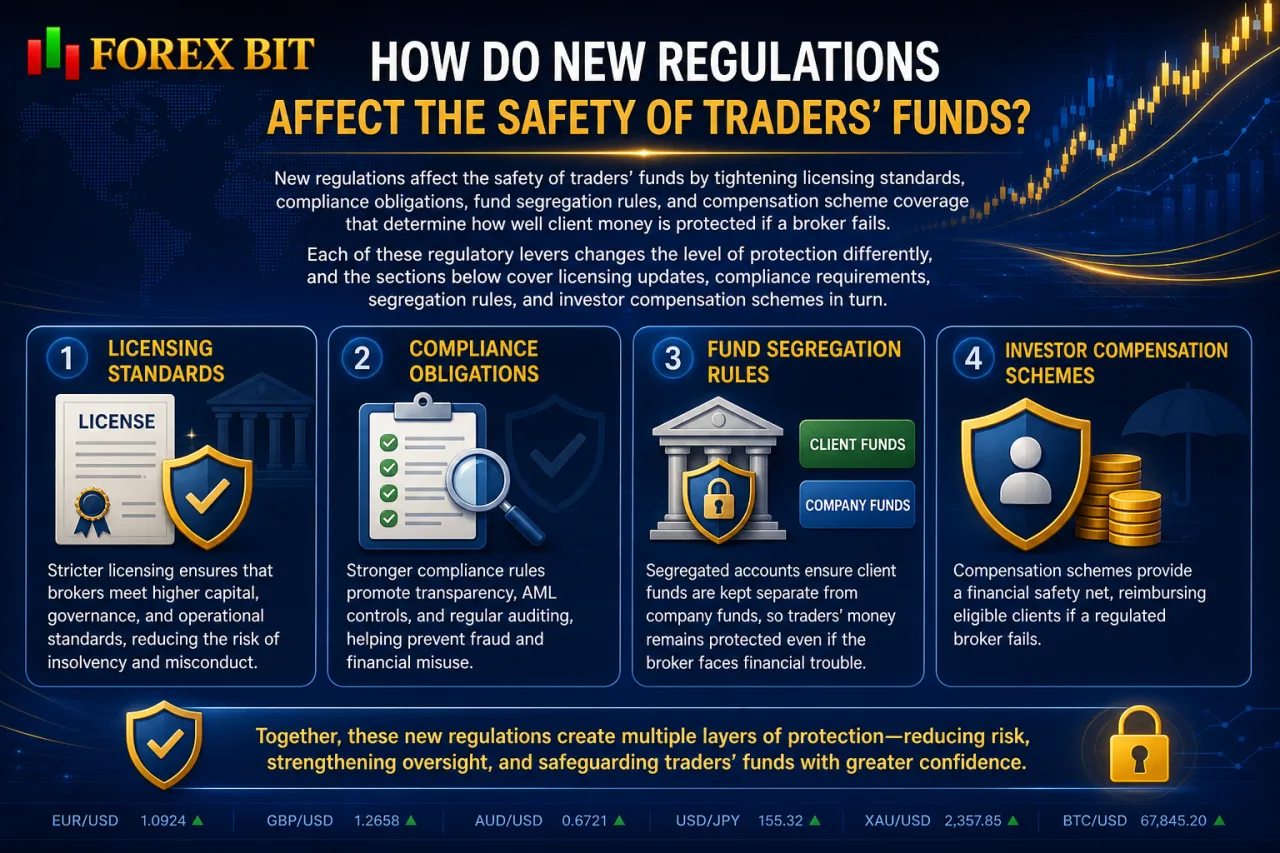
New regulations affect the safety of traders’ funds by tightening licensing standards, compliance obligations, fund segregation rules, and compensation scheme coverage that determine how well client money is protected if a broker fails. Each of these regulatory levers changes the level of protection differently, and the sections below cover licensing updates, compliance requirements, segregation rules, and investor compensation schemes in turn.
What Are the Main Types of Regulatory Changes Affecting Forex Brokers?
Regulatory changes affecting forex brokers group into four types: new licensing requirements, leverage restrictions, marketing rule changes, and cross-border regulatory actions. Each type comes from a financial authority overseeing the broker’s operating jurisdiction, and multiple regulators sometimes act on the same broker when it holds licences in more than one region.
New licensing requirements raise the bar for capital reserves, reporting standards, or the qualifications a broker must demonstrate to keep operating. Leverage restrictions cap the maximum ratio offered to retail clients, directly reducing exposure size on a given deposit.
Marketing rule changes limit how brokers advertise bonuses, risk warnings, or profit claims to prospective clients. Cross-border regulatory actions occur when a broker faces enforcement or licence review from an authority outside its home jurisdiction, often triggered by client complaints or coordination between regulators.
Traders track these categories through the specific regulator tied to their broker’s licence rather than assuming rules apply uniformly worldwide, since requirements vary by jurisdiction and authority.
How Can Traders Verify If a Broker’s Regulatory Status Has Changed?
Traders verify a broker’s regulatory status through four steps: searching the regulator’s public register, reading the broker’s own disclosures, cross-referencing licence numbers, and monitoring regulator press releases. This process confirms whether a licence remains active, has changed, or has been suspended without relying on the broker’s marketing claims alone.
Each step targets a different source, so cross-checking multiple sources catches discrepancies a single check might miss.
- Searching the regulator’s official register confirms the current licensing status tied to the broker’s registered name.
- Reading the broker’s website footer or legal disclosures identifies the exact licence number and entity claimed.
- Cross-referencing that licence number against the register catches mismatches between what a broker states and what the regulator confirms.
- Monitoring the regulator’s press releases or enforcement notices reveals warnings, suspensions, or licence changes not always announced by the broker itself.
Traders holding funds with a broker operating across multiple jurisdictions repeat this check for each relevant regulator, since licensing status differs by region and a suspension in one jurisdiction does not necessarily apply to another.
What Payment and Security Changes Affect Deposits and Withdrawals?
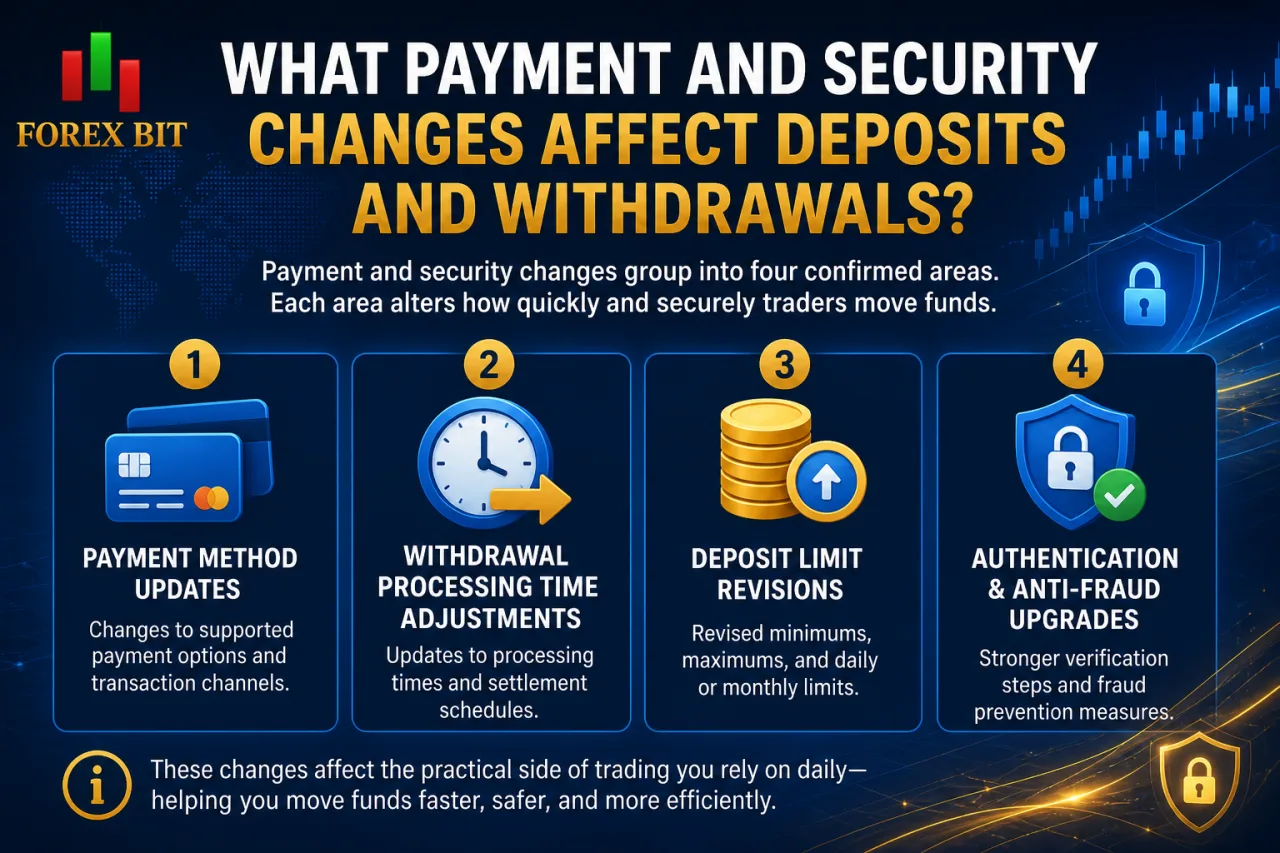
Payment and security changes group into four confirmed areas: payment method updates, withdrawal processing time adjustments, deposit limit revisions, and authentication or anti-fraud upgrades. Each area alters how quickly and securely traders move funds in and out of their trading accounts.
These changes matter because they touch the practical side of trading that traders rely on daily, separate from strategy or platform choice. The subsections below cover method and processing changes alongside limit and verification updates in turn.
What Types of Payment Method Changes Have Brokers Made?
Brokers make payment method changes in four confirmed forms: adding or removing payment providers, adjusting processing fees or times, introducing new local payment options, and updating minimum or maximum transaction limits. Each type affects a different segment of a broker’s client base depending on region and preferred funding method.
Adding or removing payment providers alters which cards, e-wallets, or bank transfer options a client uses to fund or withdraw from an account. Clients relying on a removed provider switch to an alternative method before their next transaction, while new provider additions expand available choices without changing existing options.
Processing fee or time adjustments change the cost or speed of moving funds, affecting all clients using that specific method regardless of account size. New local payment options mainly benefit traders in a specific region gaining access to a domestic transfer method or e-wallet not previously supported.
- Confirming the broker’s updated payment page identifies which providers remain active in a given account’s region.
- Checking fee schedules before a transaction avoids unexpected charges on deposits or withdrawals.
- Reviewing processing time estimates sets realistic expectations for fund availability after a withdrawal request.
How Do Security Updates Protect Trader Deposits and Withdrawals?
Yes, new security measures reduce risk for trader deposits and withdrawals, since two-factor authentication, encryption upgrades, and fraud monitoring each close a specific gap that attackers otherwise exploit. This addresses the security angle behind the payment method changes covered above, which affect access to funds separately from processing speed or fees.
Two-factor authentication blocks unauthorized withdrawal requests even when a password gets compromised, since a second verification step from a separate device stops the transaction. Encryption upgrades protect payment details and login credentials while data moves between a trader’s device and the broker’s servers, reducing exposure during transmission rather than at the storage stage. Fraud monitoring systems flag unusual withdrawal patterns, such as a sudden change in destination account or transaction size, prompting manual review before funds leave the account.
Traders support these protections through direct action rather than passive reliance on the broker:
- Enabling two-factor authentication on every trading and email account tied to fund transfers
- Confirming withdrawal destination details match the trader’s own verified accounts
- Reporting unrecognized login attempts or transaction alerts to the broker immediately
- Updating passwords after any suspected data exposure elsewhere online
These steps close the gap between what a broker’s security system detects and what a trader confirms manually.
What Are Some Lesser-Known Signals That Predict Upcoming Broker Changes?
Lesser-known signals that hint at upcoming broker changes group into three areas: ownership structure shifts, unusual withdrawal delays, and changes in regulatory audit frequency, each preceding official announcements. These indicators surface in account statements, corporate filings, or regulator activity before a broker or regulator confirms any formal update, giving attentive traders an early read on where conditions might head next.
How Can Changes in Broker Ownership Signal Future Regulatory Action?
Ownership changes can signal future regulatory action, since mergers, acquisitions, or shifts in parent company control may prompt regulators to review a broker’s licence. This links directly to the earlier point on watching ownership structure shifts as a lesser-known predictor of upcoming broker changes.
A change in parent company control often triggers a fresh fit-and-proper assessment, since regulators re-evaluate the individuals and entities now holding controlling interest in the broker. An acquisition that moves a broker under a new corporate group sometimes prompts a review of consolidated capital adequacy, since the acquiring entity’s financial position now factors into the broker’s regulatory standing.
Mergers between brokers holding licences in different jurisdictions raise questions over which regulator retains primary oversight, since overlapping licences rarely transfer automatically to a combined entity. Traders holding accounts with a broker undergoing an ownership change confirm whether the original licence number and regulated entity remain unchanged, since a shift in ultimate control sometimes accompanies a quiet transfer of the client agreement to a different regulated entity within the same group.
What Role Do Industry Forums and Regulator Advisories Play in Early Detection of Broker Issues?
Industry forums and regulator advisories function as alternative early-warning sources, surfacing broker issues through trader-reported complaints and official public notices before mainstream forex news picks up the story. This directly answers the question of what role these niche channels play alongside the ownership and withdrawal signals already discussed.
Trader community forums often carry firsthand withdrawal complaints or platform malfunction reports days or weeks before a broker issues any official statement, since affected clients post their experience as soon as a problem occurs. Regulator advisories serve a different function, publishing warnings about unlicensed activity, clone firms, or compliance breaches directly on the authority’s own register or press page rather than through the broker’s channels.
Cross-checking both sources catches different types of early signals:
- Reading recurring complaint patterns across multiple forum threads flags a systemic issue rather than an isolated incident.
- Searching a regulator’s advisory list identifies warnings tied to a broker’s registered name or licence number.
- Comparing forum timestamps against advisory publication dates shows which source raised the issue first.
Neither source replaces confirmed reporting, but both narrow the gap between an emerging problem and its formal acknowledgment.
Conclusion
Tracking forex broker news comes down to three connected threads: broker-driven updates that reshape accounts and platforms, regulatory shifts that determine how well client funds stay protected, and payment or security changes that dictate how smoothly deposits and withdrawals move. Verifying licensing status through official registers, watching for grandfathered account terms, and confirming payment provider details all give traders direct control over how these developments affect them personally.
Early signals like ownership shifts, forum complaints, and regulator advisories add a further layer of awareness ahead of formal announcements. Combining scheduled checks with attention to these subtler indicators keeps trading conditions, fund safety, and transaction reliability clear at every stage.