
Worried about a forex broker phishing scam? Learn the red flags, real cases, and how traders can stay protected. Read the full alert now.
Forex Broker Phishing Scam: Warning Signs Traders Must Know

A forex broker phishing scam works by impersonating a legitimate broker’s website, email, or support staff to steal login credentials and deposited funds. Scammers typically clone real broker branding and lure traders through fake account alerts or urgent security warnings.
The clearest warning signs include unsolicited emails demanding urgent login verification, mismatched domain URLs, and requests for deposits through unofficial payment channelsPhishing emails and fake broker websites typically share common warning signs, such as urgent or threatening language, mismatched sender addresses, suspicious links that mimic official domains, requests for sensitive account credentials, and unsolicited attachments. These tactics pressure traders into acting before checking the source.
A forex broker’s legitimacy is confirmed by cross-checking its registration number directly on the official regulator’s website, not through links sent in emailsTraders can verify a broker’s legitimacy by checking its license status directly with the relevant financial regulator, such as the FCA, CySEC, or ASIC, through their official public registers. Traders should also verify the broker’s official domain against its listed regulatory disclosures.
Victims of a forex phishing scam should immediately contact their bank to freeze transactions and report the incident to the relevant financial regulator or cybercrime authorityTraders who suspect they have encountered a phishing scam should report the incident to their national financial regulator or relevant fraud reporting authority, in addition to notifying the broker being impersonated. Documenting all communication with the scammer supports any recovery or investigation process.
Forex Bit breaks down exactly how these scams operate, the red flags to watch for, and the verification steps every trader needs before trusting a broker, starting with how a forex broker phishing scam actually works.
What Is a Forex Broker Phishing Scam and How Does It Work?
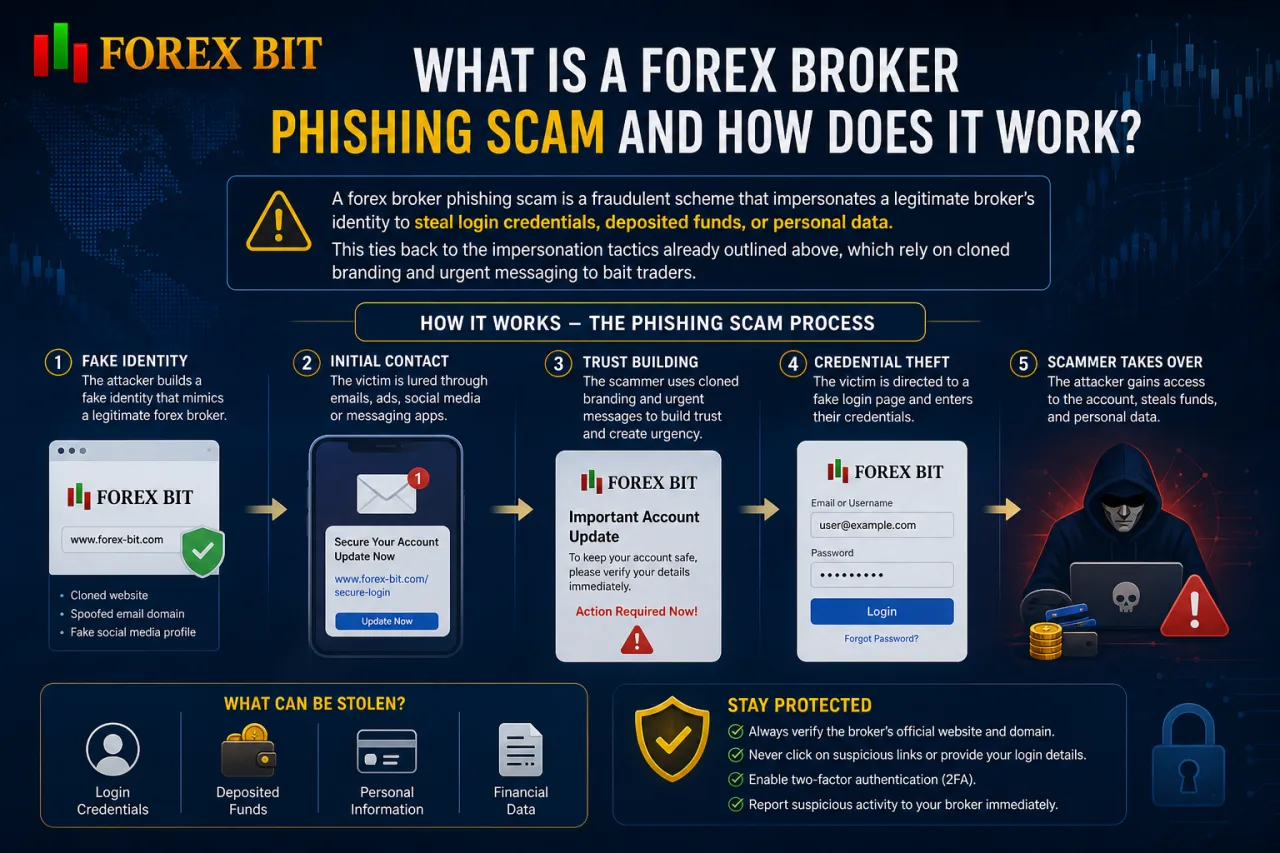
A forex broker phishing scam is a fraudulent scheme that impersonates a legitimate broker’s identity to steal login credentials, deposited funds, or personal data. This ties back to the impersonation tactics already outlined above, which rely on cloned branding and urgent messaging to bait traders. The general mechanism follows a few consistent stages: the attacker builds a fake identity, such as a cloned website, spoofed email domain, or fraudulent social media profile, that closely resembles a real, regulated broker. Victims are then lured through unsolicited emails, paid social ads, or direct messages promising bonuses, urgent account alerts, or investment opportunities.
Once contact is made, the scam pushes victims toward one of three actions: entering login details on a fake portal, transferring deposits to unofficial payment channels, or installing disguised malware presented as a trading tool. The distinguishing feature of this scam category is impersonation of an actual broker’s identity, not generic phishing aimed at random accounts. The following sections break down each stage of this mechanism in more detail.
What Are the Common Types of Forex Broker Phishing Scams?
Forex broker phishing scams fall into six common categories: fake broker websites, spoofed broker emails, fake customer support chats, fake trading apps, social media impersonation, and SMS or WhatsApp phishing. Each category builds on the impersonation mechanism described above but targets a different point of contact between the trader and the broker.
These categories often overlap in a single scam campaign, since attackers frequently combine channels to increase credibility. The main types include:
- Cloned websites that copy a real broker’s design, logo, and domain name with minor spelling variations.
- Spoofed emails sent from addresses that mimic official broker domains, requesting urgent login verification.
- Fake customer support chats operated through cloned live-chat widgets or messaging apps posing as broker staff.
- Fraudulent trading apps distributed outside official app stores that request excessive permissions or account credentials.
- Social media impersonation using fake broker profiles or ads to promote bonuses and fake investment opportunities.
- Smishing messages sent via SMS or WhatsApp that link to fraudulent login pages disguised as broker portals.
Each type shares the same goal, which is capturing credentials or funds through a fabricated broker identity rather than random targeting.
What Are the Warning Signs of a Forex Broker Phishing Scam?
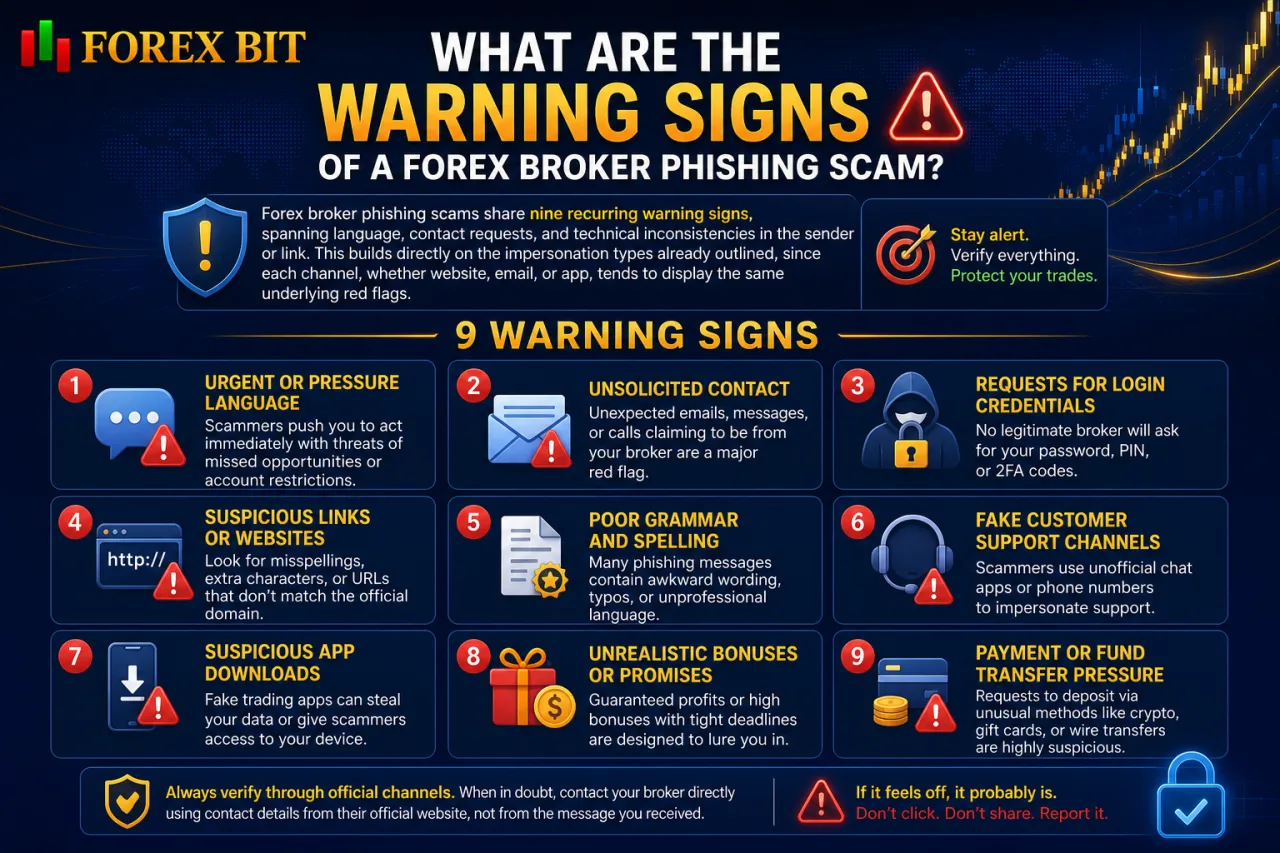
Forex broker phishing scams share nine recurring warning signs, spanning language, contact requests, and technical inconsistencies in the sender or link. This builds directly on the impersonation types already outlined, since each channel, whether website, email, or app, tends to display the same underlying red flags. The following subsections group these signs by category, covering messaging tactics, credential requests, technical mismatches, and financial pressure points traders should verify before responding.
What Tactics Do Scammers Use in Phishing Emails and Fake Websites?
Scammers rely on six recurring tactics across phishing emails and fake websites: typosquatting domains, forged SSL padlocks, embedded fake login forms, malicious attachments, cloned branding, and urgency-based social engineering. This directly addresses the delivery methods behind the warning signs already outlined, since each tactic targets a different technical or psychological weak point in how traders verify a broker.
The most common delivery methods include:
- Typosquatting domains that swap or add letters in a real broker’s URL, such as replacing a lowercase “l” with an uppercase “I”.
- Forged SSL padlocks displayed on fraudulent pages to falsely suggest a secure, verified connection.
- Embedded fake login forms that capture usernames and passwords before redirecting victims to the real broker site.
- Malicious attachments disguised as account statements or verification documents that install credential-stealing malware.
- Cloned broker logos, color schemes, and layouts copied directly from official marketing material to mimic legitimacy.
- Urgency-driven messaging citing account suspension, compliance deadlines, or expiring bonuses to rush victims into acting.
Each tactic reinforces the others within a single phishing campaign, combining visual deception with time pressure to bypass a trader’s normal verification habits.
Boolean: Can a Phishing Scam Impersonate a Regulated or Well-Known Broker?
Yes, phishing scams frequently impersonate regulated and well-known forex brokers, since an established brand name carries built-in trust that scammers exploit to bypass a trader’s normal skepticism. This directly extends the impersonation mechanism already described, where cloned branding and spoofed domains rely on borrowing credibility rather than building it from scratch.
Reputable brand names get targeted for three consistent reasons:
- Recognition lowers suspicion, since traders searching for a broker already associate the name with legitimacy and regulation.
- Documentation availability gives scammers real logos, terms pages, and email formats to copy directly from the genuine broker’s public website.
- Search volume ensures fake ads and cloned domains reach victims already primed to trust the impersonated name.
A broker’s actual regulatory status offers no protection against this tactic, because the scam targets the brand identity rather than the underlying company’s compliance record. A trader encountering a message referencing a regulated broker still needs to verify the sender domain, contact channel, and login portal independently, since regulation applies to the real entity, not to every website or email claiming to represent it.
How Can Traders Verify If a Forex Broker Is Legitimate or a Scam?
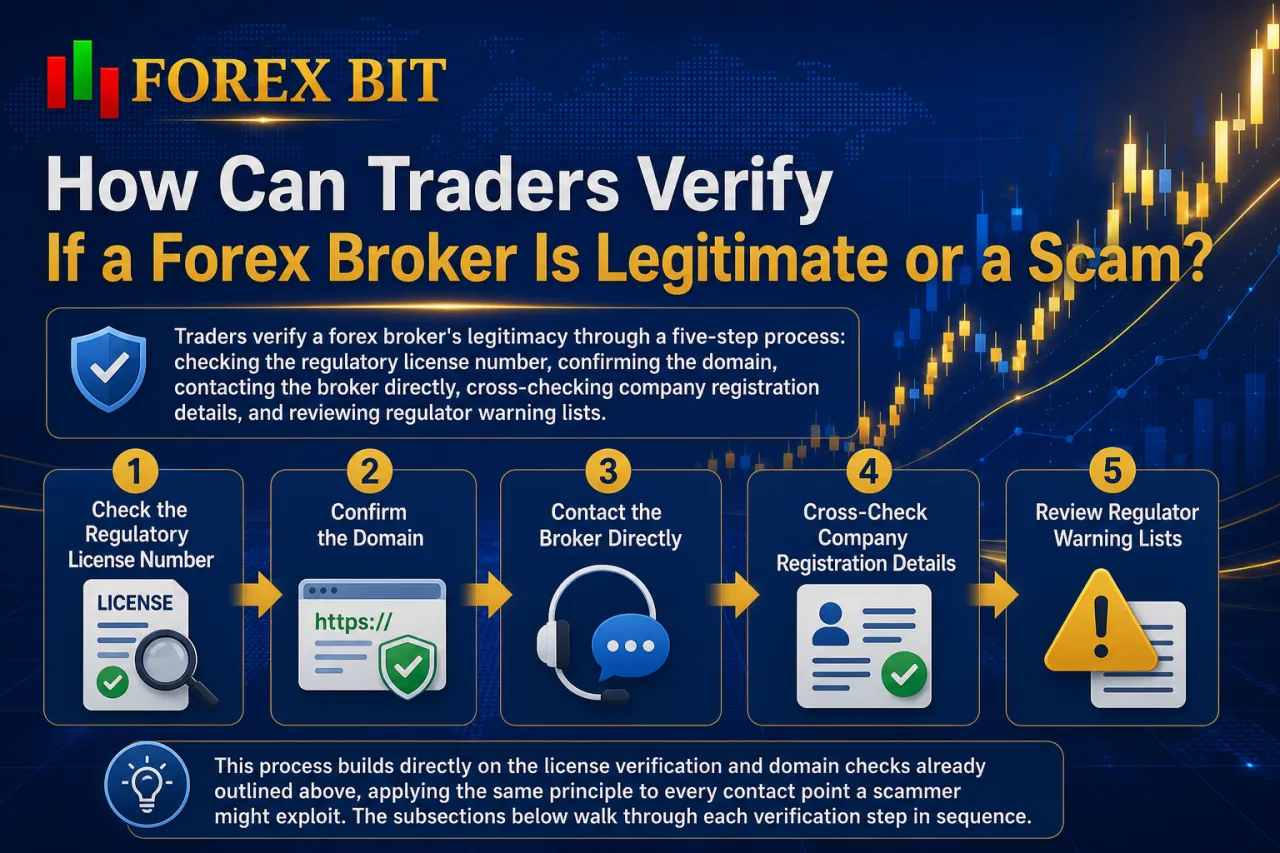
Traders verify a forex broker’s legitimacy through a five-step process: checking the regulatory license number, confirming the domain, contacting the broker directly, cross-checking company registration details, and reviewing regulator warning lists. This process builds directly on the license verification and domain checks already outlined above, applying the same principle to every contact point a scammer might exploit. The subsections below walk through each verification step in sequence.
Which Official Sources Should Traders Check to Confirm Broker Legitimacy?
Traders confirm broker legitimacy through four official source types: regulator license databases, WHOIS domain records, the broker’s verified contact channels, and regulator scam or warning lists. This directly extends the license and domain verification steps already outlined, pointing traders to the exact platforms where each check happens.
- Regulator databases such as the FCA Financial Services Register, the CySEC license list, the ASIC Connect register, and the SEC’s EDGAR or broker-check tools confirm whether a license number matches the entity name and address on file.
- WHOIS domain lookup tools reveal a website’s registration date and owner, exposing recently created domains that mimic an established broker’s name.
- Verified contact channels, meaning phone numbers and support emails listed on the regulator’s register rather than the email in question, confirm whether a message actually originates from the broker.
- Regulator scam or warning lists, published by bodies like the FCA and ASIC, name entities and clone firms already flagged as unauthorized.
Cross-referencing all four sources closes the gap that a single check might miss, since a cloned domain can still display a real license number copied from the genuine broker’s page.
What Should Traders Do After Falling Victim to a Forex Phishing Scam?
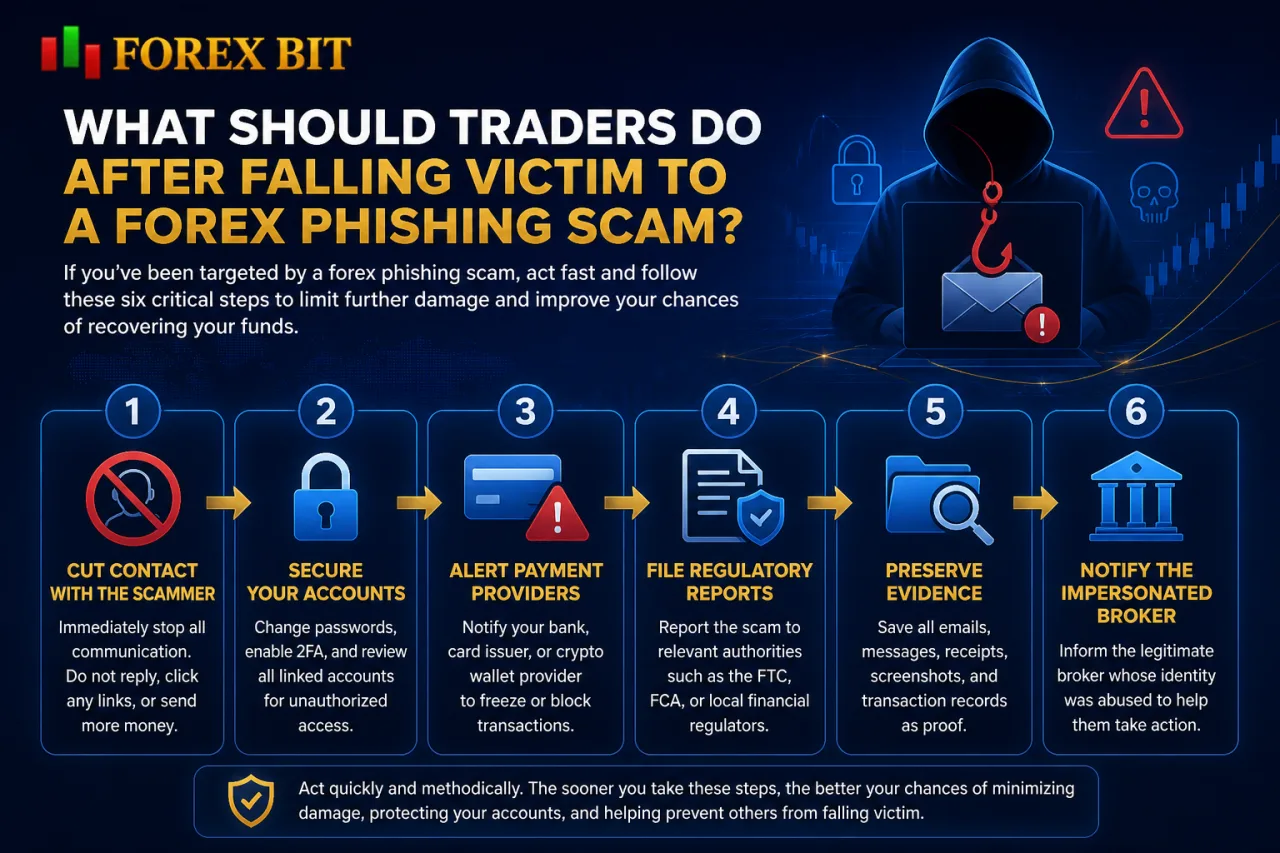
Traders who fall victim to a forex phishing scam follow a sequenced recovery process covering six actions: cutting contact with the scammer, securing accounts, alerting payment providers, filing regulatory reports, preserving evidence, and notifying the impersonated broker. This sequence extends the reporting and recovery steps already outlined earlier in this article, applying them in the specific order that limits further loss once a scam has already occurred. The subsections below cover the immediate response steps and the reporting and documentation stage separately.
How to Report a Forex Broker Phishing Scam to Authorities?
Traders report a forex broker phishing scam through four channels: the national financial regulator, a dedicated cybercrime unit, the payment processor’s fraud department, and the impersonated broker’s official security team. This extends the reporting steps already outlined earlier in this article, directing the filing process to the specific bodies equipped to act on phishing cases rather than general fraud complaints.
Each channel handles a different part of the case:
- National regulators, such as the FCA in the UK or the SEC in the US, accept phishing and impersonation reports even when the victim never opened an account with the genuine broker.
Traders can also report the incident to cybercrime authorities, such as the FBI’s Internet Crime Complaint Center (IC3) in the US or Action Fraud in the UK, so it can be logged for investigation and cross-referenced against known scam networks. - Payment processor fraud departments, covering banks, card issuers, or e-wallets used for the transfer, review chargeback or fund recovery options once notified.
- The impersonated broker’s official fraud or security team confirms the scam is not linked to its real systems and can alert other clients targeted by the same campaign.
Filing with all four increases the chance of transaction reversal and adds the case to broader scam-tracking records used by regulators.
What Emerging Phishing Techniques Are Targeting Forex Traders Today?
Forex broker phishing scams now extend beyond email and cloned websites into five emerging tactics: deepfake voice or video calls, AI-generated phishing content, fake mobile trading apps outside official stores, QR code phishing, and fraudulent broker webinars. This extends the impersonation mechanism outlined earlier in this article to newer delivery channels that exploit voice, video, and mobile trust rather than just written text. The following subsections cover each tactic in sequence.
How Do Fake Broker Mobile Apps Differ from Standard Website Phishing?
Fake broker mobile apps differ from standard website phishing in distribution channel, permission scope, and detection difficulty, since apps install directly onto a device rather than loading through a browser. This distinction extends the fraudulent trading app category already outlined earlier in this article, adding the specific comparison points traders overlook.
The two attack types diverge across several practical dimensions:
- Distribution happens through third-party app stores, direct APK links, or sideloading prompts, unlike phishing sites reached through email links or search ads.
- Permissions requested by fake apps often include contact lists, SMS access, and screen recording, exceeding what a browser-based phishing page can technically capture.
- Detection difficulty rises with fake apps, since antivirus scanning and app-store vetting rarely cover sideloaded files, while browser security tools flag suspicious domains faster.
- Red flags unique to fake apps include missing developer verification, absent app-store reviews, and update prompts requesting fresh credential entry after installation.
Both attack types share the same underlying goal of harvesting credentials, but the app-based route grants deeper device access once installed.
What Role Does Social Media Advertising Play in Sophisticated Broker Phishing Schemes?
Social media advertising drives sophisticated broker phishing schemes by using paid ads with fake celebrity endorsements or cloned broker branding to route traffic straight to phishing pages, a vector less scrutinized than email. This ad-based approach extends the social media impersonation category already outlined earlier in this article, shifting the entry point from organic fake profiles to paid placements that reach a wider, less cautious audience.
Paid ad campaigns typically rely on the following elements:
- Fabricated endorsements showing manipulated images or clips of public figures claiming guaranteed returns through a specific broker platform. Celebrity-endorsement investment ads are a recurring pattern seen in forex scams, often used to lend false credibility to fraudulent trading schemes.
- Cloned logos and layouts copied from a real broker’s marketing assets to pass quick visual verification during ad review.
- Landing pages disguised as broker sign-up forms that harvest contact details before redirecting to a fraudulent login portal.
- Ad targeting tools used to reach traders based on prior interest in trading or investment content, narrowing the campaign to a receptive audience.
Ad platforms remove flagged campaigns after review, but cloned versions frequently reappear under new accounts once a scheme is reported.
Conclusion
Forex broker phishing scams operate through cloned websites, spoofed emails, fake apps, and impersonated social media profiles, all designed to steal login credentials or deposited funds by borrowing a real broker’s identity and trust. Recognizing the pattern of urgent language, mismatched domains, forged security indicators, and unofficial payment requests allows traders to spot fraudulent contact before engaging with it.
Independent verification through regulator registers, WHOIS records, and a broker’s official channels closes the gaps that a single check might miss. For traders who already suspect compromise, cutting contact, securing accounts, and reporting to regulators, payment providers, and the impersonated broker remains the fastest path to limiting damage and supporting wider fraud tracking efforts.
William Johnson is a Forex & Broker News Analyst at Forex Bit, focusing on broker updates, regulatory developments, payment changes, and security-related news. His work helps readers stay informed about important industry developments and understand how these changes may affect broker services and trading conditions.
Email: [email protected]


Best Brokers

Trade with the world’s largest retail broker and benefit from better - than - market conditions.

We offer a superior trading environment that puts traders in the best position to profit.

Trade with the best trading conditions. WIN THE BEST TRADING ACCOUNT AWARD.

Trade global markets with Interactive Brokers – a highly regulated multi-asset broker built for active and professional investors.






Forex Bit provides independent forex broker reviews, comparisons, guides, and industry news to help traders make informed decisions.
Best Brokers
Metatrader 5 Brokers
Metatrader 4 Brokers
Lowest Spread Forex Broker
Regulated Forex Brokers
Forex Copy Trading
Ctrader Brokers
Best Forex Broker For Beginners