
Worried about fake trading platforms? Learn the red flags, verification steps, and how traders can avoid scam brokers before it’s too late.
Fake Trading Platforms: How to Spot & Avoid Scam Brokers

A fake trading platform is an unlicensed or fraudulent broker interface designed to collect deposits without executing real trades in the market. Traders identify these scams by checking regulatory licenses, verifying withdrawal history, and confirming the broker’s registration before depositing any funds.
Regulation status is checked by searching the broker’s license number directly on the official regulator’s website rather than trusting badges displayed on the broker’s own site. Regulated brokers are typically licensed by financial authorities such as the UK’s Financial Conduct Authority, the US Commodity Futures Trading Commission and National Futures Association, the Australian Securities and Investments Commission, or the Cyprus Securities and Exchange Commission, and traders can verify a broker’s license number through the official public register on each regulator’s website. A legitimate entry confirms the firm is authorized to hold client funds and offer trading services.
Common warning signs include unrealistic guaranteed returns, pressure to deposit more funds quickly, and unverifiable contact or company registration details. Fake platforms also frequently block or delay withdrawal requests once a trader attempts to cash out profits.
Victims of a fake trading platform report the incident to their local financial regulator or fraud authority and their bank or payment provider to attempt a chargeback. Traders who suspect they have encountered a forex scam can report it to their national financial regulator or consumer protection agency, such as the securities or financial conduct authority in their country, which typically handles complaints against unlicensed or fraudulent brokers. Documenting all communications and transaction records strengthens any recovery or legal claim.
Forex Bit breaks down each of these checks in detail below, starting with a clear definition of what actually makes a trading platform fake.
What Is a Fake Trading Platform?
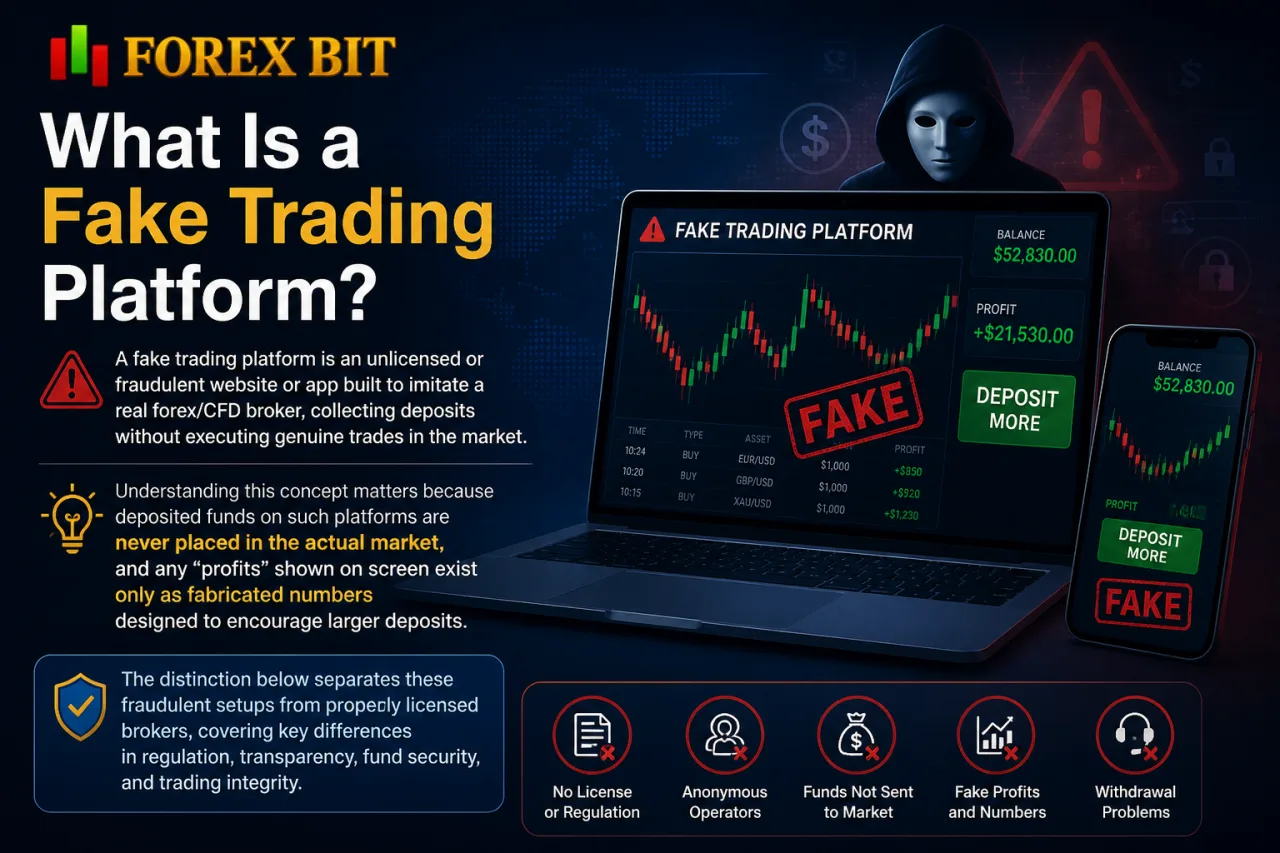
A fake trading platform is an unlicensed or fraudulent website or app built to imitate a real forex/CFD broker, collecting deposits without executing genuine trades in the market. Understanding this concept matters because deposited funds on such platforms are never placed in the actual market, and any “profits” shown on screen exist only as fabricated numbers designed to encourage larger deposits. The distinction below separates these fraudulent setups from properly licensed brokers, covering how they operate, why regulation checks matter, and what specific warning signs to watch for.
What Are the Common Types of Fake Trading Platforms?
Fake trading platforms fall into five main categories: clone firms, fabricated broker websites, fraudulent mobile apps, Ponzi-style investment schemes, and manipulated MT4/MT5 dealer plugins. Each type uses a different method to disguise itself as a legitimate broker, but all share the same goal of collecting deposits without executing real market trades.
- Clone firms copy the name, license number, and website design of an actual regulated broker to trick traders into believing they are dealing with the real company.
- Fabricated broker websites invent an entirely new brand with fake regulatory badges, fabricated team pages, and no real registration with any financial authority.
- Fraudulent mobile apps appear on app stores or are sent via direct download links, mimicking real trading interfaces while routing deposits to accounts controlled by scammers.
- Ponzi-style investment schemes present themselves as automated trading platforms or “signal” services, paying early withdrawals using new deposits rather than actual trading profits.
- Manipulated MT4/MT5 dealer plugins alter price feeds or execution data on the broker’s server side, showing traders distorted charts or fake trade fills that do not reflect genuine market conditions.
Each category targets traders differently, so recognizing which type is involved shapes the specific red flags a trader checks before depositing funds.
How to Check If a Broker or Trading Platform Is Regulated and Legitimate?
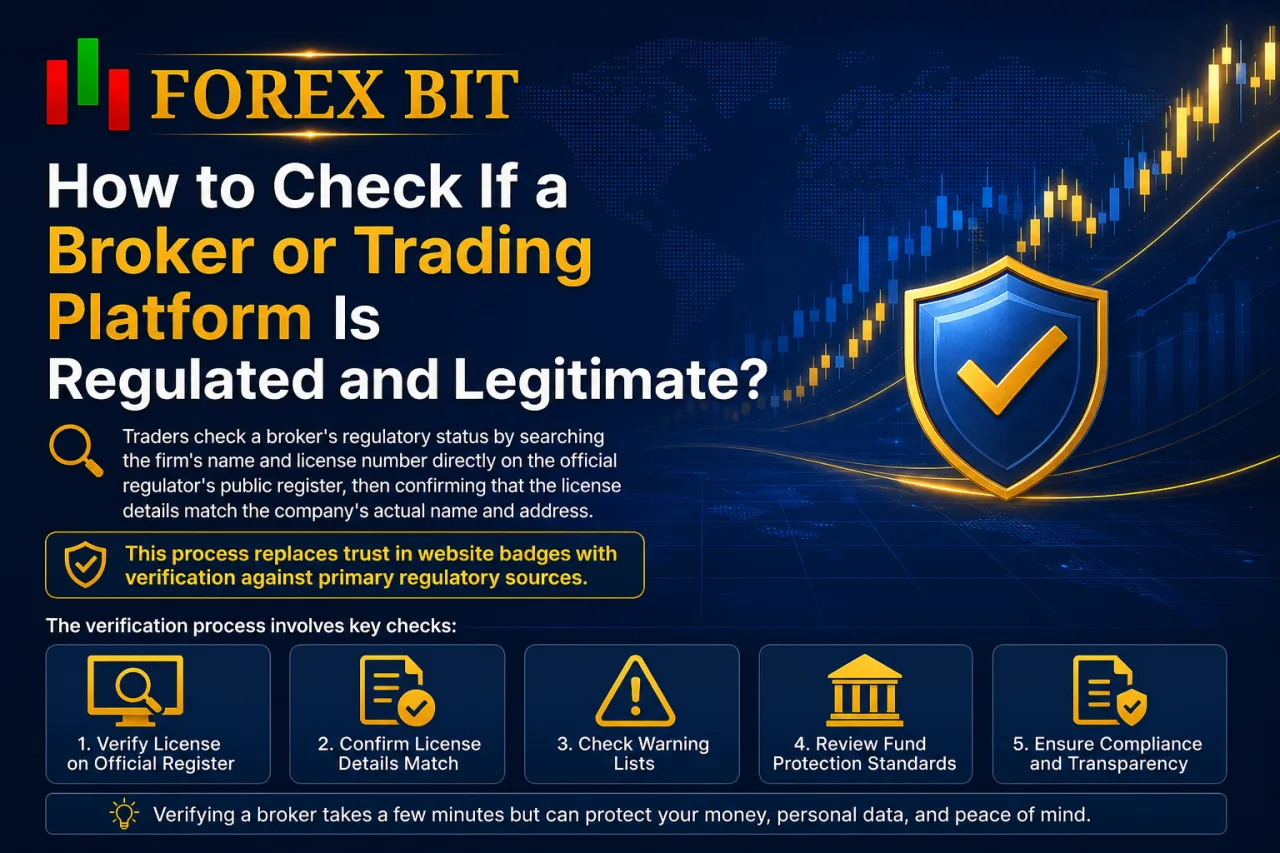
Traders check a broker’s regulatory status by searching the firm’s name and license number directly on the official regulator’s public register, then confirming that the license details match the company’s actual name and address. This process replaces trust in website badges with verification against primary regulatory sources, and it involves a few distinct checks covering license accuracy, warning lists, and fund protection standards.
The subsections below walk through each part of this verification process in order, starting with where to search and ending with what protections a legitimate license actually guarantees.
What Are the Official Regulator Websites Used to Verify a Broker?
Traders verify a broker’s license across five main public registers: the FCA Register, ASIC Connect, the CySEC list of regulated entities, NFA BASIC, and the FSCA FSP search. Each tool covers a different jurisdiction and requires cross-checking the same core details before trusting a broker’s regulatory claims.
- The FCA Register confirms whether a firm is authorized in the United Kingdom, listing the firm’s official name, address, and permitted activities.
- ASIC Connect verifies Australian Financial Services License holders and displays whether a license is current, suspended, or canceled.
- The CySEC list confirms Cyprus-based investment firms and shows whether the license covers forex/CFD services specifically.
- NFA BASIC verifies US-registered futures commission merchants and forex dealer members, including any disciplinary history.
- The FSCA FSP search confirms Financial Service Provider status in South Africa and lists the license category granted.
On every register, traders cross-check the registered company name, license number, physical address, and permitted product scope against what the broker’s own website displays. A mismatch on any of these fields signals that the broker is misusing a real license or operating without one.
Is an Offshore License Enough to Prove a Broker Is Trustworthy?
No, an offshore license alone does not prove a broker is trustworthy, because jurisdictions like Vanuatu, Belize, Saint Vincent and the Grenadines, or Seychelles typically impose minimal capital requirements and offer little to no investor protection. This gap matters directly for the license credibility check outlined above, since a broker screen showing “regulated” text carries different weight depending on which authority actually issued the license.
Offshore regulators generally lack the enforcement resources of tier-1 authorities such as the FCA or ASIC, and most offshore jurisdictions do not maintain a compensation scheme for client funds if a broker collapses or refuses withdrawals. Several factors separate a stronger offshore setup from a weak one:
- Segregated client accounts held with a recognized third-party bank rather than mixed into company operating funds.
- Negative balance protection written explicitly into the client agreement rather than left ambiguous.
- A verifiable license number that appears on the regulator’s own public register, not only on the broker’s marketing pages.
- A parent company also licensed under a tier-1 regulator, indicating the offshore entity operates as one branch of a larger regulated group.
A broker holding only an offshore license with none of these safeguards presents materially higher risk than one pairing an offshore license with a tier-1 license for the same brand.
What Are the Warning Signs of a Fake Trading Platform?
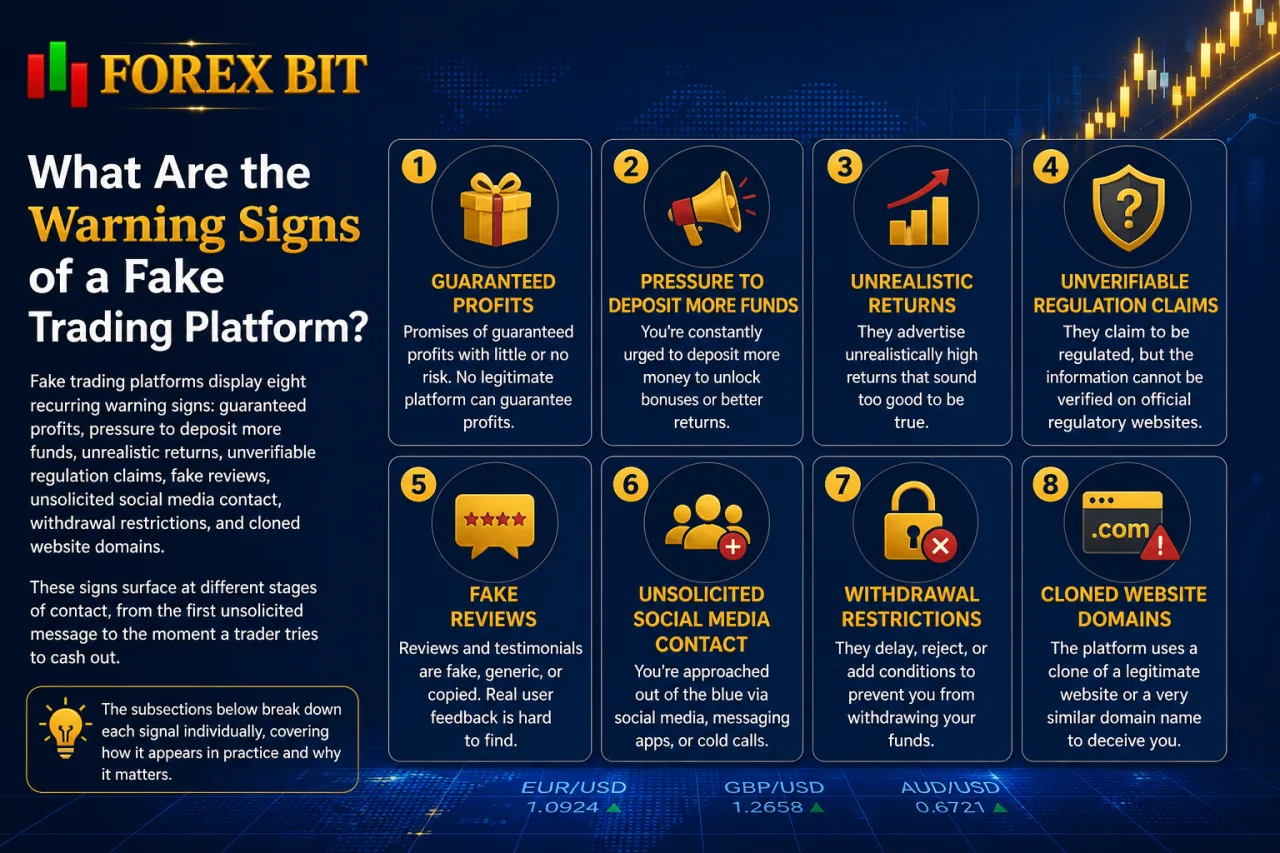
Fake trading platforms display eight recurring warning signs: guaranteed profits, pressure to deposit more funds, unrealistic returns, unverifiable regulation claims, fake reviews, unsolicited social media contact, withdrawal restrictions, and cloned website domains. These signs surface at different stages of contact, from the first unsolicited message to the moment a trader tries to cash out. The subsections below break down each signal individually, covering how it appears in practice and why it points to a fraudulent operation rather than a genuine broker.
What Tactics Do Scam Brokers Commonly Use to Deceive Traders?
Scam brokers deceive traders through six recurring tactics: fake account managers, manipulated trading platforms showing false profits, cold-calling, romance or “pig-butchering” scams, fake celebrity endorsements, and social media ads promising high returns. These tactics build trust before extracting deposits, then block withdrawals once a trader tries to cash out.
- Fake account managers contact victims by phone or messaging apps, posing as personal advisors who guide deposits into a “managed” account while claiming to grow the balance.
- Manipulated trading platforms display fabricated charts and rising balances on screen, none of which correspond to real trades executed in the market.
- Cold-calling targets traders with unsolicited calls offering exclusive investment opportunities, often citing urgency to push a first deposit quickly.
- Romance or pig-butchering scams build a personal relationship over weeks before introducing a “trading opportunity,” gradually pressuring the victim into larger transfers.
- Fake celebrity endorsements use manipulated images or fabricated quotes attributed to public figures to lend false credibility to an unregulated platform.
- Social media ads promise guaranteed high returns through short video clips or testimonials, directing viewers to download an app or contact a “broker” directly.
Each tactic converges on the same outcome: funds deposited outside a regulated broker’s official channels rarely return to the trader.
Is a Trading Platform Fake If It Refuses or Delays Withdrawals?
Yes, a trading platform qualifies as fake if it refuses or delays withdrawals, since blocking access to a trader’s own funds ranks among the clearest signals of a scam operation. This pattern connects directly to the withdrawal restrictions warning sign noted earlier, and it typically unfolds through a specific sequence of tactics rather than a single blunt refusal.
Genuine brokers process withdrawal requests within their stated timeframes and only deduct fees disclosed in advance within the client agreement. Fraudulent platforms instead introduce obstacles once a trader tries to cash out actual profits.
- Persistent delays stretch a withdrawal request across weeks with vague excuses about “processing” or “verification.”
- Sudden fee demands appear only after a withdrawal request is submitted, framed as taxes, insurance, or unlocking charges.
- Additional deposit requirements get presented as mandatory before any withdrawal can supposedly proceed.
- Account freezes occur immediately after a trader requests a payout, often citing unspecified “compliance reviews.”
A broker combining any of these behaviors with an unverifiable license, as outlined in the regulatory checks above, confirms the platform operates outside genuine market conditions.
What Should You Do After Losing Money to a Fake Trading Platform?
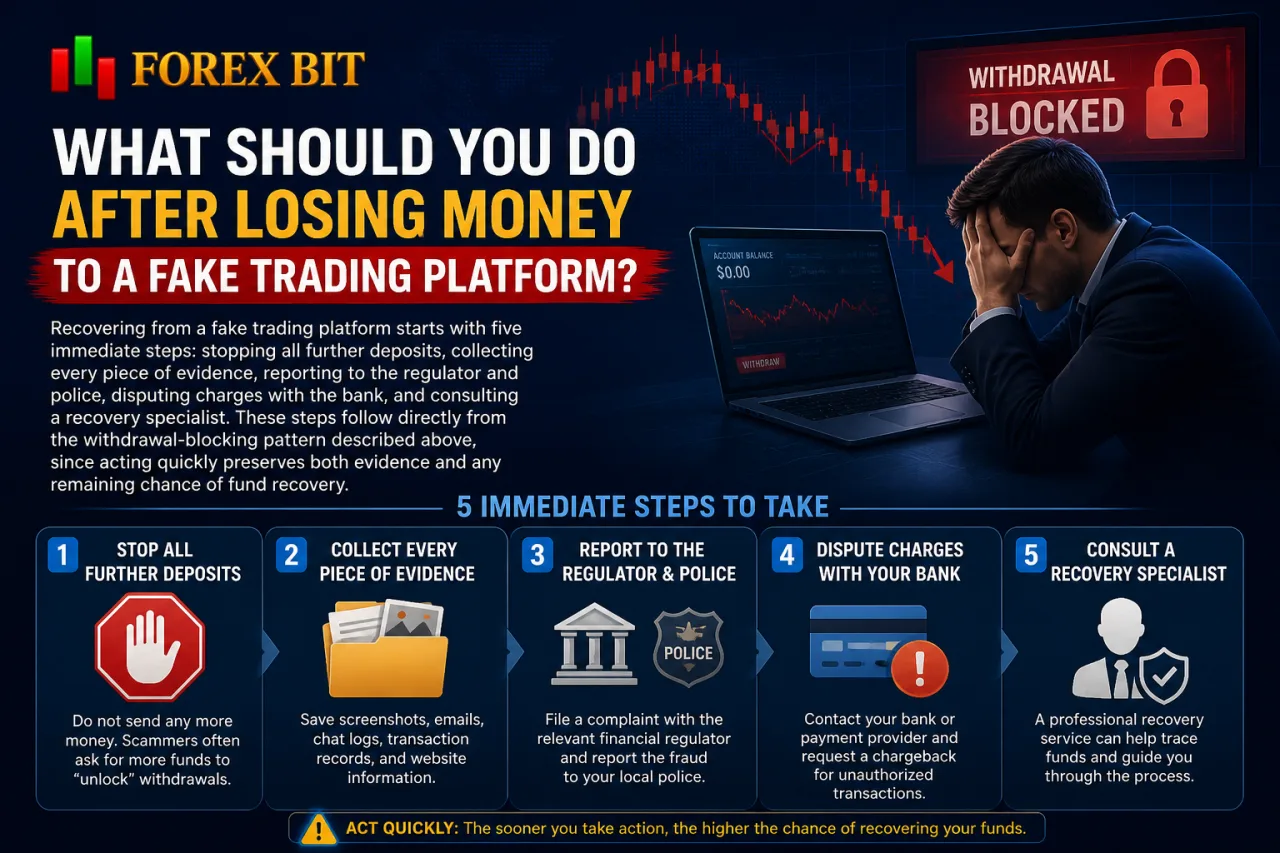
Recovering from a fake trading platform starts with five immediate steps: stopping all further deposits, collecting every piece of evidence, reporting to the regulator and police, disputing charges with the bank, and consulting a recovery specialist. These steps follow directly from the withdrawal-blocking pattern described above, since acting quickly preserves both evidence and any remaining chance of fund recovery. The subsections below cover each step individually, from halting further losses to seeking formal legal or recovery assistance.
How to Report a Fake Trading Platform to Authorities?
Traders report a fake trading platform through four main channels: the national financial regulator, a consumer protection agency, a cybercrime reporting portal, and an international body such as IOSCO or Action Fraud. This step follows directly from the recovery process outlined above, since a formal complaint creates an official record that supports both fund recovery and wider enforcement action against the fraudulent operator.
Each channel serves a distinct purpose and often requires different supporting evidence:
- The national financial regulator (such as the FCA, ASIC, or CySEC referenced in the earlier verification steps) accepts complaints against unlicensed or fraudulent brokers operating in or targeting its jurisdiction.
- A consumer protection agency handles cases where deceptive marketing or false promises of returns caused financial harm, separate from strict securities violations.
- A cybercrime reporting portal: Traders can also report the incident to a national cybercrime or fraud reporting authority, such as the FBI’s IC3 in the United States or Action Fraud in the United Kingdom, which logs the incident as online financial fraud for investigative purposes.
- IOSCO: IOSCO’s Investor Alerts Portal collects and shares warnings issued by member regulators, making it useful for checking a platform that operates across multiple countries.
Filing with more than one channel widens the chance that the case gets flagged in official warning lists.
Can You Recover Money Lost to a Fake Trading Platform?
Recovery of money lost to a fake trading platform remains possible only in limited cases, primarily through bank chargebacks, formal disputes, or law enforcement asset freezes, rather than guaranteed refunds. This limited recovery outlook connects directly to the reporting steps outlined above, since evidence gathered during those reports often becomes the basis for any dispute or investigation that follows.
Several paths offer a realistic chance of partial recovery:
- Chargeback requests filed with a bank or card issuer reverse a transaction when the deposit was made via credit or debit card within the dispute window.
- Bank disputes on wire transfers or e-wallet payments sometimes trigger a fund freeze if the receiving account is flagged before withdrawal by the scammer.
- Law enforcement asset freezes occur when a regulator or police unit identifies and locks accounts tied to a fraudulent operator before funds are moved offshore.
Success in each path depends heavily on how quickly a victim reports the loss and how much of the deposited fund remains traceable.
So-called “recovery specialists” who approach victims afterward and promise guaranteed fund retrieval for an upfront fee run a second, separate scam. Legitimate regulators and law enforcement never charge victims to pursue a case.
How Do Fake Trading Platforms Use Technology to Appear Legitimate?
Fake trading platforms deploy four core technical deception methods: manipulated MT4/MT5 white-label interfaces, spoofed SSL certificates, cloned domains with slight URL variations, and fabricated dashboards displaying false profits. These techniques mimic the visual and technical markers traders associate with genuine regulated brokers, making a fraudulent setup difficult to distinguish from a real trading environment at first glance. The subsections below break down how each method works and why it convinces traders the platform is legitimate.
What Is a Clone Firm Scam and How Does It Differ from a Fully Fake Platform?
A clone firm scam impersonates a real regulated broker’s name, license number, and website design, while a fully fake platform invents an entirely new brand with no genuine regulatory identity at all. This distinction directly affects the verification approach used for each, since checking a clone firm requires cross-referencing details against a real license, while checking a fully fake platform requires confirming that no such license exists anywhere.
A clone firm copies a licensed entity’s registered name and license number onto a separate website or contact channel, relying on victims searching the number and finding a genuine match without noticing the address or domain differs. Verification here demands contacting the real regulated firm directly through its official listed channels to confirm whether the contacting party is actually affiliated.
A fully fake platform, by contrast, displays a license number that returns no result on any regulator’s public register, or lists a jurisdiction with no searchable database at all. Verification here stops at the first failed search, since no legitimate entity corresponds to the claim.
Both scam types ultimately fail the same core check: the registered name, address, and license number never all match on an official regulator record.
Are AI-Generated Deepfake Endorsements Used to Promote Fake Trading Platforms?
Yes, AI-generated deepfake endorsements do promote fake trading platforms, since scammers fabricate video and audio of public figures to lend false credibility to unregulated schemes. This tactic extends the fake celebrity endorsement pattern noted earlier into a more technically convincing format, and it presents a rare but growing verification challenge for traders scanning social media.
Deepfake clips typically show a recognizable public figure appearing to endorse a specific app or website, using manipulated facial movements and synthesized voice audio layered over unrelated original footage. These videos tend to circulate through short-form social media ads and messaging app forwards, often paired with a direct download link or contact request.
Verification against this specific tactic follows the same core rule outlined throughout this piece: checking the platform’s license number directly on the regulator’s public register rather than trusting any celebrity association, since no genuine endorsement changes a broker’s actual regulatory status.
Conclusion
Spotting a fake trading platform comes down to one habit: verifying license numbers directly on official regulator registers instead of trusting badges, testimonials, or celebrity endorsements displayed on a broker’s own site. Clone firms, fabricated websites, and manipulated dealer plugins all fail this same check, since registered name, address, and license never fully match on record. Withdrawal refusals, sudden fee demands, and pressure for larger deposits confirm the pattern once contact begins. Traders who verify credentials before depositing avoid the losses that only limited chargebacks or law enforcement asset freezes can partially reverse afterward.
William Johnson is a Forex & Broker News Analyst at Forex Bit, focusing on broker updates, regulatory developments, payment changes, and security-related news. His work helps readers stay informed about important industry developments and understand how these changes may affect broker services and trading conditions.
Email: [email protected]



Best Brokers

Trade with the world’s largest retail broker and benefit from better - than - market conditions.

We offer a superior trading environment that puts traders in the best position to profit.

Trade with the best trading conditions. WIN THE BEST TRADING ACCOUNT AWARD.

Trade global markets with Interactive Brokers – a highly regulated multi-asset broker built for active and professional investors.






Forex Bit provides independent forex broker reviews, comparisons, guides, and industry news to help traders make informed decisions.
Best Brokers
Metatrader 5 Brokers
Metatrader 4 Brokers
Lowest Spread Forex Broker
Regulated Forex Brokers
Forex Copy Trading
Ctrader Brokers
Best Forex Broker For Beginners