





The latest confirmed forex broker updates cover new platform launches, pricing adjustments, licence approvals, and market expansions announced directly by brokers. These updates reflect verified changes rather than rumours or speculation, giving traders a clear picture of how broker conditions are evolving.
Several brokers have recently rolled out new trading platforms or account types to meet demand for more flexible trading conditions. These launches often include upgraded platform versions, additional account tiers, or region-specific offerings designed for different trader profiles.
Broker pricing structures, spreads, and trading conditions have shifted recently as competition among providers intensifies. Changes range from tighter spread offerings to revised commission models and adjusted margin requirements across various account types.
New broker licences, partnerships, and market expansions continue to reshape the regulatory and operational landscape of the forex industry. Such developments often signal a broker’s entry into new jurisdictions or strengthened compliance standing.
Forex Bit tracks these developments closely to help traders stay informed with accurate, up-to-date information. The following sections break down what are the latest confirmed forex broker updates, starting with a detailed overview of recent industry announcements.
What Are the Latest Confirmed Forex Broker Updates?
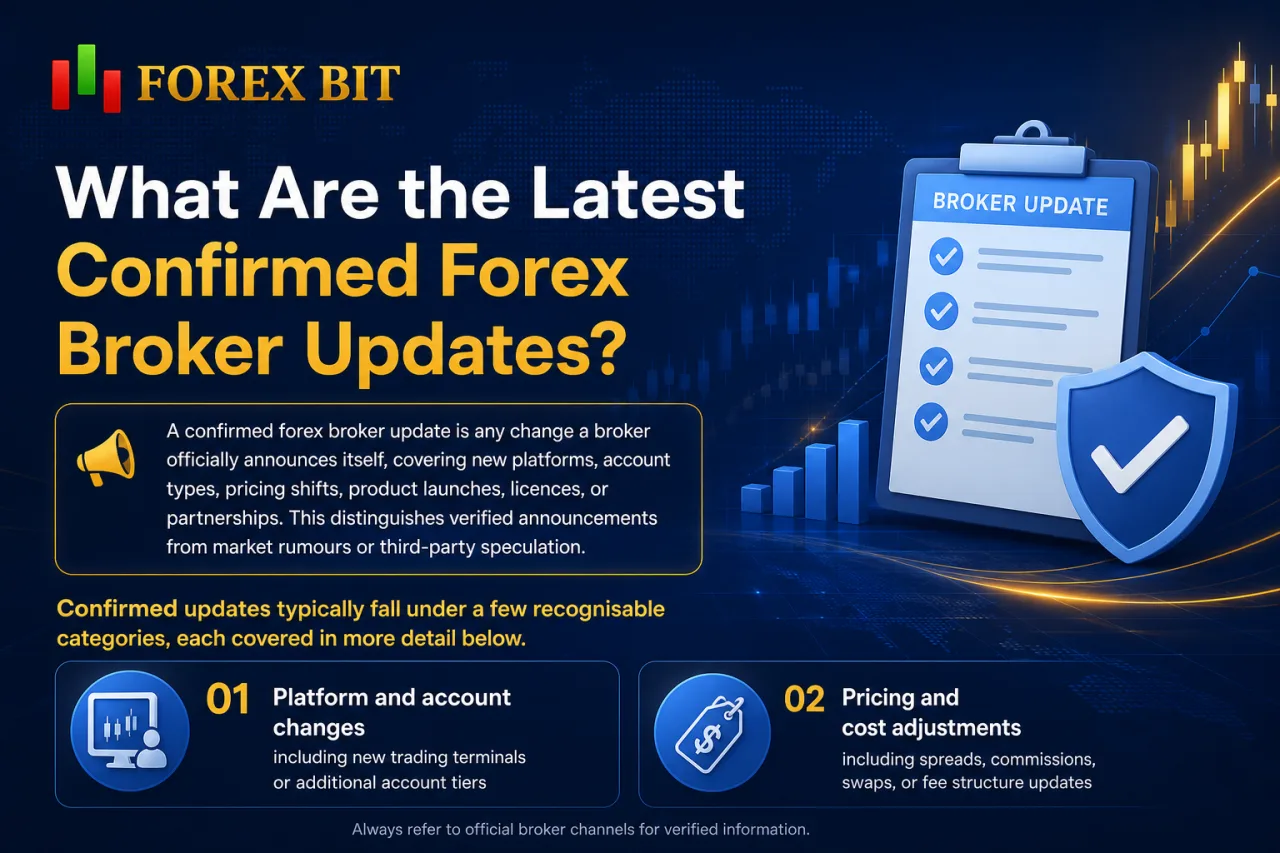
A confirmed forex broker update is any change a broker officially announces itself, covering new platforms, account types, pricing shifts, product launches, licences, or partnerships. This distinguishes verified announcements from market rumours or third-party speculation.
Confirmed updates typically fall under a few recognisable categories, each covered in more detail below.
- Platform and account changes, including new trading terminals or additional account tiers
- Pricing and cost adjustments, such as revised spreads, commissions, or margin requirements
- Regulatory and partnership news, including new licences, jurisdictional expansions, or strategic alliances
Each category reflects a direct statement from the broker rather than an inferred or predicted change, keeping the information traceable to an official source.
What Types of Broker Changes Are Tracked in Broker Updates?
Broker updates track six main categories of change: platform launches, new account types, pricing and condition adjustments, product or market expansions, licence approvals, and partnerships. This grouping frames how the rest of this article organises confirmed broker announcements.
Each category represents a distinct type of official broker statement rather than an inferred market shift.
- Launching new or upgraded trading platforms for existing or new client bases
- Introducing additional account tiers with different pricing models or conditions
- Adjusting spreads, commissions, margin requirements, or other trading costs
- Expanding into new products, instruments, or geographic markets
- Securing new regulatory licences in additional jurisdictions
- Forming partnerships with technology providers, liquidity partners, or other industry entities
These categories overlap in practice, since a licence approval frequently accompanies a market expansion or a new account type tied to a specific jurisdiction.
Which Brokers Have Launched New Trading Platforms or Account Types Recently?
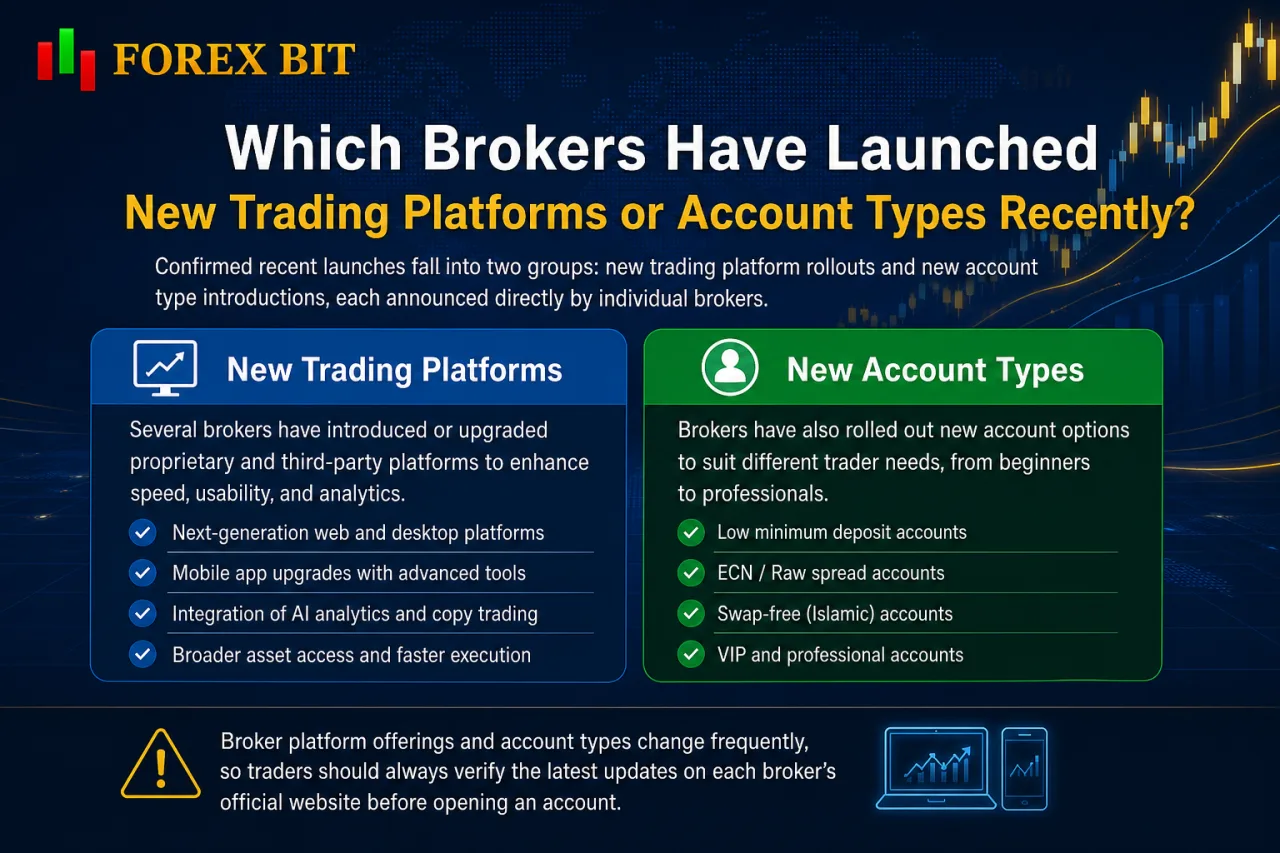
Confirmed recent launches fall into two groups: new trading platform rollouts and new account type introductions, each announced directly by individual brokers. Building on the platform and account changes outlined earlier, the following breakdown separates platform-related announcements from account-related ones, since brokers often introduce both alongside broader pricing or licensing updates.
Broker platform offerings and account types change frequently, so traders should always verify the latest details directly on the broker’s official website before making a decision.
Platform launches typically involve adding MT4, MT5, or cTrader support, or rolling out proprietary web and mobile terminals designed for specific trader segments. Account launches usually introduce tiers such as Islamic (swap-free), professional, zero-spread, or raw-pricing accounts, often tied to a particular platform or region.
Both categories require verification against a broker’s official announcement channel, since third-party listings can misrepresent launch dates or feature sets.
Which Brokers Added New Trading Platforms?
Confirmed platform additions cluster around brokers adding MT4, MT5, or cTrader support, alongside proprietary web and mobile terminals, based on official broker statements. This follows directly from the platform launch category described earlier, since each case involves a broker publicly confirming a new or upgraded trading terminal rather than a rumoured feature.
Official announcements typically describe why the addition was made and which client segment it targets. Common patterns include:
- Adding MT5 alongside an existing MT4 offering to support hedging or additional order types
- Rolling out cTrader for clients seeking algorithmic trading tools or level II pricing
- Upgrading proprietary web platforms with new charting packages or order execution features
- Extending platform access to mobile apps for existing desktop terminals
Each of these cases traces back to a specific broker press release, platform update note, or official website announcement rather than a general industry trend. Traders checking platform additions confirm the launch date and feature scope directly through the broker’s own channels, since third-party summaries can lag behind actual rollout timing.
Which Brokers Introduced New Account Types?
Confirmed new account types cluster around Islamic (swap-free), professional, zero-spread, and raw-pricing tiers, each introduced through an official broker announcement. This follows the account launch category outlined earlier, since every case involves a broker publicly confirming a new tier rather than a market rumour.
Official statements typically explain the trading need behind the addition and the client segment it targets. Common patterns include:
- Adding swap-free accounts for clients requiring compliant, interest-free conditions
- Introducing professional accounts with adjusted leverage and margin terms
- Launching zero-spread or raw-pricing tiers paired with a fixed commission structure
- Bundling a new account tier with a specific platform, such as an MT5 or cTrader launch
Each addition traces back to a distinct broker announcement rather than a general industry pattern. Traders confirm the exact conditions, minimum deposit, and eligibility requirements of a new account tier directly through the broker’s official website, since third-party listings can lag behind actual terms.
What Recent Changes Have Occurred in Broker Pricing, Spreads, or Trading Conditions?
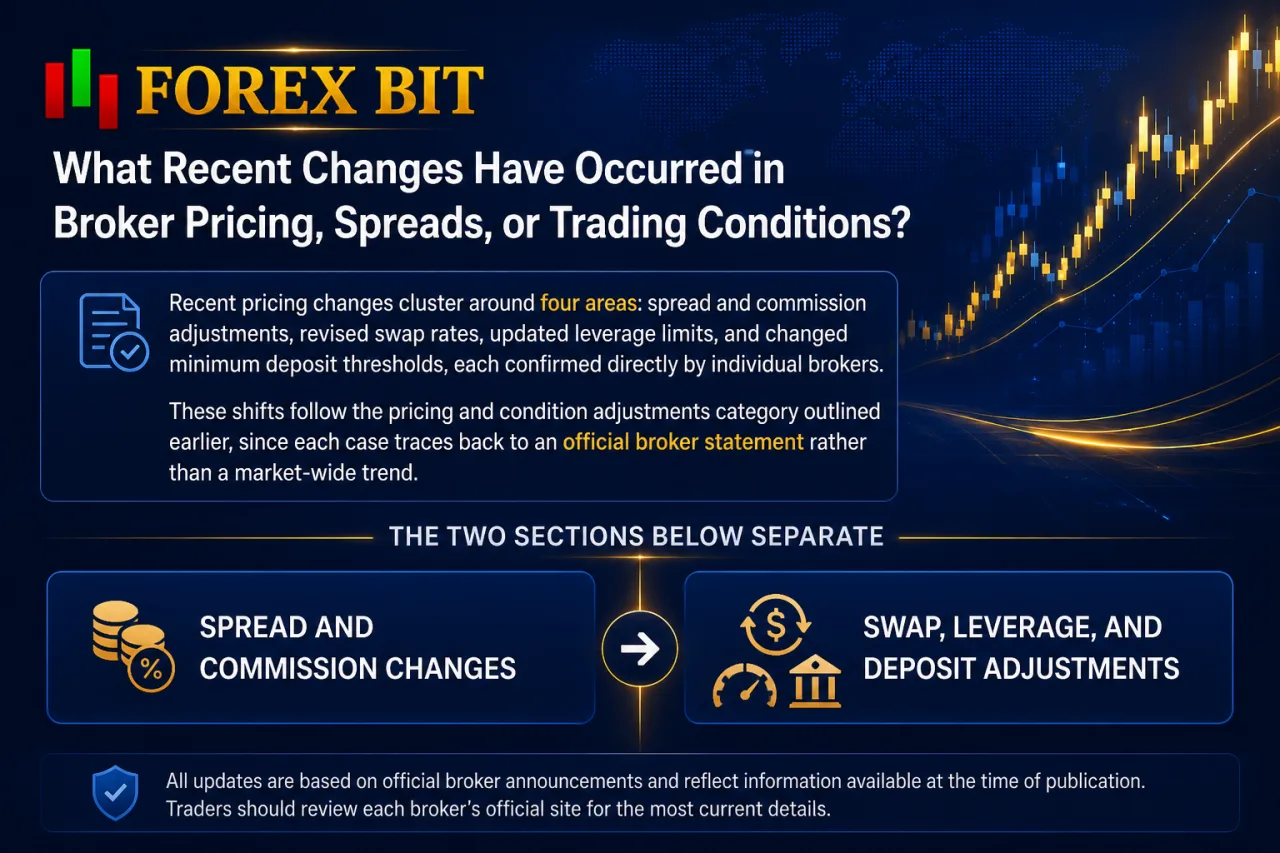
Recent pricing changes cluster around four areas: spread and commission adjustments, revised swap rates, updated leverage limits, and changed minimum deposit thresholds, each confirmed directly by individual brokers. These shifts follow the pricing and condition adjustments category outlined earlier, since each case traces back to an official broker statement rather than a market-wide trend. The two sections below separate spread and commission changes from swap, leverage, and deposit adjustments, since brokers often announce these independently across different account types.
Which Brokers Adjusted Spreads or Commissions?
Confirmed spread and commission adjustments cluster around tighter raw spreads on ECN-style accounts, revised fixed commission rates, and restructured pricing tiers tied to specific account types. This directly addresses the pricing and condition adjustments category referenced earlier, since each change traces back to an official broker statement rather than a general market pattern.
Brokers typically frame these adjustments as responses to liquidity provider terms or competitive positioning within a specific account segment. Recurring patterns include:
- Tightening raw spreads on ECN or zero-spread accounts while adjusting the paired commission per lot
- Lowering standard account spreads to reduce entry costs for retail clients
- Restructuring commission tiers based on monthly trading volume
- Adjusting spread markups on standard accounts after a platform or liquidity provider change
Each adjustment stems from a distinct broker announcement rather than an industry-wide shift, so traders confirm the exact spread figures and commission rates for their account type directly through the broker’s official pricing page before trading.
Which Brokers Changed Leverage or Deposit Requirements?
Confirmed leverage and deposit changes cluster around three areas: revised maximum leverage caps on specific account types, adjusted minimum deposit thresholds for entry-level or professional accounts, and regulatory triggers cited directly in the broker’s own announcement. These changes fall under the pricing and condition adjustments category referenced earlier, since each figure traces back to an official broker statement rather than an inferred market pattern.
Brokers typically explain a leverage or deposit change by pointing to either a business decision or a specific regulatory requirement. Recurring patterns include:
- Lowering maximum leverage on retail accounts to comply with a regulator’s updated rules
- Raising minimum deposit thresholds for professional or VIP account tiers
- Reducing entry deposits on standard accounts to attract new clients
- Applying different leverage caps across jurisdictions where the broker holds separate licences
Some brokers explicitly cite a regulatory directive as the reason for a leverage reduction, while others frame deposit or leverage changes purely as commercial decisions, so traders should always check each broker’s official announcements for the specific reason behind a given change. Traders confirm the exact leverage cap and minimum deposit for their account type and jurisdiction directly on the broker’s official website, since these figures often vary by region even within the same brand.
What New Broker Licences, Partnerships, or Market Expansions Have Been Announced?

Confirmed regulatory and expansion news falls into three groups: new licence approvals, formal partnerships, and entries into new markets or regions, each drawn from a broker’s own official statement. This builds on the licence and partnership category described earlier, since every case here traces back to a broker confirming the change itself rather than an analyst prediction or industry rumour.
The breakdown below separates licence approvals from partnership announcements, since brokers typically issue these as distinct statements even when they occur around the same time as a market expansion.
Which Brokers Obtained New Regulatory Licences?
Confirmed regulatory licence approvals cluster around brokers securing new authorisations from established regulators in jurisdictions where they previously operated without a local licence, based on the broker’s own announcement. This follows the licence approval category described earlier, since each case traces back to a broker confirming a specific new authorisation rather than an analyst prediction.
Brokers typically frame a new licence as a step toward stronger compliance standing or as the legal basis for entering a specific jurisdiction. Recurring patterns include:
- Securing a licence from a regulator in a jurisdiction where the broker previously operated an offshore entity only
- Adding a second regulated entity to serve clients under a different regional framework
- Announcing licence approval alongside a corresponding local office or client onboarding process
- Confirming licence status through an update to the broker’s regulatory disclosures page
Each licence confirmation traces back to a distinct broker statement or regulator register entry rather than a general industry trend. Traders verify the exact licence number, jurisdiction, and entity name directly through the broker’s official regulatory disclosures or the relevant regulator’s public register, since third-party listings can misstate licence scope or status.
Which Brokers Announced New Partnerships or Market Expansions?
Confirmed partnership and expansion news clusters around three types of announcements: technology or liquidity partnerships, sponsorship deals, and entries into new geographic markets, each drawn from a broker’s own statement. This follows the licence and partnership category described earlier, since every case traces back to a direct broker confirmation rather than industry speculation.
Brokers typically frame these announcements around strengthening platform infrastructure, brand visibility, or regional client access. Recurring patterns include:
- Integrating with a technology provider to add liquidity, pricing feeds, or risk management tools
- Signing sponsorship agreements tied to sports teams, events, or media platforms for brand exposure
- Entering a new regional market through a local entity, office, or introducing broker network
- Pairing a market entry announcement with a newly obtained licence in that jurisdiction
Each announcement traces back to a distinct press release or official broker statement rather than a general market trend. Traders verify the scope and current status of a partnership or market entry directly through the broker’s official news page, since promotional summaries sometimes overstate the reach or permanence of a given deal.
How Can Traders Verify a Broker Update Is Officially Confirmed?
Traders verify a broker update through three main checks: matching the announcement against the broker’s official press release or news page, cross-checking any licence claim on the relevant regulator’s public register, and confirming details through a verified broker communication channel such as an official email or account manager. This addresses the verification gap left after reviewing licence, partnership, and pricing announcements above, since none of those categories carry weight without a traceable source. The sections below separate these three checks in more detail.
What Are Reliable Sources for Confirming Broker News?
Reliable sources for confirming broker news fall into three groups: broker official websites, regulator databases, and verified press statements, each distinguished from unverified third-party claims by traceability to a primary issuer. This addresses the source reliability gap left after checking press releases, licence registers, and communication channels above.
Each source type serves a distinct verification purpose:
- Publishing pricing pages, platform notes, and press release sections directly on the broker’s own website
- Listing licence numbers, entity names, and status flags on a regulator’s public register
- Distributing verified press statements through recognised financial newswires or the broker’s official media contact
- Excluding forum posts, affiliate blog claims, and unverified social media announcements from confirmed status
Third-party aggregator sites and affiliate content frequently repeat outdated figures without a direct link back to the broker’s own statement. Cross-checking against one of these three primary sources remains the deciding factor before treating any update as confirmed.
Conclusion
Staying current on forex broker news comes down to tracking six recurring categories: platform launches, new account tiers, spread and commission shifts, leverage or deposit adjustments, licence approvals, and partnerships or market expansions. Each of these traces back to an official broker statement rather than speculation, and each carries its own verification path, whether through a broker’s press release, a regulator’s public register, or a confirmed communication channel.
Forex Bit organises these confirmed developments so traders can separate genuine announcements from unverified claims, giving a clear, traceable view of how broker conditions and industry standing continue to evolve.