
- Multi-jurisdictional regulation
- Segregated funds & negative balance protection
- Multiple account types for different traders
- Supports MT4, MT5 & multi-asset trading
- Multilingual customer support
- Protection varies by regulatory entity
- Higher deposit for Ultra Low accounts
- Restricted in the US and some regions
- Leverage limits vary by jurisdiction
- Bonuses unavailable in stricter regions
XM operates as a multi-asset broker that operates under regulatory oversight in the jurisdictions where it holds licenses, making it a legitimate option for traders evaluating safety before committing funds. This regulatory spread, combined with segregated client funds, forms the foundation of its risk profile in 2026.
XM’s legitimacy rests on licenses issued by top-tier and offshore regulators, plus participation in applicable investor compensation arrangements. Traders should still verify which entity governs their specific account, since protections differ by region.
XM offers Micro, Standard, and Ultra Low accounts, each with different minimum deposits and trading conditions. Fee structures and spread types vary across these tiers, affecting cost depending on trading style.
Spreads at XM generally start from variable levels on Standard accounts, with tighter pricing plus commission on Ultra Low accounts, and leverage that can reach a capped maximum depending on the trader’s region and applicable regulatory restrictions. These figures directly influence overall trading costs for active traders.
Opening an account with XM typically requires identity verification followed by a deposit through one of several supported payment channels, with withdrawals processed within a set timeframe. Forex Bit breaks down each step to help traders complete the process without unnecessary delays.
The following sections from Forex Bit examine whether XM is a safe and legit forex broker in 2026, compare its account types, and detail how its spreads, fees, and leverage measure up against industry standards.
Is XM a Safe and Legit Forex Broker in 2026?
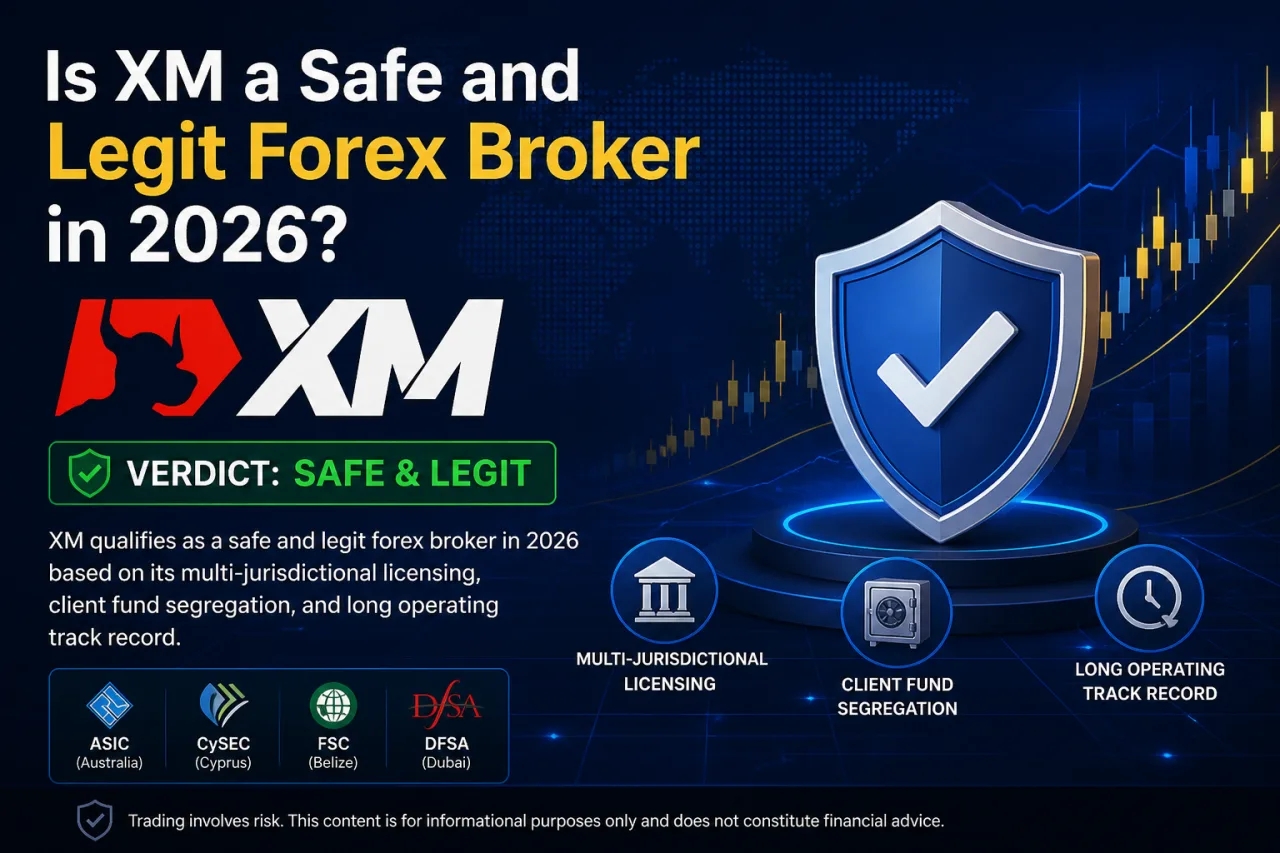
XM qualifies as a safe and legit forex broker in 2026 based on its multi-jurisdictional licensing, client fund segregation, and long operating track record. The verdict draws on three factors that traders weigh most when assessing broker safety: regulatory coverage, protection mechanisms, and company history.
XM’s safety profile rests on the following pillars:
- Regulatory licensing: XM holds licenses from multiple regulators, including ASIC, CySEC, FSC, and DFSA, placing its various entities under different tiers of oversight depending on region.
- Fund segregation: XM states that it keeps client funds in segregated accounts separate from company operating capital, which is intended to reduce exposure if the broker faces financial difficulty.
- Negative balance protection: XM states that it applies negative balance protection, which is intended to prevent retail client losses from exceeding their deposited funds.
- Compensation schemes: XM participates in investor compensation schemes tied to its CySEC and FSC licensed entities, offering limited payout protection if the broker becomes insolvent.
- Track record: XM has operated for over a decade, and its core licensed entities have maintained their regulatory standing without major sanctions during that time.
The following subsections examine each of these safety pillars individually, starting with how XM’s regulatory licenses translate into practical trader protections.
What Regulatory Licenses Does XM Hold?
XM’s regulatory licenses cover four main entities, each supervised by a different regulator: CySEC in Europe, ASIC in Australia, DFSA in the UAE, and FSC in Belize. This structure determines which protections apply depending on where a trader registers.
Each license carries distinct obligations that shape the trader safety net under that entity.
- Trading Point of Financial Instruments Ltd (CySEC) serves European clients under EU investor protection rules, including access to the Investor Compensation Fund.
- Trading Point of Financial Instruments Pty Ltd (ASIC) covers Australian clients under strict capital adequacy and client money rules.
- XM Global Limited (DFSA) operates from the Dubai International Financial Centre, applying DFSA conduct standards to regional clients.
- XM Global Limited (FSC Belize) accepts clients from regions outside stricter jurisdictions, operating under lighter offshore oversight.
Jurisdictional coverage determines which entity onboards a given trader based on residency, so account terms, leverage caps, and compensation eligibility differ depending on the assigned entity rather than applying uniformly across all XM clients worldwide.
How Does XM Protect Client Funds?
XM protects client funds through three core mechanisms working together: segregated bank accounts, negative balance protection, and investor compensation scheme participation tied to specific licensed entities. Each layer addresses a different risk scenario a trader might face.
Segregation keeps client deposits in accounts separate from XM’s own operating capital, so company debts or operational losses do not draw on trader balances. Negative balance protection resets any account that falls below zero back to zero, preventing a trader from owing XM money after extreme market volatility.
Compensation fund coverage applies only to specific entities rather than the broker as a whole.
- Clients under the CySEC-licensed entity qualify for payouts through the Investor Compensation Fund if the entity becomes insolvent.
- Clients under the FSC Belize entity access a separate compensation arrangement funded through that jurisdiction.
- Clients under ASIC or DFSA entities rely on those regulators’ capital adequacy and client money rules rather than a dedicated compensation fund.
These three mechanisms operate independently, so a trader’s actual protection level depends on which XM entity holds their account rather than a single uniform guarantee across the whole company.
What Account Types Does XM Offer?
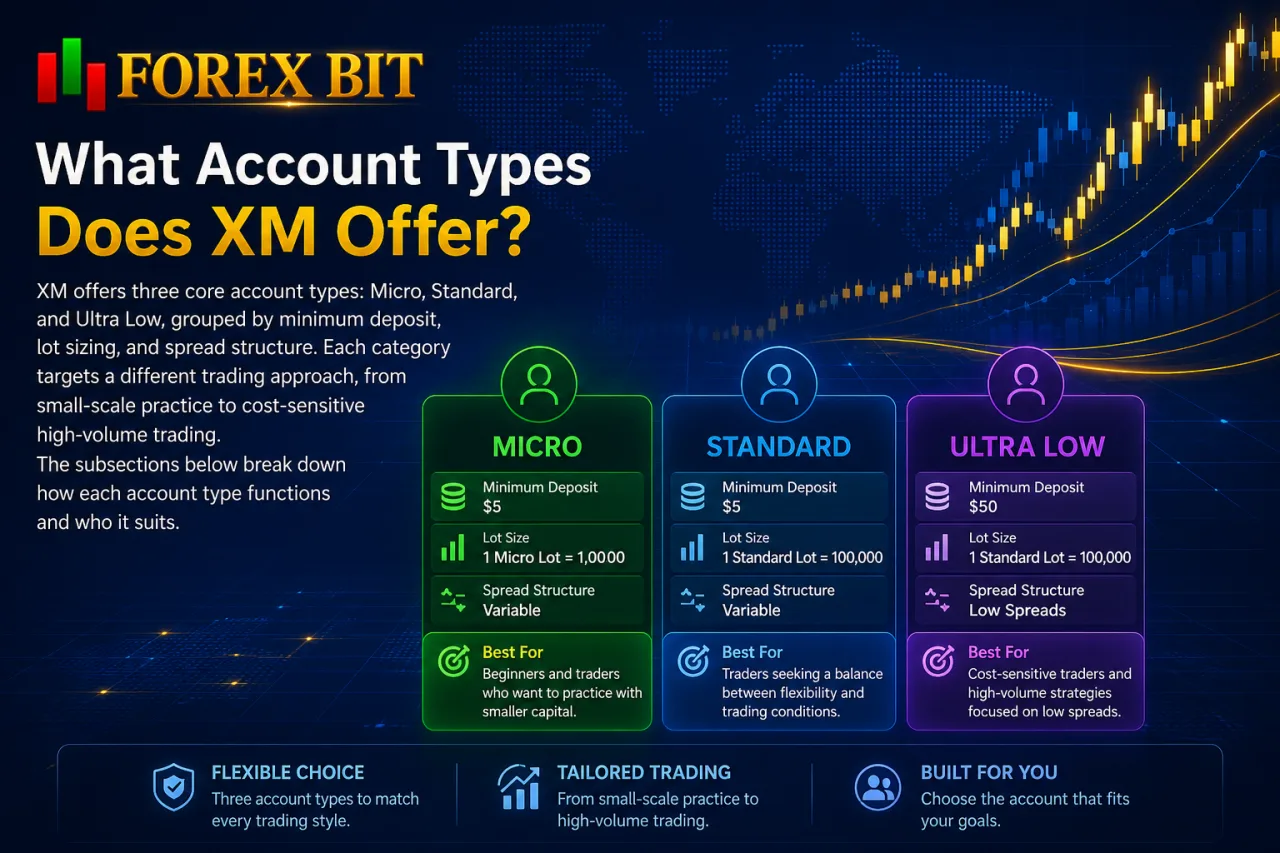
XM offers three core account types: Micro, Standard, and Ultra Low, grouped by minimum deposit, lot sizing, and spread structure. Each category targets a different trading approach, from small-scale practice to cost-sensitive high-volume trading. The subsections below break down how each account type functions and who it suits.
Which XM Account Type Suits Your Trading Style?
The Micro account suits beginners, Standard suits general active traders, and Ultra Low suits scalpers and high-volume traders seeking tighter spreads with commission. Suitability comes down to deposit size, trade frequency, and sensitivity to spread versus commission costs.
- Beginners test strategies on the Micro account, where smaller lot sizes reduce exposure while minimum deposits stay accessible for new capital.
- Active traders use the Standard account for a balance of variable spreads, no added commission, and lot sizes suited to regular position trading.
- Scalpers and high-frequency traders choose the Ultra Low account, pairing lower raw spreads with a per-lot commission to cut costs on frequent trades.
Deposit tiers scale accordingly, with Micro and Standard sharing a comparable entry threshold and Ultra Low typically requiring a higher minimum deposit to access its pricing structure. XM sets different minimum deposit thresholds depending on account type, with Micro, Standard, and Ultra Low accounts each requiring a different entry-level deposit. Traders choosing between tiers typically weigh trade volume against cost sensitivity before selecting an account.
How Do XM’s Spreads, Fees, and Leverage Compare?
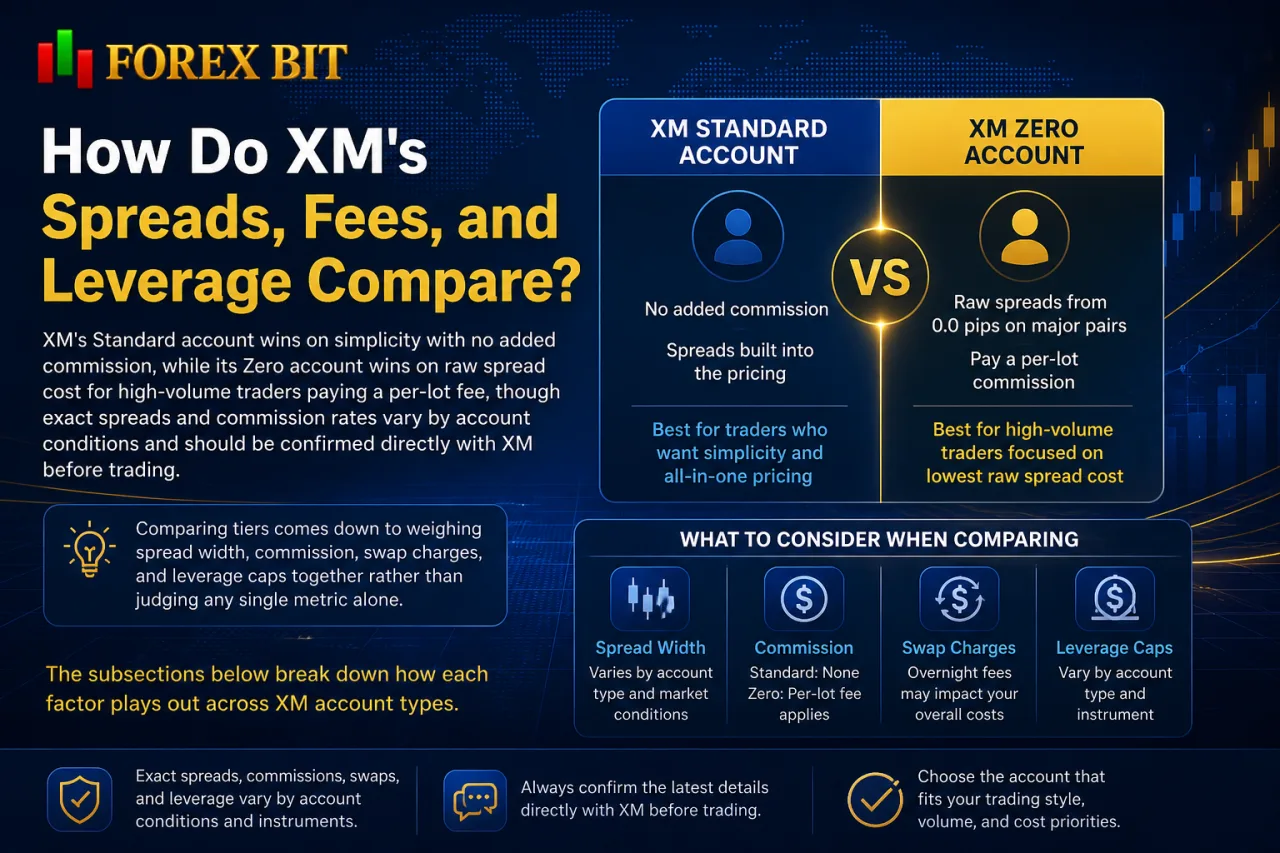
XM’s Standard account suits traders wanting no added commission, while its Zero account suits high-volume traders wanting tighter raw spreads with a per-lot fee. Exact spreads and commission rates vary by account conditions and should be confirmed directly with XM before trading. Comparing tiers comes down to weighing spread width, commission, swap charges, and leverage caps together rather than judging any single metric alone. The subsections below break down how each factor plays out across account types and regulatory regions.
What Trading Platforms and Instruments Does XM Provide?
XM provides two platform families, MetaTrader 4 and MetaTrader 5, alongside WebTrader browser access and native mobile apps, covering forex, commodities, indices, stocks, metals, and cryptocurrency CFDs. This range determines how traders execute orders and which markets they access from a single XM account.
Platform access spans desktop, browser, and mobile, so traders switch between devices without losing configured charts or open positions.
- MT4 and MT5 run as downloadable desktop terminals supporting expert advisors, custom indicators, and multiple order types.
- WebTrader delivers the same core charting and execution tools directly through a browser without installation.
- Mobile apps for iOS and Android mirror desktop functionality for monitoring and trading on the move.
Instrument coverage extends across several asset classes rather than forex alone. XM lists currency pairs, commodities such as oil and agricultural products, major stock indices, precious metals including gold and silver, individual stock CFDs, and cryptocurrency CFDs, giving traders exposure to multiple markets through the same MT4 or MT5 account without switching providers.
How Do You Open an Account, Deposit, and Withdraw Funds with XM?
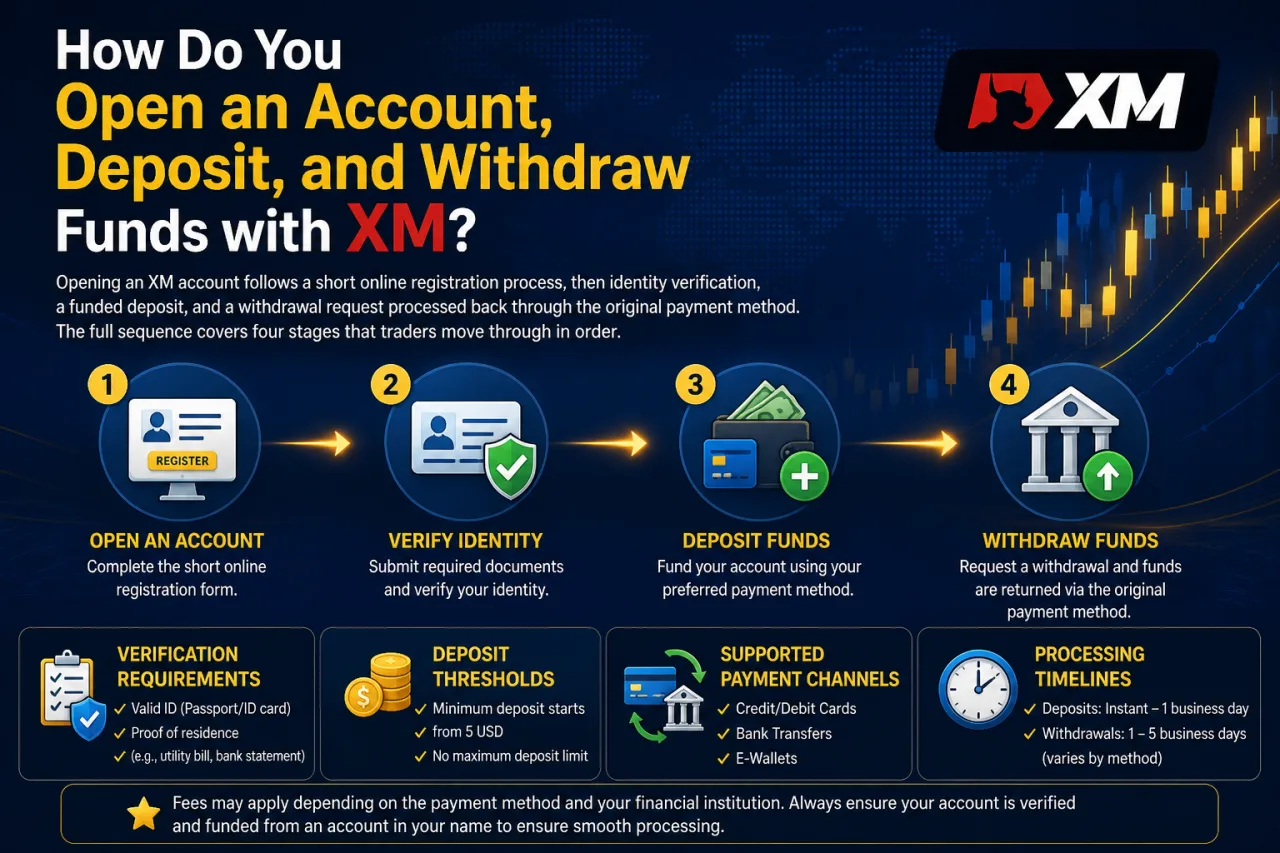
Opening an XM account follows a short online registration process, then identity verification, a funded deposit, and a withdrawal request processed back through the original payment method. The full sequence covers four stages that traders move through in order, and the subsections below cover verification requirements, deposit thresholds, supported payment channels, and processing timelines separately.
Which Countries Are Restricted from Using XM?
Yes, XM restricts United States residents and several other jurisdictions from opening accounts. This restriction stems from regulatory conflicts rather than a single uniform policy across all excluded regions, so traders should confirm current eligibility directly with XM before signing up.
The exclusion list matters for a global trader base since eligibility depends entirely on residency rather than nationality alone.
- United States residents face exclusion due to CFTC and NFA rules that conflict with XM’s offshore and CySEC/ASIC licensing structure.
- Canadian residents encounter limited access tied to IIROC’s strict domestic brokerage requirements.
- Traders in a number of other jurisdictions face restrictions where local financial authorities prohibit unlicensed foreign brokers from soliciting clients directly.
XM verifies residency during identity checks, so an application from a restricted country typically gets declined or redirected regardless of which entity a trader initially attempts to register under. Confirming eligibility directly with XM before depositing funds avoids wasted verification steps.
What Additional Tools and Support Does XM Provide Beyond Trading?
XM provides education, research tools, a loyalty program, and multilingual support beyond core trading services. Each category addresses a different stage of a trader’s journey, from learning core concepts to getting help resolving account issues. The subsections that follow cover how each of these resources functions in practice.
Does XM Offer Bonuses or Promotions for Traders?
XM offers bonuses and promotions in select regions, but availability depends heavily on the regulatory entity governing a trader’s account, with stricter jurisdictions typically excluding such offers; traders should confirm current promotional eligibility directly with XM based on their account’s regulator.
This restriction ties directly back to the jurisdictional coverage already outlined for XM’s licensed entities. Regulators such as ASIC and CySEC generally prohibit or tightly limit deposit bonuses and trading incentives under retail client protection rules, while offshore entities like FSC Belize often retain more flexibility to run such campaigns.
Compared to industry norms, this pattern matches most multi-jurisdictional brokers rather than setting XM apart. Traders under an EU or Australian entity should expect no bonus eligibility, while those onboarded through less regulated regions may see promotions offered periodically. Confirming current eligibility directly with XM before assuming any promotion applies avoids relying on outdated or region-inapplicable marketing material.
How Does XM’s Customer Support Compare to Other Brokers?
XM matches or exceeds typical industry standards on support channels and language coverage, though response times vary depending on the query type and channel used. This comparison rests on three factors that shape support quality across brokers: available contact methods, language reach, and how quickly queries get resolved.
XM offers live chat, phone support, and email as its main contact channels, mirroring what most regulated multi-asset brokers provide rather than introducing a unique channel. XM states that its customer service team supports a wide range of languages, a coverage range that appears broader than many mid-sized competitors offering only English and a handful of regional languages.
Live chat typically delivers the fastest response among the three channels, while email queries take longer to resolve depending on complexity. Phone support suits urgent account or withdrawal issues, though availability may depend on the licensed entity handling a trader’s account and its regional operating hours.
Conclusion
XM’s 2026 safety profile stands on multi-jurisdictional licensing through ASIC, CySEC, DFSA, and FSC, fund segregation, negative balance protection, and a decade-plus track record without major sanctions, confirming its status as a legitimate broker for global traders. Its three-tier account lineup accommodates everyone from beginners to high-volume scalpers, while MT4/MT5 access, multi-asset coverage, and multilingual support round out a well-rounded package.
Actual protection, bonus eligibility, and leverage caps still hinge on the specific entity handling a trader’s account, so verifying residency-based terms directly with XM before depositing remains the final step toward opening an account with confidence.
Thomas Dite is the Best Forex Brokers Research Manager at Forex Bit, specializing in researching, comparing, and editing broker-related content for different trader needs. He focuses on evaluating trading platforms, costs, regulation, account conditions, and other key factors to help readers make more informed broker comparisons.
Email: [email protected]