









Forex trading costs are the total expenses a trader pays to open, hold, and close positions, mainly through spreads, commissions, and swaps. These charges directly reduce trading profits and vary significantly between brokers and account types.
Spreads, commissions, and swaps form the core fees applied to nearly every forex trade. Deposit, withdrawal, and inactivity fees may also apply depending on the broker’s pricing structure.
Total trading costs are calculated by adding spread or commission charges to overnight swap fees accumulated over the holding period of a trade. Inactivity fees are charged separately when accounts remain unused for a set period.
Comparing spreads, commissions, and swap rates across brokers helps identify lower-cost trading conditions. Choosing an account type suited to a trading strategy reduces unnecessary charges over time. Forex Bit breaks down these cost components clearly to help traders evaluate broker pricing, starting with what forex trading costs actually are.
What Are Forex Trading Costs?
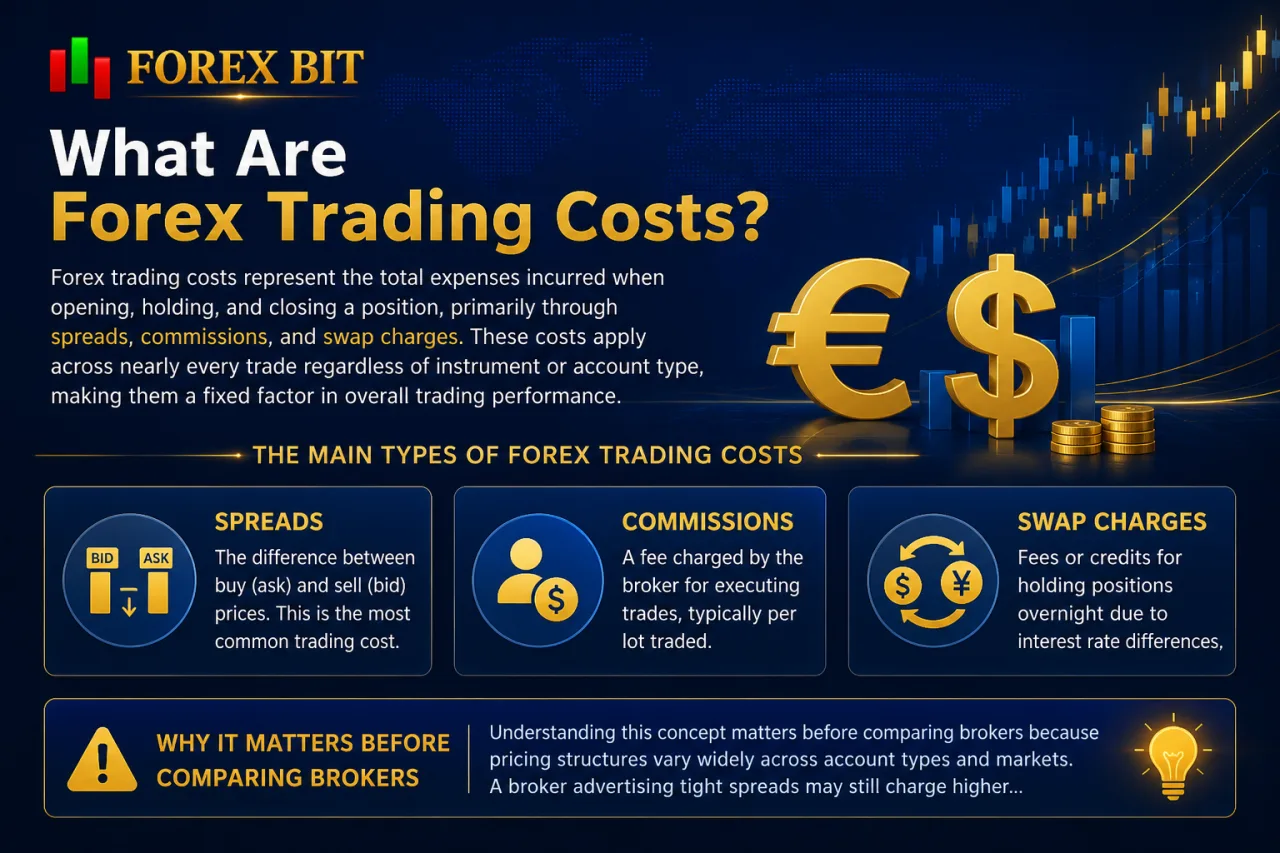
Forex trading costs represent the total expenses incurred when opening, holding, and closing a position, primarily through spreads, commissions, and swap charges. These costs apply across nearly every trade regardless of instrument or account type, making them a fixed factor in overall trading performance.
Understanding this concept matters before comparing brokers because pricing structures vary widely across account types and markets. A broker advertising tight spreads may still charge higher commissions or swap rates, so evaluating trading costs as a combined figure, rather than a single fee in isolation, gives a clearer picture of actual expense. The following sections break down each cost component individually.
What Types of Trading Costs Exist in Forex?
Forex trading costs split into two main categories: explicit costs and implicit costs, grouped by how directly they appear on a trade. Explicit costs are charged upfront and shown clearly on each transaction, while implicit costs build up over time or apply only under specific account conditions.
This distinction sets up how each fee type affects overall trading expense. Explicit costs cover spreads and commissions, both charged at the moment a trade opens or closes. Implicit and holding costs include:
- Swap or overnight fees, applied when a position stays open past the daily rollover time
- Inactivity fees, charged when an account remains unused for a set period
- Deposit and withdrawal fees, applied depending on the payment method a broker supports
Explicit costs remain the easiest to compare across brokers since they appear directly in the spread or commission structure of an account. Implicit costs vary more by trading behavior, since holding period, account activity, and withdrawal frequency all influence how much a trader ultimately pays beyond the visible spread or commission.
What Fees and Charges Apply When Trading Forex?
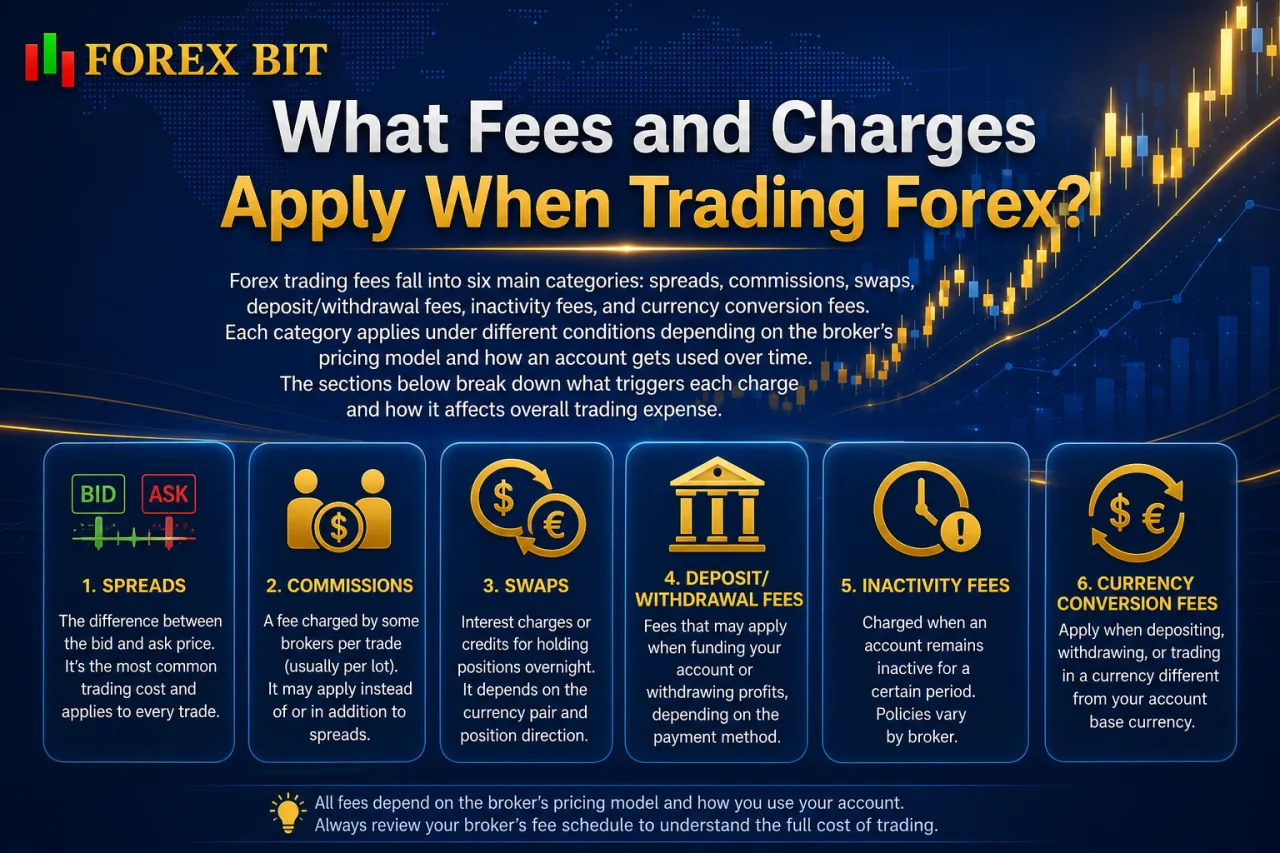
Forex trading fees fall into six main categories: spreads, commissions, swaps, deposit/withdrawal fees, inactivity fees, and currency conversion fees. Each category applies under different conditions depending on the broker’s pricing model and how an account gets used over time. The sections below break down what triggers each charge and how it affects overall trading expense.
What Is a Spread and How Does It Work?
A spread is the difference between the bid price and the ask price of a currency pair, representing the primary cost built into most forex trades. Brokers quote two prices for every instrument, and the gap between them determines how much a trade costs the moment it opens.
This gap works differently depending on the pricing model a broker applies. Fixed spreads stay constant regardless of market conditions, offering predictable costs even during volatile sessions. Variable spreads widen or narrow based on liquidity and volatility, often tightening during high-volume trading hours and expanding around major news releases.
Spread size directly affects cost per trade because a trader enters a position already at a small loss equal to the spread value. A wider spread requires more favorable price movement before a trade turns profitable, while a tighter spread lowers the breakeven point. This makes spread size a central factor when comparing broker pricing across account types.
What Is a Commission and When Is It Charged?
A commission is a fixed fee charged per lot traded, typically applied on ECN or raw spread accounts where the spread itself stays close to zero. This pricing model separates the cost of execution from the cost of liquidity, showing the fee as a distinct line item rather than folding it into the bid-ask difference.
This charging structure works alongside raw spreads rather than replacing them entirely. Brokers using commission-based pricing calculate the fee per standard lot traded, charging it when a position opens, when it closes, or split across both events depending on the broker’s model. A round-turn trade often carries the full commission amount, meaning the fee covers both the entry and exit combined into a single charge.
Commission-based accounts suit traders who value transparent, itemized costs over bundled spread markups. Comparing the commission rate alongside the raw spread gives a more accurate total cost figure than looking at either component alone, since a low headline spread paired with a high commission can still result in a higher overall charge per trade.
What Are Swaps and Overnight Fees?
Swaps, also called overnight fees, are interest charges applied when a forex position stays open past the daily rollover time, reflecting the interest rate differential between the two currencies traded. This charge separates rollover costs from spreads and commissions, applying only to positions carried beyond the trading day rather than at entry or exit.
Swap rates come from the interest rate gap between the base currency and the quote currency of a pair. Brokers calculate the differential using each currency’s benchmark rate, then apply it as either a credit or a debit depending on the direction of the trade.
Long and short positions carry opposite swap outcomes on the same pair. A long position earns a positive swap when the base currency carries a higher interest rate than the quote currency, while a short position on that same pair typically pays a negative swap. This relationship reverses when the quote currency holds the higher rate, so a long trade pays while a short trade earns.
Rollover timing also affects the total charge, since most brokers apply triple swap fees on one specific day of the week to account for weekend settlement.
Are There Deposit, Withdrawal, or Inactivity Fees?
Yes, deposit, withdrawal, and inactivity fees apply at many forex brokers, though the charges depend on payment method, withdrawal frequency, and account dormancy period rather than applying uniformly to every account. This fee structure sits apart from the spread, commission, and swap costs already outlined, since these charges relate to account management rather than trade execution.
Deposit and withdrawal fees typically depend on the payment channel a trader selects. Bank wire transfers often carry fixed processing fees, while e-wallets and card payments may process free of charge or at a lower flat rate. Inactivity fees follow a different trigger entirely, applying once an account sits untouched for a set period defined in the broker’s terms, often deducted as a recurring charge until the account closes or resumes trading activity.
Checking a broker’s terms and conditions before opening an account clarifies which of these fees apply, since payment costs and dormancy rules vary between brokers and sometimes between account types at the same broker.
How to Calculate Total Trading Costs and Overnight Fees?
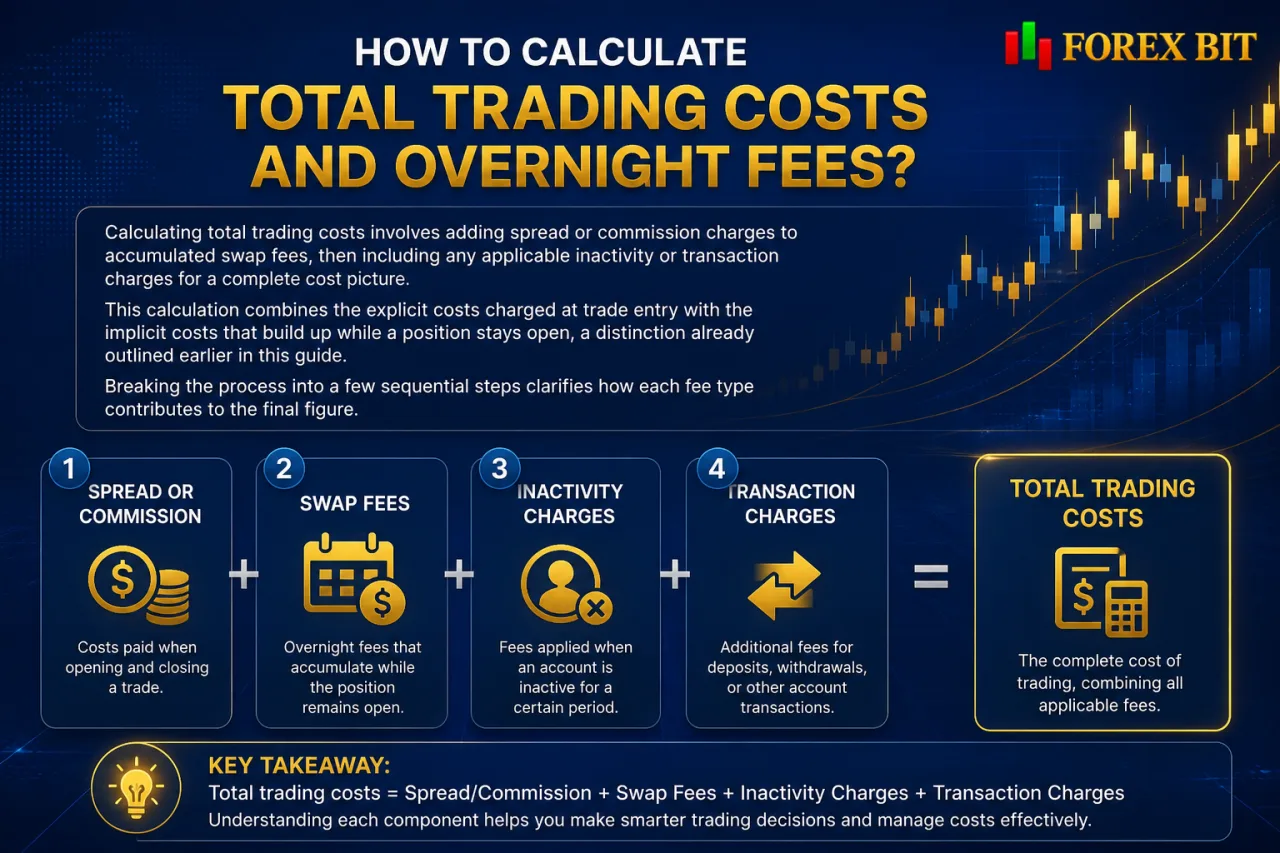
Calculating total trading costs involves adding spread or commission charges to accumulated swap fees, then including any applicable inactivity or transaction charges for a complete cost picture. This calculation combines the explicit costs charged at trade entry with the implicit costs that build up while a position stays open, a distinction already outlined earlier in this guide. Breaking the process into a few sequential steps clarifies how each fee type contributes to the final figure.
How Is Swap Calculated for Overnight Positions?
Swap for an overnight position multiplies the swap rate in points by the lot size and the number of nights held, with the rollover day tripling the standard charge to cover the weekend settlement gap. This formula applies the swap rate quoted by the broker for each currency pair to the trade volume, then scales the result by holding duration.
The calculation follows a straightforward sequence:
- Identify the swap rate points published for the specific pair and direction (long or short)
- Multiply that rate by the lot size of the open position
- Multiply the result by the number of nights the position remains open past rollover
- Apply triple the standard swap on the designated rollover day, since most brokers settle three days of interest at once to account for the weekend
Rollover day placement varies slightly by broker, though it commonly falls on Wednesday for major forex pairs to offset the weekend when markets stay closed.
The final swap figure appears in the trading platform’s account history, showing the accumulated charge or credit for each night a position stays open.
How Do You Estimate Total Cost Per Trade?
Estimating total cost per trade combines pip value, lot size, and spread or commission into a single figure covering the exact cost of entering and exiting a position. This calculation isolates the trade-level cost from swap and account-management fees already outlined, focusing only on the charge incurred at execution.
The process follows a short sequence of steps:
- Determine the pip value for the traded lot size, based on the currency pair and position volume
- Multiply the pip value by the spread in pips to get the spread cost in account currency
- Add any commission charged per lot on that trade, if the account uses a commission-based pricing model
- Sum the spread cost and commission together for the total entry-and-exit cost of that single trade
A trader on a commission-free account with a wider spread ends up paying the full cost through the spread figure alone, while a trader on a raw-spread account splits the cost between a near-zero spread and a separate per-lot commission. Comparing both figures side by side shows which pricing structure produces a lower total cost for a given lot size and pair.
How to Compare and Reduce Trading Costs Across Brokers?
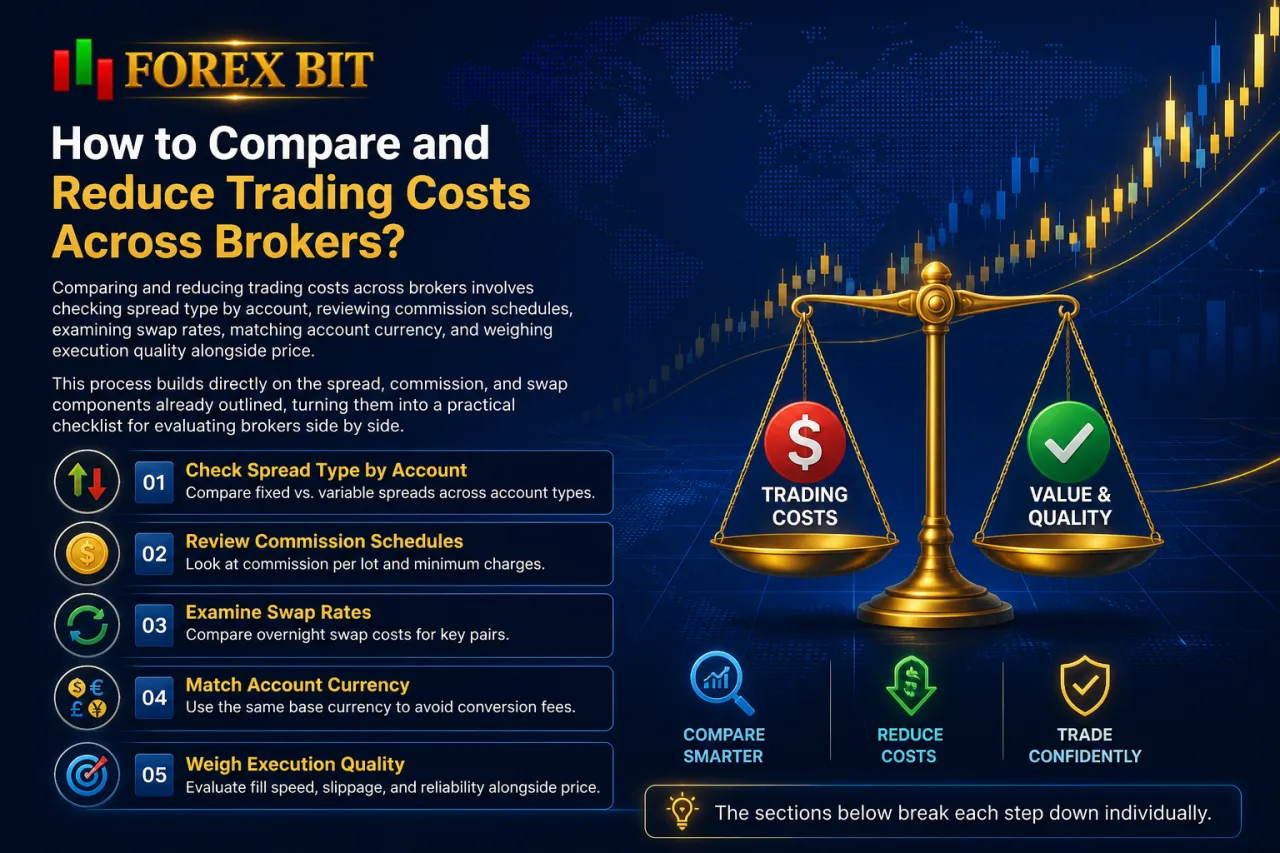
Comparing and reducing trading costs across brokers involves checking spread type by account, reviewing commission schedules, examining swap rates, matching account currency, and weighing execution quality alongside price. This process builds directly on the spread, commission, and swap components already outlined, turning them into a practical checklist for evaluating brokers side by side. The sections below break each step down individually.
Raw Spread Accounts vs Standard Spread Accounts: Which Has Lower Costs?
Raw spread accounts win on cost for high-volume traders, while standard spread accounts win for low-frequency traders, since the two models shift the same cost between commission and spread markup. This comparison builds on the spread and commission mechanics already outlined, applying them directly to the two dominant account structures brokers offer.
Raw spread accounts pair a near-zero spread with a fixed commission per lot, making the total cost transparent and predictable per trade. Standard spread accounts fold the entire cost into a wider spread with no separate commission, keeping the pricing simpler but less itemized.
Volume changes which model comes out cheaper. A trader placing many trades or larger lot sizes accumulates commission charges faster on a raw spread account, yet the near-zero spread often keeps total cost lower than the wider markup on a standard account at that same volume. A trader placing fewer trades or smaller lot sizes typically pays less on a standard spread account, since the fixed commission on a raw account can outweigh the savings from a tighter spread at low volume.
Calculating both scenarios for a given lot size and trade frequency shows which structure produces the lower total charge before opening an account.
What Practical Steps Can Reduce Overall Trading Costs?
Reducing overall trading costs involves four practical steps: selecting the right account type, timing trades around high-liquidity hours, limiting overnight holds, and using low-fee payment methods. This checklist applies the spread, swap, and account-fee mechanics already outlined to concrete trading habits rather than broker selection alone.
- Matching account type to trading frequency, choosing raw spread pricing for high-volume trading and standard spread pricing for occasional trades
- Placing trades during high-liquidity market hours, since tighter spreads typically appear when trading volume and participation peak
- Closing positions before the daily rollover cutoff, avoiding swap charges on strategies that do not require multi-day exposure
- Selecting payment methods that carry no deposit or withdrawal fees, based on the broker’s published payment terms
Each of these steps targets a different cost component covered earlier, spreads through timing, commissions through account choice, swaps through holding period, and transaction fees through payment method. Applying all four together lowers the combined cost figure calculated for a given trading style.
What Are Some Less Common Cost Factors Traders Often Overlook?
Some less common cost factors traders often overlook include currency conversion fees, negative balance protection charges, market data or platform fees, and premium execution costs on certain order types. These sit outside the spread, commission, swap, and inactivity fees already outlined, applying only under specific account setups or trading conditions rather than to every trade. The sections below break each factor down individually.
How Does Currency Conversion Affect Trading Costs?
Currency conversion affects trading costs by adding a markup whenever the account base currency differs from the currency pair traded or the currency of a deposit. This charge sits apart from spreads, commissions, and swaps already outlined, applying only when a mismatch between currencies triggers a conversion step.
A trader holding a USD-based account who trades a pair like EUR/GBP incurs a conversion cost when profit or loss settles back into USD, since the broker converts the result using its own exchange rate rather than the mid-market rate. Deposits and withdrawals made in a currency other than the account base currency face the same markup, applied at the point funds enter or leave the account. Brokers typically embed this markup as a small percentage added to the prevailing exchange rate rather than listing it as a separate line-item fee. This markup typically stays small relative to the mid-market rate on major currency conversions.
Matching the account base currency to the currency used most often for deposits and the primary traded pairs avoids this cost entirely.
Are Islamic (Swap-Free) Accounts a Way to Avoid Overnight Fees?
Yes, Islamic or swap-free accounts avoid overnight interest charges, though many brokers replace the swap with a separate administration fee rather than eliminating holding costs entirely. This structure removes the interest-based swap outlined earlier while introducing a different charge in its place, so total cost does not always drop.
Swap-free accounts remove the standard rollover interest applied to positions held past the daily cutoff. Some brokers instead apply a fixed daily administration fee on trades held beyond a set number of days, effectively substituting one holding cost for another. This option targets traders following religious restrictions on interest rather than traders seeking a general way to cut costs, making it a niche solution rather than a universal fix for overnight charges.
Conclusion
Forex trading costs come down to a combination of explicit charges like spreads and commissions and implicit ones like swaps, inactivity fees, and currency conversion markups. Calculating a true cost figure means adding entry-and-exit charges to accumulated overnight fees, then factoring in account-management costs where they apply. Raw spread and standard spread accounts shift these charges between commission and markup, with volume determining which structure costs less.
Matching account currency, timing trades around liquid hours, and limiting overnight holds all lower the combined total. Understanding each component individually, then summing them together, gives a trader an accurate picture of what a broker actually charges per trade.