
Curious how forex spreads really impact your trading costs? See verified broker spread data, comparisons, and tips to trade smarter today.
Forex Spreads Explained: Real Broker Costs Compared

A forex spread represents the difference between the bid price and the ask price quoted for a currency pair, and it represents the primary cost of entering a trade. Brokers embed this margin directly into the quoted price rather than charging it as a separate fee.
Spread costs vary significantly across brokers, as EUR/USD spreads vary between brokers, with some firms quoting spreads under 1 pip while others average 1.5 pips or more depending on account type. These differences accumulate quickly for traders who open multiple positions daily.
Spread size depends on several factors, since spreads are generally classified as fixed or variable, and variable spreads tend to widen or narrow based on liquidity conditions, market volatility, and the broker’s chosen pricing model. Variable spreads widen during low-liquidity periods or major news events, while fixed spreads remain stable regardless of market conditions.
Traders seeking minimal costs typically look toward accounts where some brokers advertise spreads starting from 0.0 pips on ECN or raw accounts, usually paired with a separate commission per lot. Forex Bit compares these figures across regulated brokers to identify where total costs, not just headline spreads, remain lowest.
Understanding these cost components starts with a clear definition of the spread itself, how it directly increases the total cost of every trade, and the different spread models brokers apply across their account offerings.
What Is a Forex Spread?
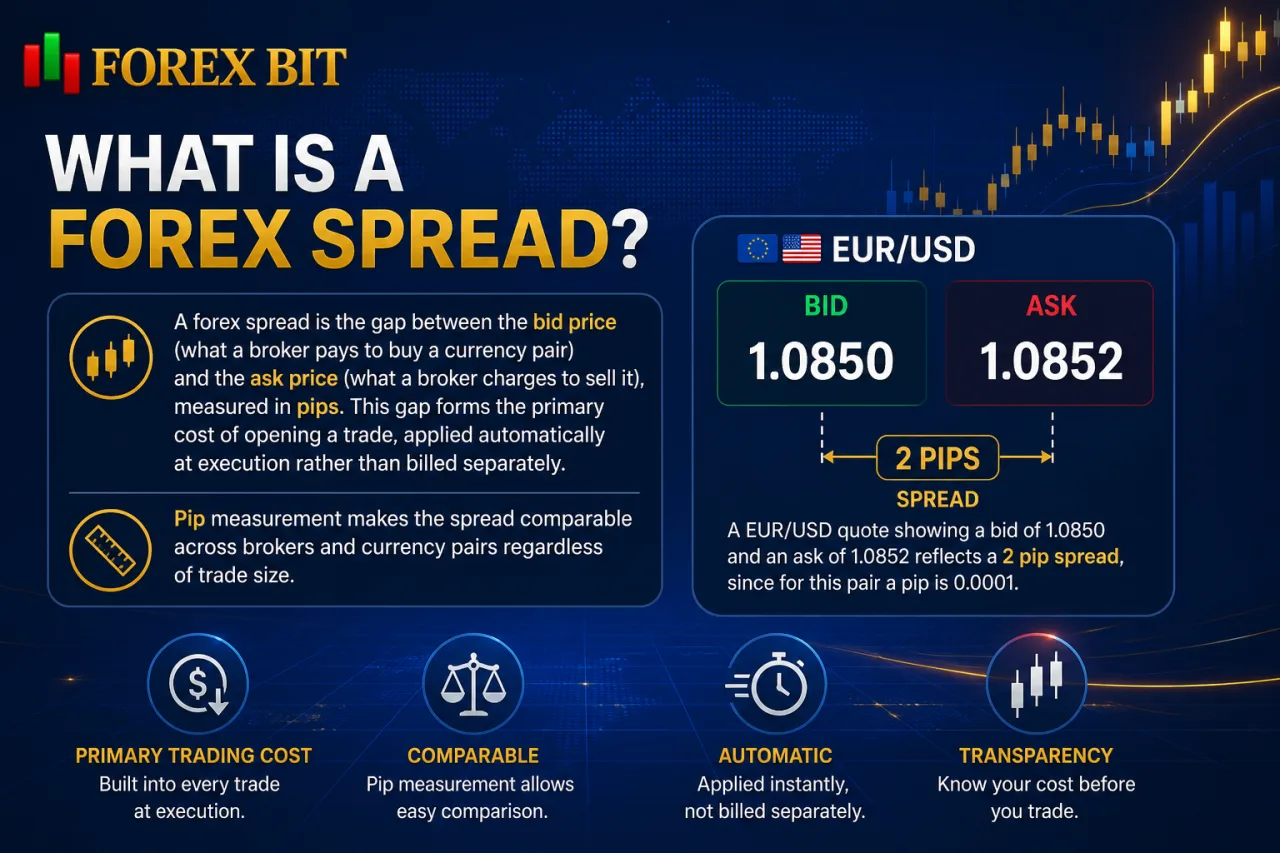
A forex spread is the gap between the bid price (what a broker pays to buy a currency pair) and the ask price (what a broker charges to sell it), measured in pips. This gap forms the primary cost of opening a trade, applied automatically at execution rather than billed separately.
Pip measurement makes the spread comparable across brokers and currency pairs regardless of trade size. A EUR/USD quote showing a bid of 1.0850 and an ask of 1.0852 reflects a 2 pip spread, since for this pair a pip is generally defined as a movement of 0.0001, making the 0.0002 difference between the two prices equal to 2 pips.
A trader entering a position at the ask price and immediately exiting at the bid price absorbs this 2 pip difference as an instant cost, before any commission or overnight fee applies. Because the spread is embedded in the quote itself, it appears on every trade regardless of account type or broker pricing model.
How Does the Spread Affect Your Total Trading Cost?
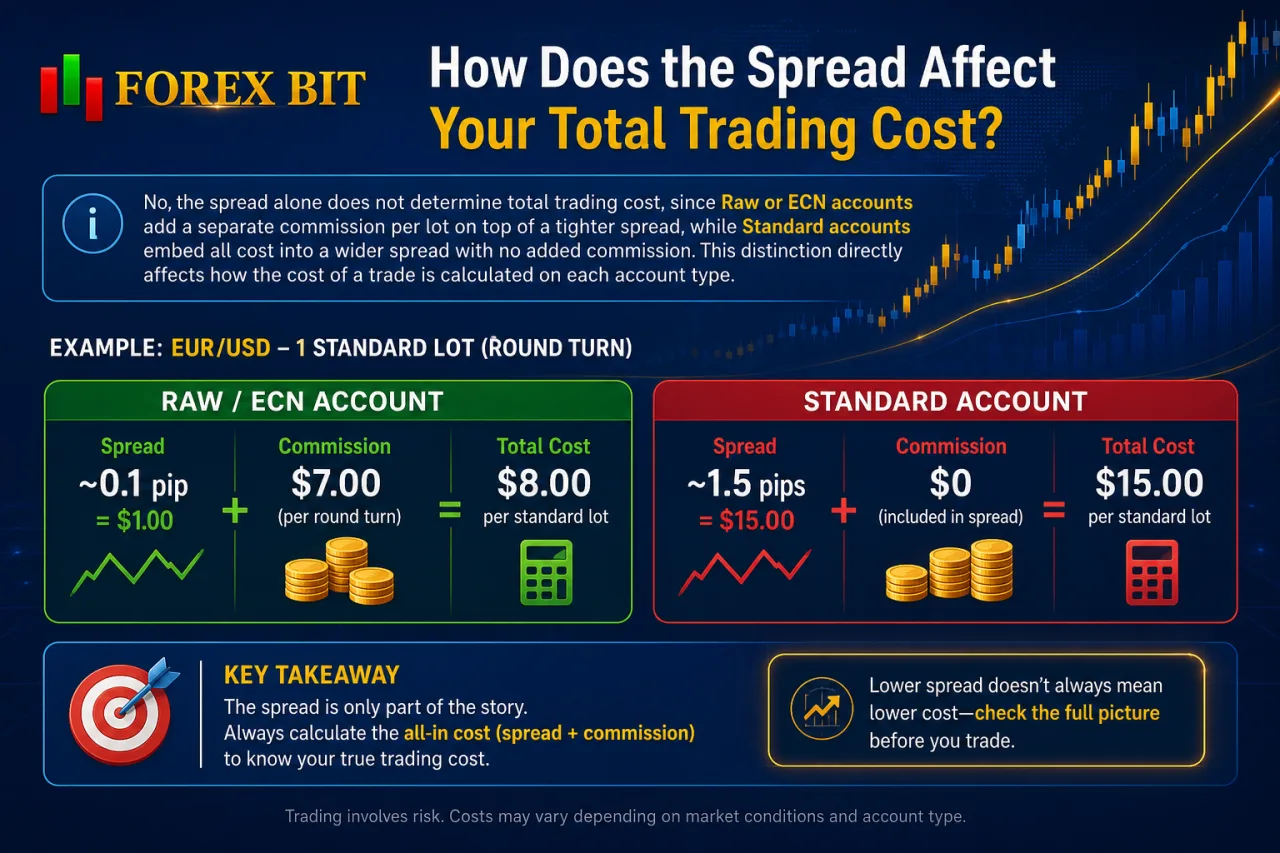
No, spread alone does not determine total trading cost. Total cost equals spread plus any commission charged by the broker. Raw or ECN accounts add a separate commission per lot on top of a tighter spread, while Standard accounts embed all cost into a wider spread with no added commission. This distinction directly affects how the cost of a trade is calculated on each account type.
A practical example clarifies the difference. On a Raw account quoting a EUR/USD spread near 0.1 pip, the spread cost on one standard lot equals about $1. Adding a typical commission of $7 per round turn per standard lot brings the total cost to around $8 for that trade.
On a Standard account with no separate commission, a EUR/USD spread averaging around 1.2 pips on a standard lot generates a cost of about $12, paid entirely through the wider spread.
Comparing both figures shows the Raw account produces a lower total cost in this scenario ($8 versus $12) despite charging commission, since the tighter spread outweighs the added fee. Traders evaluating cost efficiency need to sum spread cost and commission together rather than judging an account by the headline spread figure alone.
What Types of Forex Spreads Exist?
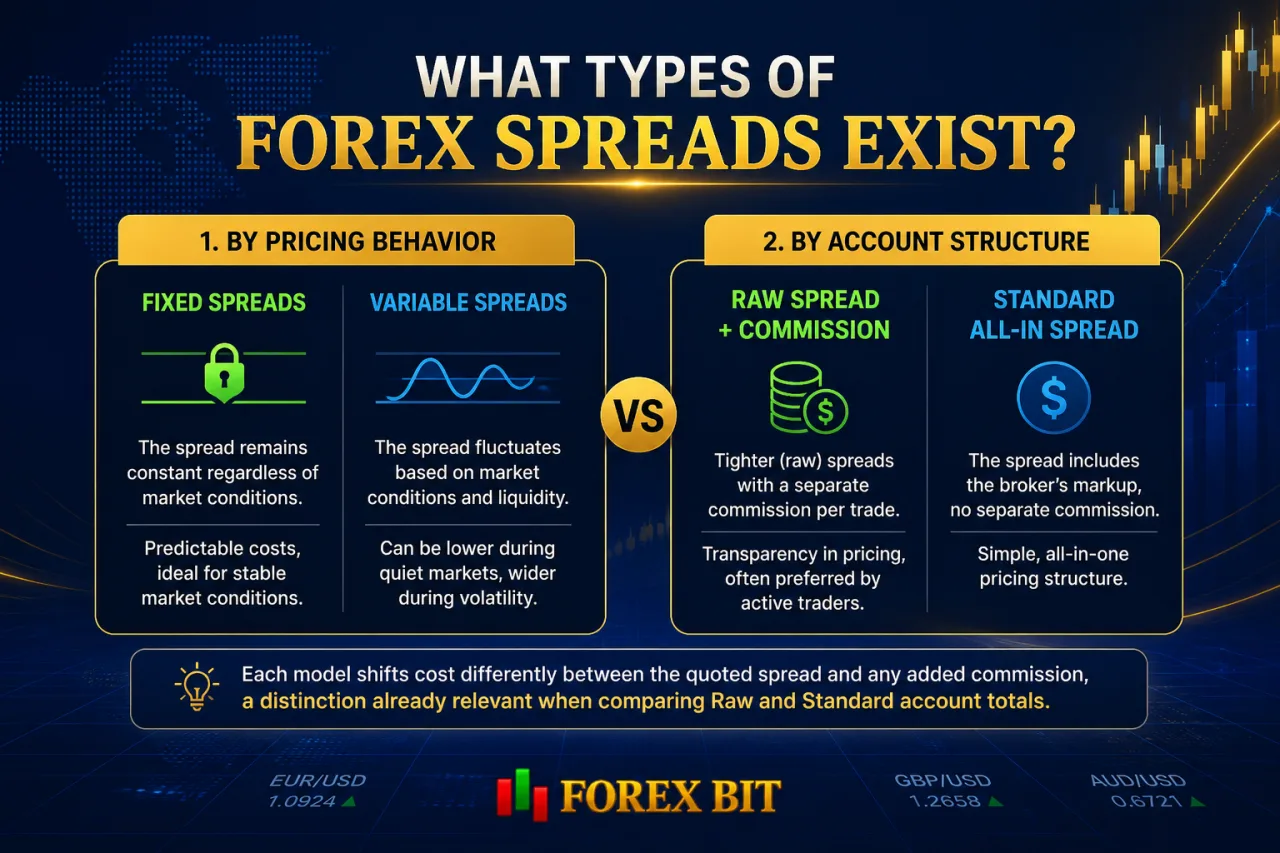
Forex spreads fall into two main models: fixed vs variable spreads by pricing behavior, and raw spread with commission vs standard all-in spread by account structure. Each model splits cost differently between the quoted spread and any added commission.
Fixed vs Variable Spreads: What’s the Difference?
Fixed spreads stay constant regardless of market conditions, while variable spreads fluctuate with liquidity and volatility, widening during news events and narrowing in calm markets. This pricing behavior determines cost predictability on each account type, extending the fixed vs variable distinction already noted above.
Fixed spreads suit traders prioritizing predictable costs. A broker offering a fixed EUR/USD spread quotes the same pip value whether liquidity is thin or deep, which simplifies cost calculation before entering a trade but often sits wider than the tightest variable quotes available during peak liquidity.
Variable spreads suit traders prioritizing lower average costs during stable market hours. These spreads compress when liquidity providers compete aggressively, often dropping below fixed-spread levels, but expand sharply during major news releases or low-liquidity sessions, sometimes exceeding several pips momentarily.
The tradeoff separates the two models clearly:
- Predictability favors fixed spreads, since the quoted cost never changes with market conditions.
- Lower average cost favors variable spreads, since tighter liquidity periods reduce the spread below fixed-rate levels.
- Execution risk favors fixed spreads during volatile events, since variable spreads can widen unexpectedly at the exact moment a trade executes.
Account type and broker pricing model determine which spread structure applies, a factor already relevant to the Raw versus Standard account comparison covered earlier.
Raw Spread Account vs Standard Account: Which Costs Less?
A Raw or ECN account costs less for larger lot sizes despite charging a separate commission, since the near-zero spread plus a fixed fee per lot undercuts a Standard account’s wider all-in spread once volume increases. This raw spread account vs standard account comparison depends heavily on lot size and trading frequency.
Raw accounts typically quote EUR/USD spreads near 0.0 to 0.2 pip, with a fixed commission charged per round turn per standard lot. Raw account commission structures typically add a separate per-lot round turn fee on top of the near-zero spread. Standard accounts embed all cost into the spread, quoting EUR/USD around 1 to 1.5 pips with zero added commission.
The comparison below illustrates cost by lot size:
| Lot Size | Raw Account Cost (spread + commission) | Standard Account Cost (spread only) |
|---|---|---|
| 0.1 lot | Low, near $0.50-$0.90 | Moderate, near $1-$1.50 |
| 1 standard lot | Moderate, near $5-$8 | Higher, near $10-$15 |
| 5 standard lots | Scales proportionally, stays lower | Scales proportionally, stays higher |
Raw accounts win on cost for traders executing frequent or larger-volume trades, while Standard accounts suit smaller, occasional positions where simplicity outweighs marginal savings.
What Factors Affect the Size of a Forex Spread?
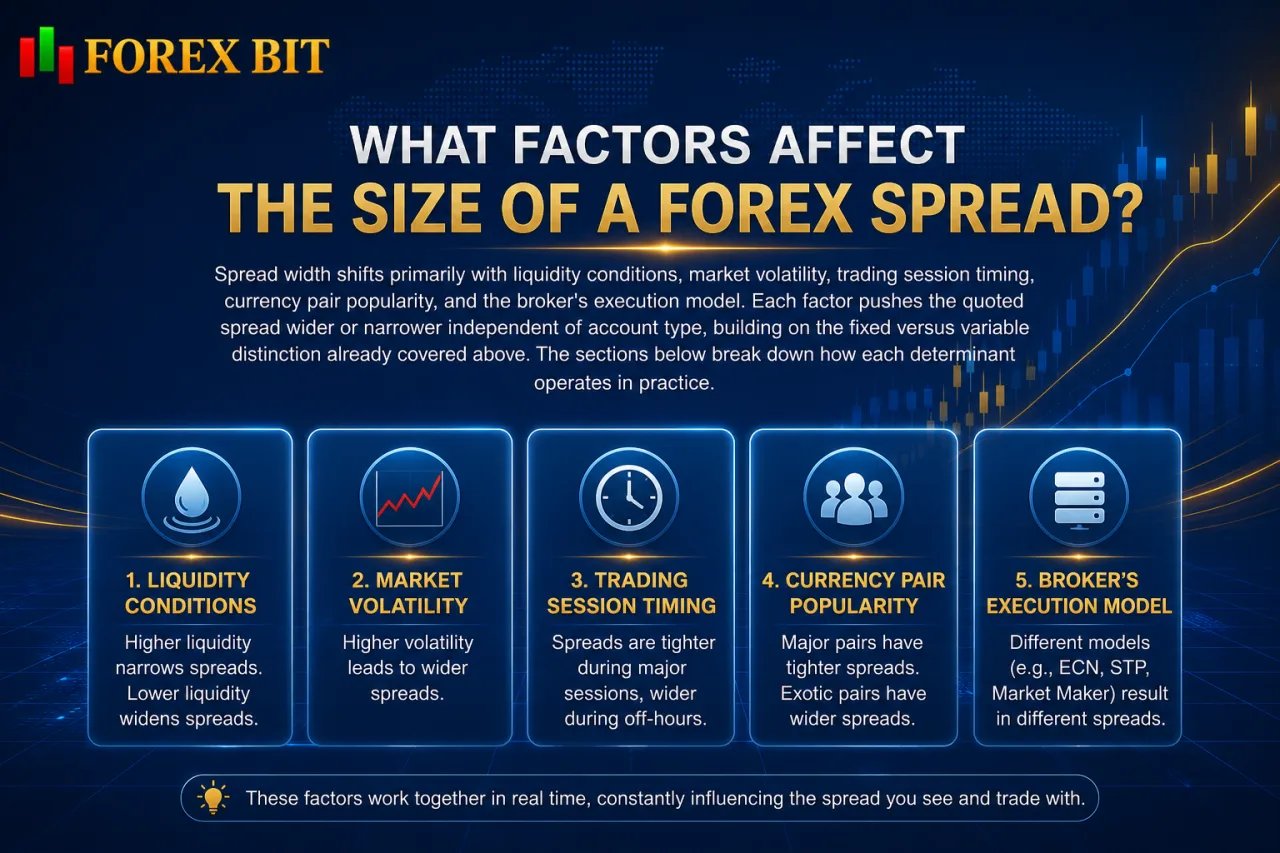
Spread width shifts primarily with liquidity conditions, market volatility, trading session timing, currency pair popularity, and the broker’s execution model. Each factor pushes the quoted spread wider or narrower independent of account type, building on the fixed versus variable distinction already covered above. The sections below break down how each determinant operates in practice.
How Does Liquidity Impact Spread Width?
Liquidity widens or narrows the spread directly, since deeper liquidity from more active buyers and sellers lets a broker quote a tighter gap between bid and ask. This liquidity influence extends the earlier point on how variable spreads track market conditions rather than staying fixed.
Major pairs draw the deepest liquidity pools among traded currencies. EUR/USD and USD/JPY carry very high trading volume compared with other currency pairs, and their spreads tend to be tighter than those of exotic pairs like USD/TRY or USD/ZAR.
Exotic pairs trade through fewer market participants, leaving less competing liquidity to compress the quoted spread. Brokers aggregate pricing from multiple liquidity providers to secure the tightest available bid-ask combination for each currency pair. This aggregation model explains why the same broker quotes a near-zero spread on EUR/USD while charging several pips or more on a thinly traded exotic pair.
How Does Market Volatility Widen or Narrow Spreads?
Market volatility widens spreads sharply during high-impact news releases and low-liquidity hours, since liquidity providers pull back competing quotes when price uncertainty spikes. This volatility influence compounds the liquidity effect already noted above, since thin order books during quiet sessions leave little depth to absorb sudden price swings.
Three conditions trigger the widest spread spikes:
- Scheduled news events, such as During an NFP release, EUR/USD spreads can widen sharply within seconds as liquidity providers pull back their quotes ahead of the data.
- Low-liquidity trading hours, particularly the Asian session overlap gap, where fewer active market participants leave wider gaps between bid and ask prices.
- Unexpected geopolitical or economic shocks, which trigger the same liquidity withdrawal pattern as scheduled news but without advance warning for traders to adjust position sizing.
Spreads typically normalize within a short window once liquidity providers resume competitive quoting after the initial volatility subsides. Traders holding positions through these windows absorb the widened cost directly, regardless of account type or broker pricing model.
Which Forex Brokers Offer the Lowest Spreads by Currency Pair?
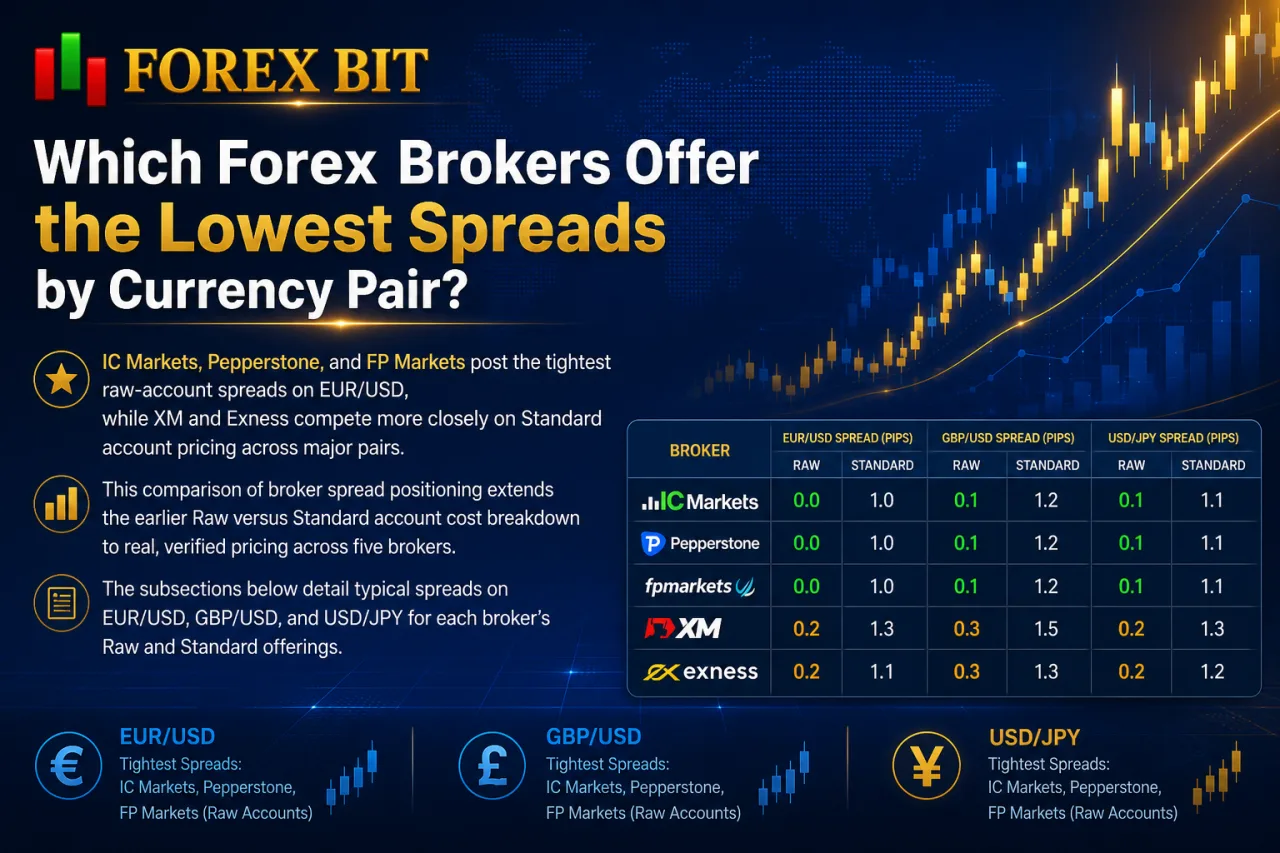
Raw-account pricing models generally post tighter spreads on EUR/USD than Standard account models, which trade wider spreads for a commission-free structure. This comparison illustrates how spread positioning typically differs between Raw and Standard account types, building on the earlier Raw versus Standard account cost breakdown. The table below presents an illustrative example of how spreads on EUR/USD, GBP/USD, and USD/JPY tend to compare across Raw and Standard account offerings, based on general account structure patterns rather than a fixed quote from any single broker at a specific point in time.
| Account Type | EUR/USD | GBP/USD | USD/JPY |
|---|---|---|---|
| Raw (example) | Ultra-tight, near-zero base spread plus commission | Tight, competitive among raw-account pricing models | Tight, competitive among raw-account pricing models |
| Standard (example) | Wider than Raw, commission-free | Wider than Raw, commission-free | Wider than Raw, commission-free |
The subsections below detail these spread patterns for Raw and Standard account types on EUR/USD, GBP/USD, and USD/JPY as an illustrative example of pricing structure differences. Readers should verify exact current spread figures directly on each broker’s official pricing page before making a decision, since these numbers change frequently and vary by market conditions.
Which Broker Has the Tightest EUR/USD Spread?
Raw-account brokers such as IC Markets, Pepperstone, and FP Markets are generally positioned close to each other in terms of total estimated EUR/USD cost per standard lot once commission is added, though the exact ranking between them varies depending on the specific moment a quote is taken. This EUR/USD-specific comparison narrows the earlier five-broker overview down to a single pair with commission included. These figures reflect general market estimates rather than a fixed quote from any single official source, and actual spreads fluctuate constantly with market conditions. Traders looking for an exact ranking should compare live spread and commission figures directly from each broker’s official pricing page rather than relying on general estimates.
On a Raw account, the combined estimated cost per lot, spread plus round-turn commission, is consistent with the earlier established cost breakdown for this account type, though the precise figure at any given time depends on current market conditions.
The Pepperstone Razor account operates on a similar raw-spread-plus-commission structure, and its estimated total round-turn cost per standard lot generally sits in the same competitive range as other Raw-account brokers, without a fixed and verifiable ranking between them.
FP Markets’ Raw account also quotes EUR/USD spreads in a comparable range to other Raw-account brokers, and once its per-lot commission is factored in, the estimated total round-turn cost per standard lot generally falls close to the same competitive range, though the exact order shifts with live pricing.
XM and Exness Standard accounts, priced without separate commission, generally generate a wider all-in EUR/USD cost per standard lot than any of the three Raw-account brokers above, confirming the earlier Raw versus Standard account cost pattern. Traders are advised to verify current spread and commission figures directly on each broker’s official pricing page before making a decision, as these values change frequently.
How Do Spreads Compare Across Major, Minor, and Exotic Pairs?
Major pairs post the tightest spreads across all five brokers, minor pairs run moderately wider, and exotic pairs carry the widest gaps, often several times the major pair cost on the same broker and account type. This pair category spread comparison extends the EUR/USD-specific breakdown above to the broader grouping of major, minor, and exotic currency pairs.
On Raw or ECN accounts, EUR/USD and USD/JPY tend to quote tighter average spreads once liquidity conditions are stable, while a minor pair like EUR/GBP or AUD/NZD generally carries a noticeably wider average spread on the same account type.
Exotic pairs such as USD/TRY or USD/ZAR tend to carry noticeably wider spreads on the same Raw accounts, reflecting the thinner liquidity already noted for these pairs.
The table below illustrates this pattern across pair categories on comparable Raw account pricing:
| Pair Category | Example Pair | Typical Raw Account Spread |
|---|---|---|
| Major | EUR/USD | Near 0.1-0.3 pip |
| Major | USD/JPY | Near 0.2-0.4 pip |
| Minor | EUR/GBP | Near 0.8-1.5 pips |
| Minor | AUD/NZD | Near 1.0-1.8 pips |
| Exotic | USD/TRY | Often 10+ pips |
| Exotic | USD/ZAR | Often 15+ pips |
Standard accounts follow the same ranking by category but at proportionally wider levels across all three pair groups, consistent with the earlier Raw versus Standard cost pattern.
How Can Traders Reduce the Real Impact of Spreads on Their Strategy?
Traders reduce the real impact of spreads through timing execution around peak liquidity, selecting account type by strategy, and controlling entry price rather than accepting market conditions passively. These tactics address cost from a different angle than account selection alone, targeting when and how a trade enters the market rather than which pricing model applies. The subsections below detail four specific approaches: trading during peak liquidity hours, matching account type to trading frequency, avoiding news-adjacent execution, and using limit orders over market orders.
Matching account type to trading frequency means aligning the pricing model with how often a trader enters and exits positions. High-frequency traders and scalpers generally benefit more from raw spread accounts paired with a commission, since the tighter spread offsets the fixed fee across many trades. Traders who place fewer trades over longer holding periods often find standard commission-free accounts more practical, since the wider spread cost is spread across less frequent execution.
Avoiding news-adjacent execution involves stepping away from the market in the minutes surrounding major economic releases. Spreads widen sharply during these windows as liquidity providers pull back their quotes to manage risk, and this widening can turn an otherwise reasonable entry price into a costly one. Waiting until volatility settles and spreads normalize keeps execution costs closer to the levels seen during normal trading conditions.
Using limit orders over market orders gives traders control over the exact price at which a position opens rather than accepting whatever price is available at the moment of execution. A market order fills at the current ask or bid regardless of how wide the spread has become, while a limit order only triggers at a specified price or better. This distinction becomes particularly relevant during volatile periods when spreads fluctuate quickly.
Does Trading Session Timing Change the Effective Spread Cost?
Yes, trading session timing changes the effective spread cost, since overlapping sessions concentrate liquidity while off-hours and rollover windows leave thinner order books. This session-based spread behavior adds a timing dimension to the liquidity and volatility factors already covered above.
The London-New York overlap typically produces tighter EUR/USD and GBP/USD spreads than other times of the trading day, since both regional liquidity pools compete simultaneously during this window.
Spreads tend to widen outside this overlap, particularly during the Asian session and the late-day rollover point. Spreads on most major pairs tend to spike briefly around the daily rollover, when swap fees apply and liquidity providers temporarily reduce quote depth.
Traders executing large orders near this rollover window absorb both the widened spread and any applicable swap charge simultaneously.
Conclusion
The bid-ask gap sits at the center of every forex trade’s cost, applied instantly at execution and shaped by liquidity, volatility, session timing, and pair category rather than a single fixed number. Raw accounts pair a near-zero spread with a per-lot commission, undercutting Standard accounts once volume rises, while fixed pricing trades predictability for a wider average cost than variable quotes during calm hours.
Major pairs like EUR/USD and USD/JPY hold the tightest gaps across IC Markets, Pepperstone, and FP Markets, exotic pairs run several times wider, and the London-New York overlap offers the cheapest execution window. Summing spread and commission together, rather than reading headline pip figures alone, gives an accurate picture of what a trade actually costs.
Isabella Brown is the Forex Trading Guide Manager at Forex Bit, focusing on educational content about broker safety, trading costs, account types, platforms, and key Forex/CFD concepts. Her work helps readers understand trading terms, broker conditions, and practical checks before evaluating or using a brokerage service.
Email: [email protected]



Best Brokers

Trade with the world’s largest retail broker and benefit from better - than - market conditions.

We offer a superior trading environment that puts traders in the best position to profit.

Trade with the best trading conditions. WIN THE BEST TRADING ACCOUNT AWARD.

Trade global markets with Interactive Brokers – a highly regulated multi-asset broker built for active and professional investors.






Forex Bit provides independent forex broker reviews, comparisons, guides, and industry news to help traders make informed decisions.
Best Brokers
Metatrader 5 Brokers
Metatrader 4 Brokers
Lowest Spread Forex Broker
Regulated Forex Brokers
Forex Copy Trading
Ctrader Brokers
Best Forex Broker For Beginners