
Uncover hidden forex broker fees—spreads, swaps, commissions & withdrawal costs brokers rarely highlight. See real examples before you trade.
Hidden Forex Broker Fees: What Traders Often Miss

Hidden forex broker fees are charges beyond the advertised spread, including commissions, swap rates, withdrawal fees, and inactivity penalties that reduce actual trading profits. These costs rarely appear in marketing materials and often surface only in the account terms or fee schedule after opening a trading account.
Traders identify hidden fees by reviewing a broker’s full fee schedule, legal documents, and account specifications before registration rather than relying on homepage advertising. Cross-checking spread data, commission tables, and swap rates against the broker’s regulatory disclosures reveals costs that promotional pages typically omit.
Fee structures differ between account types, with raw or ECN accounts typically charging lower spreads plus a fixed commission, while standard accounts embed costs into wider spreads instead of charging a separate commission. Comparing brokers side by side on both spread and commission prevents traders from selecting an account type that appears cheap but costs more per trade.
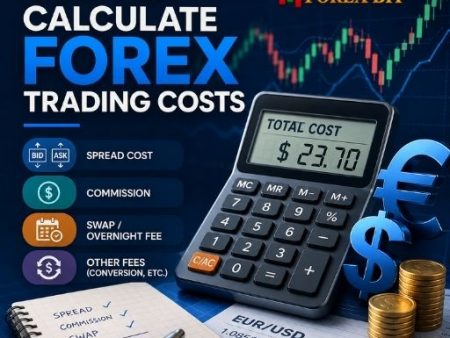
Traders minimize unexpected costs by calculating total round-turn expenses per lot, monitoring swap charges on overnight positions, and confirming deposit or withdrawal fees before funding an account. Setting alerts for inactivity periods and reading currency conversion terms further reduces exposure to charges that accumulate silently over time.
Forex Bit breaks down these overlooked charges in detail, starting with a clear definition of what qualifies as a hidden forex broker fee.
What Are Hidden Forex Broker Fees?
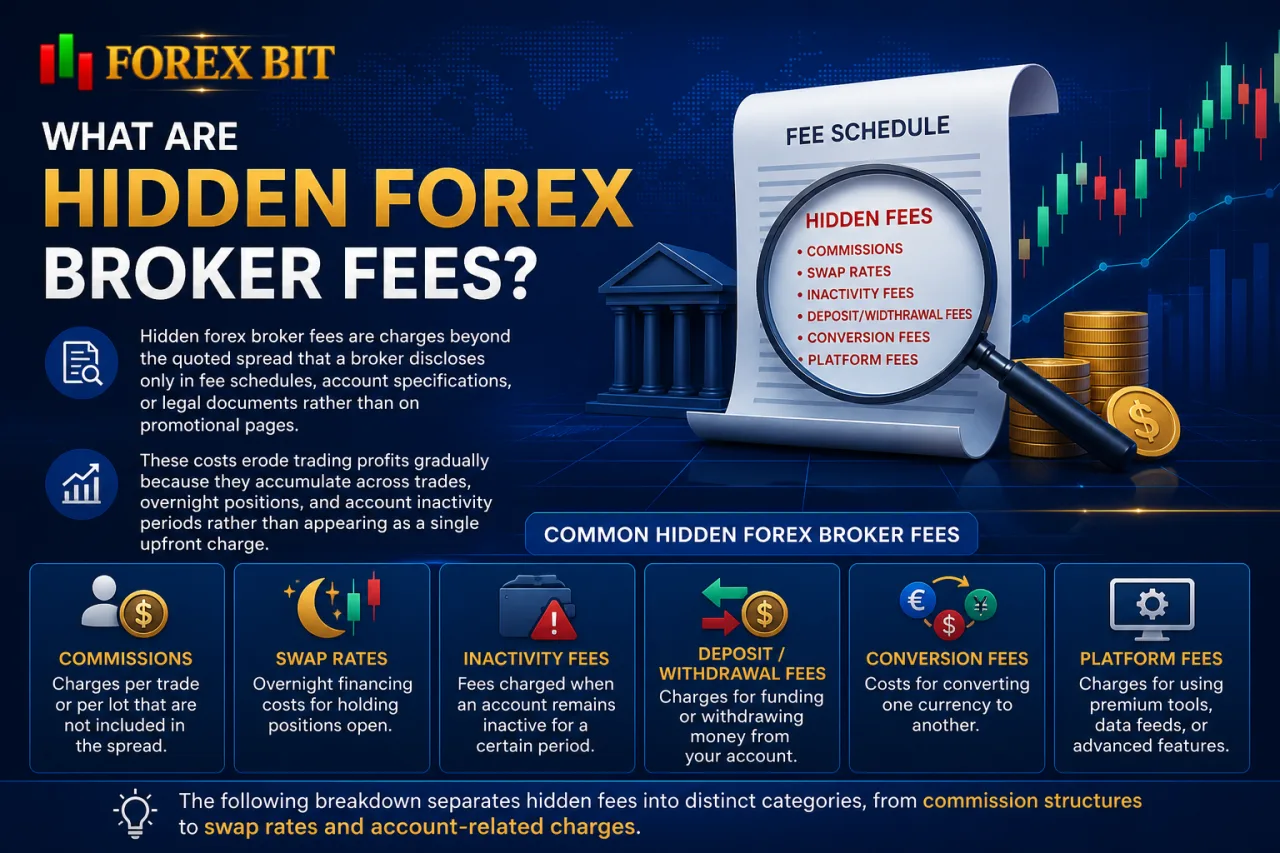
Hidden forex broker fees are charges beyond the quoted spread that a broker discloses only in fee schedules, account specifications, or legal documents rather than on promotional pages. These costs erode trading profits gradually because they accumulate across trades, overnight positions, and account inactivity periods rather than appearing as a single upfront charge. The following breakdown separates hidden fees into distinct categories, from commission structures to swap rates and account-related charges, to clarify where each cost originates and how it affects overall trading expenses.
Are Hidden Fees Legal or Just Poorly Disclosed?
Most hidden forex broker fees are legal, since regulators require disclosure in fee schedules and legal documents rather than mandating that every cost appear on marketing pages. This transparency requirement shifts responsibility onto the trader to locate the information rather than banning brokers from charging it.
The question of legality versus poor disclosure resolves into a distinction between placement and prohibition. A broker publishing swap rates or inactivity charges only within a PDF fee schedule or terms and conditions document satisfies most regulatory disclosure obligations even though the homepage never mentions those costs. Regulators overseeing licensed brokers typically require that fee information exist somewhere in official documentation, not that it appear prominently in advertising.
Regulatory frameworks in major jurisdictions generally require brokers to disclose trading costs within official account documentation rather than in promotional materials. Three factors separate legal-but-buried fees from actual violations:
- Documented charges appearing anywhere in official broker materials satisfy disclosure rules.
- Undisclosed charges absent from all legal documents constitute a compliance failure.
- Misleading advertising claiming “zero fees” while omitting commission or swap costs crosses into deceptive practice rather than simple non-disclosure.
Traders reduce exposure to buried costs by reading the fee schedule and account specifications directly, rather than assuming the absence of a fee mention on the homepage means the absence of the fee itself.
What Types of Hidden Fees Do Forex Brokers Charge?
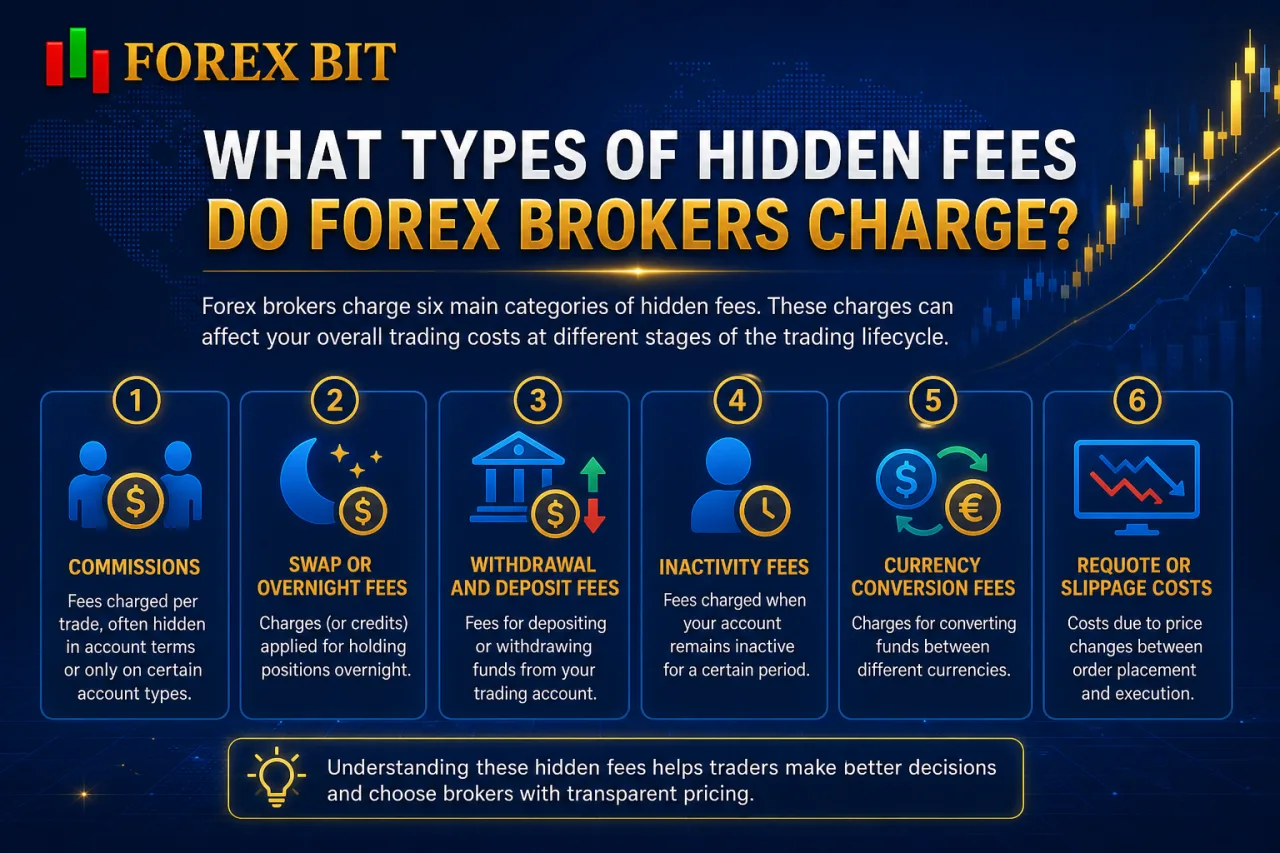
Forex brokers charge six main categories of hidden fees: commissions, swap or overnight fees, withdrawal and deposit fees, inactivity fees, currency conversion fees, and requote or slippage costs. These categories cover charges that apply at different stages of the trading lifecycle, from opening a position to holding it overnight, moving funds, or leaving an account dormant. Each category originates from a different part of a broker’s cost structure, which the following breakdown separates individually.
Requote and slippage costs belong to this list as a distinct hidden cost, separate from swap or commission charges. A requote occurs when a broker rejects the requested price and offers a new one at the moment of execution, while slippage refers to the difference between the expected entry or exit price and the price at which the trade actually fills. Both situations shift the effective cost of a trade away from the price a trader initially sees on the platform, often during periods of fast price movement or low liquidity. Traders rarely notice this cost as a separate line item because it does not appear on a statement the way a commission or swap charge does, yet it directly affects the net result of a position.
What Are Commission Fees Beyond the Spread?
Commission fees beyond the spread are fixed per-lot charges that raw or ECN accounts apply on top of a narrower spread.
This pricing model splits the total trading cost into two visible components rather than folding everything into the spread. On a raw account, a broker might quote EUR/USD at 0.1 pips but charge a separate commission per side, so the round-turn cost combines both figures into the real expense. Traders comparing brokers on spread alone frequently overlook this structure because a 0.0 pip headline spread looks cheaper than a standard account’s 1.0 pip spread, even though the commission-inclusive total often lands close to or higher than the all-in spread price. Standard accounts avoid a separate commission line item entirely, embedding the equivalent cost into a wider spread instead.
The oversight typically happens because promotional pages emphasize the raw spread number without displaying the commission table alongside it, requiring traders to check the account specifications or fee schedule separately to calculate the true round-turn cost.
What Are Swap or Overnight Fees?
Swap or overnight fees are charges a broker applies when a position stays open past a specific daily cutoff time, reflecting the interest rate differential between the two currencies in a pair. The broker credits or debits an account each night a trade remains active, separate from the spread or commission already paid at entry.
This charge directly affects the overnight or rollover cost every open position accumulates beyond the trading day it was placed.
Three factors determine the size of a swap charge:
- Interest rate differentials between the base and quote currency set the direction and baseline size of the swap.
- Position direction (long or short) determines whether the account receives or pays the swap on a given pair.
- Broker-specific markups added to the interbank rate widen the swap beyond the raw interest rate differential. Many brokers add a markup to the base interest rate differential when calculating the swap charged to client accounts.
Carry trades and long-term positions accumulate these charges across many overnight periods, so the total swap cost compounds over weeks or months even when the spread and commission paid at entry remain fixed.
Many brokers also apply a triple swap charge on one specific weekday to account for weekend settlement, though the exact day varies by broker.
What Are Deposit, Withdrawal, and Inactivity Fees?
Deposit, withdrawal, and inactivity fees are non-trading charges brokers apply for moving funds or holding a dormant account, separate from spread and commission costs tied to executing trades. These charges surface on the fee schedule rather than the trading conditions page, so they escape notice until a trader initiates a withdrawal or leaves an account untouched for an extended period.
Withdrawal processing fees typically apply per transaction and vary by payment method, with bank wire transfers often carrying a fixed charge while e-wallet withdrawals sometimes process free of cost. Some brokers set a minimum withdrawal threshold below which a request either gets rejected or incurs an additional processing charge.
Deposit fees appear less frequently than withdrawal fees, though certain payment processors or card networks pass a percentage-based charge onto the trader rather than the broker absorbing it.
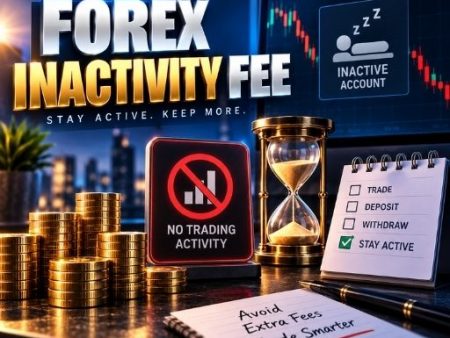
Inactivity fees activate after an account remains dormant, meaning no trades, deposits, or withdrawals occur, for a period defined in the account terms. Brokers typically deduct inactivity fees directly from the account balance on a recurring basis until the account reactivates or the balance reaches zero.
What Is a Currency Conversion Fee?
A currency conversion fee is a markup a broker applies when the account’s base currency differs from the currency of a deposit, withdrawal, or traded instrument. This charge exists separately from spread, commission, and swap costs already covered, tying instead to the exchange rate conversion itself.
The fee applies at conversion points rather than at trade execution, so it surfaces on statements as a rate difference rather than a labeled line item.
- Depositing funds in a currency other than the account base currency triggers a conversion charge at the broker’s exchange rate.
- Trading an instrument denominated in a currency different from the account base currency applies a conversion markup to profit and loss calculations.
- Withdrawing funds back to a bank account holding a different currency incurs a second conversion charge on the way out.
Brokers typically add a markup above the interbank exchange rate when converting currencies on deposits, withdrawals, or cross-currency trades.
Traders holding an account in a currency matching their primary trading pairs and funding source avoid this markup entirely, since no conversion occurs when currencies already align.
How Can Traders Identify Hidden Fees Before Opening an Account?
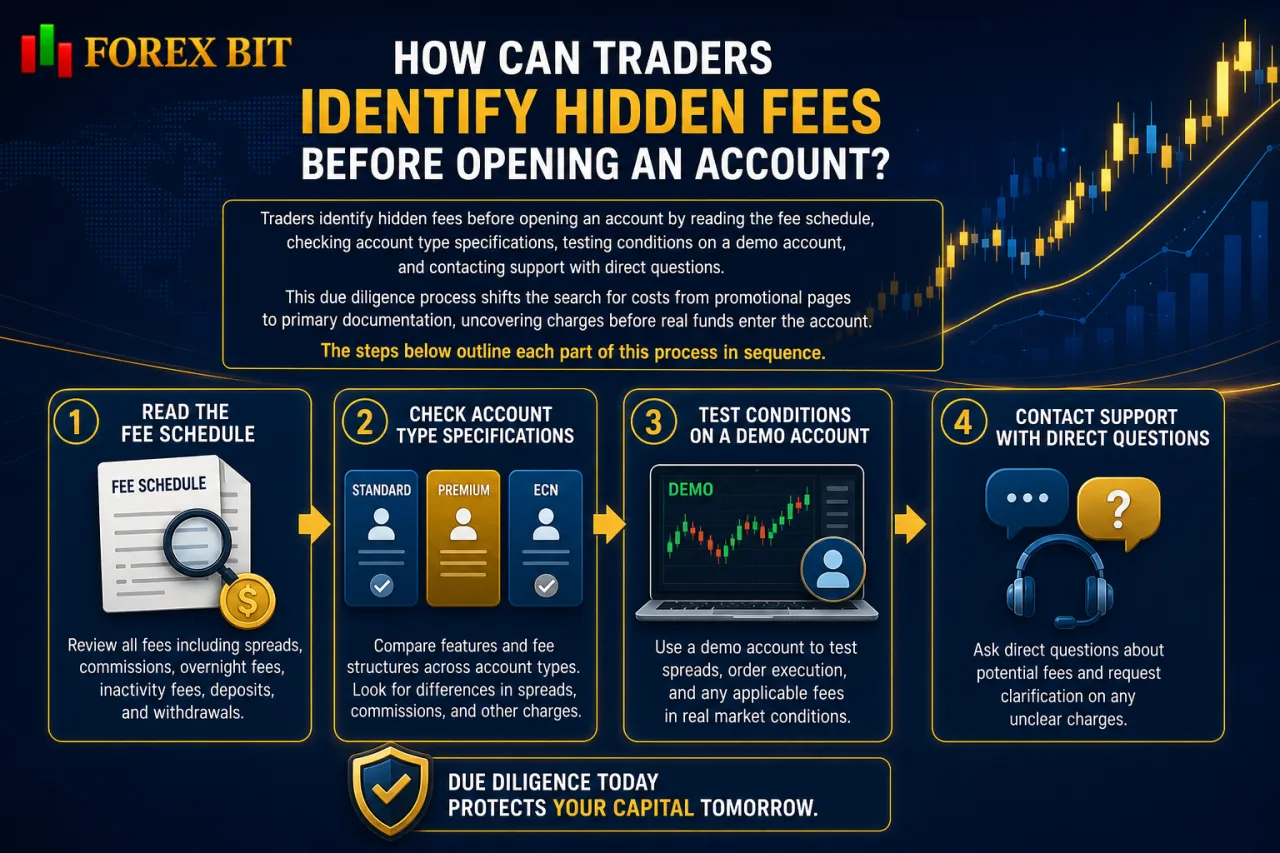
Traders identify hidden fees before opening an account by reading the fee schedule, checking account type specifications, testing conditions on a demo account, and contacting support with direct questions. This due diligence process shifts the search for costs from promotional pages to primary documentation, uncovering charges before real funds enter the account. The steps below outline each part of this process in sequence.
Where Should Traders Look on a Broker’s Website to Find Fee Details?
Traders locate fee details on four specific pages: the account types page, legal or Key Information Document (KID) files, the trading conditions page, and downloadable PDF fee schedules. Each of these sections carries a distinct piece of the cost picture, so checking one alone leaves gaps in the total expense calculation.
The account types page typically lists spread ranges and commission structures side by side for each account, revealing whether a broker charges a fixed fee per lot or embeds costs into the spread. Legal or KID documents disclose swap rates, conversion markups, and risk warnings in the format regulators require, often in more precise language than marketing copy. The trading conditions page usually consolidates execution details, minimum deposits, and leverage limits, giving context to how spreads behave under different market conditions. PDF fee schedules, when available, list withdrawal charges, inactivity fee triggers, and per-instrument commission tables in a single reference document.
- Checking the account types page for spread and commission breakdowns.
- Reading legal or KID documents for swap and conversion disclosures.
- Reviewing trading conditions for execution and leverage details.
- Downloading the PDF fee schedule for withdrawal and inactivity charges.
How Do Fee Structures Compare Between Different Account Types?
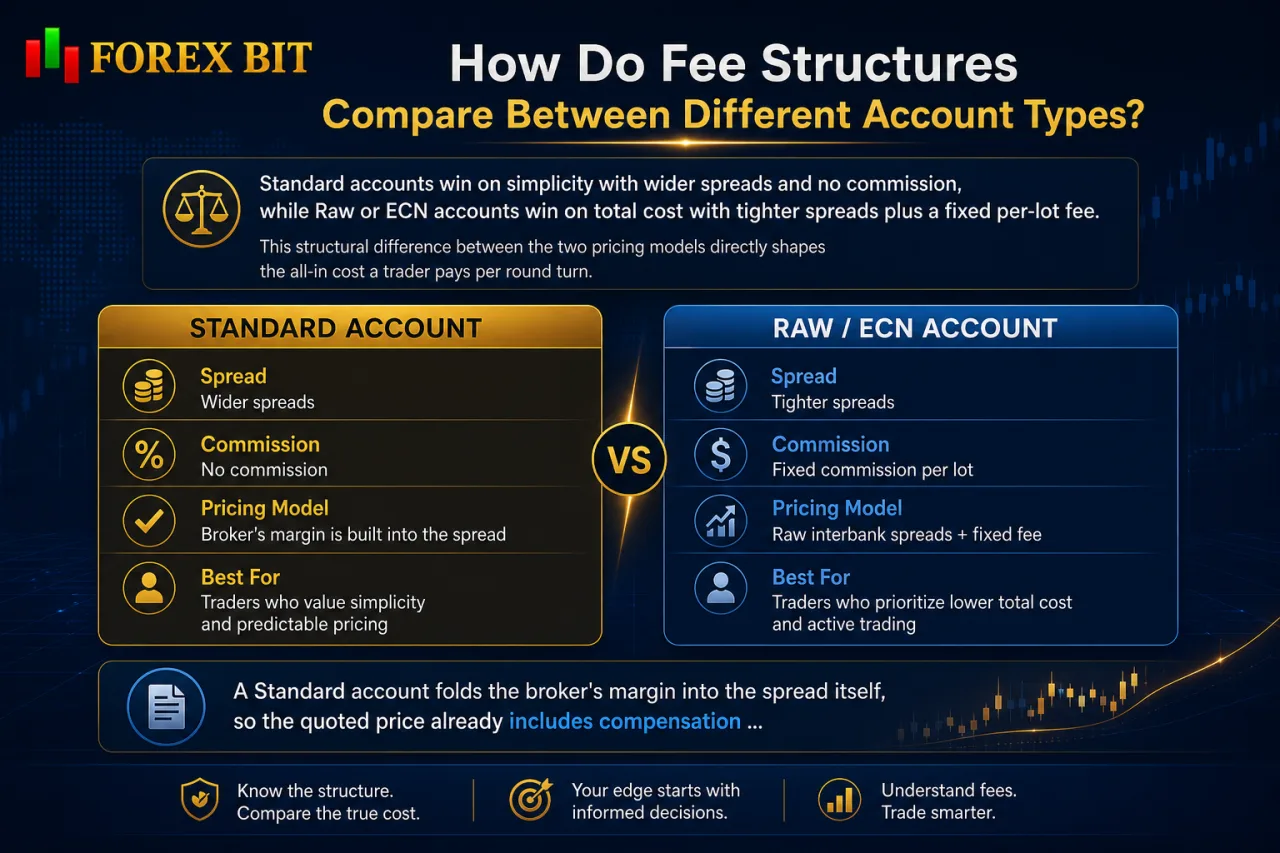
Standard accounts win on simplicity with wider spreads and no commission, while Raw or ECN accounts win on total cost with tighter spreads plus a fixed per-lot fee. This structural difference between the two pricing models directly shapes the all-in cost a trader pays per round turn, covered next through spread behavior, commission application, and a worked example on EUR/USD.
A Standard account folds the broker’s margin into the spread itself, so the quoted price already includes compensation for execution, meaning no separate fee appears on the trade confirmation. A Raw or ECN account strips that margin out of the spread, publishing a near-interbank price, then adds a fixed commission charged per lot traded to recover the cost separately. Raw or ECN commissions typically apply per lot per side, so a round-turn trade incurs the charge twice.
|
Account Type |
Typical EUR/USD Spread | Commission | Estimated Cost on 1 Standard Lot |
|
Standard |
Wider spread, no separate fee | None | Spread cost only |
| Raw/ECN | Near-zero spread | Fixed fee per lot, round turn |
Spread cost plus commission |
The comparison shows cost location shifting rather than disappearing, since a lower spread on Raw accounts offsets against the added commission line.
Standard Account vs Raw/ECN Account: Which Has Lower Total Trading Cost?
Raw or ECN accounts typically produce a lower total cost than Standard accounts at higher trade volumes, once the commission is added back to the near-zero spread. This cost comparison depends on how the two pricing models allocate the same underlying cost between spread and commission, illustrated below with a numeric breakdown on a single lot of EUR/USD.
A Standard account charges no separate commission, so the spread-only cost represents the full round-turn expense on a trade, with the dollar cost depending on the spread size and lot volume traded.
A Raw or ECN account charges spread plus commission, so the round-turn cost sums the near-zero spread cost with the fixed per-lot fee applied twice on entry and exit, with the exact figures varying by broker.
At low trade frequency, the difference between the two totals often stays marginal, since both models converge toward a similar all-in figure once commission is factored against the wider Standard spread. At higher volumes, the fixed commission on Raw accounts scales linearly per lot while the spread-based cost on Standard accounts scales with spread width, so traders executing larger or more frequent lot sizes generally see the Raw structure pull ahead on total cost. Traders placing few trades per month sometimes offset this advantage through the simplicity of a single spread-only figure on a Standard account.
How Can Traders Avoid or Minimize Hidden Trading Costs?
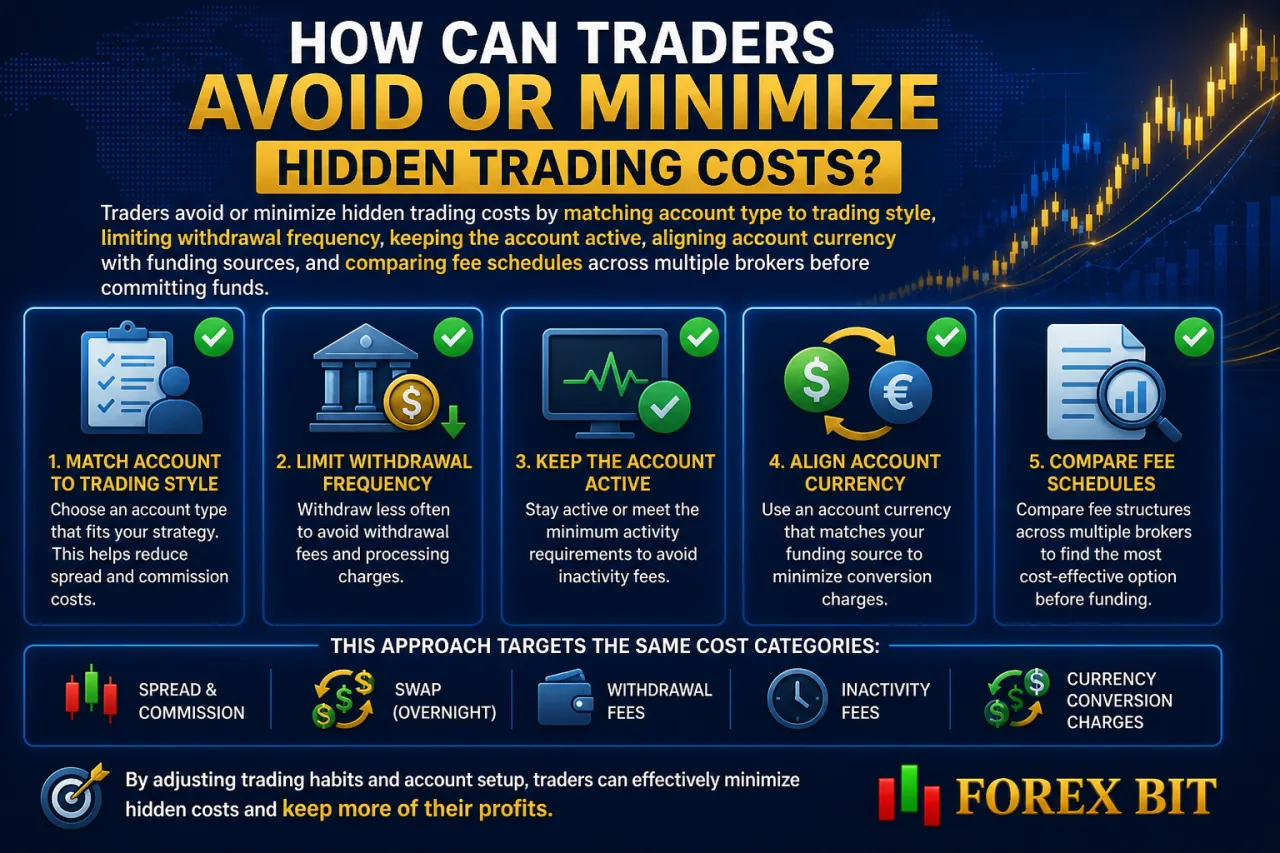
Traders avoid or minimize hidden trading costs by matching account type to trading style, limiting withdrawal frequency, keeping the account active, aligning account currency with funding sources, and comparing fee schedules across multiple brokers before committing funds.
This approach targets the same cost categories already outlined, spread and commission, swap, withdrawal, inactivity, and currency conversion charges, by adjusting trading habits and account setup rather than negotiating with a broker directly.
- Selecting a Raw or ECN account for high-frequency strategies and a Standard account for occasional trading reduces the mismatch between spread-commission structure and actual trading volume.
- Consolidating withdrawals into fewer, larger transactions cuts the number of times a fixed withdrawal fee applies.
- Placing at least one trade or transaction within the inactivity window defined in the account terms prevents recurring dormancy charges from deducting the account balance.
- Opening an account denominated in the currency matching the primary deposit source and traded instruments removes the conversion markup applied on mismatched currencies.
- Comparing fee schedules, spread tables, and commission structures across several brokers before opening an account surfaces cost differences that a single broker’s promotional page does not reveal.
Traders running frequent scalping strategies benefit most from the account-matching and comparison steps, while long-term position holders gain more from monitoring swap rates and withdrawal consolidation.
How Transparent Are Forex Brokers Required to Be About Fee Disclosure?
Yes, forex brokers face mandatory fee disclosure requirements. However, the depth and format of that disclosure varies by regulatory jurisdiction. This transparency obligation ties directly into the disclosure gaps traders already navigate when checking fee schedules, legal documents, and account specifications rather than promotional pages.
Regulatory frameworks generally mandate that brokers publish cost information somewhere in official documentation, but the specific document format and level of detail required differs between regulators. The European Securities and Markets Authority (ESMA) framework requires brokers to provide a Key Information Document (KID) outlining costs, risks, and past performance scenarios for retail clients, as part of broader EU rules on transparent disclosure for retail investment products. The UK Financial Conduct Authority (FCA) similarly requires authorized firms to disclose trading costs and charges to clients under its regulatory framework. In Australia, brokers licensed by the Australian Securities and Investments Commission (ASIC) are generally required to provide a Product Disclosure Statement (PDS) that outlines fees and other key terms for CFD and forex products.
Disclosure quality still varies across these jurisdictions and beyond, covered next through the specific differences between regulated brokers.
What Is a Key Information Document (KID) and Why Does It Matter for Fee Transparency?
A Key Information Document (KID) is a standardized pre-contractual disclosure file that EU-regulated brokers issue for CFD and forex products, summarizing total costs, risks, and performance scenarios in a fixed format, as required under the European Securities and Markets Authority (ESMA) framework on transparent disclosure for retail investment products.
This document ties directly into fee transparency because it forces a broker to state the total cost of trading in a single, comparable section rather than scattering figures across separate spread tables, commission schedules, and swap disclosures. The cost section of a KID typically expresses charges as a percentage or monetary impact on a sample investment over a defined holding period, which lets a trader see the combined effect of spread, commission, and overnight financing in one figure instead of calculating each component manually.
Traders use the KID to spot hidden charges by comparing its stated total cost figure against the broker’s advertised spread, since a gap between the two often signals commission, swap, or conversion fees not obvious in marketing pages. Because regulators standardize the KID format, traders also cross-check the same document across multiple brokers to compare total cost figures on equivalent terms.
Do Offshore-Regulated Brokers Disclose Fees Differently Than Onshore Brokers?
Yes, offshore-regulated brokers disclose fees differently than onshore brokers, since jurisdictions like St. Vincent and the Grenadines or Seychelles impose lighter documentation requirements than the EU, UK, or Australia. This gap in disclosure standards ties directly into the KID and PDS requirements already covered for onshore regulators.
Tightly regulated jurisdictions mandate standardized cost documents, the KID under ESMA rules, similar disclosure obligations under the FCA, and the PDS under ASIC, each forcing brokers to present total cost figures in a fixed, comparable format. Offshore regulators in jurisdictions such as St. Vincent and the Grenadines or Seychelles generally impose less standardized disclosure requirements for trading costs compared to EU, UK, or Australian frameworks.
Three differences separate the two disclosure environments:
- Standardized cost documents like the KID or PDS remain mandatory onshore but absent or optional offshore.
- Enforcement mechanisms compelling accurate fee reporting operate more consistently under EU, UK, and Australian regulators than offshore bodies.
- Fee schedules published by offshore entities often carry less independent verification, increasing reliance on the trader’s own document review.
Traders opening accounts with offshore-regulated entities check fee schedules and legal terms with added scrutiny, since the standardized comparison tools available onshore rarely exist in the same form under lighter offshore oversight.
Conclusion
Hidden forex broker costs sit beyond the advertised spread, spanning commissions, swap rates, withdrawal and inactivity charges, and currency conversion markups, each buried in fee schedules and legal documents rather than promotional pages. Locating these charges requires reading account specifications, KID or PDS filings, and PDF fee tables directly, then weighing spread against commission across Standard and Raw/ECN structures instead of trusting a single headline number.
Matching account type to trading frequency, consolidating withdrawals, keeping accounts active, and aligning account currency with funding sources closes most of the gap between quoted pricing and actual cost. Onshore-regulated brokers standardize this disclosure more consistently than offshore entities, making document-level verification the deciding factor traders rely on.
Isabella Brown is the Forex Trading Guide Manager at Forex Bit, focusing on educational content about broker safety, trading costs, account types, platforms, and key Forex/CFD concepts. Her work helps readers understand trading terms, broker conditions, and practical checks before evaluating or using a brokerage service.
Email: [email protected]

Best Brokers

Trade with the world’s largest retail broker and benefit from better - than - market conditions.

We offer a superior trading environment that puts traders in the best position to profit.

Trade with the best trading conditions. WIN THE BEST TRADING ACCOUNT AWARD.

Trade global markets with Interactive Brokers – a highly regulated multi-asset broker built for active and professional investors.






Forex Bit provides independent forex broker reviews, comparisons, guides, and industry news to help traders make informed decisions.
Best Brokers
Metatrader 5 Brokers
Metatrader 4 Brokers
Lowest Spread Forex Broker
Regulated Forex Brokers
Forex Copy Trading
Ctrader Brokers
Best Forex Broker For Beginners