









A forex trading account is a brokerage account that lets traders buy and sell currency pairs using a specific pricing model, leverage limit, and minimum deposit set by the broker. Different account types exist to match varying trading styles, capital levels, and cost preferences.
Forex brokers typically offer several account categories, including standard, ECN, STP, and cent accounts, each with distinct spreads, commissions, and execution models. These variations affect how orders are filled and how much traders pay per trade.
Minimum deposits, leverage ratios, and lot sizes differ across account types, directly shaping the amount of capital required and the risk exposure per trade. Some accounts allow micro or nano lots, while others require standard lot trading only.
Demo accounts let traders practise with virtual funds under real market conditions, while Islamic accounts remove overnight swap charges to comply with Sharia principles. Both options address specific trader needs rather than general profitability.
Opening a forex account generally requires identity verification, proof of address, and acceptance of the broker’s pricing model, whether spread-based, commission-based, or a hybrid structure. These requirements apply regardless of the account type selected.
Forex Bit breaks down these account structures in detail below, starting with a clear explanation of what forex trading accounts actually are before comparing account types and choosing criteria.
What Are Forex Trading Accounts?

A forex trading account is a brokerage account that links a trader’s capital to the broker’s trading infrastructure, enabling execution of buy and sell orders on currency pairs and other markets. It functions as the operational bridge between a trader and the wider forex market.
This account structure determines the terms under which every trade takes place, not just the ability to place one. The broker holds and processes the funds, applies the agreed pricing model, and enforces the leverage and margin rules tied to the account. Account structure matters before trading because it fixes the cost base, execution style, and risk parameters a trader operates under for every position opened afterward.
What Types of Forex Trading Accounts Are Available?
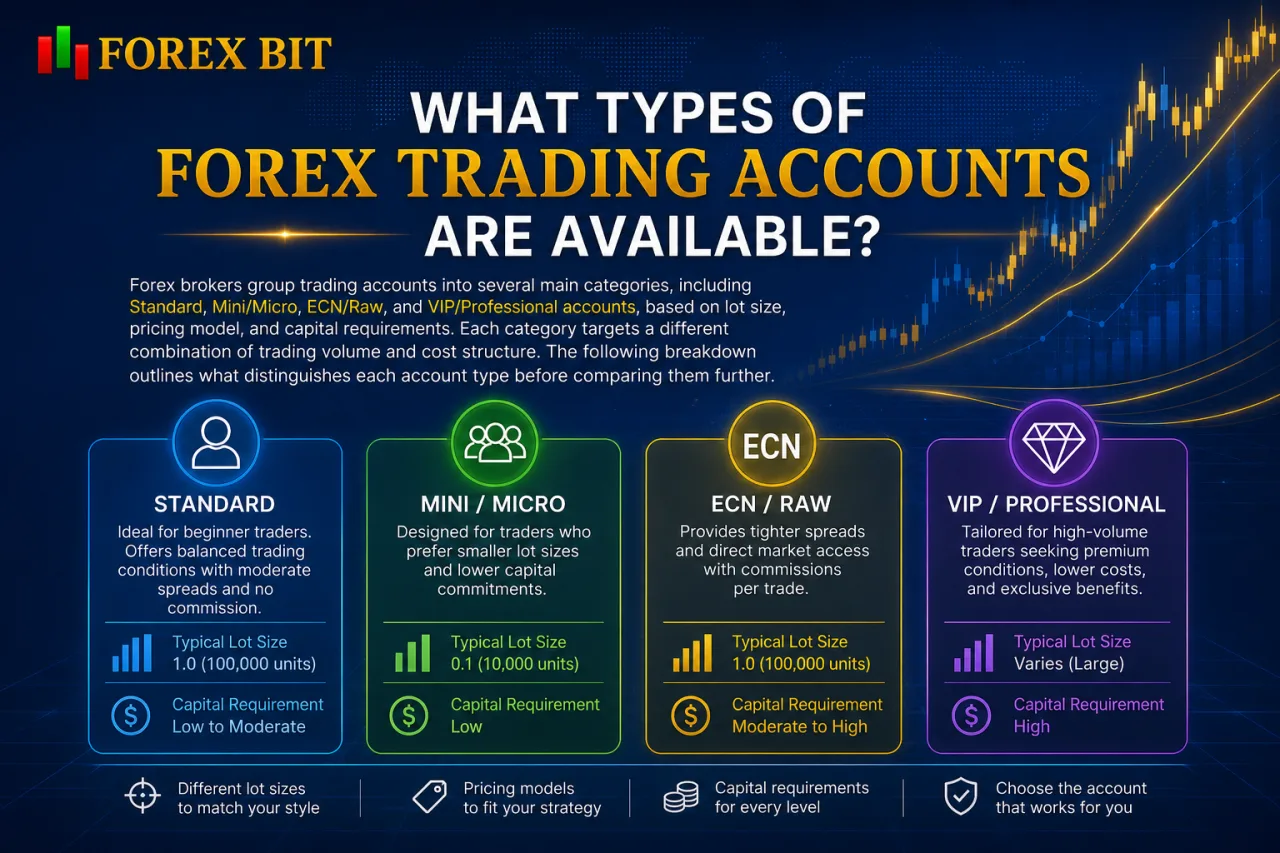
Forex brokers group trading accounts into several main categories, including Standard, Mini/Micro, ECN/Raw, and VIP/Professional accounts, based on lot size, pricing model, and capital requirements. Each category targets a different combination of trading volume and cost structure. The following breakdown outlines what distinguishes each account type before comparing them further.
How Do Standard, Mini, and ECN Accounts Compare?
Standard accounts suit moderate-capital traders with balanced spreads, Mini/Micro accounts fit smaller deposits with reduced lot sizes, and ECN/Raw accounts favor active traders through tighter spreads plus a separate commission. This comparison sets the pricing and execution differences these three account types carry.
Standard accounts typically price trades through the spread alone, with no added commission, and require a moderate minimum deposit relative to Mini/Micro options.
Mini/Micro accounts lower the entry barrier through smaller lot sizes, letting traders open positions with reduced capital while still trading standard currency pairs.
ECN/Raw accounts pass raw interbank pricing to the trader, narrowing the spread but adding a fixed commission per lot, a structure that suits high-frequency and volume-based strategies.
Trader profile follows this same split: newer or lower-capital traders lean toward Mini/Micro, cost-conscious general traders often pick Standard, and volume-focused or algorithmic traders gravitate toward ECN/Raw for its transparent execution model.
How Should You Choose the Right Forex Account Type?
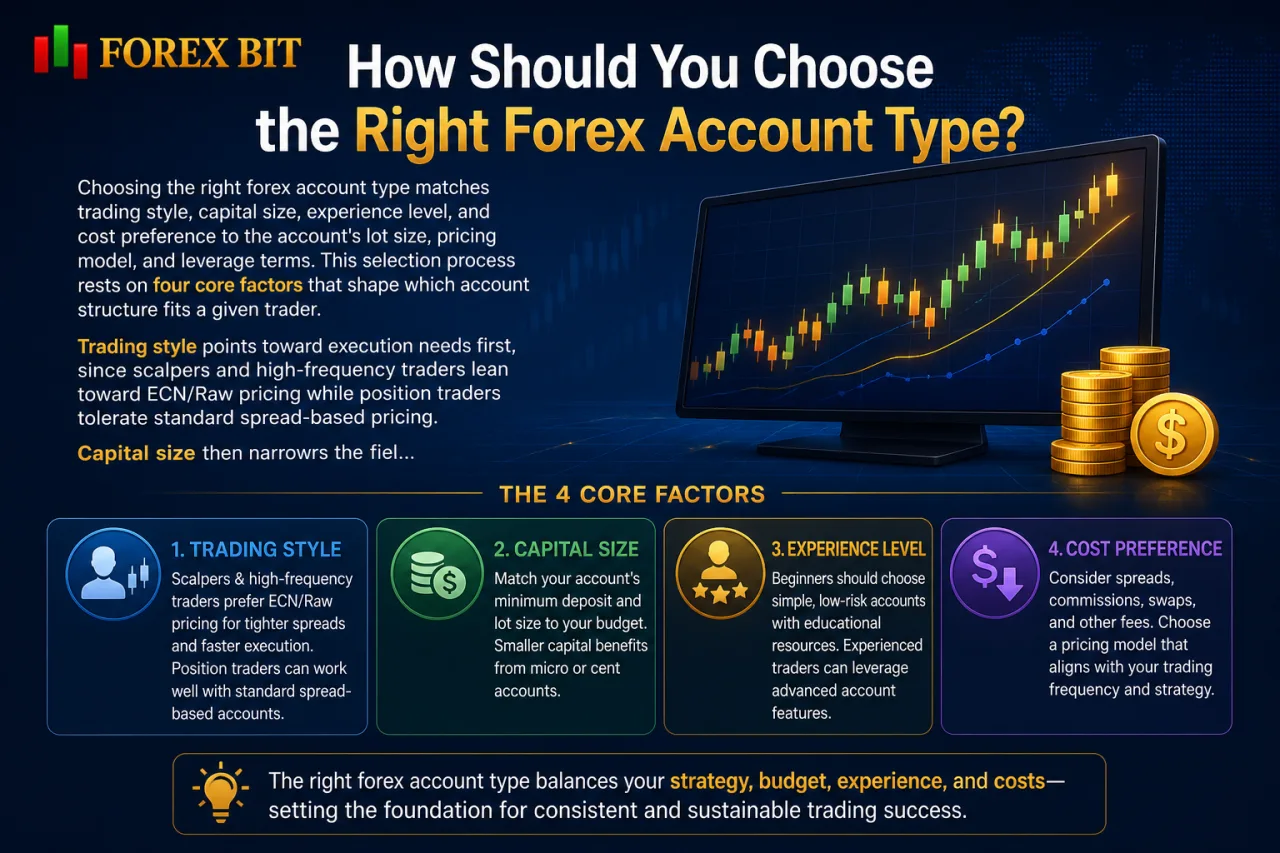
Choosing the right forex account type matches trading style, capital size, experience level, and cost preference to the account’s lot size, pricing model, and leverage terms. This selection process rests on four core factors that shape which account structure fits a given trader.
Trading style points toward execution needs first, since scalpers and high-frequency traders lean toward ECN/Raw pricing while position traders tolerate standard spread-based pricing. Capital size then narrows the field, as smaller deposits fit Mini/Micro accounts while larger balances support Standard or VIP/Professional tiers.
Experience level factors in separately from capital, since newer traders benefit from lower lot sizes and simpler cost structures regardless of deposit amount. Cost preference closes the decision, weighing a flat spread-only model against a raw spread plus commission structure based on expected trading frequency.
The following breakdown examines each of these four factors individually.
What Factors Should You Consider Before Opening an Account?
Opening a forex account rests on five key factors: trading strategy, risk tolerance, budget, instrument focus, and platform preference. Each factor narrows the account type before a broker application even starts.
Trading strategy determines execution needs, since scalping or high-frequency methods favor raw spread pricing while swing or position approaches tolerate spread-only models. Risk tolerance shapes leverage and margin choices, as lower tolerance pairs with conservative leverage ratios and smaller lot sizes.
Budget sets the minimum deposit threshold, directing traders with limited capital toward Mini/Micro tiers and larger balances toward Standard or VIP/Professional accounts. Instrument focus matters where a broker’s market range differs, since accounts built for forex pairs alone differ from accounts also covering indices, metals, or crypto.
Platform preference closes the list, as compatibility with MT4, MT5, or a broker’s proprietary platform affects order types, charting tools, and automation options available on the account. These five factors work together rather than in isolation, since a change in one, such as budget, often shifts what strategy or leverage level becomes practical.
What Are the Minimum Deposit Requirements Across Account Types?
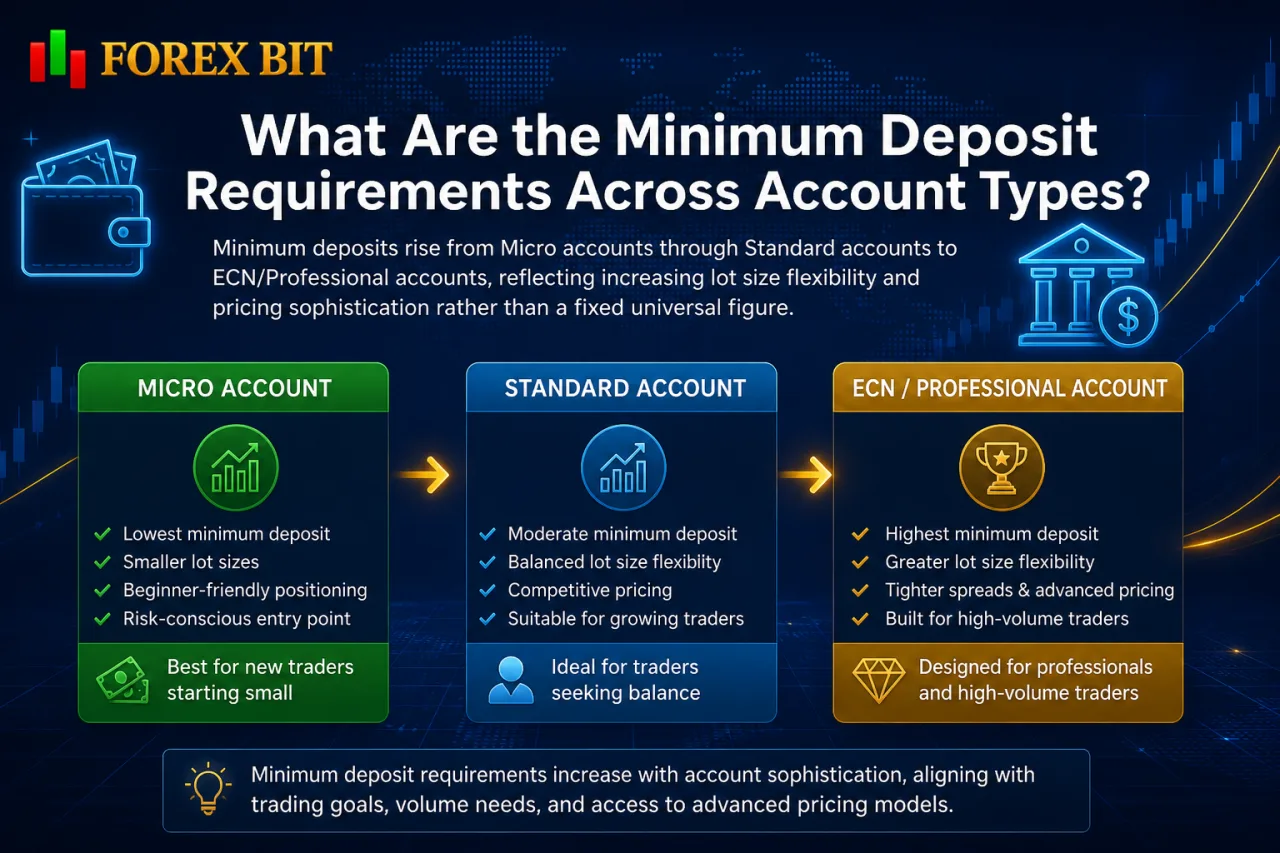
Minimum deposits rise from Micro accounts through Standard accounts to ECN/Professional accounts, reflecting increasing lot size flexibility and pricing sophistication rather than a fixed universal figure. This comparison follows directly from the account categories outlined above, since deposit size ties closely to the trading volume and pricing model each tier targets.
Micro accounts carry the lowest minimum deposit thresholds, matching their smaller lot sizes and beginner-oriented positioning. Standard accounts sit in the middle bracket, requiring a moderate deposit that aligns with spread-only pricing and full lot access. ECN/Professional accounts generally demand the highest minimum deposit, since raw spread pricing plus commission structures target traders operating larger or more frequent positions.
Exact minimum deposit figures vary by broker rather than following a fixed industry standard across Micro, Standard, and ECN tiers.
The underlying reason for this tiered structure rests on risk and cost alignment: brokers set lower deposit floors where lot sizes and leverage exposure stay small, and raise deposit floors where tighter spreads and commission-based pricing require a larger capital buffer to support consistent trading activity.
How Does Leverage Work Across Different Account Types?
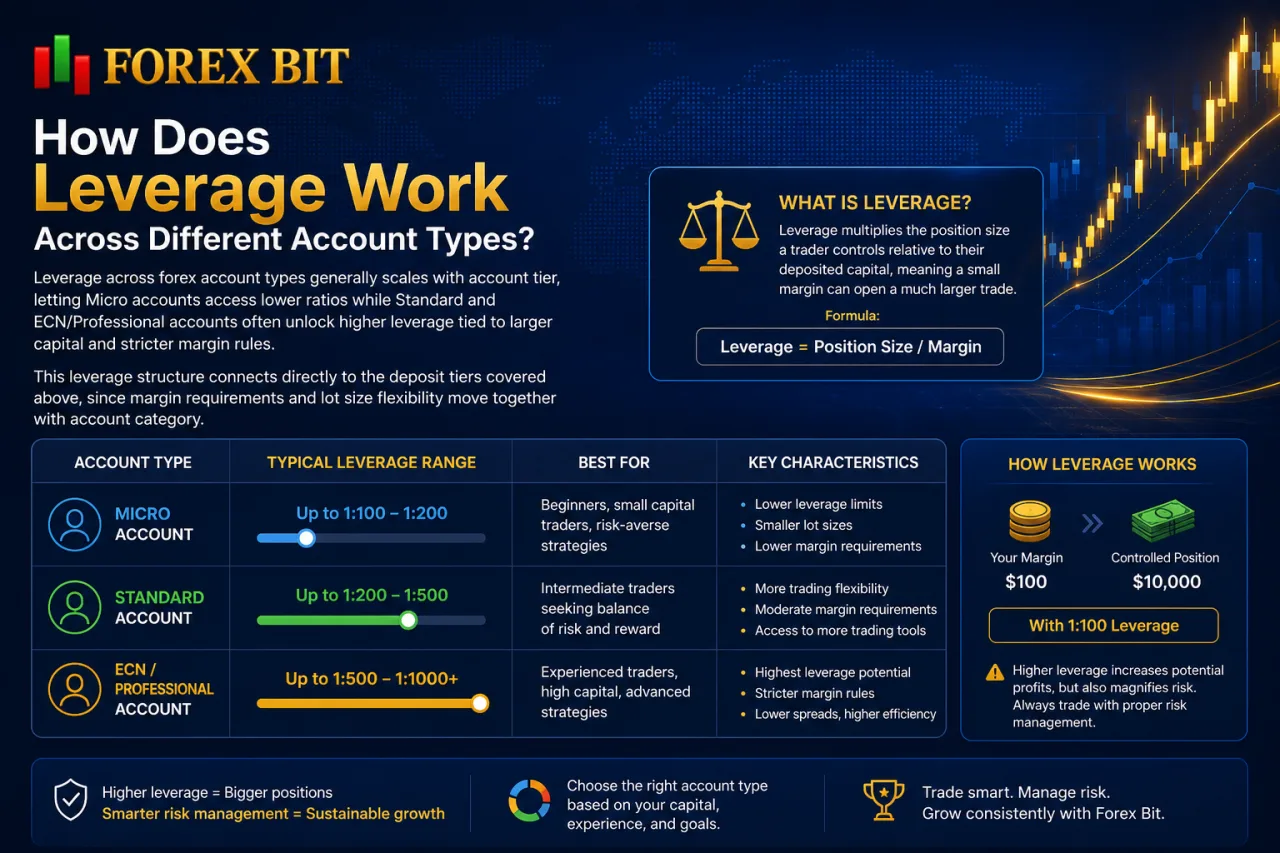
Leverage across forex account types generally scales with account tier, letting Micro accounts access lower ratios while Standard and ECN/Professional accounts often unlock higher leverage tied to larger capital and stricter margin rules. This leverage structure connects directly to the deposit tiers covered above, since margin requirements and lot size flexibility move together with account category.
Leverage multiplies the position size a trader controls relative to their deposited capital, magnifying both potential gains and potential losses on any given trade. Margin represents the portion of account balance a broker sets aside to hold that leveraged position open.
Higher leverage lowers the margin needed per trade, freeing capital for additional positions but increasing exposure if the market moves against the trade. Lower leverage raises the margin requirement per position, reducing exposure but limiting how much volume a given deposit supports.
Account type shapes this balance through its underlying risk profile: Micro accounts typically pair smaller lot sizes with conservative leverage caps suited to newer traders, while ECN/Professional accounts combine larger capital requirements with leverage terms calibrated for high-volume, commission-based trading.
What Are Lot Sizes and How Do They Vary by Account Type?
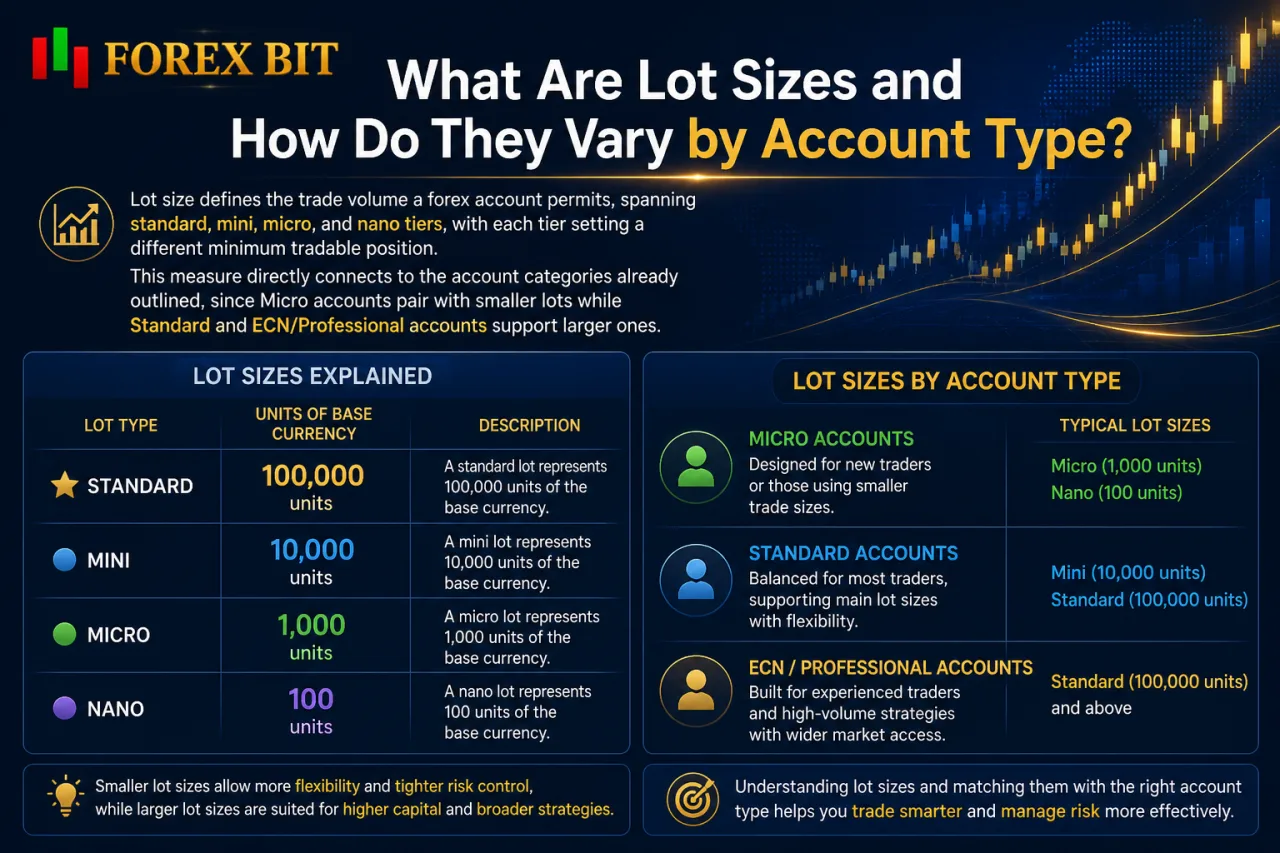
Lot size defines the trade volume a forex account permits, spanning standard, mini, micro, and nano tiers, with each tier setting a different minimum tradable position. This measure directly connects to the account categories already outlined, since Micro accounts pair with smaller lots while Standard and ECN/Professional accounts support larger ones.
A standard lot represents 100,000 units of the base currency, a mini lot represents 10,000 units, a micro lot represents 1,000 units, and a nano lot represents 100 units.
Account type ties directly to which of these units a broker allows as the minimum tradable volume:
- Standard accounts generally require standard or mini lot trading as the baseline unit.
- Mini/Micro accounts open access to mini, micro, and sometimes nano lots, lowering the capital needed per position.
- ECN/Raw and VIP/Professional accounts typically support the full lot range, including standard lots, given their larger capital base.
This tiered lot access mirrors the deposit and leverage structure covered earlier, since smaller lot sizes reduce the margin required per trade and keep exposure aligned with lower account balances.
What Is a Demo Account and How Does It Work?
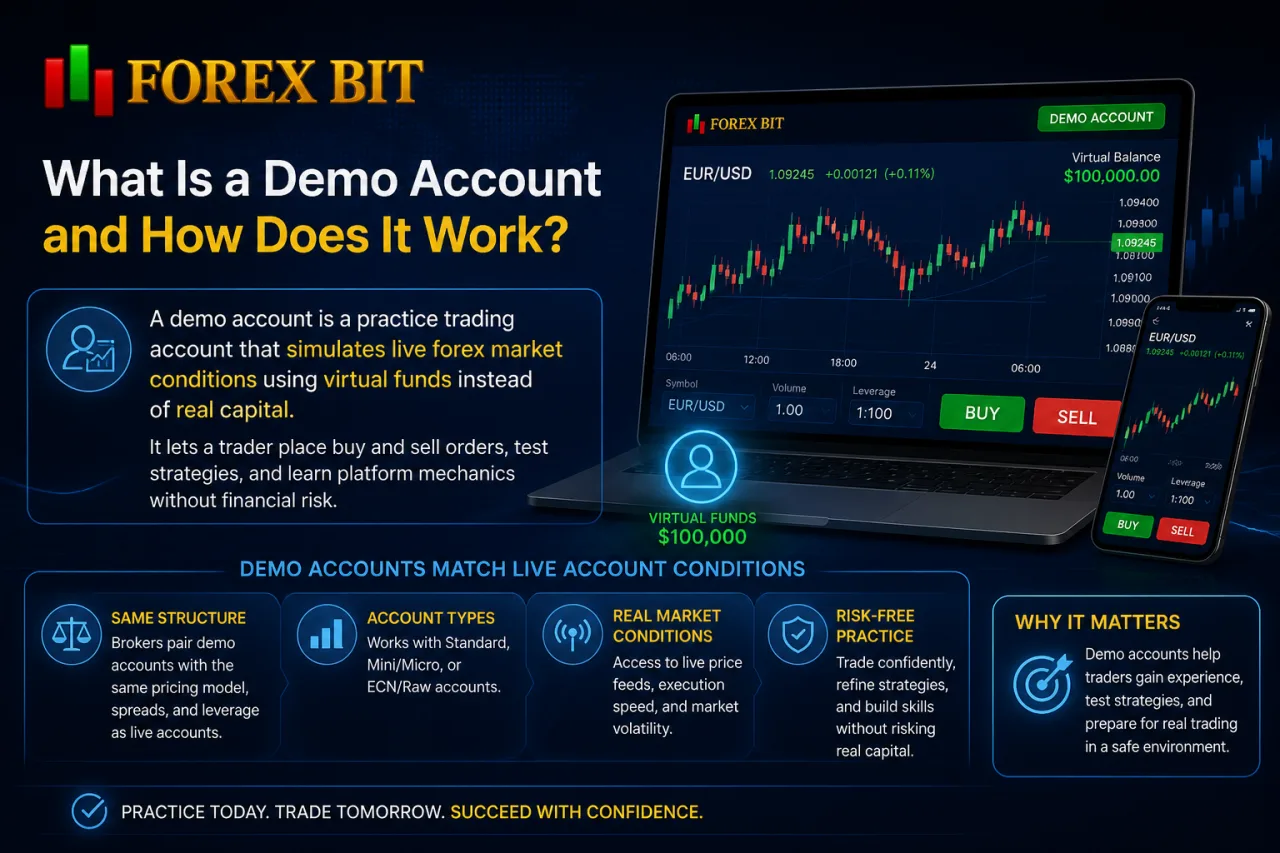
A demo account is a practice trading account that simulates live forex market conditions using virtual funds instead of real capital. It lets a trader place buy and sell orders, test strategies, and learn platform mechanics without financial risk.
This structure connects directly to the account types covered earlier, since brokers typically pair a demo account with the same pricing model, spreads, and leverage terms found on their live Standard, Mini/Micro, or ECN/Raw accounts. Price feeds, execution speed, and available instruments generally mirror live conditions, giving the trader a realistic preview of how a chosen account type behaves before committing deposited funds.
Broker demo accounts often run for a limited trial period before requiring renewal or conversion to a live account.
Demo accounts serve a narrow purpose within account selection: testing order execution, checking margin behavior under leverage, and comparing platform tools like MT4, MT5, or a broker’s proprietary interface before choosing a live account type.
What Is an Islamic (Swap-Free) Account?
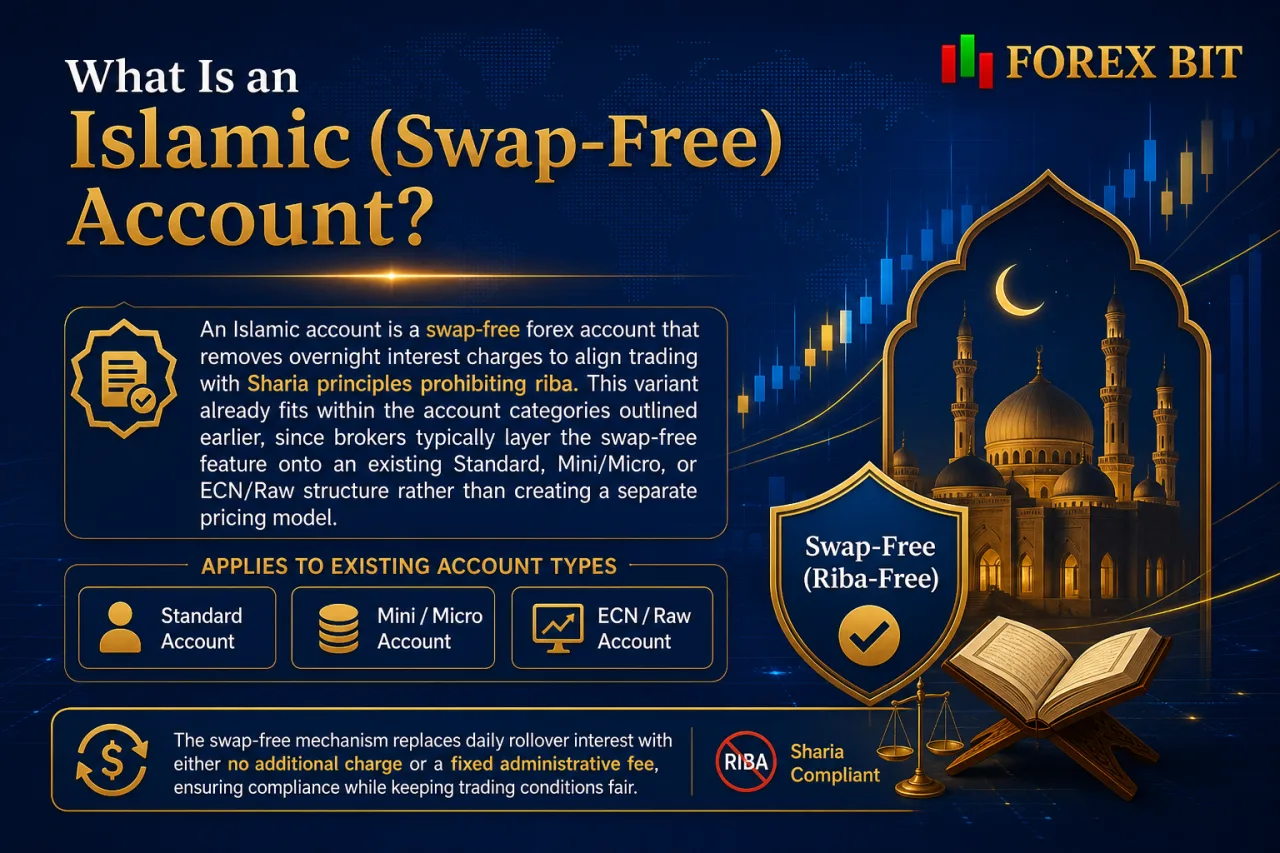
An Islamic account is a swap-free forex account that removes overnight interest charges to align trading with Sharia principles prohibiting riba. This variant already fits within the account categories outlined earlier, since brokers typically layer the swap-free feature onto an existing Standard, Mini/Micro, or ECN/Raw structure rather than creating a separate pricing model.
The swap-free mechanism replaces daily rollover interest with either no additional charge or a fixed administrative fee, depending on the broker’s policy. This structure removes the interest component that standard accounts apply when a position stays open past the daily rollover cutoff.
Islamic accounts target traders who follow Sharia-compliant financial practices and need to hold positions overnight without incurring riba-based charges. Longer-term position traders and swing traders who keep trades open across multiple sessions also rely on this structure to avoid accumulating swap costs.
The core difference from a standard account lies in this rollover treatment alone. Spreads, commissions, leverage, and lot size generally mirror the underlying account type it modifies, meaning an Islamic version of an ECN account still carries a raw spread plus commission, just without the overnight swap charge.
How Do You Open a Forex Trading Account?
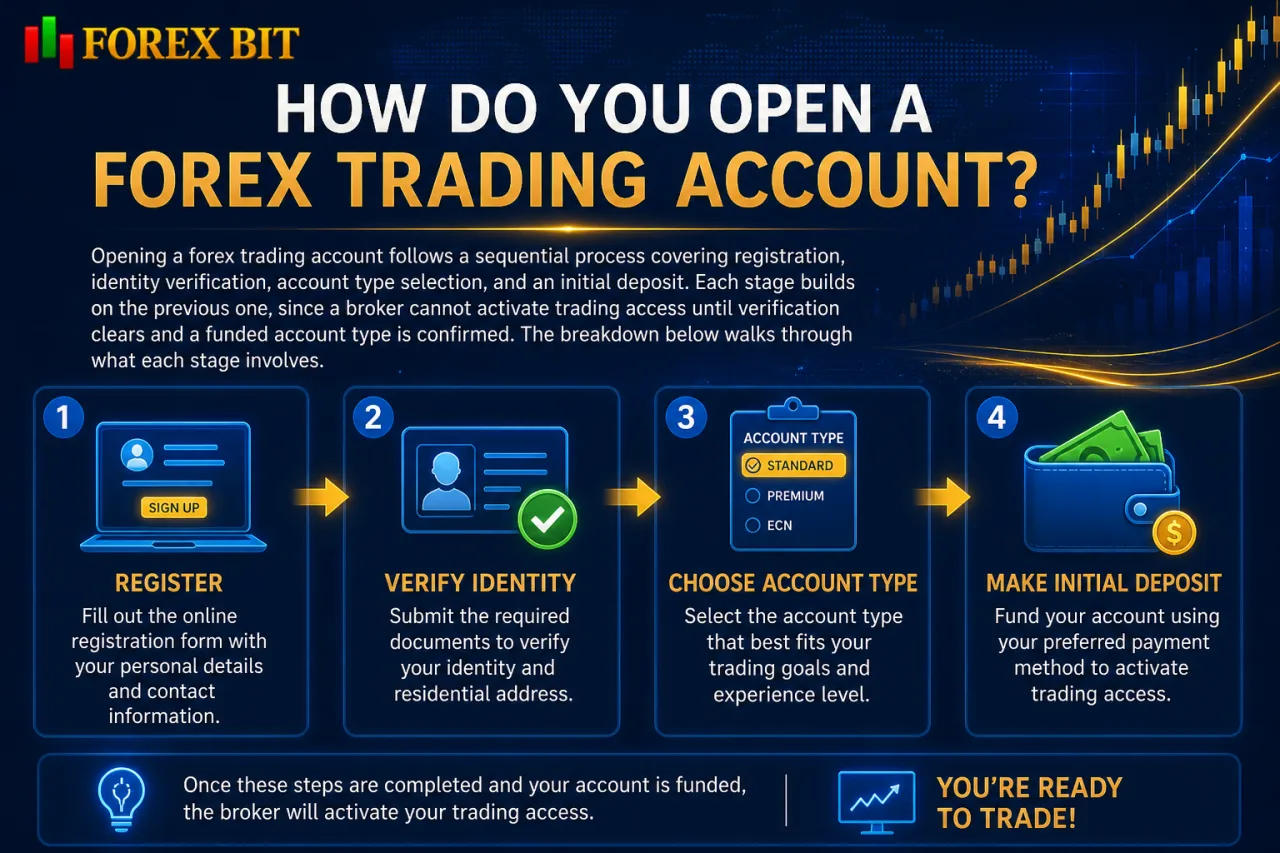
Opening a forex trading account follows a sequential process covering registration, identity verification, account type selection, and an initial deposit. Each stage builds on the previous one, since a broker cannot activate trading access until verification clears and a funded account type is confirmed. The breakdown below walks through what each stage involves.
What Documents and Information Are Required to Open an Account?
Opening a forex trading account requires four core elements: proof of identity, proof of address, personal and financial details, and completion of the broker’s verification process. This documentation list follows directly from the registration and verification stages outlined above, since a broker cannot activate an account until each item clears review.
Proof of identity typically means a passport, national ID card, or driver’s license that confirms the applicant’s legal name and date of birth. Proof of address usually takes the form of a recent utility bill, bank statement, or government correspondence showing the applicant’s current residential address.
Personal and financial details cover contact information, employment status, income range, and trading experience, which brokers collect to assess suitability and set account defaults. Verification steps close the process, as the broker cross-checks submitted documents against the provided details before releasing full trading access.
- Identity documents establish legal identity and age.
- Address documents confirm current residency.
- Financial details support suitability and risk assessment.
- Verification checks match documents against application data before account activation.
What Pricing Models Do Forex Accounts Use?
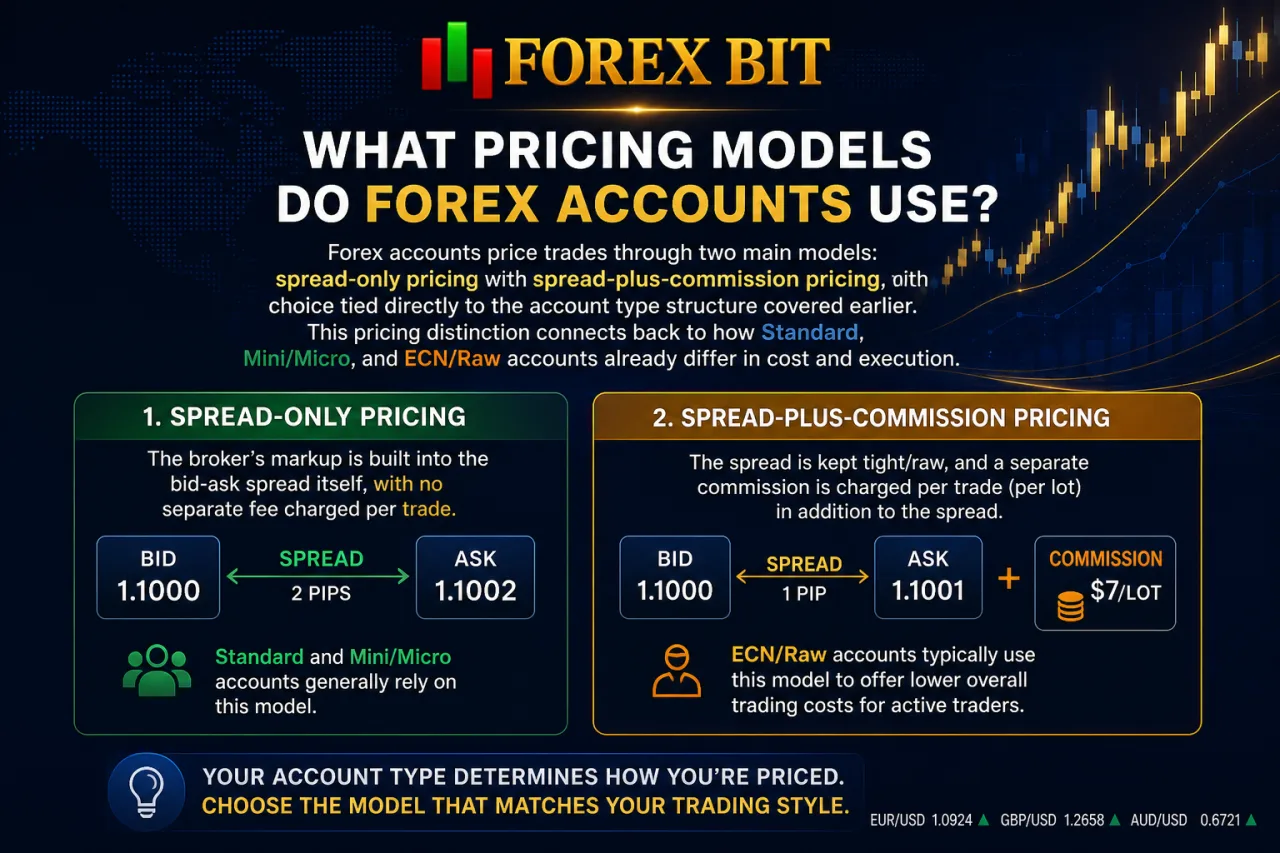
Forex accounts price trades through two main models: spread-only pricing and spread-plus-commission pricing, with the choice tied directly to the account type structure covered earlier. This pricing distinction connects back to how Standard, Mini/Micro, and ECN/Raw accounts already differ in cost and execution.
Spread-only pricing builds the broker’s markup into the bid-ask spread itself, with no separate fee charged per trade. Standard and Mini/Micro accounts generally rely on this model, keeping cost calculation simple since the spread alone reflects the total trading cost.
Spread-plus-commission pricing narrows the spread closer to raw interbank rates but adds a fixed commission per lot traded. ECN/Raw and VIP/Professional accounts typically apply this structure, since it suits traders running higher volume or frequency who benefit from tighter spreads despite the added commission line.
The underlying account category therefore dictates which pricing model applies by default, rather than pricing existing as a separate, freely mixed choice across every account tier.
What Other Account Conditions Should You Be Aware Of?
Forex trading accounts carry several less common conditions worth checking beyond lot size and leverage, including available base currencies, negative balance protection, and fund segregation practices. These conditions sit apart from the pricing and deposit factors already covered, since they touch account setup and fund safety rather than trade execution cost. The sections below break down each of these three conditions individually.
What Is a Base Currency and Why Does It Matter for Your Account?
A base currency is the currency a forex account holds and reports its balance, deposits, and profit or loss in, selected during account setup from a broker-approved list. This selection sits alongside the identity and financial details already covered during account opening, since brokers typically ask for base currency preference as part of that same application step.
Base currency matters because it determines whether a deposit or withdrawal in a different currency triggers a conversion fee before funds reach or leave the trading account. Matching the base currency to the currency a trader already holds, such as a home bank account currency, reduces the number of conversions needed at deposit and withdrawal stages.
Mismatched base currency also affects profit calculation, since gains and losses on non-base currency pairs get converted back into the account’s base currency at the broker’s applicable rate. This conversion step can add a small cost difference compared to trading pairs that already match the account’s base currency.
Do Forex Accounts Offer Negative Balance Protection?
Negative balance protection applies on many forex accounts, but availability depends on the broker’s regulatory jurisdiction rather than the account type itself. This safeguard resets a trader’s balance to zero after losses exceed deposited funds, instead of leaving the trader owing the broker money.
Regulated brokers operating under frameworks with retail client protection rules typically apply this feature automatically across Standard, Mini/Micro, and ECN/Raw accounts alike. Brokers licensed in jurisdictions without such mandates may offer negative balance protection only as an optional policy, or omit it entirely for certain account tiers. Some regulators impose negative balance protection as a mandatory requirement for retail accounts within their jurisdiction, though the specific rules and thresholds vary from one regulatory framework to another.
Traders confirm this protection by checking the account terms tied to the broker’s specific regulatory entity, since a single broker may register multiple entities across different jurisdictions with varying protection levels.
Conclusion
Forex account selection comes down to matching lot size, pricing model, and leverage terms to individual trading style, capital, and experience. Standard, Mini/Micro, and ECN/Raw structures each carry distinct deposit thresholds and cost profiles, while demo and Islamic variants address practice needs and Sharia compliance rather than general trading preference. Base currency choice, negative balance protection, and verification requirements round out the practical checklist alongside pricing model.
Weighing these factors together, rather than focusing on a single feature like spread size, points a trader toward the account tier that fits their strategy, budget, and risk tolerance most closely.