
Confused about forex margin? See how it’s calculated, what triggers a margin call, and how it varies by account type. Read the full breakdown now.
Forex Margin Explained: How It Works for Traders

Forex margin is the amount of money a trading account must set aside as collateral to open and maintain a leveraged position. It is not a fee or cost but a portion of account equity temporarily reserved by the broker while a trade remains open.
In a live trading account, margin works by locking a fraction of the required position value the moment a trade is opened, while the remaining funds stay available as free margin. This reserved amount is released back to the account once the position is closed.
Margin requirements are calculated using the trade’s lot size, the current price of the instrument, and the leverage ratio applied to the account. The formula generally divides the notional trade value by the leverage offered on that specific account type.
Margin call and stop-out levels determine when a broker warns a trader about insufficient equity or automatically closes losing positions. These thresholds are typically expressed as a percentage of margin level, and the exact levels vary from broker to broker.
Margin requirements differ significantly depending on the leverage ratio and account type selected, since higher leverage reduces the capital locked per trade. Comparing these differences across account tiers helps traders match margin usage to their risk tolerance. Forex Bit breaks down these mechanics further below, starting with a clear definition of what forex margin actually is.
What Is Forex Margin?

Forex margin is the good-faith collateral a broker holds from account equity to open and sustain a leveraged trading position. It functions as a security deposit rather than a transaction cost, since it remains part of the trader’s own funds and returns to the account once the position closes.
Margin differs from leverage in that leverage is the ratio expressing how much exposure a given margin amount controls, while margin itself is the actual dollar or currency amount reserved for that exposure. Margin also differs from total trading capital, because only a portion of account equity gets locked as margin, leaving the remainder as free margin available for new trades or to absorb floating losses.
Brokers require margin primarily for risk management purposes. It ensures the trader has sufficient skin in the game to cover potential adverse price moves before the broker’s own capital is exposed. It also allows brokers to standardize position sizing across different account types and leverage tiers, aligning collateral requirements with the actual market risk each open trade represents.
How Does Margin Differ From Leverage?
Margin and leverage move in inverse proportion: margin is the fixed deposit a trade locks up, while leverage is the ratio that determines how large a position that deposit can control. Raising the leverage ratio on an account lowers the margin required for the same position size, since a smaller slice of equity now controls the same notional exposure.
This inverse relationship means the two terms describe the same trade from opposite sides. Margin answers “how much collateral does this position lock,” while leverage answers “how much market exposure does that collateral unlock.”
- Margin stays the amount, expressed in account currency, reserved from equity for an open trade.
- Leverage stays the multiplier, expressed as a ratio such as 1:100, applied to that reserved amount to determine position size.
- Higher leverage lowers the margin needed per lot, freeing more equity as free margin for additional trades.
- Lower leverage raises the margin needed per lot, reducing the number of positions a given equity balance sustains simultaneously.
Because leverage sets the multiplier and margin sets the base collateral, changing one directly recalculates the other for any given trade size.
What Are the Types of Margin in a Trading Account?
A trading account displays four key margin categories: required margin, used margin, free margin, and margin level. Each figure updates in real time as positions open, close, or float in profit and loss, giving a continuous view of collateral usage.
Required margin refers to the specific amount locked to open one particular trade, calculated from lot size, price, and leverage. Used margin represents the total of all required margin amounts across every open position on the account, showing the combined collateral currently reserved.
Free margin covers the equity remaining after used margin is subtracted, staying available to open new trades or absorb floating losses. Margin level expresses the ratio between equity and used margin as a percentage, serving as the trigger point brokers reference for margin call and stop-out actions.
- Required margin locks collateral for a single new position.
- Used margin totals collateral reserved across all open positions.
- Free margin remains available for new trades or loss absorption.
- Margin level measures equity against used margin as a percentage.
How Does Forex Margin Work in a Trading Account?
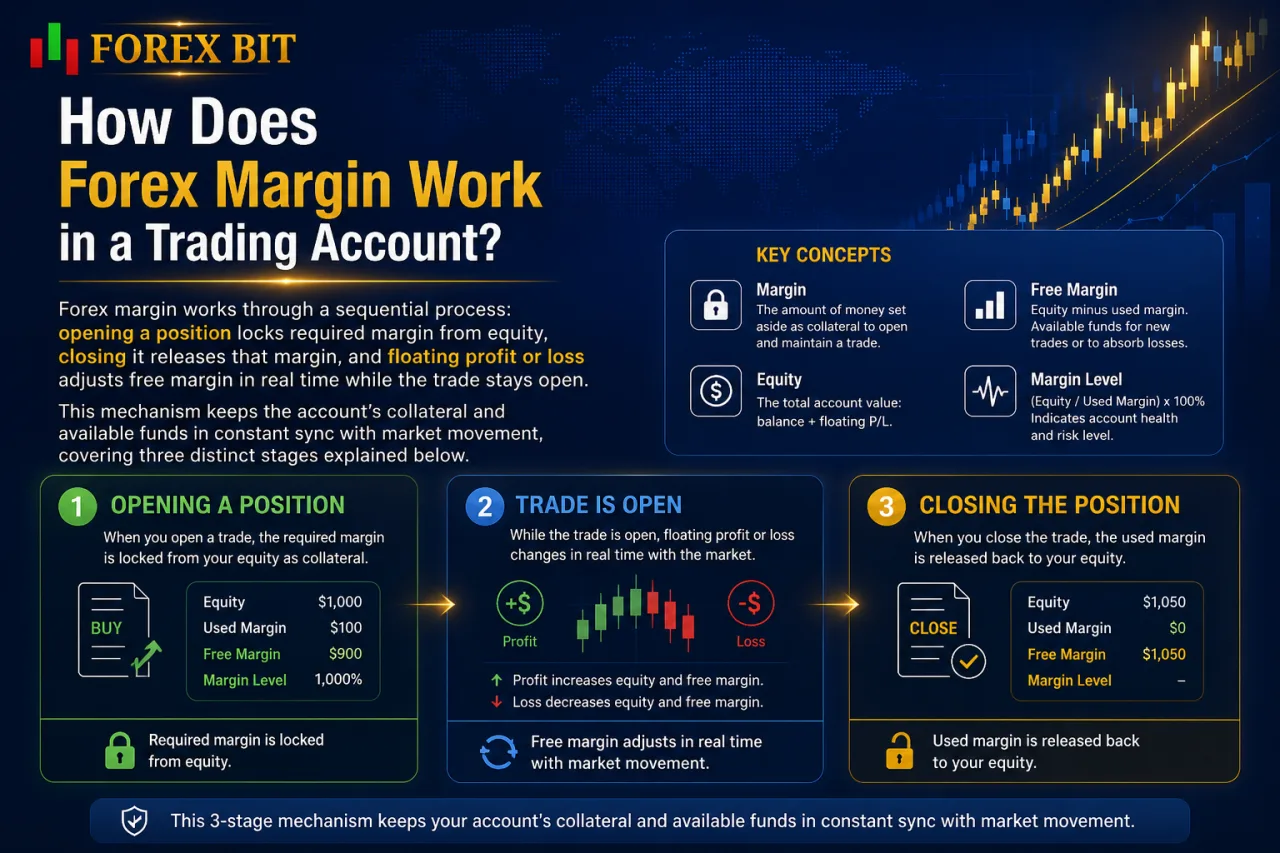
Forex margin works through a sequential process: opening a position locks required margin from equity, closing it releases that margin, and floating profit or loss adjusts free margin in real time while the trade stays open. This mechanism keeps the account’s collateral and available funds in constant sync with market movement, covering three distinct stages explained below.
How Is Margin Level Calculated and Monitored?
Margin level is calculated by dividing account equity by used margin and multiplying the result by 100%. This single formula, Equity / Used Margin x 100%, generates the percentage figure that platforms display continuously while any position stays open.
Trading platforms typically show margin level as a running percentage on the account summary panel, updating it in real time as equity shifts with floating profit or loss. Because used margin only changes when a new position opens or an existing one closes, most of the fluctuation in margin level comes directly from price movement affecting equity.
- Rising equity with unchanged used margin pushes margin level higher, widening the buffer before margin call or stop-out.
- Falling equity with unchanged used margin pushes margin level lower, narrowing that same buffer.
- Opening additional positions raises used margin and lowers margin level even if equity stays constant.
Continuous monitoring of this percentage matters because margin level is the exact metric brokers reference to trigger margin call notifications or automatic stop-out closures, meaning a trader unaware of a declining margin level risks losing open positions without prior warning.
How Do You Calculate Forex Margin and Margin Requirements?
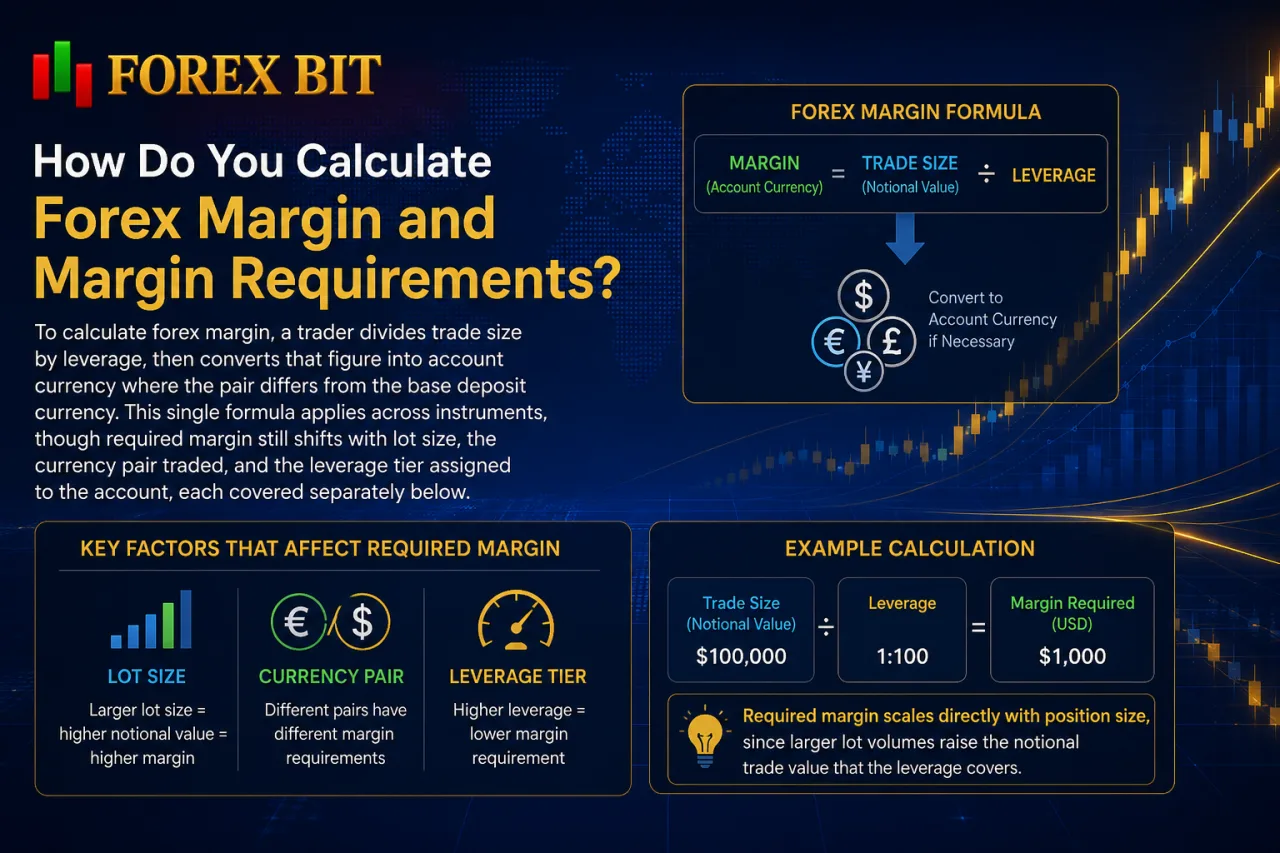
To calculate forex margin, a trader divides trade size by leverage, then converts that figure into account currency where the pair differs from the base deposit currency. This single formula applies across instruments, though required margin still shifts with lot size, the currency pair traded, and the leverage tier assigned to the account, each covered separately below.
Required margin scales directly with position size, since larger lot volumes raise the notional trade value that the leverage ratio then divides. Instrument choice also affects the outcome, because currency pairs quoted against the account’s base currency skip conversion, while cross pairs require an extra step to translate margin into that base currency.
- Standard lots raise required margin proportionally to their larger notional value.
- Micro or mini lots lower required margin to match their smaller notional exposure.
- Base-currency pairs calculate margin without a conversion step.
- Cross-currency pairs add a conversion step using the current exchange rate between the quote currency and account currency.
How Do Margin Requirements Vary by Broker and Account Type?
Margin requirement percentages vary by broker, by regulatory jurisdiction, and by account tier, so no single figure applies universally across the forex market. This variation follows directly from the broker/account distinctions already outlined for required and used margin above.
A standard account and an ECN account from the same broker often carry different leverage caps, which changes the margin locked for an identical lot size. Professional or elective-professional accounts, where regulation permits, typically unlock higher leverage tiers than retail accounts, reducing margin requirements per trade.
Regulatory jurisdiction also drives this variation, since retail leverage limits set by regulators differ from one licensing region to another. Traders confirm exact margin percentages through their broker’s account specification page rather than assuming one account type’s figures apply to another.
- Standard accounts generally apply retail leverage caps set by the governing regulator.
- ECN accounts sometimes carry separate margin schedules tied to raw spread pricing.
- Professional accounts access reduced margin requirements where jurisdiction and eligibility criteria allow it.
What Tools Can Traders Use to Calculate Margin in Advance?
Traders calculate margin in advance using the margin calculator built into a trading platform or hosted on a broker’s website, which returns required margin instantly after lot size, instrument, and leverage are entered. This addresses the practical question of pre-checking margin before a trade goes live, rather than discovering the collateral impact only after the position opens.
A margin calculator applies the same required-margin formula covered earlier, but automates the lookup of current price and any currency conversion for cross pairs. Entering the intended lot size, the currency pair, and the account’s leverage tier returns the exact amount that will be locked from equity.
- Broker-hosted calculators pull live pricing directly from the broker’s own quote feed for accuracy.
- Platform-integrated tools, available within most trading terminals, preview margin impact before an order is submitted.
- Spreadsheet-based calculations replicate the formula manually for traders who prefer offline verification.
Checking required margin through one of these tools before placing a trade confirms the position fits within available free margin and keeps margin level at a safe distance from margin call thresholds.
What Are Margin Call and Stop-Out Levels?
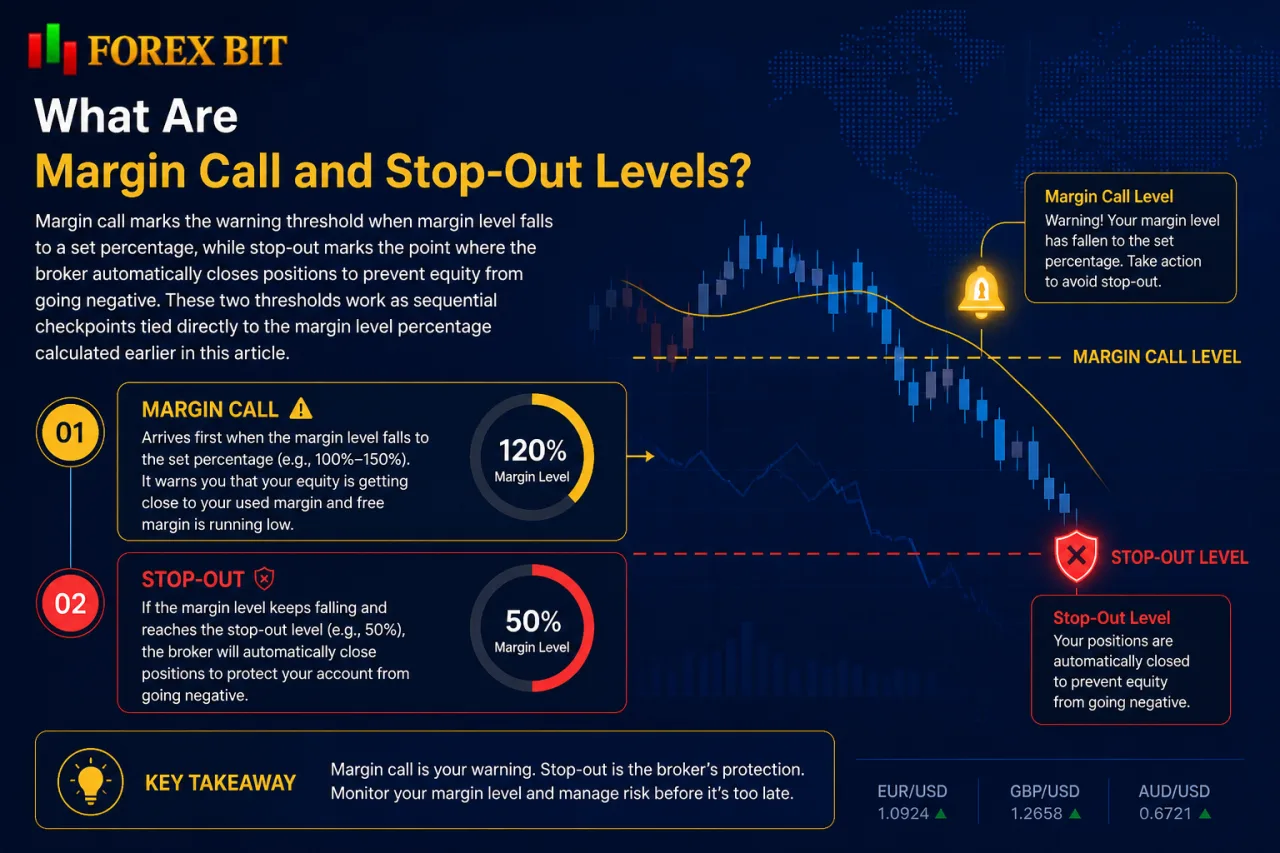
Margin call marks the warning threshold when margin level falls to a set percentage, while stop-out marks the point where the broker automatically closes positions to prevent equity from going negative. These two thresholds work as sequential checkpoints tied directly to the margin level percentage calculated earlier in this article.
A margin call arrives first, alerting the trader that equity has dropped close to used margin and that free margin is running low. If the margin level keeps falling and no action follows, either from added funds or closed positions, the account reaches the stop-out level, where the platform closes one or more open trades without further confirmation.
- Margin callA margin call is triggered once the margin level drops to the broker’s specified percentage threshold, notifying the trader that additional funds or position adjustments may be needed.
- Stop-outA stop-out is triggered once the margin level falls to the broker’s specified percentage threshold, causing automatic closure of open positions.
- Trigger sequence moves from margin call warning to stop-out execution as margin level continues declining.
Exact percentages for both thresholds differ across brokers and account types, following the same broker-specific variation already noted for margin requirements.
How Can Traders Avoid a Margin Call or Stop-Out?
Traders avoid a margin call or stop-out by keeping a wide equity buffer above used margin, applying stop-loss orders, sizing positions conservatively, and checking margin level at regular intervals. These four practices work together rather than in isolation, since each one addresses a different point where margin level can decline unexpectedly.
Maintaining buffer equity means depositing or retaining funds well beyond the minimum required margin, so a string of adverse price moves does not immediately push margin level toward the margin call threshold. Stop-loss orders cap the potential loss on any single position, preventing floating losses from eroding equity to the point where margin level collapses.
- Reducing position size lowers required margin per trade, leaving more free margin as a buffer against price swings.
- Monitoring margin level on a regular basis catches a declining trend before it approaches the stop-out threshold.
- Avoiding over-concentration across correlated pairs limits simultaneous drawdown on multiple positions at once.
Combining these steps keeps margin level further from the broker’s stop-out percentage, reducing the likelihood of forced position closures during volatile market conditions.
Do Margin Call and Stop-Out Levels Differ Between Brokers?
Yes, margin call and stop-out percentage thresholds differ between brokers, since each firm sets these levels individually within limits allowed by its regulatory regime. This variation ties directly to the broker-specific and jurisdiction-specific differences already noted for margin requirements above, and it carries the same logic into where a losing account actually gets flagged or closed.
Three factors drive this divergence. Regulatory jurisdiction sets a floor or a fixed figure in some regions, forcing every licensed broker in that region toward similar thresholds. Individual broker policy still allows firms operating under the same regulator to set marginally different percentages for margin call versus stop-out. Account type also plays a role, since a professional account sometimes carries a different threshold than a standard retail account at the same broker.
- Regulated brokersStop-out thresholds are set by each broker rather than following one universal figure, though regulatory requirements in certain jurisdictions can influence the minimum level a broker is permitted to set.
- Offshore or less-regulated brokers set thresholds independently, sometimes lower than jurisdictions with stricter rules.
- Account tiers within the same broker occasionally carry distinct margin call and stop-out percentages.
Traders confirm the exact figures through their broker’s account terms rather than assuming a threshold seen elsewhere applies universally.
How Do Margin Requirements Compare Across Leverage Levels and Account Types?
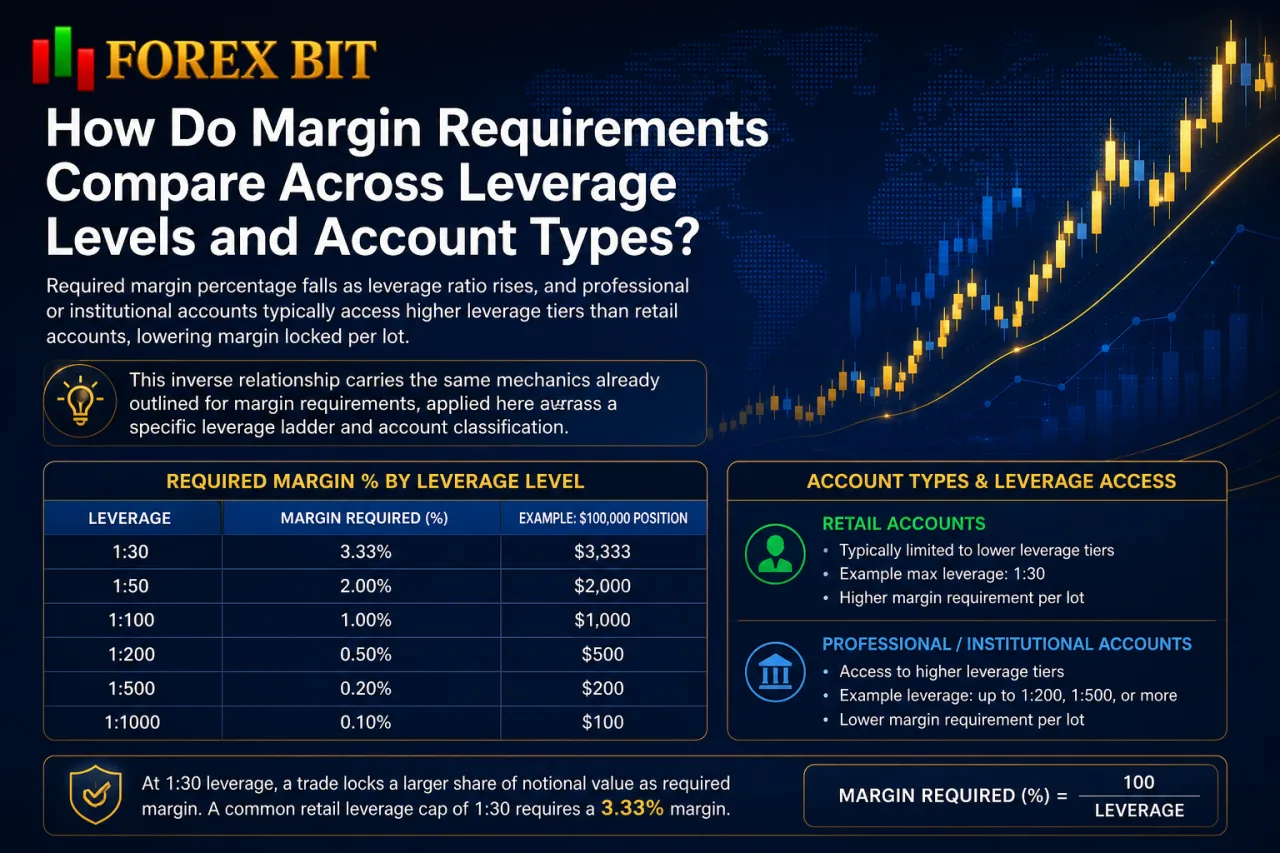
Required margin percentage falls as leverage ratio rises, and professional or institutional accounts typically access higher leverage tiers than retail accounts, lowering margin locked per lot. This inverse relationship carries the same mechanics already outlined for margin requirements, applied here across a specific leverage ladder and account classification.
At 1:30 leverage, a trade locks a larger share of notional value as required margin. A common retail leverage cap of 1:30 requires a 3.33% margin per position, while 1:100 lowers that figure to 1%, and 1:500 reduces it further to 0.2%, based on the standard margin formula of dividing notional trade value by leverage.
| Leverage Ratio | Required Margin % | Typical Account Type |
|---|---|---|
| 1:30 | 3.33% | Retail (regulated regions) |
| 1:100 | 1% | Retail (standard offshore) |
| 1:500 | 0.2% | Professional/institutional |
Retail accounts under stricter regulatory regimes stay capped near the lower leverage end, while professional or elective-professional classifications unlock the higher tiers shown above, provided eligibility criteria are met.
- Retail accounts operate within regulator-imposed leverage ceilings.
- Professional accounts access reduced margin percentages through higher leverage eligibility.
- Institutional accounts negotiate leverage terms separately from standard retail schedules.
What Rare Margin-Related Situations Should Traders Be Aware Of?
Traders encounter several rare margin situations beyond standard margin calls and stop-outs, including negative balance events, weekend margin adjustments, and broker-imposed margin changes during high volatility. These edge cases fall outside routine margin monitoring covered earlier, since they involve broker discretion or market conditions rather than the predictable equity-to-margin ratio traders track daily. The scenarios below outline how each situation departs from standard margin mechanics.
How Does Negative Balance Protection Relate to Margin?
Negative balance protection prevents equity from falling below zero after a stop-out, absorbing the excess loss so a trader never owes the broker more than the deposited margin. This safeguard connects directly to the margin call and stop-out sequence, addressing the rare scenario where price gaps past the stop-out level before positions close.
Under normal conditions, stop-out execution closes losing positions while margin level still reflects a positive equity figure. During extreme volatility, however, a price gap can skip the stop-out trigger entirely and push equity into negative territory before any closure occurs. Negative balance protection, mandated in certain regulatory jurisdictions, resets the account balance to zero in that scenario rather than leaving the trader with a debt to the broker.
- Standard stop-out closes positions while equity remains positive.
- Gapped or slippage events occasionally bypass stop-out and drive equity negative.
- Negative balance protection restores the account to a zero floor rather than a deficit.
Availability of this protection depends on the broker’s regulatory license and the account type held, so traders confirm its inclusion through their broker’s terms rather than assuming universal coverage.
How Does Overnight Margin Differ From Intraday Margin?
Overnight margin requirements sometimes exceed intraday margin because certain brokers apply a higher percentage to positions held past the daily rollover cutoff or over a weekend. This distinction addresses a gap left by the standard margin formula covered earlier, since that formula assumes a constant leverage ratio regardless of how long a position stays open.
Intraday margin follows the account’s standard leverage tier throughout normal trading hours, keeping required margin at the baseline percentage already outlined for that account type. Some brokers raise required margin ahead of rollover or before a weekend close, citing reduced liquidity and wider potential price gaps during those windows.
- Intraday positions carry the account’s standard margin percentage during regular market hours.
- Overnight positions sometimes carry an elevated margin percentage past the rollover cutoff.
- Weekend-held positions face the same elevated treatment at some brokers, reflecting the wider gap risk when markets stay closed.
Traders confirm whether this adjustment applies through their broker’s account terms rather than assuming intraday and overnight margin stay identical.
Conclusion
Forex margin functions as the collateral an account locks to open and hold a leveraged position, calculated from lot size, instrument price, and the leverage tier assigned to that account. Equity, used margin, free margin, and margin level track this collateral in real time, with margin call and stop-out thresholds acting as the checkpoints that protect against runaway losses.
Leverage and account type set how much collateral each trade requires, retail accounts facing stricter caps than professional or institutional tiers, while negative balance protection and overnight margin adjustments cover the rarer edge cases outside routine monitoring. Understanding this mechanism gives a trader a complete view of how margin governs position sizing and account risk.
Isabella Brown is the Forex Trading Guide Manager at Forex Bit, focusing on educational content about broker safety, trading costs, account types, platforms, and key Forex/CFD concepts. Her work helps readers understand trading terms, broker conditions, and practical checks before evaluating or using a brokerage service.
Email: [email protected]



Best Brokers

Trade with the world’s largest retail broker and benefit from better - than - market conditions.

We offer a superior trading environment that puts traders in the best position to profit.

Trade global markets with Interactive Brokers – a highly regulated multi-asset broker built for active and professional investors.

Invest and trade global markets with eToro – a Nasdaq-listed multi-asset platform built around social investing and CopyTrader.






Forex Bit provides independent forex broker reviews, comparisons, guides, and industry news to help traders make informed decisions.
Best Brokers
Metatrader 5 Brokers
Metatrader 4 Brokers
Lowest Spread Forex Broker
Regulated Forex Brokers
Forex Copy Trading
Ctrader Brokers
Best Forex Broker For Beginners