
Corrections Policy Forex Bit explains how we review errors, fix inaccurate information, document corrections, and assess reported issues after content has been published.
Broker conditions, regulation, fees, trading platforms, payment methods, and account details can change over time, and factual mistakes can also occur despite careful research and review.
This policy creates a clear process for identifying, verifying, correcting, and documenting information that may be inaccurate. We distinguish between a correction, an update, and a minor edit because these changes do not mean the same thing.
Whether a request comes from a reader, broker, partner, or another source, Forex Bit evaluates it based on verifiable evidence rather than commercial interest or simple disagreement. The sections below explain how Forex Bit reviews reported errors and decides what action to take.
What Is a Correction on Forex Bit?
Not every change made to a published article is considered a correction. Forex-bit.com distinguishes factual corrections from routine updates and minor editorial edits, so readers can better understand why content has changed.

A Correction
A correction is made when published content contains information that was factually wrong or materially misleading at the time it was presented.
Examples can include information that is:
- Factually incorrect
- Materially misleading
- Attributed to the wrong legal entity
- Based on the wrong jurisdiction
- Based on inaccurate fee, account, or platform information
- Incorrectly describing a broker’s regulatory status
- Containing another verifiable factual error
A correction addresses an error in the published record rather than a later change in the underlying facts.
An Update
An update is different from a correction because the information may have been accurate when first published but changed later.
Examples include:
- A broker changes its fees
- A new account type is launched
- A trading platform is discontinued
- A broker changes legal entities
- A license status changes after publication
- A payment method is added or removed
In these cases, the original article may not have been wrong; it simply needs to reflect newer information.
A Minor Edit
Minor editorial changes do not normally count as corrections.
Examples include:
- Fixing a typo
- Improving grammar
- Adjusting formatting
- Improving readability
- Changing wording without altering factual meaning
These edits can improve presentation without changing the underlying substance of the article.
Defining these categories helps us determine which reported issues require factual correction and which simply require routine content maintenance.
What Types of Errors Do We Correct?
Forex Bit prioritizes errors that could materially affect how readers understand a broker, financial service, or related condition. The seriousness of the issue and its potential impact help determine how urgently it should be reviewed.
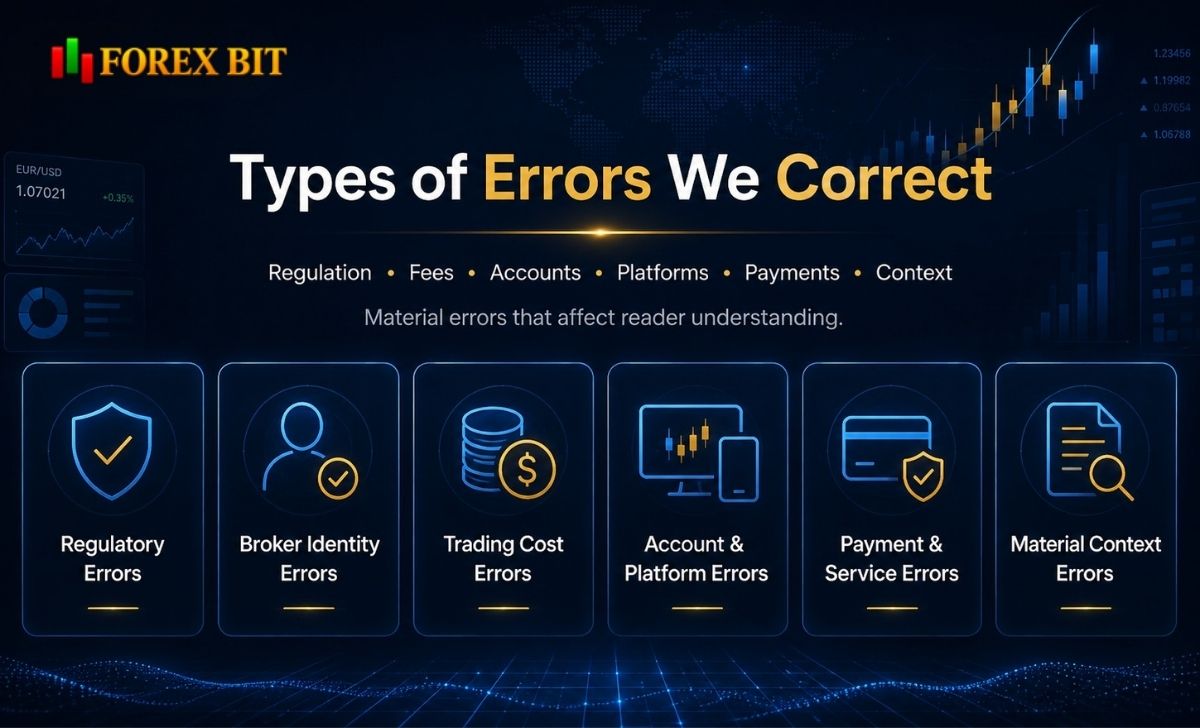
Regulatory Errors
Regulatory information requires particular care because an error can create a false impression about a broker’s legal status or applicable protections.
Examples include:
- Wrong regulator
- Incorrect license number
- Incorrect legal entity
- Incorrect license status
- Wrong jurisdiction
- Incorrect information about a regulatory warning
Where possible, regulatory corrections should be checked against the relevant regulator or other authoritative source.
Broker Identity Errors
A broker brand may operate through multiple companies, so correctly identifying the entity involved is important.
Examples include:
- Wrong company name
- Wrong operating entity
- Confusing two entities under the same brand
- Linking to the wrong official domain
An identity error can also affect other information in the article, such as regulation, account conditions, or jurisdiction.
Trading Cost Errors
Trading-cost information can influence how readers compare brokers.
Examples include:
- Incorrect spread information
- Wrong commission
- Incorrect swap or overnight-fee description
- Wrong minimum deposit
- Incorrect non-trading fee
When correcting a cost figure, Forex Bit should also check whether the error affects a comparison table, ranking, or other related content.
Account & Platform Errors
Broker accounts and platform availability can change, but an article can also contain inaccurate information from the outset.
Examples include:
- An account incorrectly listed as available
- Incorrect leverage
- Wrong trading-platform availability
- Incorrect instrument availability
- Incorrect account condition
The relevant entity, jurisdiction, and account type should be considered when verifying these details.
Payment & Service Errors
Payment and service information may also require correction when published inaccurately.
Examples include:
- Wrong deposit method
- Incorrect withdrawal method
- Incorrect stated processing information
- Incorrect customer-support channel
If payment conditions vary by location or account, the correction should preserve that context.
Material Context Errors
A statement can be technically correct but still misleading when placed in the wrong context.
Examples include:
- A figure that is correct for one jurisdiction but presented as universal
- A broker condition that applies to one entity but is described as applying to the entire brand
- A promotional condition omitted in a way that materially changes the meaning
These errors may require more than changing a single number because the surrounding explanation may also need to be revised.
Once a potential error is identified, Forex Bit follows a structured review process rather than changing content automatically.
How Forex Bit Reviews Correction Requests
A correction request is treated as a claim that requires verification, not as automatic proof that the published content is wrong. Forex Bit reviews the reported issue, supporting evidence, and original published information before deciding whether a change is justified.
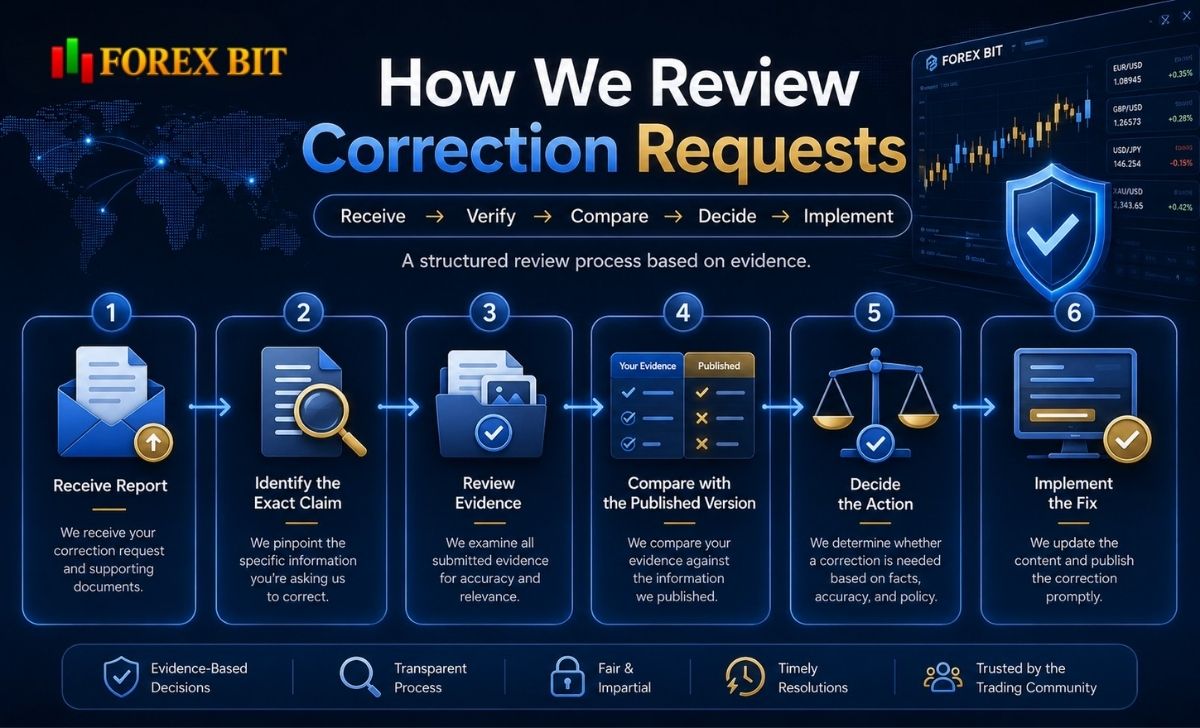
Step 1: Receive the Report
Potential errors can be identified from several sources, including:
- Readers
- Brokers
- Regulators
- Industry professionals
- Authors or editors
- Internal content reviews
- Other credible sources
The source of the report does not determine the outcome by itself.
Step 2: Identify the Exact Claim
The next step is to identify exactly what is being challenged.
Useful details include:
- Article URL
- Exact sentence, table entry, or data point
- Date of the report
- Relevant broker or legal entity
- Jurisdiction
- Explanation of why the information may be incorrect
Specific reports are easier to verify than broad statements such as “this review is wrong.”
Step 3: Review Supporting Evidence
Forex Bit then checks the evidence supporting the correction request.
Preferred sources can include:
- Financial regulator databases
- Official legal documents
- Broker terms and conditions
- Official fee schedules
- Account specifications
- Official broker announcements
- Other authoritative material
The strength of the evidence matters, especially for corrections that would materially change an article.
Step 4: Compare Against the Published Version
We compare the evidence with what the article currently says and what was known when it was published or last updated.
This can include checking:
- The exact wording currently published
- Publication and update dates
- The original source used
- Whether the information was incorrect when published
- Whether the information was correct originally but changed later
This step helps determine whether the issue is a correction or an update.
Step 5: Decide the Appropriate Action
Possible outcomes include:
- No change
- Minor edit
- Factual correction
- Content update
- Clarification
- Removal of an unsupported claim
- Addition of missing context
- Material correction note
The appropriate action depends on the evidence and the significance of the issue.
Step 6: Implement and Review
Before publishing a change, Forex Bit should verify the corrected information and review the surrounding content.
This may include:
- Confirming the corrected fact
- Checking nearby paragraphs for related errors
- Ensuring other sections remain consistent
- Updating affected tables
- Reviewing related conclusions where necessary
A correction should resolve the issue rather than create new contradictions elsewhere in the article.
The outcome depends on the evidence, which means not every correction request will result in a change.
What Evidence Is Required for a Correction?
Forex Bit prefers verifiable evidence over unsupported claims or requests based only on disagreement. The more significant the requested correction, the stronger and more authoritative the supporting evidence should be.
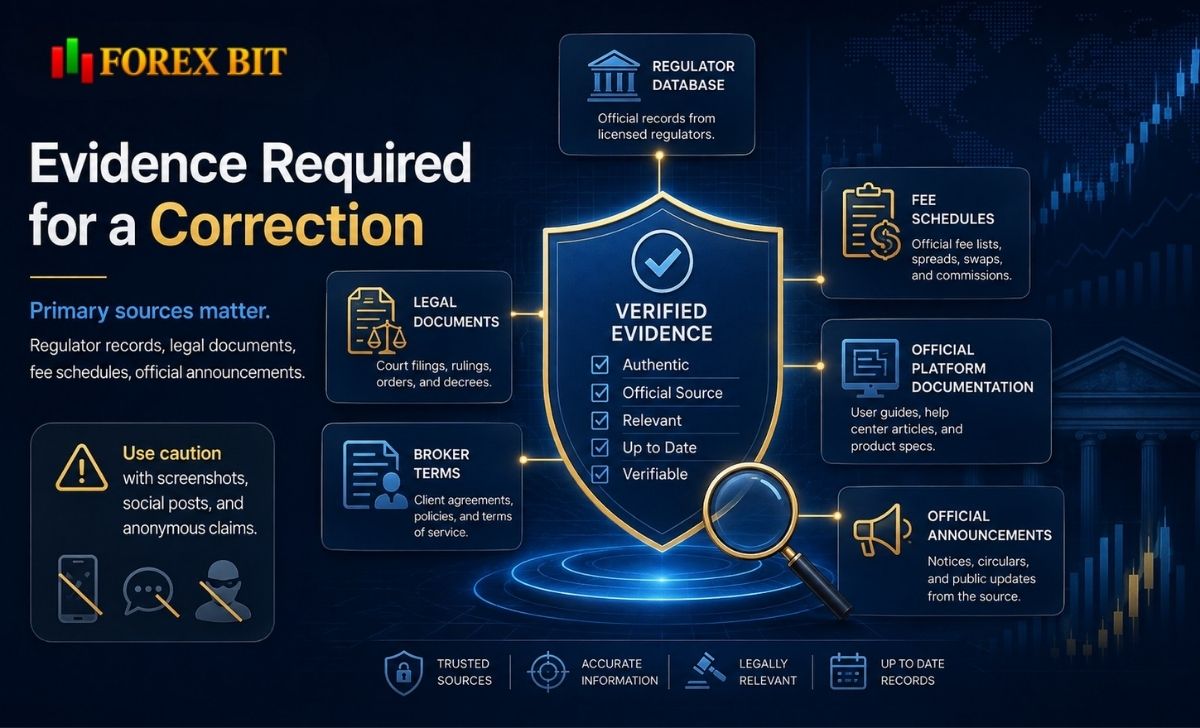
Strong Evidence
Sources that generally carry greater weight include:
- Financial regulator records
- Official legal documents
- Current broker terms and conditions
- Official fee schedules
- Account specifications
- Official platform documentation
- Official broker announcements
- Other authoritative primary sources
For example, a regulator’s database is usually more appropriate for verifying regulatory status than a third-party broker directory.
Evidence We May Treat With Caution
Some material may help identify an issue but may not be sufficient to prove a correction on its own.
Examples include:
- Screenshots without context
- Undated documents
- Social media claims
- User comments
- Anonymous messages
- Marketing statements
- Third-party broker directories
- Cached information without a clear date
These sources may still lead to further investigation, but they should not automatically override stronger primary evidence.
When a Broker Provides Evidence
A broker may submit information such as:
- An official document
- A direct source link
- Updated terms
- A regulator record
- Clarification about an entity or jurisdiction
Forex Bit should independently verify the material rather than accept a correction automatically because it came from the broker involved.
When Evidence Conflicts
Different sources can sometimes provide conflicting information.
In that situation, Forex Bit may:
- Check publication and update dates
- Compare legal entities
- Confirm jurisdiction
- Prefer regulator records for regulatory facts
- Prefer current legal terms for broker conditions
- Explain an unresolved discrepancy where appropriate
If a material issue cannot be reliably resolved, the article should avoid presenting uncertain information as a confirmed fact.
When the evidence supports a correction, the next question is whether the change should be documented publicly.
When Do We Add a Correction Note?
Not every edit requires a public correction note. Forex Bit should document corrections when the original error was significant enough to materially affect how readers could understand the article.
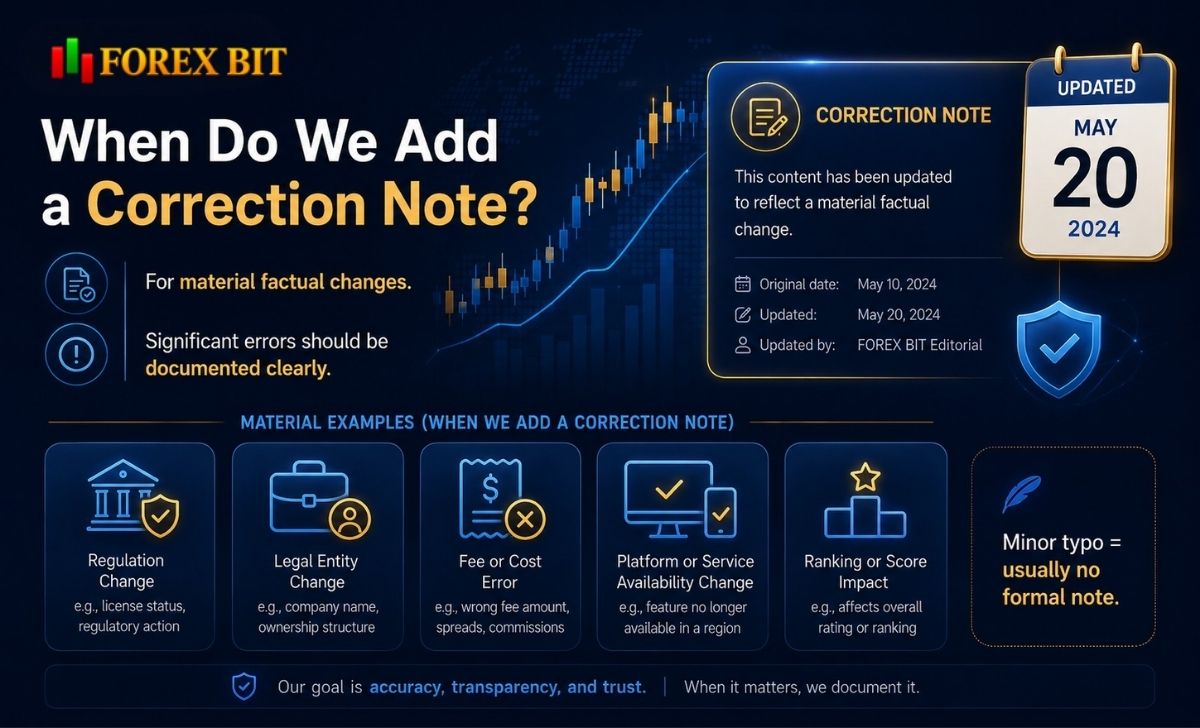
Material Corrections May Include
Examples of changes that may justify a correction note include:
- Incorrect regulatory status
- Wrong broker legal entity
- Incorrect license information
- Major fee error
- Incorrect ranking conclusion caused by bad data
- Misidentified account or platform availability
- Materially misleading statement
- Error that significantly affects the article’s conclusion
The significance of the error matters more than the number of words changed.
Minor Corrections Usually Do Not Need a Note
Minor edits generally do not require a formal correction notice.
Examples include:
- Typographical errors
- Punctuation changes
- Formatting fixes
- Small wording improvements
- Non-material grammar corrections
These changes do not materially alter the factual meaning of the article.
What a Correction Note May Include
A correction note should be concise and understandable.
It may explain:
- What was incorrect
- What was changed
- The date of the correction
- Why the correction was made, where useful
Example: Correction [Date]: An earlier version of this article incorrectly stated [X]. The article has been updated to reflect [Y].
The purpose is to make a material factual change transparent without overcomplicating the article.
We Do Not Rewrite History Without Reason
A material error should not be silently hidden when doing so would make the correction process less transparent.
Where appropriate, Forex Bit may preserve a visible correction note so readers can understand that the published information changed because the earlier version contained a factual mistake.
Correction notes address errors in published content, while routine updates address information that changed after publication.
Corrections vs. Content Updates
Broker information can become outdated even when it was fully accurate at the time of publication. Forex Bit therefore separates factual corrections from updates caused by later changes in broker conditions or regulatory information.
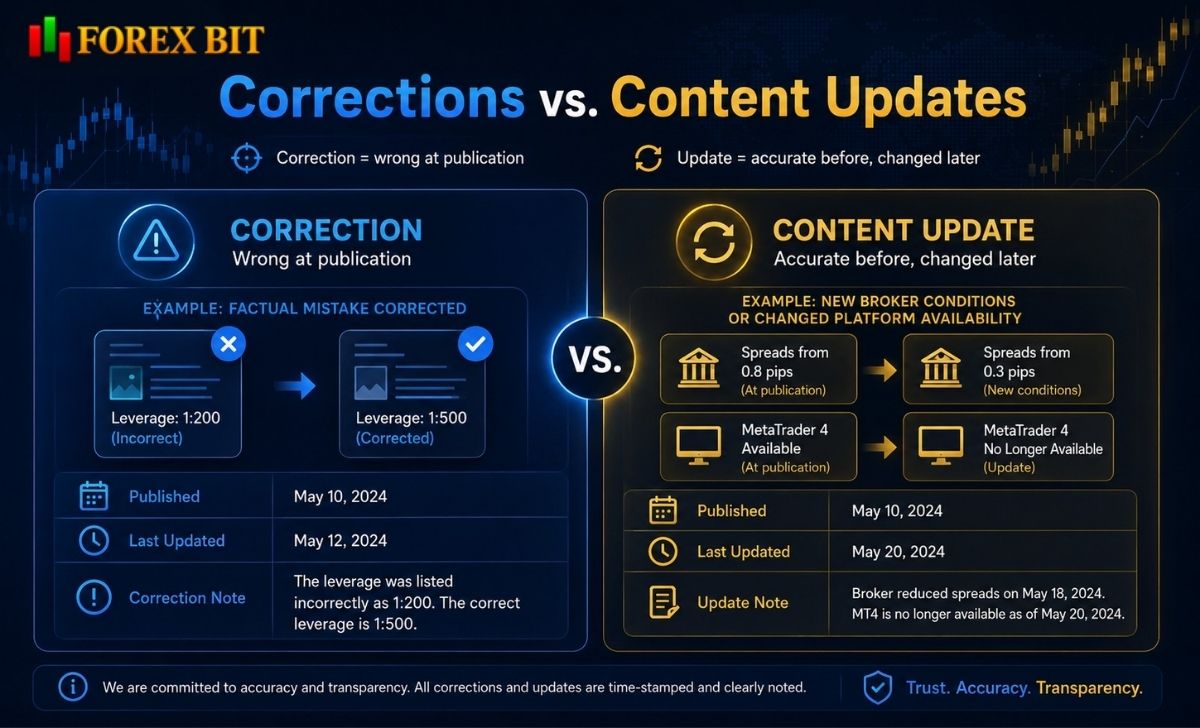
Correction Example
Suppose an article states: Broker X is regulated by Authority A.
If later fact-checking shows that Broker X did not hold that license at the time the article was published, the original statement was incorrect.
→ Correction
Update Example
Suppose an article correctly states: Broker X offers MT4 and MT5.
If the broker later discontinues MT4, the original statement was accurate when published but has become outdated.
→ Update
Why This Distinction Matters
This distinction helps readers understand:
- Whether Forex Bit made a factual mistake
- Whether the broker’s conditions changed later
- Why the Last Updated date changed
- Whether a formal correction note is appropriate
It also creates a more accurate editorial record of what happened.
Published and Last Updated Dates
Forex Bit may use:
- Published: The original publication date
- Last Updated: The date of a substantive content update
- Correction Note: A notice used when a material factual error is corrected
A correction may also result in a Last Updated change when the article is substantively revised, but the correction note serves a different transparency purpose.
This distinction is also important when a broker itself asks Forex Bit to change published content.
Can Brokers Request Corrections?
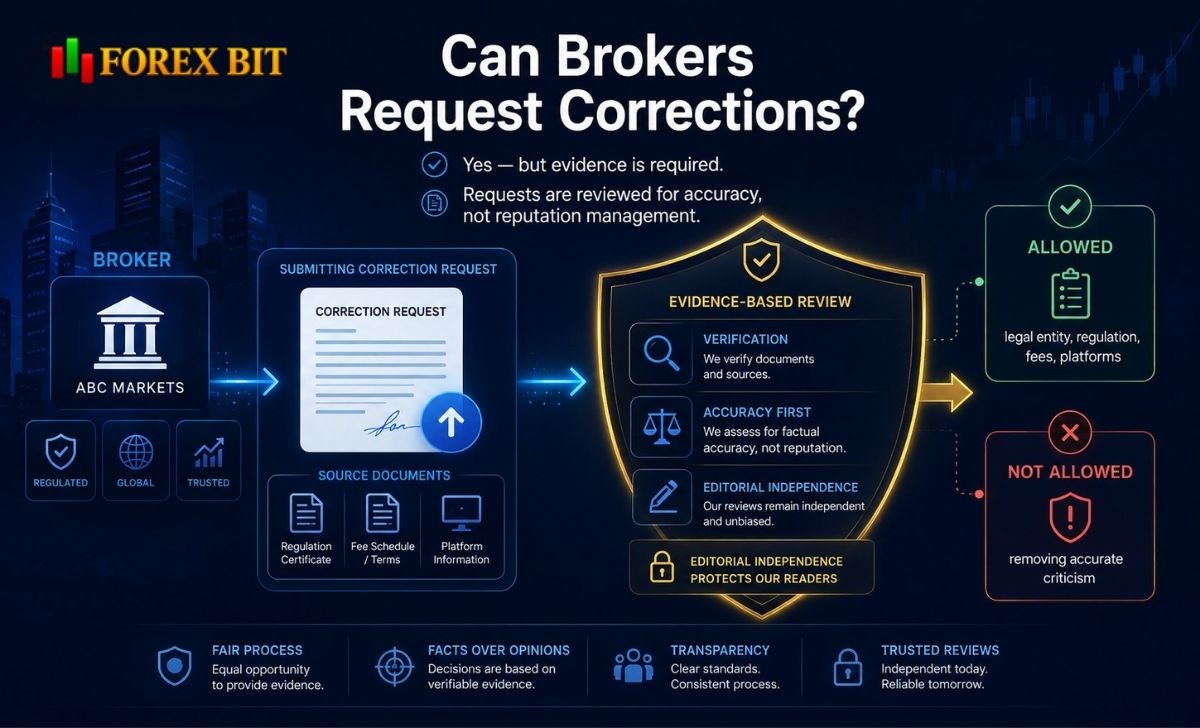
Yes. Brokers can submit correction requests if they believe Forex Bit has published inaccurate factual information about their company, services, regulation, or trading conditions. However, broker requests are reviewed under the same evidence-based standards applied to reports from readers and other sources.
What Brokers Can Request
Brokers may ask Forex Bit to review factual information involving:
- Legal entities
- Regulation
- Fees
- Account types
- Trading platforms
- Payment information
- Company details
- Other verifiable factual information
A request should identify the exact statement believed to be inaccurate.
What Brokers Cannot Require
A broker cannot require Forex Bit to change content simply because the information is unfavorable.
For example, brokers cannot require Forex Bit to:
- Remove accurate criticism
- Delete verified regulatory information
- Change an editorial opinion without supporting evidence
- Remove factual disadvantages
- Change a ranking solely because they disagree
- Remove accurate historical context
Correction requests address factual accuracy, not reputation management.
Evidence Is Required
A useful broker correction request should include:
- Page URL
- Exact factual issue
- Correct information
- Official source
- Date
- Relevant entity or jurisdiction
This gives the editorial team a clear basis for verification.
Commercial Relationships Do Not Change the Standard
An affiliate partner or advertiser does not receive special correction treatment because of its commercial relationship with Forex Bit.
The same evidence standard should apply whether the broker:
- Is an affiliate partner
- Is an advertiser
- Has another commercial arrangement
- Has no commercial relationship at all
The correction process remains focused on factual accuracy.
The same evidence-based approach applies when readers, rather than brokers, identify a potential problem.
Reader Correction Requests
Readers can help Forex Bit identify factual errors, outdated information, and inconsistencies that may otherwise be missed. Reports that clearly identify the issue and provide reliable supporting information are easier for the editorial team to investigate.

What Readers Can Report
Readers may report issues such as:
- Incorrect factual claims
- Outdated broker conditions
- Wrong regulatory information
- Broken factual sources
- Wrong broker links
- Incorrect fees
- Misleading context
- Data inconsistencies
A report does not need to involve a major error to be useful.
What to Include
Where possible, readers should provide:
- Article URL
- Exact text, table, or section involved
- Explanation of what appears incorrect
- Supporting source
- Date observed
- Screenshot if helpful
A direct primary source can significantly speed up the verification process.
What Happens After Submission?
The general process is:
Receive → Review → Verify → Decide → Correct or Update if Needed
Forex Bit may also contact the reporter for additional information where appropriate.
No Guaranteed Outcome
Submitting a correction request does not guarantee:
- Removal of content
- A correction
- A ranking change
- An editorial revision
The outcome depends on the available evidence and whether the published information is actually inaccurate or outdated.
Some reports can be resolved quickly, while others require additional verification before Forex Bit can make a reliable change.
How Long Does a Correction Review Take?
Correction requests vary in complexity, and some issues require more verification than others. Forex Bit prioritizes making an accurate decision rather than rushing a change simply to close a report quickly.
Factors That May Affect Review Time
Review time can depend on:
- Severity of the potential error
- Availability of authoritative sources
- Whether regulator information is current
- Multiple legal entities
- Jurisdiction complexity
- Conflicting documentation
- Need to review multiple Forex Bit articles
An issue involving a simple fee correction may be easier to resolve than one involving several legal entities and conflicting regulatory records.
Higher-Priority Issues
Forex Bit should prioritize errors that could materially affect user understanding or safety.
Examples include:
- Wrong regulatory status
- Scam or security implications
- Incorrect legal identity
- Major fee errors
- Information affecting user safety
- Incorrect regulatory warnings
These issues may receive greater editorial urgency.
Lower-Priority Issues
Lower-priority matters may include:
- Minor wording changes
- Formatting issues
- Non-material context improvements
- Low-impact outdated details
Read more about Forex Bit Policy:
- About Us
- Corrections Policy
- Affiliate Disclosure
- Review Methodology
- Editorial Policy
- Risk Warning
- Privacy Policy
- Terms and Conditions
- Cookie Policy
These may still be addressed but may not require the same urgency as a major factual error.
No Fixed Deadline Unless Operationally Guaranteed
Forex Bit should not promise a specific correction deadline unless it can consistently meet that commitment.
For example, we should avoid statements such as:
“All corrections are completed within 24 hours.”
Some issues require additional verification before a reliable correction can be made.
When one factual error affects multiple pages, Forex Bit may need to review more than the article where the issue was first reported.
Corrections Across Multiple Forex Bit Pages
The same broker fact may appear in reviews, comparisons, rankings, guides, FAQs, or news articles. A confirmed error may therefore require a broader site review so that inconsistent information does not remain elsewhere on Forex Bit.
Related Content We May Check
A wider correction review may include:
- Broker reviews
- Best Broker rankings
- Broker comparisons
- Broker Guides
- Tables
- FAQs
- News articles
- Internal summaries
The scope depends on where the incorrect information has been repeated.
Example
Suppose a broker’s minimum deposit is incorrectly listed in:
- The main broker review
- A broker comparison
- A Best Broker table
Correcting only the main review would leave the other pages inaccurate.
In this situation, Forex Bit should review and update all affected locations where practical.
Consistency Review
After confirming a material error, the editorial team may:
- Search related pages
- Check repeated data
- Update affected tables
- Review relevant internal links
- Remove contradictory information
A consistency review helps prevent the same factual problem from remaining elsewhere on the website after the original correction is made.
For especially serious errors, Forex Bit may take stronger action than simply editing a sentence or data point.
When We May Remove or Retract Content
Most factual errors can be corrected while leaving the rest of an article intact. In limited situations, however, content may need to be withdrawn, substantially rewritten, or clearly marked when its central factual basis can no longer be supported.
Possible Reasons
More serious action may be appropriate when:
- The core article is based on false information
- The wrong company or legal entity is discussed throughout
- A serious allegation lacks sufficient support
- A material legal issue affects publication
- A source is found to be fabricated or fundamentally unreliable
- The article’s central conclusion cannot be supported after review
These situations go beyond an ordinary isolated factual correction.
Correction vs. Retraction
A correction is appropriate when an article remains substantially valid after a specific factual error is fixed.
A retraction or withdrawal may be appropriate when the article’s central factual basis cannot be repaired without substantially replacing the content.
Retraction Transparency
Where content is withdrawn or substantially retracted, Forex Bit may explain the reason where appropriate.
The goal is to avoid silently rewriting significant factual history when transparency would better serve readers. Forex Bit may also preserve an appropriate internal record of the original issue and action taken.
News Content
Breaking news can require additional correction handling because early information may later prove inaccurate.
If a material news claim is disproven, Forex Bit may:
- Update the article clearly
- Correct the headline where necessary
- Add correction or clarification context
- Remove materially false framing
An article should not remain online in a way that continues to create a false impression after the underlying claim has been disproven.
Whether a change is minor or substantial, Forex Bit keeps editorial responsibility separate from commercial pressure.
Corrections Are Independent of Commercial Relationships
Correction decisions should be determined by evidence, not by whether a broker advertises with Forex Bit or generates affiliate revenue for the website. This separation keeps the correction process focused on factual accuracy rather than commercial preference.
Affiliate Partners
Affiliate partners do not receive automatic approval for correction requests.
A commercial relationship does not allow a partner to:
- Receive automatic correction approval
- Remove accurate criticism through commission
- Influence factual correction standards
A partner’s evidence should be assessed in the same way as evidence from any other source.
Advertisers
Advertisers also cannot purchase control over correction outcomes.
Advertising payments cannot be used to:
- Suppress a legitimate error report
- Demand removal of verified facts
- Control whether a correction is accepted
- Prevent publication of a factually supported correction
Advertising and factual correction are separate processes.
Non-Partners
Brokers with no commercial relationship should receive the same evidence-based review standard.
The existence or absence of revenue should not determine whether factual information is corrected.
Core Principle
Evidence determines the correction—not the commercial relationship.
This principle helps keep the process consistent across partners, advertisers, non-partners, readers, and other correction sources.
This separation helps ensure that readers can report issues without needing to understand Forex Bit’s commercial relationships first.
How to Report a Correction to Forex Bit
Readers, brokers, and other relevant parties can contact Forex Bit when they believe a published factual statement should be reviewed. Providing precise information and reliable supporting evidence can help the editorial team investigate the issue more efficiently.
Include These Details
Where possible, include:
- Article URL
- Relevant heading or paragraph
- Incorrect statement
- Correct information
- Supporting source
- Relevant legal entity
- Jurisdiction
- Date observed
The more specific the report, the easier it is to identify the exact issue.
Forex Bit Contact Information
You can contact Forex Bit through:
- Website: https://forex-bit.com
- Email: [email protected]
- Contact Page: https://forex-bit.com/about/contact
- Facebook: https://www.facebook.com/forexbit.global
- Instagram: https://www.instagram.com/forexbit.global
When submitting a correction, please include supporting documentation or a direct source where available.
What This Channel Is For
This correction channel can be used for issues involving:
- Factual corrections
- Outdated broker information
- Regulatory discrepancies
- Broken factual sources
- Data inconsistencies
These reports are reviewed as editorial matters.
What This Channel Is Not For
This correction process is not intended to resolve:
- Trading-account disputes
- KYC approval
- Deposits
- Withdrawals
- Order execution
- Broker-support complaints requiring broker action
Forex Bit does not operate broker accounts or control broker services.
For broker account or transaction issues, contact the relevant broker directly.
The correction process ultimately exists to keep Forex Bit accountable for the factual information it publishes.
Conclusion
The corrections policy Forex Bit explains how we identify, verify, correct, and document factual errors after publication. Our correction decisions are based on reliable evidence rather than commercial pressure, personal disagreement, or the status of the party requesting the change. By clearly separating corrections, updates, minor edits, and more serious retractions, Forex Bit aims to maintain a more accurate, transparent, and accountable record of its published content.