










IC Markets, Pepperstone, XM, and FP Markets rank among the best MetaTrader 4 brokers in 2026.
Brokers suited for MT4 trading are generally compared based on regulation, spread quality, and account flexibility. Each broker offers distinct MT4 account structures suited to different trading needs.
IC Markets and Pepperstone are known for offering some of the tightest MT4 spreads among raw spread accounts, typically paired with a commission charged per lot traded. Standard accounts typically carry wider spreads but no added commission.
IC Markets, Pepperstone, and XM are commonly regarded as brokers holding licenses from multiple financial regulators. These licenses require segregated client funds and negative balance protection for added trader safety.
XM is often considered suitable for beginners due to its lower minimum deposit requirement, while IC Markets and Pepperstone are generally favored by scalpers and traders running EA-based automated strategies. Hedging is permitted across all four brokers on MT4 accounts. Forex Bit compares these MT4 brokers in detail below, starting with a full breakdown of the top-ranked options for 2026.
Which Are the Best MetaTrader 4 Brokers in 2026?
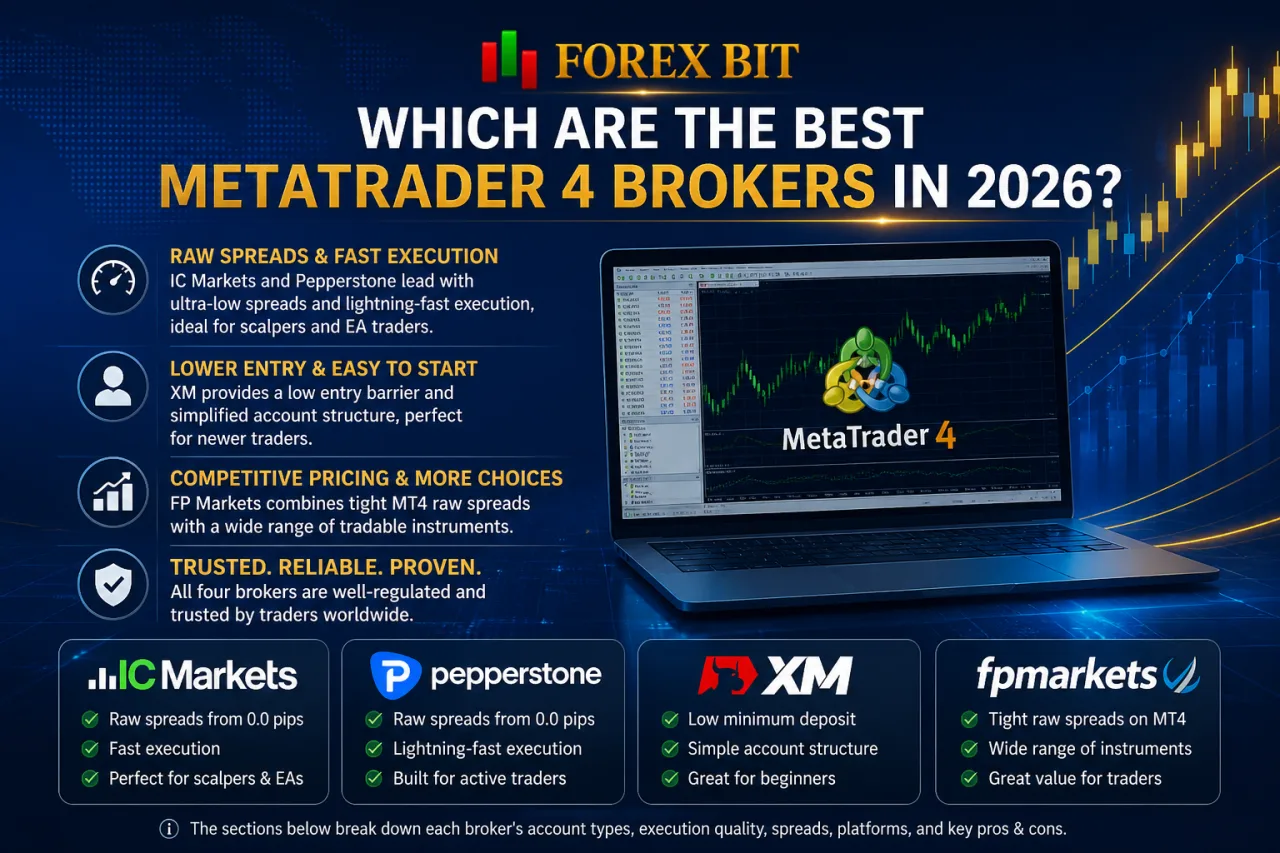
The best MetaTrader 4 brokers in 2026 include IC Markets, Pepperstone, XM, and FP Markets, each shortlisted for distinct MT4 strengths. IC Markets and Pepperstone stand out for raw spread pricing and fast execution suited to scalping and EA trading. XM offers a lower entry barrier and simplified account structure for newer traders, while FP Markets pairs competitive MT4 raw spreads with a wide range of tradable instruments. The sections below break down each broker’s account types, execution quality, and regulatory standing.
| Broker | MT4 Availability | Account Type | Spread | Commission | Regulation |
|---|---|---|---|---|---|
| IC Markets | Yes (Desktop, Web, Mobile) | Raw Spread, Standard | From 0.0 pips (Raw) | Charged per lot (Raw) | ASIC, CySEC, FSA |
| Pepperstone | Yes (Desktop, Web, Mobile) | Razor, Standard | From 0.0 pips (Razor) | Charged per lot (Razor) | FCA, ASIC, CySEC, DFSA |
| XM | Yes (Desktop, Web, Mobile) | Micro, Standard, XM Ultra Low | From 0.6 pips (Ultra Low) | No commission (Standard/Micro) | CySEC, ASIC, FSC |
| FP Markets | Yes (Desktop, Web, Mobile) | Raw, Standard | From 0.0 pips (Raw) | Charged per lot (Raw) | ASIC, CySEC |
How Was This MT4 Broker List Selected? (Methodology)
This MT4 broker list was selected using six weighted criteria: regulation and trust, MT4-specific trading conditions, execution quality, account type variety, platform stability, and EA/VPS support, with the first two carrying the most weight. This weighting reflects what matters most when comparing MT4 brokers specifically, rather than general broker features.
- Regulation and trust: Checked first, since fund safety depends on licensing from authorities such as ASIC, CySEC, FCA, or the FSA, along with segregated client accounts and negative balance protection.
- MT4 trading conditions: Evaluated through spread type, commission structure, and how raw spread accounts compare against standard accounts.
- Execution quality: Covers order fill speed and slippage under normal and volatile market conditions.
- Account type variety: Assessed for how well account options suit different trader profiles, from beginners to scalpers.
- Platform stability: Looks at uptime and consistency across desktop, web, and mobile MT4 versions.
- EA and VPS support: Reviewed for automated strategy compatibility, since uninterrupted connectivity is required for algorithmic trading and hedging setups on MT4.
What Are the Key Differences Between These MT4 Brokers?
IC Markets and Pepperstone differ from XM and FP Markets mainly in cost structure, account complexity, and target trader profile. IC Markets and Pepperstone charge commission on raw spread accounts and suit scalpers running EA-based strategies that need tighter spreads. XM removes commission on its Standard and Micro accounts, trading off a lower entry barrier for wider spreads, which suits traders prioritizing simplicity over raw execution cost.
Regulation strength also separates this group. Pepperstone holds licenses across four regulators including the FCA and DFSA, while XM’s coverage centers on CySEC, ASIC, and the FSC, a lighter regulatory footprint by comparison. FP Markets sits closer to IC Markets on cost, offering raw spreads from 0.0 pips with per-lot commission, but differs in instrument range and account variety.
Account structure trade-offs follow the same pattern: IC Markets and FP Markets split traders between Raw and Standard, Pepperstone uses Razor and Standard, and XM adds a third tier through XM Ultra Low. Cost-focused MT4 traders lean toward IC Markets or Pepperstone, while those wanting fewer decisions and lower capital requirements lean toward XM.
Which MT4 Brokers Offer the Lowest Spreads and Commissions?

IC Markets and Pepperstone offer the lowest combined MT4 trading costs among the shortlisted brokers, with raw spread accounts pairing near-zero pips with a per-lot commission. Comparing spreads and commissions across MT4 brokers requires looking at total cost rather than the headline spread figure alone.
On raw spread accounts, IC Markets and Pepperstone both advertise EUR/USD spreads from 0.0 pips, offset by a commission charged per lot traded. Actual spreads on raw accounts often exceed the advertised 0.0-pip floor during volatile market conditions. FP Markets follows a comparable raw spread structure with per-lot commission, positioning it close to IC Markets on total cost.
XM takes a different approach on its Standard and Micro accounts, building the cost into a wider spread with no separate commission, while its Ultra Low account offers spreads from 0.6 pips without commission. For traders prioritizing lowest all-in cost per trade, IC Markets, Pepperstone, and FP Markets rank ahead of XM on raw account pricing, though XM removes commission calculation entirely on its no-commission tiers.
Which MT4 Brokers Are Properly Regulated and Safe to Trust?
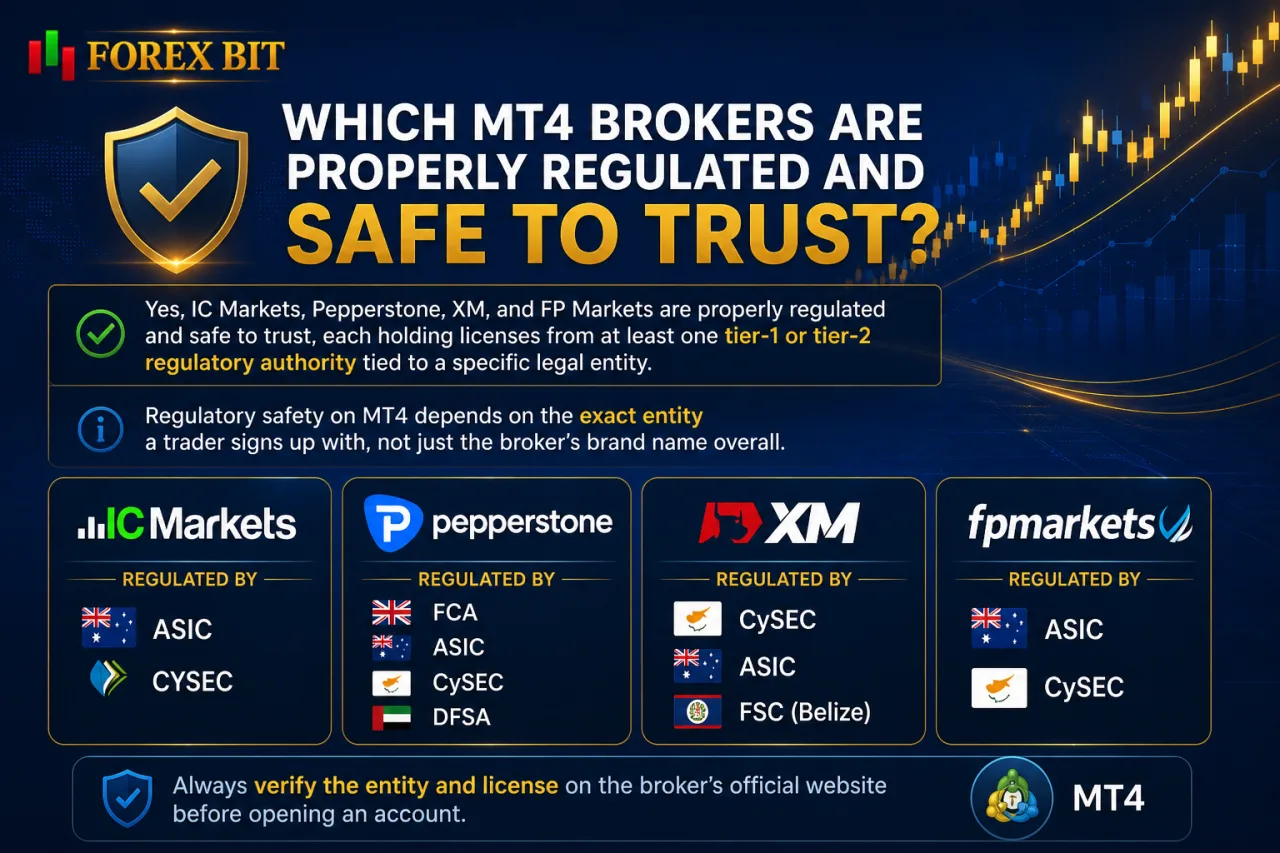
Yes, IC Markets, Pepperstone, XM, and FP Markets are properly regulated and safe to trust, each holding licenses from at least one tier-1 or tier-2 authority tied to a specific legal entity. Regulatory safety on MT4 depends on the exact entity a trader signs up with, not just the broker’s brand name overall.
Pepperstone carries the widest regulatory spread, licensed through the FCA, ASIC, CySEC, and DFSA, with each entity governed by the rules of its home jurisdiction. IC Markets holds ASIC, CySEC, and FSA licensing, while XM operates under CySEC, ASIC, and FSC authorization. FP Markets is regulated by ASIC and CySEC.
These four brokers are generally understood to apply client fund segregation and negative balance protection across their regulated entities.
Segregation keeps client deposits separate from company operating funds, while negative balance protection prevents an account from losing more than its deposited capital. These protections vary by legal entity and client jurisdiction.
A trader onboarded under an FCA-regulated entity, for example, does not automatically receive the same protections as one onboarded under an offshore entity of the same broker. Checking the specific regulator and entity assigned at account opening remains necessary before funding an MT4 account.
Which MT4 Brokers Are Best for Beginners, Scalping, EAs, or Hedging?
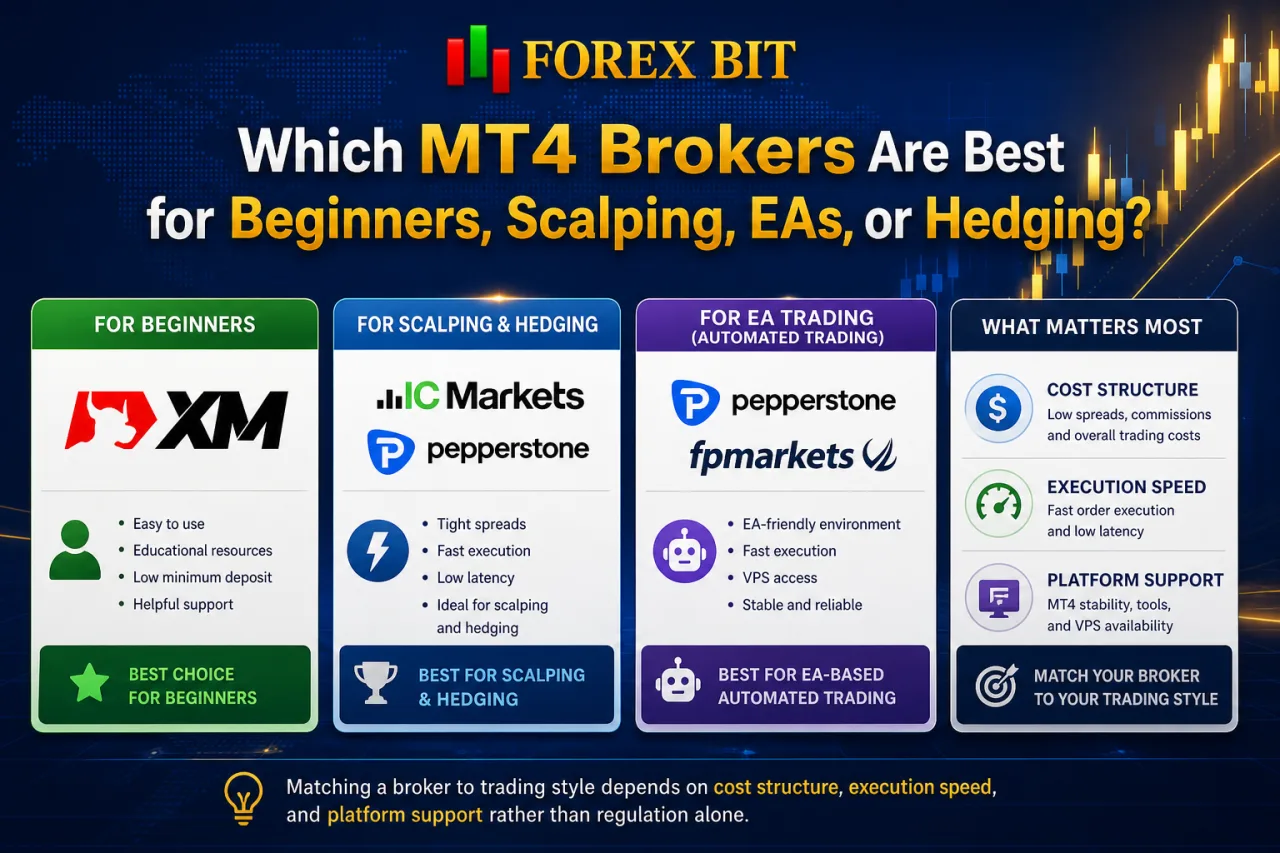
XM suits beginners, IC Markets and Pepperstone suit scalping and hedging, and Pepperstone with FP Markets suit EA-based automated trading. These last two brokers pair fast execution with VPS access for traders running automated strategies. Matching a broker to trading style depends on cost structure, execution speed, and platform support rather than regulation alone. The breakdown below groups each broker by trader type before covering account specifics separately.
Which MT4 Brokers Support Expert Advisors (EAs) and VPS Hosting Best?
Pepperstone and FP Markets support Expert Advisors and VPS hosting best among this MT4 broker group, pairing low-latency execution with free VPS access tied to eligibility conditions. IC Markets follows closely with comparable execution infrastructure for EA-based strategies, while XM offers VPS support with stricter qualifying requirements.
Execution speed on Pepperstone and IC Markets stays consistent for EA order placement, since both route raw spread accounts through infrastructure designed for high-frequency automated trading. FP Markets matches this standard on its Raw account tier, supporting EAs without added platform restrictions.
Free VPS eligibility across these brokers typically ties to minimum trading volume or account equity thresholds rather than being offered unconditionally.
Server reliability differs less by broker brand and more by account type, since raw spread and ECN-style accounts generally connect to lower-latency bridges than standard commission-free accounts. XM’s Standard and Micro accounts run on the same MT4 infrastructure but suit EA strategies less demanding of ultra-low latency, given the wider spread environment on those tiers.
What Advanced MT4 Account Features Do Top Brokers Offer Beyond the Basics?
Top MT4 brokers differentiate through five advanced account features: swap-free options, multi-terminal management, MAM/PAMM support, custom EA marketplace access, and mobile app parity. These features separate money managers and specific-need traders from standard retail account holders across IC Markets, Pepperstone, XM, and FP Markets. The sections below break down how each broker handles these less common MT4 capabilities.
Do Any of These MT4 Brokers Offer Swap-Free or MAM/PAMM Accounts?
Yes, IC Markets, Pepperstone, and XM offer Islamic swap-free MT4 accounts, while Pepperstone stands out for structured MAM/PAMM support aimed at fund managers. Availability and eligibility differ by broker and account type rather than applying uniformly across the group.
IC Markets and Pepperstone enable swap-free status on Raw and Razor accounts upon request, typically requiring verification of religious eligibility before approval. XM’s swap-free trading is generally available across its Standard, Micro, and Ultra Low accounts, though eligibility depends on internal review and country restrictions. FP Markets offers swap-free accounts on request as well, though approval criteria follow a similar verification process.
For MAM/PAMM, Pepperstone provides dedicated multi-account manager infrastructure built for third-party fund managers handling multiple client accounts through MT4. IC Markets supports MAM structures through approved money manager applications, while XM and FP Markets offer more limited manager account access, generally requiring separate onboarding outside standard retail account opening.
Conclusion
Choosing among IC Markets, Pepperstone, XM, and FP Markets for MT4 trading comes down to matching cost structure and account design to individual trading style. Traders focused on raw pricing and EA-driven strategies find the strongest fit with IC Markets or Pepperstone, both backed by wide regulatory coverage and infrastructure built for scalping and hedging. FP Markets sits close behind on cost while adding a broader instrument range. XM remains the more accessible entry point for newer traders through its lower deposit threshold and commission-free tiers. Regulation, spread type, and execution together determine which of these four brokers delivers the best MT4 setup for a given trading approach in 2026.