
- Multi-jurisdiction regulation
- Segregated client funds
- Supports MT4, MT5 & AvaTradeGO
- AvaProtect risk management tool
- Copy trading via DupliTrade & ZuluTrade
- Leverage varies by jurisdiction
- Not available to US traders
- Crypto access is relatively limited
- Professional accounts may lose some protections
- Some features vary by regional entity
AvaTrade holds licenses from multiple top-tier and mid-tier financial regulators across several jurisdictions, including authorities overseeing markets in Europe, Australia, the Middle East, and Asia, making it a legitimate broker for global traders in 2026. Its multi-regulated structure and long operating history support its reputation as a trustworthy trading provider.
AvaTrade is regulated and considered safe under its core licenses issued by financial authorities in regions including Europe, Australia, and the Middle East, confirming compliance with client fund protection standards required in those jurisdictions. This regulatory framework separates AvaTrade from unregulated or offshore-only brokers.
AvaTrade’s fees rely mainly on spread-based pricing with no separate commission on standard accounts, positioning it competitively against brokers charging commission per trade. Spread costs vary depending on the account type and traded instrument.
AvaTrade supports popular platforms including MetaTrader 4, MetaTrader 5, and its proprietary AvaTradeGO app, alongside defined minimum deposit and leverage limits that vary by region. Country availability also differs due to local regulatory restrictions.
This Forex Bit guide examines AvaTrade’s regulatory standing, fee structure, and trading conditions in detail, starting with whether AvaTrade qualifies as a trustworthy and legit broker in 2026.
Is AvaTrade a Trustworthy and Legit Broker in 2026?
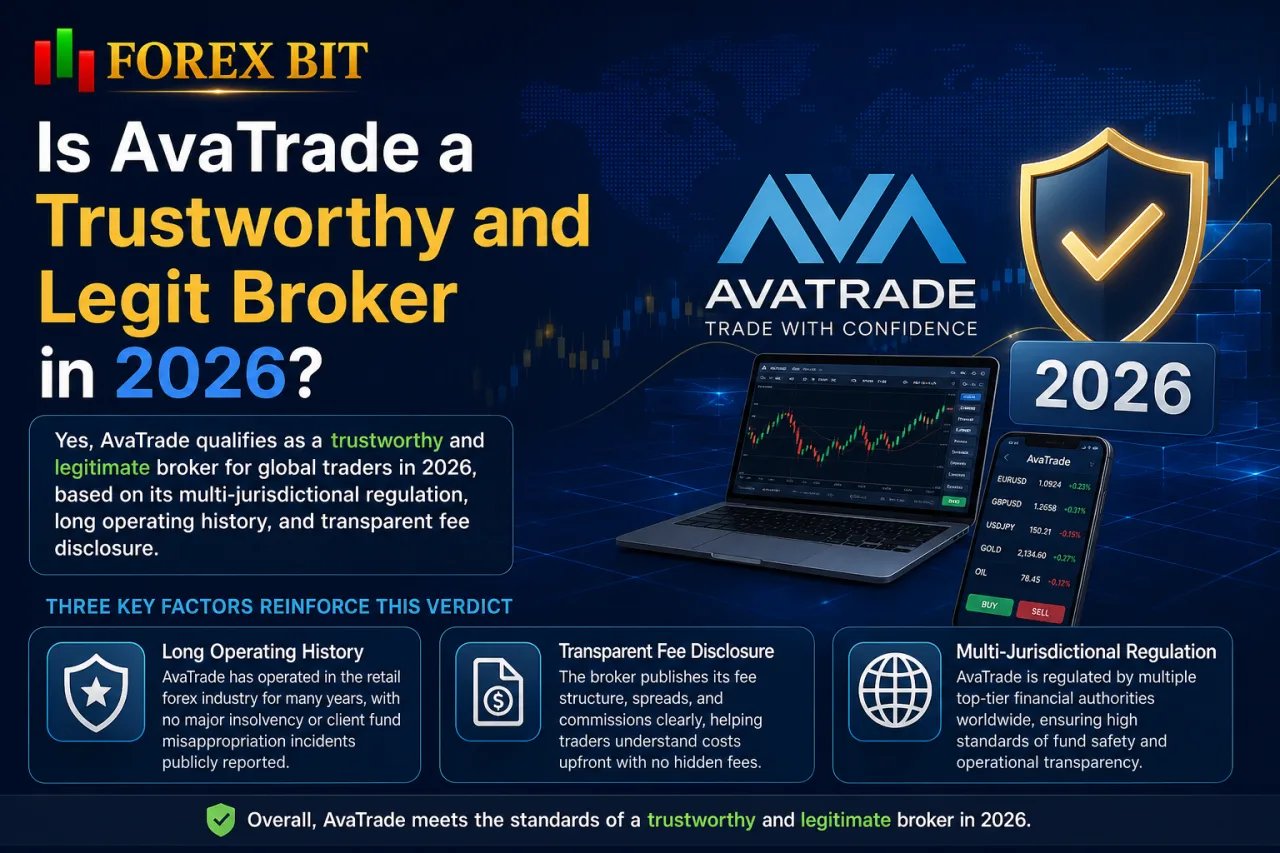
Yes, AvaTrade qualifies as a trustworthy and legitimate broker for global traders in 2026, based on its multi-jurisdictional regulation, long operating history, and transparent fee disclosure. Three factors reinforce this verdict beyond the regulatory framework already outlined above.
First, AvaTrade has operated in the retail forex industry for many years, with no major insolvency or client fund misappropriation incidents publicly reported.
Second, the broker publishes its fee structure, spread ranges, and platform terms openly rather than concealing costs within account agreements, a practice consistent with regulated entities under oversight bodies requiring disclosure standards.
Third, AvaTrade segregates client funds from company operating capital, a standard safeguard commonly required by financial regulators to protect trader deposits in the event of broker insolvency.
Together, these elements distinguish AvaTrade from unregulated offshore providers and support its standing as a credible choice for both beginner and experienced traders evaluating broker safety in 2026.
Is AvaTrade Regulated and Which Licenses Does It Hold?
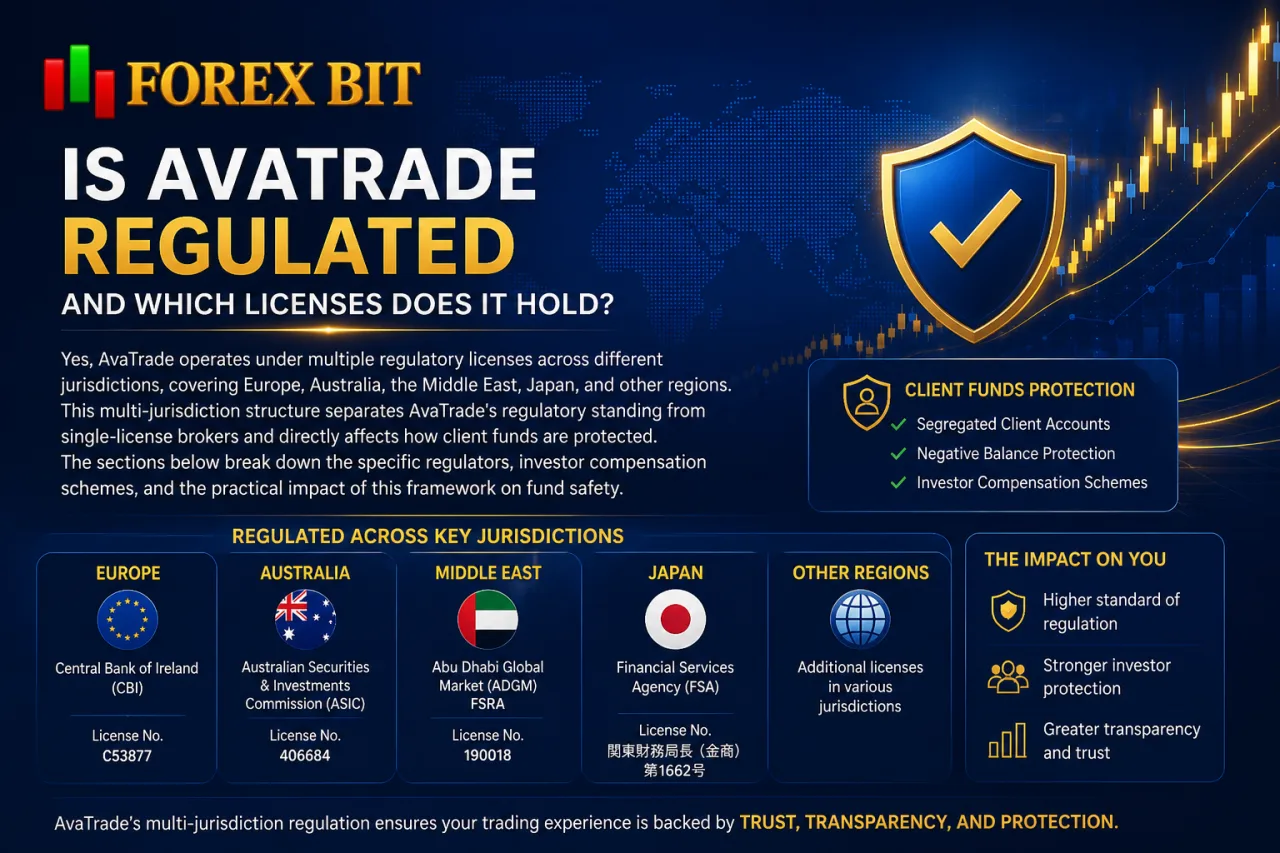
Yes, AvaTrade operates under multiple regulatory licenses across different jurisdictions, covering Europe, Australia, the Middle East, Japan, and other regions. This multi-jurisdiction structure separates AvaTrade’s regulatory standing from single-license brokers and directly affects how client funds are protected. The sections below break down the specific regulators, investor compensation schemes, and the practical impact of this framework on fund safety.
How Does AvaTrade Protect Client Funds and Ensure Safety?
AvaTrade protects client funds through segregated accounts, negative balance protection, and regulator-linked compensation schemes, combined into one layered safety framework. This structure connects directly to the regulatory licenses outlined above, since each protection mechanism ties to a specific regulator’s requirements rather than a single global policy.
Segregation keeps trader deposits in separate bank accounts from AvaTrade’s operational funds, preventing company funds from being mixed with client money. AvaTrade holds client funds with reputable banking institutions under segregated account arrangements required by its regulators.
Negative balance protection prevents a trader’s account from falling below zero after extreme market volatility, limiting losses to the deposited capital. This protection applies to retail clients under specific regulatory entities of AvaTrade rather than uniformly across every jurisdiction.
Compensation fund coverage adds a further layer where applicable. Eligible clients under certain AvaTrade regulatory entities may gain access to investor compensation schemes that cover client claims up to a set limit if the broker becomes insolvent, with the specific scheme and coverage amount depending on the regulator overseeing that entity.
How Much Do AvaTrade’s Fees, Spreads and Commissions Cost?
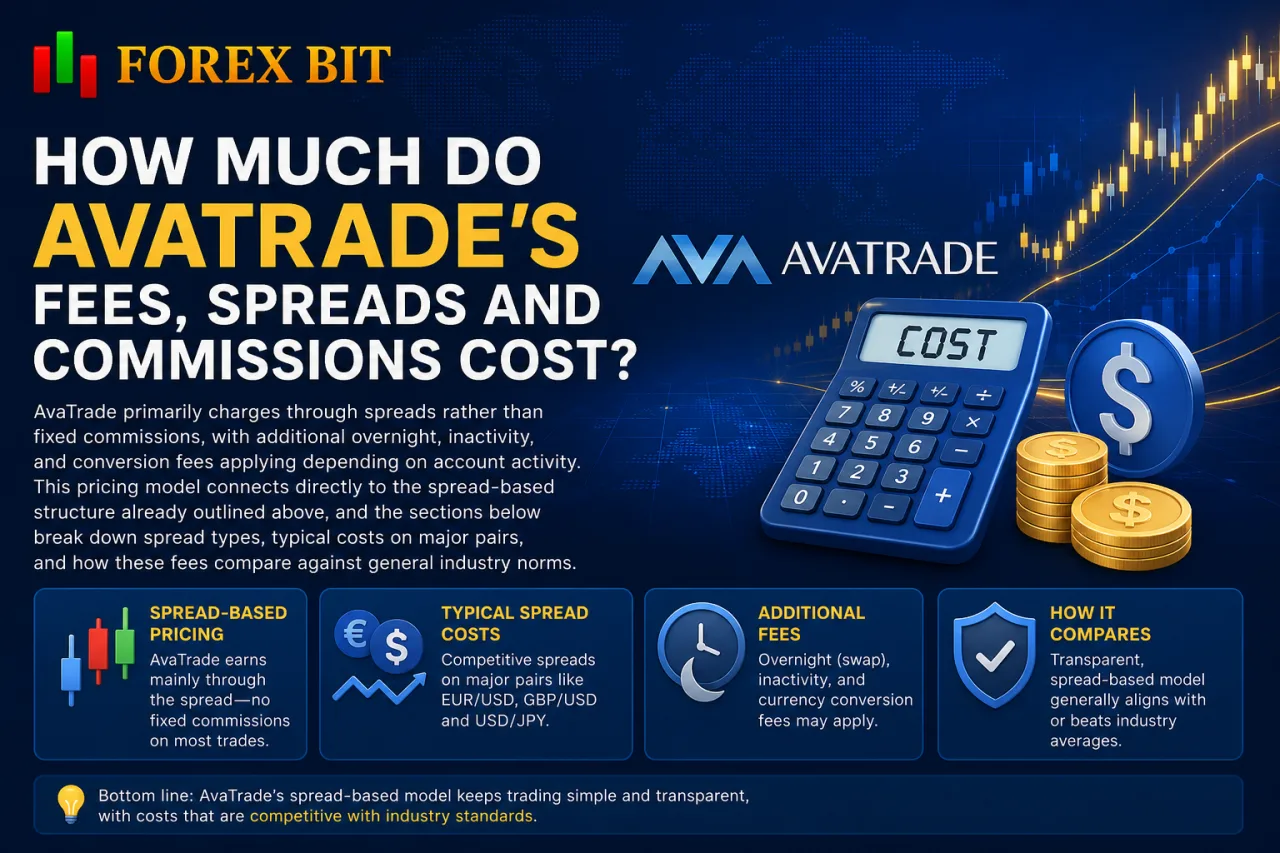
AvaTrade primarily charges through spreads rather than fixed commissions, with additional overnight, inactivity, and conversion fees applying depending on account activity. This pricing model connects directly to the spread-based structure already outlined above, and the sections below break down spread types, typical costs on major pairs, and how these fees compare against general industry norms.
What Account Types Does AvaTrade Offer and How Do They Differ?
AvaTrade offers multiple account types, generally including a standard retail account, a professional account, an Islamic swap-free account, and region-specific variants tied to its different regulatory entities. This account structure connects directly to the spread-based fee model outlined above, since each account type carries its own leverage cap, margin requirement, and swap treatment.
The retail account applies default leverage limits and full negative balance protection under most regulators, targeting traders who fall under standard client classification. Professional accounts unlock higher leverage than retail accounts but remove several regulatory safeguards, including guaranteed negative balance protection, depending on the jurisdiction and regulatory entity involved. Eligibility for professional status depends on meeting criteria set by the regulator overseeing that specific AvaTrade entity.
The Islamic account removes overnight swap interest and replaces it with an administration fee structure designed to comply with Sharia principles. This fee structure applies to eligible instruments rather than the entire product range, and the exact administration charge varies by instrument and by the regulatory entity servicing the account. Traders considering this account type verify the applicable fee schedule directly with AvaTrade before opening a position.
Beyond these core types, AvaTrade also provides variants accessed through its regional regulatory entities, which differ in available leverage and instrument range depending on the licensing jurisdiction.
What Is the Minimum Deposit Required to Open an AvaTrade Account?
AvaTrade sets a minimum deposit for standard retail accounts, though the exact amount varies by regulatory entity and regional restrictions. This threshold connects directly to the account structure outlined earlier, since the specific entity a trader registers under determines both the deposit floor and available funding options.
Minimum deposit requirements differ across AvaTrade’s licensed entities rather than following one global standard. Traders registering under certain regulators face a different minimum deposit than those under other AvaTrade licenses, reflecting local compliance rules rather than a uniform company-wide policy.
Accepted deposit currencies also depend on the account’s base currency selection at registration. AvaTrade allows funding in major currencies such as USD, EUR, and GBP, with additional currency options depending on the specific regional entity a client is registered under.
Traders confirm the applicable minimum deposit and supported currency before registration, since the account opening process displays region-specific terms tied to the entity assigned based on the trader’s country of residence.
Which Trading Platforms Does AvaTrade Support?
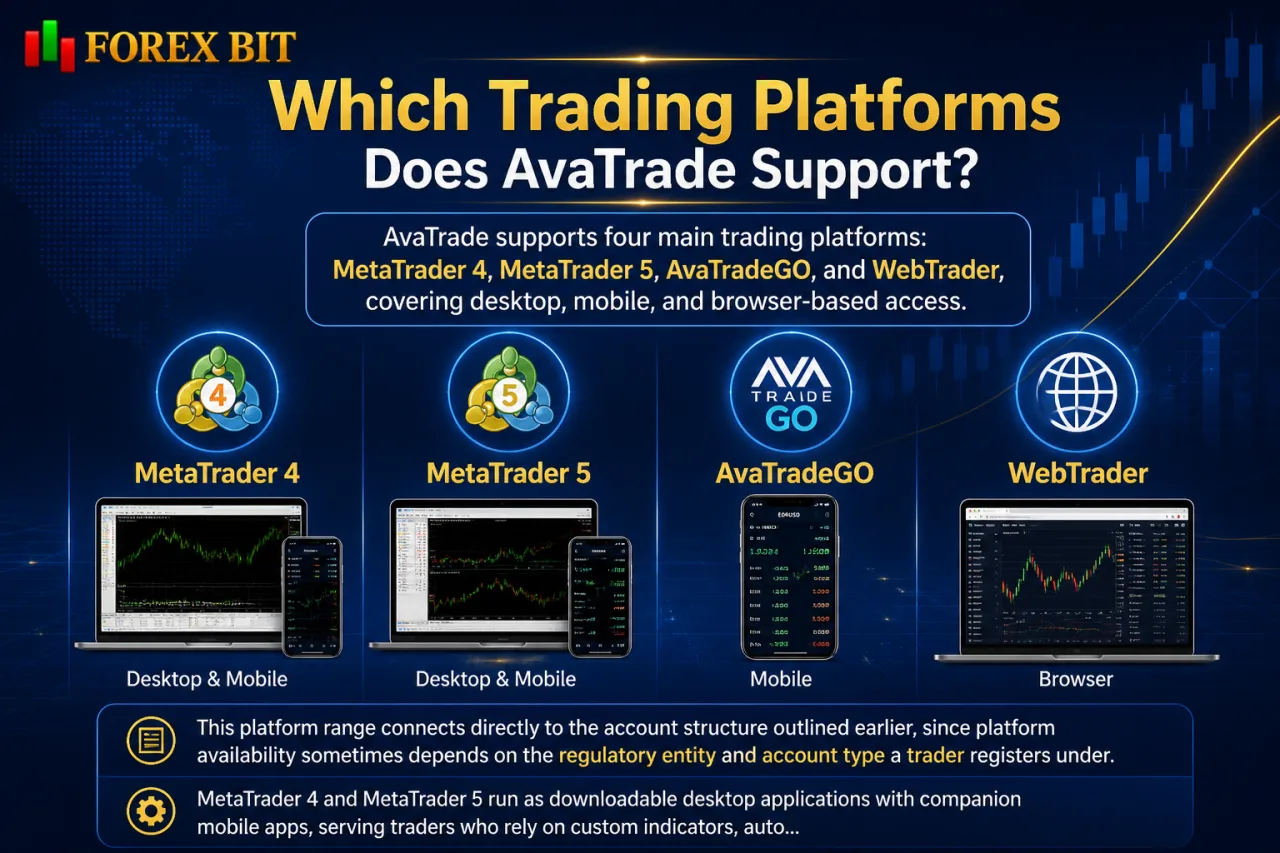
AvaTrade supports four main trading platforms: MetaTrader 4, MetaTrader 5, AvaTradeGO, and WebTrader, covering desktop, mobile, and browser-based access. This platform range connects directly to the account structure outlined earlier, since platform availability sometimes depends on the regulatory entity and account type a trader registers under.
MetaTrader 4 and MetaTrader 5 run as downloadable desktop applications with companion mobile apps, serving traders who rely on custom indicators, automated expert advisors, and multi-chart analysis. AvaTradeGO operates as AvaTrade’s proprietary mobile app, built for traders who prioritize simplified order execution and account management on smartphones and tablets.
WebTrader provides browser-based access without requiring software installation, suiting traders who switch between devices or trade from shared or work computers. AvaTrade also offers AvaOptions for options trading and integrates with third-party platforms such as DupliTrade and ZuluTrade for copy trading purposes.
Overall, this combination gives traders flexibility across desktop, web, and mobile environments regardless of trading style or device preference.
What Leverage Does AvaTrade Offer and How Does It Vary by Region?
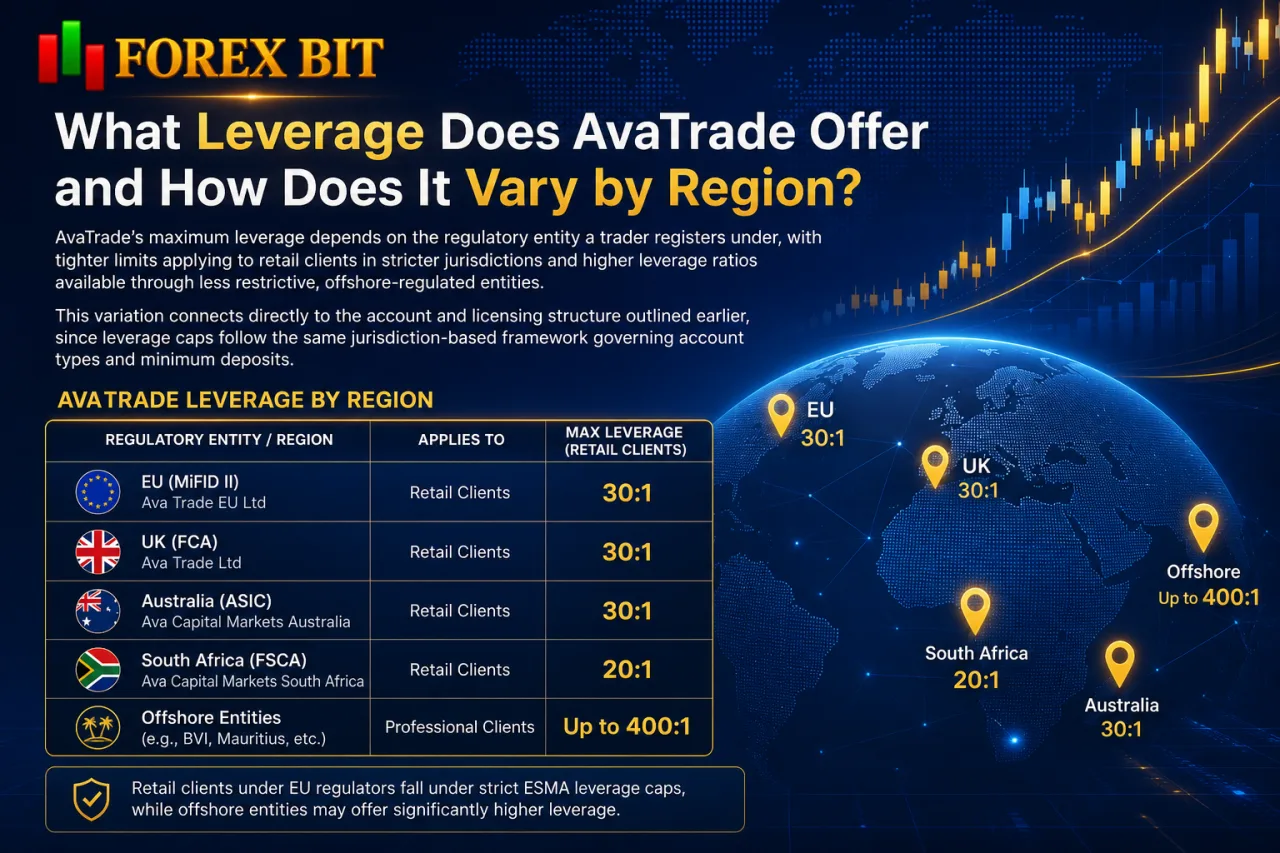
AvaTrade’s maximum leverage depends on the regulatory entity a trader registers under, with tighter limits applying to retail clients in stricter jurisdictions and higher leverage ratios available through less restrictive, offshore-regulated entities. This variation connects directly to the account and licensing structure outlined earlier, since leverage caps follow the same jurisdiction-based framework governing account types and minimum deposits.
Leverage limits at AvaTrade break down by region and client classification as follows:
- EU retail clients: Fall under ESMA-aligned leverage restrictions, which cap ratios on major forex pairs and apply lower limits on indices, commodities, and shares.
- Professional clients:Traders classified as professional clients under specific AvaTrade entities access higher leverage than retail clients, provided they meet the regulator’s eligibility criteria for that classification.
- Non-EU and offshore entities: Entities operating under regulators outside the EU and Australia, including certain Middle East and offshore licenses, tend to permit higher leverage ratios than the ESMA-aligned caps applied to European retail clients.
- Instrument type: Forex pairs generally carry higher leverage allowances than indices, commodities, cryptocurrencies, or individual shares under most AvaTrade entities.
Traders confirm the exact leverage tied to their registered entity and client classification during account verification, since the trading platform displays limits specific to that jurisdiction rather than a single global rate.
AvaTrade vs Other Brokers: How Do Its Markets and Country Availability Compare?
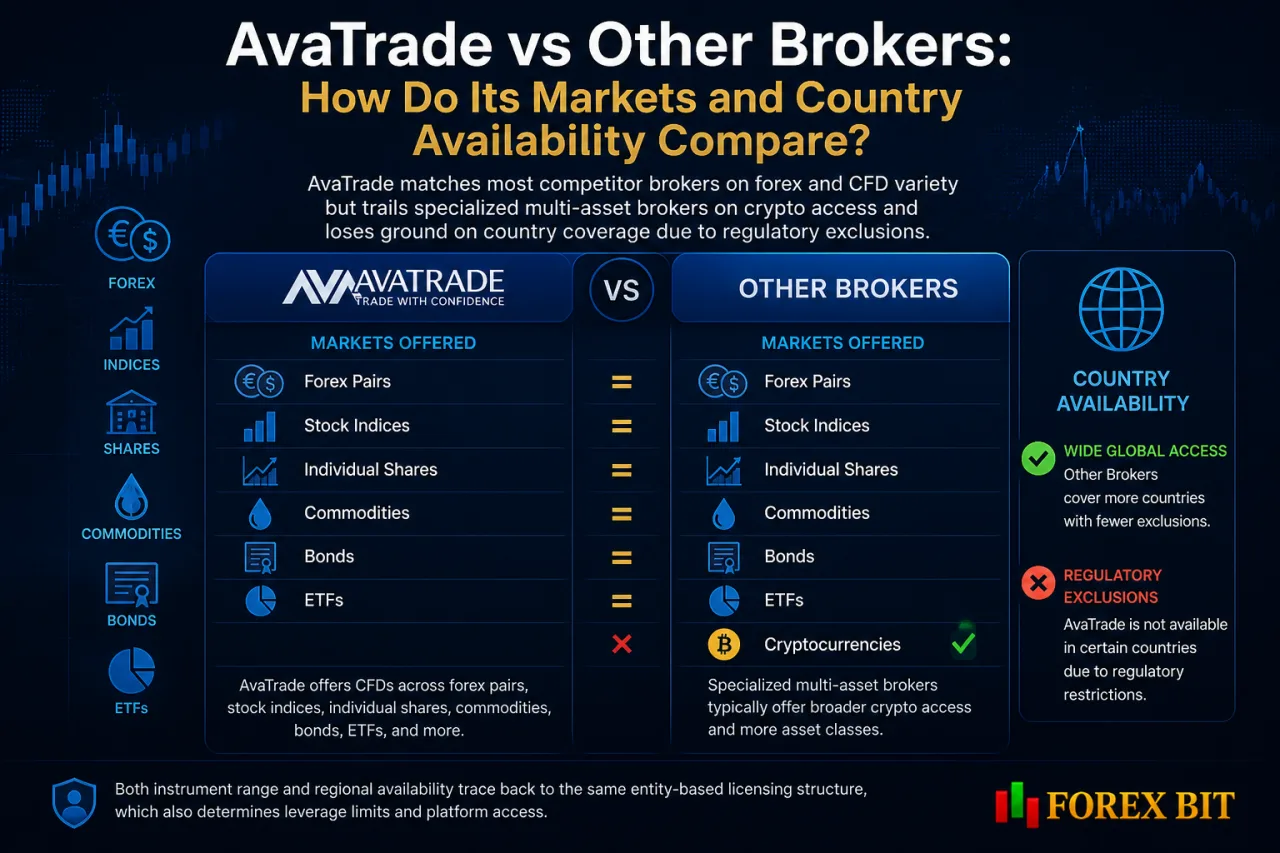
AvaTrade matches most competitor brokers on forex and CFD variety but trails specialized multi-asset brokers on crypto access and loses ground on country coverage due to regulatory exclusions. This comparison connects directly to the leverage and platform framework outlined earlier, since instrument range and regional availability both trace back to the same entity-based licensing structure.
AvaTrade offers CFDs across forex pairs, stock indices, individual shares, commodities, bonds, ETFs, and a limited selection of cryptocurrencies, with the exact range of instruments depending on the regulatory entity governing the account. This range sits in line with typical multi-asset brokers, though crypto CFD availability narrows further under stricter regulators that restrict retail access to digital assets.
Country availability varies more sharply than instrument range. AvaTrade restricts or excludes residents of certain countries, including the United States, from opening live trading accounts under its regulated entities. This exclusion stems directly from licensing terms tied to each regulatory entity, meaning access depends on which jurisdiction governs the account rather than a single unified policy across the broker.
Compared to brokers holding a single regulatory license, AvaTrade’s multi-entity structure widens overall regional reach but still leaves gaps in specific jurisdictions where local compliance requirements remain unmet.
What Unique Tools and Educational Resources Set AvaTrade Apart?
AvaTrade differentiates itself through three trader-facing offerings beyond regulation and pricing: AvaAcademy educational content, the AvaProtect risk management tool, and copy trading integrations with DupliTrade and ZuluTrade. These features connect directly to the platform ecosystem outlined earlier, since AvaProtect and the copy trading partners operate alongside AvaTradeGO and MetaTrader rather than as standalone products. The sections below break down each tool along with AvaTrade’s customer support channels and language coverage.
How Does AvaProtect Work as a Risk Management Feature?
AvaProtect works by letting eligible traders pay a small fee to insure a trade against loss over a set time window, with a refund credited if the position closes negative when that window expires. This mechanism separates AvaTrade from most competitors, since few brokers offer a built-in loss-refund tool directly inside a retail trading account.
The feature operates through AvaTradeGO and MetaTrader-linked accounts, where a trader selects a position, chooses a protection duration, and views the fee before confirming. AvaProtect availability depends on the trader’s registered regulatory entity and the specific instrument traded, since not all AvaTrade accounts or asset classes qualify for this feature.
If the protected trade closes in profit, the fee paid simply reduces net gains rather than triggering any refund. If it closes at a loss within the chosen window, AvaTrade credits the loss amount back to the trader’s account balance, functioning as a built-in hedge against short-term adverse price moves.
What Copy Trading and Social Trading Options Does AvaTrade Provide?
AvaTrade provides copy trading through two third-party integrations, DupliTrade and ZuluTrade, both connected directly to live AvaTrade trading accounts. This copy trading layer connects directly to the AvaAcademy and AvaProtect tools outlined earlier, since all three sit within the same broader AvaTrade ecosystem rather than functioning as separate standalone products.
DupliTrade links an AvaTrade account to a selection of vetted strategy providers, automatically mirroring their trades into the trader’s own account based on chosen risk settings. ZuluTrade operates on a similar principle but draws from a larger, ranked community of signal providers, letting traders filter by performance history and risk score before following a strategy.
Both integrations suit traders who prefer delegating trade execution to experienced signal providers rather than analyzing charts directly, including beginners building exposure and busy traders managing limited screen time. Account eligibility for DupliTrade and ZuluTrade depends on the trader’s registered regulatory entity, since not every AvaTrade jurisdiction supports both platforms equally.
Conclusion
AvaTrade earns its trustworthy reputation through a multi-jurisdictional regulatory framework, segregated client funds, negative balance protection, and transparent spread-based pricing rather than hidden costs. Its long operating history without insolvency or fund misappropriation incidents, paired with regulator-linked compensation schemes and disclosed fee structures, confirms genuine broker safety rather than marketing claims alone.
Combined with established platforms like MetaTrader 4, MetaTrader 5, and AvaTradeGO, plus differentiators such as AvaProtect and copy trading integrations, AvaTrade stands as a legitimate, well-regulated choice for global traders in 2026, provided each trader verifies the specific licensing entity, leverage limits, and country eligibility tied to their region before opening an account.
Thomas Dite is the Best Forex Brokers Research Manager at Forex Bit, specializing in researching, comparing, and editing broker-related content for different trader needs. He focuses on evaluating trading platforms, costs, regulation, account conditions, and other key factors to help readers make more informed broker comparisons.
Email: [email protected]