


- Strong FCA regulation
- Segregated funds & FSCS protection
- MT4, MT5 & TradingView support
- Wide range of tradable markets
- API trading & rewards program
- Higher costs on some products
- No US retail access
- Inactivity fee on dormant accounts
- Crypto CFD access is region-limited
This CMC Markets review evaluates the broker’s regulation, trading costs, platforms, and account structure to help traders decide whether it fits their strategy in 2026. CMC Markets operates as a multi-regulated forex and CFD broker offering a wide range of tradable instruments across currencies, indices, shares, and commodities.
CMC Markets is regulated by several top-tier financial authorities across multiple jurisdictions, including regulators in the UK, Australia, and Singapore. This regulatory coverage places CMC Markets among brokers subject to strict capital and client-fund segregation requirements.
CMC Markets offers variable spreads on major currency pairs, alongside a commission-based account option for active traders. Its proprietary Next Generation platform and MetaTrader 4 integration cater to different trading preferences and technical needs.
CMC Markets suits both beginner and experienced traders. The broker provides a demo account for practice alongside advanced charting tools and risk management features for active traders.
Beginners benefit from the demo account, which allows them to practice strategies in a risk-free environment before committing real funds. Experienced traders make use of the advanced charting tools and risk management features, such as stop-loss and take-profit orders, to manage active positions with greater precision.
Forex Bit examines these features in detail below, starting with the broker’s safety and regulatory standing, followed by its platforms and account types.
Is CMC Markets a Safe and Regulated Broker?
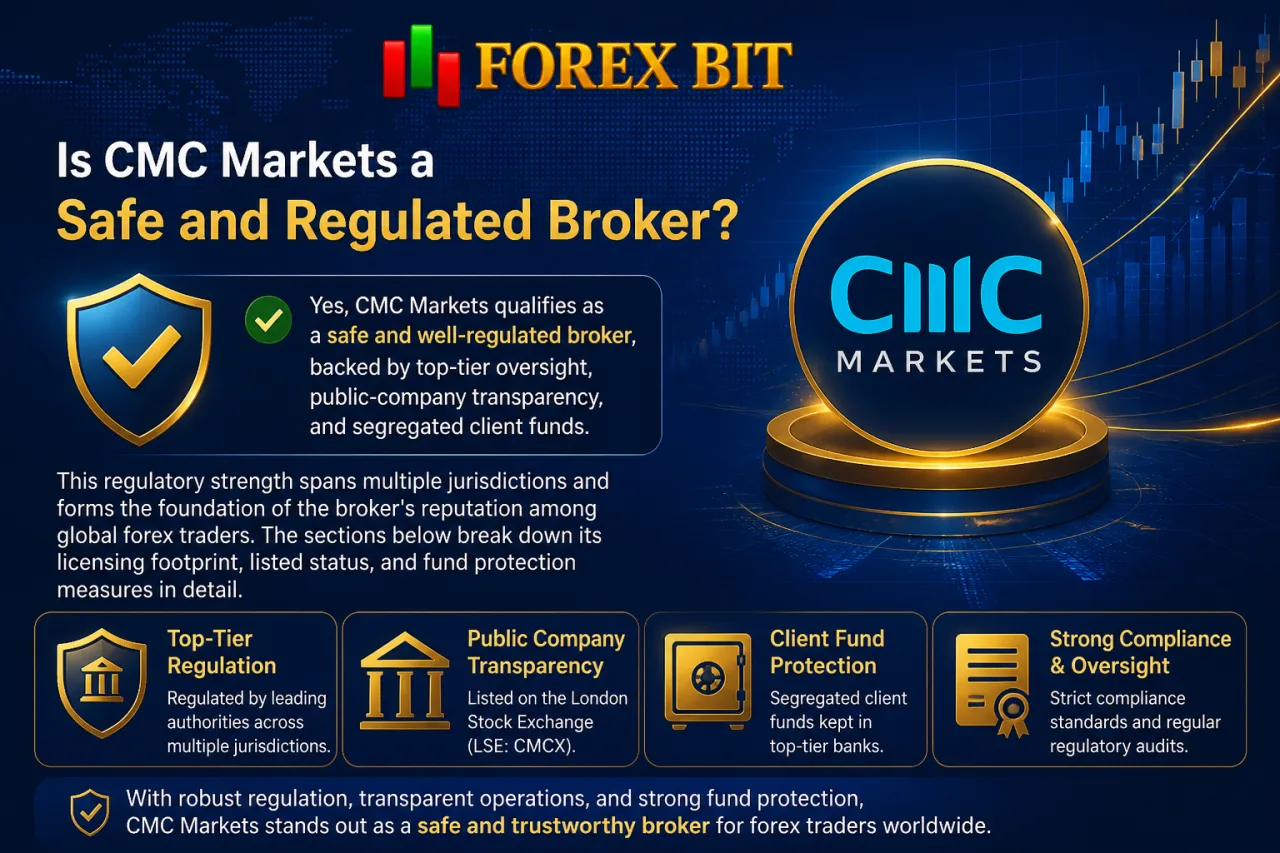
Yes, CMC Markets qualifies as a safe and well-regulated broker, backed by top-tier oversight, public-company transparency, and segregated client funds. This regulatory strength spans multiple jurisdictions and forms the foundation of the broker’s reputation among global forex traders. The sections below break down its licensing footprint, listed status, and fund protection measures in detail.
What Licenses and Regulators Oversee CMC Markets?
CMC Markets is regulated by several top-tier financial authorities across multiple jurisdictions, including markets in the UK, Australia, and Singapore, with each regional entity supervised separately. This licensing structure directly answers which authorities oversee CMC Markets and what protections traders receive under each.
The FCA-regulated entity serves UK clients and enforces client-money segregation along with adherence to negative balance protection rules for retail accounts. The UK arm also participates in the Financial Services Compensation Scheme, which covers eligible retail client claims up to a set limit if the broker fails.
ASIC oversight applies to Australian clients and mandates similar fund-segregation standards alongside regular financial reporting obligations. The MAS license governs CMC Markets’ Singapore operations, imposing capital adequacy rules typical of the region’s institutional-grade brokers. IIROC supervision extends these protections to Canadian traders, adding local dispute-resolution access. Together, these regulators reinforce CMC Markets’ standing as a multi-jurisdictional, publicly accountable broker.
How Does CMC Markets Protect Client Funds?
CMC Markets protects client funds through segregated bank accounts, negative balance protection for retail clients under FCA and ASIC rules, and compensation scheme coverage in regulated jurisdictions. This approach directly answers how client money stays separate from company operating funds and what happens if the broker faces financial difficulty.
Segregated accounts hold retail client deposits at approved banks separate from CMC Markets’ corporate funds, preventing use of client money for operational expenses. Negative balance protection applies to retail accounts under FCA and ASIC oversight, capping losses at the deposited balance during extreme market volatility. Eligible UK retail clients also receive coverage through the Financial Services Compensation Scheme up to a set limit if the broker becomes insolvent.
Australian and Singapore entities apply comparable fund-segregation standards, though compensation scheme availability varies by region and account classification. Professional clients typically fall outside negative balance protection and compensation scheme guarantees in most jurisdictions.
What Trading Platforms Does CMC Markets Offer?
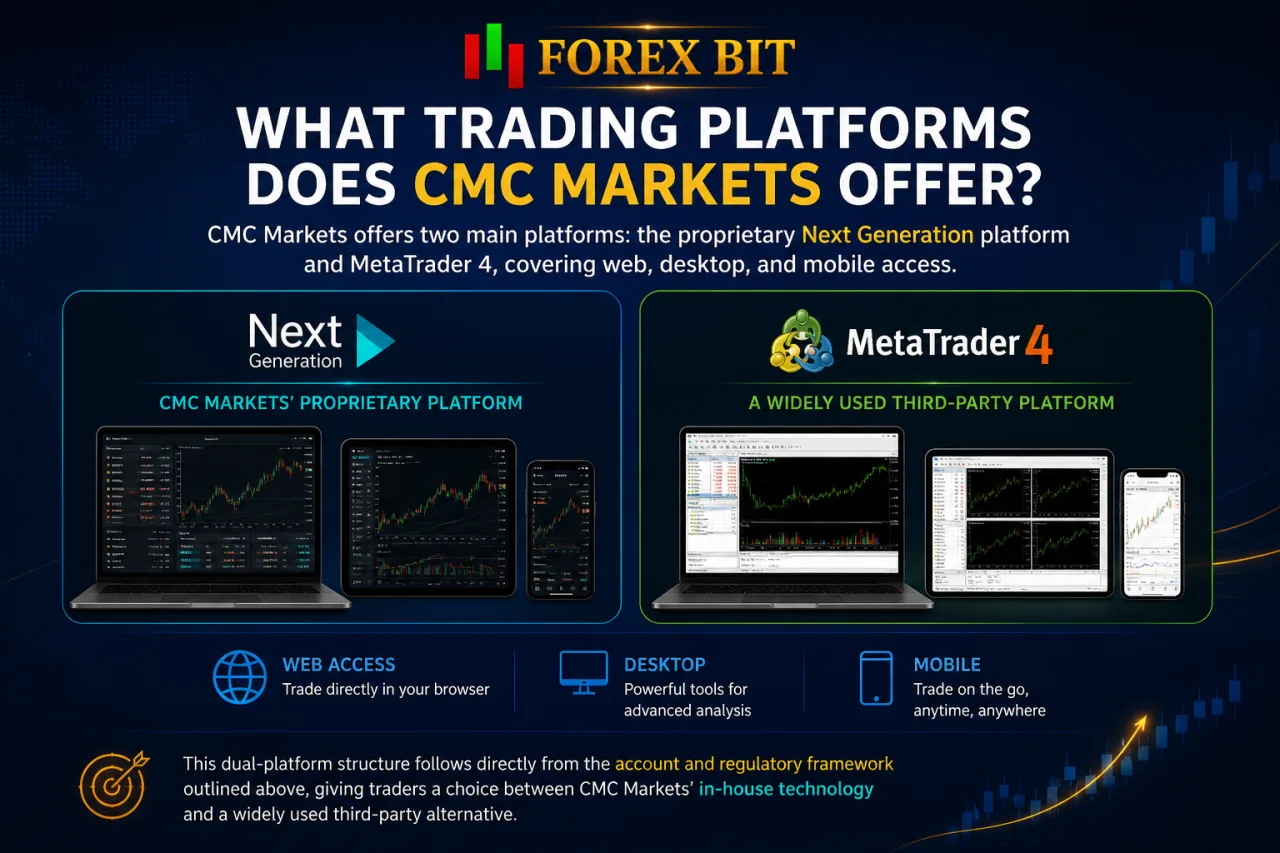
CMC Markets offers two main platforms: the proprietary Next Generation platform and MetaTrader 4, covering web, desktop, and mobile access. This dual-platform structure follows directly from the account and regulatory framework outlined above, giving traders a choice between CMC Markets’ in-house technology and a widely used third-party alternative. The next sections detail each platform’s tools, charting depth, and device availability.
CMC Markets Next Generation vs MetaTrader 4: Which Platform Fits Which Trader?
Next Generation suits active and technical traders through deeper charting and order flexibility, while MetaTrader 4 fits traders who prioritize automation and familiarity with a widely used third-party system. This comparison follows from the platform overview above, weighing charting depth, order types, and usability differences between the two systems.
Next Generation includes advanced technical analysis tools, pattern recognition, and a broader set of order types tailored to discretionary trading styles. CMC Markets’ Next Generation platform offers pattern-recognition scanning and customizable charting layouts built specifically for its proprietary system.
MetaTrader 4, by contrast, appeals to traders who rely on Expert Advisors, automated strategies, and third-party indicators developed across the broader MT4 ecosystem. Its interface favors traders already accustomed to MetaQuotes’ layout from other brokers.
Usability differs as well: Next Generation presents a more modern, streamlined web and mobile experience, while MT4 retains a simpler, function-driven design. Traders choosing between platform depth and algorithmic flexibility find their preference reflected in this split.
What Account Types Does CMC Markets Provide?
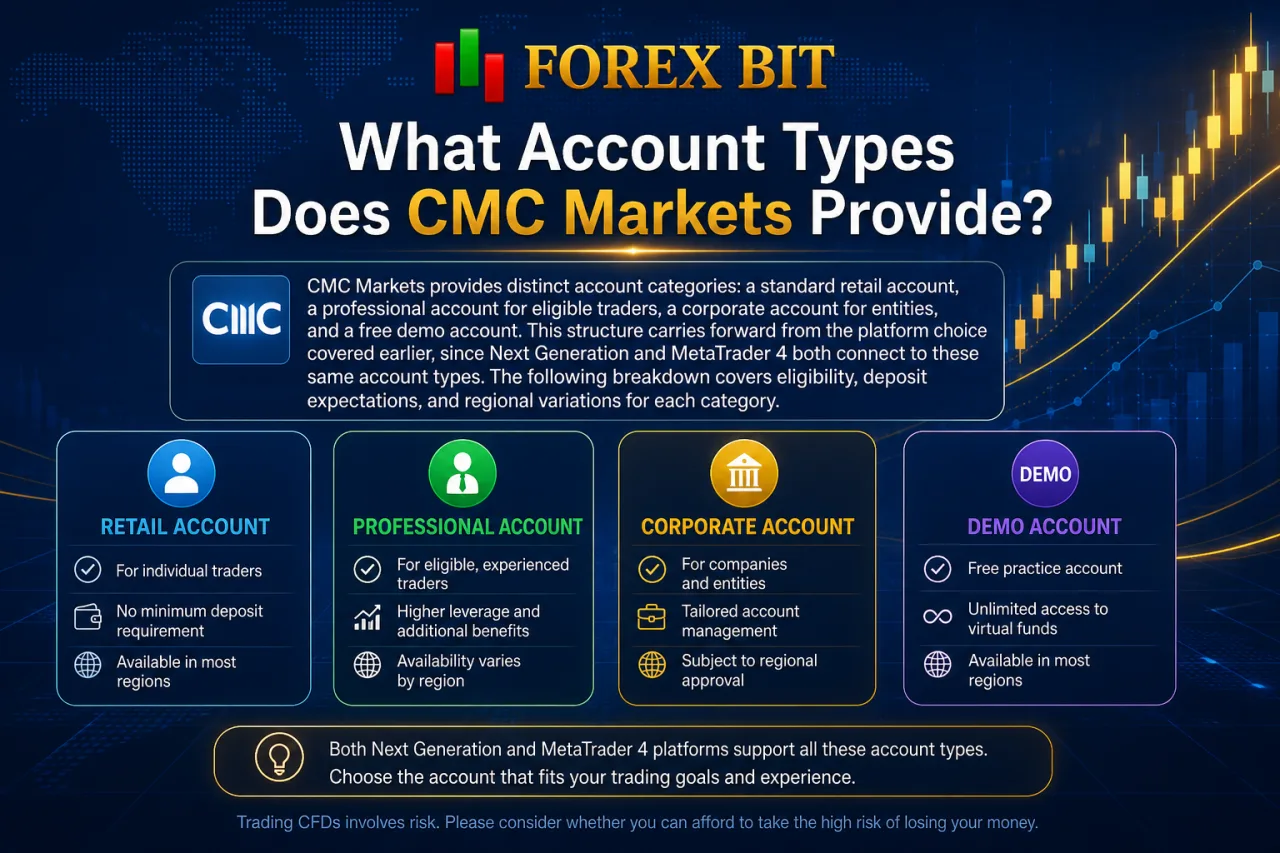
CMC Markets provides distinct account categories: a standard retail account, a professional account for eligible traders, a corporate account for entities, and a free demo account. This structure carries forward from the platform choice covered earlier, since Next Generation and MetaTrader 4 both connect to these same account types. The following breakdown covers eligibility, deposit expectations, and regional variations for each category.
How Do You Open a CMC Markets Trading Account?
Opening a CMC Markets trading account follows an online registration process with identity verification, typically completed within one business day for standard retail applicants. This process determines how quickly a trader moves from account creation to live trading access.
The application starts with basic personal details, followed by a suitability questionnaire covering trading experience and financial background. CMC Markets requires government-issued identification and proof of address as standard KYC documents before activating a live account.
Verification then proceeds through these steps:
- Submitting a passport or national ID for identity confirmation
- Providing a recent utility bill or bank statement for address verification
- Completing a financial suitability and experience assessment
- Funding the account through an approved payment method
Approval timeframes vary by jurisdiction and document quality, though most straightforward applications clear review faster than accounts requiring manual compliance checks. CMC Markets accounts remain in verification-pending status until documents pass internal compliance review, after which live trading access opens on the linked platform.
How Much Does It Cost to Trade with CMC Markets?
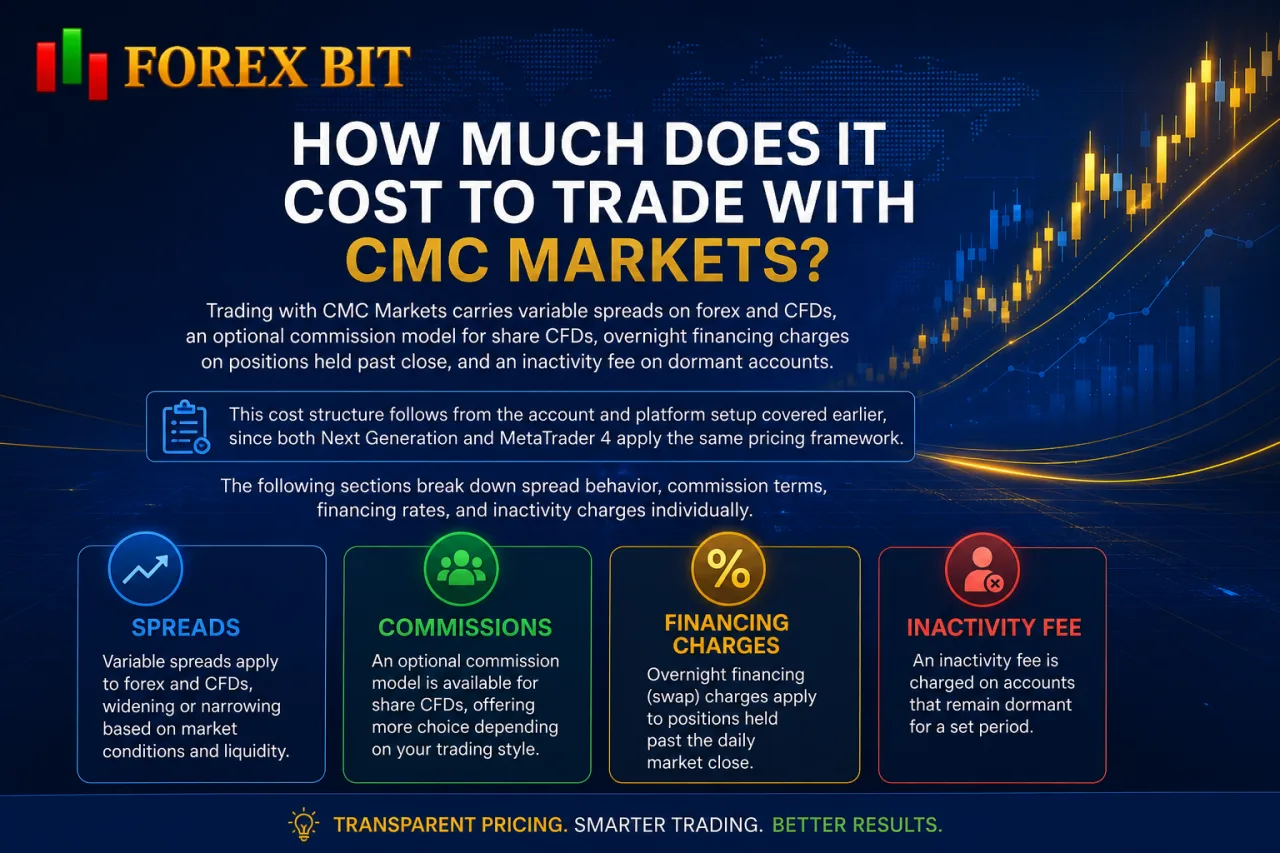
Trading with CMC Markets involves several cost components rather than a single flat fee. These include variable spreads on forex and CFDs, an optional commission model for share CFDs, overnight financing charges on positions held past close, and an inactivity fee on dormant accounts. This cost structure follows from the account and platform setup covered earlier, since both Next Generation and MetaTrader 4 apply the same pricing framework. The following sections break down spread behavior, commission terms, financing rates, and inactivity charges individually.
Are CMC Markets’ Fees Higher or Lower Than Other Forex Brokers?
CMC Markets prices its major forex pairs close to industry averages while charging slightly higher costs on some indices and share CFDs compared to discount-focused competitors. This positioning follows the spread and commission structure outlined above, weighing CMC Markets against typical benchmarks rather than naming specific rival brokers.
CMC Markets’ variable spreads on majors are broadly comparable to those offered by other established brokers providing standard, non-ECN account types.
Traders comparing pricing models find CMC Markets’ commission-based share CFD option roughly aligned with rates charged by other full-service brokers, rather than matching ultra-low-cost providers focused solely on high-volume execution. Overnight financing charges and the inactivity fee also fall within ranges typical of regulated, multi-asset brokers rather than at the extreme low or high end of the market.
Overall, CMC Markets trades a slight cost premium in certain instrument categories for broader platform tools, deeper market access, and multi-jurisdictional regulatory protection.
What Leverage Does CMC Markets Offer?
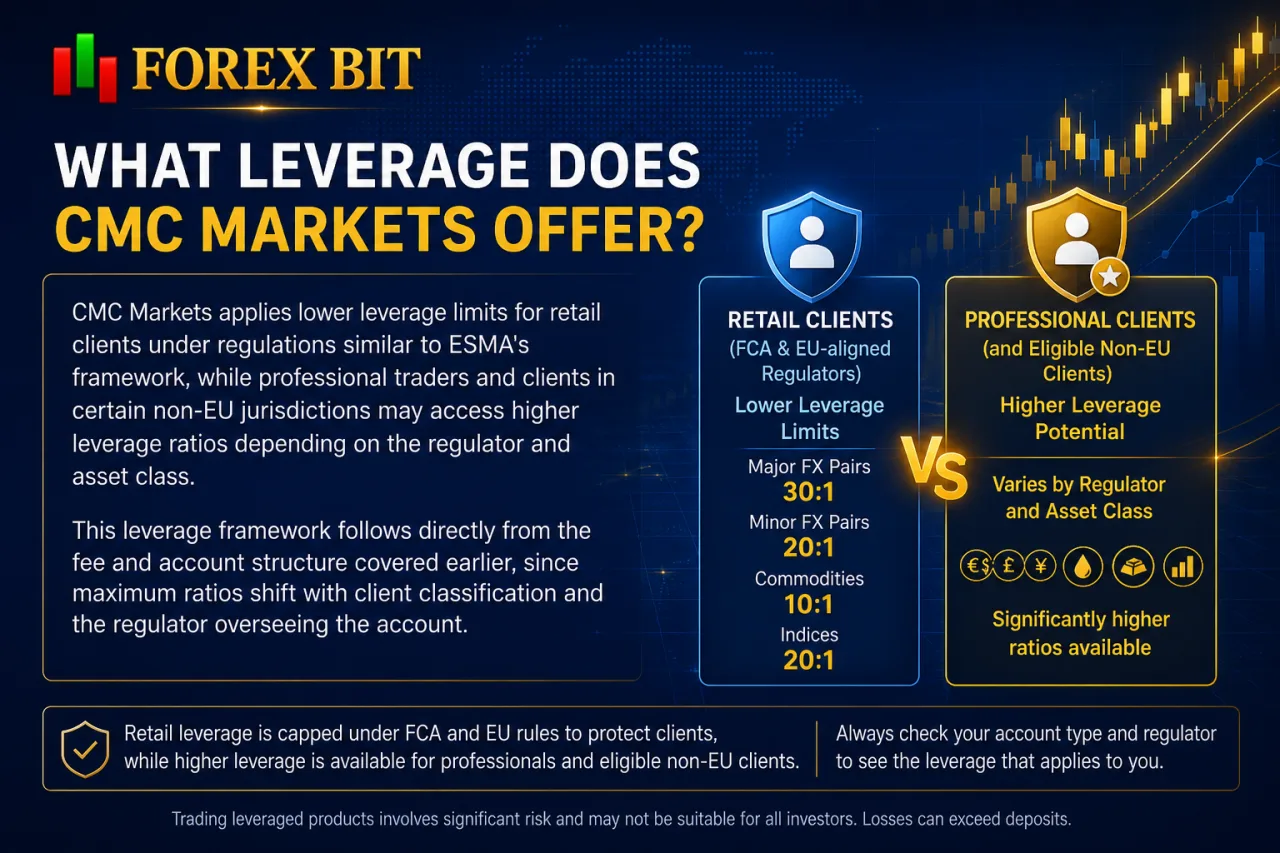
CMC Markets applies lower leverage limits for retail clients under regulations similar to ESMA’s framework, while professional traders and clients in certain non-EU jurisdictions may access higher leverage ratios depending on the regulator and asset class. This leverage framework follows directly from the fee and account structure covered earlier, since maximum ratios shift with client classification and the regulator overseeing the account.
Retail clients under FCA and comparable EU-aligned frameworks face tiered maximum leverage that lowers as instrument volatility rises, with major currency pairs receiving the highest allowance and single-stock CFDs the lowest. CMC Markets applies reduced leverage tiers on indices, commodities, and shares compared to major forex pairs, in line with standard retail protection rules.
Professional account holders who meet income, experience, or portfolio-size criteria qualify for substantially higher leverage, though they forfeit negative balance protection and compensation scheme coverage in the process. ASIC-regulated Australian retail accounts and IIROC-supervised Canadian accounts follow their own regional leverage caps rather than the ESMA-style structure applied to UK and EU clients. Traders operating under different entities therefore encounter varying maximum ratios for the same instrument.
What Markets and Instruments Can You Trade at CMC Markets?
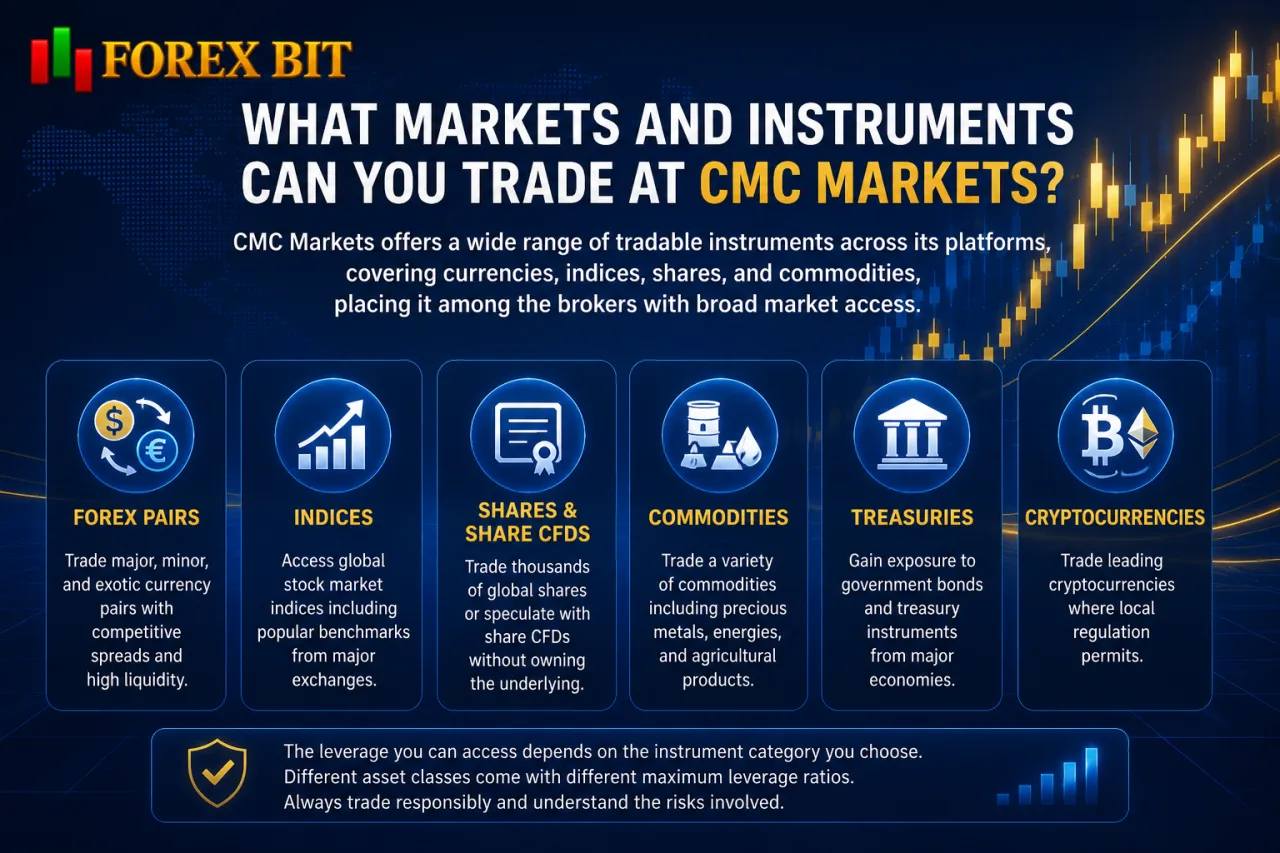
CMC Markets lists several main asset classes: forex pairs, indices, shares and share CFDs, commodities, treasuries, and cryptocurrencies where local regulation permits. This range follows from the leverage structure covered earlier, since maximum ratios shift depending on which of these instrument categories a trader selects.
CMC Markets offers a wide range of tradable instruments across its platforms, covering currencies, indices, shares, and commodities, placing it among the brokers with broader instrument ranges in the retail CFD industry.
The forex category covers major, minor, and exotic currency pairs traded through both Next Generation and MetaTrader 4. Indices span key global benchmarks, while shares and share CFDs give exposure to individual companies across multiple exchanges without requiring direct stock ownership.
Commodities include energy, metals, and agricultural markets priced as CFDs rather than physical delivery contracts. Treasuries add interest-rate-linked instruments for traders tracking bond markets. Cryptocurrency CFDs remain accessible only where the relevant regulator, such as the FCA or ASIC, permits retail access to these products.
How Do You Deposit and Withdraw Funds at CMC Markets?
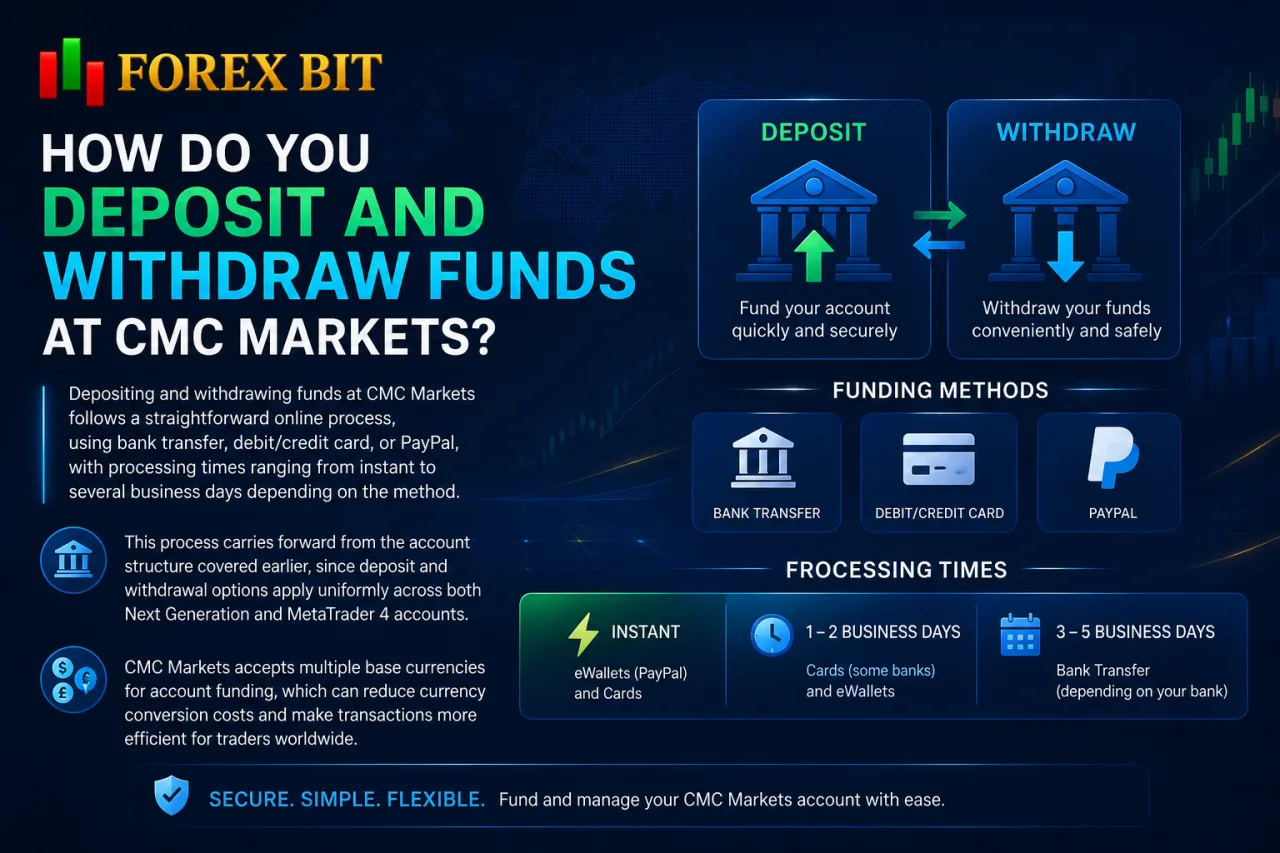
Depositing and withdrawing funds at CMC Markets follows a straightforward online process, using bank transfer, debit/credit card, or PayPal, with processing times ranging from instant to several business days depending on the method. This process carries forward from the account structure covered earlier, since deposit and withdrawal options apply uniformly across both Next Generation and MetaTrader 4 accounts.
CMC Markets accepts multiple base currencies for account funding, which can reduce conversion costs for traders depositing in a currency other than their account’s default.
Card and PayPal deposits typically credit the trading account faster than bank transfers, which require additional clearing time through the banking network. Withdrawals generally return to the original funding source, and CMC Markets processes standard withdrawal requests without charging a fee for the transaction itself. CMC Markets does not charge deposit or withdrawal fees under its standard policy, though intermediary banks may apply their own charges outside the broker’s control.
Processing speed also depends on the verification status of the account, since pending compliance checks delay fund release until documentation clears review.
Is CMC Markets Suitable for Beginners or Experienced Traders?

CMC Markets suits both beginner and experienced traders, since platform choice, research depth, and account structure adapt across experience levels rather than targeting a single trader type. This suitability spans platform complexity, educational resources, research tools, and support quality, each weighted differently depending on whether a trader is starting out or already managing an active strategy.
Beginners generally find MetaTrader 4 more approachable given its simpler, function-driven interface, while the demo account referenced earlier in this review allows practice without live capital at risk. Educational materials and guided account setup further support traders unfamiliar with CFD mechanics or platform navigation.
Experienced traders lean toward the Next Generation platform, using its deeper charting, pattern-recognition scanning, and broader order types for active, discretionary strategies. Access to a wider instrument range and professional account eligibility also appeals to traders seeking higher leverage and more technical control.
Overall, CMC Markets’ strengths include multi-jurisdictional regulation, dual-platform flexibility, and broad market access, while its limitations include a slight cost premium on certain instruments and leverage restrictions tied to retail classification.
What Are the Main Advantages and Drawbacks of CMC Markets?
CMC Markets balances multi-jurisdictional regulation, dual-platform depth, and a broad instrument range against a slight cost premium on certain products, no US retail access, and an inactivity fee on dormant accounts. This comparison weighs the regulatory and pricing details covered earlier against the practical limitations traders face when choosing this broker.
Strengths include:
- Holding oversight from top-tier regulators across the UK, Australia, and Singapore, reinforcing fund safety and compliance standards
- Offering dual-platform access through Next Generation and MetaTrader 4, covering both discretionary and automated trading styles
- Providing a wide instrument range spanning forex, indices, shares, commodities, treasuries, and cryptocurrency CFDs where permitted
- Applying transparent fund segregation and negative balance protection for retail clients under FCA and ASIC rules
Limitations include:
- Charging spreads on some indices and share CFDs above discount-focused competitors
- Excluding US retail traders from account access under current jurisdictional restrictions
- Applying an inactivity fee on accounts left dormant for an extended period
- Restricting cryptocurrency CFD access in regions where local regulators, such as the FCA or ASIC, limit retail exposure
Traders should verify the current inactivity fee terms directly with CMC Markets before leaving an account untraded for a long stretch.
These trade-offs position CMC Markets as a broker suited to regulatory-conscious traders willing to accept moderate costs for broader market access and platform choice.
How Responsive Is CMC Markets’ Customer Support?
CMC Markets offers customer support through live chat, phone, and email, with UK and Australian desks generally operating during extended weekday hours aligned to trading sessions. This responsiveness follows from the multi-jurisdictional regulatory structure covered earlier, since support desks split by region rather than operating as a single global team.
Live chat typically delivers the fastest response for account and platform queries, while email handles more complex compliance or verification questions that require document review. Phone support remains available for urgent trading or withdrawal issues, though availability windows differ between the UK, Australian, and Singapore entities.
Trader feedback on CMC Markets’ support quality tends to be positive, particularly regarding platform navigation and account verification issues. Response times can extend outside core market hours, since coverage narrows on weekends and regional public holidays. Traders working across time zones may notice delays when contacting a desk outside its designated operating region.
What Unique Tools and Research Features Set CMC Markets Apart?
CMC Markets stands apart through four distinctive research and execution features: the Insights news and analysis hub, the Pattern Recognition Scanner, client sentiment indicators, and API access for algorithmic trading. This set of tools carries forward from the platform and instrument coverage outlined earlier, since each feature integrates directly into the Next Generation platform rather than existing as a separate product. The following breakdown covers each tool’s function and the trader profile it best serves.
Does CMC Markets Support API and Algorithmic Trading?
Yes, CMC Markets supports API and algorithmic trading, primarily through its Next Generation platform infrastructure rather than MetaTrader 4’s standard interface. This API access sets CMC Markets apart from brokers offering only manual or MT4-based execution, and the following details cover its purpose and typical users.
The API connects to CMC Markets’ pricing and order-execution engine, letting external software place trades, stream market data, and manage positions without manual platform input. CMC Markets’ API access is generally geared toward quantitative traders, developers, and institutional-style users looking to build custom automated strategies outside the standard platform interface.
Retail traders relying on discretionary strategies generally find little use for this feature, since Next Generation’s built-in charting and order tools already cover standard trading needs. Traders running systematic or high-frequency approaches gain more value from API connectivity than those trading manually.
What Awards and Industry Recognition Has CMC Markets Received?
CMC Markets has received industry recognition over the years for its trading platform, research tools, and overall service quality. This recognition follows from the platform depth and research features covered earlier, since award categories typically judge charting tools, execution quality, and client service rather than regulatory status alone.
Independent industry publications and trading-focused award bodies have historically ranked CMC Markets among leading brokers for platform technology and market research. CMC Markets has received industry recognition in categories covering CFD trading, forex execution, and mobile app functionality from various financial industry award panels.
Award recognition alone does not substitute for verifying current regulatory standing, fee structures, or platform performance before opening an account. Traders researching CMC Markets’ award history should confirm the most recent rankings directly through the broker’s official channels or verified financial media sources, since award cycles and criteria change annually.
Conclusion
CMC Markets earns its standing as a multi-regulated broker through top-tier oversight in the UK, Australia, and Singapore, segregated client funds, and negative balance protection for retail accounts. Its dual-platform setup pairs the technical depth of Next Generation with the automation strengths of MetaTrader 4, while research tools like the Pattern Recognition Scanner and API access add further value for active and systematic traders.
Costs run slightly above discount-focused rivals on certain indices and share CFDs, and US retail traders remain excluded, yet the broad instrument range and regulatory transparency outweigh these trade-offs for traders prioritizing safety and platform choice over rock-bottom pricing.
Thomas Dite is the Best Forex Brokers Research Manager at Forex Bit, specializing in researching, comparing, and editing broker-related content for different trader needs. He focuses on evaluating trading platforms, costs, regulation, account conditions, and other key factors to help readers make more informed broker comparisons.
Email: [email protected]