


- Low minimum deposit
- Fast trade execution
- Built-in copy trading
- No broker-side withdrawal fees
- Multi-asset trading access
- No FCA or ASIC license
- Not available to US traders
- Lower leverage for EU clients
- Compensation coverage is limited
- Offshore entities offer weaker protection
Octa is a multi-regulated broker that has operated in the retail forex market for many years. Traders evaluating safety in 2026 need to look beyond marketing claims and verify the broker’s actual licensing footprint and client fund protections.
Octa holds licenses from multiple offshore and international financial regulators, though it does not currently hold a top-tier license such as the FCA or ASIC. This regulatory structure directly affects which countries can legally access Octa’s services.
Octa offers a limited set of account types, typically including a standard account with no fixed commission and competitive spreads, alongside a swap-free option. Leverage limits also vary depending on the trader’s region and account settings.
Octa supports MetaTrader 4 and MetaTrader 5, alongside its own proprietary OctaTrader platform, giving traders access across desktop, web, and mobile. Deposit and withdrawal options, along with country availability, differ based on local payment infrastructure and regulatory restrictions.
Forex Bit breaks down each of these factors in detail below, starting with a direct look at whether Octa qualifies as a safe and legitimate broker to trade with in 2026.
Is Octa a Safe and Legitimate Broker to Trade With in 2026?
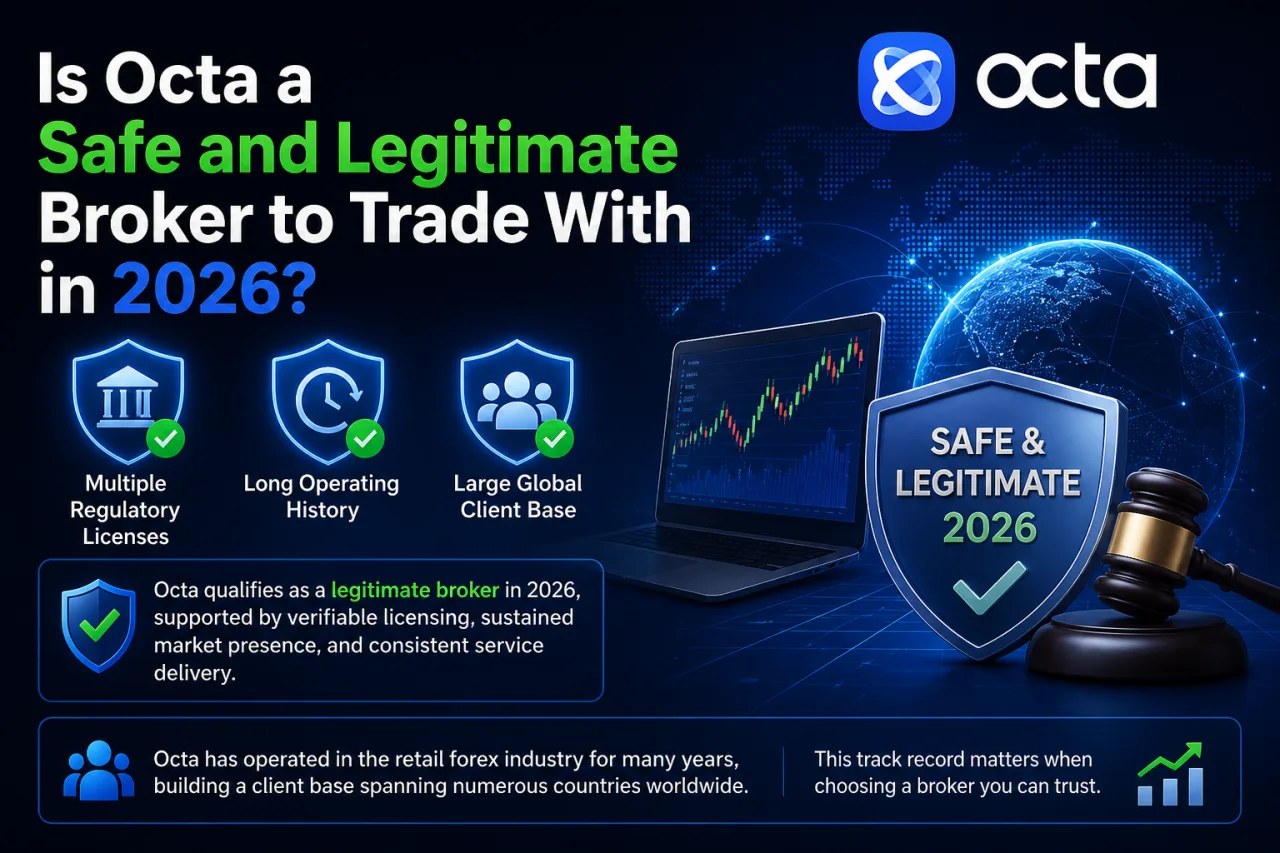
Octa qualifies as a legitimate broker in 2026, supported by multiple regulatory licenses, a long operating history, and a large global client base, though it falls short of top-tier oversight. Legitimacy in this case rests on verifiable licensing, sustained market presence, and consistent service delivery rather than marketing claims alone.
Octa has operated in the retail forex industry for many years, building a client base spanning numerous countries worldwide.
This track record matters when assessing whether a broker is safe to trade with, since longevity and scale reduce the likelihood of a broker being a short-lived or fraudulent operation. Several factors support this overall safety verdict for Octa:
- Regulatory licensing from multiple offshore and international authorities, detailed further in the regulation section above.
- Segregated client funds policies commonly cited by the broker for capital protection.
- A consistent trading environment maintained across MetaTrader 4, MetaTrader 5, and OctaTrader.
- Industry recognition through broker awards received over the years.
Traders in regions with stricter regulatory expectations still need to weigh Octa’s offshore licensing structure against their own risk tolerance before depositing funds.
Is Octa Regulated? What Licenses Does Octa Hold?
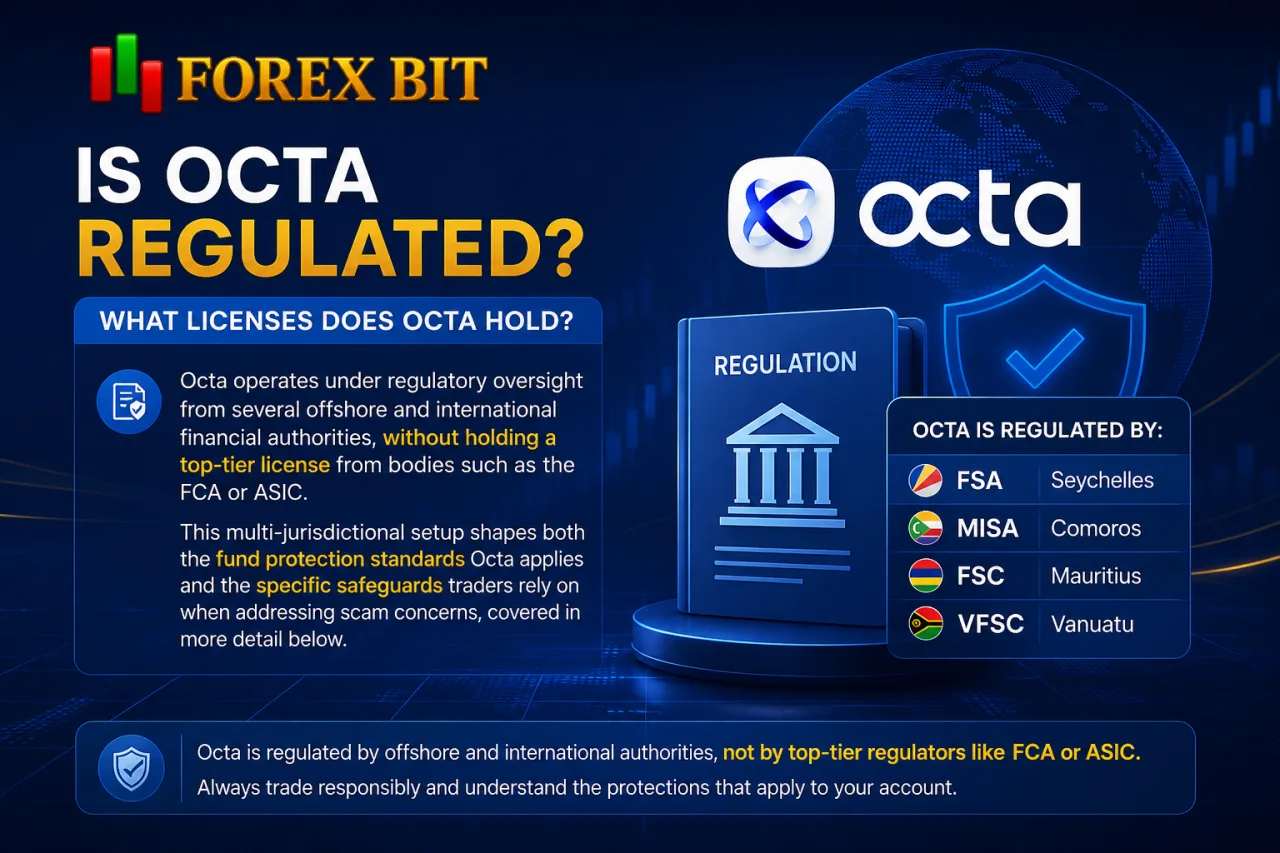
Octa operates under regulatory oversight from several offshore and international financial authorities, without holding a top-tier license from bodies such as the FCA or ASIC. This multi-jurisdictional setup shapes both the fund protection standards Octa applies and the specific safeguards traders rely on when addressing scam concerns, covered in more detail below.
Which Regulatory Bodies Oversee Octa’s Operations?
Octa’s regulatory footprint spans several offshore and international financial authorities, each licensing a separate corporate entity rather than one single global registration. This structure reflects how Octa segments its client base by region and account jurisdiction.
The oversight bodies attached to Octa entities include the following:
- Financial Services Authority of Saint Vincent and the Grenadines, covering registration of the parent business structure.
- Cyprus Securities and Exchange Commission, noted as a regulator applicable to entities serving traders across the European Economic Area.
- Financial Sector Conduct Authority of South Africa, noted as a regulator applicable to the entity serving traders in that jurisdiction.
- Additional offshore financial registrations under which affiliated Octa entities are set up outside the jurisdictions above.
Oversight strength differs between these bodies, as regulators covering EU-facing entities generally apply stricter capital and conduct standards compared with the lighter compliance requirements typical of offshore registrations. Traders opening accounts under an offshore-registered Octa entity operate with fewer regulatory protections than those onboarded through the CySEC-regulated entity.
How Does Octa Protect Client Funds?
Octa protects client funds primarily through segregated account structures that separate client money from company operating capital. This measure addresses the fund safety concern raised throughout the regulation discussion above, since segregation limits the risk of client deposits being used for the broker’s own business expenses.
Beyond segregation, Octa applies negative balance protection across retail client accounts. This mechanism resets an account back to zero when losses would otherwise exceed the deposited balance, preventing traders from owing Octa money after extreme market volatility. Octa also references its CySEC-regulated entity as being covered under the Investor Compensation Fund available to Cyprus-regulated brokers, though specific compensation limits and eligibility conditions should be confirmed directly with the regulator or the broker.
Traders opening accounts under offshore-registered Octa entities typically do not qualify for this compensation scheme, since it applies only to the CySEC-licensed entity. This distinction matters when comparing protection levels across the broker’s different regional entities. Overall, these combined measures form Octa’s core approach to safeguarding trader capital rather than relying on a single protective layer.
What Account Types Does Octa Offer?
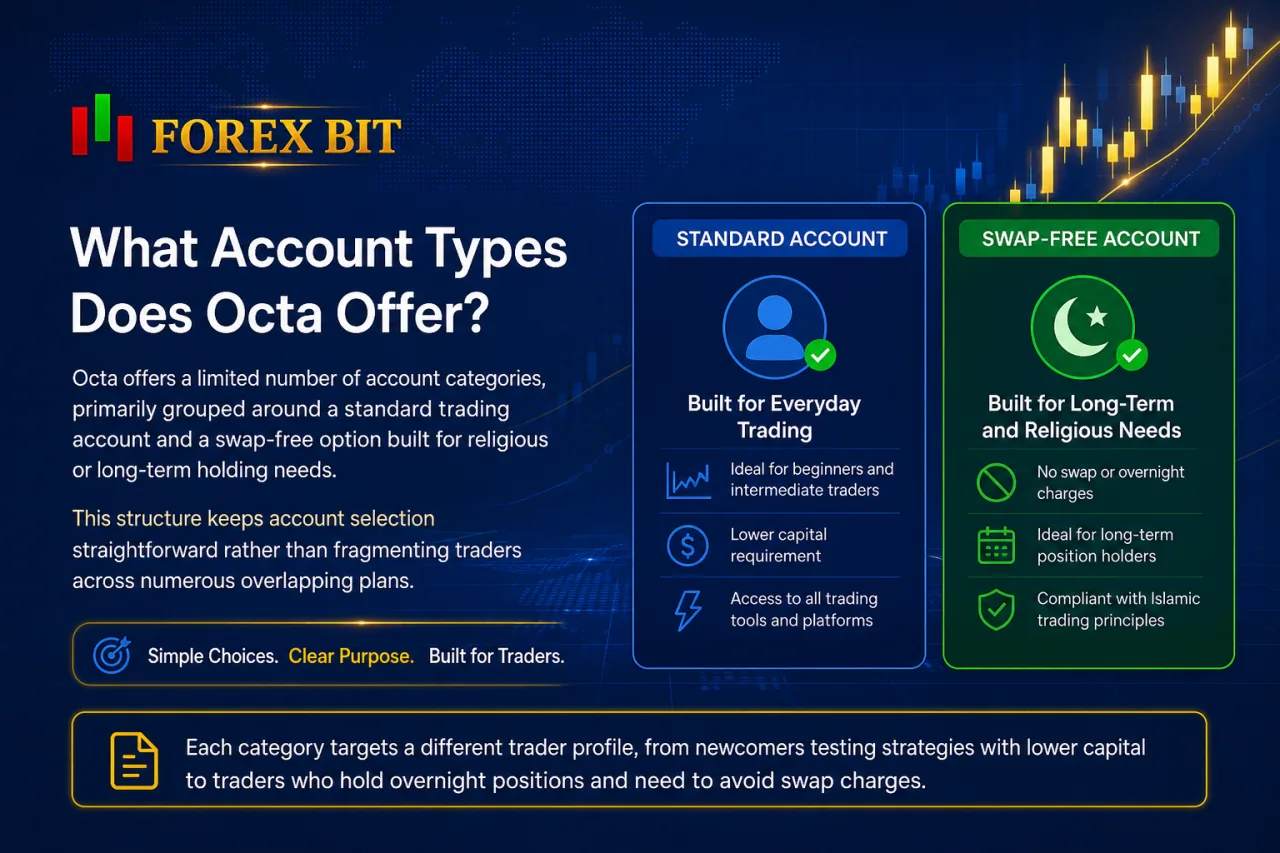
Octa offers a limited number of account categories, primarily grouped around a standard trading account and a swap-free option built for religious or long-term holding needs. This structure keeps account selection straightforward rather than fragmenting traders across numerous overlapping plans.
Each category targets a different trader profile, from newcomers testing strategies with lower capital to traders who hold overnight positions and need to avoid swap charges. The subsections below break down the specific account types, their minimum deposit requirements, and how leverage and spread conditions differ across each option.
How Do Octa’s Account Types Compare to Each Other?
Octa’s Standard account offers easier accessibility with a low minimum deposit, while the Swap-Free account matches its spreads but replaces overnight interest with other fee adjustments.
Both account types share the same commission-free pricing model, meaning trading costs sit within the spread rather than as a separate fee line. The table below summarizes the core differences traders weigh when picking between the two.
| Feature | Standard Account | Swap-Free Account |
|---|---|---|
| Minimum deposit | Low entry threshold | Low entry threshold |
| Commission | None (spread-based) | None (spread-based) |
| Overnight swap fees | Applied | Waived |
| Best suited for | General intraday and swing trading | Long-term or overnight position holders |
| Leverage | Region-dependent | Region-dependent |
Traders holding positions for extended periods generally lean toward the Swap-Free option to avoid interest charges, while short-term traders find little practical difference between the two setups given the shared spread structure.
What Are Octa’s Spreads, Fees, and Commissions?
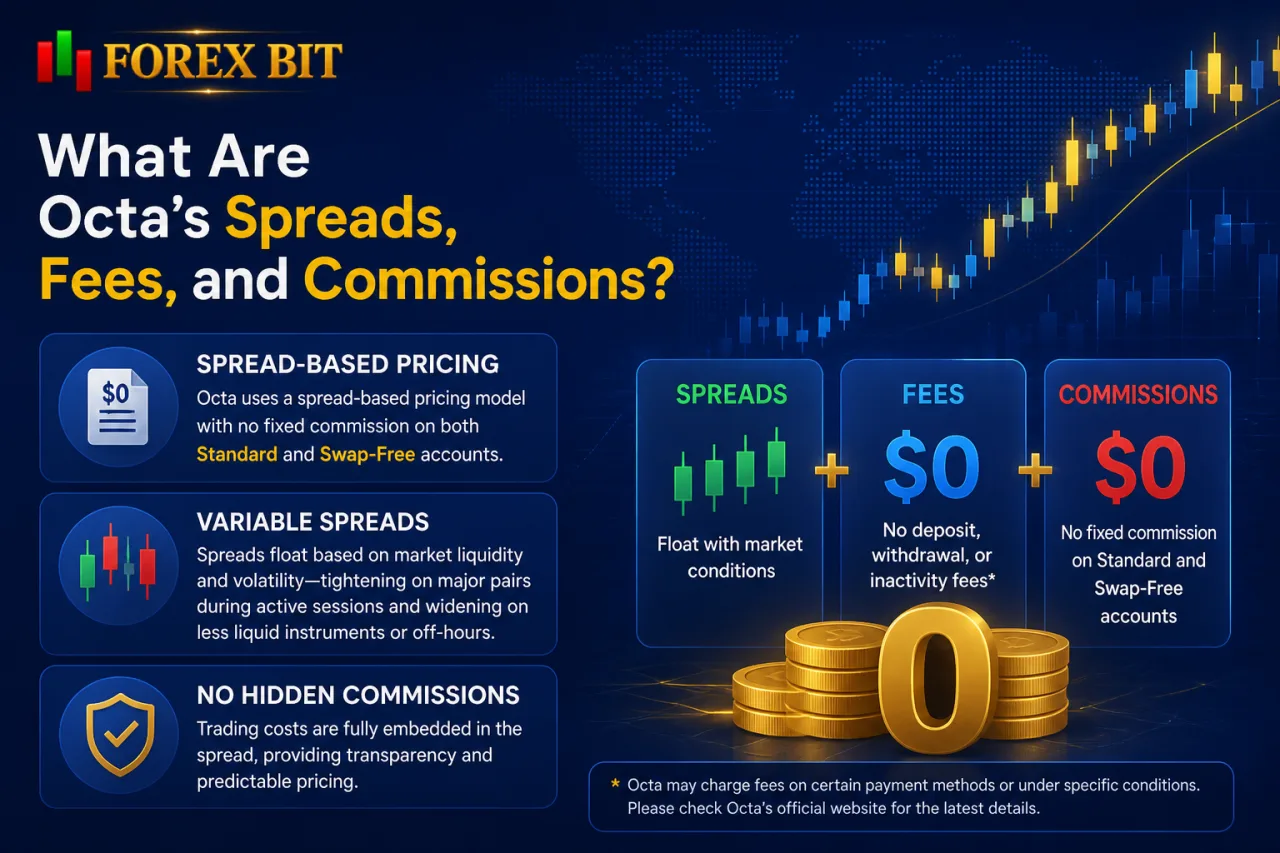
Octa applies a spread-based pricing model with no fixed commission on its Standard and Swap-Free accounts, keeping trading costs embedded directly in the spread. This structure continues the account comparison discussed above, where both account types share the same commission-free approach.
Spreads float according to market liquidity and volatility, tightening during active trading sessions on major currency pairs and widening on less liquid instruments or during off-hours. Octa advertises spreads starting from a low level on major currency pairs under normal market conditions.
Swap fees apply on the Standard account for positions held overnight, calculated per instrument based on interest rate differentials, while the Swap-Free account waives these charges in exchange for other fee adjustments already outlined earlier.
Beyond spreads and swaps, Octa does not charge deposit fees, and withdrawal costs generally depend on the payment method used rather than a flat broker-side charge. Inactivity fees are not a standard feature of Octa’s core account terms based on publicly available information. A full breakdown of spreads by individual currency pair, commodity, and index sits outside this overview and is covered in a dedicated instrument-level comparison.
What Leverage Does Octa Offer?
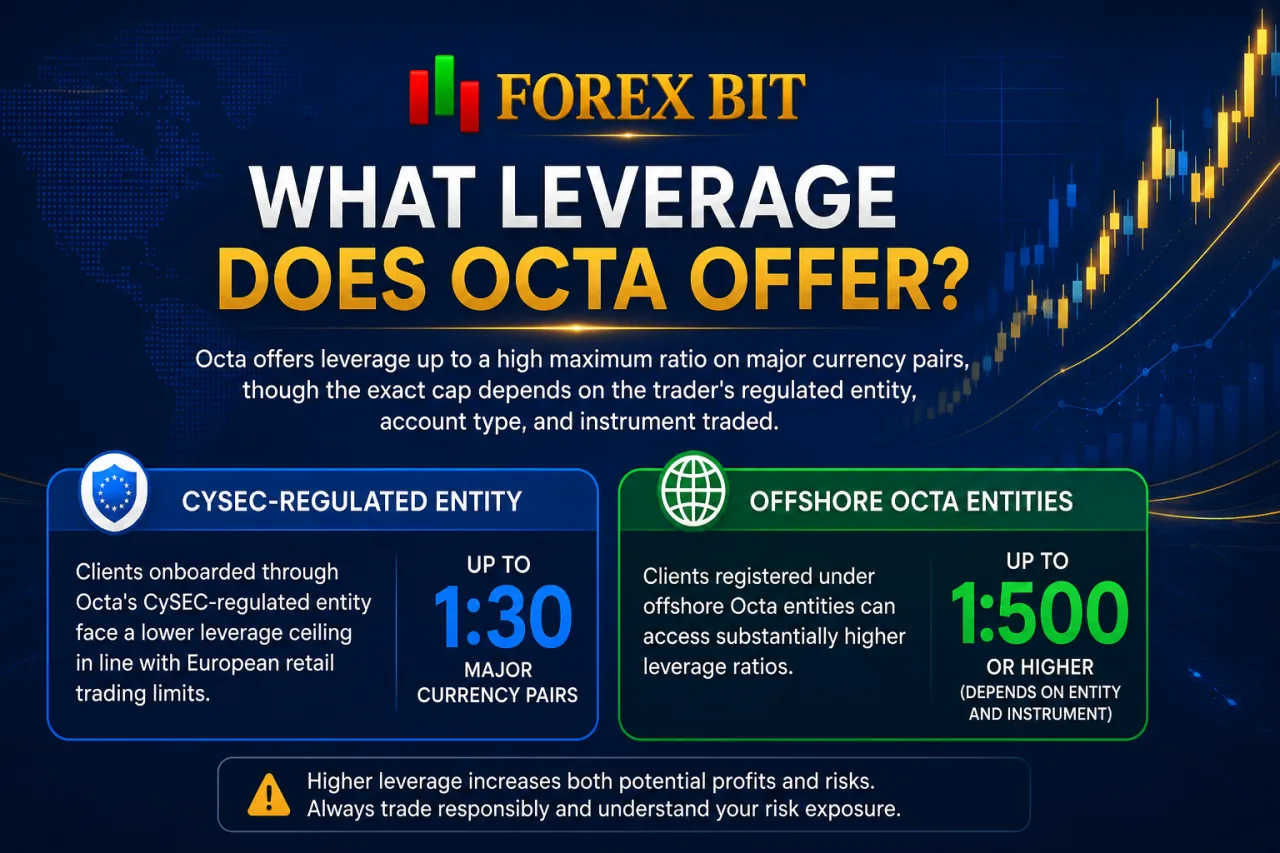
Octa offers leverage up to a high maximum ratio on major currency pairs, though the exact cap depends on the trader’s regulated entity, account type, and instrument traded. This leverage structure ties directly into the account and risk factors already outlined above.
Clients onboarded through Octa’s CySEC-regulated entity face a lower leverage ceiling in line with European retail trading limits, while clients registered under offshore Octa entities can access substantially higher leverage ratios.
Leverage also varies by instrument, with currency pairs typically carrying higher available ratios than indices, commodities, or cryptocurrencies. Octa may reduce leverage automatically as position size or account equity grows, a common risk-control practice across multi-regulated brokers.
High leverage amplifies both potential gains and potential losses on the same trade size. Traders using elevated leverage ratios carry greater exposure to margin calls during volatile price swings, making position sizing and stop-loss placement more critical than the leverage ratio itself.
Which Trading Platforms Does Octa Support?
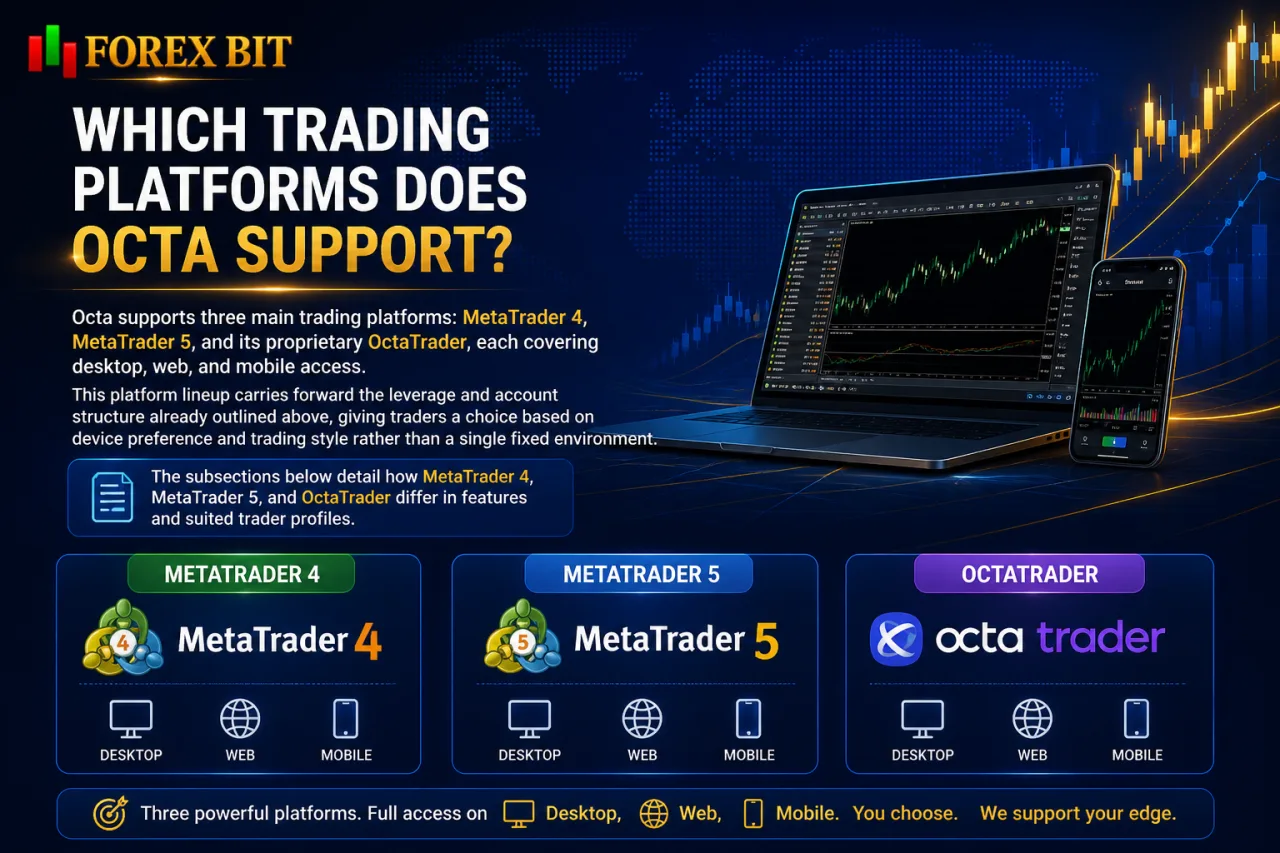
Octa supports three main trading platforms: MetaTrader 4, MetaTrader 5, and its proprietary OctaTrader, each covering desktop, web, and mobile access. This platform lineup carries forward the leverage and account structure already outlined above, giving traders a choice based on device preference and trading style rather than a single fixed environment. The subsections below detail how MetaTrader 4, MetaTrader 5, and OctaTrader differ in features and suited trader profiles.
MetaTrader vs OctaTrader: Which Platform Should You Choose?
MetaTrader wins on algorithmic trading tools and third-party indicator support, while OctaTrader wins on ease of use and streamlined account management for newer traders. This comparison builds on the platform lineup already outlined above, weighing accessibility, tools, and overall trading experience across the three options.
MetaTrader 4 and MetaTrader 5 favor traders who rely on Expert Advisors, custom scripts, and a wide library of third-party indicators built up over years of community development. Both versions run across desktop, web, and mobile, with MetaTrader 5 adding a broader range of order types and a built-in economic calendar not present in MetaTrader 4.
OctaTrader, by contrast, targets traders who prioritize a simplified interface, in-app deposit and withdrawal handling, and direct access to account management features without switching between separate applications. It suits beginners and traders who value convenience over deep customization.
Traders needing automated strategy execution generally lean toward MetaTrader, while those wanting a lighter, all-in-one experience across web and mobile find OctaTrader more practical for daily account operations.
What Markets and Instruments Can You Trade With Octa?
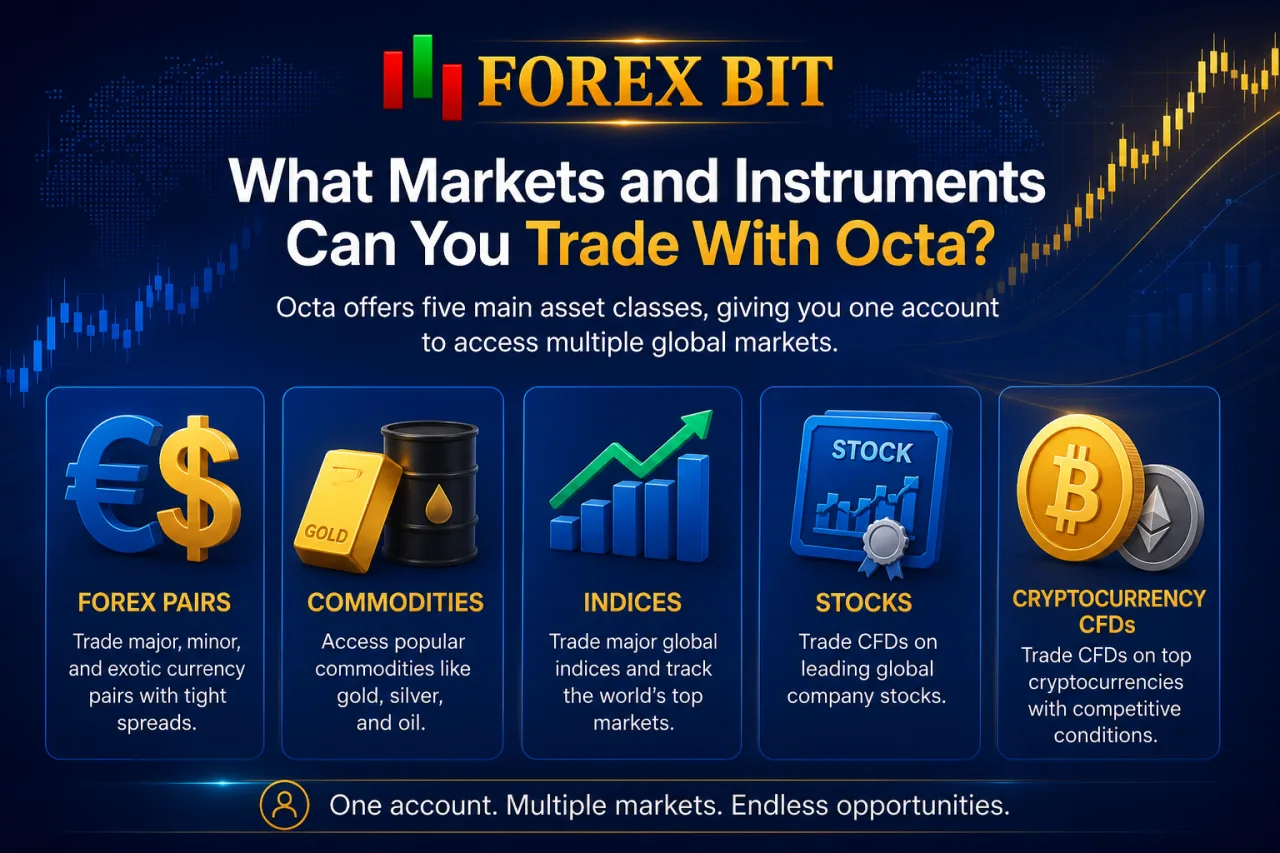
Octa offers five main asset classes: forex pairs, commodities, indices, stocks, and cryptocurrency CFDs. This range extends the platform and trading-cost details already outlined above, giving traders a single account structure through which to access multiple markets rather than separate setups per instrument type.
Forex pairs make up the core of Octa’s offering, spanning major, minor, and exotic currency combinations traded through spread-based pricing on the Standard and Swap-Free accounts. Commodities cover instruments such as metals and energy products, priced as CFDs rather than physical delivery contracts. Indices give exposure to major global stock benchmarks without requiring ownership of underlying shares, while stock CFDs let traders speculate on individual company price movements without holding the actual equity. Cryptocurrency CFDs round out the lineup, letting traders take positions on major digital assets through the same MetaTrader or OctaTrader interface used for other instrument classes.
This mix suits traders seeking a single broker relationship covering both traditional and digital markets, though instrument availability within each class depends on the specific Octa entity and account jurisdiction.
How Do You Deposit and Withdraw Funds With Octa?
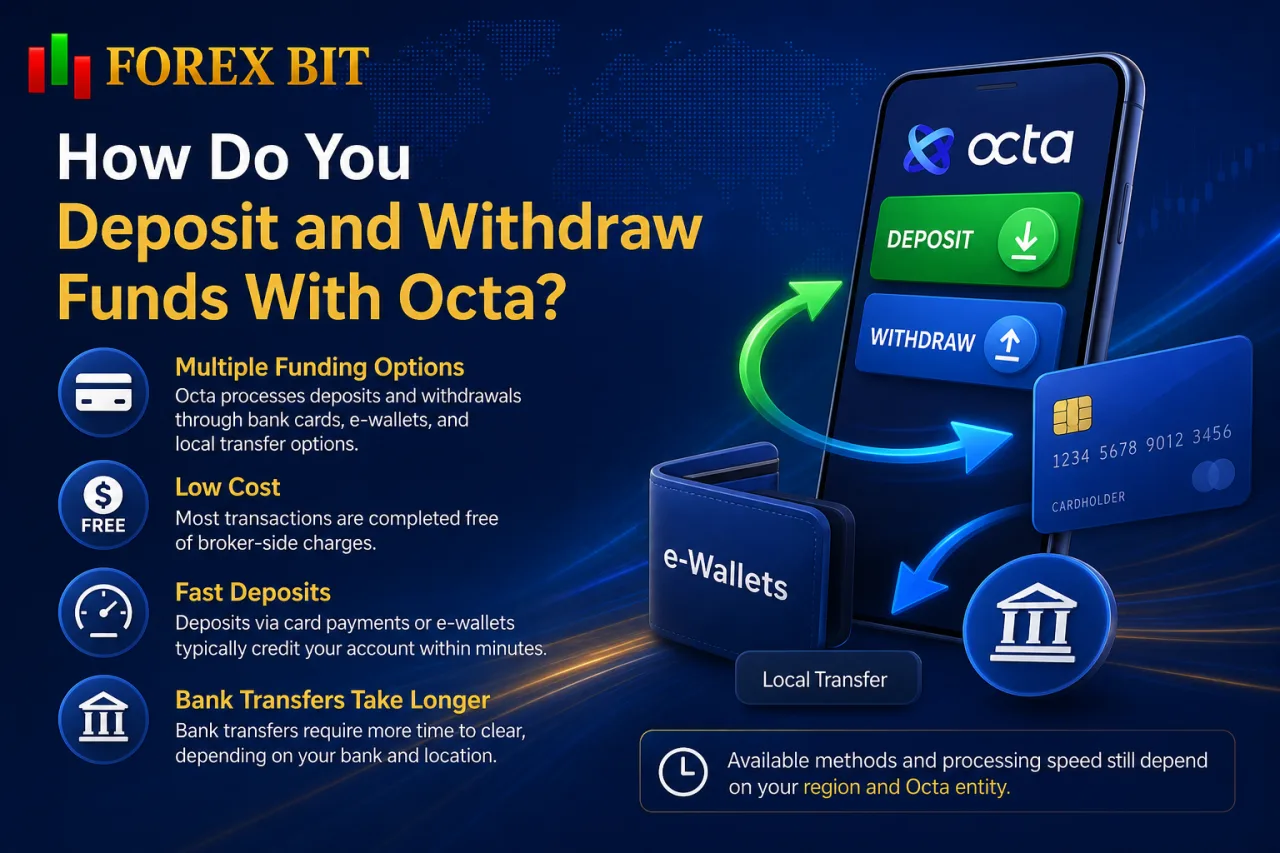
Octa processes deposits and withdrawals through bank cards, e-wallets, and local transfer options, with most transactions completed free of broker-side charges. This funding process ties into the account and payment infrastructure already outlined above, since available methods and processing speed still depend on the trader’s region and Octa entity.
Deposits typically credit the trading account within minutes when made through card payments or e-wallets, though bank transfers take longer to clear. Octa does not charge a deposit fee on standard funding methods, and withdrawal costs generally come from the payment provider rather than the broker itself.
Common funding channels include:
- Bank cards, covering major debit and credit card networks.
- E-wallets, including widely used digital payment services available in the trader’s region.
- Local bank transfers, tailored to regional banking systems in supported countries.
- Regional payment methods, offered selectively depending on country availability.
Withdrawal processing generally returns funds through the same method used for the original deposit, a standard anti-fraud practice among regulated brokers.Traders using e-wallets typically see faster withdrawal turnaround than those relying on bank transfers, which tend to take longer to settle.
Is Octa Available in Your Country?
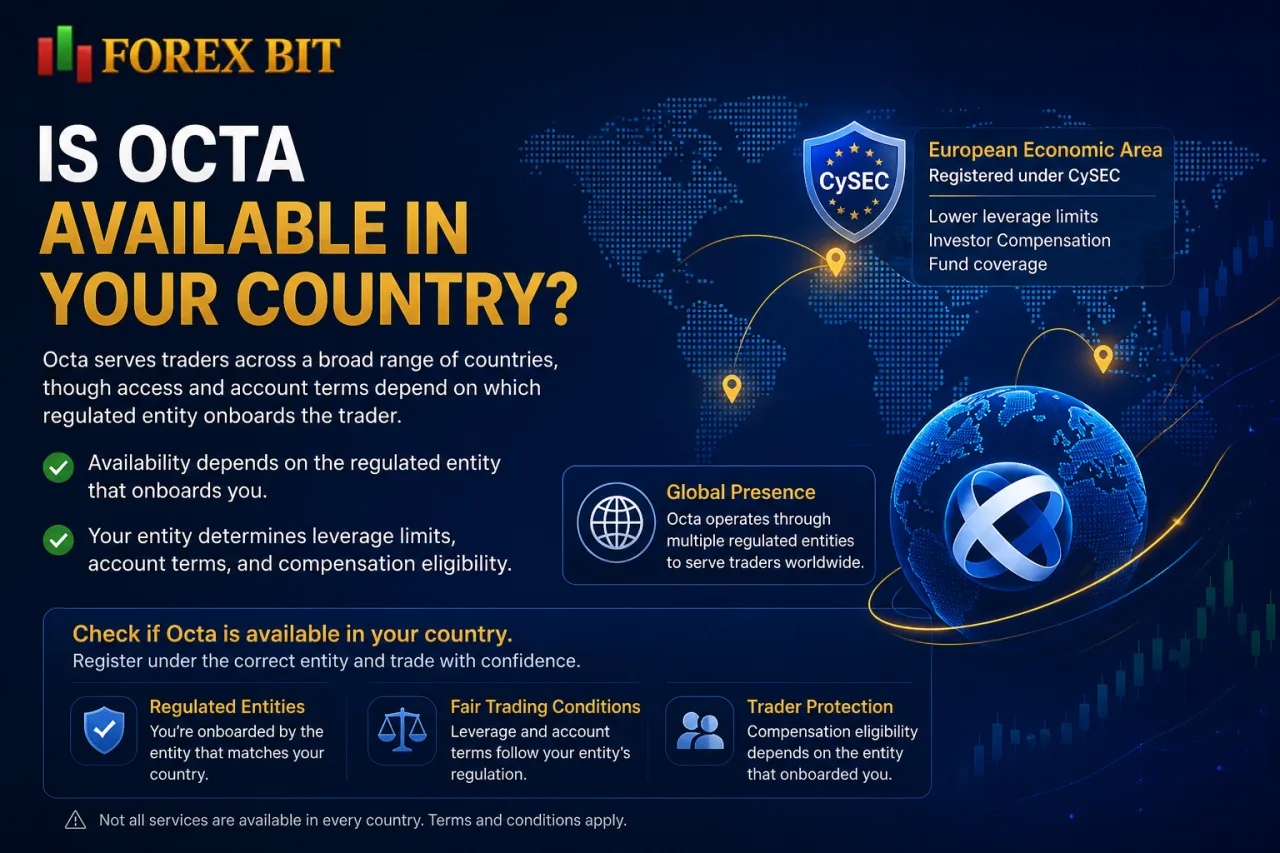
Octa serves traders across a broad range of countries, though access and account terms depend on which regulated entity onboards the trader. This availability question builds directly on the licensing structure already outlined above, since entity assignment by region also determines leverage caps and compensation eligibility.
Traders based in the European Economic Area typically register under Octa’s CySEC-regulated entity, applying the lower leverage limits and Investor Compensation Fund coverage described earlier. Traders in South Africa fall under the FSCA-regulated entity, while most other regions default to Octa’s offshore-registered entities offering higher leverage.
Octa does not accept clients from certain jurisdictions, including the United States, due to local regulatory restrictions on offshore forex brokers. Traders in other restricted or sanctioned regions also face account access limitations depending on Octa’s compliance checks at signup.
Confirming country eligibility before depositing funds remains a practical step, since entity assignment shapes leverage, protections, and available payment methods for that specific account.
What Are the Main Advantages and Limitations of Trading With Octa?
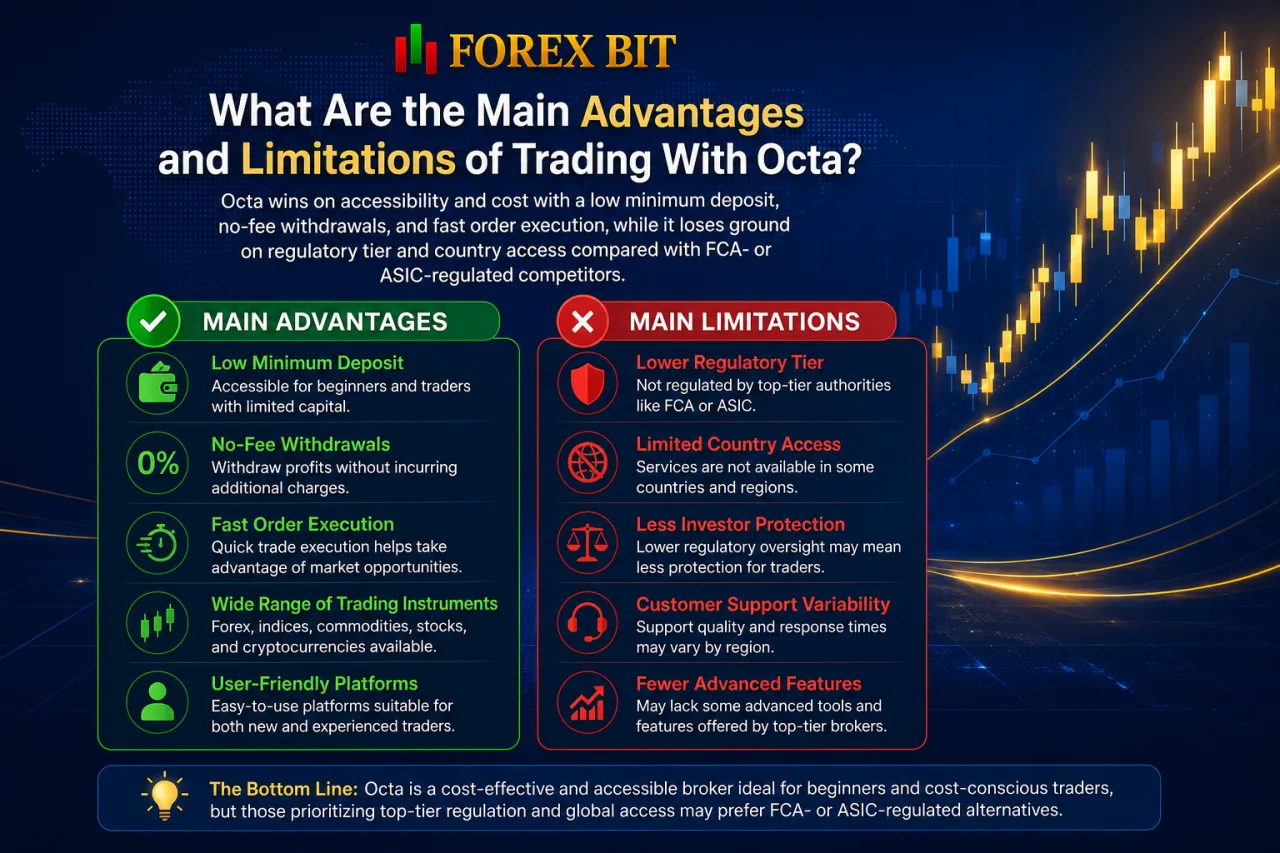
Octa wins on accessibility and cost with a low minimum deposit, no-fee withdrawals, and fast order execution, while it loses ground on regulatory tier and country access compared with FCA- or ASIC-regulated competitors. This trade-off sums up the balance traders weigh when deciding whether Octa fits their trading needs, building on the licensing, account, and platform details already covered above.
Key advantages include:
- Provides a low minimum deposit that keeps entry accessible for beginners.
- Delivers fast trade execution across MetaTrader and OctaTrader.
- Includes copy trading functionality for traders following other strategies.
- Processes withdrawals without broker-side fees on most payment methods.
- Supports five asset classes through a single account structure.
Key limitations include:
- Lacks a top-tier license from regulators such as the FCA or ASIC.
- Excludes traders from the United States due to regulatory restrictions.
- Restricts EU-based clients to lower leverage caps under CySEC rules.
- Limits compensation coverage to the CySEC-regulated entity only.
Traders prioritizing low-cost, fast-execution access weigh these limitations against their own regulatory expectations before committing capital.
Who Is Octa Best Suited For?
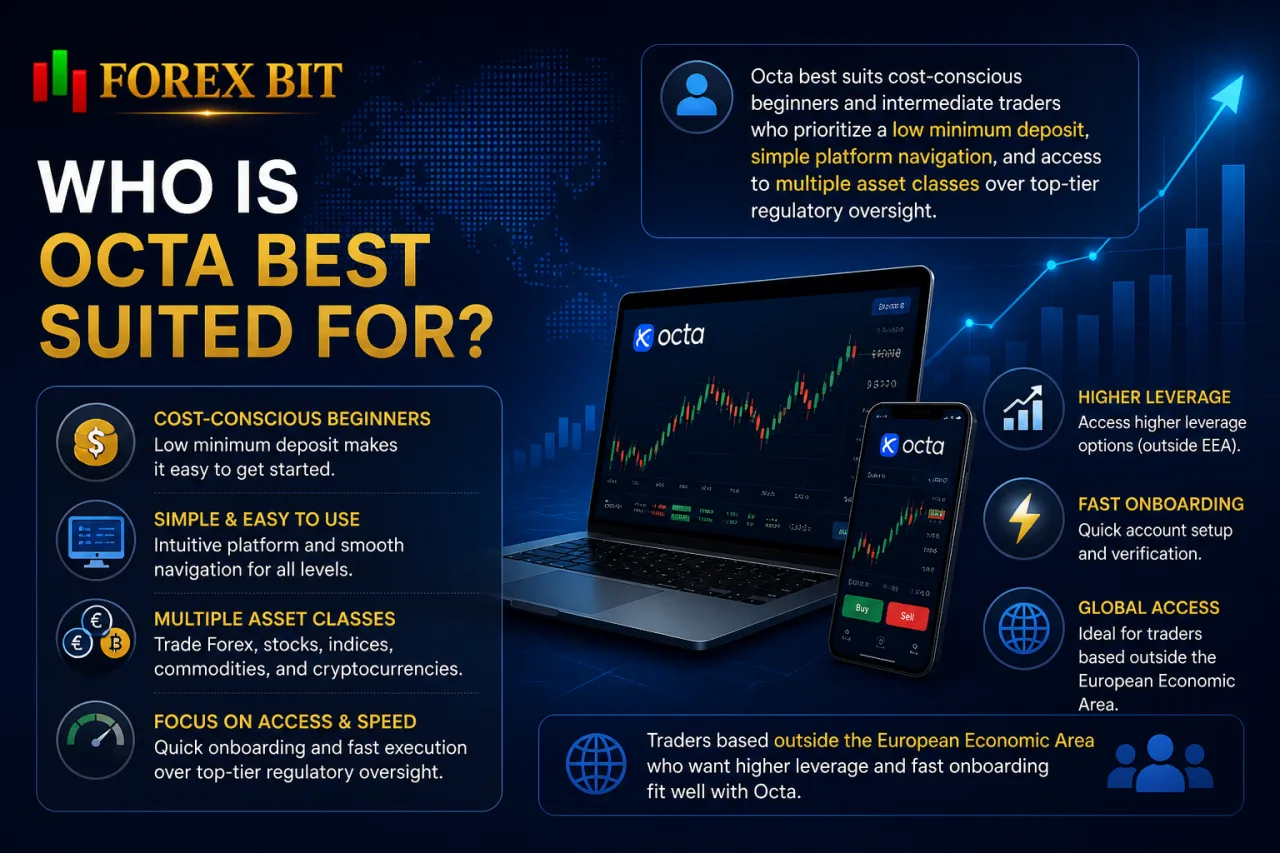
Octa best suits cost-conscious beginners and intermediate traders who prioritize a low minimum deposit, simple platform navigation, and access to multiple asset classes over top-tier regulatory oversight. This profile builds directly on the account, leverage, and platform trade-offs already outlined above, where accessibility and execution speed stood out against a lighter regulatory tier.
Traders based outside the European Economic Area who want higher leverage and fast onboarding fit well with Octa’s offshore-registered entities. Beginners drawn to OctaTrader’s streamlined interface and in-app account management also gain from the lower learning curve compared with the more technical MetaTrader environment. Traders following copy trading strategies find Octa’s built-in functionality useful without needing a separate third-party platform.
Traders who prioritize FCA or ASIC oversight, strict compensation scheme access, or trading from the United States fit better with a top-tier regulated alternative rather than Octa. EU-based traders wanting leverage above the CySEC-mandated caps described earlier face the same mismatch, since Octa’s regional entity structure keeps those limits fixed regardless of account preference.
How Good Is Octa’s Customer Support?
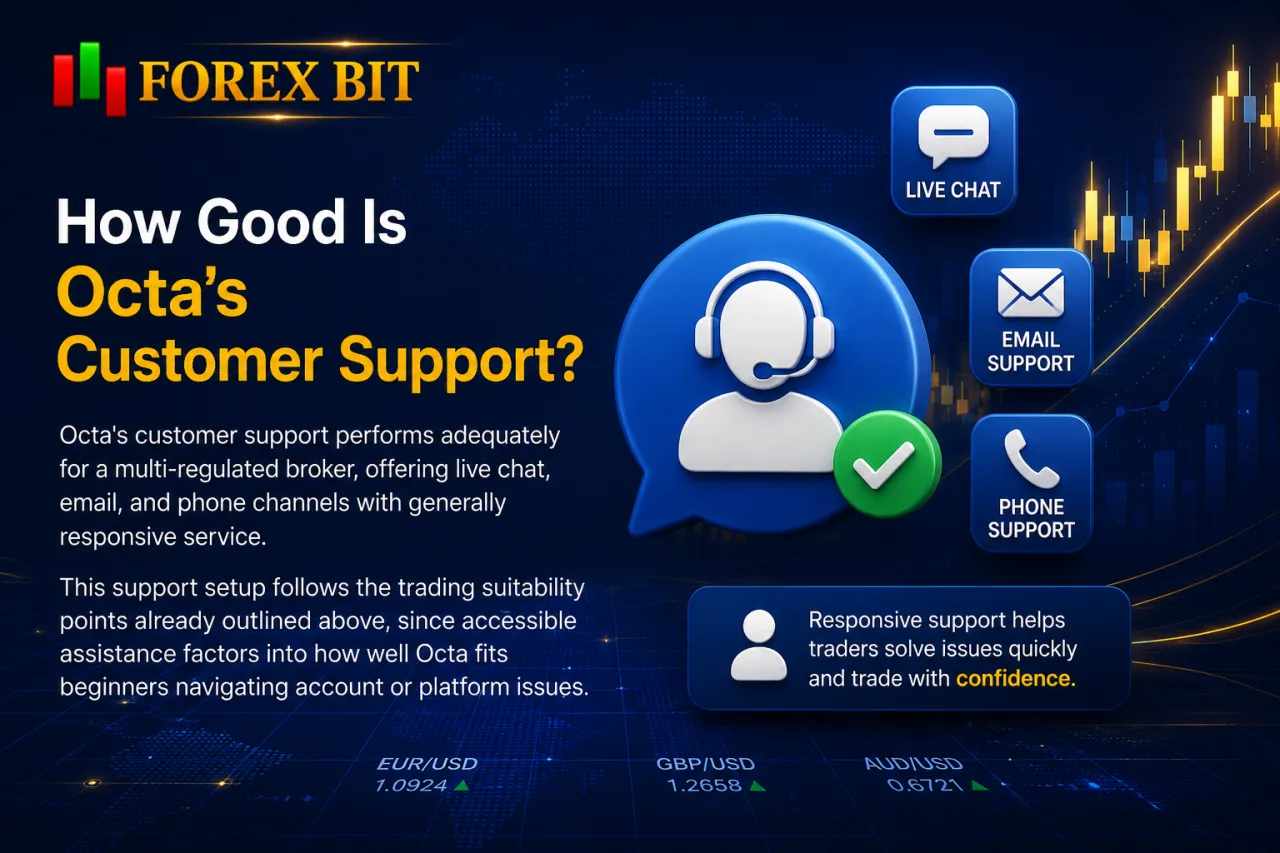
Octa’s customer support performs adequately for a multi-regulated broker, offering live chat, email, and phone channels with generally responsive service. This support setup follows the trading suitability points already outlined above, since accessible assistance factors into how well Octa fits beginners navigating account or platform issues.
Live chat serves as the primary support channel, available directly through Octa’s website and within OctaTrader for account-related queries. Email support handles more detailed technical or documentation requests that require attachments or longer explanations. Phone support remains available for traders who prefer direct conversation over written channels.
Octa provides customer support across multiple languages, reflecting its broad international client base spanning numerous regions.
User feedback on response quality generally points toward quick live chat replies during active trading hours, though email response times run longer than chat given the nature of written correspondence. Traders reporting account verification or withdrawal questions typically note that live chat resolves straightforward issues faster than email tickets requiring escalation.
What Unique Tools and Perks Does Octa Offer Beyond Standard Trading?
Octa offers three distinctive extras beyond standard trading: a built-in copy trading system, proprietary market analysis tools, and ongoing promotions paired with educational resources. These perks extend the trading, platform, and support features already outlined above, giving traders reasons to stay within the Octa ecosystem rather than relying on third-party add-ons for strategy following, market research, or skill-building.
Does Octa Offer Copy Trading or Social Trading Features?
Octa provides a built-in copy trading system, letting traders replicate the trades of other participants directly through their linked account. This feature ties into the perks already outlined above, extending beyond standard trading tools into passive strategy following.
The system pairs a follower account with a chosen strategy provider, mirroring trade size, entry, and exit proportionally to the allocated capital. Novice traders use this setup to gain market exposure without building their own trading rules from scratch. Passive traders benefit similarly, since the feature runs through MetaTrader or OctaTrader without requiring a separate third-party application.
- Selects a strategy provider from available performance rankings.
- Allocates a chosen portion of account balance to follow trades.
- Mirrors opened and closed positions automatically in real time.
- Stops or adjusts copying settings at any point without penalty.
What Bonuses, Promotions, or Educational Resources Does Octa Provide?
Octa provides three supplementary offerings alongside standard trading: periodic deposit bonus promotions, proprietary market analysis tools, and free educational materials such as webinars and articles. These extras sit outside the core trading conditions already outlined and function as added value rather than pricing or execution features.
Octa runs deposit bonus and cashback-style promotions periodically, though specific terms, percentages, and eligible regions change over time and require confirmation on the broker’s official promotions page.
Educational resources include:
- Webinars covering market analysis and trading strategy topics.
- Written guides and articles for beginner and intermediate traders.
- Proprietary market analysis tools built into OctaTrader and the broker’s website.
- Economic calendar access for tracking scheduled market-moving events.
Traders treat these perks as supplementary rather than a factor in choosing an account type or regulated entity.
Conclusion
Octa stands as a legitimate, multi-regulated broker rather than a scam operation, backed by years of market presence, segregated funds, negative balance protection, and a broad international client base. Its offshore-heavy licensing structure places it below FCA or ASIC-tier brokers, limiting compensation coverage and country access for certain traders, yet its low deposit threshold, commission-free spreads, fast execution, and copy trading tools make it a practical choice for cost-conscious beginners and intermediate traders outside strict regulatory zones. Traders seeking top-tier oversight or U.S. access should look elsewhere, but for most global traders, Octa answers the safety question with a qualified, evidence-backed yes.
Thomas Dite is the Best Forex Brokers Research Manager at Forex Bit, specializing in researching, comparing, and editing broker-related content for different trader needs. He focuses on evaluating trading platforms, costs, regulation, account conditions, and other key factors to help readers make more informed broker comparisons.
Email: [email protected]