


FXCM operates as a broker regulated by financial authorities in several jurisdictions where it offers services. This multi-tier regulatory framework separates client funds from company operating capital and subjects FXCM to periodic compliance audits.
FXCM’s safety status depends on which regulated entity a trader signs up with, since license coverage and investor protection can vary by region. Traders should confirm which entity holds their account before depositing funds.
FXCM’s spreads are variable on major currency pairs, and cost structures differ between its standard and active trading accounts. Platform choice, from MetaTrader to FXCM’s proprietary Trading Station, also affects execution speed and order costs.
FXCM suits both beginners and experienced traders, though account availability and leverage limits can shift depending on the trader’s country of residence. Newer traders benefit from educational tools, while active traders lean toward lower-cost commission accounts.
This Forex Bit review breaks down FXCM’s licensing, trading conditions, and platform lineup in detail, starting with its regulatory standing and safety credentials in 2026.
Is FXCM a Legitimate and Safe Broker to Trade With in 2026?
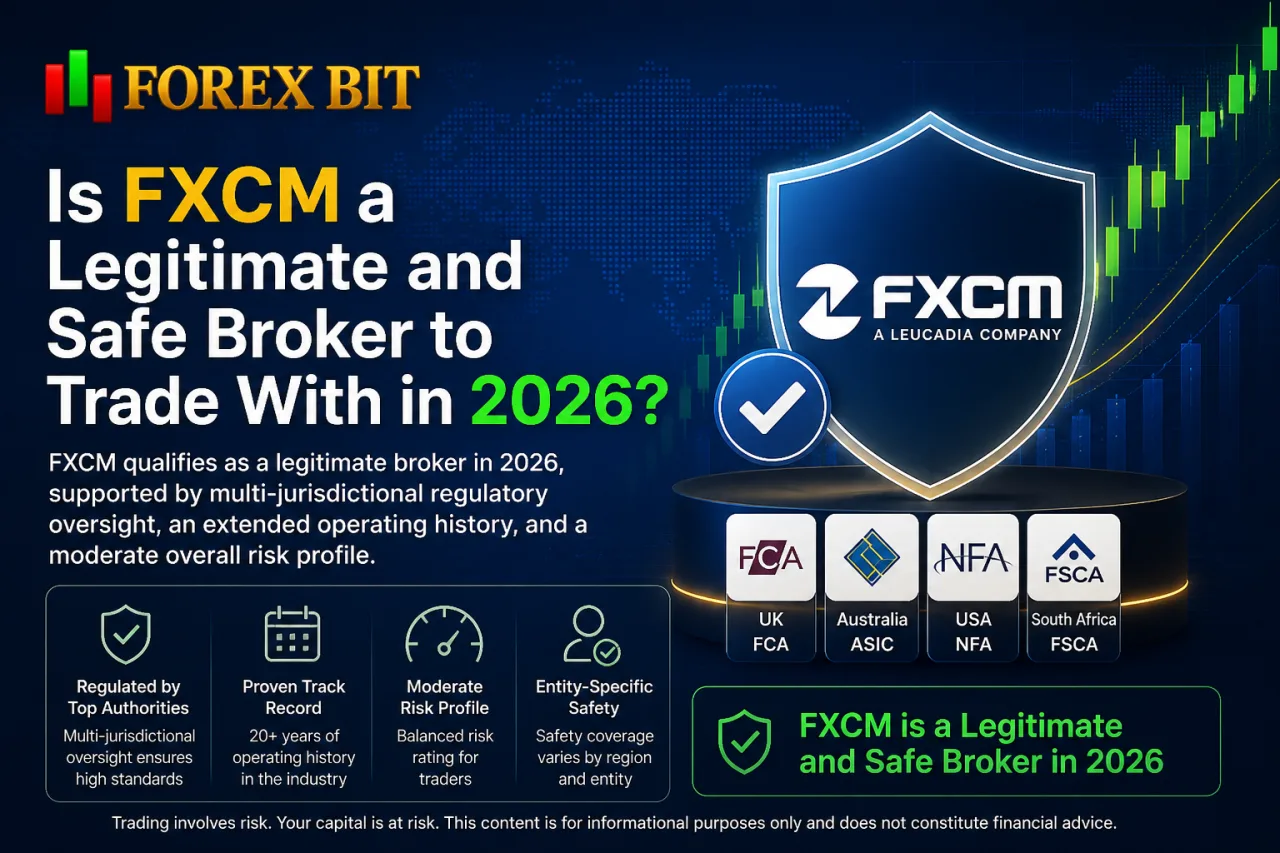
FXCM qualifies as a legitimate broker in 2026, supported by multi-jurisdictional regulatory oversight, an extended operating history, and a moderate overall risk profile. The sections below examine its licensing structure, entity-specific safety coverage, and how these factors shape trader risk depending on region of residence.
What Regulatory Licenses and Financial Authorities Oversee FXCM?
FXCM operates under multiple regional entities, each licensed by a separate financial authority that governs the specific market it serves. This regulatory framework directly shapes fund protection and dispute resolution options for traders based on their onboarding entity.
The oversight bodies attached to FXCM’s regional entities include:
- The UK entity is supervised by the FCA (Financial Conduct Authority), which requires segregated client funds and participation in a compensation scheme for eligible clients.
- ASIC (Australian Securities and Investments Commission) regulates FXCM’s Australian entity, enforcing client money rules under local financial services law.
- FSCA (Financial Sector Conduct Authority) oversees FXCM’s South African entity, applying local capital adequacy and client asset segregation standards.
- CySEC (Cyprus Securities and Exchange Commission) licenses FXCM’s Cyprus-based entity, and eligible EU clients may be covered under an Investor Compensation Fund.
Segregated client fund accounts are generally kept separate from FXCM’s corporate operating capital across its regulated entities, in line with the client money rules enforced by each regulator. Compensation scheme eligibility and coverage caps differ by jurisdiction, so traders confirm their assigned entity’s license before funding an account.
How Does FXCM Protect Client Funds and Ensure Safety of Deposits?
FXCM protects client funds through segregated accounts, negative balance protection, and jurisdiction-specific compensation schemes tied to each regulated entity. These three layers work together, though their exact terms shift depending on which regional entity holds a trader’s account.
Segregation keeps deposited capital in accounts separate from FXCM’s own operating funds, so client money stays outside company assets in an insolvency scenario. Negative balance protection caps a trader’s losses at their deposited balance, preventing debt beyond account equity during extreme market moves. This safeguard tends to apply primarily to retail clients trading under leverage limits set by their regulator, since professional accounts may fall outside standard negative balance rules.
Compensation coverage also varies by regulator:
- FCA-regulated clients have access to the UK’s compensation scheme for eligible claims, subject to its published coverage limit.
- CySEC-regulated clients may qualify for coverage under the Cyprus Investor Compensation Fund, subject to its eligibility criteria.
- ASIC and FSCA-regulated entities enforce client money rules without a matching statutory compensation fund.
Which Countries Can Legally Access FXCM’s Trading Services?
FXCM’s regional entities grant access to traders across the UK, EU, Australia, South Africa, and other approved jurisdictions, while explicitly excluding US retail clients from its offshore trading services. This entity-based structure means the specific broker a trader can join depends entirely on their country of residence.
Access generally follows this pattern across FXCM’s licensed entities:
- FCA-regulated access covers UK residents through FXCM’s UK entity.
- CySEC-regulated access covers eligible EU and EEA residents through the Cyprus entity.
- ASIC-regulated access covers Australian residents through the local entity.
- FSCA-regulated access covers South African residents through the local entity.
US retail traders generally cannot open standard offshore FXCM accounts, as American residents fall outside the jurisdictional scope of FXCM’s FCA, CySEC, ASIC, and FSCA-licensed entities. Traders in other restricted or sanctioned countries also face onboarding limits, so confirming eligibility directly with FXCM before registration remains the most reliable step.
What Trading Platforms Does FXCM Offer to Its Clients?
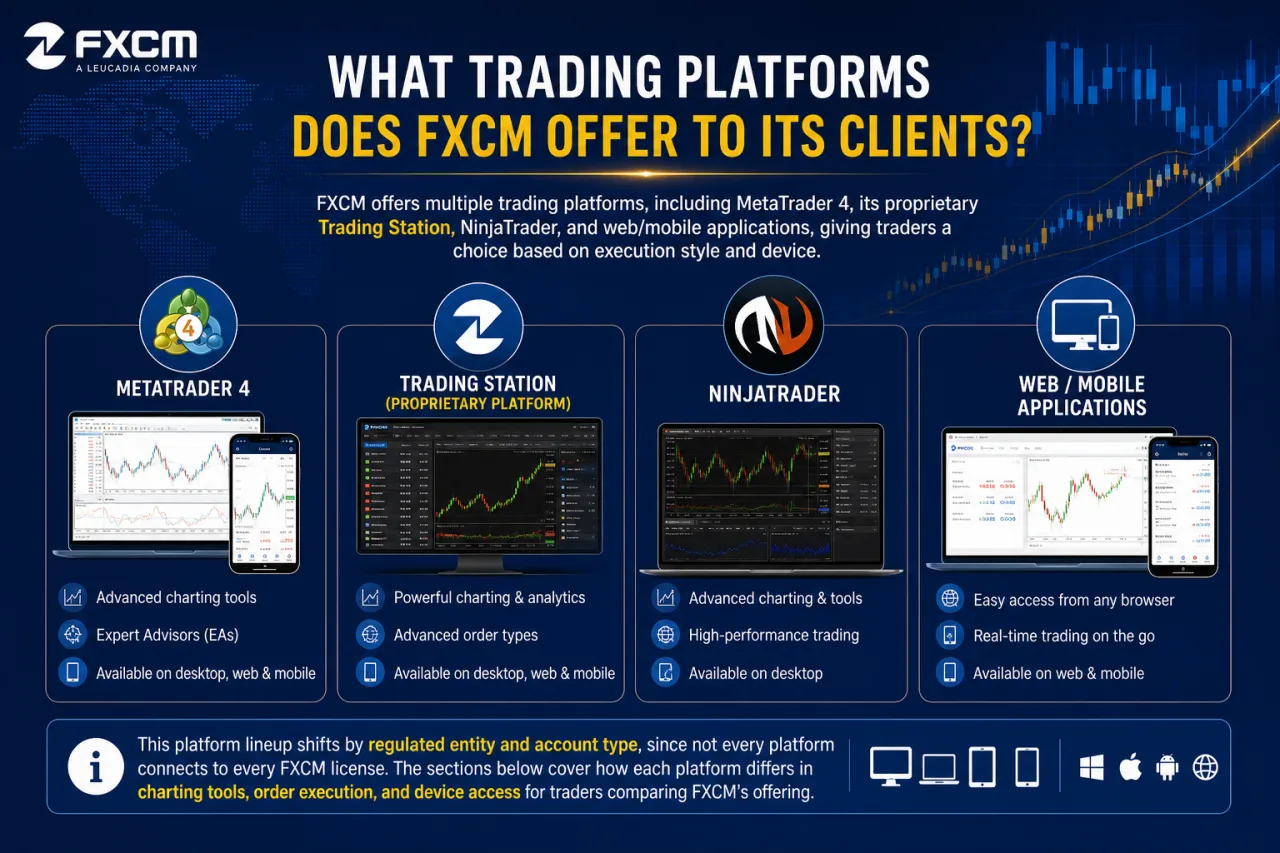
FXCM offers multiple trading platforms, including MetaTrader 4, its proprietary Trading Station, NinjaTrader, and web/mobile applications, giving traders a choice based on execution style and device. This platform lineup shifts by regulated entity and account type, since not every platform connects to every FXCM license. The sections below cover how each platform differs in charting tools, order execution, and device access for traders comparing FXCM’s offering.
MetaTrader 4 vs Trading Station: Which FXCM Platform Suits You Best?
MetaTrader 4 wins on charting flexibility and third-party tools, while Trading Station wins on integrated order execution and FXCM-specific features like SSI sentiment data. The choice between the two depends on whether a trader prioritizes MT4’s ecosystem or FXCM’s native workflow.
MT4 offers a familiar interface built around custom indicators, Expert Advisors, and a large library of third-party plugins, making it the preferred choice for traders migrating from other brokers or running automated strategies. Its charting stays functional but comparatively basic compared to FXCM’s own platform.
Trading Station, FXCM’s proprietary platform, integrates order execution with built-in tools such as trading signals and the Speculative Sentiment Index, giving discretionary traders more context directly on the trading screen. Execution speed on Trading Station tends to feel tighter since it connects natively to FXCM’s pricing engine rather than through a bridge.
- Algorithmic traders and EA users generally prefer MT4 for its scripting support.
- Discretionary traders using sentiment and order-flow cues generally prefer Trading Station.
- Traders switching from another broker generally prefer MT4 for interface familiarity.
Does FXCM Support Mobile and Automated Trading?
FXCM supports both mobile and automated trading, offering dedicated mobile apps alongside Expert Advisor and API-based algorithmic trading across its platform lineup. This dual coverage addresses two distinct trader needs: on-the-go account access and rules-based strategy execution.
Mobile access runs through FXCM’s own app plus MetaTrader 4 mobile, both syncing with desktop charts, open positions, and pending orders in real time. Automated trading runs primarily through MT4’s Expert Advisor support, letting traders deploy custom scripts and third-party algorithms without manual order entry.
Trading Station adds its own layer of automation-adjacent tools, including built-in trading signals and the Speculative Sentiment Index referenced earlier, though EA scripting itself sits within MT4’s ecosystem. NinjaTrader extends algorithmic capability further for traders needing advanced backtesting and custom strategy development. FXCM also provides API access for traders building proprietary automated systems outside the standard platform interfaces, though specific API types and eligibility requirements can vary by account and region.
- Mobile apps sync positions and orders across devices in real time.
- Expert Advisors run automated strategies through MT4.
- API connections support custom-built algorithmic trading systems.
What Are FXCM’s Spreads, Fees, and Commission Structures?
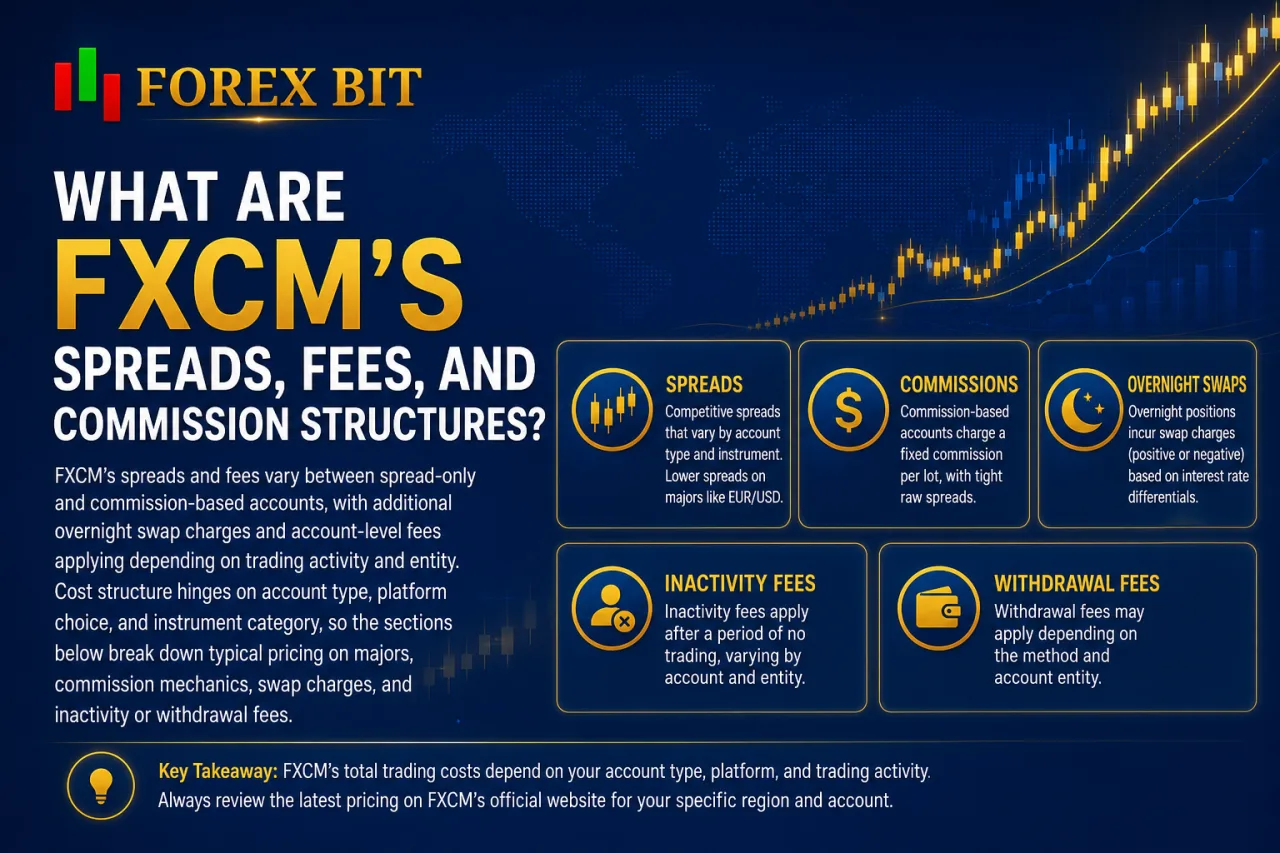
FXCM’s spreads and fees vary between spread-only and commission-based accounts, with additional overnight swap charges and account-level fees applying depending on trading activity and entity. Cost structure hinges on account type, platform choice, and instrument category, so the sections below break down typical pricing on majors, commission mechanics, swap charges, and inactivity or withdrawal fees.
Standard vs Active Trader Account: How Do Fees and Spreads Compare?
FXCM’s Standard Account uses wider spread-only pricing with no minimum deposit requirement, while the Active Trader Account applies commission-based pricing tied to tighter raw spreads for high-volume traders. This split lets beginners start with simple spread costs and lets frequent traders shift toward a lower-cost, volume-based fee model.
The Standard Account builds its cost entirely into the spread, so there’s no separate per-lot commission charged on top of the quoted price. The Active Trader Account instead pairs a narrower raw spread with a fixed commission per lot traded, a structure that generally favors traders running higher monthly volume. Active Trader Account eligibility ties to reaching a minimum monthly trading volume threshold set by FXCM, though the exact figure can vary and is best confirmed directly with the broker.
- Beginners and lower-volume traders generally suit the Standard Account for its straightforward, spread-only pricing.
- Scalpers and high-frequency traders generally suit the Active Trader Account for its tighter raw spreads.
- Algorithmic and EA-based traders generally suit the Active Trader Account since commission costs scale predictably with volume.
What Is the Minimum Deposit Required to Open an FXCM Account?
FXCM’s Standard Account requires no minimum deposit, while the Active Trader Account and other entity-specific accounts may carry separate funding thresholds tied to volume eligibility, though exact figures can vary by region and are best confirmed directly with the broker. This deposit flexibility ties directly into how account types and regional entities shape FXCM’s onboarding requirements.
Funding requirements shift depending on which FXCM entity processes the account application, since FCA, CySEC, ASIC, and FSCA-regulated units each set their own onboarding rules. The Standard Account generally opens with a low or no minimum deposit barrier, making it accessible to traders testing the platform with smaller capital. The Active Trader Account, tied to commission-based pricing and volume thresholds discussed earlier, may involve a different funding expectation given its focus on frequent, higher-volume trading.
- Standard Account funding starts with no fixed minimum deposit requirement.
- Active Trader Account funding aligns with volume-based eligibility rather than a flat deposit rule.
- Entity-specific deposit rules vary depending on the regulator overseeing a trader’s account.
Traders confirm exact deposit figures directly with FXCM’s regional entity before funding, since published thresholds can differ by country and account type.
What Leverage and Trading Instruments Does FXCM Provide?
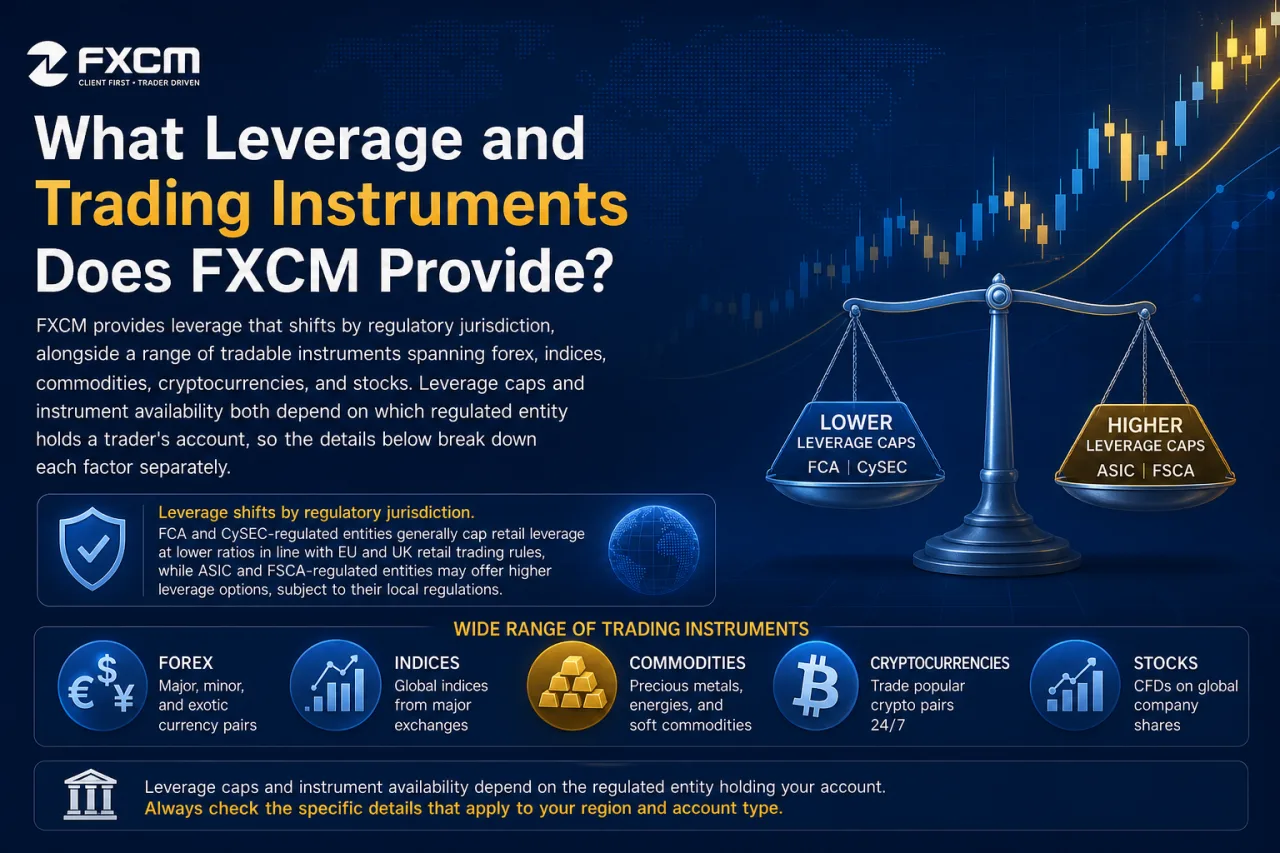
FXCM provides leverage that shifts by regulatory jurisdiction, alongside a range of tradable instruments spanning forex, indices, commodities, cryptocurrencies, and stocks. Leverage caps and instrument availability both depend on which regulated entity holds a trader’s account, so the details below break down each factor separately.
FCA and CySEC-regulated entities generally cap retail leverage at lower ratios in line with EU and UK retail trading rules, while ASIC and FSCA-regulated entities may permit different maximum ratios depending on local regulation. Professional client classification can unlock higher leverage tiers under certain entities, subject to eligibility criteria set by the relevant regulator.
FXCM’s instrument range covers several markets:
- Forex pairs spanning major, minor, and exotic currency combinations.
- Indices tracking global stock market benchmarks.
- Commodities including metals and energy products.
- Cryptocurrencies offered as CFD instruments in eligible regions.
- Stocks available through CFD-based share trading.
Instrument access and leverage limits on each asset class vary by entity, so traders confirm current specifications with their assigned FXCM regulator before opening positions.
How Do Deposits and Withdrawals Work at FXCM?
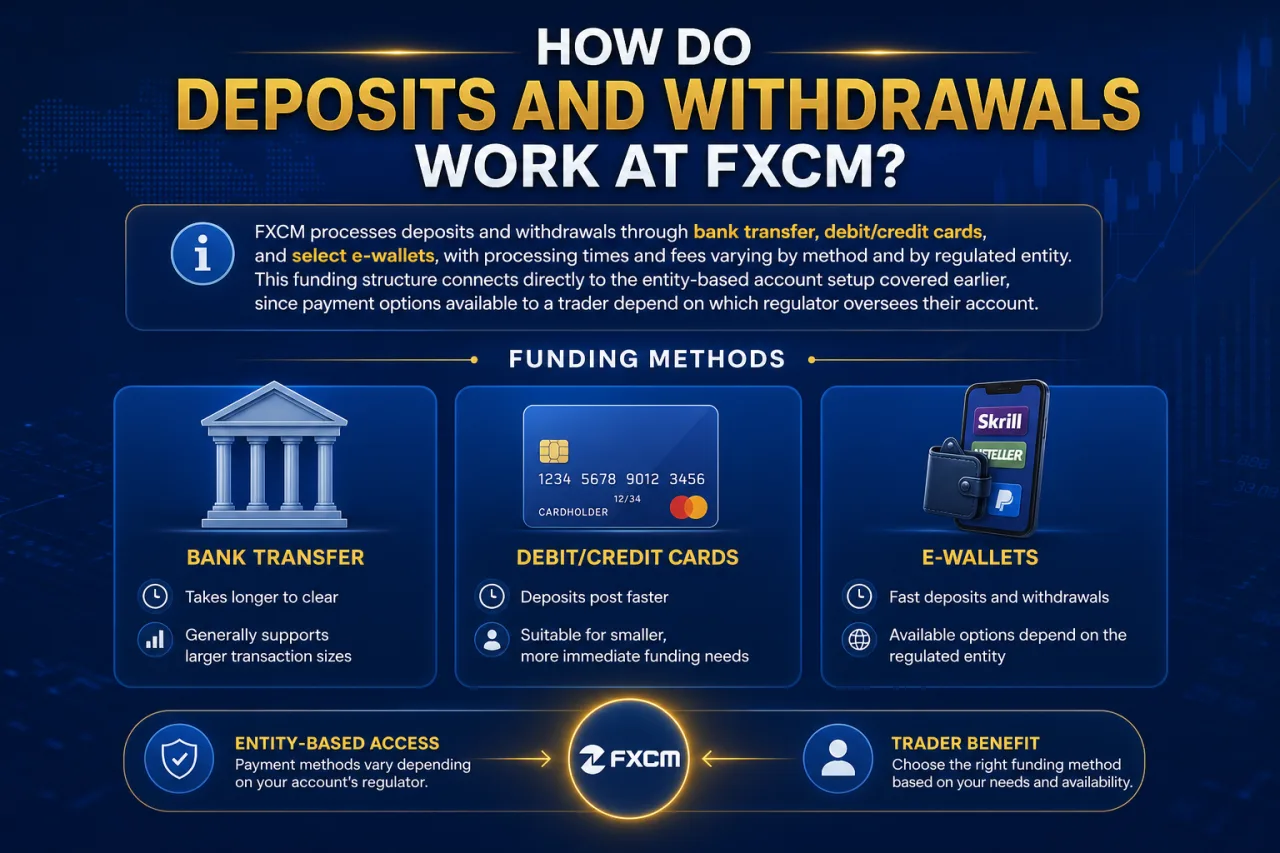
FXCM processes deposits and withdrawals through bank transfer, debit/credit cards, and select e-wallets, with processing times and fees varying by method and by regulated entity. This funding structure connects directly to the entity-based account setup covered earlier, since payment options available to a trader depend on which regulator oversees their account.
Bank transfers tend to take longer to clear but generally support larger transaction sizes, while card deposits post faster and suit smaller, immediate funding needs. E-wallet availability varies by region and regulated entity, so traders should confirm which specific e-wallet providers apply to their account before initiating a transfer.
Processing speed differs across methods:
- Card deposits post to trading accounts within a short timeframe after approval.
- Bank transfer deposits take longer to clear due to intermediary banking steps.
- Withdrawals typically return to the original funding source used for deposit.
FXCM does not appear to publish one uniform fee schedule across all entities, as deposit and withdrawal charges can depend on the payment method, currency conversion, and the specific regulated entity processing the transaction. Traders confirm current processing times and applicable charges directly with their assigned FXCM entity before transferring funds.
Is FXCM Better Suited for Beginners or Experienced Traders?
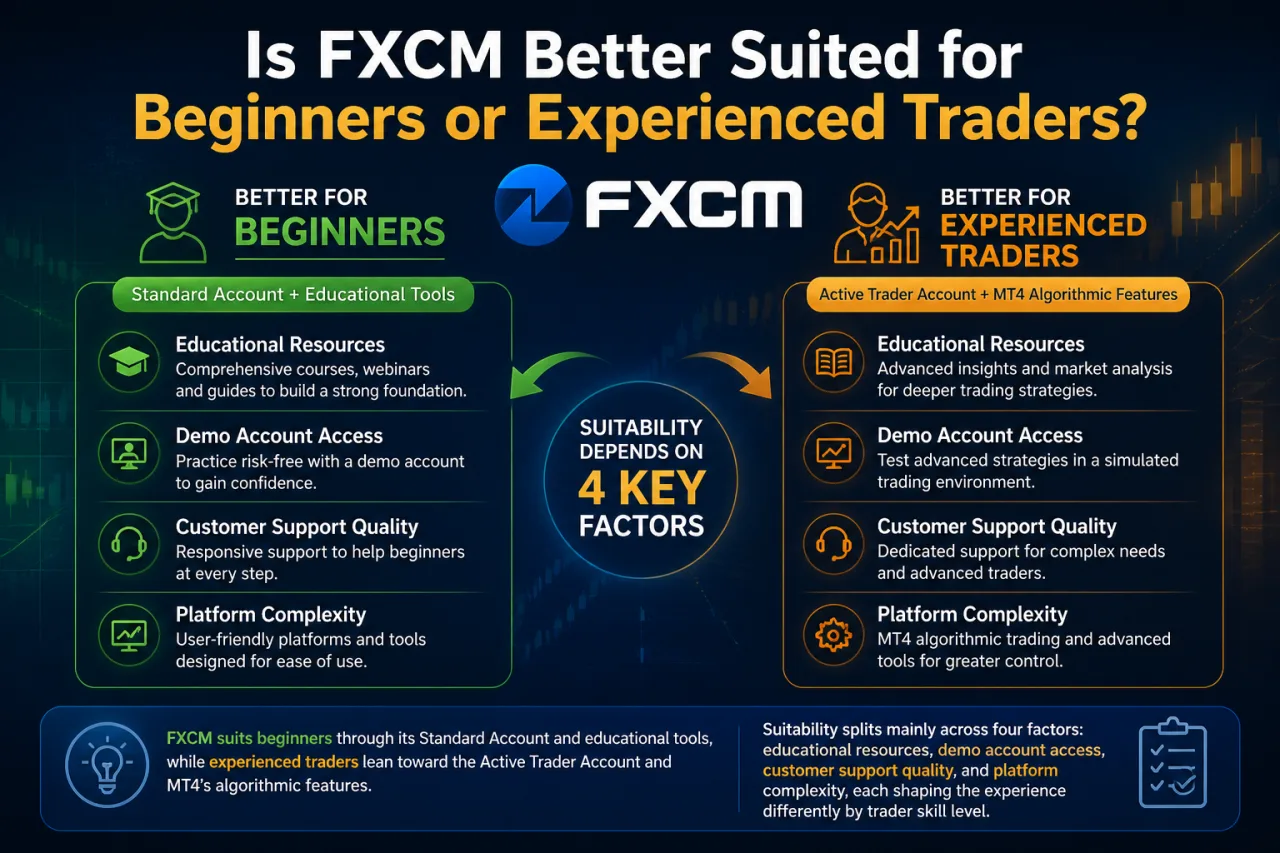
FXCM suits beginners through its Standard Account and educational tools, while experienced traders lean toward the Active Trader Account and MT4’s algorithmic features. Suitability splits mainly across four factors: educational resources, demo account access, customer support quality, and platform complexity, each shaping the experience differently by trader skill level.
What Customer Support Channels Does FXCM Offer?
FXCM offers customer support through live chat, phone lines, and email, with channel availability and operating hours differing by regulated entity. This support structure ties back into FXCM’s entity-based setup, since the specific desk handling a query depends on which regulator oversees the trader’s account.
Live chat connects traders to support staff for account, platform, and general trading queries without leaving the browser or app. Phone support routes through region-specific numbers tied to each FXCM entity, which typically speeds up resolution for urgent account or execution issues. Email remains available for non-urgent requests, documentation, or issues requiring supporting files.
FXCM’s support desks generally operate during regional business hours aligned with each entity’s local market, rather than offering uniform round-the-clock coverage across every jurisdiction, though traders should confirm exact hours directly with the broker.
Language coverage extends beyond English across several FXCM entities, reflecting the international client base served by its FCA, CySEC, ASIC, and FSCA-regulated units, though the exact list of supported languages can vary by region and is best confirmed directly with the broker. Traders confirm exact hours, contact numbers, and language options through the support page tied to their specific FXCM entity.
What Unique Research Tools and Trading Signals Does FXCM Provide Beyond Standard Broker Offerings?
FXCM sets itself apart through a cluster of proprietary research features, including sentiment-based signals, Autochartist pattern scanning, and API access for custom algorithmic systems, rather than relying only on standard charting tools. These tools layer on top of the platform lineup and cost structure already discussed, giving traders extra decision-support beyond raw price feeds. The sections below break down each tool and how it fits into a trader’s workflow.
Does FXCM Offer Algorithmic Trading APIs for Developers?
FXCM offers algorithmic trading APIs for developers, giving traders programmatic access to pricing and execution beyond the standard MT4 and Trading Station interfaces. This API access ties directly into the platform lineup discussed earlier, extending automated trading capability to custom-built systems outside off-the-shelf software.
FXCM’s API access can support developers pulling market data and managing orders through standard web-based requests, which may suit traders building proprietary dashboards or bots, though exact API specifications are best confirmed directly with the broker.
FXCM also appears to support FIX API connectivity in addition to its other API options, a protocol generally favored by institutional-style systems needing low-latency order routing and high-volume execution, though exact version support and eligibility conditions are best confirmed directly with the broker.
This dual API structure sets FXCM apart from many retail-focused brokers that limit automation to Expert Advisors alone. Access eligibility, supported languages, and connection requirements vary by account type and regulated entity, so developers confirm technical documentation directly with FXCM before building a system.
Conclusion
FXCM’s licensing across the FCA, CySEC, ASIC, and FSCA confirms its legitimacy as a regulated broker, with fund segregation, negative balance protection, and entity-specific compensation coverage forming a solid safety framework for 2026. Trading conditions reinforce this standing: flexible platform choices between MT4, Trading Station, and NinjaTrader, transparent spread-only versus commission pricing, and API access for algorithmic systems cater to both new and experienced traders.
Coverage does shift by region, since leverage caps, deposit thresholds, and support hours depend on the regulated entity handling an account. Overall, FXCM stands as a credible, well-regulated broker, provided traders verify their specific entity’s terms before funding an account.