
Ready to open a forex account? Compare Forex-bit.com’s account types, deposits, leverage, spreads and swap-free options before you sign up.
Open Forex Account: Step-by-Step Guide for Beginners

Opening a forex trading account gives traders access to currency markets through a forex broker or trading provider. However, the process involves more than simply creating a username, making a deposit, and placing a trade.
Before you Open Forex Account, you need to understand how forex accounts work, what information a broker may request, how to evaluate regulation, and which trading costs can affect your results.
Forex trading commonly involves leverage, which can magnify both profits and losses. Investor.gov warns that leveraged forex trading can expose investors to substantial losses and may not be suitable for everyone.
The process also differs between brokers and countries. Account requirements, available products, leverage limits, minimum deposits, and investor protections depend on the broker and the regulatory entity under which the account is opened.
Forex Bit is an informational website. It does not open, hold, fund, or manage forex trading accounts. This guide explains the general process traders can use when evaluating and opening an account directly with a forex broker.
What Is a Forex Account?
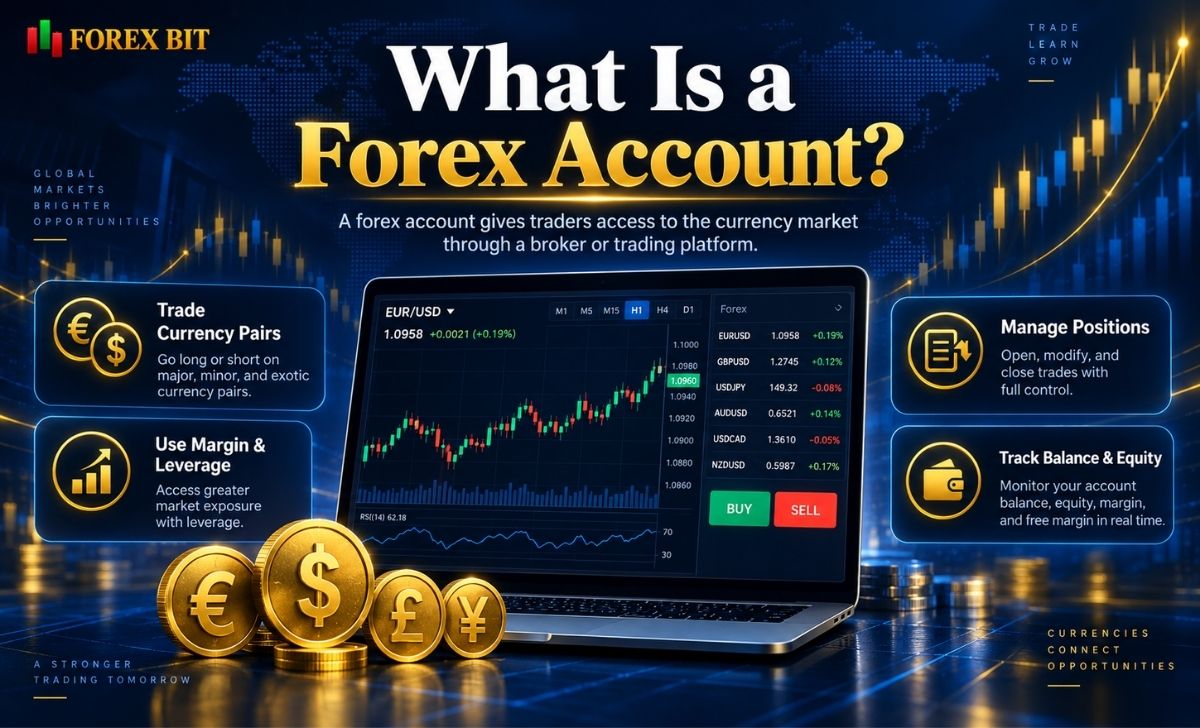
A forex account is an account opened with a broker or regulated trading provider that allows a client to trade currencies or forex-related products.
Depending on the provider and jurisdiction, the account may offer access to:
- Currency pairs such as EUR/USD, GBP/USD, and USD/JPY
- Spot or rolling spot forex
- Forex CFDs
- Trading platforms such as MetaTrader or proprietary software
- Margin and leveraged trading
- Market orders, limit orders, and stop orders
The broker maintains the account balance, margin information, open positions, transaction history, and applicable trading fees.
Live Forex Account vs Demo Account
A live forex account uses real money and exposes the trader to real profits and losses.
A demo account normally uses virtual funds and is designed for platform practice and strategy testing.
Beginners may find it useful to practice with a demo account before depositing real capital, but demo trading should not be considered identical to live trading. Execution, liquidity, slippage, emotional pressure, and other market conditions can differ.
Are All Forex Accounts the Same?
No.
Brokers use different names and structures for their trading accounts. Common examples include:
- Standard or spread-only accounts
- Raw spread or commission-based accounts
- Micro or cent accounts
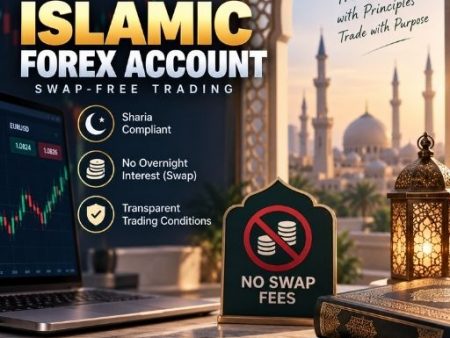
- Swap-free accounts
- Professional accounts
- Demo accounts
These names are not standardized across the forex industry.
A “Standard Account” at one broker can have completely different spreads, minimum deposits, leverage, and trading conditions from a Standard Account offered by another broker.
For this reason, traders should compare the actual account specifications rather than choosing an account based only on its name.
How to Open Forex Account Step by Step
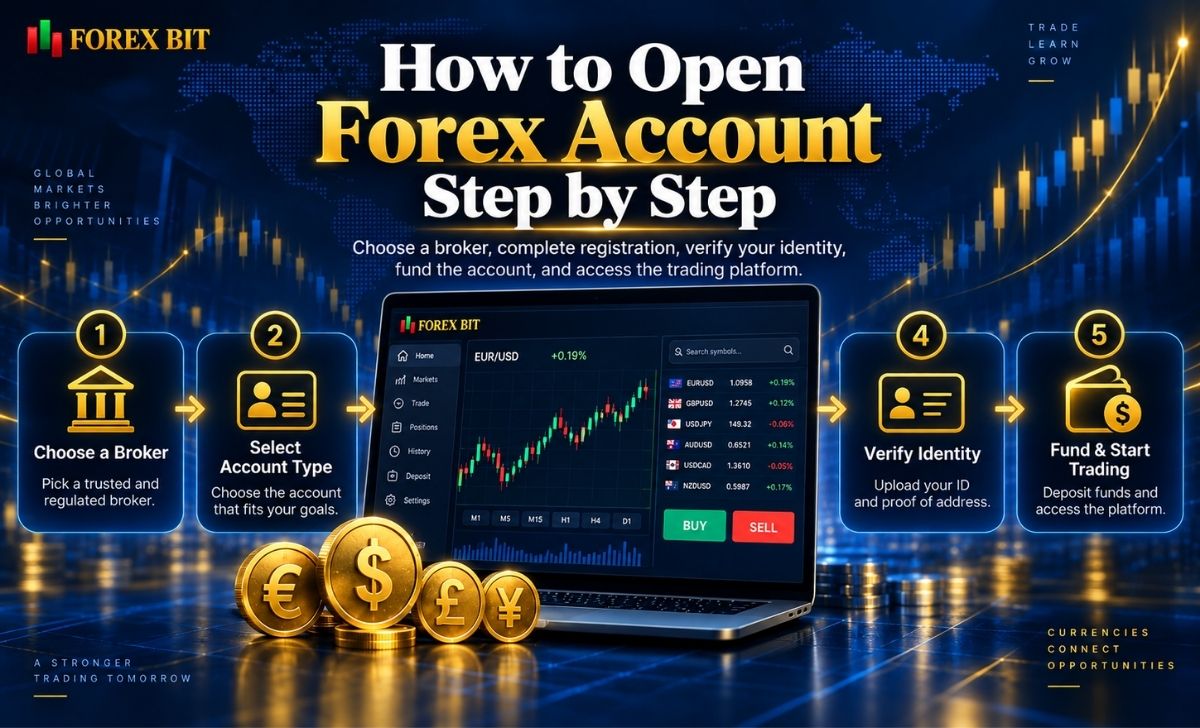
The precise process differs between brokers, but opening a forex account typically involves several basic stages.
Step 1: Choose a Forex Broker
Before entering personal information or depositing money, research the broker.
Important details include:
- Regulatory status
- Legal company name
- Regulatory entity handling your account
- Country restrictions
- Available instruments
- Trading costs
- Withdrawal policies
- Platforms
- Customer support
- Account protection rules
This step should come before depositing money.
The CFTC specifically advises traders to investigate forex dealers before providing sensitive personal information or making an initial deposit. For firms subject to U.S. regulation, it recommends checking registration and disciplinary history through CFTC/NFA resources.
The exact regulator to check depends on the country and legal entity involved.
Step 2: Select an Account Type
After choosing a broker, compare the available account structures.
For example:
| Account Structure | Typical Characteristic |
| Demo | Virtual funds for practice |
| Standard | Trading costs commonly incorporated into the spread |
| Raw/Commission | Tighter spreads with a separate commission |
| Micro/Cent | Smaller position sizing where offered |
| Swap-Free | Alternative overnight financing structure |
| Professional | Subject to broker and regulatory eligibility |
Do not assume every broker offers all of these options.
Step 3: Complete the Account Application
Most online brokers require basic personal information such as:
- Full name
- Date of birth
- Residential address
- Email address
- Telephone number
- Country of residence
Additional information may be requested depending on the regulatory jurisdiction.
Some regulated providers may also ask about:
- Employment
- Income
- Source of funds
- Trading experience
- Financial knowledge
- Investment objectives
The purpose is generally to identify the account holder and satisfy applicable customer identification, anti-money-laundering, and regulatory requirements.
Step 4: Complete Identity Verification
The broker may require identity verification before providing full access to a live trading account or withdrawals.
This commonly involves government-issued identification and, depending on the provider, proof of residence.
Customer-identification rules in regulated financial markets commonly require information such as name, date of birth, address, and an identification number.
Step 5: Review the Account Agreement
Do not skip the broker’s legal documentation.
Review information covering:
- Trading costs
- Margin requirements
- Leverage
- Liquidation or margin close-out
- Overnight financing
- Deposits and withdrawals
- Client money treatment
- Order execution
- Conflicts of interest
- Account termination
- Complaint procedures
The CFTC recommends reading account agreements carefully and checking funding and withdrawal requirements before opening an OTC forex account.
Step 6: Fund the Account
Once the account is approved, a broker may offer funding methods such as:
- Bank transfer
- Debit or credit card
- Electronic payment service
- Other region-specific payment methods
Availability depends on the broker and jurisdiction.
Check:
Minimum deposit ≠ minimum amount required to trade safely.
A broker may technically allow a small initial deposit while margin requirements, position sizes, and volatility make that balance unsuitable for the trader’s intended strategy.
Step 7: Access the Trading Platform
After funding, traders can normally access the broker’s supported platform.
Before entering a trade, review:
- Contract specifications
- Lot size
- Pip value
- Margin requirement
- Spread
- Commission
- Stop-loss settings
- Overnight financing
Understanding these conditions before placing the first trade can help prevent unexpected costs.
What Documents Are Needed to Open a Forex Account?
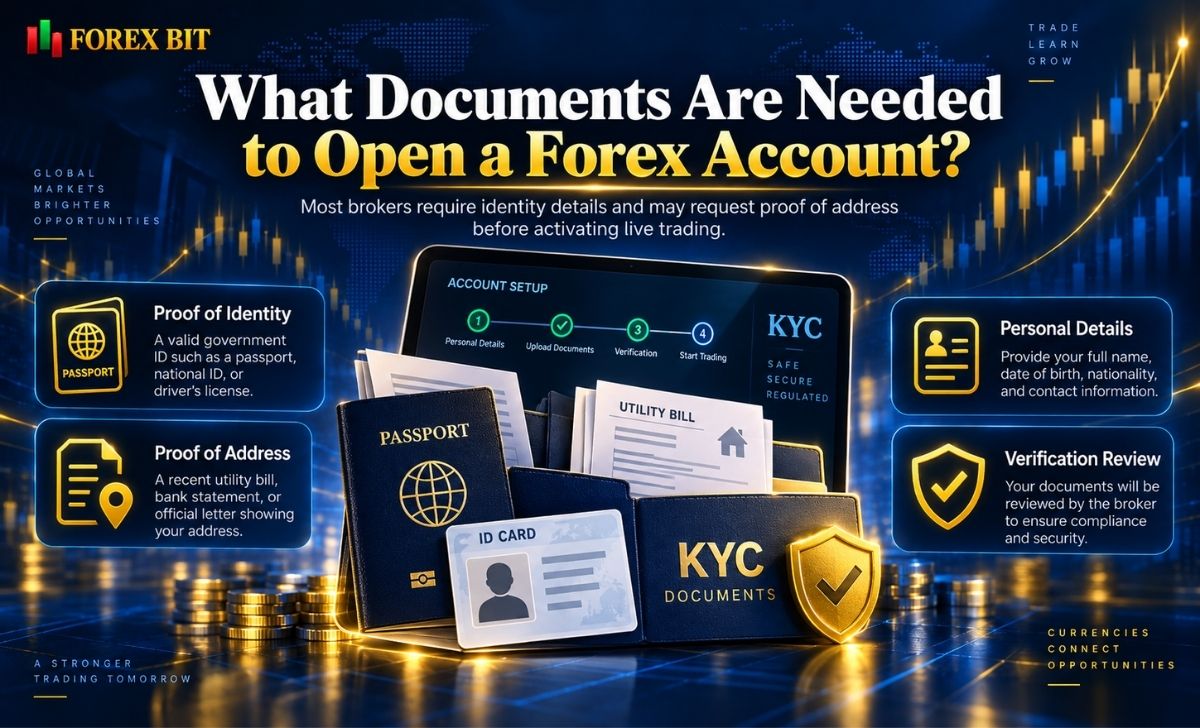
Document requirements depend on the broker, country, and account type, so there is no single document list that applies worldwide.
However, brokers operating under customer-identification requirements commonly ask for information or documents that establish a client’s identity.
Proof of Identity
Common examples may include:
- Passport
- National identity card
- Driver’s license
- Other government-issued photo ID
For example, U.S. customer-identification requirements may require information such as name, date of birth, address, and an identification number, with government-issued documents used for verification when necessary.
Proof of Address
A broker may also request documentation showing the trader’s current residential address.
Depending on the provider, examples could include:
- Bank statement
- Utility bill
- Government correspondence
- Other accepted proof of residence
The acceptable document type and maximum document age vary between providers.
Financial or Trading Information
Some brokers may ask questions about:
- Employment
- Annual income
- Net worth
- Source of funds
- Trading experience
- Investment knowledge
These requirements should not be interpreted as universal forex-account rules. They depend on the broker and the applicable regulatory framework.
Why Is Forex Account Verification Required?
Financial institutions may be required to identify customers as part of anti-money-laundering and customer-identification procedures.
Verification can also help reduce:
- Identity fraud
- Account misuse
- Unauthorized transactions
- Fraudulent funding activity
A legitimate broker should clearly explain what information it requires and why.
Be cautious if a platform requests unusual documents, asks you to send passwords, or demands unexplained payments supposedly required to “unlock” withdrawals.
How to Choose a Forex Broker Before Opening an Account
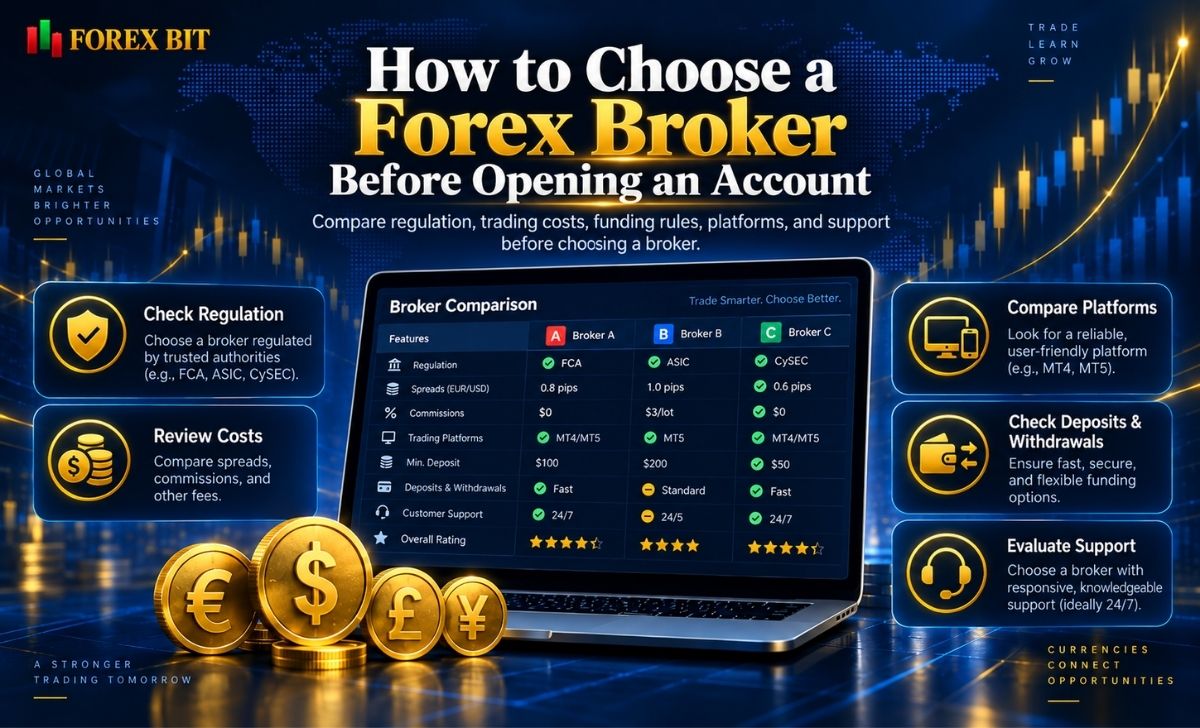
Choosing the broker may be more important than choosing the account label.
Before opening an account, start with the legal entity behind the trading platform.
Check the Broker’s Regulatory Status
Identify:
- The broker’s legal company name.
- The regulator supervising that company.
- The license or registration number.
- The legal entity that will hold your account.
- Whether that entity is permitted to serve customers in your country.
Do not rely only on a regulatory logo displayed on a website.
Verify the information independently with the relevant regulator.
The CFTC recommends checking both registration status and disciplinary history before trading with a forex firm subject to U.S. oversight.
Check Which Legal Entity Will Hold Your Account
Large international brokers may operate several entities.
For example, customers from different countries can be registered under different:
- Regulators
- Leverage limits
- Product rules
- Client-money protections
- Compensation arrangements
Therefore, seeing that a broker has one regulated company somewhere in the world does not necessarily mean your account will be opened under that company.
Always check the specific entity stated in your account agreement.
Review Deposit and Withdrawal Policies
Before depositing, confirm:
- Available deposit methods
- Withdrawal methods
- Processing times
- Fees
- Minimum withdrawal
- Currency conversion charges
- Whether withdrawals must return to the original payment source
Withdrawal problems are a major warning sign.
The CFTC warns about unregistered offshore forex dealers that have demanded additional payments or invented fees when customers attempted to withdraw funds.
Check the Trading Platform
Consider whether the broker provides the tools you need, such as:
- Desktop platform
- Web platform
- Mobile app
- MetaTrader support
- Charting tools
- Expert Advisors
- API access
- VPS support
Platform availability alone should never be used as evidence that a broker is legitimate.
What Costs and Trading Conditions Should You Compare?
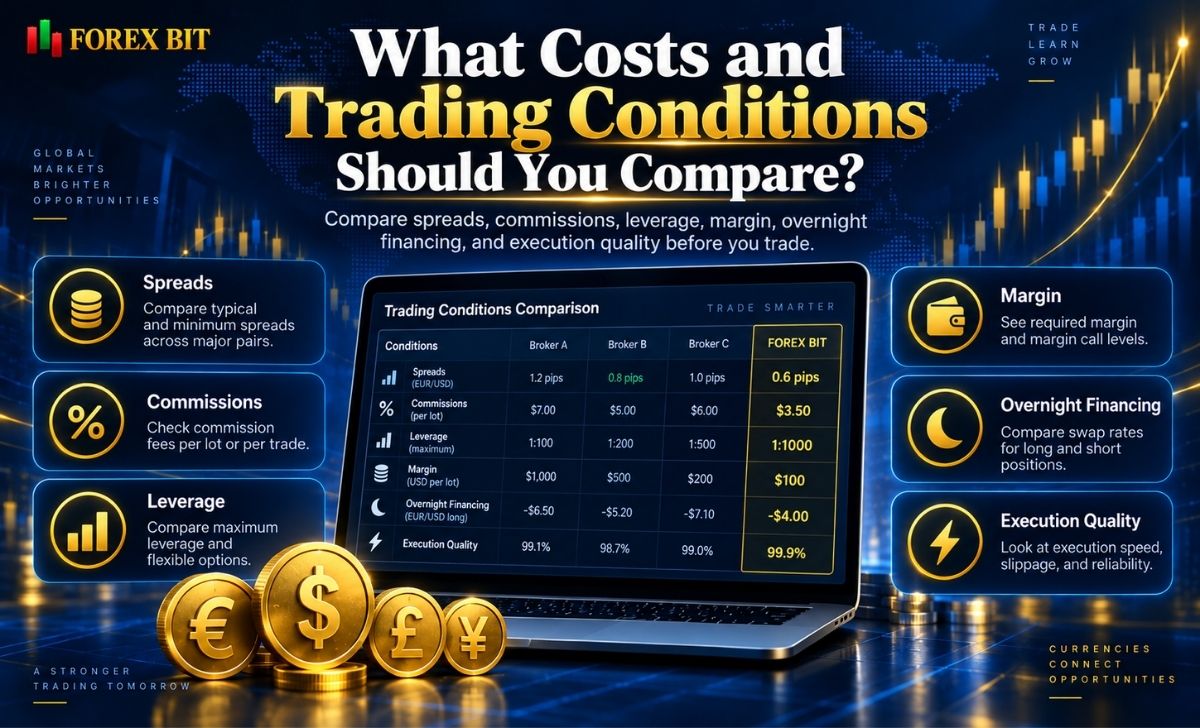
Once you have shortlisted brokers, compare the actual trading conditions behind their accounts.
Spread
The spread is the difference between the bid and ask price.
Example:
EUR/USD Bid: 1.1000
EUR/USD Ask: 1.1001
The spread is approximately 1 pip.
Some accounts incorporate most trading costs into the spread.
Others combine a tighter spread with a separate commission.
Commission
Commission may be charged:
- Per lot
- Per side
- Per round turn
- Based on traded notional value
When comparing accounts, calculate the all-in cost, not just the advertised spread.
A “0.0 pip spread” does not necessarily mean a zero-cost trade if commission applies.
Minimum Deposit
There is no universal minimum deposit for opening a forex account.
It varies by:
- Broker
- Account
- Country
- Payment method
- Regulatory entity
Do not assume that the account with the lowest deposit requirement is automatically the best choice.
Minimum Trade Size
Forex position size may be expressed in lots or currency units.
Typical lot terminology includes:
- Standard lot: 100,000 units
- Mini lot: 10,000 units
- Micro lot: 1,000 units
However, platform and contract specifications vary.
Check the broker’s minimum order size before funding the account.
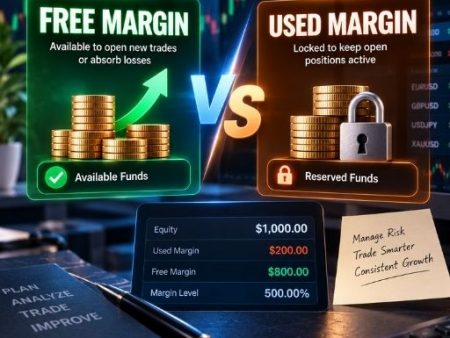
Leverage and Margin
Leverage allows a trader to control a larger market position with a smaller amount of margin.
For example, at 30:1 leverage, a position worth $30,000 would require roughly $1,000 in margin before other broker-specific calculations.
Higher leverage magnifies both gains and losses.
Investor.gov warns that even relatively small adverse currency movements can produce substantial losses when leverage is used.
Leverage limits also differ by jurisdiction. In the UK, for example, FCA rules limit retail CFD leverage between 30:1 and 2:1 depending on the underlying asset and require certain margin close-out and negative-balance protections.
Do not apply these limits to every country; they are an example of how regulation can change trading conditions.
Overnight Financing
Positions held beyond a broker’s rollover time may incur:
- Swap
- Rollover
- Overnight financing
- Holding charges
These costs can vary based on:
- Currency pair
- Trade direction
- Position size
- Interest-rate conditions
- Broker pricing
They are particularly important for traders holding positions for several days or weeks.
Execution
Also compare:
- Slippage
- Execution model
- Order rejection
- Price improvement
- Stop-order handling
- Maximum trade size
A low spread is less valuable if execution quality is poor.
What Should Beginners Know Before Opening a Live Forex Account?
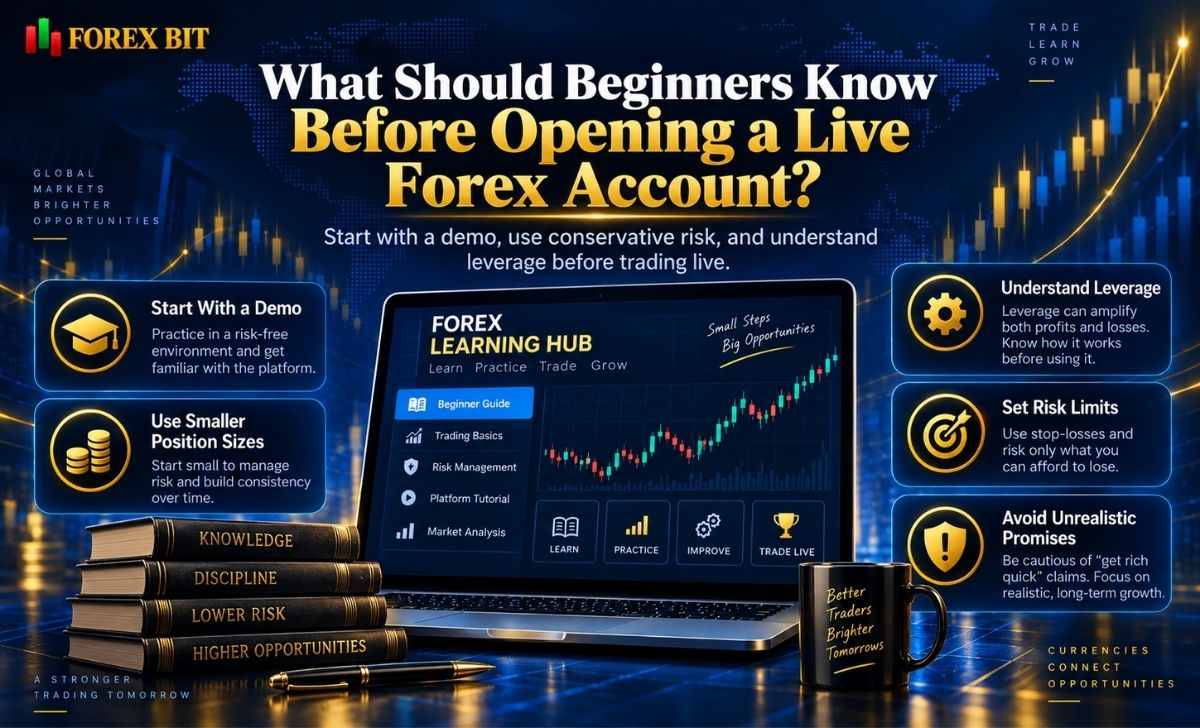
Opening an account is technically simple. Managing the risks after opening it is harder.
Start With a Demo Account
A demo account can help beginners learn:
- How to open and close trades
- Order types
- Platform navigation
- Stop-loss placement
- Position sizing
- Margin calculations
Move to live trading only after understanding the platform and basic risk controls.
Use Conservative Position Sizes
The ability to trade a large position does not mean that the position is appropriate.
Before every trade, know:
- Entry price
- Stop-loss level
- Position size
- Maximum loss
- Margin used
Avoid deciding trade size based only on the broker’s maximum leverage.
Never Treat Leverage as Free Capital
Leverage increases exposure; it does not increase the actual money in your account.
A leveraged position can move against you quickly.
Regulators consistently classify leveraged retail forex and CFD products as high-risk. The FCA states that CFDs and rolling spot FX are high-risk products and are not suitable for all retail consumers.
Be Cautious of Unrealistic Promises
Warning signs can include:
- Guaranteed returns
- “Risk-free” forex profits
- Pressure to deposit immediately
- Unsolicited social-media messages
- Requests for extra payments before withdrawal
- Claims that more deposits are needed to release your existing funds
The CFTC specifically warns that many forex frauds begin through social media and recommends verifying firms independently.
Only Use Money You Can Afford to Lose
Forex trading should not be funded with money required for:
- Rent
- Daily living expenses
- Emergency savings
- Retirement needs
- Debt payments
The CFTC advises traders to use only risk capital they can afford to lose and to establish a risk-management plan before trading.
Conclusion
If you want to Open Forex Account, start by choosing a regulated broker and checking its legal entity, trading conditions, fees, and account requirements. Always review the broker’s current terms and verify the available deposit, withdrawal, leverage, margin, and overnight financing conditions before depositing money.
Forex Bit provides educational information to help readers research and compare forex topics, but does not open brokerage accounts, accept trading deposits, execute trades, or manage client funds.
Isabella Brown is the Forex Trading Guide Manager at Forex Bit, focusing on educational content about broker safety, trading costs, account types, platforms, and key Forex/CFD concepts. Her work helps readers understand trading terms, broker conditions, and practical checks before evaluating or using a brokerage service.
Email: [email protected]

Best Brokers

Trade with the world’s largest retail broker and benefit from better - than - market conditions.

We offer a superior trading environment that puts traders in the best position to profit.

Trade with the best trading conditions. WIN THE BEST TRADING ACCOUNT AWARD.

Trade global markets with Interactive Brokers – a highly regulated multi-asset broker built for active and professional investors.






Forex Bit provides independent forex broker reviews, comparisons, guides, and industry news to help traders make informed decisions.
Best Brokers
Metatrader 5 Brokers
Metatrader 4 Brokers
Lowest Spread Forex Broker
Regulated Forex Brokers
Forex Copy Trading
Ctrader Brokers
Best Forex Broker For Beginners