
Confused about margin trading? Get forex leverage explained simply—ratios, risks, and how to use it safely. Read the full guide now.
Forex Leverage Explained: How It Works for Traders

Forex leverage lets traders control a large position using a comparatively small amount of capital. It works by borrowing funds from a broker, magnifying both potential profits and potential losses on a trade.
In practice, leverage is applied through a ratio such as 30:1, 100:1, or 500:1, depending on the regulatory jurisdiction and the broker’s risk policies. This ratio determines how much margin a trader must deposit to open a position. A higher ratio reduces the required upfront margin while increasing exposure to price movements.
Leverage ratios directly determine margin requirements and the maximum position size a trading account can support. A higher leverage ratio reduces the margin required to open a position, while a lower leverage ratio requires a trader to put up a larger margin for the same position size. A higher leverage setting lowers the margin needed per lot, allowing larger positions relative to account balance.
High leverage increases the risk of rapid, significant losses relative to the invested capital. Traders manage this risk through position sizing, stop-loss orders, and maintaining margin buffers above the broker’s stop-out level.
Leverage limits differ significantly between regulated and offshore brokers, with regulators such as the FCA generally imposing stricter caps than many offshore jurisdictions. Forex Bit compares these regulatory differences to help traders understand what leverage levels are available under each framework.
Understanding these fundamentals sets the stage for a closer look at what forex leverage actually is and how brokers structure it.
What Is Forex Leverage?
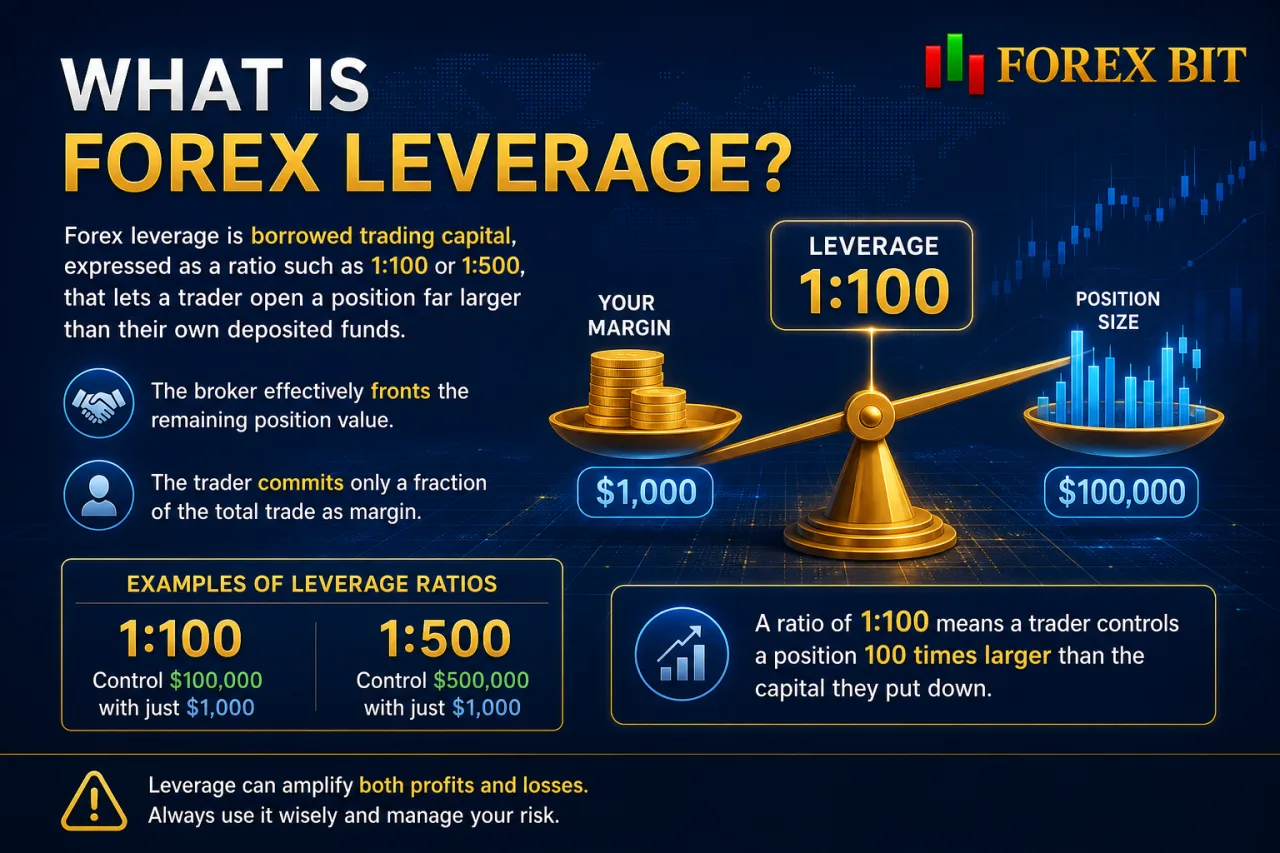
Forex leverage is borrowed trading capital, expressed as a ratio such as 1:100 or 1:500, that lets a trader open a position far larger than their own deposited funds. This mechanism connects directly to the leverage ratios and margin requirements already outlined above.
The broker effectively fronts the remaining position value, while the trader commits only a fraction of the total trade as margin. A ratio of 1:100 means a trader controls a position 100 times larger than the capital they put down.
Margin functions as the collateral that unlocks this borrowed capital. A smaller margin requirement corresponds to a higher leverage ratio, while a larger margin requirement corresponds to a lower ratio for the same position size. This relationship makes leverage and margin two sides of the same trading mechanism rather than separate, unrelated conditions.
How Does Forex Leverage Work in Practice?
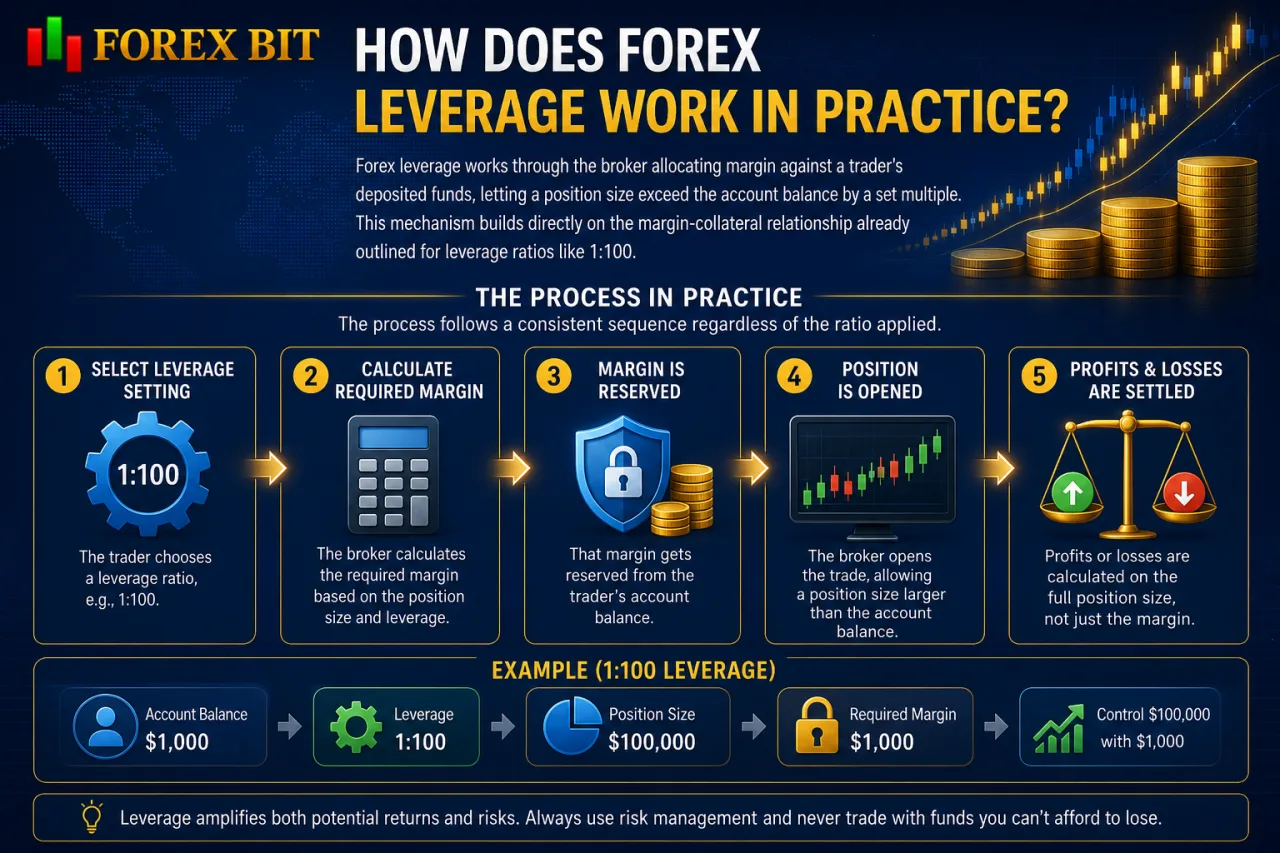
Forex leverage works through the broker allocating margin against a trader’s deposited funds, letting a position size exceed the account balance by a set multiple. This mechanism builds directly on the margin-collateral relationship already outlined for leverage ratios like 1:100.
The process follows a consistent sequence regardless of the ratio applied. A trader selects a leverage setting, the broker calculates the required margin for the intended position size, that margin gets reserved from the account balance, and the remaining exposure is effectively financed by the broker.
The following subsections walk through this sequence in detail, including a numeric comparison of required margin versus total exposure across different leverage ratios.
How Is Position Size Calculated Using Leverage?
Position size is calculated by dividing account equity multiplied by the leverage ratio, then dividing that figure by the price of one unit of the traded instrument. This formula ties directly into the margin-and-exposure sequence already described for leverage ratios like 1:100.
The core formula reads: Maximum Position Size = (Account Equity × Leverage Ratio) ÷ Asset Price. Equity represents the trader’s own deposited funds, the leverage ratio sets the multiplier applied to that equity, and the resulting figure caps the notional value of the trade the account can support.
A worked example clarifies the mechanics. With $1,000 of equity and a 1:100 leverage ratio, an account supports a maximum notional position value of $100,000, since the leverage ratio multiplies the trader’s equity into total buying power.
From there, the trader converts that notional value into lots based on the instrument’s contract size, then confirms the required margin fits within the account balance before the trade is opened. Brokers apply this same calculation automatically at order entry, rejecting orders that exceed the equity-leverage limit.
What Role Do Pip Value and Lot Size Play in Leveraged Trades?
Pip value scales directly with lot size, so leverage determines how large a position a given margin can support and, in turn, how much each pip movement is worth to the account. This connects to the position-sizing formula already covered, since the notional value calculated from equity and leverage translates into a specific lot size before pip value can be measured.
Lot size sets the fixed unit exposure a trade carries, and three standard increments apply across most brokers:
- Standard lot: represents 100,000 units of the base currency A standard lot in forex trading represents 100,000 units of the base currency, and its pip value typically works out to around $10 for most major currency pairs.
- Mini lot: represents 10,000 units of the base currency A mini lot in forex trading represents 10,000 units of the base currency, and its pip value typically works out to around $1 for most major currency pairs.
- Micro lot: represents 1,000 units of the base currency A micro lot in forex trading represents 1,000 units of the base currency, and its pip value is typically a fraction of a dollar for most major currency pairs.
Leverage interacts with these lot categories by lowering the margin needed to open larger lot sizes, which raises the pip value exposed per trade without requiring proportionally more capital. A trader using higher leverage on a standard lot faces a larger dollar swing per pip than the same equity applied to a micro lot, making lot size selection a direct lever on overall trade risk alongside the leverage ratio itself.
How Do Leverage Ratios Affect Margin Requirements and Position Size?
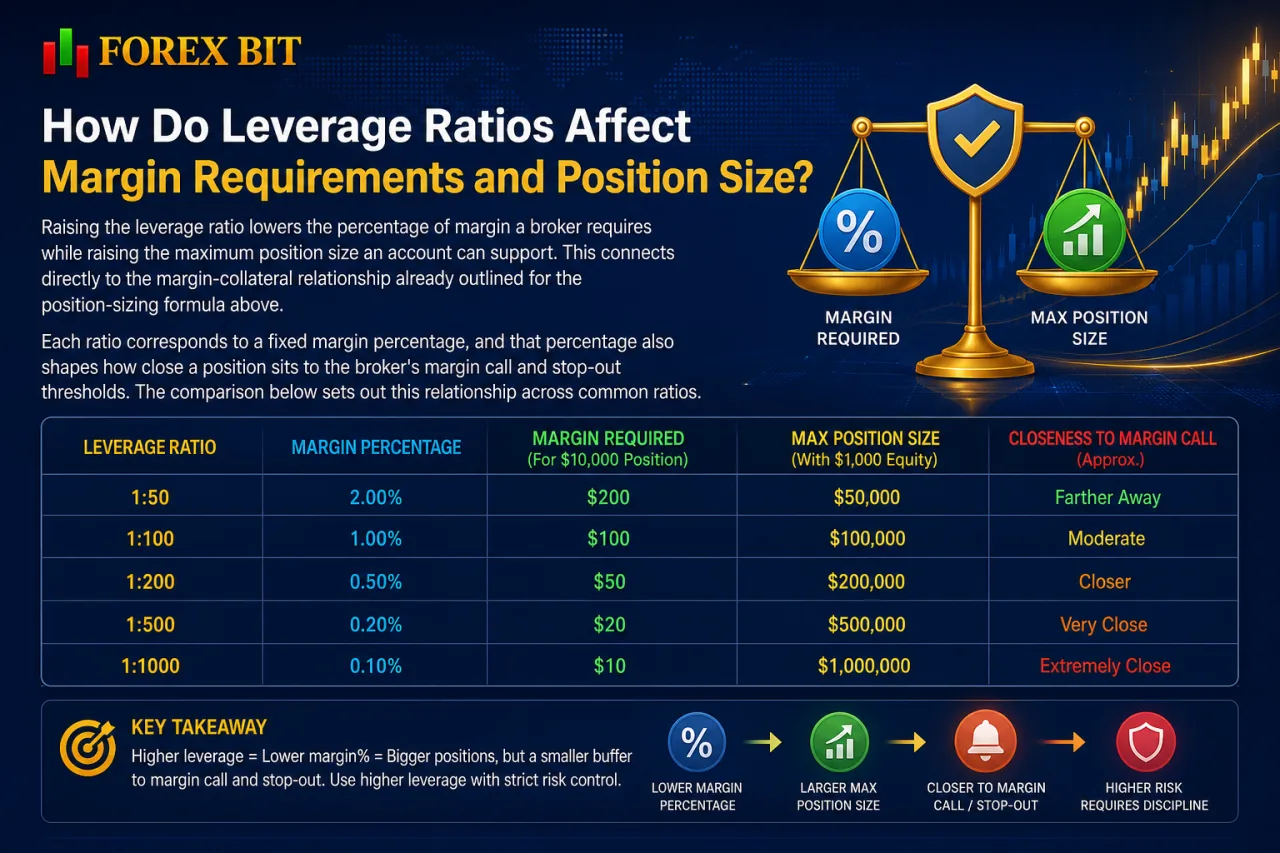
Raising the leverage ratio lowers the percentage of margin a broker requires while raising the maximum position size an account can support.
Each ratio corresponds to a fixed margin percentage, and that percentage also shapes how close a position sits to the broker’s margin call and stop-out thresholds. The comparison below sets out this relationship across common ratios.
| Leverage Ratio | Required Margin (%) | Typical Margin Call Level | Typical Stop-Out Level |
|---|---|---|---|
| 1:30 | 3.33% | 100% | 50% |
| 1:100 | 1.00% | 100% | 50% |
| 1:500 | 0.20% | 100% | 20% |
| 1:1000 | 0.10% | 100% | 20% |
Margin call and stop-out percentages vary by broker and regulatory jurisdiction rather than following a single universal standard. Margin call and stop-out percentage thresholds vary from broker to broker, so traders should check the specific thresholds set by their broker for each leverage ratio rather than assuming a universal standard.
What Is the Difference Between Initial Margin, Used Margin, and Free Margin?
Initial margin is the amount reserved to open a new position, used margin is the total of all initial margins currently locked across open trades, and free margin is the equity remaining available to open further positions or absorb losses. These three figures move together as a leveraged position shifts in the trader’s favor or against it, so tracking the relationship between them matters throughout the life of a trade.
Used margin stays fixed at the sum of initial margins committed unless positions are added or closed, regardless of price movement. Free margin, by contrast, expands as floating profit accumulates on open positions and contracts as floating losses grow, since it equals equity minus used margin.
- Initial margin locks in at trade entry and does not change unless the position size changes.
- Used margin grows whenever a new position adds its own initial margin to the total.
- Free margin rises with unrealized gains and falls with unrealized losses, directly affecting how close an account sits to a margin call.
When free margin drops toward zero, the account approaches the margin call and stop-out thresholds already outlined for the account’s leverage ratio.
What Happens During a Margin Call or Stop-Out?
A margin call is a broker notification that free margin has fallen to a set threshold, while a stop-out is the automatic closing of positions once equity drops further, both designed to prevent the account balance from going negative. This mechanic follows directly from the free-margin behavior already described for leveraged positions moving against a trader.
Margin call and stop-out levels are typically expressed as a percentage of equity relative to used margin, with margin call and stop-out thresholds varying by broker and leverage ratio rather than following a single universal standard.
The sequence unfolds in stages as losses accumulate on open positions:
- Equity falls toward the margin call level, triggering a warning that additional funds or reduced exposure are required.
- Equity continues declining past the margin call level without intervention from the trader.
- The broker’s system automatically closes one or more open positions once equity reaches the stop-out level.
- Remaining positions close progressively if equity keeps falling, halting losses before the balance turns negative.
This automated closure protects both the broker and the trader from exposure exceeding the deposited capital, reinforcing why free margin tracking matters throughout a leveraged trade.
What Are the Risks of High Leverage and How Can Traders Manage Them?
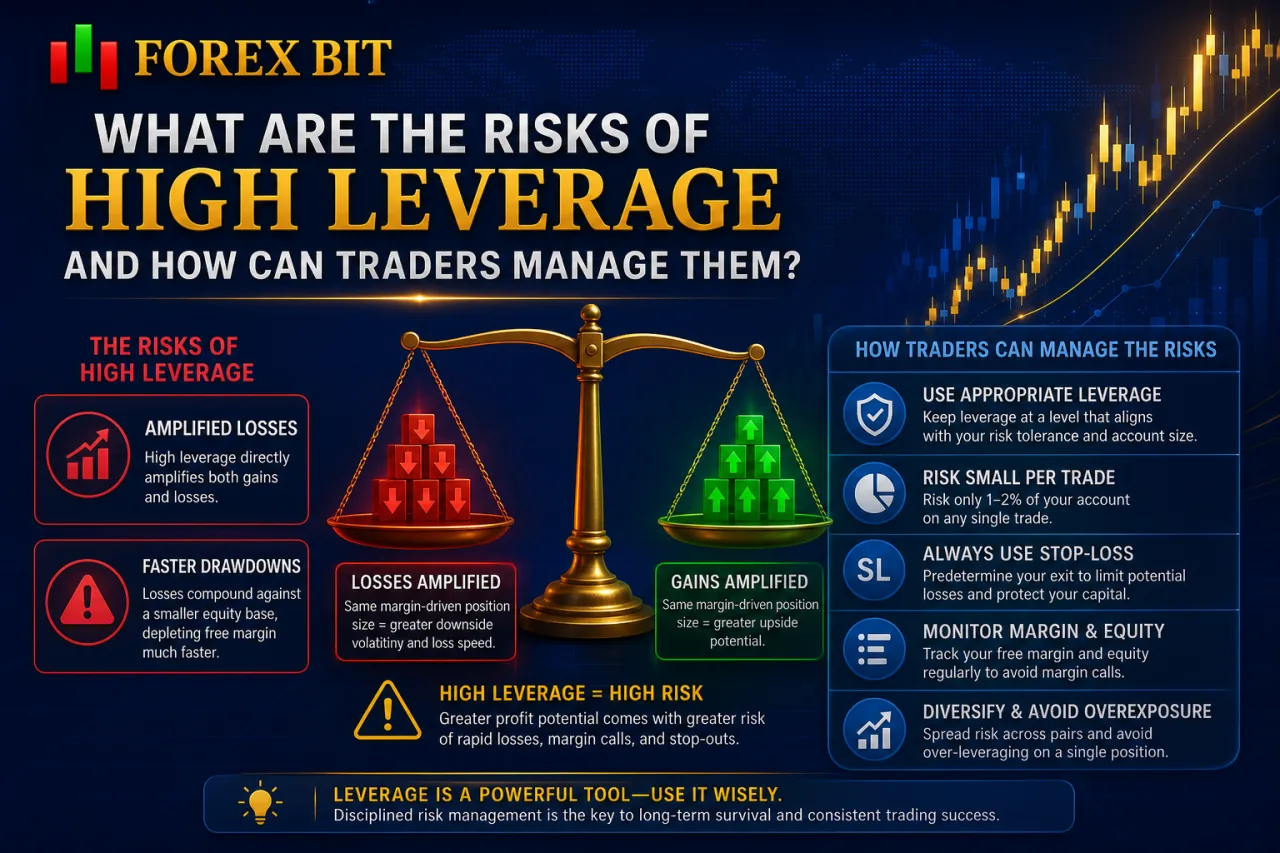
High leverage confirms a direct amplification of both gains and losses, since the same margin-driven position size that boosts profit potential also magnifies drawdown speed. This risk profile stems from the leverage-margin mechanics already outlined for margin calls and stop-outs above.
Two conditions drive most of the risk: exposure to normal price volatility gets scaled up by the leverage ratio, and free margin depletes faster as losses compound against a smaller equity base. This combination also creates psychological pressure, since traders watching rapid equity swings often deviate from a planned strategy under stress.
Practical management techniques address these conditions directly:
- Placing stop-loss orders on every position caps downside before it reaches the margin call threshold.
- Applying lower effective leverage than the maximum offered keeps required margin further from the stop-out level.
- Sizing positions as a fixed percentage of equity limits how much any single trade affects free margin.
- Maintaining a margin buffer above the stop-out level prevents forced closure during short-term volatility.
The following subsections examine volatility exposure and specific mitigation methods in more detail.
How Does Leverage Amplify Both Profits and Losses?
Leverage multiplies the dollar gain or loss from an identical price move, since a higher ratio ties the same equity to a larger position size and therefore a larger pip value. This mechanism follows directly from the pip-value and lot-size relationship already outlined for leveraged trades.
A side-by-side comparison isolates the effect. Two traders each hold $1,000 of equity and open a position on the same currency pair, and the pair moves 50 pips in their favor.
- Trader A applies 1:30 leverage, controlling a position size of $30,000. On a pair where one pip equals $10 per standard lot, a 0.3-lot position carries a pip value of $3, so the 50-pip move produces a profit of $150.
- Trader B applies 1:500 leverage on the same $1,000 equity, controlling a position size of $500,000. That position size equals 5 standard lots, giving a pip value of $50, so the identical 50-pip move produces a profit of $2,500.
A 50-pip move against Trader B’s position under 1:500 leverage produces a loss of $2,500, more than 16 times larger in dollar terms than the $150 loss Trader A would face on the identical adverse move, since both accounts share the same starting equity but control very different position sizes.
The equity base stays identical in both cases. Only the position size scales with the leverage ratio, which is why the same market movement produces sharply different dollar outcomes depending on the leverage applied.
What Risk Management Techniques Reduce Leverage-Related Losses?
Reducing leverage-related losses works through four core techniques: fixed stop-loss and take-profit levels, capping effective leverage below the maximum offered, monitoring margin level percentage, and sizing positions relative to account equity. This set of practices addresses the same drawdown-speed risk already outlined for high-leverage positions moving against a trader.
Each technique targets a different point in the leveraged-trade lifecycle, from order placement through ongoing position management:
- Setting stop-loss and take-profit levels on every trade locks in an exit point before losses reach the margin call threshold.
- Limiting effective leverage below the account’s maximum ratio keeps required margin further from the stop-out level.
- Monitoring margin level percentage throughout the trading session flags declining free margin before it triggers an automatic close.
- Sizing positions as a fixed percentage of account equity contains the impact of any single trade on overall free margin.
Applying these techniques together keeps an account further from the margin call and stop-out thresholds tied to its leverage ratio, rather than relying on any single safeguard alone.
How Do Leverage Limits Compare Across Brokers and Regulators (e.g., FCA vs Offshore)?
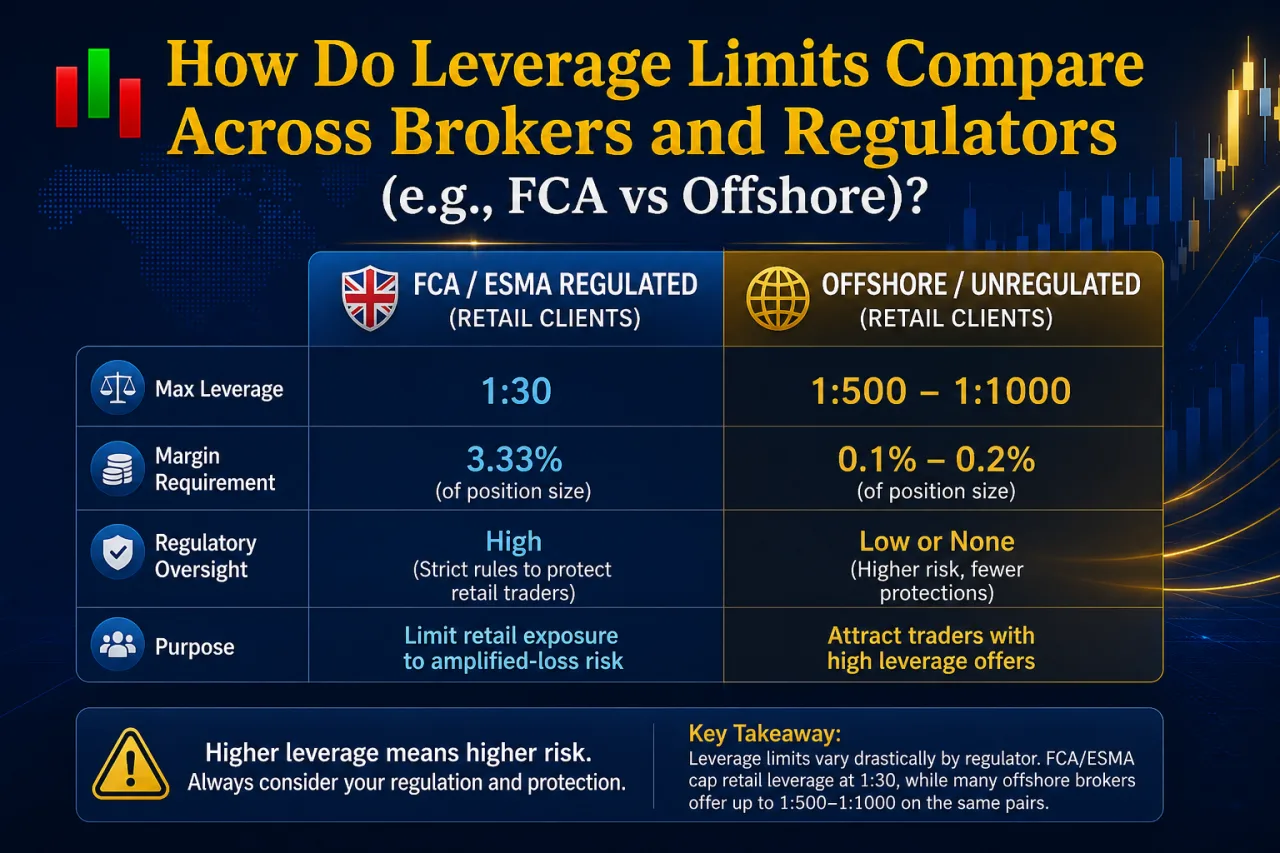
Leverage caps differ sharply by regulatory framework: FCA and ESMA-aligned regulators generally restrict retail forex leverage to a maximum of 1:30, while many offshore or unregulated brokers offer 1:500 or 1:1000 on the same currency pairs. This gap ties directly into the margin-percentage relationship already outlined for leverage ratios above.
Regulators set these ceilings to limit retail exposure to the amplified-loss risk already described, but jurisdictions apply that principle at very different levels. The comparison below sets out the maximum retail leverage permitted under several major frameworks alongside typical offshore practice.
| Regulator | Jurisdiction | Maximum Retail Leverage |
|---|---|---|
| FCA | United Kingdom | 1:30 |
| ESMA | European Union | 1:30 |
| ASIC | Australia | 1:30 |
| CFTC/NFA | United States | 1:50 |
| Offshore/unregulated brokers | Various (e.g., St. Vincent, Seychelles) | 1:500 to 1:1000 |
Specific leverage caps vary by jurisdiction and change over time, so traders should check the current rulebook of their relevant regulator for exact figures rather than relying on fixed numbers.
Traders classified as professional clients under FCA or ESMA rules access higher ratios than the retail caps shown, subject to separate eligibility criteria set by each regulator.
Why Do Regulated Brokers Offer Lower Leverage Than Offshore Brokers?
Regulated brokers cap leverage lower than offshore brokers because regulators mandate investor protection, restricting retail exposure to the amplified-loss risk already outlined for margin calls and stop-outs. This rationale ties directly into the FCA-versus-offshore comparison already covered above.
Investor protection mandates require regulators to limit how much loss a retail account can absorb relative to deposited capital, since retail clients are presumed to have less trading experience and smaller risk tolerance than institutional participants. Offshore jurisdictions typically lack an equivalent mandate, allowing brokers registered there to offer 1:500 or 1:1000 without the same retail safeguards.
Retail versus professional client classification further explains the gap. Regulators like the FCA and ESMA reserve higher leverage for traders who qualify as professional clients under separate eligibility criteria, while retail clients remain subject to the lower caps already listed in the comparison table above.
Regulators justify these lower caps by pointing to the faster margin depletion and stop-out risk that high leverage creates for retail accounts, aiming to reduce the frequency and severity of forced position closures.
What Other Leverage-Related Factors Should Advanced Traders Consider?
Advanced traders weigh three additional leverage factors beyond standard ratios and margin calculations: tiered leverage schedules, negative balance protection, and professional client classification. Each factor shapes how much effective leverage an account carries once position size, equity, or regulatory status changes, extending the margin and jurisdictional comparisons already outlined above.
What Is Tiered Leverage and How Does It Reduce Leverage on Larger Positions?
Tiered leverage is a broker-side structure that automatically lowers the leverage ratio applied to a position once trade volume or total exposure crosses set thresholds. This mechanism extends the professional-classification and negative-balance considerations already introduced for advanced traders.
Instead of a single fixed ratio across an entire account, the broker assigns leverage in bands tied to position size. A trader might receive the account’s maximum ratio on the first portion of a position, then a progressively lower ratio on each additional volume tier as exposure grows.
- Reduces leverage as notional exposure per instrument increases beyond a set volume band.
- Applies separate tiers per symbol or per account, depending on the broker’s risk model.
- Limits the broker’s counterparty risk on unusually large retail positions.
Exact tier thresholds and reduced ratios vary by broker and by traded instrument, so traders should confirm the specific schedule published in their broker’s contract specifications.
Does Negative Balance Protection Offset the Risks of High Leverage?
Negative balance protection does not offset the risks of high leverage; it only guarantees a trader cannot lose more than their deposited funds once the broker closes positions. This policy addresses the outcome of a leveraged account reaching zero equity, but it does not reduce the speed or frequency of margin depletion already tied to high leverage ratios.
The protection triggers only after equity turns negative, meaning the stop-out process already covered still runs its course beforehand. Negative balance protection availability and its exact terms vary by broker and by regulatory jurisdiction, so traders should confirm the specific policy stated in their account agreement.
Three points clarify the limit of this safeguard:
- Prevents an account balance from settling below zero after adverse price gaps or slippage.
- Applies after position closure, not before, so margin calls and stop-outs still occur first.
- Excludes protection against normal drawdown, since losses up to the full deposit remain possible.
Conclusion
Forex leverage functions as borrowed capital that turns a small margin deposit into control over a much larger position, with the ratio applied determining margin requirements, pip value exposure, and how close an account sits to margin call and stop-out thresholds. Regulatory framework shapes the ceiling available, with FCA, ESMA, and ASIC retail caps sitting far below the ratios common among offshore brokers, while professional classification and tiered leverage schedules adjust that ceiling further for qualifying accounts.
Negative balance protection limits worst-case outcomes without reducing how fast margin depletes. Combined with disciplined position sizing, stop-loss placement, and margin monitoring, this framework answers how leverage operates and why matching ratio choice to risk tolerance defines its practical use in trading.
Isabella Brown is the Forex Trading Guide Manager at Forex Bit, focusing on educational content about broker safety, trading costs, account types, platforms, and key Forex/CFD concepts. Her work helps readers understand trading terms, broker conditions, and practical checks before evaluating or using a brokerage service.
Email: [email protected]



Best Brokers

Trade with the world’s largest retail broker and benefit from better - than - market conditions.

We offer a superior trading environment that puts traders in the best position to profit.

Trade with the best trading conditions. WIN THE BEST TRADING ACCOUNT AWARD.

Trade global markets with Interactive Brokers – a highly regulated multi-asset broker built for active and professional investors.






Forex Bit provides independent forex broker reviews, comparisons, guides, and industry news to help traders make informed decisions.
Best Brokers
Metatrader 5 Brokers
Metatrader 4 Brokers
Lowest Spread Forex Broker
Regulated Forex Brokers
Forex Copy Trading
Ctrader Brokers
Best Forex Broker For Beginners