
Wondering how forex swap fees work? See real overnight rates, how they’re calculated, and ways to cut costs with swap-free trading options.
Forex Swap Fees Explained: Rates, Costs & How to Avoid Them

Forex swap fees are interest charges applied when a trading position stays open past the daily rollover time, typically around 5 PM New York time. They are calculated from the interest rate differential between the two currencies in a pair, adjusted by the broker’s own swap rate and the trade’s lot size.
Swap rates vary significantly between brokers and even between account types offered by the same broker, since each broker sets its own markup over the interbank rate differential. Some brokers publish fixed swap tables per instrument, while others adjust rates daily based on interbank interest rate movements.
Traders reduce or eliminate overnight charges by opening a swap-free (Islamic) account, closing positions before the daily rollover cutoff, or trading instruments with historically low swap rates. Each method carries trade-offs affecting spreads, commissions, or eligible instruments.
Calculating the swap cost on a specific pair and lot size requires the pair’s swap rate in points, the current pip value, and the number of nights the position remains open. A standard 1-lot EUR/USD position, for example, accrues a different overnight charge depending on whether it is long or short.
Forex Bit breaks down how these calculations work in practice, starting with the mechanics behind swap fees before comparing typical broker rates and account structures. The following sections explain what forex swap fees are and how they are calculated, how much brokers commonly charge, and whether standard or swap-free accounts offer lower overnight trading costs.
What Are Forex Swap Fees and How Are They Calculated?
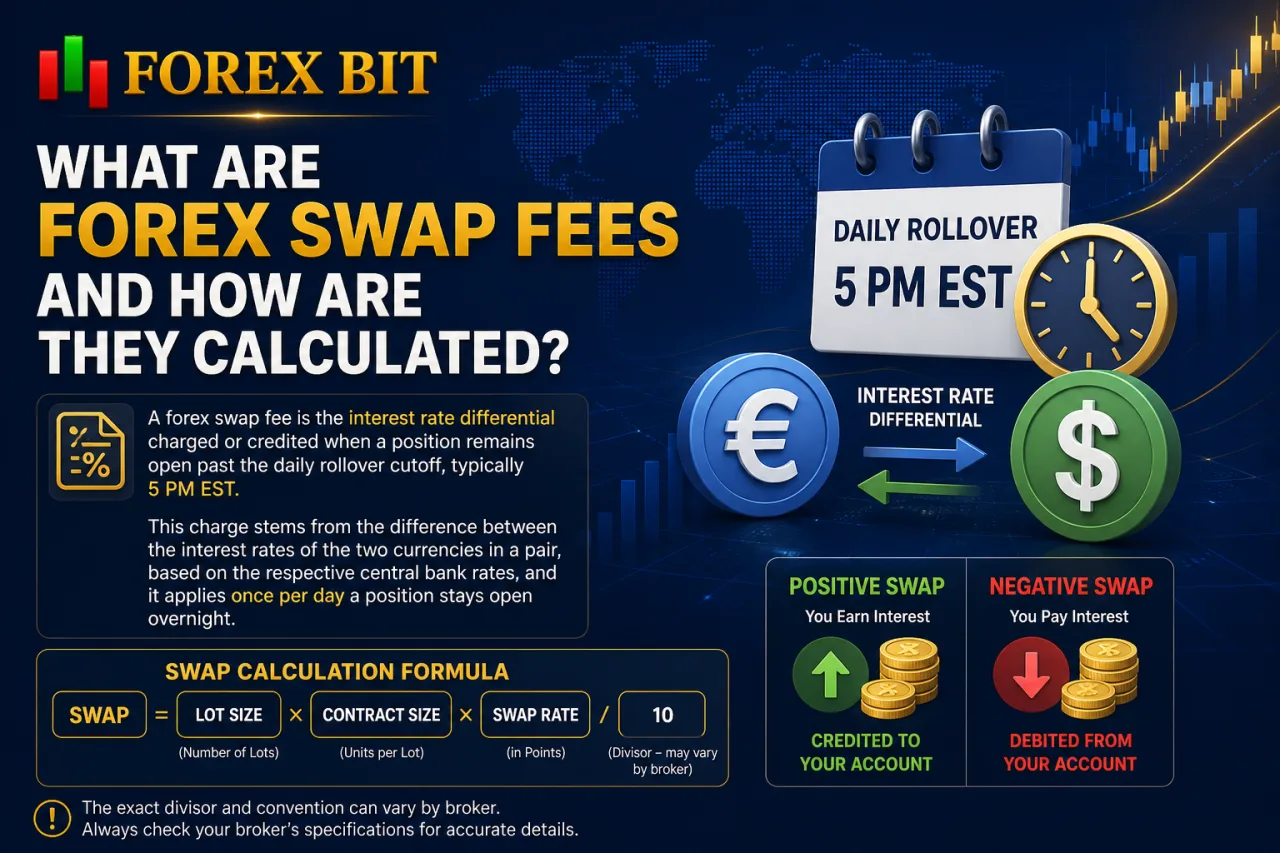
A forex swap fee is the interest rate differential charged or credited when a position remains open past the daily rollover cutoff, typically 5 PM EST. This charge stems from the difference between the interest rates of the two currencies in a pair, based on the respective central bank rates, and it applies once per day a position stays open overnight.
The core calculation follows a standard formula: Swap = (Lot Size × Contract Size × Swap Rate) / 10, though the exact divisor and convention can vary slightly between broker platforms.
The swap rate itself derives from the interest rate differential between the base and quote currency, adjusted by the broker’s markup or discount on that differential. Swap fees are expressed either in pips per lot or directly in the account’s base currency per lot held overnight, depending on the broker’s reporting format. A long position on a currency pair with a higher-yielding base currency typically earns a positive swap, while a short position on the same pair typically pays a negative swap, subject to each broker’s specific rate table.
How Much Do Brokers Typically Charge in Swap Rates?
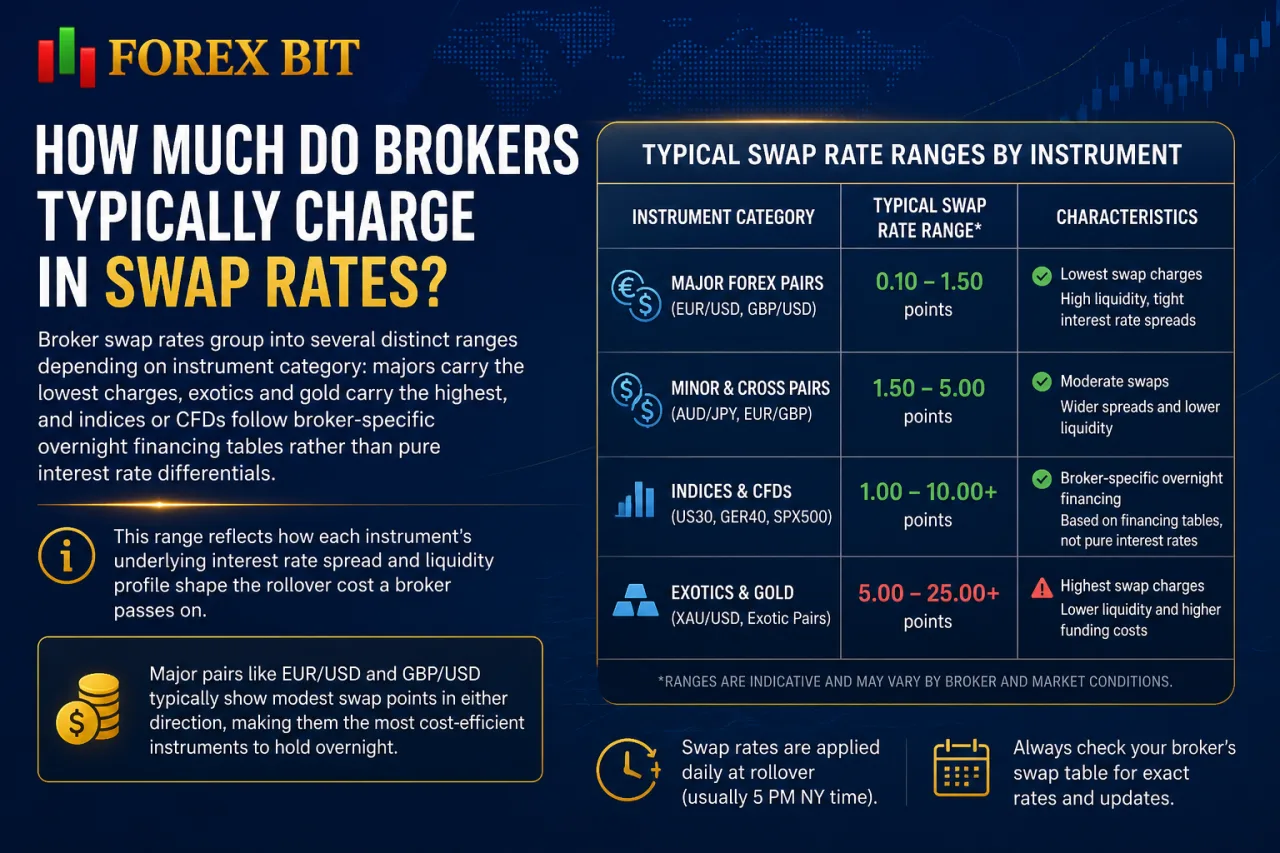
Broker swap rates group into several distinct ranges depending on instrument category: majors carry the lowest charges, exotics and gold carry the highest, and indices or CFDs follow broker-specific overnight financing tables rather than pure interest rate differentials.
This range reflects how each instrument’s underlying interest rate spread and liquidity profile shape the rollover cost a broker passes on. Major pairs like EUR/USD and GBP/USD typically show modest swap points in either direction, since the interest rate gap between the US dollar, euro, and pound stays relatively narrow. USD/JPY often carries a more noticeable long/short asymmetry due to the persistent rate differential between the dollar and yen.
Exotic pairs such as USD/TRY generally show the widest swap values, driven by high benchmark rates in emerging-market currencies. Gold (XAU/USD) is quoted with its own swap convention tied to storage and financing cost rather than a currency interest differential. Indices and other CFDs follow separate overnight financing formulas set individually by each broker.
The following table illustrates sample long/short swap values in points for common instruments:
| Instrument | Long Swap (points) | Short Swap (points) |
|---|---|---|
| EUR/USD | -6.5 | 1.2 |
| GBP/USD | -5.8 | 0.9 |
| USD/JPY | 3.1 | -8.4 |
| USD/TRY | -450 | 120 |
| XAU/USD (Gold) | -8.2 | -2.1 |
Illustrative example only, not actual data from a specific broker. Actual figures vary by broker and change daily, so verify current values directly on the broker’s official swap rate table.
These figures fluctuate daily based on interbank interest rate movements and each broker’s individual markup. Traders verify current values directly on the broker’s swap rate table before holding a position overnight.
What Is Triple Swap (Wednesday/Friday Rollover)?
Triple swap refers to the standard forex market convention of charging three times the normal overnight rate on one specific weekday to account for weekend settlement, since spot forex trades settle on a T+2 basis.
This convention connects directly to the swap mechanics already outlined, since positions held on that single day absorb the interest cost that would otherwise accrue over Saturday and Sunday, days when banks remain closed and no settlement occurs.
Many brokers apply a triple swap charge on Wednesdays, a convention often linked to the T+2 settlement cycle used for spot currency trades, though the specific day and rules can vary by broker. A smaller number of brokers instead apply the triple charge on Friday, depending on their internal settlement and rollover schedule. Traders holding a position through the designated triple-swap day pay or receive three days’ worth of interest in a single charge, rather than the standard single-day amount applied on other weekdays.
Checking the broker’s official swap schedule confirms which weekday carries the triple charge, since this detail varies by broker rather than following one universal industry-wide date.
Standard Account vs Swap-Free (Islamic) Account: Which Has Lower Overnight Costs?
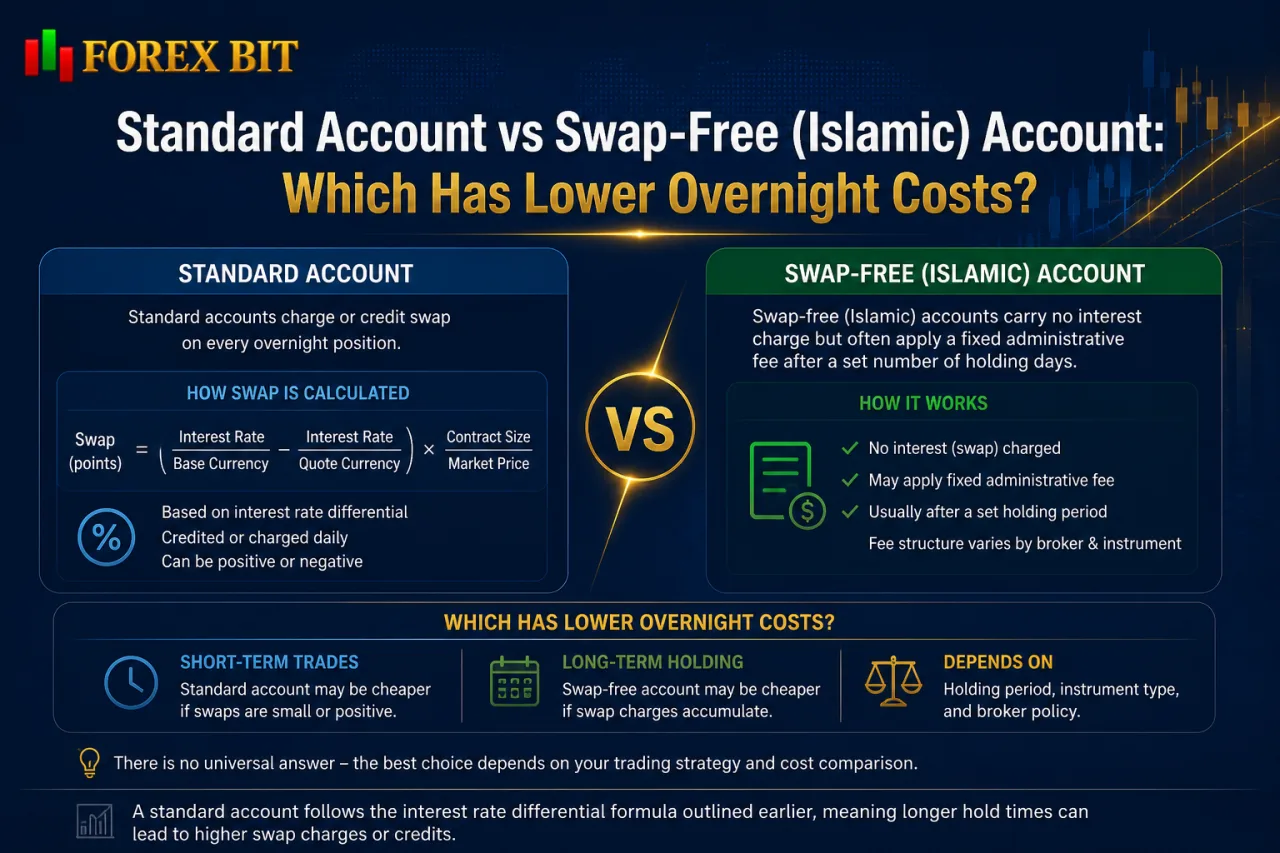
Standard accounts charge or credit swap on every overnight position, while swap-free (Islamic) accounts carry no interest charge but often apply a fixed administrative fee after a set number of holding days. This distinction shapes which account structure produces a lower overnight cost, since the comparison depends on holding period, instrument, and broker policy rather than a single universal answer.
A standard account follows the interest rate differential formula outlined earlier, meaning long or short positions accrue a variable daily charge that shifts with interbank rates. A swap-free account removes that interest component entirely at account opening, which typically requires proof of religious eligibility or broker approval, but many brokers replace it with a flat administrative fee once a position exceeds a grace period, commonly a few trading days. This grace period and its replacement fee vary by broker and are not standardized across the industry.
| Feature | Standard Account | Swap-Free (Islamic) Account |
|---|---|---|
| Spread | Standard/raw spread | Often slightly wider |
| Commission | Standard/none, per broker model | Same as standard, per broker model |
| Swap policy | Charged/credited daily | None, replaced by admin fee after grace period |
| Eligibility | Open to all traders | Requires eligibility verification |
| Admin fee after X days | Not applicable | Fixed fee per lot, broker-specific |
Short-term traders closing positions within the grace period typically pay less on a swap-free account, while long-term holders on standard pairs with favorable differentials sometimes benefit from a positive swap credit unavailable elsewhere.
How to Avoid or Reduce Forex Swap Fees?
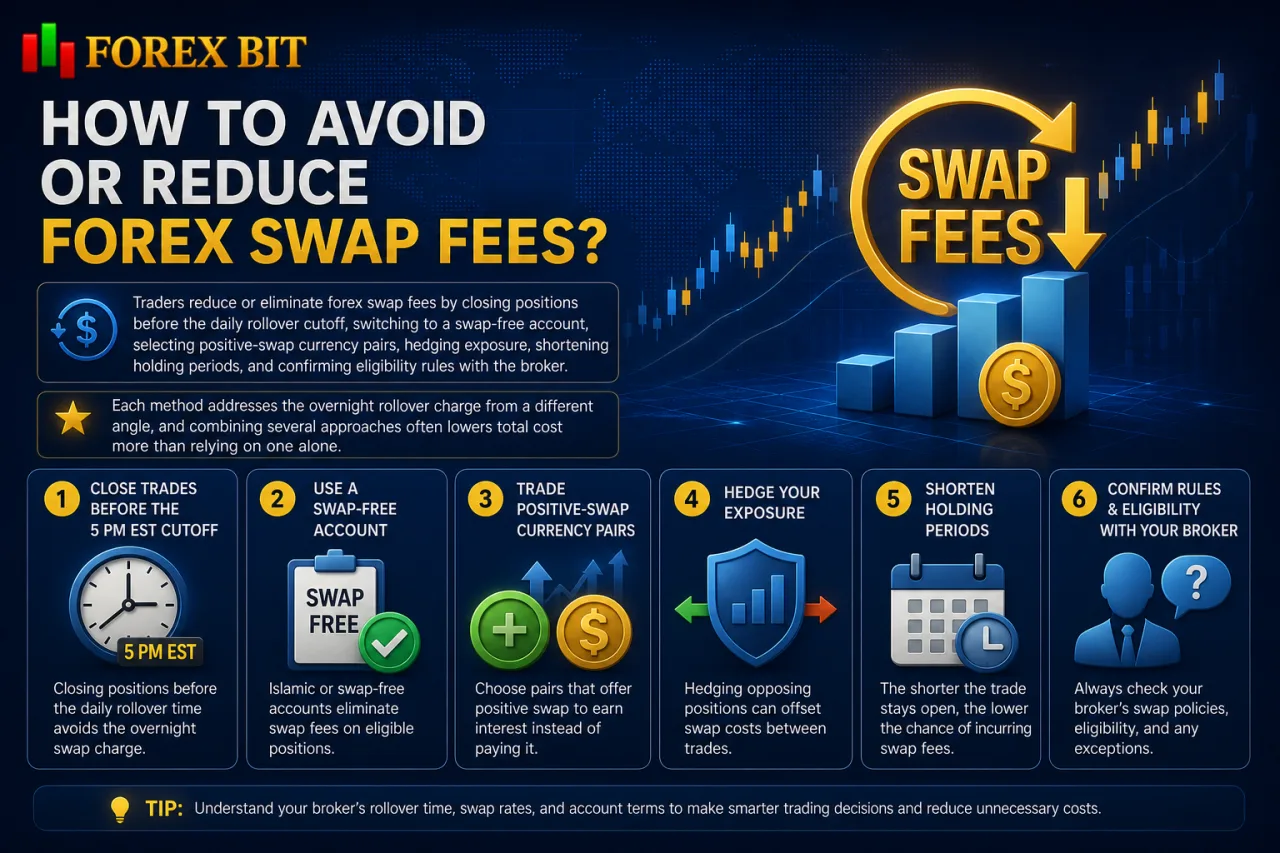
Traders reduce or eliminate forex swap fees by closing positions before the daily rollover cutoff, switching to a swap-free account, selecting positive-swap currency pairs, hedging exposure, shortening holding periods, and confirming eligibility rules with the broker.
Each method addresses the overnight rollover charge from a different angle, and combining several approaches often lowers total cost more than relying on one alone.
- Closing trades before the 5 PM EST cutoff avoids the daily interest charge entirely, since no position remains open when rollover applies.
- Opening a swap-free (Islamic) account removes the interest component, subject to the eligibility verification and grace period noted earlier for that account type.
- Choosing a currency pair or direction with a positive swap value turns the rollover into a credit rather than a cost, based on the interest rate differential between the two currencies.
- Hedging a position with an opposite trade on a correlated instrument offsets part of the net overnight exposure, though this typically doubles spread or commission costs.
- Trading on shorter timeframes, such as intraday strategies that close before the cutoff, sidesteps rollover charges by design.
- Checking the broker’s swap-free eligibility policy by country or religious criteria confirms whether an account qualifies before applying, since these rules vary by broker rather than following one industry standard.
How to Calculate Swap Fees for a Specific Lot Size and Currency Pair?
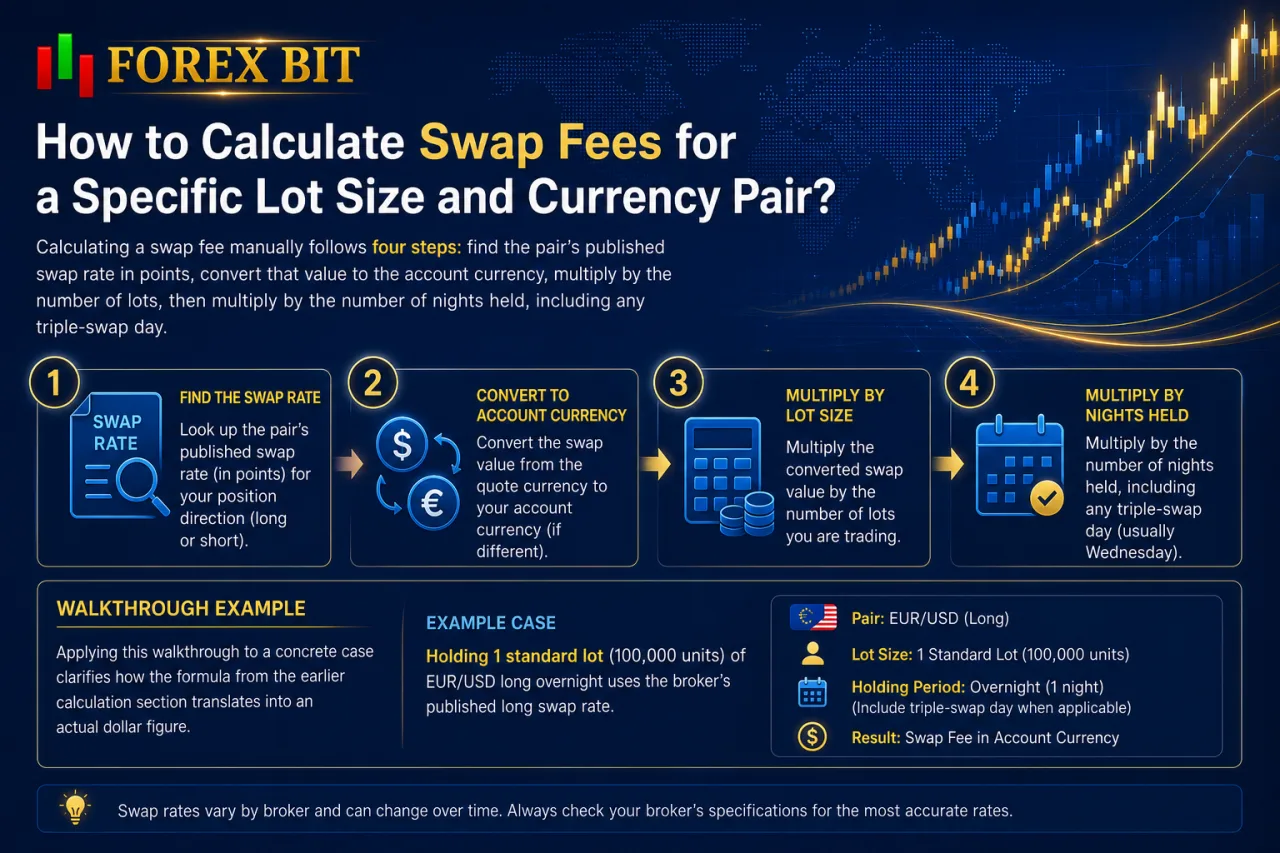
Calculating a swap fee manually follows four steps: find the pair’s published swap rate in points, convert that value to the account currency, multiply by the number of lots, then multiply by the number of nights held. This last step includes any triple-swap day, which adjusts the final total on the broker’s designated rollover night.
Applying this walkthrough to a concrete case clarifies how the formula from the earlier calculation section translates into an actual dollar figure.
- Holding 1 standard lot (100,000 units) of EUR/USD long overnight uses the broker’s published long swap rate, for example -6.5 points, while a short position uses the published short rate, for example 1.2 points.
- Converting points to account currency value multiplies the swap rate by the pip value for that lot size, since most brokers quote swap in points rather than a direct cash amount.
- Multiplying the converted value by the number of lots held scales the charge proportionally, so 2 lots accrue twice the single-lot swap.
- Applying the triple swap on the broker’s designated rollover day (commonly Wednesday) multiplies the standard nightly charge by three for that single night only.
Most brokers offer a built-in swap calculator on their website or client portal, which returns the converted cash value directly from the lot size and pair selected. The MT4 or MT5 terminal also displays swap long and swap short values in the contract specification window, sourced from Market Watch, for each symbol.
Do Swap Fees Differ Across Brokers, Regulators, or Account Currencies?
Yes, swap fees differ across brokers, regulatory entities of the same broker, and account base currencies, since no universal swap rate applies industry-wide. This variance ties directly back to the broker-specific markup on the interest rate differential noted earlier in the swap formula. Three factors drive these differences: the broker’s own pricing model, the regulatory entity handling the account, and the currency used for conversion.
Swap rates stay broker-specific rather than standardized, since each firm sets its own markup over the interbank rate differential. The same broker can quote different swap values across its regulatory entities, such as an FCA-regulated arm compared to an offshore entity under the same brand. Account base currency also shifts the final charge, since a swap rate quoted in points converts through an extra currency exchange step when the account currency differs from the pair’s quote currency.
Confirming the exact rate for a given entity and currency requires checking the broker’s own contract specifications page rather than assuming a single rate applies across its entire brand.
Can Swap Rates Change Without Notice?
Yes, swap rates change without notice, since brokers reserve the right to adjust rates daily or during high-volatility periods without alerting individual traders in advance. This variability connects directly to the broker-specific markup discussed earlier, since that markup shifts alongside interbank conditions rather than staying fixed.
Three situations commonly trigger a rate change:
- Adjusting rates daily as interbank interest rates and overnight funding costs move.
- Swap values tend to widen around central bank rate decisions, when short-term rate expectations shift quickly.
- Modifying rates during low-liquidity holiday periods, when reduced market depth can raise the broker’s own funding cost.
Brokers typically disclose these adjustments through an updated contract specification sheet on their website rather than a direct notification to each account holder. Checking that page before holding a position overnight confirms the current rate rather than relying on a previously observed value.
Conclusion
Forex swap fees ultimately come down to a daily interest rate differential applied at the 5 PM EST rollover, scaled by lot size and broker markup, with a triple charge on one designated weekday to cover weekend settlement. Rates vary widely by instrument category, from narrow charges on major pairs to steep costs on exotics and gold, and further differ across brokers, regulatory entities, and account currencies.
Traders control this cost through timing trades around the cutoff, selecting positive-swap pairs, or opting for a swap-free account when eligible, though each route carries its own trade-off in spreads or fees. Verifying the current contract specification sheet remains the only reliable way to confirm actual overnight charges before holding a position.
Isabella Brown is the Forex Trading Guide Manager at Forex Bit, focusing on educational content about broker safety, trading costs, account types, platforms, and key Forex/CFD concepts. Her work helps readers understand trading terms, broker conditions, and practical checks before evaluating or using a brokerage service.
Email: [email protected]

Best Brokers

Trade with the world’s largest retail broker and benefit from better - than - market conditions.

We offer a superior trading environment that puts traders in the best position to profit.

Trade with the best trading conditions. WIN THE BEST TRADING ACCOUNT AWARD.

Trade global markets with Interactive Brokers – a highly regulated multi-asset broker built for active and professional investors.






Forex Bit provides independent forex broker reviews, comparisons, guides, and industry news to help traders make informed decisions.
Best Brokers
Metatrader 5 Brokers
Metatrader 4 Brokers
Lowest Spread Forex Broker
Regulated Forex Brokers
Forex Copy Trading
Ctrader Brokers
Best Forex Broker For Beginners