
Confused about spread vs commission forex pricing? See real cost comparisons, lot examples, and which account type saves you more.
Spread vs Commission Forex: Which Costs Less to Trade?

Commission-based pricing tends to cost less for high-volume traders, while spread-only pricing tends to suit smaller retail accounts. The actual answer depends on trade size, frequency, and the specific broker’s fee schedule rather than a single fixed rule.
Total trading cost equals the spread in pips converted to money plus the fixed commission charged per lot. For example, a 1.0 pip spread on EUR/USD costs $10, and adding a $7 commission per lot gives a combined cost figure traders can compare across brokers.
Raw or ECN accounts offer tighter spreads, sometimes close to 0 pips, but add a separate per-lot commission on top. Standard spread-only accounts bundle all costs into a wider spread with no extra commission line.
Scalpers and day traders generally benefit more from commission-based ECN pricing, while long-term position traders often find spread-only accounts simpler and cost-effective. Trading frequency and average holding time determine which structure minimizes total cost.
Forex Bit breaks down these pricing models in detail below, starting with a direct comparison of whether spread or commission carries the lower overall cost for forex trading.
Is Spread or Commission Cheaper for Forex Trading?
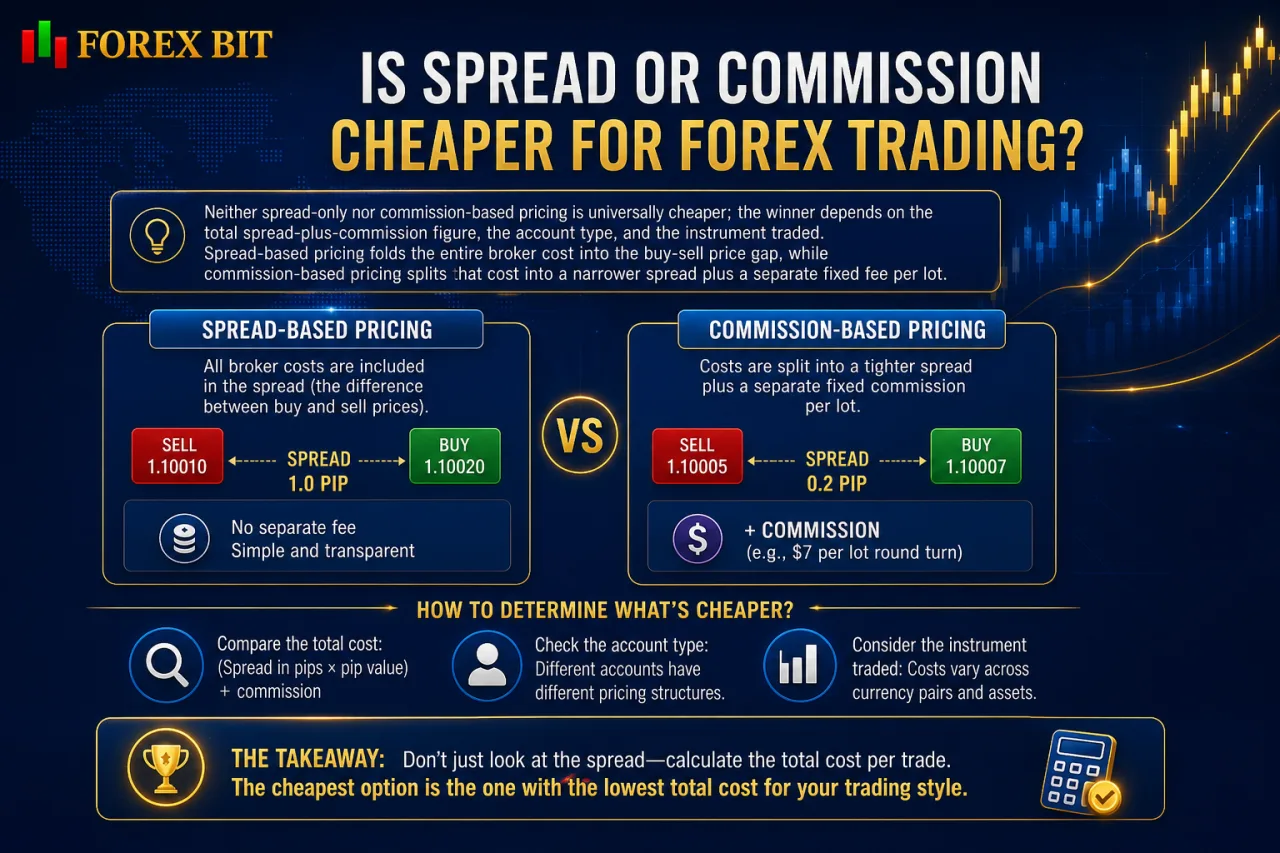
Neither spread-only nor commission-based pricing is universally cheaper; the winner depends on the total spread-plus-commission figure, the account type, and the instrument traded. Spread-based pricing folds the entire broker cost into the buy-sell price gap, while commission-based pricing splits that cost into a narrower spread plus a separate fixed fee per lot.
Answering which structure costs less requires comparing both pricing models side by side rather than judging spread size alone. The two models differ in three practical ways: cost transparency, cost predictability, and how trade size affects the final bill. A spread-only account hides the true markup inside the price quote, making it harder to isolate the broker’s actual margin. A commission-based account separates the raw market spread from the broker’s fee, so traders see exactly what they pay per round turn. Instrument choice also matters, since major pairs like EUR/USD carry tighter raw spreads than exotic pairs, which shifts the commission’s relative weight on total cost.
The following breakdown applies this combined spread-plus-commission framework to compare both pricing structures directly.
What Is a Spread in Forex Trading?
A spread in forex trading is the difference between the bid price and the ask price, quoted in pips, and it represents the primary cost built into spread-only pricing. Standard accounts embed this markup directly into the quoted price rather than charging a separate fee.
This pricing structure defines exactly how the spread functions inside standard, commission-free account types. A broker sets the bid slightly below and the ask slightly above the underlying market rate, and the gap between those two prices covers the broker’s margin without a visible line-item charge. On EUR/USD, standard spread-only accounts typically display variable spreads that widen further during low-liquidity periods or major news events.
Since no separate commission applies on this account type, the quoted spread reflects the entire trading cost for that transaction. Exotic currency pairs and less liquid instruments carry noticeably wider spreads than major pairs like EUR/USD, reflecting lower trading volume and higher price volatility in those markets.
What Is a Commission in Forex Trading?
A commission in forex trading is a fixed fee charged per lot traded on the round turn, applied on top of a near-zero raw spread on Raw or ECN accounts. This charge replaces part of the markup that spread-only accounts embed directly into the bid-ask price.
This fee structure separates the broker’s cost from the underlying market spread rather than folding both into one number. Raw or ECN accounts typically charge a commission per lot per side, meaning a round-turn trade adds an extra cost on top of the spread for a standard lot.
Commission applies regardless of the raw spread available at the moment of execution, since the fee is fixed per lot rather than tied to price movement. Raw spreads on major pairs like EUR/USD can compress close to 0 pips under normal liquidity conditions, but the commission remains constant, making it the predictable half of total trading cost on this account type.
How to Calculate Total Trading Cost Combining Spread and Commission?
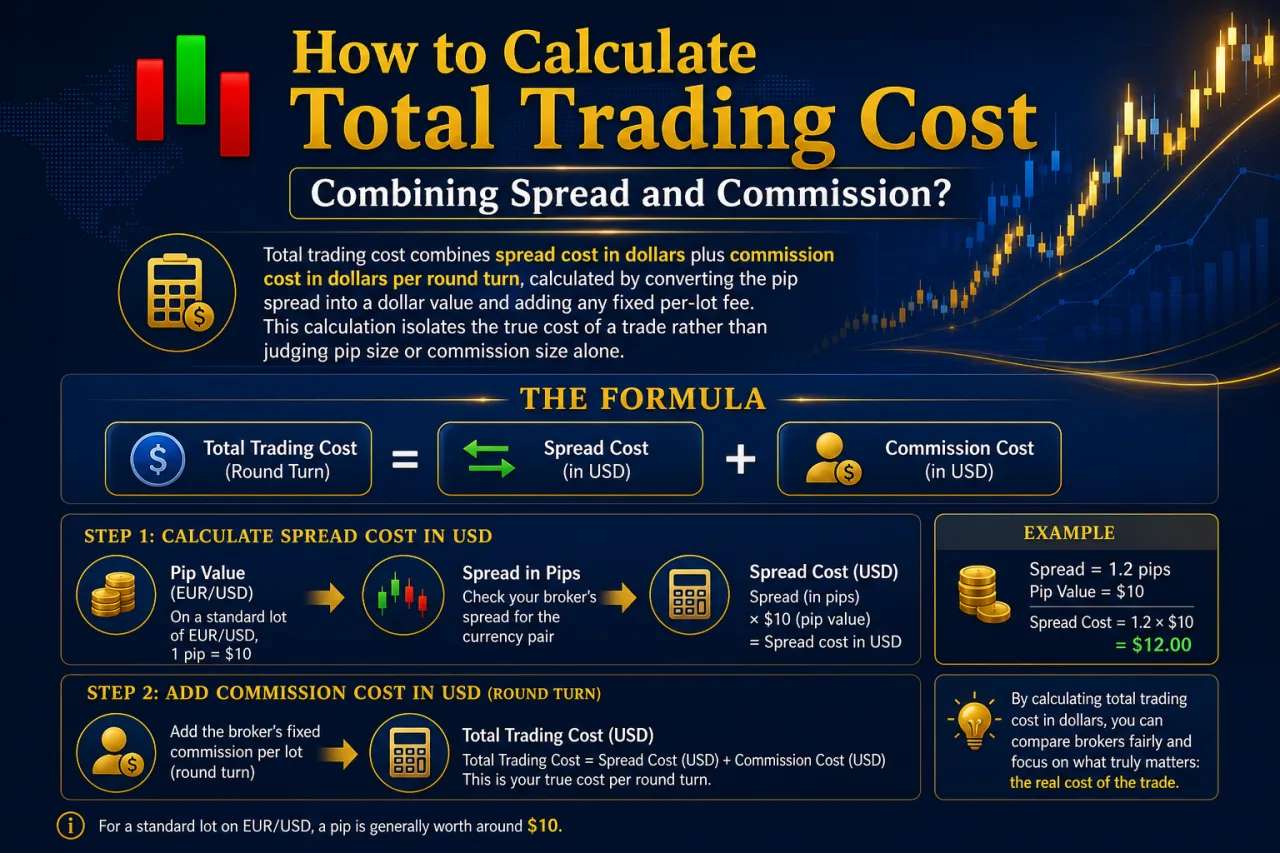
Total trading cost combines spread cost in dollars plus commission cost in dollars per round turn, calculated by converting the pip spread into a dollar value and adding any fixed per-lot fee. This calculation isolates the true cost of a trade rather than judging pip size or commission size alone.
The formula follows two steps before arriving at a final dollar figure. First, pip value on a standard lot of EUR/USD equals $10 per pip. For a standard lot on EUR/USD, a pip is generally worth around $10, so a spread quoted in pips converts directly into dollars by multiplying pip count by that pip value. Second, commission cost adds a flat dollar amount per lot per round turn, independent of the spread figure. Total Cost = (Spread in Pips x Pip Value) + Commission per Round Turn.
Applying this formula to 1 standard lot of EUR/USD produces the comparison below:
| Account Type | Spread (Pips) | Spread Cost | Commission | Total Cost |
|---|---|---|---|---|
| Spread-Only (Standard) | 1.0 pip | $10.00 | $0 | $10.00 |
| Raw + Commission (ECN) | 0.1 pip | $1.00 | $7.00 | $8.00 |
In this type of example, a raw-plus-commission account can work out cheaper per round turn than a comparable spread-only account, though the actual gap depends on each broker’s specific spread and commission pricing. Results shift with wider or tighter spreads, since the same formula applies to any instrument or account type.
Raw/ECN Accounts vs Standard Spread-Only Accounts: What’s the Real Difference?
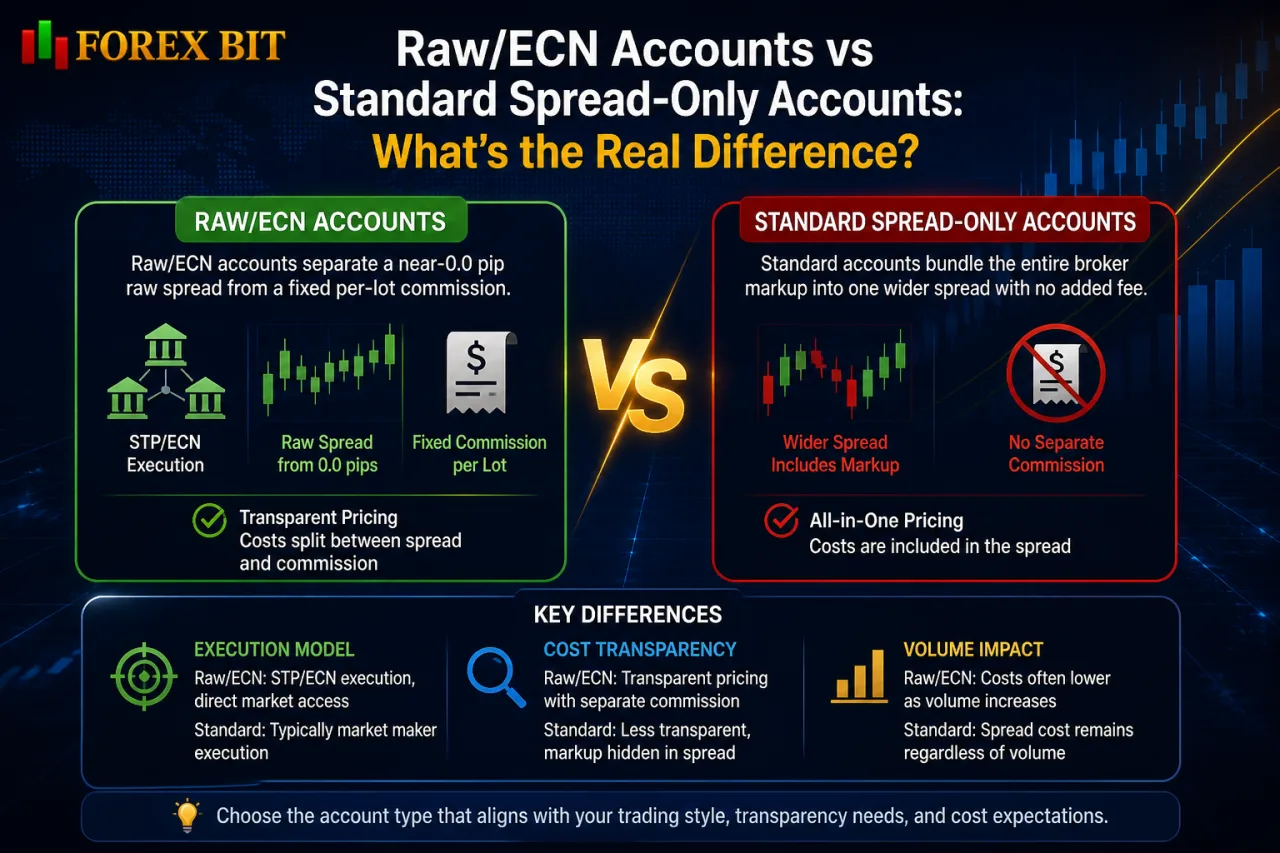
Raw/ECN accounts separate a near-0.0 pip raw spread from a fixed per-lot commission, while Standard spread-only accounts bundle the entire broker markup into one wider spread with no added fee. This structural split changes how each account type distributes cost between the price quote and a separate line-item charge.
The two models differ in execution model, cost transparency, and how volume affects total price. Raw/ECN accounts route orders through STP or ECN execution, passing raw interbank pricing through with a visible commission on top. Standard accounts typically use STP-style dealing but embed the markup directly into the spread, so no commission line ever appears on the trade confirmation.
| Feature | Raw/ECN Account | Standard Spread-Only Account |
|---|---|---|
| Typical Spread Range | Near 0.0 to 0.2 pips | 1.0 to 1.5 pips |
| Commission per Lot | Fixed fee, round turn | None |
| Total Cost per Lot (approx.) | Spread cost + commission | Spread cost only |
| Execution Model | STP/ECN | STP |
| Best Suited For | High-frequency, scalping, large volume | Lower-frequency, smaller retail trades |
Traders placing frequent, high-volume orders generally offset the fixed commission through tighter raw spreads on Raw/ECN accounts. Traders holding fewer or smaller positions often avoid the added commission line by choosing a Standard spread-only account instead.
Which Pricing Model Suits Different Trading Styles – Scalping, Day Trading, or Long-Term?
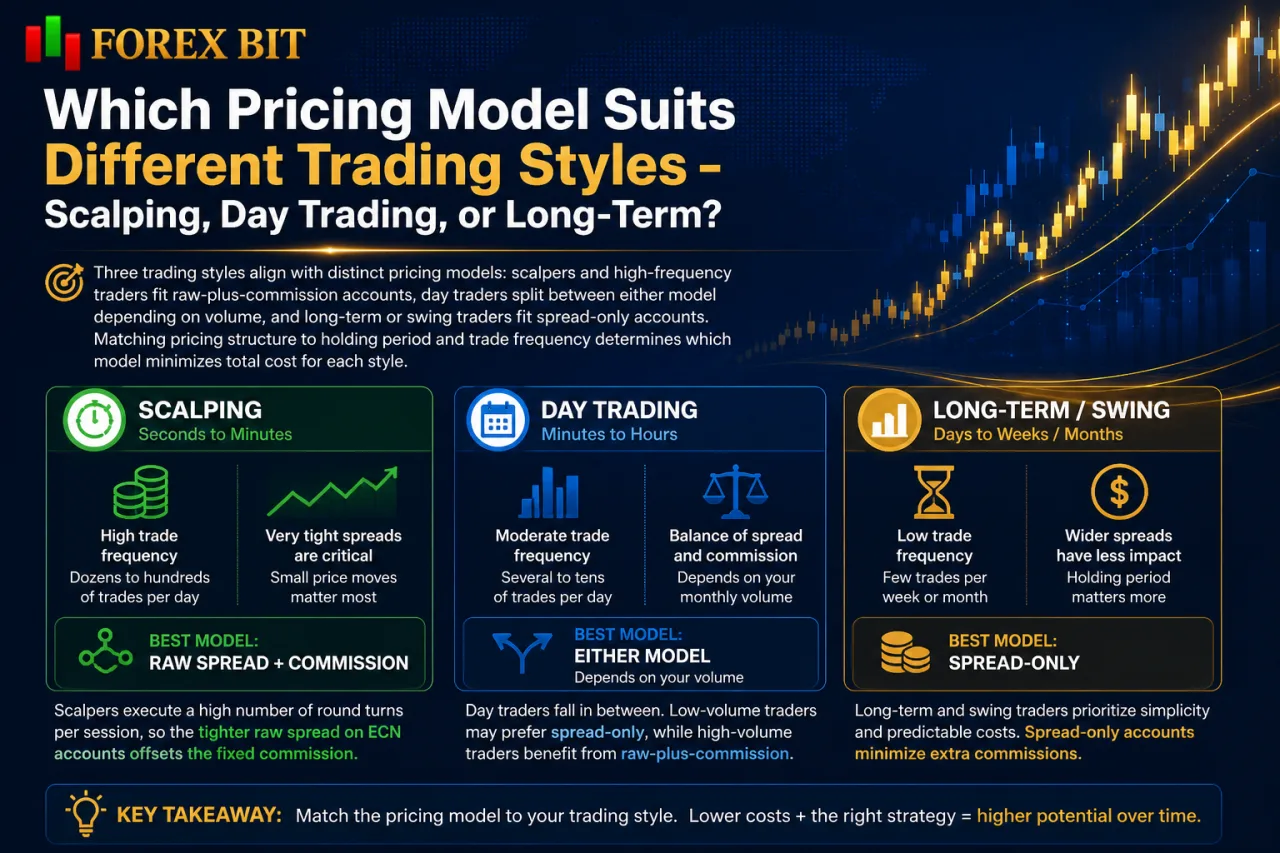
Three trading styles align with distinct pricing models: scalpers and high-frequency traders fit raw-plus-commission accounts, day traders split between either model depending on volume, and long-term or swing traders fit spread-only accounts. Matching pricing structure to holding period and trade frequency determines which model minimizes total cost for each style.
Scalpers execute a high number of round turns per session, so the tighter raw spread on ECN accounts offsets the fixed commission across repeated trades. Predictable per-lot commission also simplifies cost tracking for traders running frequent, small-margin strategies.
Day traders occupy a middle ground where either structure works, since a moderate trade count means the crossover point between spread-only and commission-based total cost depends on the specific spread and commission figures from the earlier comparison table. Higher daily volume pushes the decision toward raw-plus-commission, while lower volume favors spread-only pricing.
Long-term and swing traders place fewer round turns, so the fixed commission charged per lot on ECN accounts accumulates less benefit relative to a spread-only account’s simpler, one-line cost.
Swap or overnight fees apply to positions held past the daily rollover cutoff regardless of account type. This holding-period cost interacts more heavily with long-term and swing positions than with scalping trades that close within the same session.
Are There Hidden Cost Factors That Affect the Spread vs Commission Comparison?
Yes, several hidden variables shift the spread-vs-commission comparison beyond the listed pip and per-lot figures. These include variable spread widening, weekend swap differences, and volume-based commission discounts, and they change the total cost formula covered earlier without appearing in a broker’s headline pricing table.
Each factor interacts differently with the two account types described above. Variable spreads widen during news releases or thin liquidity, which raises cost more sharply on Standard spread-only accounts than on Raw/ECN accounts where the commission stays fixed. Swap or rollover charges also differ by account type and by broker, and weekend triple-swap conventions can add cost regardless of whether the account uses spread-only or commission-based pricing. Some brokers additionally offer tiered commission discounts to traders exceeding a monthly lot volume threshold, lowering the effective per-lot fee on Raw/ECN accounts and shifting the cost comparison in favor of commission-based pricing at scale.
The subsections below examine each of these three hidden factors individually.
Do Commission-Based Accounts Offer Volume Discounts on Trading Costs?
Yes, many commission-based brokers reduce the per-lot fee on Raw/ECN accounts once a trader’s monthly volume increases, cutting cost through tiered pricing, loyalty programs, or professional-account reclassification, though exact thresholds and discount levels vary by broker and are best confirmed directly with each provider.
Volume-tiered discounts change the earlier spread-plus-commission comparison as monthly trading activity grows. Three mechanisms typically drive this reduction:
- Tiered commission schedules lower the fixed fee per lot once a trader exceeds a defined monthly volume bracket.
- Loyalty or cashback programs rebate a portion of paid commission back to active traders after each settlement period.
- Professional or institutional account classifications unlock reduced per-lot pricing for traders meeting eligibility and volume criteria.
These reductions apply only to the commission component, so the raw spread on the account remains largely unchanged regardless of volume tier. Standard spread-only accounts generally lack this scaling mechanism, since the entire cost sits inside a fixed spread markup rather than a separate, negotiable fee line. As a result, high-frequency or professional traders who qualify for lower tiers progressively widen their cost advantage over spread-only pricing as monthly lot volume increases.
How Do Spreads Widen During News Events on Standard vs Raw Accounts?
Standard spread-only accounts see the entire cost widen during major news releases, since the full markup sits inside one variable spread, while Raw accounts keep the commission fixed and let only the raw spread component fluctuate. This asymmetry directly affects how predictable real-time trading cost stays during high-impact events.
On Standard accounts, a spread that normally sits near 1.0 to 1.5 pips can expand sharply within seconds of a news release, since liquidity providers pull quotes and the broker’s dealing desk repriced markup passes fully into the bid-ask gap. Because no separate commission line exists, this widened spread represents the entire added cost, leaving no fixed reference point for traders to anchor their cost expectations.
On Raw/ECN accounts, the commission per lot stays constant regardless of volatility, so only the raw spread portion, normally near 0.0 to 0.2 pips, widens during the news window. This structure isolates the variable cost to a smaller share of the total trade price, giving traders a partially predictable cost floor even as market conditions shift.
As a result, Raw accounts typically retain more real-time cost predictability than Standard accounts during high-impact news events, since only part of the total cost fluctuates rather than the whole spread.
Conclusion
Neither pricing model wins outright on cost; the combined spread-plus-commission figure decides the outcome for each individual trade. Raw/ECN pricing pulls ahead for frequent, high-volume execution, since tighter spreads and volume-based commission discounts offset the fixed per-lot fee, while the fixed commission also holds cost steady during volatile news windows.
Standard spread-only pricing suits smaller, less frequent trades, keeping cost tracking simple with a single line-item price. Traders answer the spread-versus-commission question by matching their own trade frequency and size to the account structure that minimizes total dollar cost per round turn, rather than favoring one model universally.
Isabella Brown is the Forex Trading Guide Manager at Forex Bit, focusing on educational content about broker safety, trading costs, account types, platforms, and key Forex/CFD concepts. Her work helps readers understand trading terms, broker conditions, and practical checks before evaluating or using a brokerage service.
Email: [email protected]



Best Brokers

Trade with the world’s largest retail broker and benefit from better - than - market conditions.

We offer a superior trading environment that puts traders in the best position to profit.

Trade with the best trading conditions. WIN THE BEST TRADING ACCOUNT AWARD.

Trade global markets with Interactive Brokers – a highly regulated multi-asset broker built for active and professional investors.






Forex Bit provides independent forex broker reviews, comparisons, guides, and industry news to help traders make informed decisions.
Best Brokers
Metatrader 5 Brokers
Metatrader 4 Brokers
Lowest Spread Forex Broker
Regulated Forex Brokers
Forex Copy Trading
Ctrader Brokers
Best Forex Broker For Beginners