
See which forex influencers fined by regulators, why, and how much—real cases traders should know before following finfluencer advice.
Forex Influencers Fined: Real Enforcement Cases Explained

Forex influencers and other social-media trading promoters have faced real regulatory enforcement for unauthorised financial promotions, unlicensed financial advice, forex fraud, and misleading claims. Outcomes have ranged from warnings and injunctions to criminal convictions, civil monetary penalties, restitution orders, and permanent trading or registration bans.
The regulatory response depends heavily on the jurisdiction and the conduct involved. In the UK, the FCA has criminally prosecuted influencers for unauthorised promotions of forex CFDs, while the CFTC has obtained multimillion-dollar judgments against social-media forex promoters in the United States.
ASIC has also increased scrutiny of finfluencers in Australia. In June 2025, it issued warning notices to 18 social-media finfluencers suspected of unlawfully promoting high-risk financial products or providing unlicensed financial advice, with ASIC specifically identifying CFDs and OTC derivatives as areas of concern.
Followers should therefore be cautious of social-media personalities promising guaranteed profits, promoting paid forex signals, directing users into closed trading groups, or marketing leveraged products without clear regulatory credentials.
Forex Bit examines these regulatory cases below to show how authorities have responded to unlawful forex promotions and what traders should watch for when following social-media trading influencers.
What Are the Most Notable Forex Influencer Fine Cases So Far?
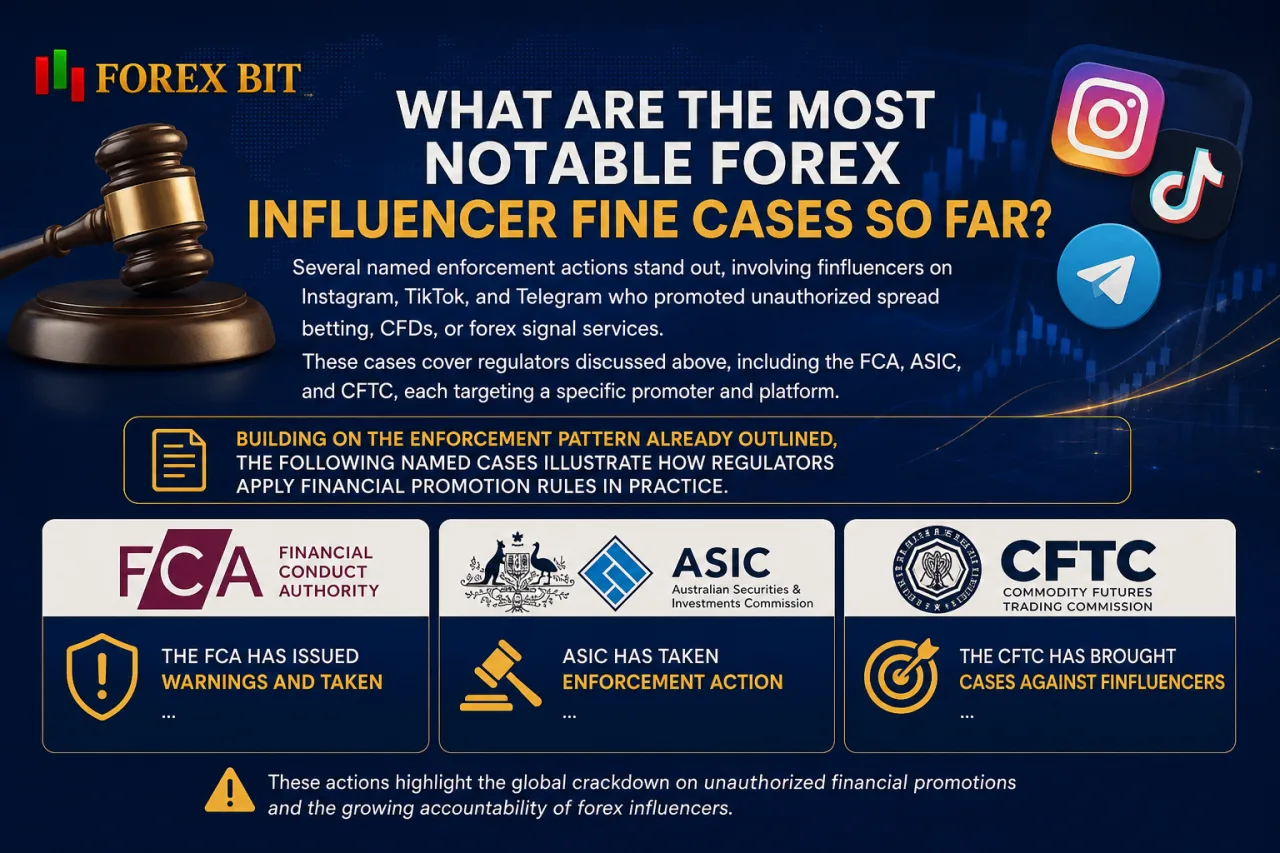
Several verified cases show how regulators have acted against influencers and social-media promoters involved in forex or high-risk trading products.
One of the clearest UK cases involved seven social-media influencers sentenced by Southwark Crown Court in February 2026 for promoting an unauthorised foreign-exchange trading scheme. Biggs Chris, Jamie Clayton, Lauren Goodger, Rebecca Gormley, Yazmin Oukhellou, Scott Timlin and Eva Zapico all pleaded guilty to issuing unauthorised financial promotions. Their combined Instagram following was approximately 4.5 million.
The FCA confirmed the following outcomes:
- Lauren Goodger: £3,750 fine plus £5,778.18 costs.
- Biggs Chris: £600 fine plus £1,000 costs.
- Jamie Clayton: £820 fine plus £1,000 costs.
- Yazmin Oukhellou: £974 fine plus £1,000 costs.
- Scott Timlin: £938 fine plus £1,000 costs.
- Rebecca Gormley: conditional discharge plus £2,866.42 costs.
- Eva Zapico: absolute discharge plus £1,770.44 costs.
In the United States, the Kelvin Ramirez case provides an even more severe example of social-media-based forex enforcement. The CFTC said Ramirez attracted clients primarily through Instagram, WhatsApp and similar platforms by promoting supposed forex profits, a lavish lifestyle, forex education and trading signals. A federal court ordered him to pay $735,983.48 in restitution and more than $2.2 million in civil monetary penalties, while permanently banning him from CFTC-regulated trading and registration.
Another verified case involved Roberto Pulido and Lions of Forex LLC. The CFTC said Lions of Forex offered a paid retail-forex signals service and that Pulido used social media to claim significant trading profits and represent himself as a successful trader. In 2025, the court ordered approximately $172,000 in restitution and more than $516,000 in civil monetary penalties, together with permanent trading and registration bans.
ASIC’s recent approach has been somewhat different. In June 2025, ASIC issued warning notices to 18 suspected unlawful finfluencers rather than announcing fines against named forex influencers. ASIC said its concerns included so-called trading experts promoting CFDs and OTC derivatives, unlicensed financial advice and misleading representations about trading success.
A separate, named ASIC finfluencer case involved Tyson Robert Scholz, who was found to have operated an unlicensed financial-services business through social media and paid trading communities. That case related primarily to ASX share advice rather than forex, so it should not be presented as a forex-specific fine case.
What Rules Did These Influencers Violate to Get Fined?
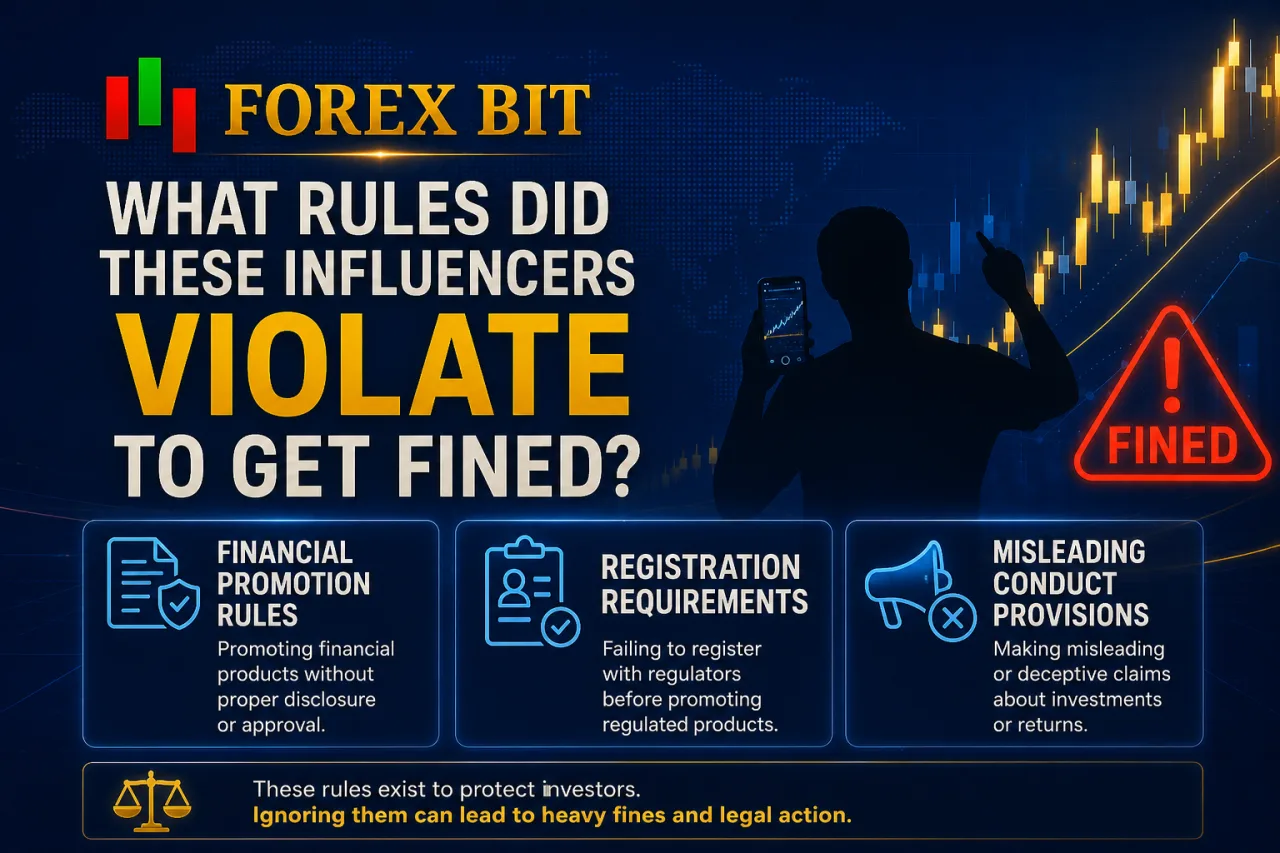
The legal basis differs between the UK, United States and Australia.
In the FCA’s 2026 forex-finfluencer case, the individuals pleaded guilty to issuing unauthorised financial promotions. The FCA states that communicating unauthorised financial promotions is an offence under sections 21 and 25 of the Financial Services and Markets Act 2000 (FSMA) and can be punishable by a fine and/or up to two years’ imprisonment.
This is more precise than attributing those prosecutions to the FCA’s Consumer Duty. The Consumer Duty sets standards for authorised firms, but the criminal basis cited by the FCA in these influencer prosecutions was the financial-promotion prohibition under FSMA.
In Australia, ASIC states that a person carrying on a business of providing financial services must generally hold an Australian Financial Services licence or be properly authorised. ASIC also states that misleading or deceptive conduct relating to financial products can breach the law even if the influencer is not licensed.
ASIC’s guidance specifically warns that statements about investment returns or risk must be accurate and substantiated. For example, presenting derivative trading as a “risk-free” way to make quick money would likely be misleading.
In the United States, CFTC forex cases can involve several provisions depending on the conduct. The CFTC has pursued social-media forex promoters for fraud, misappropriation, unregistered Commodity Trading Advisor activity and other violations of the Commodity Exchange Act and CFTC regulations.
The CFTC’s action against Silver Star FX is one example of a registration violation: Silver Star FX and related parties were found to have acted as unregistered Commodity Trading Advisors while offering automated trading in retail forex accounts. They were ordered to pay a $75,000 civil monetary penalty.
Was the Violation About Unauthorized Promotion or Misleading Content?
Both types of violations occur, but they should be distinguished.
Unauthorised promotion was central to the FCA case involving the seven influencers. They promoted a foreign-exchange trading scheme without the authorisation required to communicate those financial promotions.
Misleading or fraudulent content played a central role in the CFTC’s Ramirez and Lions of Forex cases. Ramirez used social media to claim large forex profits, substantial assets and a lavish lifestyle funded by trading; the court found those representations false.
In the Lions of Forex case, Pulido claimed significant forex profits and represented that clients could earn guaranteed monthly profits. The CFTC said he failed to deliver the promised returns and did not return a significant portion of customer funds when requested.
ASIC’s current finfluencer concerns also cover both categories. ASIC says unlicensed finfluencers may unlawfully provide financial product advice, while misleading representations about the prospects of trading success can independently breach Australian law.
How Much Were the Fines and Penalties Imposed in These Cases?
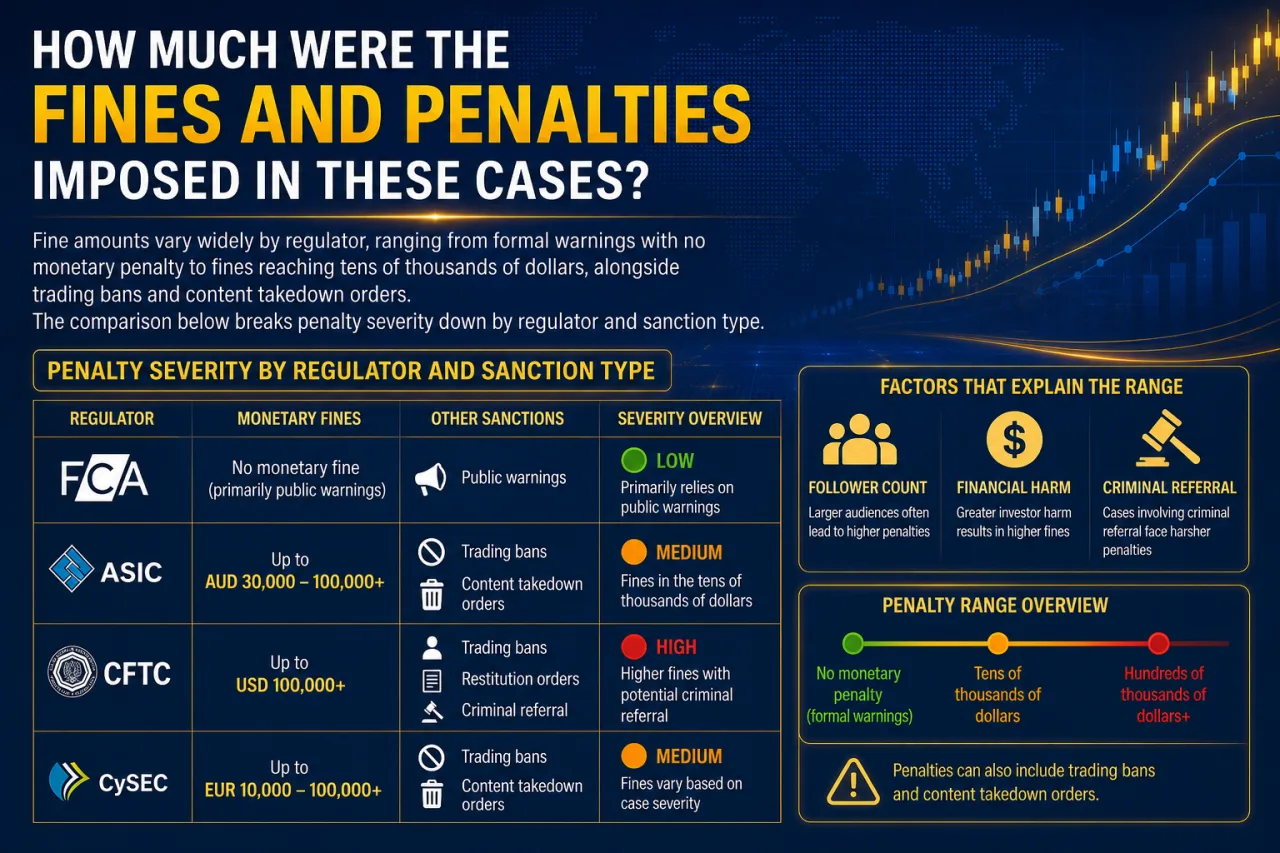
Penalty amounts vary substantially because the verified cases involve very different conduct.
| Case | Regulator | Verified outcome |
| Lauren Goodger | FCA | £3,750 fine + £5,778.18 costs |
| Biggs Chris | FCA | £600 fine + £1,000 costs |
| Jamie Clayton | FCA | £820 fine + £1,000 costs |
| Yazmin Oukhellou | FCA | £974 fine + £1,000 costs |
| Scott Timlin | FCA | £938 fine + £1,000 costs |
| Kelvin Ramirez | CFTC / Federal Court | $735,983.48 restitution + over $2.2m penalty |
| Roberto Pulido / Lions of Forex | CFTC / Federal Court | About $172,000 restitution + over $516,000 penalty |
| Silver Star FX and related parties | CFTC | $75,000 civil monetary penalty |
The FCA figures are confirmed in its February 2026 sentencing announcement. The CFTC figures are confirmed in its enforcement releases concerning Ramirez, Lions of Forex and Silver Star FX.
ASIC’s June 2025 finfluencer crackdown should not be described as an Australian fine case because ASIC announced warning notices against 18 suspected finfluencers rather than monetary penalties against those individuals.
Likewise, the Tyson Scholz matter resulted in permanent injunctions and later a costs order rather than a forex-related civil fine of the type seen in the CFTC cases. ASIC reported that the costs were eventually assessed at A$456,296.64.
Which Regulator Has Issued the Most Fines Against Forex Finfluencers?
There is not enough comparable public data to reliably state that one regulator has issued the most forex-finfluencer fines.
The FCA, ASIC and CFTC publish enforcement information in different formats and apply different legal tools. A warning notice, criminal fine, civil monetary penalty, injunction and restitution order are not directly comparable.
The FCA currently provides a particularly clear example of direct criminal fines against named social-media influencers promoting forex CFDs: seven influencers were sentenced in February 2026.
The CFTC has imposed much larger monetary sanctions in individual social-media forex fraud cases. Ramirez alone was ordered to pay more than $2.9 million when restitution and the civil monetary penalty are combined, while Lions of Forex and Pulido faced approximately $685,000 in combined restitution and civil penalties.
ASIC has concentrated recent finfluencer activity on surveillance, warning notices, licensing compliance and court injunctions. In its June 2025 international crackdown, it issued warning notices to 18 suspected unlawful finfluencers but did not publish individual monetary fines.
It is therefore more accurate to compare verified enforcement outcomes rather than claim that any single regulator has issued the most fines.
What Should Followers Watch Out for to Avoid Fraudulent Forex Influencer Schemes?
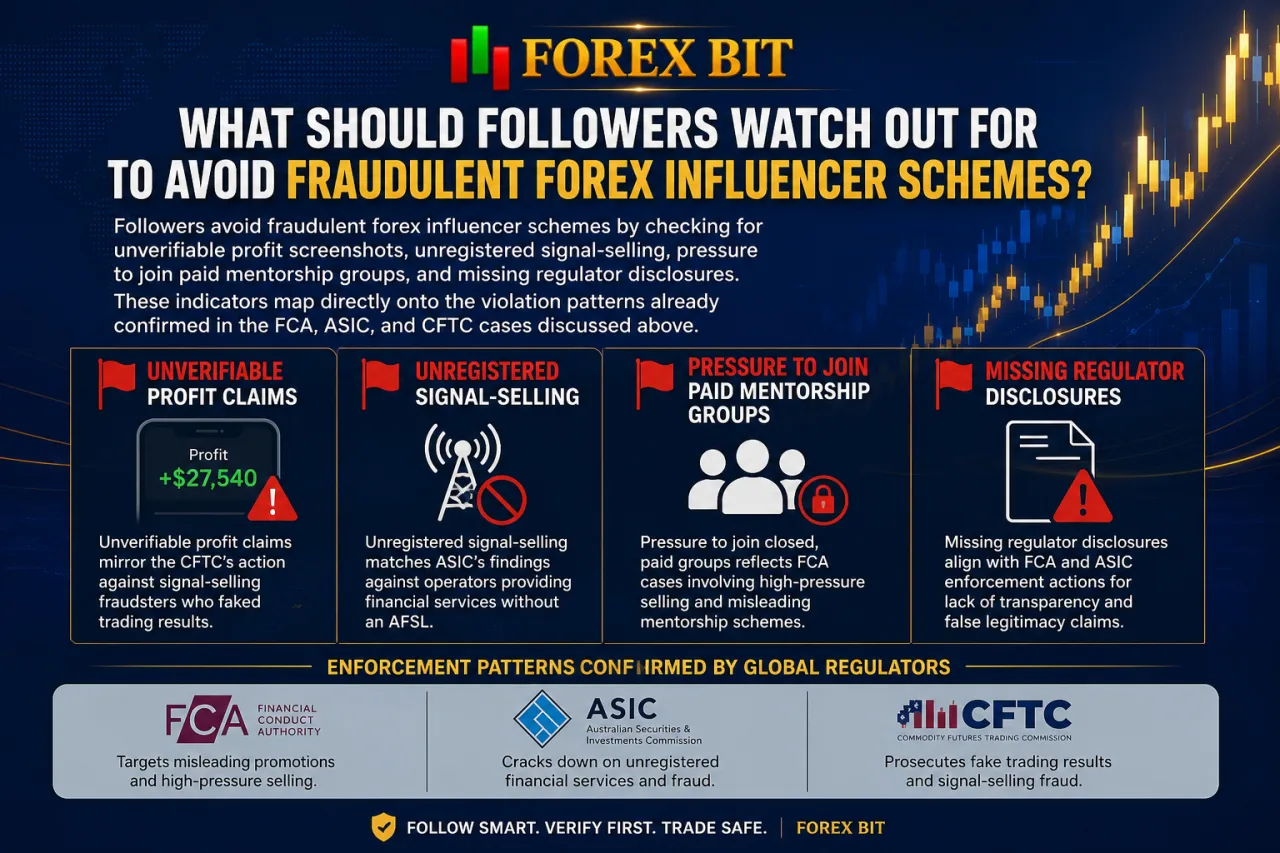
Several warning signs seen in actual regulatory cases can help followers identify higher-risk promotions.
Guaranteed or unusually high returns are a major warning sign. Lions of Forex promoted claims of guaranteed monthly profits, while Ramirez promoted supposed large weekly forex profits and a highly successful trading lifestyle.
Luxury lifestyle marketing should not be treated as proof of trading success. Ramirez used claims about a lavish lifestyle and a multimillion-dollar personal bank balance as part of his social-media solicitations, which the court found to be false.
Paid signals or closed groups also deserve scrutiny. Lions of Forex sold monthly forex signals and higher-priced one-on-one training, while ASIC says it has observed unlicensed finfluencers inviting consumers into closed communities to learn supposed trading secrets or copy their trades.
Missing regulatory authorisation is another key warning sign. Followers should check whether a promoter who is giving regulated financial advice or arranging financial transactions is properly licensed or authorised in the relevant country. The FCA, ASIC and CFTC all provide public tools or registers for checking regulatory status.
A large follower count is not evidence that a trading promoter is trustworthy. The seven influencers convicted in the FCA case had a combined Instagram following of around 4.5 million.
How Are Forex Influencer Fines Enforced Across Different Countries?
Enforcement differs significantly by jurisdiction.
In the United Kingdom, unauthorised financial promotion can be a criminal offence. The FCA can investigate using criminal powers and bring prosecutions through the courts. In the 2026 forex-finfluencer case, the defendants pleaded guilty and were sentenced at Southwark Crown Court.
The FCA also uses preventative measures. During its 2024 crackdown, it interviewed 20 finfluencers under caution and issued 38 alerts against social-media accounts suspected of containing unlawful financial promotions.
In Australia, ASIC can use surveillance, warning notices, administrative measures and court proceedings. In June 2025, ASIC issued warning notices to 18 suspected unlawful finfluencers as part of a coordinated international enforcement campaign.
ASIC can also pursue court orders. The Federal Court permanently restrained Tyson Scholz from carrying on an unlicensed financial-services business after finding he breached section 911A of the Corporations Act.
In the United States, the CFTC frequently uses civil enforcement proceedings in federal court or administrative orders. Sanctions can include:
- civil monetary penalties;
- restitution;
- disgorgement;
- permanent injunctions;
- trading bans; and
- registration bans.
The Ramirez and Lions of Forex cases illustrate how substantial these sanctions can become when forex promotions involve fraud or misappropriation.
Cross-border social media makes enforcement more complex, which is one reason regulators increasingly cooperate internationally. ASIC’s 2025 finfluencer action was coordinated with regulators including the FCA and authorities in Canada, Hong Kong, Italy and the UAE.
Can a Fined Forex Influencer Be Penalized Again for Repeat Violations?
Yes. A previous fine, injunction or warning does not give a promoter permission to continue the prohibited conduct.
However, the exact consequences of repeat violations depend on the jurisdiction, the earlier order and the new conduct involved. It is therefore better not to claim that all regulators follow one automatic sequence of “warning → fine → ban → criminal prosecution.”
In CFTC cases, courts can impose permanent injunctions and trading or registration bans. Both Ramirez and Pulido were permanently barred from registering with the CFTC and from trading in CFTC-regulated markets following their respective forex cases.
In the UK, communicating unauthorised financial promotions can itself constitute a criminal offence under sections 21 and 25 of FSMA. Further unlawful promotions can therefore expose an individual to additional investigation and prosecution depending on the circumstances.
In Australia, ASIC states that it continues monitoring finfluencers and may take enforcement action where unlicensed or misleading conduct causes harm. Its powers are not limited to issuing a single warning notice.
The important point is that an earlier regulatory intervention does not eliminate future liability.
Conclusion
Real enforcement cases show that forex-related social-media promotion is actively regulated. In the UK, seven influencers were sentenced in 2026 for issuing unauthorised promotions of a forex trading scheme, while U.S. cases such as Kelvin Ramirez and Lions of Forex resulted in restitution orders, civil penalties and permanent trading or registration bans.
ASIC has also intensified its monitoring of finfluencers promoting CFDs and other high-risk products, although its 2025 crackdown involved warning notices rather than the named monetary fines originally implied in this article.
For followers, the most practical safeguards are to verify regulatory credentials, distrust guaranteed-return claims, treat luxury lifestyle marketing as advertising rather than evidence, and investigate paid signal or copy-trading groups before sending money.
William Johnson is a Forex & Broker News Analyst at Forex Bit, focusing on broker updates, regulatory developments, payment changes, and security-related news. His work helps readers stay informed about important industry developments and understand how these changes may affect broker services and trading conditions.
Email: [email protected]

Best Brokers

Trade with the world’s largest retail broker and benefit from better - than - market conditions.

We offer a superior trading environment that puts traders in the best position to profit.

Trade with the best trading conditions. WIN THE BEST TRADING ACCOUNT AWARD.

Trade global markets with Interactive Brokers – a highly regulated multi-asset broker built for active and professional investors.






Forex Bit provides in-depth analysis of commodities, forex, and stock markets to help traders make informed investment decisions.
Best Brokers
Metatrader 5 Brokers
Metatrader 4 Brokers
Lowest Spread Forex Broker
Regulated Forex Brokers
Forex Copy Trading
Ctrader Brokers
Best Forex Broker For Beginners