


- Multi-jurisdictional regulation
- Segregated client funds
- No fixed minimum deposit
- Advanced API & algorithmic trading
- Flexible trade sizes
- Protection varies by jurisdiction
- Leverage limits vary by regulator
- Pricing is only average vs competitors
- Proprietary platform has limited portability
- Support hours vary by region
OANDA is a globally recognized Forex and CFD broker suitable for both beginners and experienced traders in 2026, offering competitive pricing, transparent execution, and a long operating history in the industry. Its combination of regulatory coverage and flexible account options makes it a common candidate when traders compare established brokers before opening a live account.
OANDA holds regulatory licenses from multiple top-tier financial authorities, as it operates under oversight from multiple financial regulators across regions such as the United States, United Kingdom, Australia, and Canada. This multi-jurisdictional regulation is a key factor traders check when assessing whether a broker is safe for depositing funds and executing trades.
OANDA offers a Standard account with variable spreads and no fixed commission, alongside a separate Core account that uses a commission-based pricing model. These pricing structures differ enough that traders often compare them against other brokers before deciding which cost model fits their strategy.
OANDA suits beginners through its accessible account opening and educational tools, while experienced traders benefit from its API access and advanced charting. This dual appeal is one reason Forex Bit includes OANDA among the brokers worth evaluating in detail.
The sections below from Forex Bit examine what OANDA is and whether it remains a strong choice in 2026, followed by a closer look at its regulatory status and safety measures.
What Is OANDA and Is It a Good Forex Broker in 2026?

OANDA is a well-established Forex and CFD broker with a long operating history, offering execution models that vary by account type, including options positioned closer to no-dealing-desk style pricing.
This addresses whether OANDA remains a good choice for traders comparing brokers in 2026. The company built its reputation on transparent pricing, a proprietary trading platform, and consistent regulatory compliance across multiple regions rather than aggressive marketing or bonus-driven promotions.
OANDA maintains a global presence, serving retail and institutional clients across regions such as North America, Europe, and Asia-Pacific through region-specific entities.
For traders conducting commercial investigation before opening an account, OANDA fits the profile of a stable, long-standing broker rather than a high-risk or newly formed operator. Its longevity, combined with layered regulatory oversight and a straightforward account structure, positions it as a broker suited to traders prioritizing reliability over aggressive incentives.
Is OANDA Regulated and Safe for Traders?
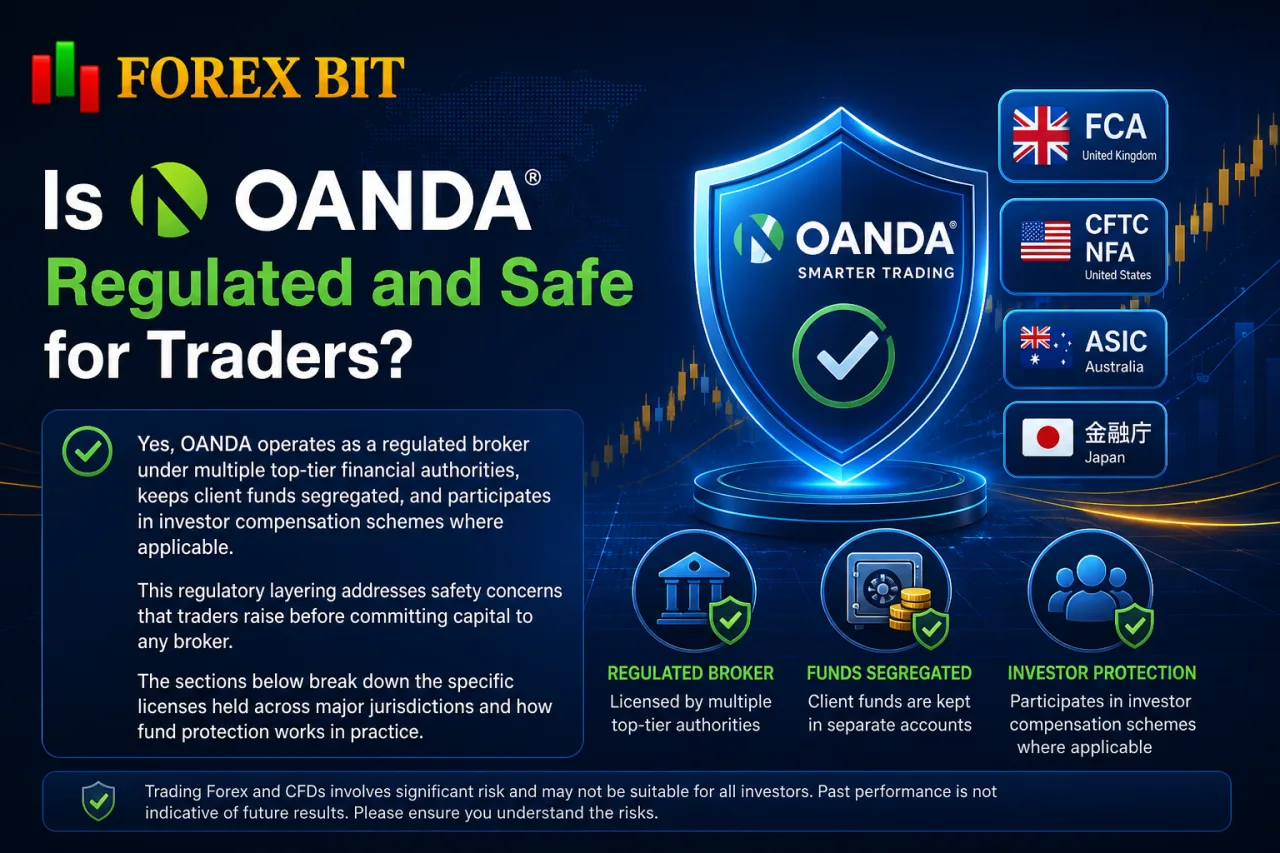
Yes, OANDA operates as a regulated broker under multiple top-tier financial authorities, keeps client funds segregated, and participates in investor compensation schemes where applicable. This regulatory layering addresses safety concerns that traders raise before committing capital to any broker. The sections below break down the specific licenses held across major jurisdictions and how fund protection works in practice.
Which Regulators Oversee OANDA in Different Countries?
OANDA operates through separate regional entities, each licensed by the financial regulator governing that jurisdiction, so the applicable rules depend on where the trader resides.
This regulatory grouping determines account terms, leverage limits, and product availability for traders opening an account. The entity structure typically separates clients across a few main groups:
- North American clients route through the U.S. and Canadian entities, subject to domestic derivatives and futures oversight.
- European clients fall under an EU-authorized entity, following regional retail investor protection rules.
- UK-based clients are served through a separately licensed entity following the country’s post-Brexit framework.
- Asia-Pacific clients, including those in Australia and Singapore, access OANDA through regional entities supervised by local regulators.
Leverage caps, negative balance protection, and available instruments vary between these entities, depending on the regulatory framework each one operates under.Traders from certain restricted countries may not be eligible to open an account, depending on local licensing coverage.
How Does OANDA Protect Client Funds?
OANDA protects client funds through segregated bank accounts, negative balance protection on eligible entities, and compensation scheme coverage tied to each regional regulator. This addresses how OANDA safeguards trader capital beyond standard account security.
Fund protection differs by entity, following the specific regulatory framework each region enforces:
- Segregated accounts keep client deposits separate from OANDA’s operating capital across all major entities.
- Negative balance protection prevents retail accounts from losing more than the deposited balance under regulators that mandate this safeguard, such as the UK and EU entities.
Compensation schemes, such as the UK’s Financial Services Compensation Scheme, cover eligible client funds up to a set limit if the broker becomes insolvent, though traders should verify the current limit directly with the scheme. - U.S. clients trading through the CFTC/NFA-regulated entity fall under futures industry safeguards rather than a deposit compensation scheme.
These layered protections vary by jurisdiction, so the exact level of coverage depends on which OANDA entity a trader registers with.
What Are OANDA’s Spreads, Fees, and Account Types?
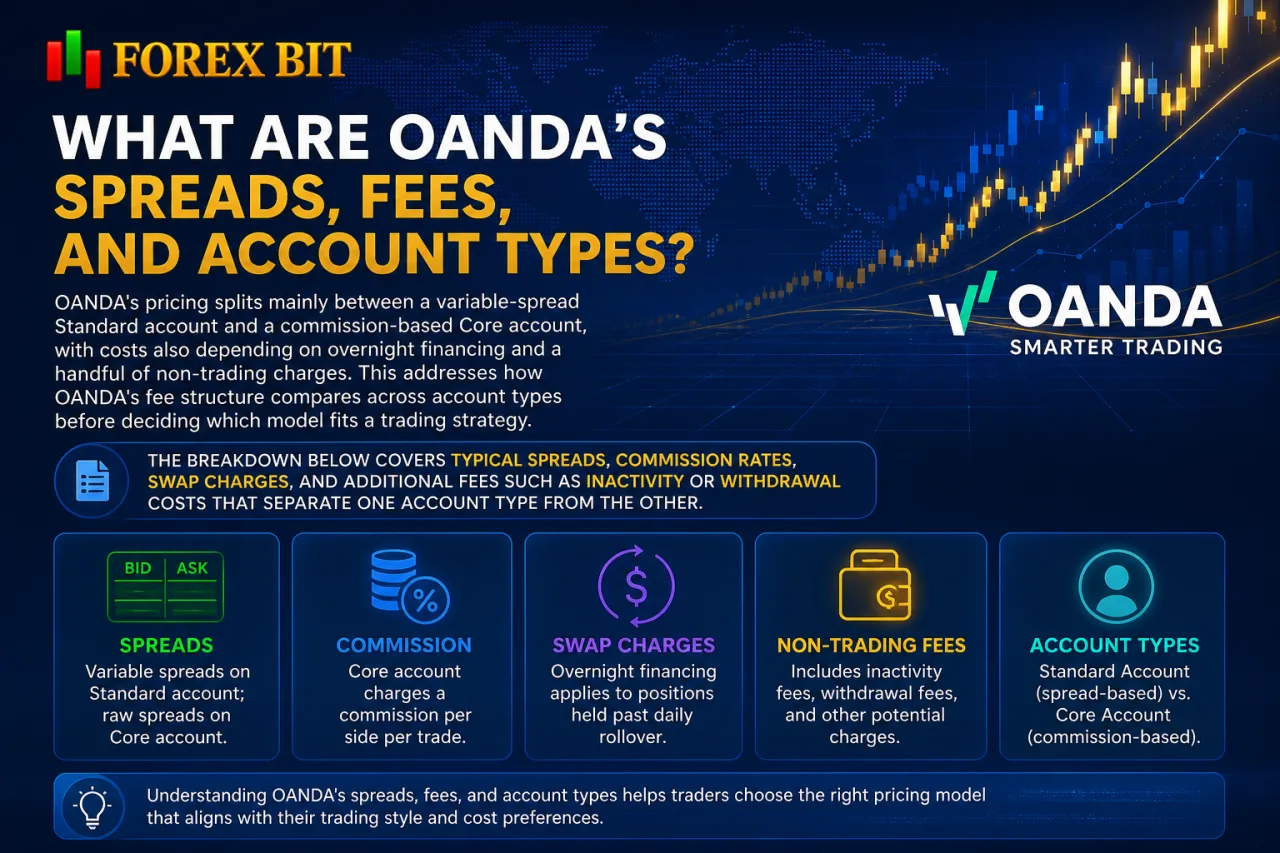
OANDA’s pricing splits mainly between a variable-spread Standard account and a commission-based Core account, with costs also depending on overnight financing and a handful of non-trading charges. This addresses how OANDA’s fee structure compares across account types before deciding which model fits a trading strategy. The breakdown below covers typical spreads, commission rates, swap charges, and additional fees such as inactivity or withdrawal costs that separate one account type from the other.
What Account Types Does OANDA Offer?
OANDA offers two main account types for most retail traders: a Standard account with variable spreads and no commission, and a Core account with tighter raw spreads plus a per-trade commission. This split addresses the account type variety traders weigh before funding an account.
Neither account type carries a fixed minimum deposit requirement in most regions, allowing traders to start with an amount that matches their risk tolerance rather than a preset threshold. U.S. clients access these offerings through the CFTC/NFA-regulated entity, which applies its own account terms separate from other regions.
The two options generally suit different trader profiles:
- Beginners and lower-frequency traders favor the Standard account for its simple, spread-only pricing.
- Active traders and scalpers favor the Core account for its lower spreads offset by a transparent commission.
- Institutional and high-volume clients access custom pricing tiers through OANDA’s institutional division in certain jurisdictions.
Account availability still depends on the regional entity a trader registers with, since product access varies by license.
Are OANDA’s Trading Costs Competitive Compared to Other Brokers?
OANDA’s costs sit in line with industry norms rather than clearly beating or lagging major competitors, with the Standard account priced similarly to other no-commission spread models and the Core account competitive against comparable raw-spread offerings. This addresses whether OANDA’s pricing gives traders a cost edge when weighed against other established Forex and CFD brokers.
Positioning depends on which side of the comparison a trader focuses on:
- Standard account spreads compare closely with other variable-spread brokers targeting beginners, without standing out as unusually cheap or expensive.
- Core account commissions align with typical ECN-style pricing found among brokers serving active traders and scalpers.
- Overall cost competitiveness depends more on account type selection and trading volume than on OANDA holding a distinct pricing advantage over peers.
Traders researching exact spread figures, commission rates, or swap charges in more depth benefit from consulting a dedicated breakdown of OANDA’s fee structure, since this section focuses on relative positioning rather than a full cost analysis.
What Trading Platforms and Markets Does OANDA Offer?
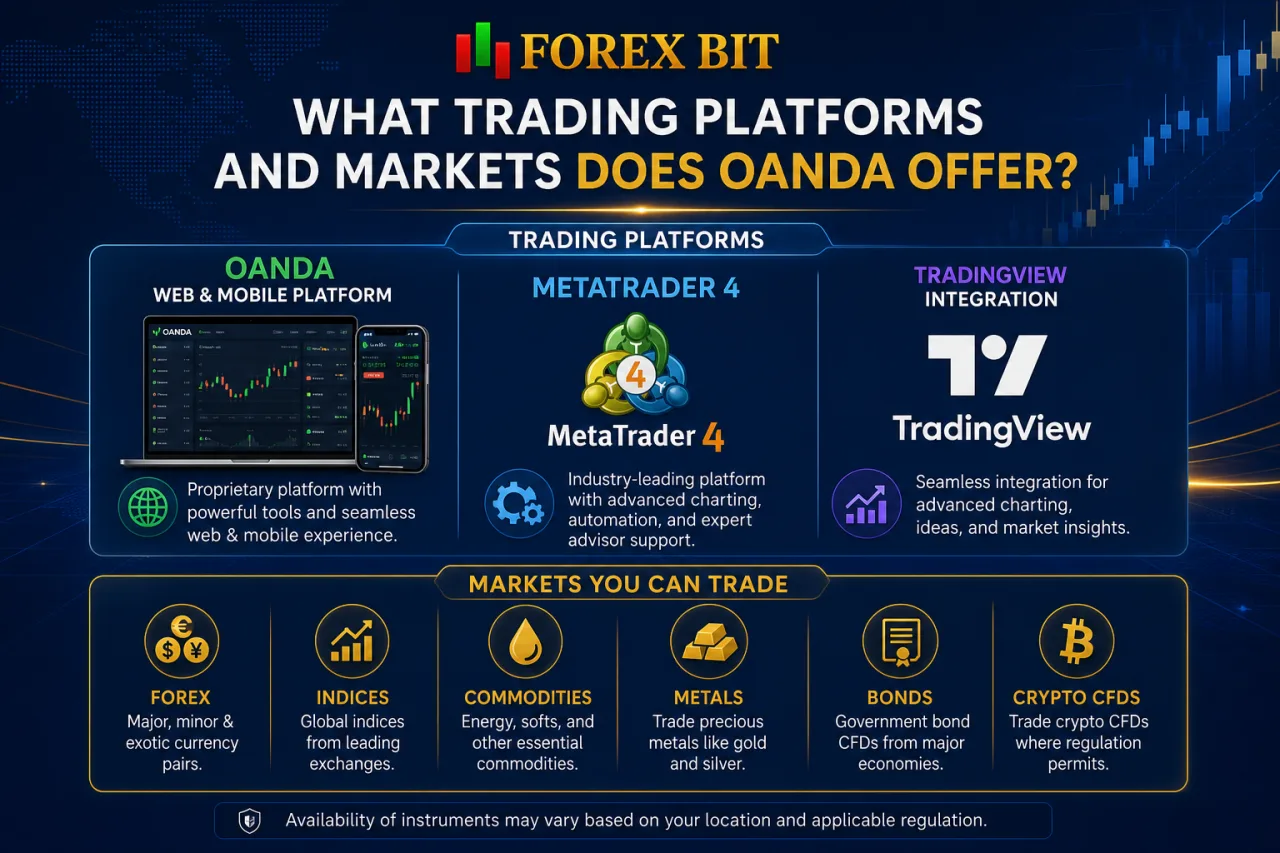
OANDA offers two main platform options, its proprietary web and mobile platform alongside MetaTrader 4, plus TradingView integration for charting, covering forex, indices, commodities, metals, bonds, and crypto CFDs where regulation permits. This addresses the platform and market range traders weigh before committing to a broker. The sections below break down each platform choice and the tradable instrument categories separately.
OANDA Web/Mobile Platform vs MetaTrader 4: Which Should You Choose?
The OANDA proprietary platform suits traders wanting integrated charting and API access, while MetaTrader 4 suits traders prioritizing automated trading and broker-independent familiarity.
This comparison addresses which platform fits different trading habits after weighing the proprietary web/mobile option against MT4. The two tools differ mainly in customization depth, automation support, and how portable a trader’s setup remains across brokers.
- The OANDA web and mobile platform delivers advanced charting tools, direct order execution, and API access built for traders running custom or algorithmic strategies.
- MetaTrader 4 delivers Expert Advisor support, a large library of third-party indicators, and a familiar interface for traders migrating from another MT4 broker.
- The proprietary platform ties workflow closely to OANDA’s own ecosystem, limiting portability if a trader later switches brokers.
- MetaTrader 4 keeps strategies and custom scripts transferable across any broker offering the same platform.
Traders leaning toward automation or cross-broker consistency generally lean toward MT4, while those valuing OANDA’s native charting depth and API flexibility lean toward the proprietary platform.
What Leverage Does OANDA Offer?
OANDA’s maximum leverage varies by regulator, with tighter caps applied under stricter regulatory frameworks like the FCA and ASIC, and higher ratios potentially available through less restrictive entities.
This addresses how leverage limits shift depending on which OANDA entity a trader registers with. Leverage caps tie directly to the regulatory framework governing each region rather than a single global standard.
- UK clients trading under the FCA-regulated entity face reduced retail leverage limits aligned with European-style investor protection rules.
- Australian clients under ASIC follow comparably restricted retail leverage caps introduced through product intervention measures.
- U.S. clients trading through the CFTC/NFA-regulated entity operate under leverage limits set by domestic futures and forex regulations.
- Traders accessing OANDA through less restrictive offshore or professional-classification entities reach higher leverage ratios where local rules permit.
Professional trader classifications, where offered, unlock higher leverage than standard retail terms under the same regulator. Exact ratios differ by instrument category, with major currency pairs typically allowing higher leverage than indices, commodities, or crypto CFDs.
How Do You Deposit, Withdraw, and Contact Support at OANDA?
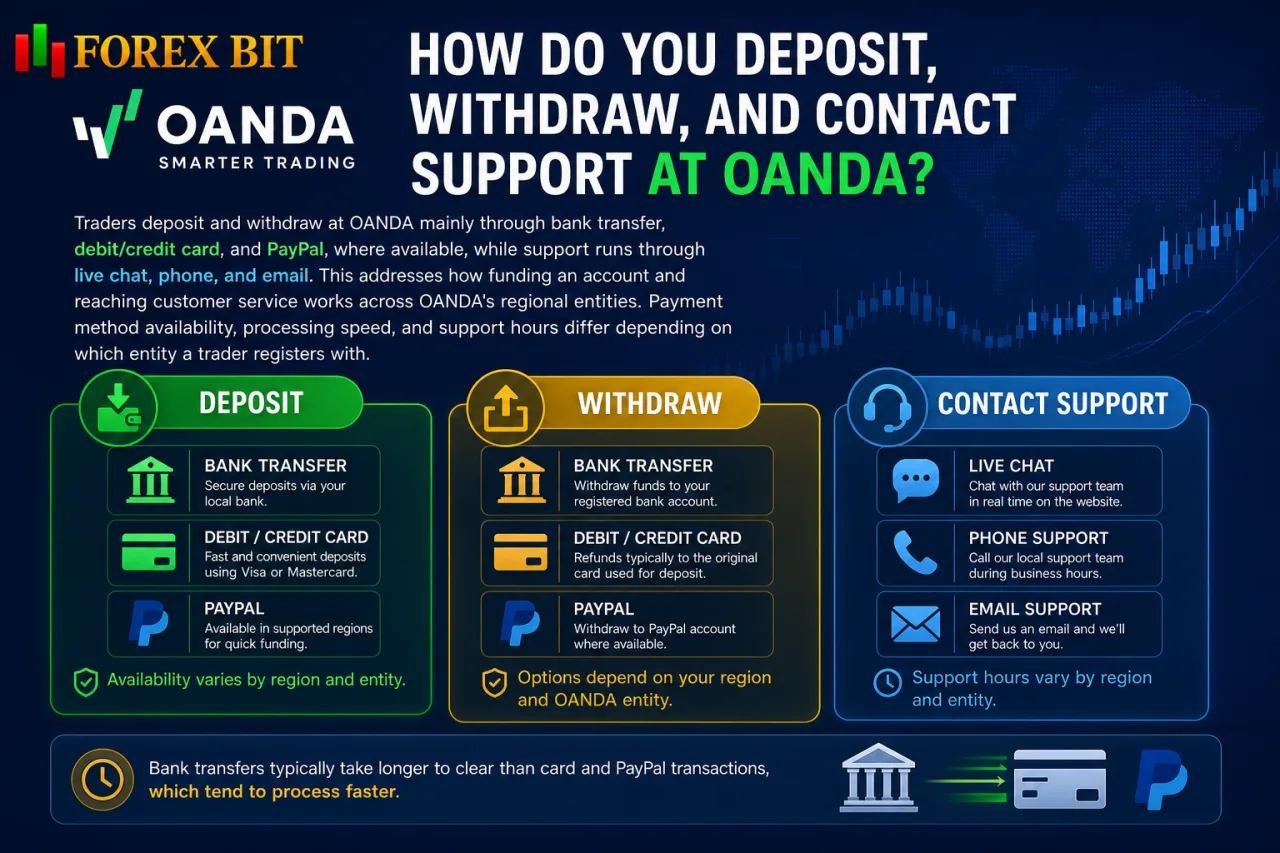
Traders deposit and withdraw at OANDA mainly through bank transfer, debit/credit card, and PayPal where available, while support runs through live chat, phone, and email. This addresses how funding an account and reaching customer service works across OANDA’s regional entities. Payment method availability, processing speed, and support hours differ depending on which entity a trader registers with.
Bank transfers typically take longer to clear than card and PayPal transactions, which tend to post faster, though exact timing depends on the receiving bank and region.
OANDA does not charge a deposit fee on standard payment methods, though intermediary banks may apply their own charges outside OANDA’s control.
Customer support channels generally include:
- Live chat available directly through the OANDA website and client portal for quick queries.
- Phone support staffed by regional teams during local business hours.
- Email support handling account-specific or documentation-related requests.
Support hours and available languages vary by regional entity, so traders should confirm coverage directly with the OANDA team serving their jurisdiction.
Is OANDA Suitable for Beginners or Experienced Traders?
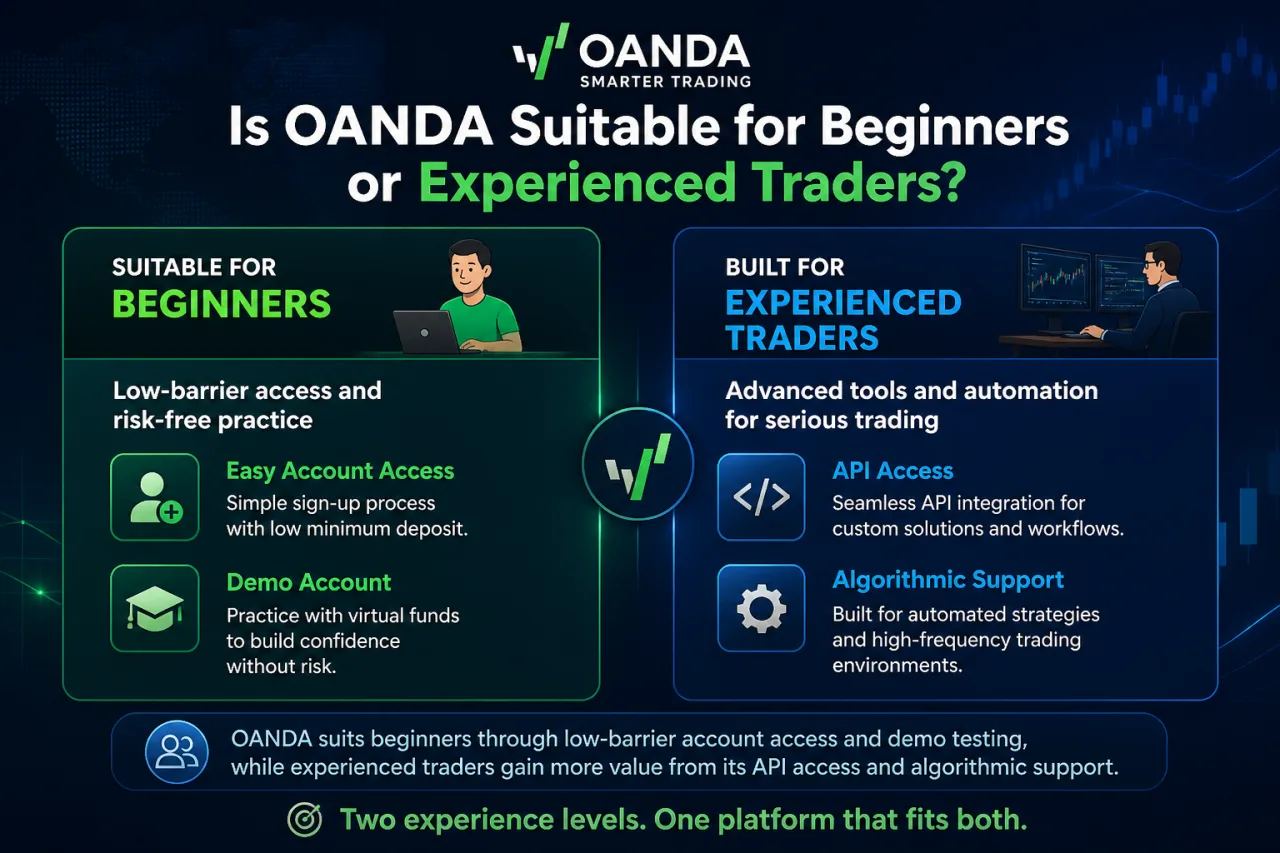
OANDA suits beginners through low-barrier account access and demo testing, while experienced traders gain more value from its API access and algorithmic support. This suitability split addresses how well OANDA fits different experience levels rather than a single trader profile. The following breakdown separates beginner-focused features from tools built for more advanced trading workflows.
What Educational Resources and Tools Does OANDA Provide for Beginners?
OANDA provides four main educational resources for beginners: demo accounts, webinars, market analysis, and structured learning materials covering trading fundamentals. This grouping addresses which tools new traders access before committing real capital at OANDA.
- Demo accounts replicate live market conditions using virtual funds, letting beginners test the platform and strategies without financial risk.
- Webinars cover trading concepts, platform tutorials, and market outlook sessions hosted periodically for account holders.
- Market analysis includes daily commentary, economic calendar updates, and technical outlooks published through OANDA’s research team.
- Learning materials consist of articles, guides, and glossary content explaining order types, leverage, and risk management basics.
Access to these resources generally applies across regional entities, though specific webinar schedules and content depth vary by region.
What Advanced Features Does OANDA Offer for Experienced Traders?
OANDA offers four advanced features geared toward experienced traders: API access, algorithmic trading support, advanced order types, and in-depth analytical tools. This grouping addresses which capabilities separate OANDA’s offering for professional-level trading workflows from its beginner-focused features.
- API access lets traders connect custom-built applications directly to OANDA’s trading infrastructure for automated execution and data retrieval.
- Algorithmic trading support extends through the REST API and MetaTrader 4’s Expert Advisor framework, enabling rule-based strategies to run without manual intervention.
- Advanced order types cover conditional orders such as trailing stops, one-cancels-the-other setups, and market-if-touched instructions for more precise trade management.
- Analytical tools include integrated technical indicators, customizable charting layouts, and TradingView-linked analysis for deeper market evaluation.
Together, these tools position OANDA closer to platforms built for systematic and high-frequency trading approaches rather than purely discretionary, manual strategies.
What Lesser-Known Facts Should Traders Know About OANDA’s History and Technology?
OANDA’s history traces back to a currency data and analytics origin rather than a brokerage start, later expanding into technology-driven pricing that removed fixed lot size requirements. This background separates OANDA from brokers that launched purely as trading platforms. The details below cover its origin story, its historical exchange rate database, and its role in continuous pricing technology.
How Does OANDA’s API Support Algorithmic and Automated Trading?
OANDA supports algorithmic and automated trading through a REST API and a streaming API, giving developers direct programmatic access to pricing data, order execution, and account management. This API infrastructure addresses how OANDA extends beyond manual, click-based trading toward systematic strategy deployment.
The REST API handles order placement, account queries, and historical rate retrieval, while the streaming API delivers real-time price feeds for latency-sensitive strategies. Documentation and SDK support cover common programming languages, appealing to quant traders and developers building custom execution logic rather than relying on off-the-shelf platform tools.
This setup differs from standard retail broker offerings in a few ways:
- Direct API access removes dependence on a fixed graphical platform for trade execution.
- Streaming price feeds support high-frequency or latency-sensitive strategy testing.
- Combined REST and streaming access, alongside MetaTrader 4’s Expert Advisor framework, gives developers two distinct routes into automation depending on their coding preference.
Retail brokers limited to MT4 alone typically lack this level of native API flexibility.
Does OANDA Offer Fractional Pip Pricing and Flexible Trade Sizes?
Yes, OANDA offers fractional pip pricing and flexible trade sizes, letting traders open positions in any unit amount rather than fixed standard lots. This flexible unit sizing addresses precision and accessibility beyond typical fixed-lot execution models.
- Unit-based sizing lets traders enter positions as small as a single currency unit instead of committing to a full standard lot.
- Fractional pip pricing quotes rates to a tenth of a pip, sharpening entry and exit precision compared to whole-pip quoting.
- Flexible sizing supports smaller accounts and precise risk calibration without rounding position size up to the nearest lot.
This unit-based structure separates OANDA from brokers restricted to fixed lot increments, giving traders finer control over exposure per trade.
Conclusion
OANDA’s combination of multi-jurisdictional regulation, segregated fund protection, and a straightforward two-tier account structure makes it a solid candidate for traders evaluating brokers before opening a live account in 2026. Beginners gain accessible entry through the Standard account, demo testing, and educational content, while experienced traders find value in the Core account’s raw spreads, API access, and algorithmic trading support.
Pricing sits in line with industry norms rather than offering a clear cost advantage, and leverage, platform access, and fund safeguards all depend on the regional entity a trader registers with. For those prioritizing regulatory reliability and flexible execution over aggressive promotions, OANDA holds up as a dependable, well-established choice.
Thomas Dite is the Best Forex Brokers Research Manager at Forex Bit, specializing in researching, comparing, and editing broker-related content for different trader needs. He focuses on evaluating trading platforms, costs, regulation, account conditions, and other key factors to help readers make more informed broker comparisons.
Email: [email protected]