
Wondering what counts as proof of address for forex account verification? See accepted documents, KYC steps, and tips to avoid rejection.
Proof of Address for Forex Account: Accepted Documents & KYC

Valid proof of address for a forex account includes recent utility bills, bank statements, or government-issued residency documents that confirm a trader’s current home address. Most forex brokers require this document to match the name and address provided during account registration, and it must fall within an accepted validity window before submission.
Accepted proof of address documents typically include utility bills such as electricity or water, bank or credit card statements, tax letters, and official government correspondence, generally required to be recently issued. These documents must clearly display the applicant’s full name, address, and issue date to pass KYC checks.
Address verification typically takes a few business days once the document is submitted, though delays can occur due to incomplete details or outdated paperwork. Rejections often stem from mismatched names, blurry scans, or documents older than the broker’s accepted timeframe.
Traders often cannot withdraw funds without completed proof of address verification, and some brokers also restrict account opening until this step is finished. This requirement forms part of standard KYC compliance across regulated forex platforms, a topic Forex Bit covers extensively for traders comparing broker verification processes.
The following sections from Forex Bit detail which documents qualify as valid proof of address, how to properly submit them for KYC verification, and how long the review process typically takes.
What Documents Are Accepted as Proof of Address for a Forex Account?
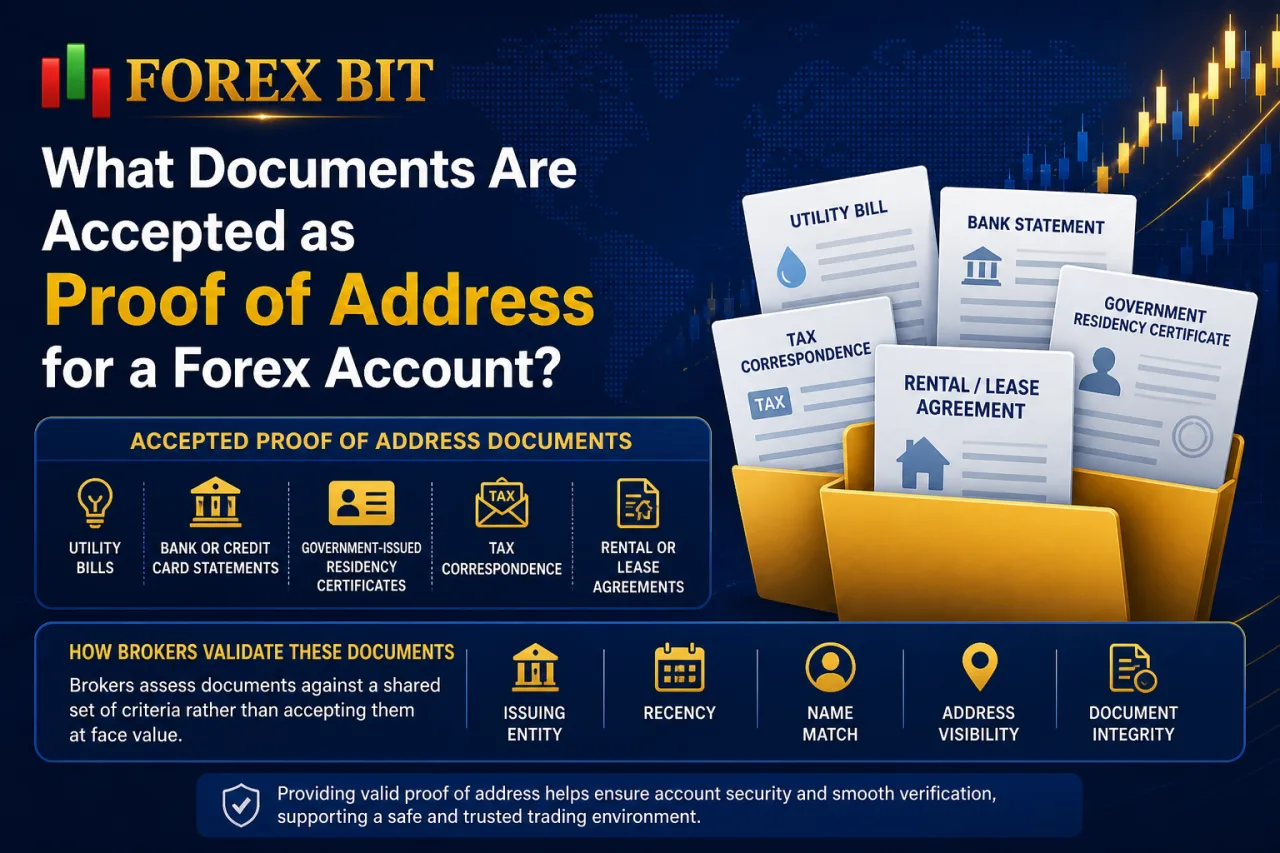
Forex brokers group accepted proof of address documents into several standard categories: utility bills, bank or credit card statements, government-issued residency certificates, tax correspondence, and rental or lease agreements. This overview outlines the general validation criteria brokers apply before checking each document type in detail.
Brokers assess these documents against a shared set of criteria rather than accepting them at face value. The issuing entity matters first, since utility companies, licensed banks, tax authorities, and government offices carry more weight than personal or unofficial correspondence. Official letterhead or a recognizable institutional header confirms the issuer’s identity on the page itself.
Name matching forms the second core criterion, as the document holder’s name must correspond exactly to the name registered on the trading account. Address formatting also gets checked against the residential details submitted during onboarding, and any mismatch typically triggers a manual review or rejection.
Rental or lease agreements sometimes require an accompanying utility bill or landlord confirmation, since a lease alone does not always confirm current occupancy. Brokers regulated in different jurisdictions may weigh these document categories differently based on regional compliance standards.
What Details Must Appear on a Valid Proof of Address Document?
A valid proof of address document must display four mandatory fields: the applicant’s full legal name, current residential address, a visible issue date, and the issuing entity’s name or logo. This set of required data fields determines whether a broker’s compliance team accepts or rejects the submission during KYC review.
Each field serves a distinct verification purpose rather than existing as a formality. The full legal name must match the name registered on the trading account character for character, since brokers flag partial matches or nicknames for manual review. The residential address must correspond to the location declared during onboarding, including unit numbers or postal codes where applicable.
The issue date confirms recency, as brokers apply a validity window to prevent outdated submissions from passing review. The issuing entity name or logo, whether from a utility company, bank, or government office, establishes the document’s authenticity and distinguishes it from unofficial correspondence. Missing any one of these four fields typically results in rejection or a request for a supplementary document.
How Recent Must the Document Be to Be Accepted?
Most forex brokers accept a proof of address document only if it was issued fairly recently, typically within the last few months of the submission date.
This validity window addresses the recency requirement tied to document age. Brokers apply this cutoff because address details on utility bills or bank statements can change quickly, and an older document no longer reliably confirms where a trader currently resides.
The exact cutoff varies by broker and by regulatory jurisdiction, so a document accepted at one platform may fall outside the window at another. Traders submitting a bill dated beyond the accepted range typically receive a rejection notice or a request for a newer document, even if every other field on the page meets the standard requirements.
Checking the specific validity period listed in a broker’s account verification or KYC policy before submission avoids delays caused by an outdated document.
How Do You Submit Proof of Address for KYC Verification?
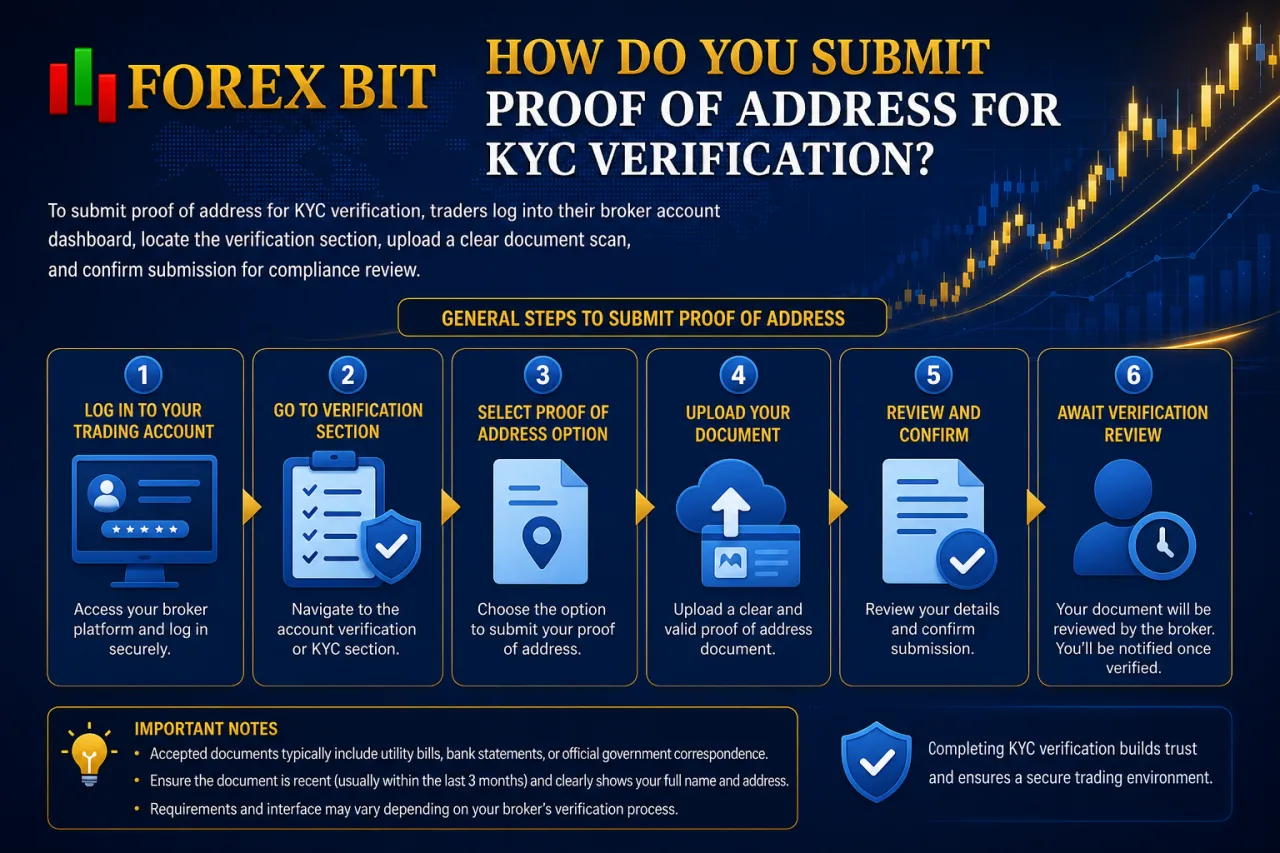
To submit proof of address for KYC verification, traders log into their broker account dashboard, locate the verification section, upload a clear document scan, and confirm submission for compliance review. This process follows a consistent structure across most regulated forex platforms, though the exact interface and required steps differ depending on the broker’s dashboard design and verification workflow.
The general sequence includes a few core steps:
- Logging into the trading account through the broker’s client portal
- Navigating to the verification, KYC, or account settings section
- Selecting proof of address as the document type before uploading
- Attaching a scanned copy or clear photo showing all required fields
- Confirming submission and waiting for compliance team review
Brokers typically restrict uploads to common file formats such as JPEG, PNG, or PDF, alongside a maximum file size limit per document. A blurry image, cropped edges, or a file exceeding the size cap often triggers an automatic rejection before a compliance officer even reviews the content, so checking image clarity beforehand reduces resubmission delays.
What File Formats and Quality Standards Are Required for Upload?
Brokers require proof of address uploads as PDF, JPG, or PNG files that show the full page in a clear, uncropped scan without glare or blur. This file requirement determines whether the verification system or a compliance officer can read every mandatory field on the document.
Resolution and clarity expectations sit at the center of this standard, since a low-resolution photo or a screenshot with compressed text often obscures the issue date or address line. Brokers reject scans where corners are cut off, shadows cover part of the page, or the image resolution falls below what compliance software can process.
Full-page uncropped scans matter because brokers verify the issuing entity’s letterhead, logo, or footer alongside the name and address fields. Cropping out these edges removes context that confirms the document’s authenticity, even if the visible portion looks legitimate.
- Uploading the complete page, including borders and letterhead
- Using natural or well-lit conditions to avoid glare on glossy paper
- Avoiding heavy compression that blurs small print
- Checking file size against the broker’s stated upload limit before submission
Can Proof of Address Be Submitted via Mobile App or Only Web Platform?
Yes, most forex brokers allow proof of address submission through both mobile trading apps and web-based client portals, though the underlying verification workflow stays identical across channels. This addresses submission channels for KYC documents beyond the standard web dashboard already outlined.
Mobile apps typically mirror the web portal’s verification section, letting traders photograph a document directly through the phone’s camera instead of uploading a pre-scanned file. Email submission remains less common as a primary channel, since most compliance systems route documents through the account dashboard for tracking and audit purposes rather than through unstructured inbox attachments.
- Uploading a photo or scan through the app’s verification menu
- Accessing the same KYC dashboard section available on the web portal
- Avoiding email submission unless a broker’s support team specifically requests it
Brokers processing document uploads through a centralized compliance system tend to apply consistent file format and quality standards, regardless of whether the trader submits through a mobile app or a web platform.
How Long Does Address Verification Take and Why Might It Be Rejected?
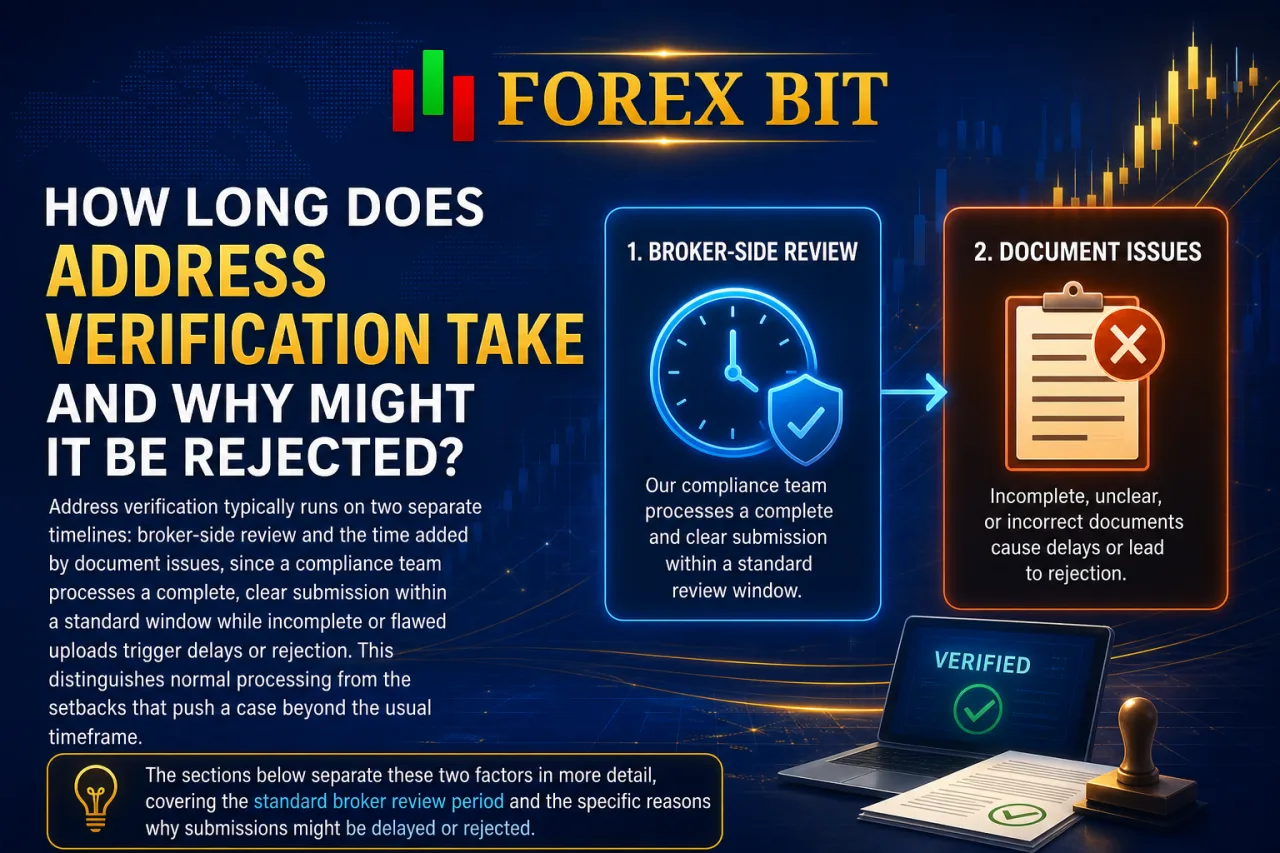
Address verification typically runs on two separate timelines: broker-side review and the time added by document issues, since a compliance team processes a complete, clear submission within a standard window while incomplete or flawed uploads trigger delays or rejection. This distinguishes normal processing from the setbacks that push a case beyond the usual timeframe.
The sections below separate these two factors in more detail, covering the standard broker review period and the specific reasons compliance teams reject a submitted document.
What Are the Most Common Reasons Proof of Address Gets Rejected?
Compliance teams reject proof of address submissions for five common reasons: an expired issue date, illegible text, an address mismatch against the ID document, missing issuer information, and a cropped or edited image. Each cause traces back to a specific field or quality check applied during KYC review, rather than a random or arbitrary decision.
- Expired date: the document falls outside the broker’s accepted validity window
- Illegible text: blurry scans, glare, or heavy compression obscure the name, address, or date
- Address mismatch: the address on the document differs from the one linked to the ID document or account registration
- Missing issuer information: the letterhead, logo, or institutional header does not appear on the page
- Cropped or edited image: the scan cuts off page edges or shows signs of digital alteration
An address mismatch against the identity document often causes the most confusion among traders, since a proof of address showing a different address than the ID creates a discrepancy the compliance system flags for manual review rather than automatic approval. Correcting any one of these five issues before resubmission typically clears the flag on the next review cycle.
How Can You Correct and Resubmit a Rejected Document?
To correct and resubmit a rejected proof of address, traders review the rejection notice, obtain an updated or clearer document, and re-upload it through the same verification portal used for the original submission. This resubmission workflow addresses each rejection cause identified in the compliance feedback rather than requiring a fresh application from scratch.
The rejection notice or in-dashboard message typically states the specific reason for the failed check, whether an expired date, illegible text, or an address mismatch. Reading this feedback first prevents traders from resubmitting the same flawed file or guessing at the wrong fix.
Once the cause is identified, obtaining a corrected document follows directly:
- Requesting a fresh utility bill or bank statement if the original expired
- Rescanning the page in better lighting to remove glare or blur
- Confirming the address matches the ID document before resubmitting
- Capturing the full page, including letterhead and edges, if cropping caused rejection
The corrected file then goes back through the same dashboard or app section used initially, keeping the review process within a single tracked verification channel.
Can Traders Open a Forex Account or Withdraw Funds Without Proof of Address?
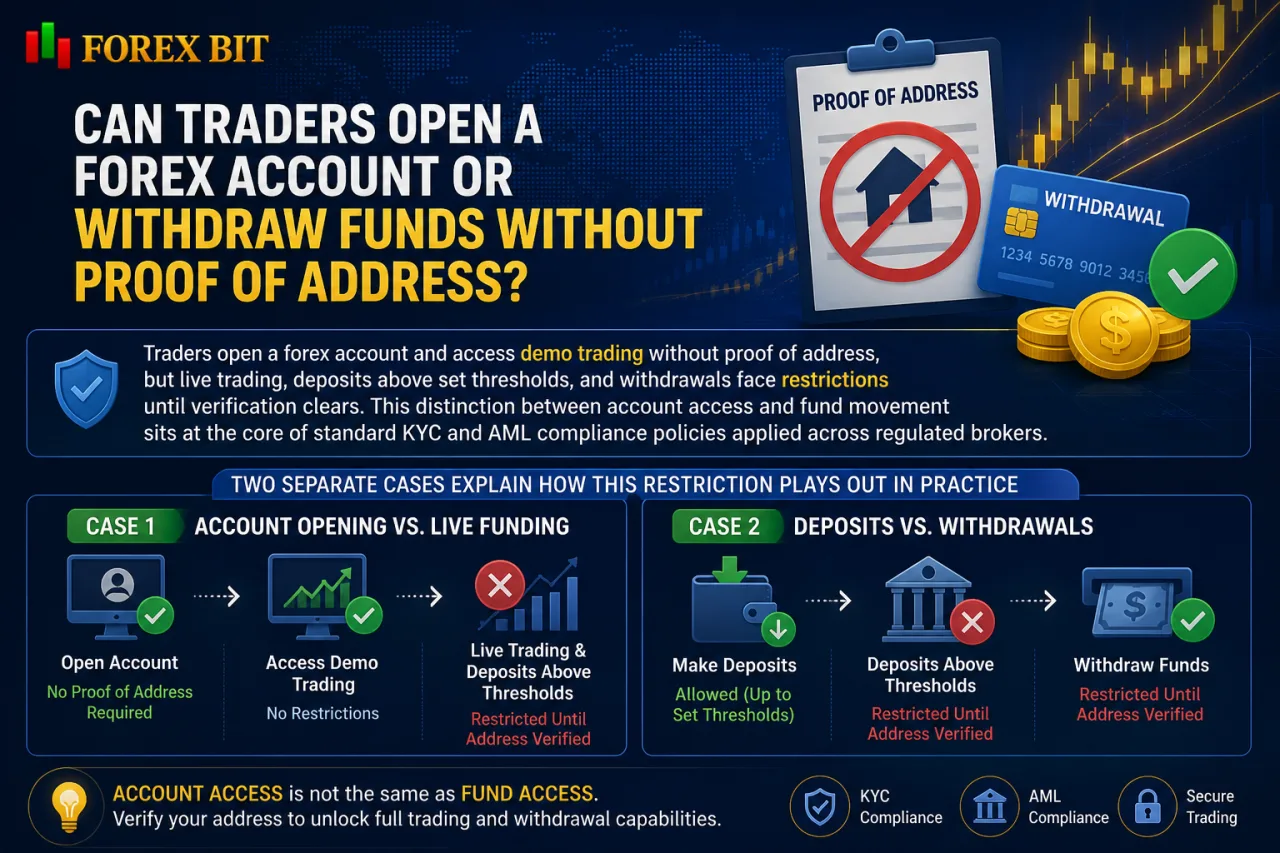
Traders open a forex account and access demo trading without proof of address, but live trading, deposits above set thresholds, and withdrawals face restrictions until verification clears. This distinction between account access and fund movement sits at the core of standard KYC and AML compliance policies applied across regulated brokers.
Two separate cases explain how this restriction plays out in practice, covering account opening against live funding, and deposits against withdrawals.
What Account Functions Are Limited Before Address Verification Is Complete?
Unverified accounts face four typical restrictions: withdrawal holds, deposit caps, trading limits, and full account suspension. These limitations apply until the compliance team clears the submitted proof of address.
Each restriction targets a different account function rather than blocking access uniformly:
- Holding withdrawal requests until the compliance team confirms the trader’s registered address
- Capping deposit amounts below a threshold that would otherwise require full identity and address checks
- Limiting trading activity to demo mode or restricting order sizes on a live account
- Suspending the entire account when verification documents remain outstanding past a broker’s deadline
Brokers apply these limits based on internal AML and KYC policy rather than as an arbitrary inconvenience.
Withdrawal holds tend to affect traders most directly, since funds already deposited stay locked in the account until the compliance review closes. Trading restrictions and deposit caps generally lift automatically once the system confirms the document meets the standard fields and validity window covered earlier in this guide.
What Special Cases Arise When Submitting Proof of Address for KYC?
Special cases involve three edge scenarios: traders without utility bills in their own name, digital-only bank customers lacking paper statements, and expatriates holding foreign address documents. These situations fall outside the standard document categories already outlined, so brokers apply alternative verification paths rather than rejecting the account outright. The sections below address each scenario separately.
What If You Don’t Have Any Bills or Documents in Your Own Name?
Traders without a bill or bank statement in their own name resolve this gap through a third-party residency letter, pairing an affidavit from the property owner with that owner’s own proof of address and identity document. This addresses situations where a trader lives with family, rents informally, or shares a household without a utility account under their own name.
The alternative path substitutes ownership of a document with a formal declaration confirming shared residency:
- Obtaining a signed affidavit or letter from the property owner stating the trader resides at the address
- Attaching the owner’s own recent utility bill or bank statement as proof of address
- Including a copy of the owner’s government-issued ID to confirm their identity
- Submitting all three items together through the same verification portal used for standard documents
Compliance teams cross-check the owner’s identity against the submitted affidavit before accepting the combined package. Requirements for accepting this affidavit-based route vary by broker and regulatory jurisdiction.
Can a Foreign or Translated Address Document Be Accepted?
Yes, brokers accept a foreign or non-English proof of address, though most require a certified translation alongside the original document before compliance review clears it. This addresses cross-border and language variations tied to the standard document checks already covered.
Expatriates, remote traders, and applicants living outside their broker’s home jurisdiction commonly submit a utility bill or bank statement issued in a foreign country. Compliance teams generally accept these foreign-language originals only when paired with a certified or notarized translation confirming the name, address, and issue date match the source document, though exact requirements vary by broker and jurisdiction.
- Submitting the original foreign-language document without alteration
- Attaching a certified translation covering all mandatory fields
- Confirming the translator’s credentials or stamp appear on the translated copy
- Checking the broker’s specific jurisdiction for notarization requirements beyond translation
Requirements for certified translation versus notarization vary by broker and by the regulatory jurisdiction overseeing the account, so confirming the exact policy before submission avoids delays already noted for other document errors.
Conclusion
Forex account verification accepts proof of address from recognized issuers such as utility companies, banks, and government offices, provided the name, address, and issue date align with the account details and fall inside the broker’s validity window. Traders lacking a document in their own name rely on a third-party affidavit paired with the owner’s identification, while expatriates submit foreign-language originals alongside a certified translation.
Uploading a clear, full-page scan through the broker’s dashboard or app, checking the four mandatory fields beforehand, and confirming the accepted timeframe reduces rejection risk. Since unverified accounts face withdrawal holds and deposit caps, completing this step early keeps trading and fund access free from KYC-related interruptions.
William Johnson is a Forex & Broker News Analyst at Forex Bit, focusing on broker updates, regulatory developments, payment changes, and security-related news. His work helps readers stay informed about important industry developments and understand how these changes may affect broker services and trading conditions.
Email: [email protected]


Best Brokers

Trade with the world’s largest retail broker and benefit from better - than - market conditions.

We offer a superior trading environment that puts traders in the best position to profit.

Trade with the best trading conditions. WIN THE BEST TRADING ACCOUNT AWARD.

Trade global markets with Interactive Brokers – a highly regulated multi-asset broker built for active and professional investors.






Forex Bit provides independent forex broker reviews, comparisons, guides, and industry news to help traders make informed decisions.
Best Brokers
Metatrader 5 Brokers
Metatrader 4 Brokers
Lowest Spread Forex Broker
Regulated Forex Brokers
Forex Copy Trading
Ctrader Brokers
Best Forex Broker For Beginners