


- Top-tier multi-jurisdiction regulation
- Next Generation & MT4 support
- Wide range of tradable instruments
- Segregated client funds
- Negative balance protection
- Withdrawal delays reported
- Slow customer support at times
- Slippage during volatile markets
- Account verification delays
- Withdrawal & conversion fees may apply
XTB operates as a regulated broker under multiple financial authorities, which is relevant for UK traders assessing broker safety. This regulatory status directly affects fund safety, client protection schemes, and dispute resolution options available to traders opening an account.
XTB’s fee structure includes spreads that vary depending on account type, alongside possible commission charges on certain instruments. These costs sit within a competitive range when measured against other brokers offering similar CFD and forex products.
Opening an XTB account generally involves identity verification, a funding deposit, and a choice between standard or professional account types. The platform then provides access to its proprietary xStation software for executing trades across supported markets.
User reviews and complaint records reveal mixed feedback on XTB’s execution speed, customer support responsiveness, and withdrawal processing times. These reported experiences add practical context beyond the broker’s formal regulatory standing.
Forex Bit examines these factors below, starting with a closer look at XTB’s regulatory framework and safety credentials for UK-based traders.
Is XTB a Safe and Regulated Broker?
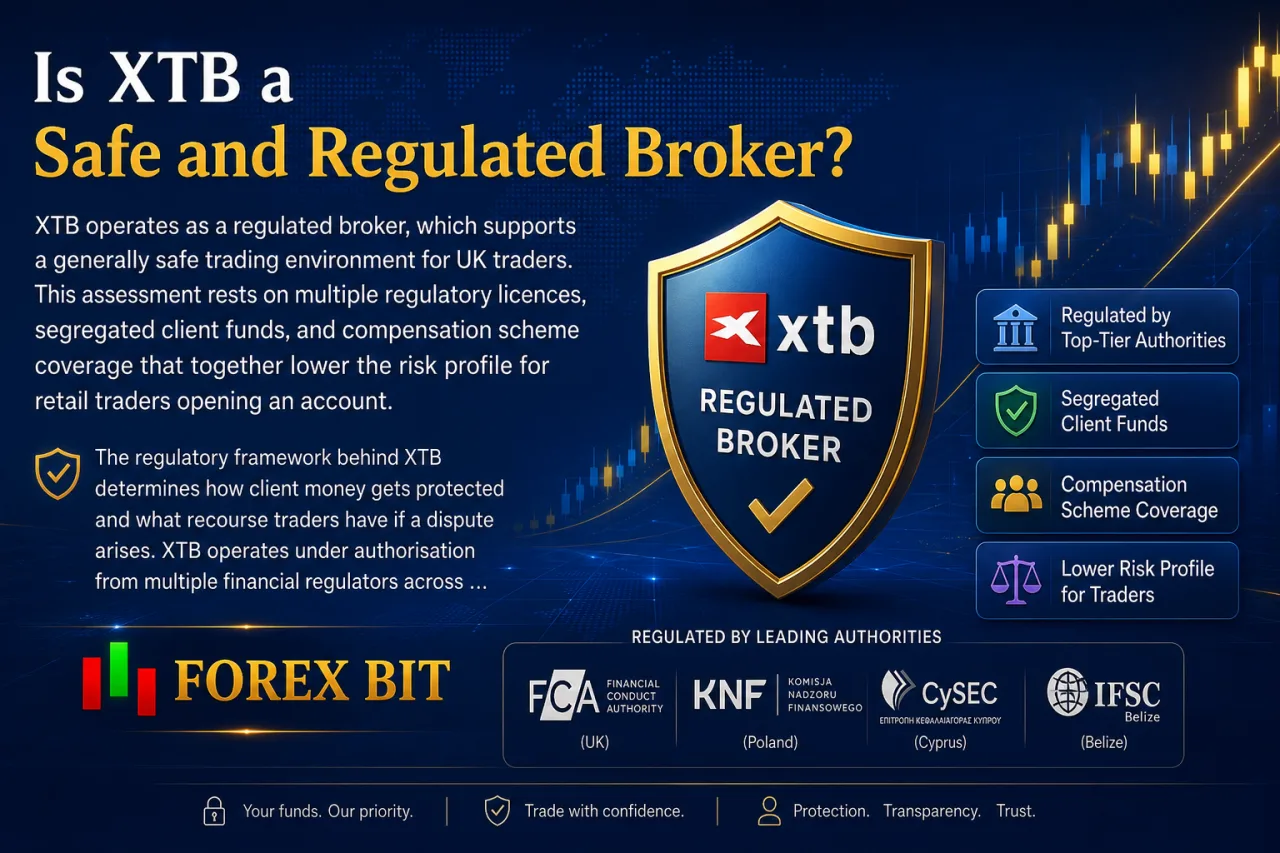
XTB operates as a regulated broker, which supports a generally safe trading environment for UK traders. This assessment rests on multiple regulatory licences, segregated client funds, and compensation scheme coverage that together lower the risk profile for retail traders opening an account.
The regulatory framework behind XTB determines how client money gets protected and what recourse traders have if a dispute arises. XTB operates under authorisation from multiple financial regulators across the jurisdictions in which it offers services, with each regulator issuing its own licence to the broker.
XTB segregates client funds from company operating capital, a standard safeguard against misuse of trader deposits. This policy is outlined in XTB’s official client asset protection disclosures, which detail how segregated accounts are maintained separately from the firm’s own funds and held with regulated custodian institutions.
UK clients trading through an FCA-regulated XTB entity qualify for coverage under the Financial Services Compensation Scheme (FSCS), which protects eligible funds up to a set limit if the broker fails.
The following sections break down each regulator, the licence details, and how fund protection applies in practice for UK-based traders.
What Regulatory Licences Does XTB Hold?
XTB operates as a regulated broker under multiple financial authorities, which is relevant for UK traders assessing broker safety.
Each licence ties to a separate XTB legal entity and defines the rules that entity follows regarding client fund handling, capital requirements, and reporting obligations. The FCA licence governs XTB’s UK entity, which requires the broker to hold client money in segregated accounts and meet minimum capital thresholds set by UK regulation.
CySEC authorisation covers XTB’s European entity, which allows the broker to offer its services across the European Economic Area under passporting arrangements.
The KNF licence applies to XTB’s home market oversight in Poland, where the group originates. UK-based traders opening an account with XTB are generally onboarded under the broker’s FCA-regulated entity, placing their funds and trading activity under UK regulatory oversight.
This entity assignment determines which compensation scheme and complaints process apply to a UK client’s account.
How Does XTB Protect Client Funds?
XTB protects client funds through segregated bank accounts, FSCS compensation coverage, and negative balance protection applied to UK-based accounts. These three safeguards work together to reduce financial exposure for traders regardless of the broker’s own financial standing.
XTB holds UK client money in segregated bank accounts separate from company funds, which is consistent with the client money protection rules required under XTB’s FCA regulation, preventing those deposits from forming part of the broker’s operating capital.
UK clients trading through XTB’s FCA-regulated entity qualify for coverage under the Financial Services Compensation Scheme (FSCS), which protects eligible funds up to a set limit if the broker fails, as established under the FSCS rules, detailed on the Financial Services Compensation Scheme website.
XTB applies negative balance protection to retail client accounts, capping losses at the deposited account balance rather than allowing debt beyond that amount.
Together, fund segregation limits misuse of client deposits, FSCS coverage addresses broker insolvency risk, and negative balance protection guards against extreme market volatility, forming a layered protection structure for UK-based XTB accounts.
How Do XTB’s Fees and Spreads Compare to Other Brokers?
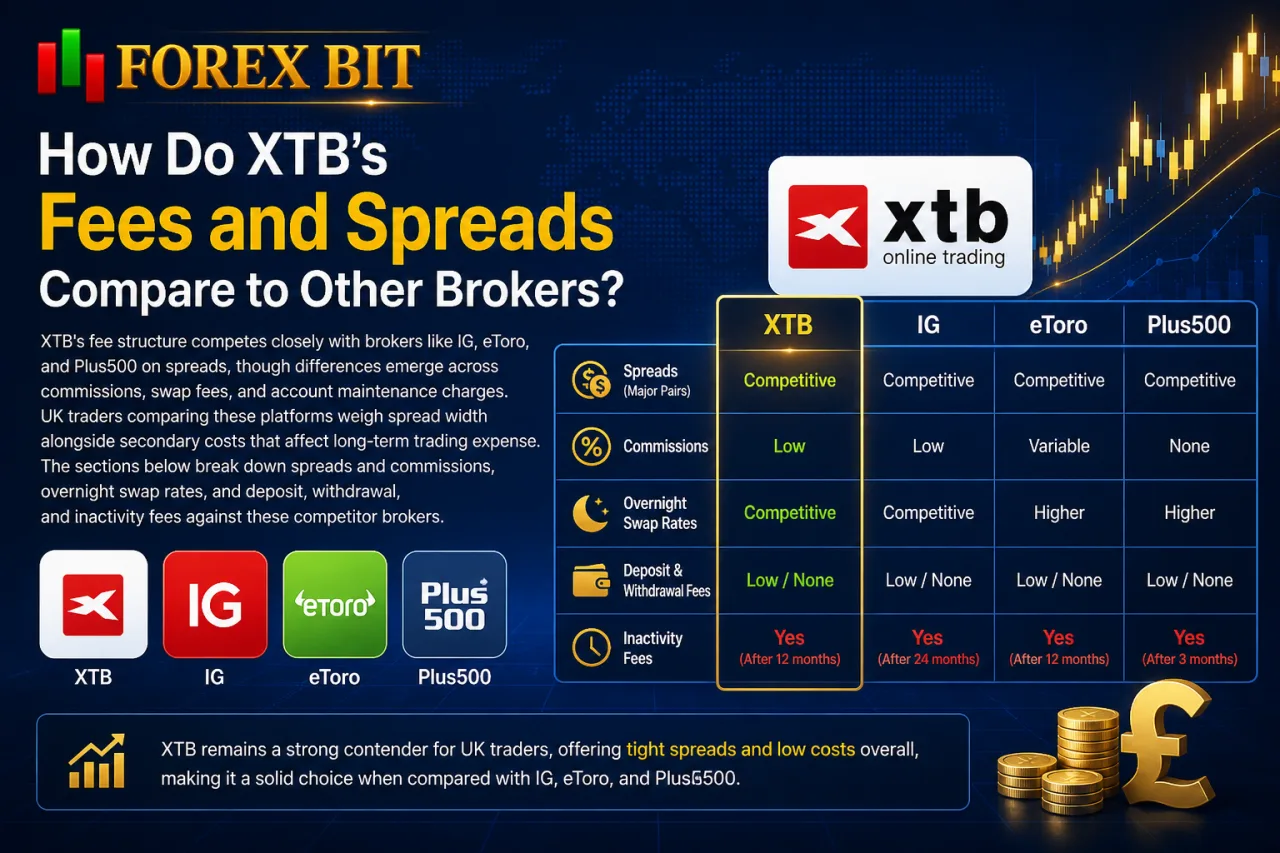
XTB’s fee structure competes closely with brokers like IG, eToro, and Plus500 on spreads, though differences emerge across commissions, swap fees, and account maintenance charges. UK traders comparing these platforms weigh spread width alongside secondary costs that affect long-term trading expense. The sections below break down spreads and commissions, overnight swap rates, and deposit, withdrawal, and inactivity fees against these competitor brokers.
What Are XTB’s Trading Costs (Spreads and Commissions)?
XTB’s trading costs run on variable spreads for forex, indices, and stocks, with a commission layer added specifically on the Pro account tier. Standard account traders pay a spread-only structure, while Pro account traders face tighter raw spreads plus a per-lot commission charge.
Major forex pairs such as EUR/USD typically carry tight spreads on the Standard account, though exact spread figures can vary depending on market conditions.
Indices and stock CFDs carry their own spread ranges, which widen or narrow depending on market volatility and the specific instrument traded.
On the Pro account, XTB applies a commission per lot traded on forex and certain other instruments, rather than folding that cost entirely into a wider spread. This Pro account commission structure suits higher-volume traders seeking reduced spread costs offset by a per-trade commission charge.
Standard accounts remain commission-free, making the spread the sole trading cost for most retail clients using that account type.
XTB vs Other UK Brokers: Which Offers Lower Fees?
XTB’s Standard account spreads are generally competitive with IG and Plus500, but total cost varies depending on withdrawal and conversion fees. Deposit methods, withdrawal thresholds, and currency conversion markups add expenses that vary by broker.
IG and XTB differ in cost structure: IG’s pricing model relies on spreads alongside overnight funding and inactivity charges, while XTB’s Standard account pricing is spread-based, so the overall cost comparison between the two brokers depends on trading frequency and holding periods rather than spreads alone.
eToro and XTB differ in cost structure for forex and stock CFDs, with variations in spreads and commission charges depending on the instrument traded.
Plus500 sets its spreads close to XTB’s range on indices and forex, though Plus500’s currency conversion charge on non-USD deposits can raise total cost for UK traders funding accounts in GBP, so traders should verify the current fee structure directly with Plus500 before depositing.
The table below lines up these four brokers across spread type, commission structure, withdrawal fee, and currency conversion charge, giving UK traders a side-by-side view of hidden costs beyond the quoted spread. Exact withdrawal thresholds and currency conversion rates change over time and differ by account type, so traders should confirm current figures directly on each broker’s official fee page before making a deposit or withdrawal decision.
| Broker | Spread Type | Commission | Withdrawal Fee | Currency Conversion Fee |
|---|---|---|---|---|
| XTB | Variable, Pro account adds per-lot commission | Pro account only | Charged on withdrawals below a minimum amount, waived above that threshold per XTB’s published policy | Applied when the deposit or withdrawal currency differs from the account base currency |
| IG | Variable, tighter on majors | Share dealing only | Generally free, subject to conditions outlined in IG’s account terms | Applied on conversions between account currency and trade currency, rate set by IG |
| eToro | Wider on forex | None on stock CFDs | A flat fee applies per withdrawal request, per eToro’s fee schedule | Applied since eToro accounts are USD-denominated, affecting GBP deposits and withdrawals |
| Plus500 | Comparable to XTB | None | Generally free above a minimum withdrawal amount, per Plus500’s policy | Applied on non-USD deposits and withdrawals, rate set by Plus500 |
How Do You Open and Start Trading on an XTB Account?
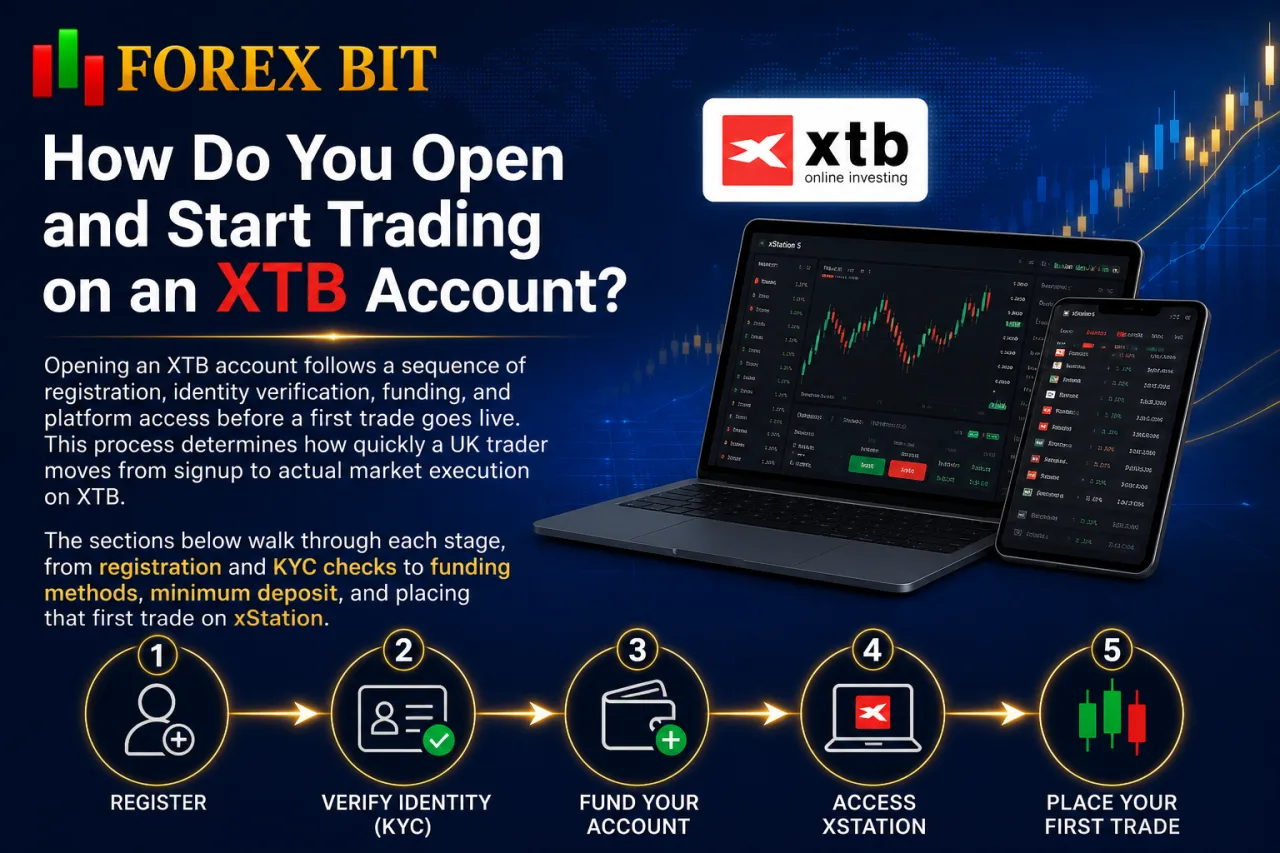
Opening an XTB account follows a sequence of registration, identity verification, funding, and platform access before a first trade goes live. This process determines how quickly a UK trader moves from signup to actual market execution on XTB. The sections below walk through each stage, from registration and KYC checks to funding methods, minimum deposit, and placing that first trade on xStation.
What Documents Are Needed to Verify a UK XTB Account?
Verifying a UK XTB account requires a government-issued photo ID and a recent proof of address document, submitted digitally through the registration portal. These two document categories form the core KYC requirement before an account gains full trading access.
Accepted photo ID options include a valid passport or a UK driving licence, both of which confirm identity and date of birth. Proof of address typically comes from a recent utility bill, bank statement, or council tax statement, each showing the applicant’s name and current residential address. XTB generally requires proof of address documents to be recently issued to count as valid, so traders should check the current specific timeframe directly with XTB before submitting verification documents.
Verification timeframe varies by document quality and volume of submissions at the time of application. XTB reviews submitted documents and generally approves verified UK accounts once both ID and address proof pass the check, though traders should confirm current processing times directly with XTB.
Uploading clear, unedited scans and matching the name across both documents reduces the chance of a rejected submission and speeds up approval.
What Are the Available XTB Account Types?
XTB offers three main account types: Standard, Pro, and Islamic (swap-free), grouped by spread structure, commission model, and eligibility requirements. Each type targets a different trading approach, from spread-only retail trading to commission-based execution or religiously compliant swap-free positions.
- Standard account: Carries a spread-only cost structure with no added commission, making it the default choice for most retail UK traders opening an account.
- Pro account: Applies tighter raw spreads alongside a per-lot commission charge on forex and certain other instruments, suiting higher-volume traders seeking reduced spread costs. Access to this account type depends on the entity a trader registers under and carries volume or experience-based conditions.
- Islamic account: Removes overnight swap charges, replacing them with an alternative fee structure to comply with Sharia-compliant trading principles. Activation requires eligibility verification.
Traders switching between Standard, Pro, or Islamic account types check the current specific terms directly with XTB before making the change.
Is XTB Trustworthy Based on Regulation Status and User Reviews?
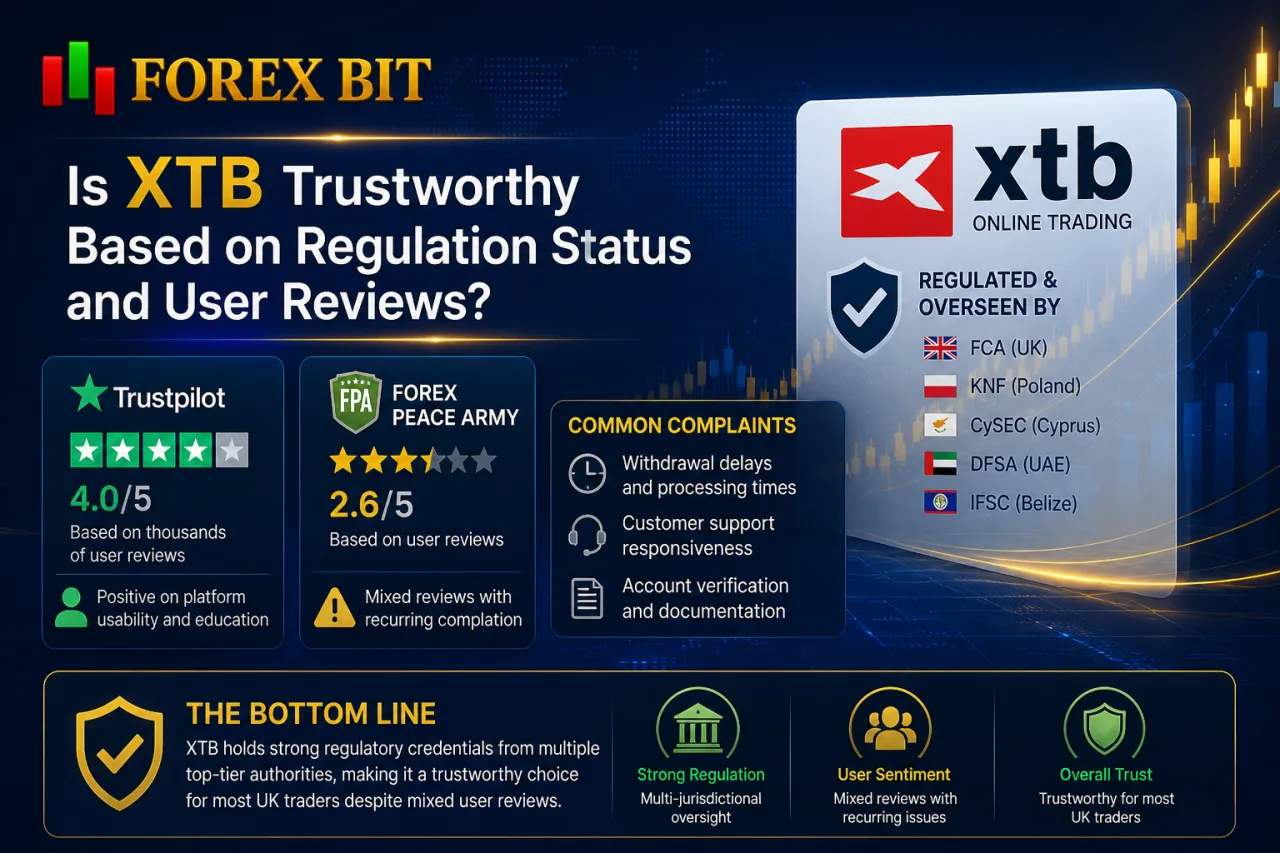
Yes, XTB is trustworthy for most UK traders. Its solid regulatory standing supports this rating, though independent review platforms flag recurring complaints on withdrawal timing and support responsiveness. This combination of solid regulatory backing and mixed user sentiment shapes the overall trust picture.
Independent review platforms consistently surface the same complaint patterns: delayed withdrawal processing and slow support response times during high-demand periods. These are service-level friction points rather than signs of misconduct or fund security risk.
XTB’s regulatory framework, including oversight from the FCA for UK-based accounts, offsets these service-level concerns. Client fund segregation and compensation scheme protection remain intact regardless of the support or withdrawal complaints raised on review platforms. [[CẦN_DẪN_CHỨNG: specific Trustpilot and Forex Peace Army review scores, review counts, and source links for XTB]]
What Do Verified User Reviews Say About XTB?
Verified reviews on XTB show mixed sentiment: praise for platform stability, criticism for slow customer support. This split centres on three recurring themes: platform reliability, execution speed, and customer service responsiveness. This mixed pattern echoes the broader complaint records covered earlier regarding withdrawal timing and support turnaround.
On platform reliability, many reviewers describe the xStation software as stable during normal trading hours, with positive comments centred on charting tools and order execution on standard market conditions. Some traders report platform slowdowns or requotes during high-volatility news events, a complaint pattern seen across CFD brokers generally rather than something unique to any single provider.
Execution speed draws similarly divided feedback. Some traders note fast order fills on major forex pairs, while others report delayed execution on less liquid instruments during busy sessions.
Customer service responsiveness generates the most negative commentary among verified reviews. Some traders report slower reply times from XTB support channels when handling withdrawal queries or account verification issues.
Positive reviews, by contrast, credit XTB’s onboarding process and educational resources as straightforward for new UK traders.
What Are the Most Common Complaints Against XTB?
XTB’s most common complaints group into three categories: withdrawal delays, execution slippage, and account verification issues. These three patterns surface repeatedly across independent review platforms and connect directly to the customer service concerns noted earlier regarding support responsiveness.
Withdrawal delays draw the highest volume of negative feedback among these three categories. Some traders report withdrawal processing taking longer than expected, particularly when the withdrawal method differs from the original deposit method, so traders should confirm current processing timeframes directly with XTB before initiating a withdrawal.
Execution slippage complaints cluster around volatile market conditions, echoing the platform slowdown pattern already noted during high-volatility news events. Traders describe orders filling at prices worse than the quoted rate during fast-moving sessions on major economic announcements.
Account verification issues involve delayed approval or repeated document requests during the KYC stage, sometimes extending beyond the timeframe new traders expect at signup.
XTB has addressed some of these complaint patterns through updated support channels and documentation guidance, though traders should confirm current resolution status directly with XTB before opening an account. Public responses to individual complaints vary by case and platform, with no single unified resolution log covering all three categories.
What Unique Tools and Features Does XTB Offer Beyond Standard Trading?
XTB offers several unique tools beyond standard trading, grouped into two main categories: proprietary platform features and educational resources. This grouping separates the trading interface itself from the support materials built around it. The sections below break down the xStation 5 platform’s built-in tools, including market sentiment indicators and account related rewards features, followed by the XTB Trading Academy.
What Makes the xStation 5 Platform Different From Competitor Platforms?
xStation 5 differentiates from MetaTrader-based competitor platforms through a native heatmap tool, an integrated economic calendar, and a customisable in-house charting interface built specifically for XTB’s own trade execution engine rather than adapted from third-party software. This structural difference matters for UK traders comparing XTB’s platform experience against brokers running standard MetaTrader 4 or 5.
Key differences from MetaTrader-based platforms include:
- Modular UI/UX layout: market watchlists, order tickets, and chart windows sit in a modular grid that traders rearrange freely, a flexibility MetaTrader’s fixed template structure does not replicate as directly.
- Built-in analytics: a market sentiment heatmap shows buy/sell positioning ratios across instruments, alongside an order execution panel embedded directly into the chart view.
- Integrated economic calendar: market events display within the platform itself rather than through a separate tool or browser tab.
- Trading calculators: margin, pip value, and swap cost calculators sit built into the platform, removing the need for external spreadsheets that MetaTrader users often rely on.
These proprietary tools position xStation 5 as a self-contained trading environment rather than a customisable shell requiring third-party plugins.
What Educational Resources Does XTB Provide for Traders?
XTB provides educational resources through three main channels: the XTB Trading Academy, live webinars, and daily market commentary. These resources sit alongside the platform’s core trading services rather than replacing them, adding practical learning support for UK traders using xStation 5.
The XTB Trading Academy structures lessons around forex and CFD fundamentals, technical analysis, and risk management concepts, aimed at traders moving from beginner to intermediate skill levels. Live webinars cover topics such as chart reading and platform navigation, with sessions offered to UK-based account holders, though traders should check XTB’s current schedule directly for specific dates and hosts.
Daily market commentary delivers written analysis on major currency pairs, indices, and economic events, giving traders context before entering trades on xStation 5.
Together, these three resources extend XTB’s value beyond order execution, positioning the broker as a learning-support platform rather than a pure trade-execution tool for UK traders building market knowledge over time.
Conclusion
XTB stands as a safe option for UK traders on the strength of its regulatory backing: FCA authorisation, segregated client funds, FSCS compensation coverage, and negative balance protection form a layered safeguard against both broker insolvency and market volatility. Competitive spreads across Standard and Pro accounts, a straightforward verification and funding process, and proprietary tools like xStation 5 add practical value beyond compliance alone.
The main friction points, withdrawal delays and inconsistent support response times, reflect service-level weaknesses rather than structural safety gaps. On balance, UK traders get a properly regulated broker with dependable fund protection, provided they weigh those recurring service complaints before committing significant capital.
Thomas Dite is the Best Forex Brokers Research Manager at Forex Bit, specializing in researching, comparing, and editing broker-related content for different trader needs. He focuses on evaluating trading platforms, costs, regulation, account conditions, and other key factors to help readers make more informed broker comparisons.
Email: [email protected]