
Regulated vs offshore forex broker: see how licensing, fund protection & compensation schemes differ before you trade. Check what really matters.
Regulated vs Offshore Forex Broker: Key Safety Differences

A regulated forex broker operates under a licensed authority that enforces capital requirements, fund segregation, and compensation schemes, while an offshore broker typically registers in a jurisdiction with minimal oversight. This distinction directly affects how client funds are protected if a broker becomes insolvent or acts in bad faith.
Tier-1 regulators such as the FCA, ASIC, and CySEC generally enforce stricter capital, reporting, and client protection standards than most offshore licenses. Each authority applies different compensation limits and leverage restrictions, so protection levels vary even among brokers regulated in these regions.
Trading with an offshore-regulated broker raises the risk of unprotected client funds, limited access to compensation schemes, and weak enforcement during disputes. Withdrawal delays and unclear legal recourse are common concerns traders report when a broker holds only an offshore license.
A broker’s license status can typically be verified directly on the relevant regulator’s official register using its license number and legal entity name. Checking segregated account disclosures in the broker’s legal documents further confirms whether client funds are held separately from company operating capital. Forex Bit breaks down these safety differences in detail, starting with how regulated and offshore forex brokers are formally classified below.
What Is the Difference Between a Regulated and an Offshore Forex Broker?
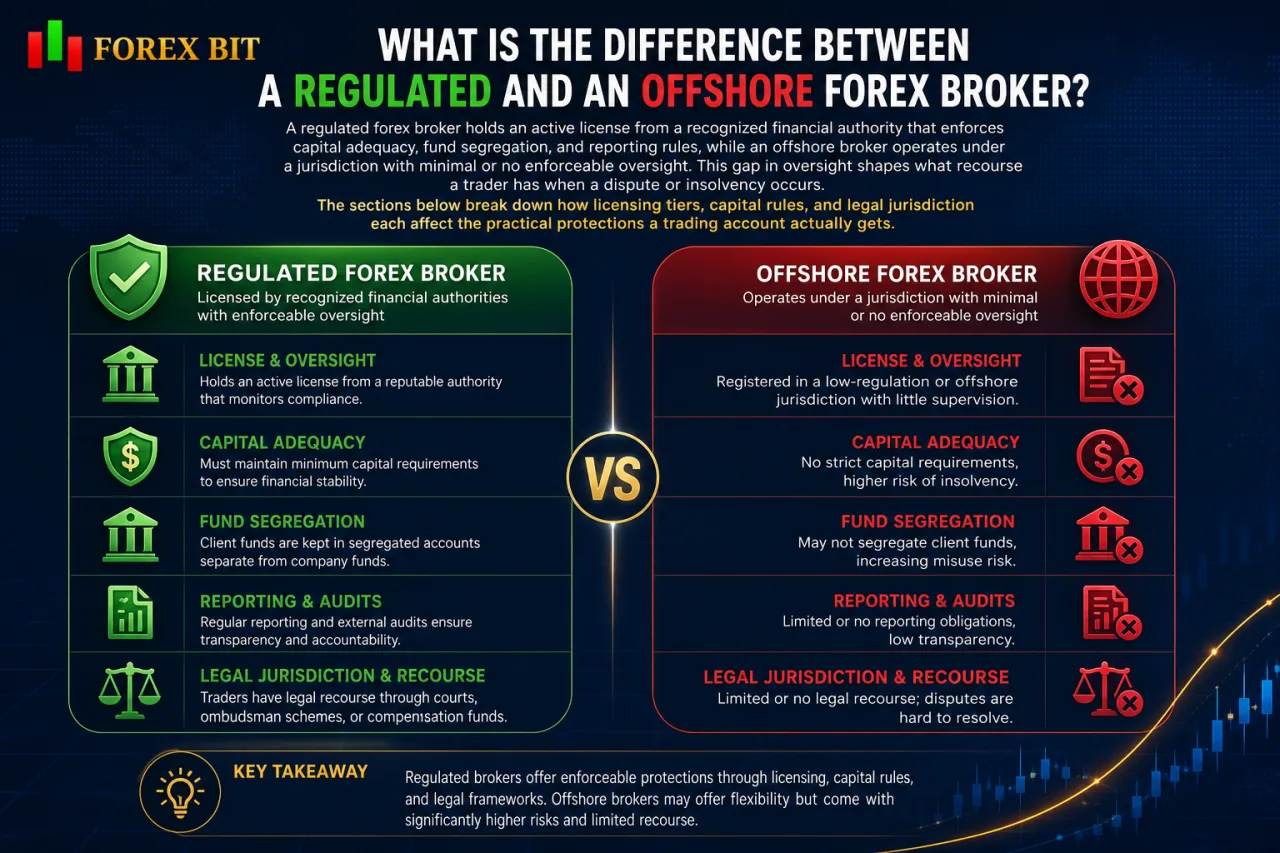
A regulated forex broker holds an active license from a recognized financial authority that enforces capital adequacy, fund segregation, and reporting rules, while an offshore broker operates under a jurisdiction with minimal or no enforceable oversight. This gap in oversight shapes what recourse a trader has when a dispute or insolvency occurs. The sections below break down how licensing tiers, capital rules, and legal jurisdiction each affect the practical protections a trading account actually receives.
What Does ‘Regulated Broker’ Actually Mean?
A “regulated broker” designation means a specific legal entity holds an active license number issued and monitored by a named financial authority, not that the broker’s global brand as a whole is licensed. That entity-specific detail matters because a group’s marketing site often promotes one license while onboarding traders under a different, less-regulated entity.
Licensing under a recognized authority carries ongoing obligations, not a one-time approval. A licensed entity typically must:
- maintain minimum capital adequacy set by the regulator
- submit periodic financial and operational reports
- follow conduct rules covering marketing, order execution, and complaint handling
- keep client funds in segregated accounts separate from company capital
Because licensing applies per legal entity, a trader opening an account under an offshore affiliate of an otherwise regulated group receives none of the protections tied to the regulated entity. Verifying which specific entity holds the account, and cross-checking its license number on the regulator’s public register, confirms whether these obligations actually apply to that account.
What Does ‘Offshore Broker’ Actually Mean?
An “offshore broker” designation means the operating entity is registered in a jurisdiction with minimal capital requirements and limited enforcement capacity, rather than under a major financial authority. This registration status shapes how much recourse a trader actually has when a dispute arises with that entity.
Common offshore jurisdictions include Seychelles, Belize, Vanuatu, Mauritius, and St. Vincent and the Grenadines. These jurisdictions generally impose lower minimum capital thresholds on brokers than tier-1 regulators and often lack the staffing or authority to actively investigate client complaints.
Not every offshore regulator applies identical standards. Some offshore authorities publish license registers and require basic reporting, while others issue registration certificates with little ongoing supervision. This variation means an “offshore-regulated” label alone does not indicate the actual level of oversight; checking the specific licensing body’s public register and enforcement history remains necessary to assess what protection, if any, that entity provides.
Which Regulators Offer the Strongest Investor Protection: FCA, ASIC, or CySEC?
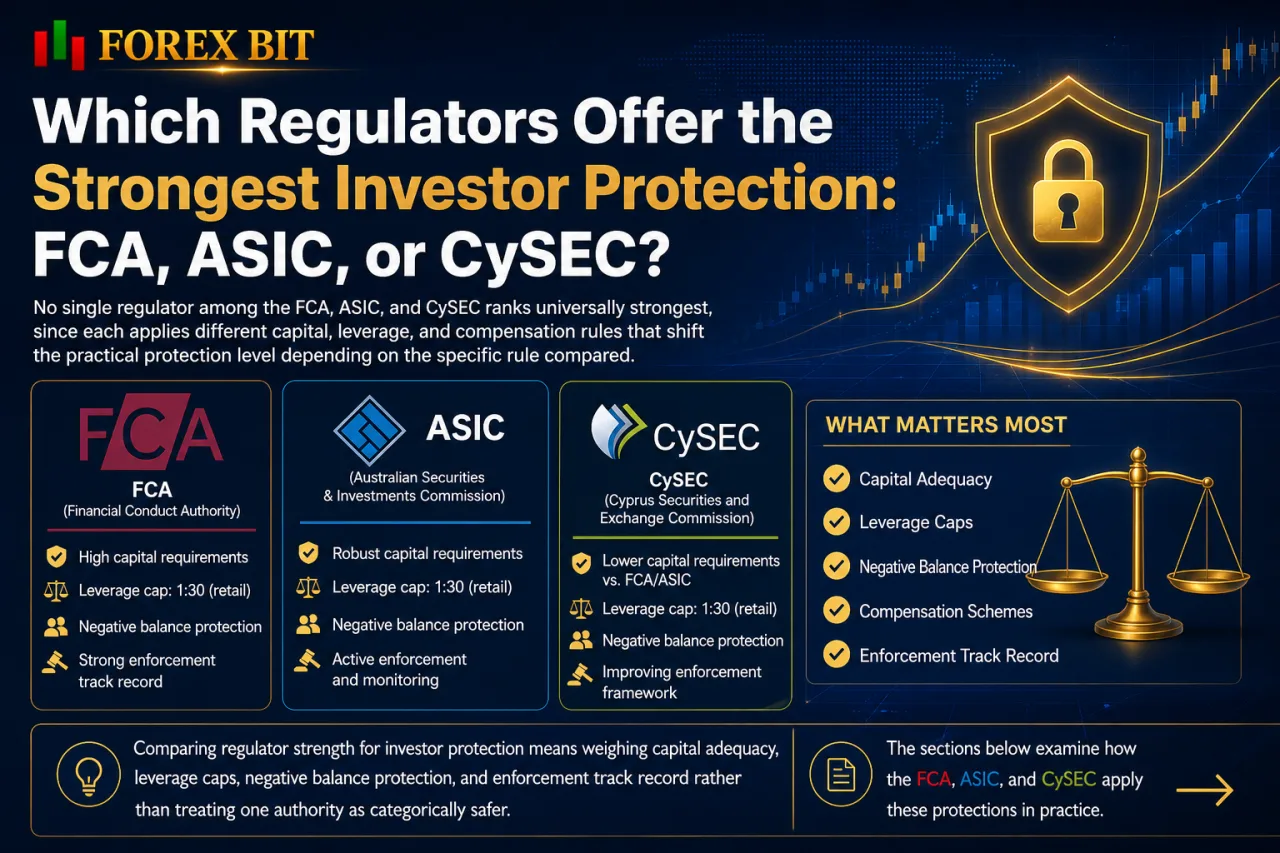
No single regulator among the FCA, ASIC, and CySEC ranks universally strongest, since each applies different capital, leverage, and compensation rules that shift the practical protection level depending on the specific rule compared. Comparing regulator strength for investor protection means weighing capital adequacy, leverage caps, negative balance protection, and enforcement track record rather than treating one authority as categorically safer. The sections below examine how the FCA, ASIC, and CySEC differ on these specific points.
How Does the FCA (UK) Protect Forex Traders?
The FCA protects forex traders through mandatory client money segregation under its CASS rules, leverage caps for retail accounts, and FSCS compensation coverage if an FCA-authorized firm fails. These protections address the same practical concerns raised when comparing regulated brokers against offshore entities.
The FCA’s Client Assets Sourcebook (CASS) requires authorized firms to hold client funds in accounts separate from company operating capital, reducing the risk that trading capital gets used to cover business expenses or debts.
FCA rules cap leverage for retail clients, with lower limits applying to riskier or less liquid instruments compared to major currency pairs.
If an FCA-authorized broker becomes insolvent, eligible clients can claim compensation through the Financial Services Compensation Scheme (FSCS).
FSCS coverage for eligible claims is capped at a set limit per person, per firm, so traders should check the current threshold directly on the FSCS website before relying on it.
These protections apply strictly to the FCA-regulated legal entity itself. A trader onboarded through an offshore sister company of the same broker group falls outside CASS segregation rules and FSCS eligibility entirely, even if the group’s FCA license is prominently advertised.
How Does ASIC (Australia) Protect Forex Traders?
ASIC protects forex traders through mandatory retail leverage caps, client money segregation rules under the Corporations Act, and mandatory membership in the Australian Financial Complaints Authority (AFCA) for dispute resolution, though it lacks a dedicated compensation fund comparable to the FSCS. That gap in a fund-backed guarantee shapes how much recourse an Australian-regulated trader actually has if a broker becomes insolvent.
ASIC caps leverage for retail clients on major currency pairs, with lower limits applying to minor pairs, commodities, and other CFD instruments; traders should check the current thresholds directly on ASIC’s official website before relying on them.
ASIC-regulated brokers hold client money in segregated accounts separate from company operating funds, under rules enforced through the Corporations Act and ASIC’s client money reporting regime.
AFCA handles complaints against ASIC-regulated brokers and issues binding determinations, but it resolves disputes rather than guaranteeing repayment of lost trading funds. Unlike the FCA’s FSCS, ASIC has no equivalent scheme that compensates traders for a broker’s insolvency or fraud, so segregation compliance and AFCA outcomes remain the primary safeguards available to Australian clients.
How Does CySEC (Cyprus/EU) Protect Forex Traders?
CySEC protects forex traders through MiFID II passporting rights across the EU, mandatory client fund segregation, and Investor Compensation Fund (ICF) coverage, though its enforcement staffing remains smaller than the FCA or ASIC. That resourcing gap shapes how closely CySEC-regulated brokers get supervised compared to their FCA or ASIC counterparts.
A CySEC license operates under MiFID II, allowing a Cyprus-based entity to passport its license across other EU member states without applying for separate national authorization. This structure lets one CySEC-regulated entity legally serve clients throughout the EU under a single set of conduct and capital rules.
CySEC-regulated brokers also participate in the Investor Compensation Fund, which pays eligible clients if the firm fails to meet its financial obligations. ICF coverage applies up to a set compensation limit per eligible client, so traders should confirm the current cap directly on CySEC’s official website before relying on it.
Compared to the FCA and ASIC, CySEC operates with a smaller regulatory staff relative to the number of licensed firms it oversees. CySEC’s supervisory capacity is generally considered less intensive than the FCA’s or ASIC’s, reflecting its narrower enforcement resources relative to its licensee base. This gap does not eliminate CySEC’s regulatory value, but it does mean license verification and complaint history checks carry extra weight when assessing a CySEC-regulated entity.
What Are the Risks of Trading With an Offshore-Regulated Broker?
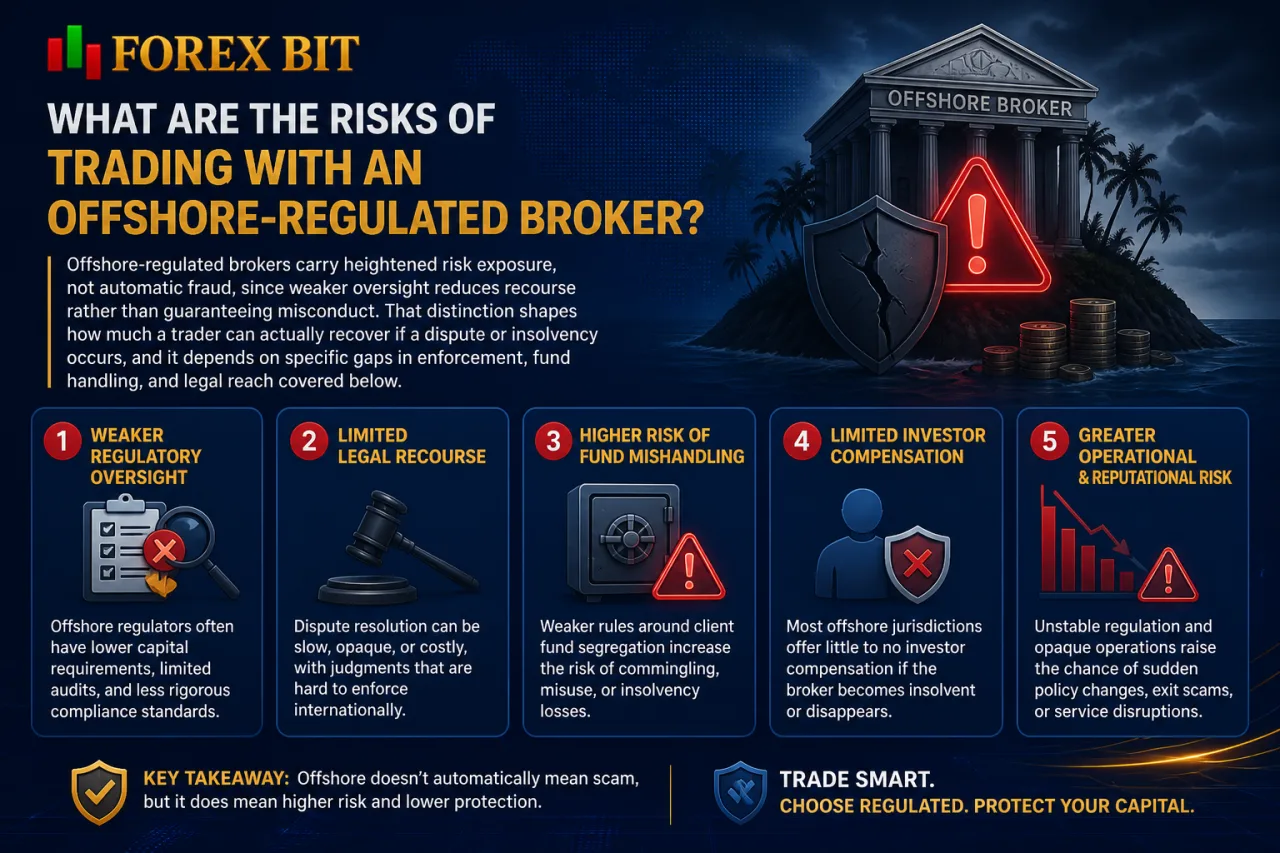
Offshore-regulated brokers carry heightened risk exposure, not automatic fraud, since weaker oversight reduces recourse rather than guaranteeing misconduct. That distinction shapes how much a trader can actually recover if a dispute or insolvency occurs, and it depends on specific gaps in enforcement, fund handling, and legal reach covered below.
Is Negative Balance Protection Guaranteed With Offshore Brokers?
No, negative balance protection is not guaranteed with offshore brokers, since most offshore jurisdictions treat it as a discretionary company policy rather than a legal mandate. That policy-versus-law distinction shapes whether a trader actually gets reimbursed after an account balance goes negative in fast-moving markets.
Under FCA and ESMA-aligned retail client rules, negative balance protection is generally treated as a mandatory regulatory requirement rather than an optional feature offered at the broker’s discretion. Offshore entities within the same broker group commonly advertise negative balance protection on their marketing pages without that guarantee carrying any enforceable backing under the offshore license itself.
Three points determine whether the protection actually applies to a given account:
- Checking the specific legal entity name listed in the account-opening terms, not the group’s homepage.
- Reading the entity’s client agreement for an explicit negative balance clause rather than assuming a group-wide policy applies.
- Confirming whether that clause is described as a regulatory obligation or a discretionary company practice.
A trader opening an account under an offshore affiliate receives whatever balance protection that affiliate’s own terms specify, regardless of what the group’s FCA or CySEC entity promises.
Do Offshore Brokers Offer Compensation Schemes Like FSCS or ICF?
No, most offshore jurisdictions do not operate a compensation scheme comparable to the FSCS or the ICF, since bodies like the Seychelles FSA, Belize IFSC/FSC, and Vanuatu VFSC generally focus on registration rather than funding client payouts. That absence of a backing fund reshapes how much a trader actually recovers if an offshore-regulated entity becomes insolvent.
Three points explain the gap:
- Registration-focused mandates: these offshore authorities primarily confirm a company’s incorporation and license status rather than maintaining a pooled fund for client claims.
- Discretionary marketing claims: some offshore brokers advertise “investor protection” or “insurance” on their websites without that coverage tracing back to any regulator-backed scheme.
- Entity-specific verification: a broker group’s FCA or CySEC compensation scheme applies only to the licensed entity named in that scheme, not to a sister company registered offshore.
If a broker claims compensation coverage under an offshore license, that claim requires direct verification against the specific legal entity a trader signs with, since group-wide marketing pages commonly reference protections tied to a different, more regulated affiliate.
How Can You Verify a Broker’s License, Legal Entity, and Segregated Account Status?
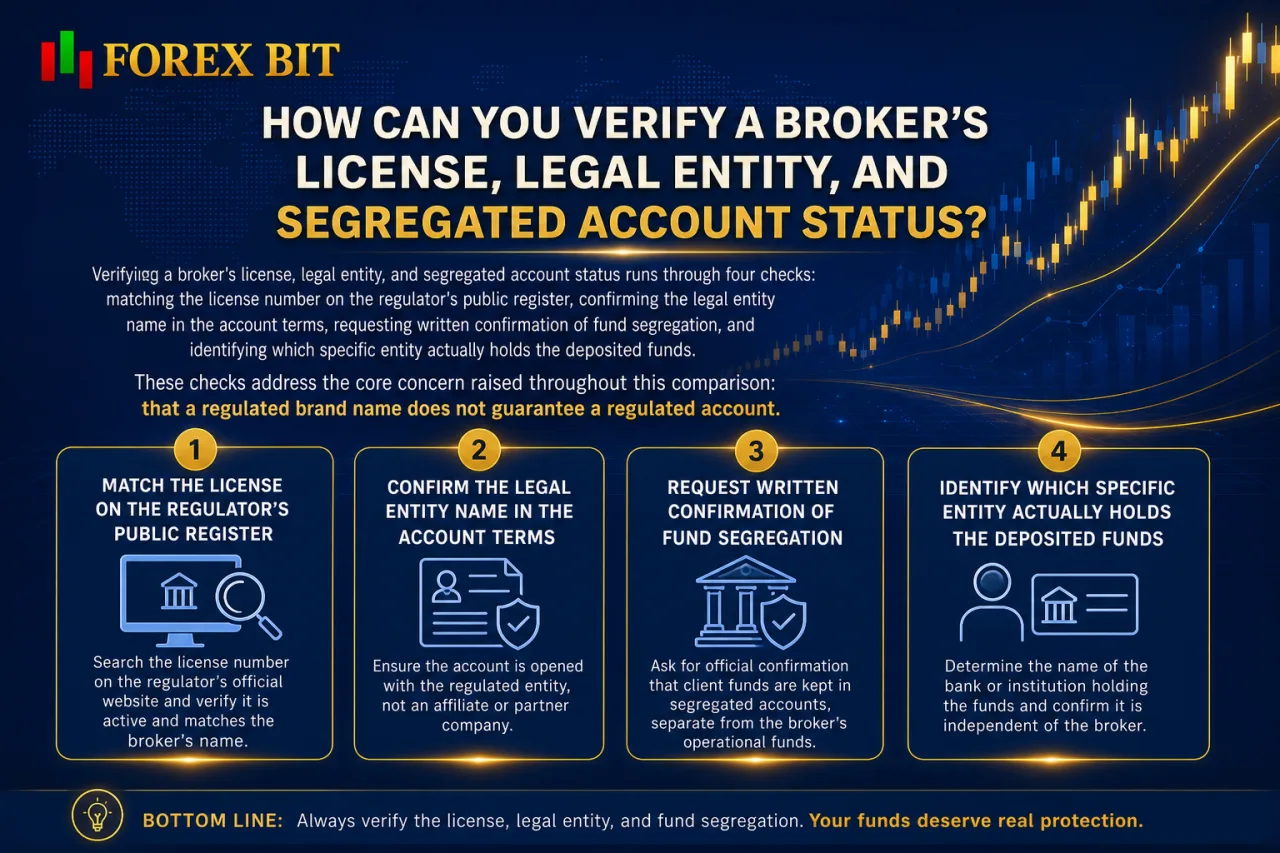
Verifying a broker’s license, legal entity, and segregated account status runs through four checks: matching the license number on the regulator’s public register, confirming the legal entity name in the account terms, requesting written confirmation of fund segregation, and identifying which specific entity actually holds the deposited funds. These checks address the core concern raised throughout this comparison: that a regulated brand name does not guarantee a regulated account. Each step is broken down below.
How Do You Check a License on an Official Regulator Register?
Checking a license on an official regulator register runs through three steps: locating the license number in the broker’s footer or legal disclaimer, entering that number into the relevant regulator’s public database, and confirming the listed entity name matches the account terms. This process directly answers the verification concern raised above about matching license numbers to specific legal entities rather than group brand names.
The three steps break down as follows:
- Locating the license number, usually printed in the website footer, the terms and conditions PDF, or the risk disclosure page.
- Searching that number on the applicable register, such as the FCA Register, ASIC Connect, or the CySEC list of regulated entities.
- Confirming the register entry shows the exact legal entity name from the account terms, along with a status marked active rather than suspended or revoked.
A mismatch between the entity name on the register and the entity named in the account-opening documents indicates the account may sit outside that license’s protections entirely, regardless of what the broker’s marketing pages display.
Why Does the Legal Entity You Sign Up With Matter More Than the Brand Name?
Yes, the legal entity you sign up with matters more than the brand name, since regulatory protections attach to that specific entity, not to the group’s global marketing identity. This same entity-specific gap runs through every check covered above, from license verification to negative balance protection and compensation eligibility.
Global broker groups commonly operate several legal entities across different jurisdictions under one shared brand and website. A trader onboarded through the FCA-licensed entity gets CASS segregation and FSCS eligibility, while a trader onboarded through that same brand’s offshore affiliate gets none of it, even when both accounts display identical logos, platforms, and promotional pages.
Three points explain why this distinction carries practical weight:
- Identifying the exact entity named in the account-opening agreement, not the homepage brand.
- Confirming that entity’s license status separately on the relevant regulator’s register.
- Recognizing that offshore onboarding removes FCA or ASIC-level protections entirely, regardless of shared branding.
A signup form routed to an offshore arm binds the trader to that entity’s terms alone, not the group’s regulated reputation elsewhere.
What Other Factors Affect Fund Safety Beyond Licensing Status?
Fund safety beyond licensing status rests on four supplementary signals: use of tier-1 bank custodians for segregated funds, availability of independent audits or proof-of-reserves, professional indemnity insurance, and transparency of the company’s ownership structure. These indicators matter because a broker can hold a valid license while still leaving gaps that licensing alone does not close. The following points outline each factor as an additional due-diligence layer rather than a repeat of the license and entity checks already covered above.
What Is the Difference Between Segregated Accounts and Fund Custodianship?
Segregated accounts describe the separation of client funds from a broker’s operating capital, while custodianship refers to the specific bank or financial institution actually holding those segregated funds. This distinction addresses a gap the license and entity checks above do not cover: a broker can correctly segregate client money and still expose that money to risk if the holding institution itself is financially unstable.
A segregation rule confirms funds sit apart from company money, not what institution safeguards them. Custodianship identifies that institution, commonly a tier-1 bank, and its own solvency, deposit protections, and jurisdiction directly affect fund recovery if the broker fails.
- Confirming segregation status through the broker’s legal documents or regulator disclosures.
- Identifying the named custodian bank where segregated funds are actually deposited.
- Checking whether that custodian carries its own deposit insurance or credit rating.
A well-segregated account held with a financially weak custodian still carries recovery risk despite correct segregation practice.
Does Professional Indemnity Insurance Add Extra Protection?
Yes, professional indemnity insurance adds extra protection, since it covers client claims arising from broker negligence, operational errors, or professional misconduct rather than firm insolvency. This protection sits alongside the licensing and custodianship checks already covered, but it addresses a different failure point: mistakes in service delivery rather than fund segregation or capital adequacy.
PI insurance is more common among top-tier regulated brokers, where regulators encourage or require this coverage as part of broader operational risk management. It functions separately from compensation schemes like the FSCS or ICF, which activate on firm insolvency rather than individual service errors.
PI insurance coverage is not universal even among regulated brokers, so its presence depends entirely on the specific licensed entity a trader signs with. Confirming whether a broker holds this coverage requires direct verification through the entity’s disclosures or a written request, not assumptions based on regulatory tier alone.
Conclusion
The safety gap between a regulated and an offshore forex broker comes down to enforceable oversight versus discretionary policy: tier-1 authorities like the FCA, ASIC, and CySEC mandate fund segregation, capital adequacy, and compensation access, while offshore jurisdictions such as Seychelles, Belize, or Vanuatu mostly confirm registration without backing client payouts or enforcing negative balance protection.
Since these protections attach to a specific legal entity rather than a broker’s global brand, the deciding factor before opening an account is verifying the exact entity name against the regulator’s register, confirming its segregation and compensation status, and checking its custodian bank and insurance coverage rather than trusting shared logos or marketing claims.
As a Financial Blogger with 5 years of experience, I focus on delivering in-depth market insights, investment strategies, and personal finance advice. My content has helped a diverse audience navigate the complexities of financial planning and stay informed about the latest trends in the financial world.
Email: [email protected]



Best Brokers

Trade with the world’s largest retail broker and benefit from better - than - market conditions.

We offer a superior trading environment that puts traders in the best position to profit.

Trade with the best trading conditions. WIN THE BEST TRADING ACCOUNT AWARD.

Trade global markets with Interactive Brokers – a highly regulated multi-asset broker built for active and professional investors.






Forex Bit provides in-depth analysis of commodities, forex, and stock markets to help traders make informed investment decisions.
Best Brokers
Metatrader 5 Brokers
Metatrader 4 Brokers
Lowest Spread Forex Broker
Regulated Forex Brokers
Forex Copy Trading
Ctrader Brokers
Best Forex Broker For Beginners