
Curious what an offshore forex broker really is? Learn how they operate, key risks, and how to check licensing before you trade with one.
What Is an Offshore Forex Broker? Risks & Regulation Explained

An offshore forex broker is generally understood as a brokerage registered and licensed in a jurisdiction outside a trader’s home country, often in regions with lighter regulatory oversight. These entities operate under local licensing rules rather than the stricter frameworks found in major financial hubs, which changes how client funds and disputes are handled.
The main risks include weaker fund protection, limited legal recourse, and inconsistent enforcement of negative balance protection or segregated account rules. Traders often have fewer options if a broker becomes unresponsive or insolvent.
Onshore or regulated brokers generally operate under tier-1 regulators with defined capital requirements and investor compensation schemes, while offshore brokers typically follow lighter local rules with fewer investor safeguards. This gap directly affects how safe a trader’s deposited funds are in practice.
Checking legitimacy generally requires verifying the broker’s license number directly on the regulator’s official register and confirming that the legal entity named in the account opening agreement matches the licensed entity. Mismatched entity names or unverifiable license numbers are common red flags. Forex Bit breaks down exactly what an offshore forex broker is, why the label matters, and how the regulatory gap compares to onshore brokers, starting with a clear definition below.
What Is an Offshore Forex Broker?
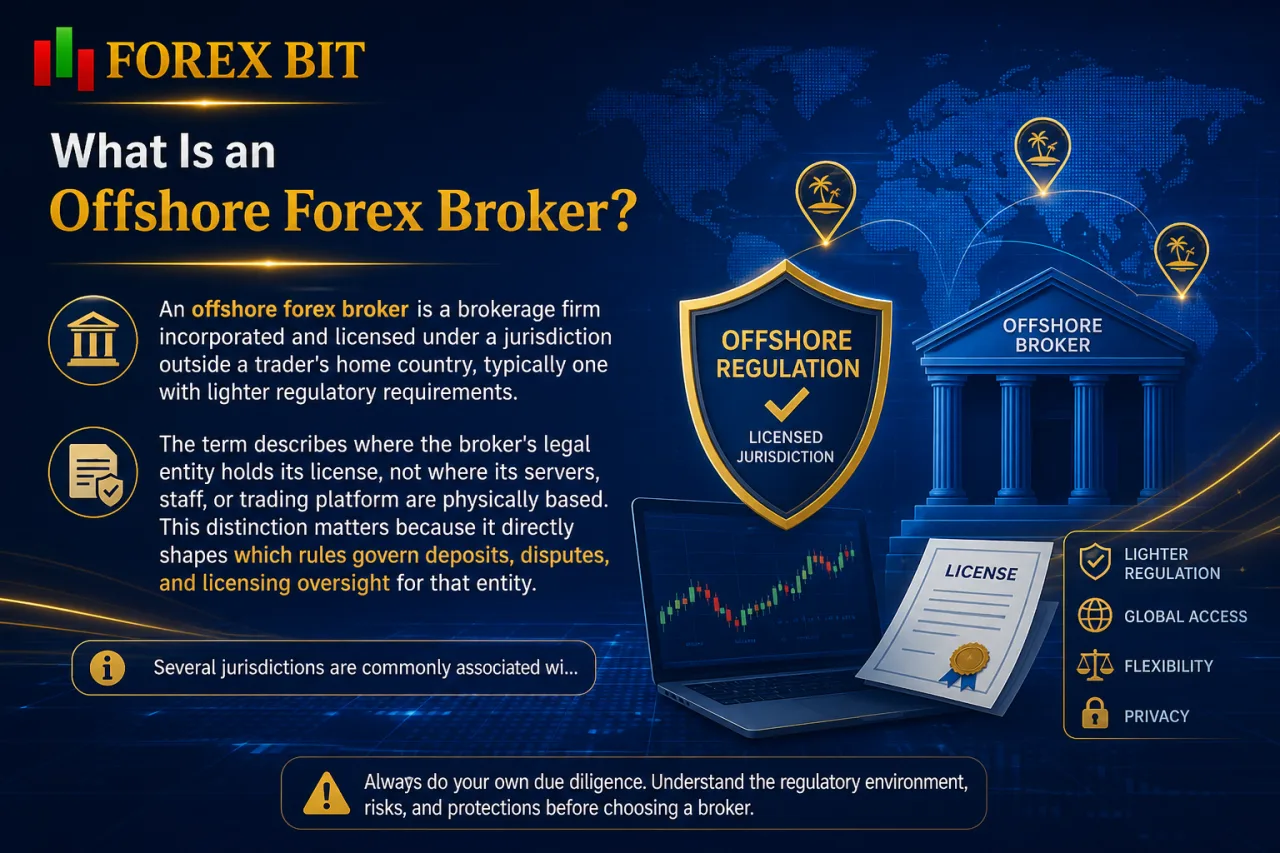
An offshore forex broker is a brokerage firm incorporated and licensed under a jurisdiction outside a trader’s home country, typically one with lighter regulatory requirements. The term describes where the broker’s legal entity holds its license, not where its servers, staff, or trading platform are physically based. This distinction matters because it directly shapes which rules govern deposits, disputes, and licensing oversight for that entity.
Several jurisdictions are commonly associated with offshore forex licensing due to lower capital thresholds and simpler registration processes. These include:
- St. Vincent and the Grenadines
- Seychelles
- Belize
- Vanuatu
- Marshall Islands
- Mauritius
A broker’s offshore status refers strictly to the regulatory jurisdiction listed in its legal entity documents, not its physical office location, customer support region, or the language of its website. A brokerage can market itself internationally while its regulated entity, the one named in the account agreement, remains registered under one of these lighter-oversight authorities.
What Makes a Jurisdiction Considered ‘Offshore’ in Forex Regulation?
A jurisdiction is generally considered “offshore” in forex regulation when its licensing regime combines low capital requirements, minimal ongoing supervision, and no mandatory investor compensation scheme. These traits sit at the opposite end of the spectrum from tier-1 financial hubs, where licensing demands higher operating capital and continuous reporting.
This set of traits explains why certain regulators are labeled offshore rather than a judgment on any single broker’s conduct.
- Low minimum capital thresholds compared to tier-1 regulators
- Limited or infrequent ongoing supervision of licensed firms
- No mandatory investor compensation fund for client claims
- Fast and comparatively inexpensive licensing application process
Regulators commonly associated with offshore forex licensing include the FSA of St.Common offshore jurisdictions used by forex brokers include the FSA of St. Vincent and the Grenadines, the FSC of Belize, the VFSC of Vanuatu, and the FSC of Mauritius, each of which sets its own capital, supervision, and compensation fund requirements that traders should verify directly with the relevant authority. Holding a license from any of these authorities does not automatically indicate fraudulent intent, since many legitimately operating brokers register under them for lower compliance costs. The practical impact for traders lies in reduced legal recourse and fewer formal safeguards if a dispute or insolvency occurs under one of these entities.
How Does an Offshore Broker Differ From an Onshore Broker Legally?
Offshore brokers differ from onshore brokers legally through the licensing entity itself, since many global brokerage groups operate separate legal entities, one regulated onshore under tier-1 authorities like the FCA, ASIC, or CySEC, and another registered offshore under lighter oversight. This multi-entity structure directly determines which rules apply to a trader’s account, not the brand name displayed on the website.
Clients are typically assigned to a specific entity based on their declared country of residence, and this assignment changes the legal protections available to them.
- Traders based in the United Kingdom, Australia, or the European Economic Area are commonly onboarded under the group’s onshore entity, subject to stricter capital and reporting rules.
- Traders based in regions outside these tier-1 jurisdictions are often onboarded under the group’s offshore entity instead, even when using the same brand and trading platform.
- Contractual terms, deposit protections, and leverage limits can differ significantly between these entities despite shared branding.
Verifying which entity governs an account generally requires checking the account opening agreement and terms of service, since the entity named there, not the marketing website, defines the applicable legal protections.
What Are the Risks of Trading With an Offshore Forex Broker?
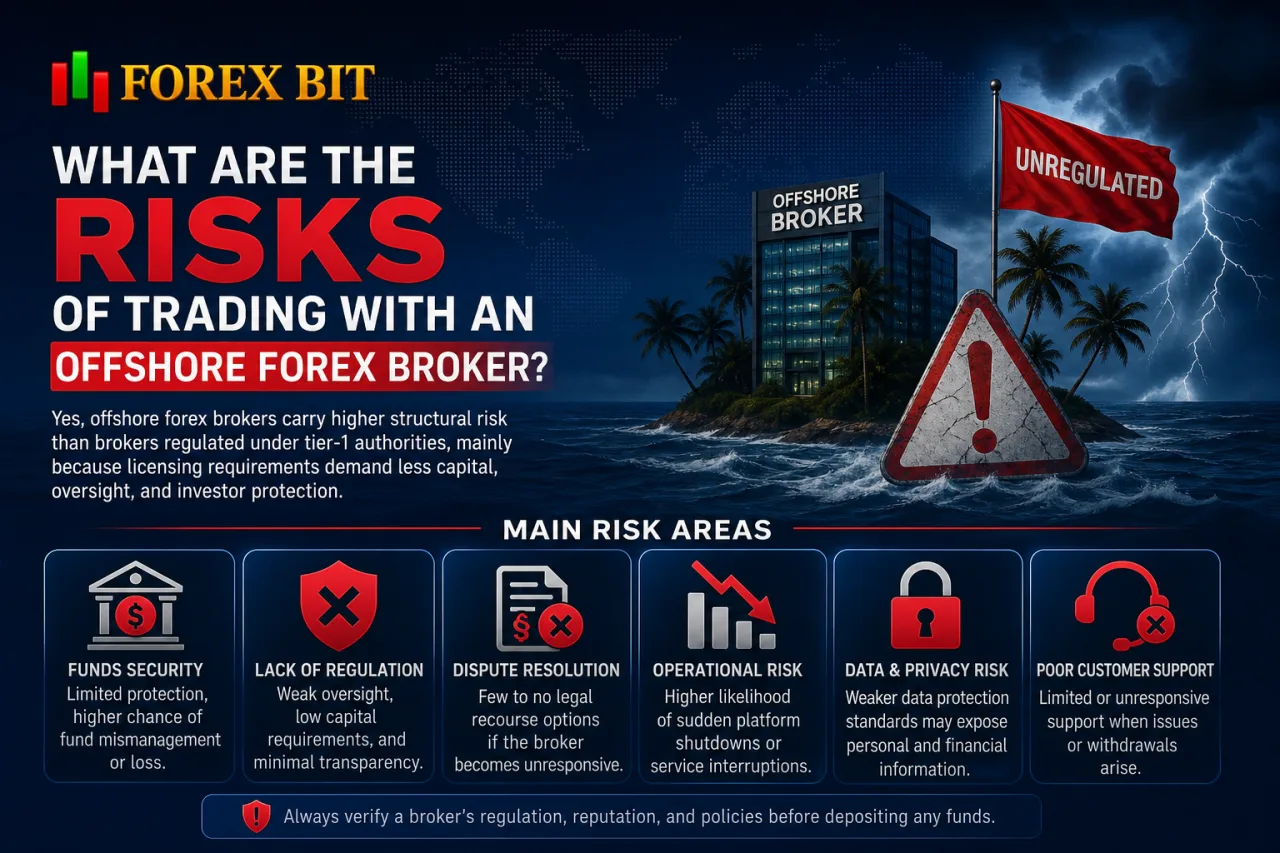
Yes, offshore forex brokers carry higher structural risk than brokers regulated under tier-1 authorities, mainly because licensing requirements demand less capital, oversight, and investor protection. This structural gap touches several areas of a trading account at once, from how deposits are held to how disputes get resolved once a broker becomes unresponsive.
The main risk areas fall under a few distinct issues that traders should verify before funding an account with an offshore-licensed entity.
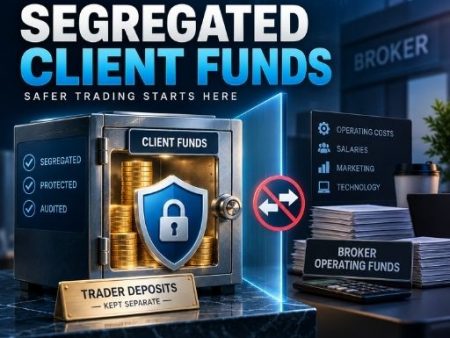
- Weaker enforcement of segregated account rules, since offshore regulators rarely audit client fund separation as closely as tier-1 authorities.
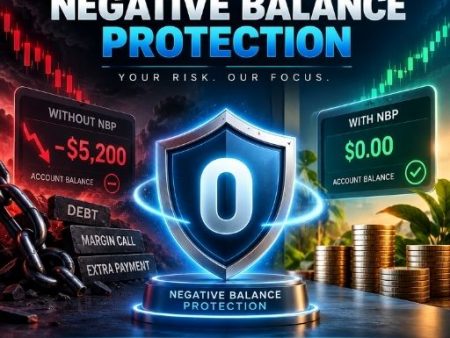
- Limited or no guaranteed negative balance protection, leaving traders liable for losses exceeding their deposited balance during extreme volatility.
- Absence of a statutory compensation scheme, meaning no fallback fund exists to reimburse clients if the broker becomes insolvent.
- Higher leverage limits offered with less regulatory oversight, increasing exposure to rapid account losses.
- Limited legal recourse in cross-border disputes, since offshore jurisdictions often lack accessible arbitration or court enforcement for foreign clients.
- Harder enforcement of fund withdrawals, as traders have fewer regulatory bodies to escalate complaints to if a broker delays or denies a payout.
These risks apply specifically to the offshore legal entity a trader is onboarded under, not necessarily to every brand operating a parallel onshore entity.
Is Client Fund Segregation Guaranteed With Offshore Brokers?
No, client fund segregation is not guaranteed with offshore brokers, since the practice is often stated in legal documents but rarely backed by mandatory third-party audits or consistent enforcement. A segregation clause in a client agreement confirms only that the broker states an intent to separate operating funds from client deposits, not that an independent authority verifies this separation.
This gap between written policy and actual enforcement defines the core problem with segregated account claims under offshore licensing.
- Documented in the account terms, yet lacking any regulator-mandated audit requirement in several offshore jurisdictions.
- Enforced inconsistently across offshore regulators, since supervision frequency and audit depth vary widely by authority.
- Unverifiable by traders directly, because most offshore regulators do not publish audit results or fund segregation reports publicly.
- Dependent entirely on the broker’s internal compliance culture rather than external regulatory pressure in jurisdictions with lighter oversight.
Traders confirming segregation status generally request the broker’s latest audited financial statement or proof of custodian bank arrangements, since a policy statement alone does not confirm actual fund separation.
Do Offshore Brokers Offer Negative Balance Protection or Compensation Schemes?
Some offshore brokers offer negative balance protection or compensation arrangements, but these typically exist as voluntary broker policies rather than legally mandated regulatory requirements. This distinction matters because it changes who a trader can hold accountable if a broker withdraws the benefit or fails to honor it during a claim.
The gap becomes clear when comparing offshore policies against tier-1 frameworks named earlier in this guide, such as the FCA’s FSCS scheme or CySEC’s ICF.
- Publishes negative balance protection as a marketing feature rather than a statutory obligation enforced by the regulator.
- Lacks a government-backed compensation fund that reimburses clients automatically if the broker becomes insolvent.
- Retains discretion to modify or withdraw these protections through updated terms and conditions at any time.
- Depends on the broker’s own capital reserves to honor a negative balance write-off, with no external guarantor involved.
Traders confirming whether these protections apply generally check the specific clause in the account agreement rather than relying on general website claims, since a voluntary policy under an offshore entity carries no regulatory guarantee of enforcement.
Offshore vs Onshore/Regulated Forex Brokers: What Is the Difference?
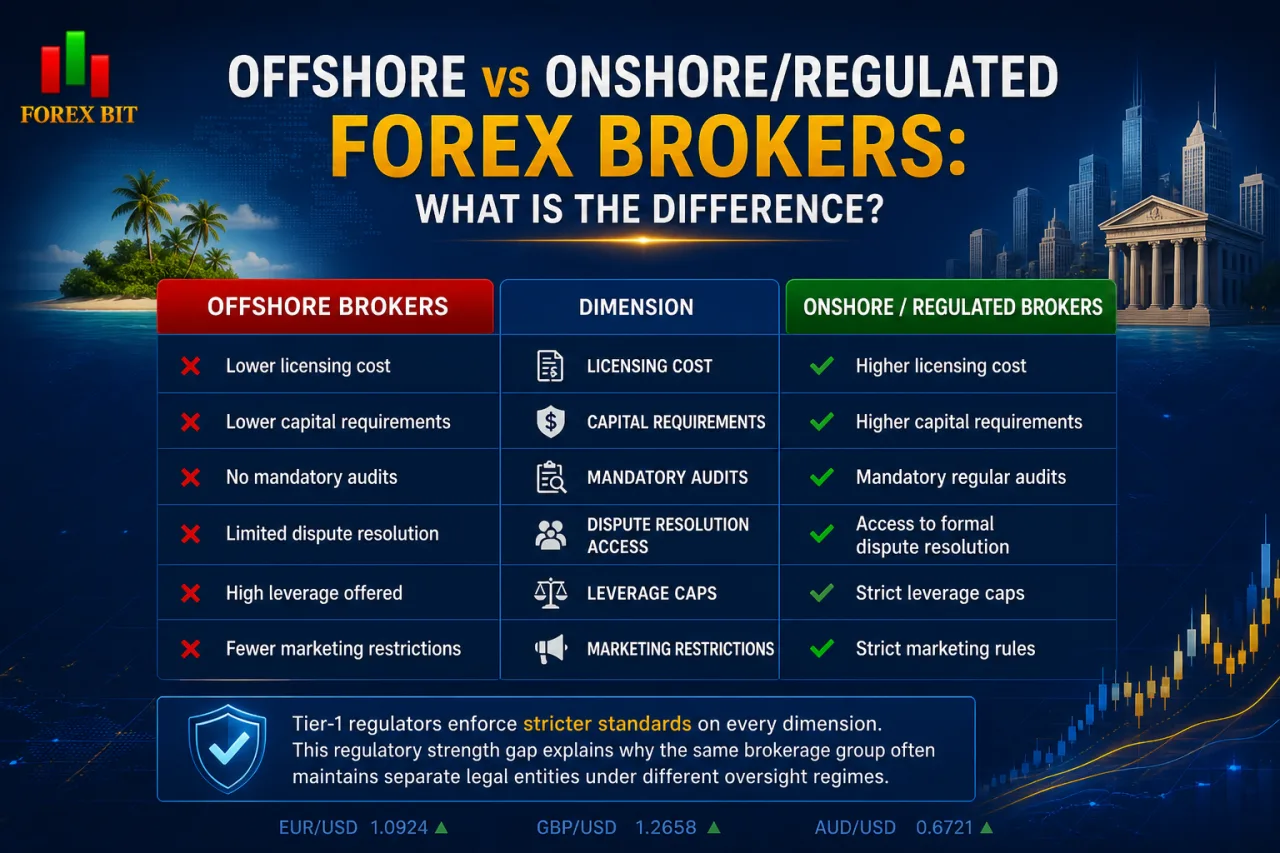
Offshore and onshore forex brokers differ across licensing cost, capital requirements, mandatory audits, dispute resolution access, leverage caps, and marketing restrictions, with tier-1 regulators enforcing stricter standards on every dimension. This regulatory strength gap explains why the same brokerage group often maintains separate legal entities under different oversight regimes. The comparison below breaks these differences down by dimension before looking closer at capital adequacy and dispute resolution specifically.
| Dimension | Tier-1 Regulators (FCA, ASIC, CySEC, NFA) | Common Offshore Regulators |
|---|---|---|
| Licensing cost and difficulty | Demands extensive documentation, background checks, and higher application fees | Offers faster approval with lower fees and simpler paperwork |
| Capital adequacy requirements | Requires substantial minimum operating capital held continuously | Sets lower minimum capital thresholds |
| Mandatory audits | Enforces regular independent financial audits and reporting | Applies inconsistent or infrequent audit obligations |
| Dispute resolution/ombudsman access | Provides formal ombudsman or arbitration channels for client complaints | Offers limited or no accessible cross-border dispute mechanism |
| Leverage caps | Restricts maximum leverage for retail clients | Permits significantly higher leverage limits |
| Marketing restrictions | Enforces strict rules on risk disclosure and promotional claims | Applies looser or minimal marketing oversight |
Tier-1 regulators such as the FCA, ASIC, CySEC, and NFA generally impose higher minimum capital requirements and stricter retail leverage caps compared to the lighter rules typically applied by popular offshore regulators, so traders should verify the exact figures directly on each regulator’s official website.
Which Regions Have the Strictest vs Most Lenient Forex Regulation?
Forex regulation generally splits into three strictness tiers: Tier-1 authorities like the FCA, ASIC, NFA/CFTC, and BaFin, Tier-2 authorities like CySEC, FSCA, and DFSA, and Tier-3 offshore authorities like the FSA of St. Vincent and the Grenadines, Belize’s FSC, Vanuatu’s VFSC, Mauritius FSC, and Seychelles FSA. This tiering reflects capital requirements, audit frequency, and dispute resolution access rather than a broker’s individual conduct, and it directly explains the regional gap in trader protection covered above.
- Tier-1 regulators enforce the highest capital thresholds, mandatory audits, and formal ombudsman or arbitration channels for client complaints.
- Tier-2 regulators apply moderate capital and reporting rules, sitting between full tier-1 oversight and lighter offshore licensing.
- Tier-3 offshore regulators set the lowest capital thresholds and rarely mandate independent audits or compensation funds.
Traders based in the United States generally cannot legally access offshore-regulated entities, since domestic regulatory rules typically restrict US residents to brokers registered under domestic oversight. Restricted-country lists vary by broker and jurisdiction, so verifying eligibility directly against the entity’s terms remains necessary before opening an account.
How Can You Check If an Offshore Broker Is Legitimate or Licensed?
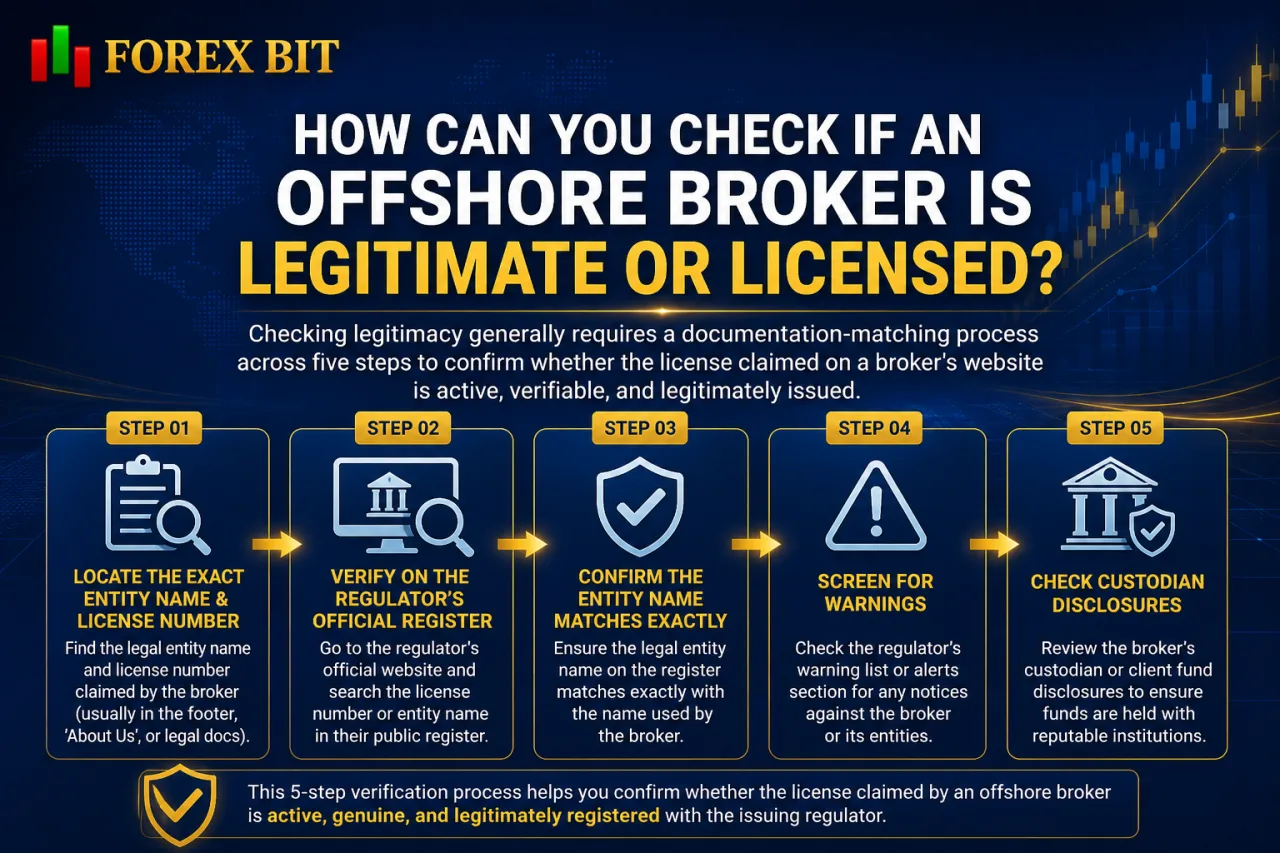
Checking legitimacy generally requires a documentation-matching process across five steps: locating the exact entity name and license number, verifying that number on the regulator’s official register, confirming the entity name matches exactly, screening for warnings, and checking custodian disclosures. This process confirms whether the license claimed on a broker’s website actually corresponds to an active, verifiable registration rather than a copied or expired number.
The steps below outline how this verification generally proceeds from document review to regulator confirmation.
What Warning Signs Indicate an Offshore Broker May Be Unregulated or Fraudulent?
Six red flags signal that an offshore broker may be unregulated or fraudulent: an unverifiable license number, entity name mismatches across documents, appearance on a regulator’s public warning list, unusually high leverage promises with no risk disclosure, publicly reported withdrawal difficulties, and no physical registered address. Each flag points to a specific gap in the verification process described earlier for confirming license legitimacy.
- Lacks a license number that returns a match on the regulator’s official register search tool.
- Displays an entity name on its website that differs from the name printed on account statements or the client agreement.
- Appears on a warning list published by a tier-1 or tier-2 regulator such as the FCA, ASIC, or CySEC.
- Advertises extreme leverage ratios without pairing the offer with a clear risk warning disclosure.
- Generates multiple public complaints describing delayed, reduced, or denied withdrawal requests.
- Omits a verifiable physical registered address from its legal disclosures and regulatory filings.
Traders spotting two or more of these signs on a single entity generally treat the broker as high-risk regardless of any marketing claims of regulation.
What Are Some Lesser-Known Aspects of Offshore Forex Regulation?
Offshore forex regulation carries a few lesser-known mechanics beyond licensing gaps already discussed: multi-entity onboarding based on a trader’s location, regulatory arbitrage through relicensing after warnings, and introducing broker or white-label setups that obscure the true regulated entity. These practices operate quietly within the account opening process itself, often invisible unless a trader checks the fine print closely.
Why Do Some Brokers Hold Both Onshore and Offshore Licenses Simultaneously?
Some brokerage groups hold both onshore and offshore licenses because separate legal entities serve different regulatory purposes: the onshore entity builds marketing credibility and accesses tightly regulated markets, while the offshore entity onboards clients in regions where higher leverage and lighter compliance costs matter more. This dual-license structure follows directly from the multi-entity onboarding pattern described earlier, where a single brand routes traders to different legal entities based on residency.
The onshore entity typically satisfies strict capital and audit rules under a tier-1 regulator, which supports advertising claims and builds trust among traders in stricter jurisdictions. The offshore entity, registered under lighter oversight, then serves clients in regions where local rules allow higher leverage or fewer restrictions on marketing and account terms.
- Operates the onshore entity primarily for regulatory credibility and access to tier-1 client markets.
- Runs the offshore entity for clients seeking higher leverage or residing outside strict regulatory zones.
- Maintains separate capital, audit, and compensation obligations for each entity despite shared branding.
- Assigns account protections strictly based on which entity actually signs the client agreement.
Traders confirming which protections apply generally check the specific legal entity named in their account documents rather than assuming the brand’s overall reputation extends equally to every entity under it.
Can an Offshore Broker Later Obtain a Tier-1 License?
Yes, some offshore-first brokers later obtain a tier-1 license, though this progression is not universal across the industry and applies only to the specific entity that upgrades, not automatically to sister entities under the same brand. This upgrade path connects directly to the multi-entity structure described earlier, where a brand adds a stricter license rather than replacing the offshore one.
A few patterns explain why this progression happens for some firms and not others.
- Expands into regulated markets such as the UK, EU, or Australia, where local rules require a tier-1 license to legally solicit clients.
- Builds credibility with traders and institutional partners by pairing the original offshore entity with a newly licensed onshore entity.
- Retains the original offshore entity for regions where tier-1 licensing offers no added market access benefit.
- Applies for tier-1 status through the standard licensing process required of any new applicant, with no shortcut based on prior offshore history.
Traders confirming this progression check the specific entity’s license status directly on the relevant tier-1 regulator’s register, rather than relying on a broker’s marketing claim of having “upgraded” or “gone regulated.”
Conclusion
The offshore label identifies where a broker’s legal entity holds its license, and that single detail decides how much protection a trader actually has. Lighter capital rules, inconsistent audits, and the absence of statutory compensation schemes define offshore licensing, standing in clear contrast to tier-1 frameworks built around FCA, ASIC, CySEC, or NFA oversight. None of this makes every offshore-licensed firm fraudulent, but it removes the safety net a trader would otherwise rely on during a dispute or insolvency.
Confirming which entity governs an account, matching that entity against the regulator’s official register, and reading the fine print on segregation and negative balance clauses turns the abstract question of what an offshore forex broker is into a concrete, verifiable answer before any funds move.
As a Financial Blogger with 5 years of experience, I focus on delivering in-depth market insights, investment strategies, and personal finance advice. My content has helped a diverse audience navigate the complexities of financial planning and stay informed about the latest trends in the financial world.
Email: [email protected]

Best Brokers

Trade with the world’s largest retail broker and benefit from better - than - market conditions.

We offer a superior trading environment that puts traders in the best position to profit.

Trade with the best trading conditions. WIN THE BEST TRADING ACCOUNT AWARD.

Trade global markets with Interactive Brokers – a highly regulated multi-asset broker built for active and professional investors.






Forex Bit provides in-depth analysis of commodities, forex, and stock markets to help traders make informed investment decisions.
Best Brokers
Metatrader 5 Brokers
Metatrader 4 Brokers
Lowest Spread Forex Broker
Regulated Forex Brokers
Forex Copy Trading
Ctrader Brokers
Best Forex Broker For Beginners