
Learn how to check if a forex broker is regulated using official registers, license numbers, and legal entity checks—avoid unregulated brokers today.
How to Check If a Forex Broker Is Regulated (2026)

Checking if a forex broker is regulated requires confirming its license number directly on the official regulator’s public register, not just trusting claims on the broker’s website. This means matching the exact legal entity name, license number, and status shown on the broker’s site with the record held by the regulator itself.
Official regulator databases such as the FCA Register, ASIC Connect, and CySEC’s list of regulated entities allow traders to search a broker’s license number for free. Each database displays the entity’s registered name, permission type, and current license status.
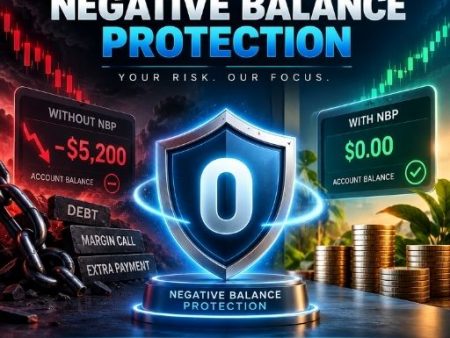
License status determines how a broker must protect client funds, but protection differs by legal entity and jurisdiction, not by brand name alone. A broker regulated in one country may operate an unregulated offshore entity for clients in other regions, changing rules on segregated accounts, negative balance protection, and compensation schemes.
Warning signs of unregulated or clone brokers include mismatched entity names, unverifiable license numbers, and regulator warnings listing lookalike company details. Forex Bit outlines these red flags below alongside the exact verification steps every trader should follow before opening an account, starting with how to check if a forex broker is regulated.
How Do You Check If a Forex Broker Is Regulated?
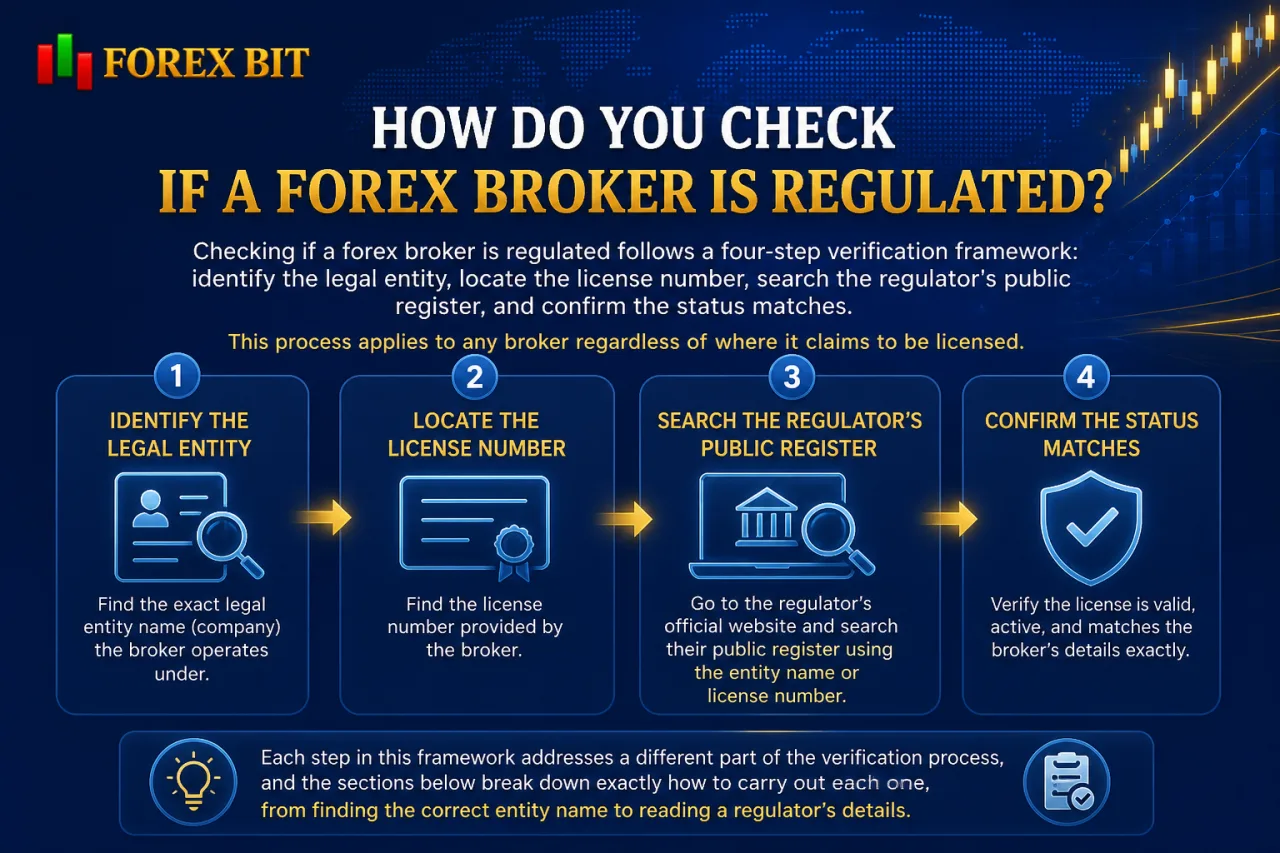
Checking if a forex broker is regulated follows a four-step verification framework: identify the legal entity, locate the license number, search the regulator’s public register, and confirm the status matches. This process applies to any broker regardless of where it claims to be licensed.
Each step in this framework addresses a different part of the verification process, and the sections below break down exactly how to carry out each one, from finding the correct entity name to reading a regulator’s register entry correctly.
- Identify the exact legal entity name operating the trading account, usually found in the account opening agreement or terms of business.
- Locate the license or registration number, typically listed in the website footer, legal documents page, or account statements.
- Search the relevant regulator’s public register using that license number or entity name.
- Confirm the register shows an active status with a name and address matching the broker’s disclosed details.
Skipping any single step creates a verification gap. A broker may display a real license number belonging to a different entity, or reference a regulator that does not actually license its client-facing brand for a trader’s specific country.
What Information Do You Need Before Checking a Broker’s License?
Checking a broker’s license requires three pieces of verification data: the exact legal entity name, the license or registration number, and the registered address listed by the regulator. Gathering these three details before searching any register prevents matching a real license number to the wrong company.
This connects directly to the earlier verification framework, since a trader cannot search a regulator’s register accurately without first locating this information from the broker itself.
- Locate the legal entity name in the account opening agreement or terms of business, not the marketing name shown on the homepage.
- Find the license number in the website footer, a dedicated legal documents page, or client account statements.
- Note the registered address listed on the broker’s regulatory disclosures page, then compare it against the regulator’s register entry.
A common point of confusion is treating a license number as the same thing as a company registration number. A company registration number only confirms that a business entity legally exists in a country; it does not confirm that the entity holds permission to offer trading services to clients or that client funds receive any regulatory protection.
How Do You Read a Broker’s Legal Entity and Terms of Business Correctly?
Reading a broker’s legal entity and terms of business correctly means locating the exact contracting entity clause first, then matching that entity to its stated regulator before checking any protection details. This clause sits near the beginning or end of the terms of business document, often under a heading like “parties” or “the company.”
Reading these documents connects directly to the earlier point about locating the legal entity name, since the terms of business is the primary source for that name rather than the broker’s marketing pages.
- Identify the sentence naming which entity a client contracts with, since this determines which regulator’s rules actually apply to the account.
- Check whether the document references multiple entities under one brand, as brands frequently register separate companies for different regions.
- Compare protection clauses across entities, since segregated account rules, negative balance protection, and compensation scheme eligibility can differ between entities sharing the same brand name.
- Confirm the regulator named in the terms of business matches the regulator whose register was searched during verification.
A trader onboarded through a regional website may be contracting with an offshore entity carrying weaker protections than the brand’s flagship regulated entity, even though both share the same visible brand name.
Which Official Regulator Databases Can You Use to Verify a License Number?
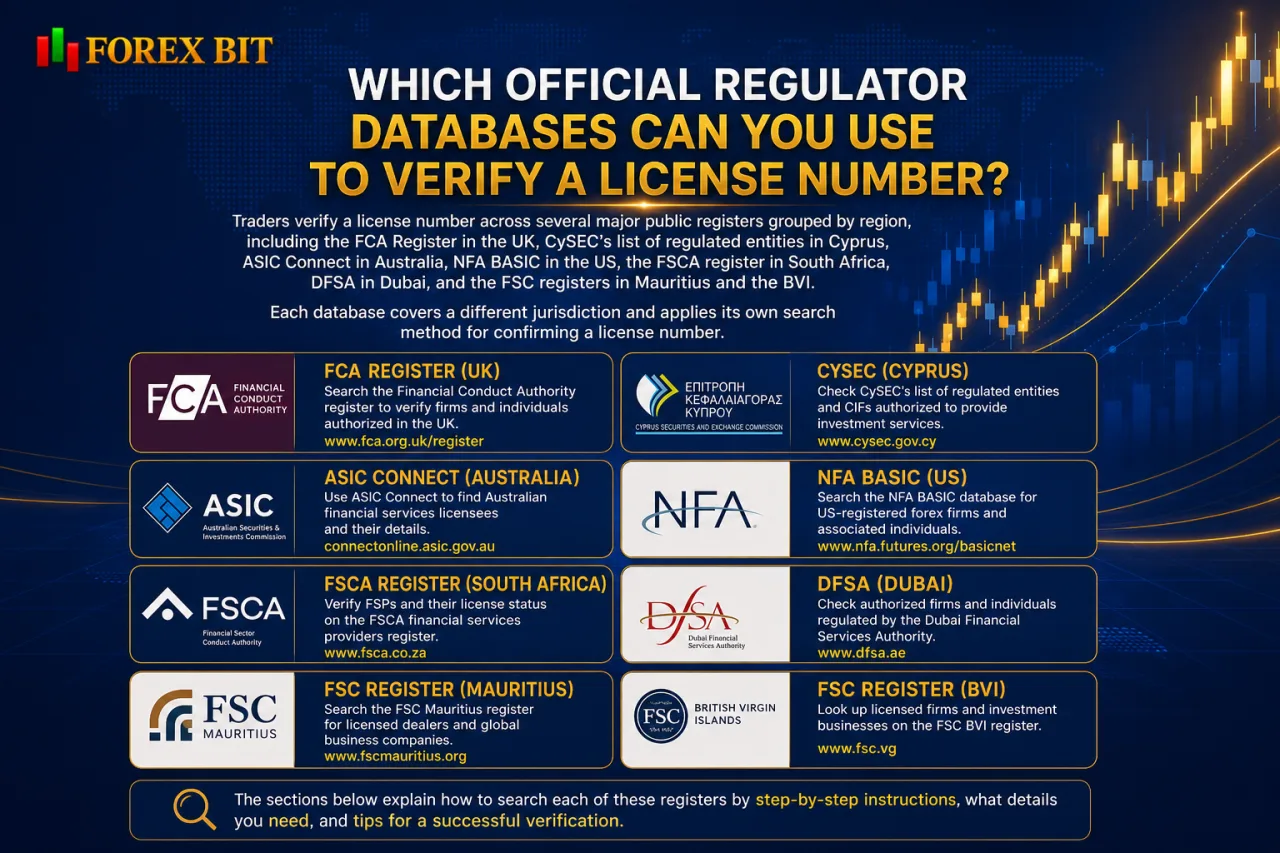
Traders verify a license number across several major public registers grouped by region, including the FCA Register in the UK, CySEC’s list of regulated entities in Cyprus, ASIC Connect in Australia, NFA BASIC in the US, the FSCA register in South Africa, DFSA in Dubai, and the FSC registers in Mauritius and the BVI. Each database covers a different jurisdiction and applies its own search method for confirming a license number.
The sections below explain how to search each of these registers by firm name or reference number, since the search fields and result formats differ from one regulator to another.
How Do You Search a License Number on a Tier-1 Regulator’s Register (FCA, ASIC, CySEC)?
Searching a license number on a Tier-1 register follows the same three-part pattern across FCA Register, ASIC Connect, and CySEC’s licensed entities list: enter the firm name or number, open the record, then check the permissions and status fields rather than just confirming a number exists.
This search process applies directly to the three regulators grouped together here, since each publishes a free public database but formats results slightly differently.
- Open the FCA Register, search by firm name or Financial Services Register number, then check the “Permissions” tab to confirm the entity holds permission for the specific activity, such as retail forex dealing, not just a general listing.
- Open ASIC Connect, search the Australian Financial Services Licence number or entity name, then check the license “Status” field for wording such as “current” rather than “revoked” or “suspended.”
- Open CySEC’s list of regulated entities, search by company name or Cyprus Investment Firm number, then confirm the “Authorised” status column alongside the license class shown for that entity.
A license number appearing in a search result does not confirm active permission on its own. Traders confirm the permissions field lists the correct trading activity and the status field shows a current, unrestricted standing before treating the entity as verified.
What Should You Do If a Regulator’s Website Doesn’t Show the Broker at All?
A regulator’s register showing no record of the broker at all counts as a major warning sign, since active licenses always appear on the issuing regulator’s public database. This scenario differs from a mismatched entity name, since here the broker’s cited license number or name returns no result whatsoever.
This situation ties directly back to the earlier verification steps, since a failed search means the entity name or license number gathered from the broker’s terms of business does not exist in that regulator’s records at all.
- Recheck spelling of the exact legal entity name and license number, since minor typos produce false negative results on some registers.
- Confirm the broker actually claims regulation by that specific regulator, since some brands reference a regulator that has no jurisdiction over the client-facing offering entity.
- Treat a genuinely blank result as evidence the broker may be unregulated or is citing a fabricated license number.
- Check the regulator’s own warning list, since many publish alerts naming clone firms that copy a real license number from an unrelated company.
A broker missing entirely from an official register offers no confirmed segregated account rules, negative balance protection, or compensation scheme access for that entity.
What Does License Status Actually Mean for Your Fund Protection?
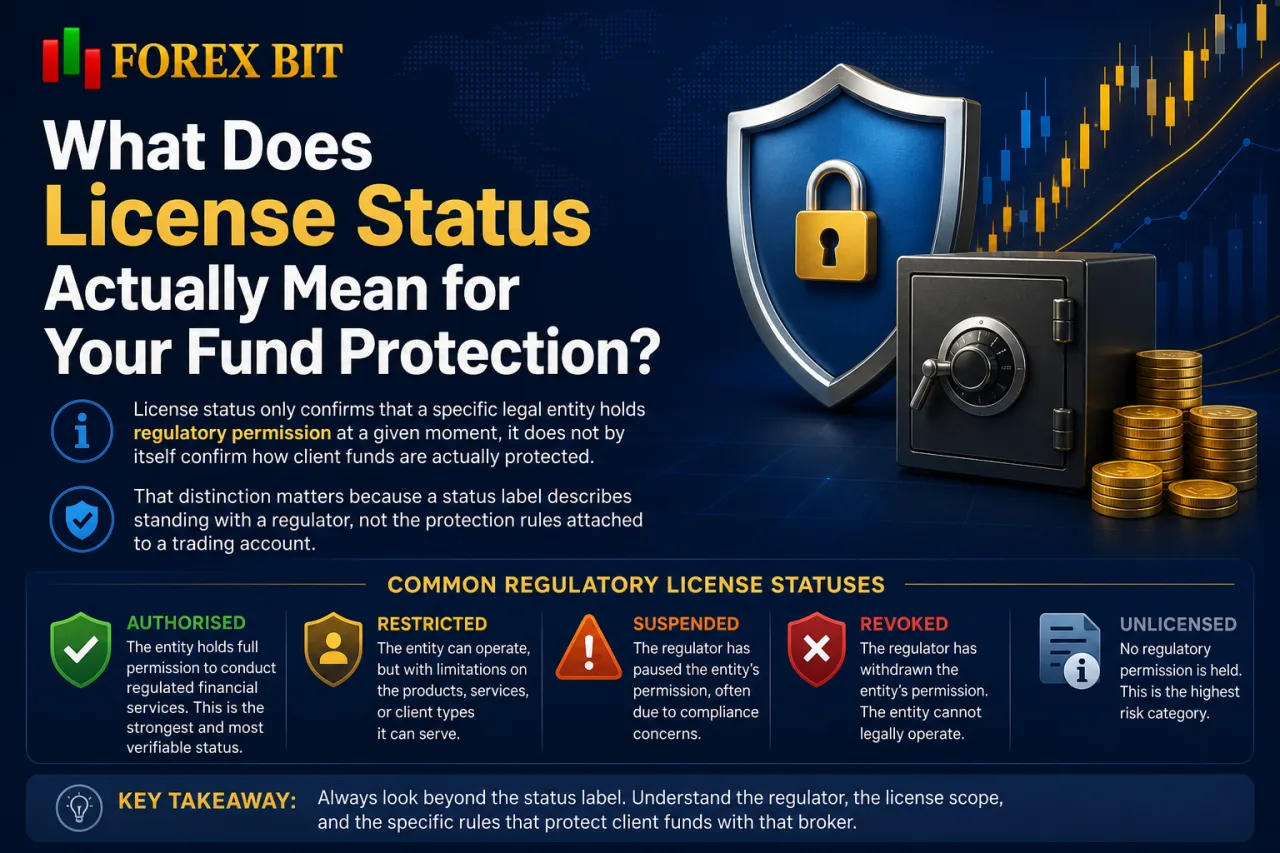
License status only confirms that a specific legal entity holds regulatory permission at a given moment, it does not by itself confirm how client funds are actually protected. That distinction matters because a status label describes standing with a regulator, not the protection rules attached to a trading account.
Regulators use several status categories, and each carries a different meaning for a trader checking a broker’s fund safety.
- Authorised: the entity holds full permission to conduct the regulated activity and appears active on the register.
- Registered: the entity is listed with a regulator but may hold a lighter oversight category than a full license, depending on the jurisdiction.
- Suspended: permission is temporarily paused, meaning the entity cannot be treated as currently authorised.
- Revoked: permission has been withdrawn permanently, and the entity no longer holds regulatory standing.
- Warning list: the regulator has flagged the entity or a lookalike name as unauthorised or fraudulent.
An active status alone confirms neither segregated client accounts, negative balance protection, nor compensation scheme eligibility, since each of these protections is set out separately by the specific legal entity a trader has contracted with.
What Is the Difference Between an Onshore and an Offshore Regulatory License?
Onshore regulators in tier-1 jurisdictions enforce higher capital requirements, mandatory compensation schemes, and active enforcement records, while offshore regulators such as those in SVG, Belize, Vanuatu, and Seychelles typically require lower minimum capital and offer no compensation scheme for retail clients. This distinction affects how much protection a trader actually receives once a dispute or broker insolvency occurs.
Tier-1 regulators such as the FCA and ASIC set minimum capital thresholds for licensed firms and require segregated client accounts audited on a regular basis. These regulators back client protection with statutory compensation schemes that can reimburse eligible claimants up to a set limit if a firm fails.
Offshore regulators generally publish lighter capital rules and rarely operate a compensation scheme at all, leaving client fund recovery dependent solely on the broker’s own segregation practices. Enforcement differs as well:
- Tier-1 regulators publish detailed enforcement notices, fines, and license revocations tied to named firms.
- Offshore regulators publish fewer public enforcement actions, making a broker’s compliance history harder to verify independently.
A broker holding both an onshore and an offshore license typically routes higher-risk clients or regions through the offshore entity, which carries weaker fund protection despite sharing the same brand name.
Does Regulation Guarantee Segregated Client Accounts and Negative Balance Protection?
No, regulation alone does not guarantee segregated client accounts or negative balance protection, since both protections depend on the specific regulator’s rules and the legal entity a client is registered under. This links directly to the earlier point that license status confirms standing with a regulator, not the protection terms attached to a particular trading account.
A trader confirming these protections checks entity-specific terms rather than assuming brand-wide coverage, for three reasons:
- Regulators set different mandatory rules, since some jurisdictions require segregated accounts and negative balance protection while others leave these as optional broker policies.
- Brands operate multiple entities, since a client registered under an offshore arm of a broker may hold none of the protections offered under that same brand’s onshore entity.
- Terms of business documents disclose the actual policy, since the specific clauses on fund segregation and negative balance protection apply only to the contracting entity named in that agreement, not the group as a whole.
Confirming which entity holds the trading account, as outlined earlier in reading the terms of business, remains the only reliable way to verify whether these two protections actually apply to a specific account.
What Are the Warning Signs of an Unregulated or Clone/Scam Broker?
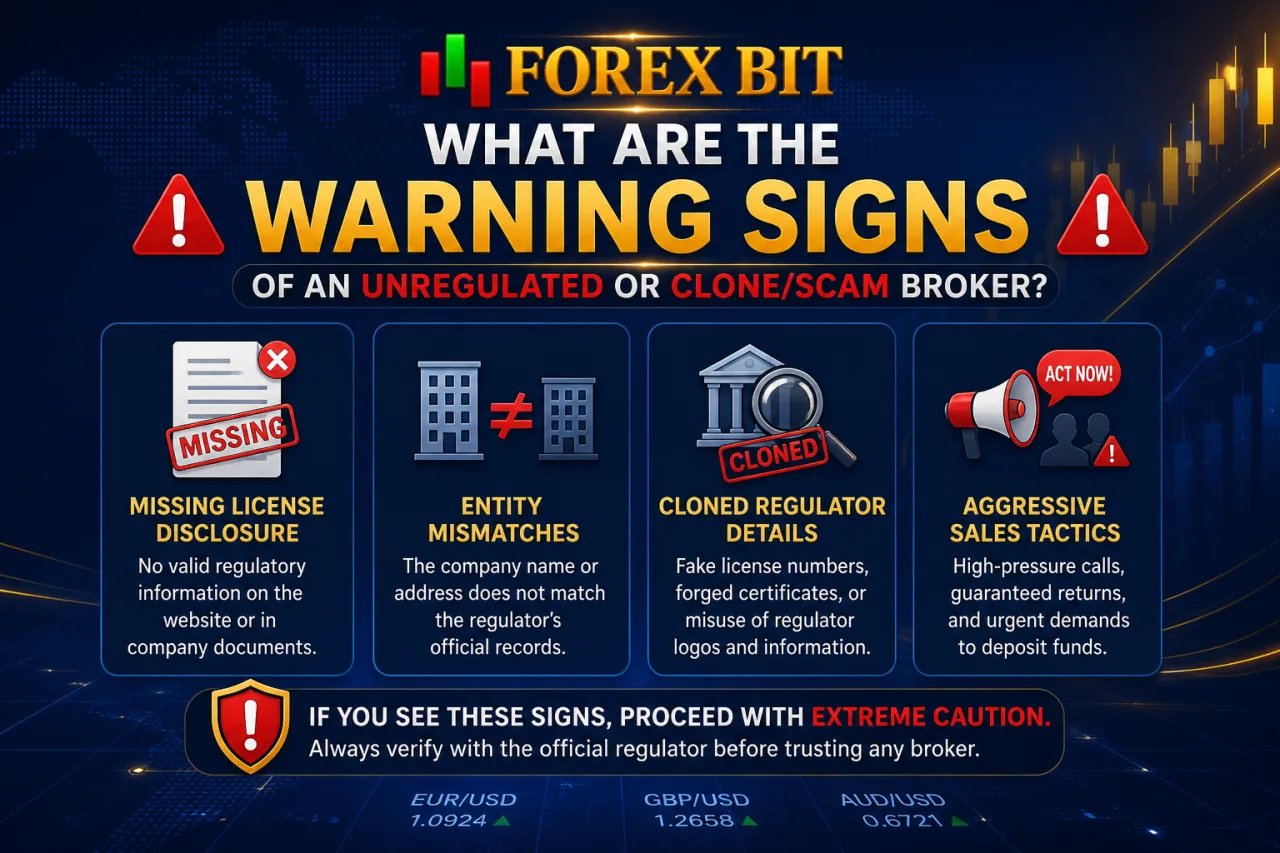
Warning signs of an unregulated or clone broker fall into several groups: missing license disclosure, entity mismatches, cloned regulator details, and aggressive sales tactics. Each group signals a different gap in the verification process described earlier, from a blank register search to pressure tactics that bypass proper due diligence entirely. The subsections below break down these specific indicators one by one.
What Is a ‘Clone Firm’ and How Do You Spot One?
A clone firm is a scam operation that impersonates a genuine regulated broker by copying its firm name, address, license number, or staff details to trick traders into sending funds to an unregulated entity. This differs from the entity mismatch or blank register scenarios covered earlier, since a clone firm actively mimics a real, currently authorised license rather than citing a fabricated or missing one.
Regulators such as the FCA publish dedicated clone firm alerts once they identify this pattern, since the copied license number still shows an active status when searched, masking the fraud from a quick check alone.
- Compare the contact phone number and email against the details listed on the regulator’s own register page, not the number shown on the suspicious broker’s website.
- Check the regulator’s warning list section for the exact firm name, since regulators post clone alerts naming the impersonated firm alongside the fraudulent contact details being used.
- Contact the genuine regulated firm directly through the phone number or email published on the regulator’s register to confirm whether the entity contacting the trader is legitimate.
- Note any request to communicate only through personal messaging apps or unofficial email domains, a pattern common among clone firm operators impersonating regulated brands.
A license number matching a real record does not confirm the trader is dealing with the actual regulated firm behind it.
Should You Trust a Broker That Only Lists an Offshore License and No Tier-1 Regulation?
No, a broker listing only an offshore license and no tier-1 regulation is not automatically a scam, but it does carry higher counterparty risk and weaker dispute-resolution options. This scenario differs from the clone firm and missing-record cases covered earlier, since the offshore license itself may be genuine and active on its issuing regulator’s register.
An offshore-only license still functions as legitimate proof of business registration and permission to operate, though the protections attached to it fall short of what tier-1 jurisdictions require.
- Confirm the minimum capital requirement set by that offshore regulator, since lower thresholds mean less financial buffer if the broker faces a liquidity shortfall.
- Check whether the offshore regulator operates any formal dispute-resolution process or ombudsman service for retail clients.
- Verify whether a compensation scheme exists for that entity, since most offshore jurisdictions offer none for retail traders.
- Review the entity’s segregated account and negative balance protection terms directly in its own terms of business, since these are not guaranteed by the license alone.
Traders holding large deposits under an offshore-only entity carry recourse limited mainly to the broker’s own policies rather than regulator-backed intervention.
How Does Regulatory Protection Differ When a Broker Operates Multiple Legal Entities Across Regions?
Regulatory protection differs sharply across a multi-entity broker brand because each legal entity answers to its own regulator, capital rules, and compensation scheme, regardless of shared branding. A group operating under one visible brand name commonly registers a separate entity under a tier-1 regulator like CySEC for EU-based clients, alongside a distinct international entity licensed offshore for clients outside that region. Assignment to a given entity depends mainly on country of residence at signup, not trader choice, meaning two people using the identical website can end up contracted with entities carrying very different protection standards. The following breakdown covers how this jurisdiction-shopping structure works and why confirming the exact contracting entity remains the deciding factor.
Why Might Traders From Certain Countries Be Onboarded Under a Different (Often Offshore) Entity of the Same Broker?
Traders from certain countries get onboarded under a different, often offshore, entity of the same broker because regulators typically restrict a licensed entity from marketing to or accepting clients outside its own jurisdiction. This routing practice ties directly back to the earlier point that a broker’s protection depends on the specific contracting entity, not the shared brand name.
A tier-1 regulator such as the FCA or CySEC authorizes an entity to serve clients within its own region, leaving the same broker group to register a separate international entity for applicants elsewhere. Country of residence entered at sign-up typically determines which entity issues the account, not trader preference.
- Restricts the onshore entity from soliciting or servicing residents outside its licensed jurisdiction.
- Directs applicants from unlisted or higher-risk countries toward the offshore arm automatically.
- Reduces the group’s compliance burden by limiting tier-1 obligations to a narrower client base.
- Shifts fund protection terms, since the offshore entity’s segregation and compensation rules apply instead.
Confirming the exact contracting entity stated in the account opening agreement remains the only way to know which rules actually apply.
Conclusion
Verifying a forex broker’s regulatory status comes down to a repeatable process: pin down the exact legal entity from the terms of business, pull its license number, run that number through the correct regulator’s public register, and match the name, address, and status shown there. An active listing still leaves entity-specific details unconfirmed, since segregated accounts, negative balance protection, and compensation schemes attach to the contracting entity rather than the brand.
Blank register results, cloned firm details, or offshore-only entities each carry distinct risk levels rather than a single pass-or-fail outcome. Working through these steps before funding an account closes the verification gap and answers the core question directly, whether a given broker is genuinely regulated for that specific trader’s region.
As a Financial Blogger with 5 years of experience, I focus on delivering in-depth market insights, investment strategies, and personal finance advice. My content has helped a diverse audience navigate the complexities of financial planning and stay informed about the latest trends in the financial world.
Email: [email protected]


Best Brokers

Trade with the world’s largest retail broker and benefit from better - than - market conditions.

We offer a superior trading environment that puts traders in the best position to profit.

Trade global markets with Interactive Brokers – a highly regulated multi-asset broker built for active and professional investors.

Invest and trade global markets with eToro – a Nasdaq-listed multi-asset platform built around social investing and CopyTrader.






Forex Bit provides in-depth analysis of commodities, forex, and stock markets to help traders make informed investment decisions.
Best Brokers
Metatrader 5 Brokers
Metatrader 4 Brokers
Lowest Spread Forex Broker
Regulated Forex Brokers
Forex Copy Trading
Ctrader Brokers
Best Forex Broker For Beginners