
Confused about forex slippage? Discover what it means, why it happens, and how it affects your trades—plus tips to minimize its impact.
What Is Slippage in Forex? Meaning, Causes & Types

Slippage in forex refers to the difference between the price a trader expects to get on an order and the price at which the order actually executes. This gap occurs during the brief moment between order placement and execution, and it can move in either direction depending on market conditions.
Slippage happens mainly because of rapid price movement and delays in trade execution speed. High volatility around news releases, low market liquidity, and gaps between quoted and available prices are the primary triggers, especially when order volume outpaces available liquidity at the requested price.
Forex slippage falls into two categories: positive slippage and negative slippage. Positive slippage fills an order at a better price than requested, while negative slippage fills it at a worse price, directly affecting entry cost, exit value, and overall trade profitability.
Traders reduce slippage by using limit orders, trading during high-liquidity sessions, and avoiding major news events. Choosing a broker with fast execution and transparent order handling, a factor Forex Bit evaluates when comparing brokers, also lowers the risk of unexpected price shifts.
The next section breaks down exactly what slippage means in forex trading and how it fits into the broader execution process.
What Is Slippage in Forex Trading?
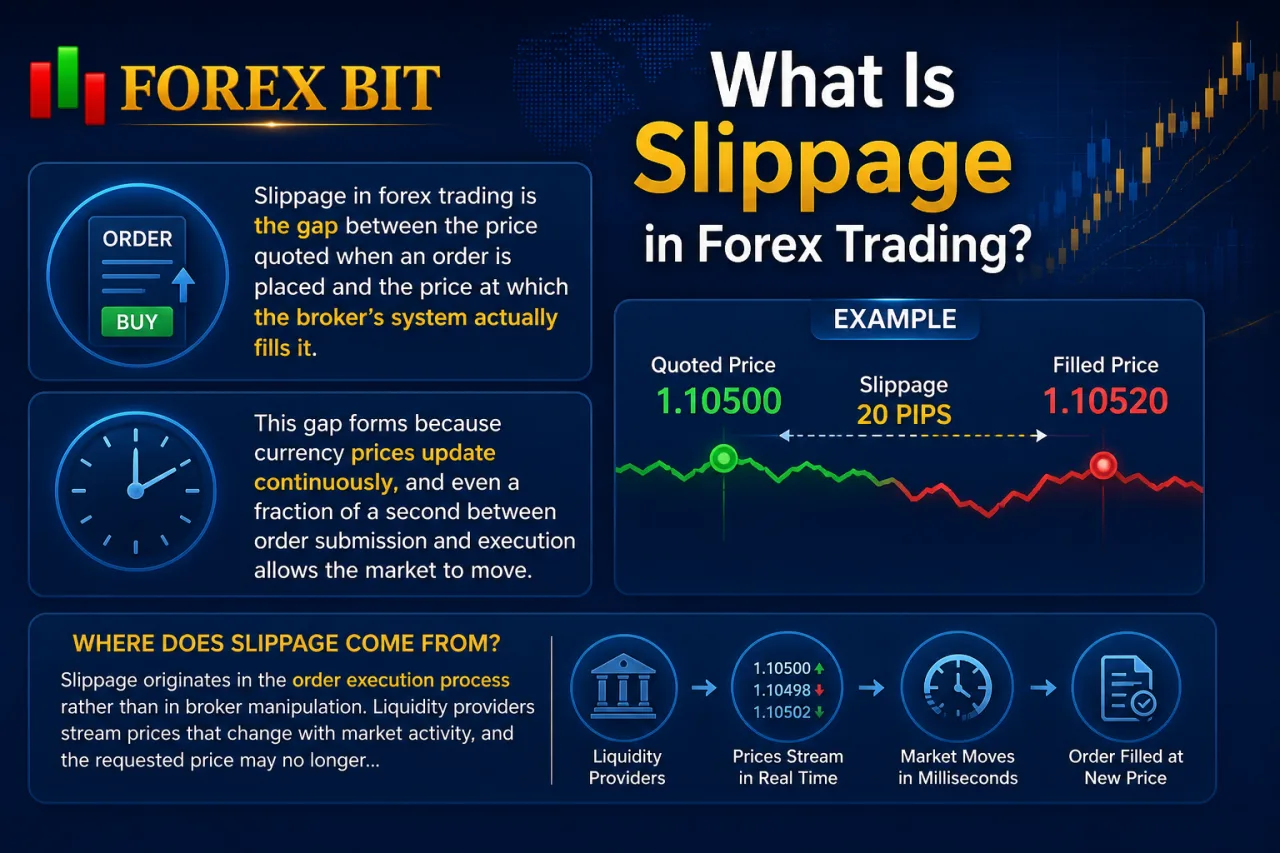
Slippage in forex trading is the gap between the price quoted when an order is placed and the price at which the broker’s system actually fills it. This gap forms because currency prices update continuously, and even a fraction of a second between order submission and execution allows the market to move.
Slippage originates in the order execution process rather than in broker manipulation. Liquidity providers stream prices that change with market activity, and the requested price may no longer be available by the time the order reaches the market. This is why regulated brokers treat slippage as a normal market mechanic rather than a fault, since it stems from price movement and connection latency, not deliberate repricing. The following sections outline why this delay occurs and the specific forms slippage takes during live execution.
How Does Slippage Occur During Order Execution?
Slippage occurs when the market price shifts during the interval between an order being sent to the broker’s server and the moment it reaches execution. The trader’s platform transmits the order at the displayed quote, but that quote reflects the price available only at the instant of submission, not necessarily at the instant of fill.
This gap ties directly into the execution mechanism itself. The process generally unfolds in three steps:
- Order departs the trading terminal at the quoted price the trader clicked.
- Price moves during transmission as liquidity providers update their streams in real time.
- Order fills at whatever price is currently available, which may sit above, below, or match the original quote.
Faster connections and lower network latency shorten this interval, narrowing the price gap that can form before execution completes. During calm market conditions, the quoted and filled prices often align closely, while volatile conditions widen the interval between placement and fill, making the resulting execution price less predictable.
What Causes Slippage in Forex Trading?
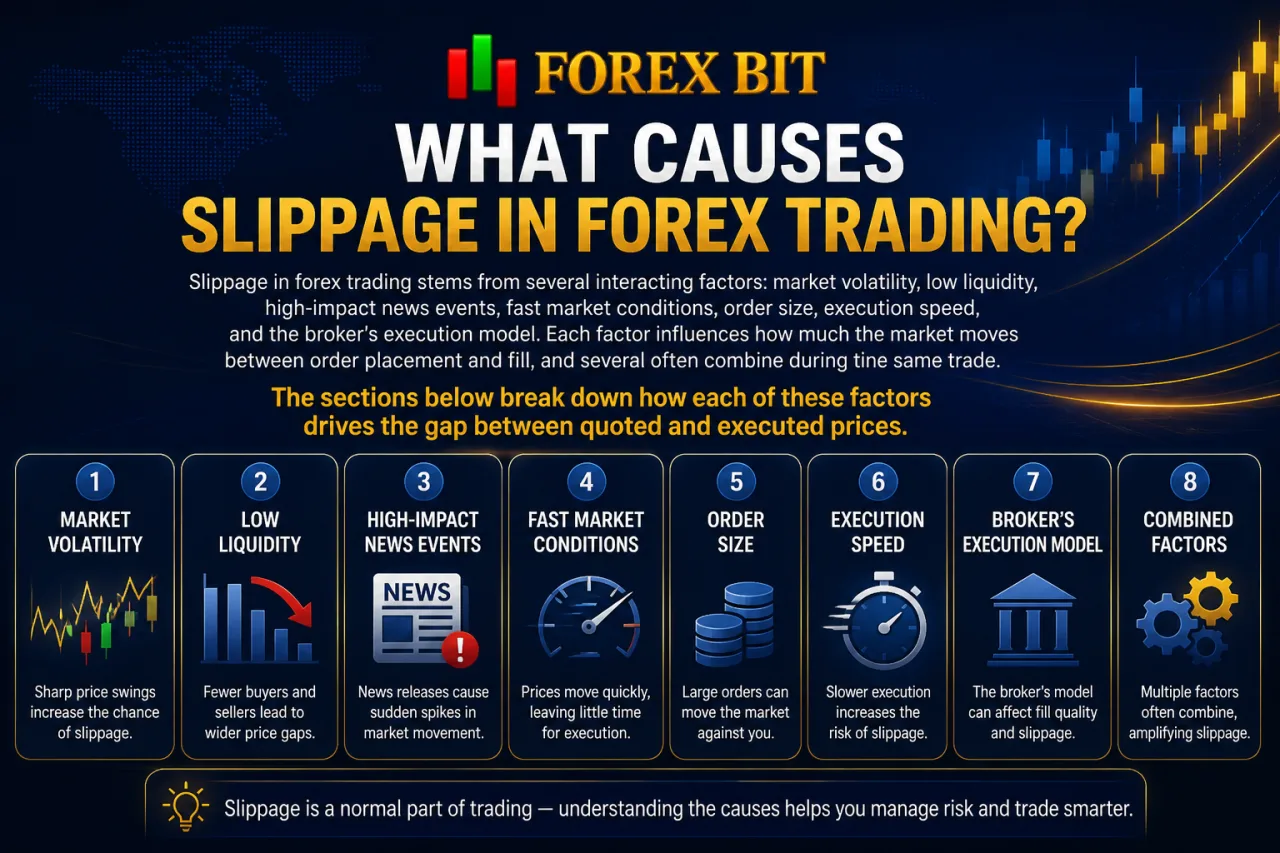
Slippage in forex trading stems from several interacting factors: market volatility, low liquidity, high-impact news events, fast market conditions, order size, execution speed, and the broker’s execution model. Each factor influences how much the market moves between order placement and fill, and several often combine during the same trade.
The sections below break down how each of these factors drives the gap between quoted and executed prices.
Why Does Market Volatility Increase Slippage?
Market volatility increases slippage because rapid price movement widens the gap between the price requested and the price available at execution. This happens as liquidity providers adjust their quotes faster than the order can reach the market, leaving the original price outdated by the time the fill occurs.
This dynamic directly ties into the volatility-slippage relationship outlined earlier. During sharp price swings, several conditions compound the effect:
- Quotes refresh multiple times within the same second the order travels through the execution chain.
- Bid-ask spreads widen as liquidity providers hedge against fast-moving prices, pushing the fill further from the requested level.
- Order books thin out at the requested price, forcing execution at the next available level.
- Large price gaps form between consecutive quotes, particularly around sudden market shocks.
The wider the price swing during the transmission window, the greater the deviation between the quoted and executed price. This is why volatile sessions produce noticeably larger slippage than stable, low-movement conditions.
Why Does Low Liquidity Cause Slippage?
Low liquidity causes slippage because fewer buyers and sellers remain available at the requested price, forcing orders to fill at the next accessible level. This directly affects execution quality in the way market volatility does, only through a shortage of counterparties rather than fast quote changes.
Thin order books amplify this gap in several ways:
- Fewer resting orders sit at the best bid and ask, so larger orders consume multiple price levels to fill completely.
- Wider spreads appear as liquidity providers withdraw quotes during quiet trading periods.
- Currency pairs outside major sessions, such as during the Asian session overlap gap, tend to show reduced market depth compared to peak trading hours.
- Exotic currency pairs experience this effect more consistently than major pairs, since fewer market participants trade them at any given time.
Execution during these low-liquidity windows, including market open and close or holiday sessions, tends to produce wider slippage even without a major news trigger, since the shortage of counterparties alone limits how close the fill lands to the original quote.
How Do News Events Trigger Slippage?
High-impact economic releases trigger slippage by causing prices to jump instantly from one level to another instead of moving gradually, leaving little or no tradable price in between. This ties directly into the news-driven slippage risk since scheduled announcements concentrate large order flow into a single moment rather than spreading it across the trading session.
Interest rate decisions, employment reports, and inflation data release scheduled figures at a fixed time, and market participants react within the same instant. This creates two related effects:
- Prices gap across multiple levels as liquidity providers withdraw quotes ahead of the release to avoid holding risk at outdated prices.
- Order books thin out momentarily right as the figures hit, since providers pause streaming until volatility settles.
Orders placed just before or during the release often fill several pips away from the expected price, since no continuous quote exists to bridge the pre-release and post-release levels.This gap tends to close once liquidity providers resume normal quoting, with wider deviations from forecasts generally taking longer to stabilize than smaller ones.
What Are the Types of Slippage in Forex?
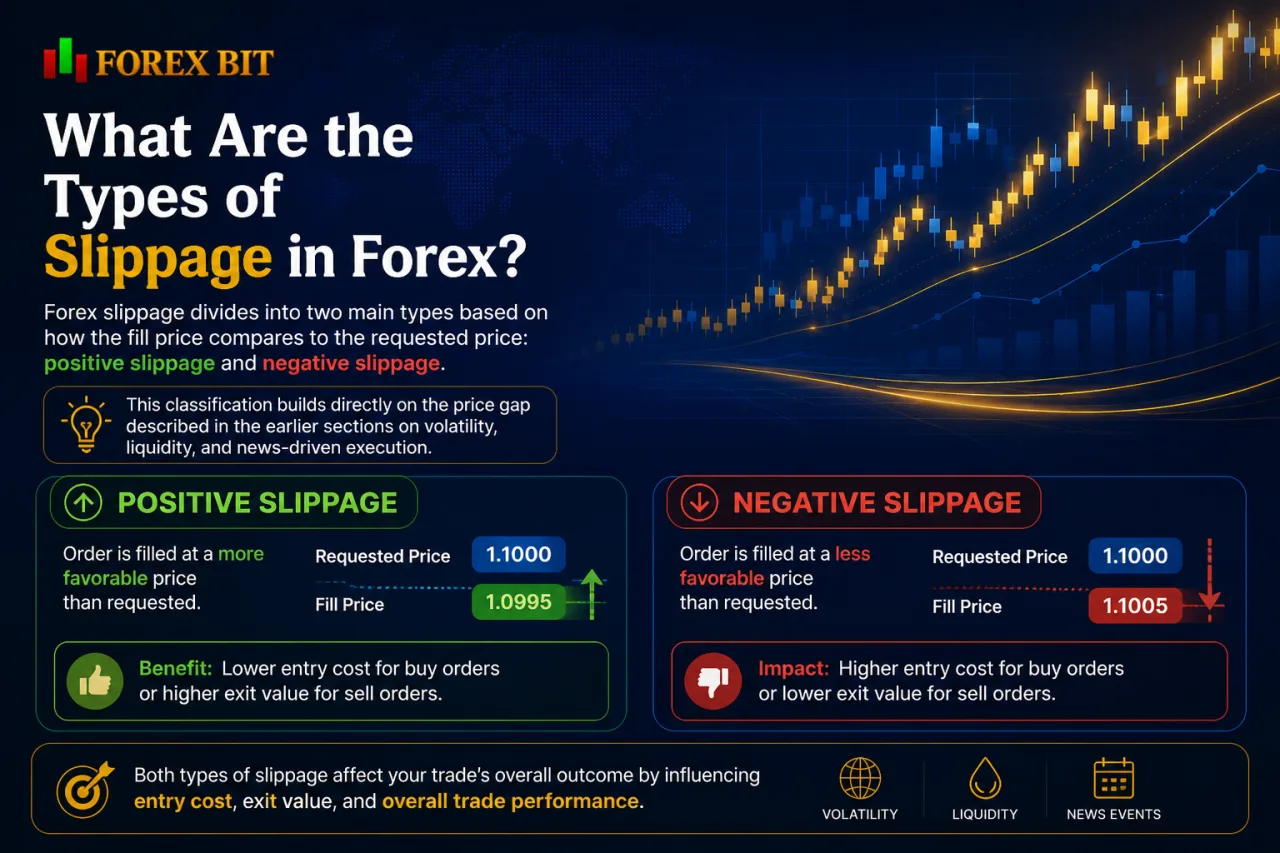
Forex slippage divides into two main types based on how the fill price compares to the requested price: positive slippage and negative slippage. This classification builds directly on the price gap described in the earlier sections on volatility, liquidity, and news-driven execution. Positive slippage fills an order at a more favorable price than requested, while negative slippage fills it at a less favorable one, each carrying distinct implications for entry cost, exit value, and overall trade outcome. The following sections detail how each type forms and affects executed trades.
Positive Slippage vs Negative Slippage: What Is the Difference?
Positive slippage fills an order at a more favorable price than requested, while negative slippage fills it at a less favorable price. Both outcomes stem from the same execution gap described earlier, only the direction of the price move during transmission determines which type occurs.
A buy order benefits from positive slippage when the price drops before the fill completes, letting the trader enter cheaper than quoted. A sell order sees the same benefit when the price rises during that same window, allowing an exit above the requested level.
Negative slippage works in reverse. A buy order filling above the quoted price, or a sell order filling below it, both represent negative slippage, since the trader pays more or receives less than intended.
- Positive slippage: buy fills lower or sell fills higher than requested.
- Negative slippage: buy fills higher or sell fills lower than requested.
Neither type reflects broker intent, since both arise from price movement occurring between order placement and execution during volatile or fast-moving conditions.
What Is the Difference Between Slippage on Market Orders and Pending Orders?
Market orders carry higher slippage exposure than pending orders, since market orders fill immediately at the next available price while pending orders trigger only once the market reaches a preset level. This distinction ties directly into the execution gap covered earlier, only here the order type itself determines how much price movement gets absorbed before the fill completes.
A market order, whether opening or closing a position, accepts whatever price the broker’s system provides at the moment of execution, making it fully exposed to volatility and liquidity shifts. A pending order, such as a stop or limit order, waits inactive until the market touches its trigger price, then converts into a market order for execution, carrying the same slippage risk from that point onward.
Stop-loss and take-profit orders follow this same pending-order behavior once triggered:
- Take-profit orders, functioning as limit orders, generally fill at or better than the requested level, since brokers typically avoid filling limit-type orders at worse prices.
- Stop-loss orders, functioning as stop orders, remain vulnerable to negative slippage during fast markets, since they convert to market orders once triggered and fill at the next available price rather than the exact stop level.
This means a stop-loss can close a losing trade at a worse price than set during sharp price gaps, while a take-profit order maintains more predictable execution.
How Does Slippage Impact Forex Trades?
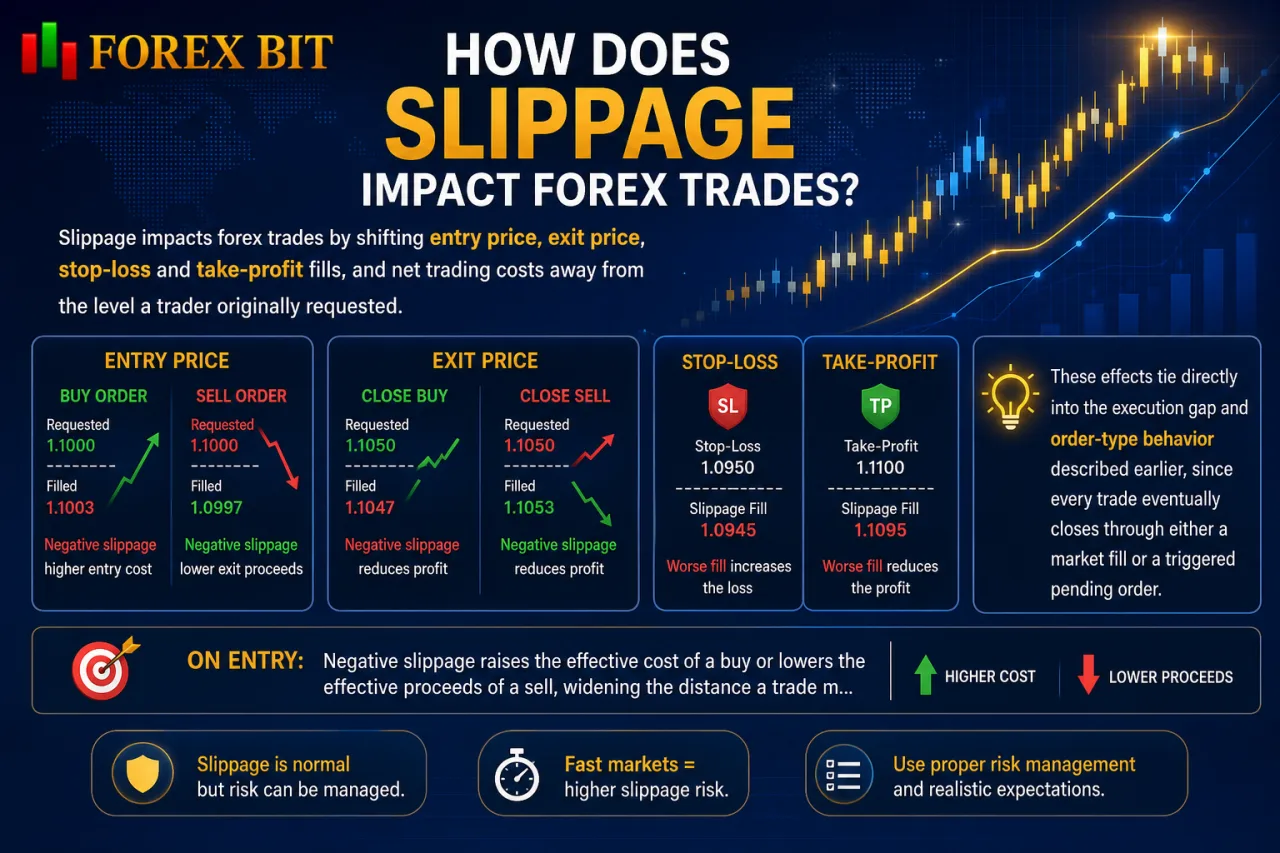
Slippage impacts forex trades by shifting entry price, exit price, stop-loss and take-profit fills, and net trading costs away from the level a trader originally requested. These effects tie directly into the execution gap and order-type behavior described earlier, since every trade eventually closes through either a market fill or a triggered pending order.
On entry, negative slippage raises the effective cost of a buy or lowers the effective proceeds of a sell, widening the distance a trade must travel before reaching breakeven. On exit, the same mechanic applies in reverse: a stop-loss triggered during a fast market can close further from the intended level, increasing the realized loss beyond what the trader planned when placing the order.
Repeated negative slippage across many trades compounds into a measurable drag on overall profitability, since each fill adds a small but consistent cost on top of spreads and commissions. Positive slippage offsets this drag when it occurs, improving entry cost or exit value, though its frequency depends on the same volatility and liquidity conditions that drive negative slippage.
How to Avoid or Reduce Slippage When Trading Forex?
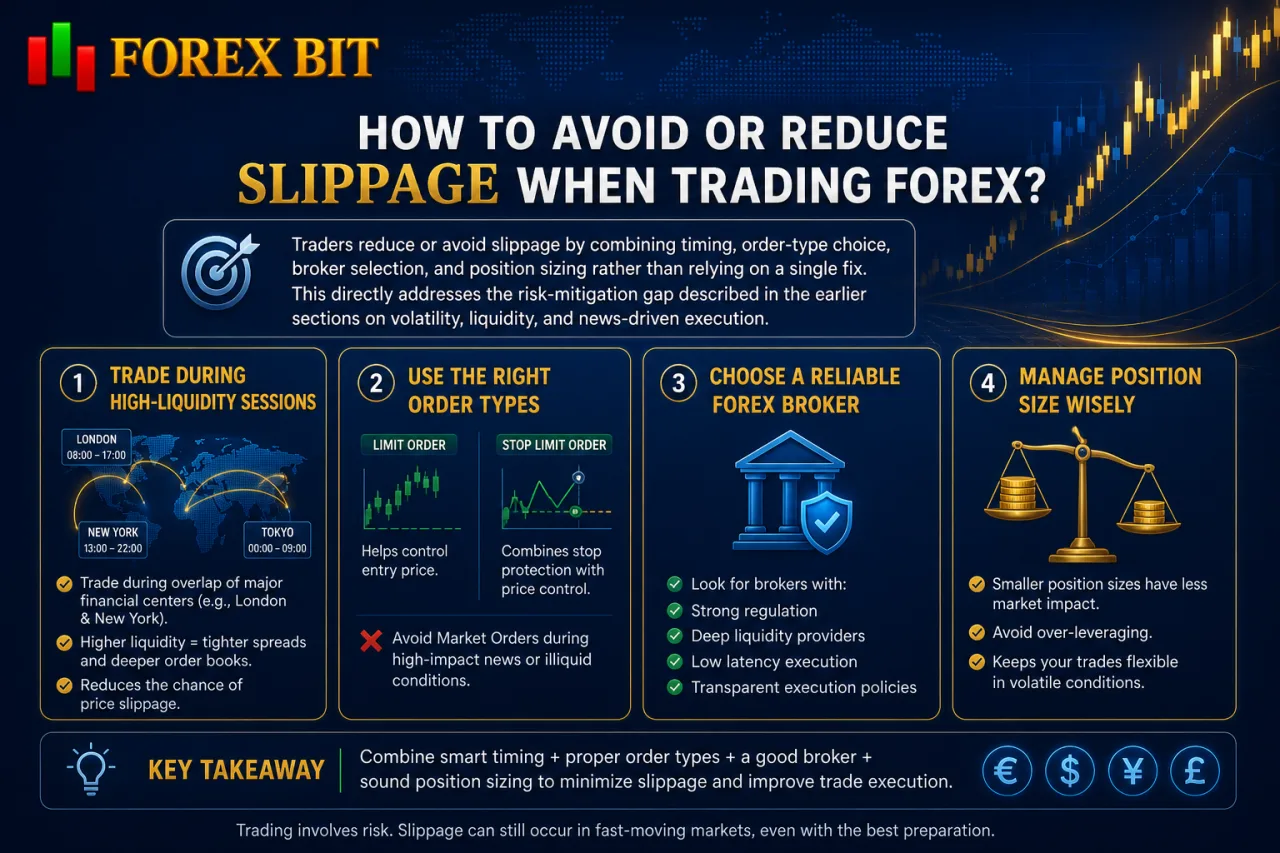
Traders reduce or avoid slippage by combining timing, order-type choice, broker selection, and position sizing rather than relying on a single fix. This directly addresses the risk-mitigation gap described in the earlier sections on volatility, liquidity, and news-driven execution, and the methods below break down each part of that combined approach.
- Trading during high-liquidity sessions, such as the overlap between major financial centers, narrows spreads and keeps order books deep enough to absorb fills near the requested price.
- Avoiding open positions around high-impact news releases sidesteps the price gaps and thin liquidity that form when scheduled figures hit the market.
- Using limit orders instead of market orders caps the fill price at a chosen level, preventing execution at a worse price even though the order may go unfilled if the market moves away.
- Choosing a broker with fast execution and a tight requote policy shortens the transmission window between order placement and fill, reducing the price movement that can occur in between.
- Adjusting position size downward during volatile conditions limits how much a given slippage amount affects total trade cost.
Does Trading Time Affect the Level of Slippage?
Yes, trading time affects the level of slippage, since liquidity depth shifts throughout the day and directly changes how far a fill can drift from the requested price. This connects to the timing-based mitigation approach outlined earlier, where session choice functions as one of the primary levers a trader controls before execution even begins.
Overlapping major sessions, such as the London-New York overlap, concentrate the highest volume of market participants and liquidity providers into the same window. This depth keeps order books thick at the requested price, narrowing spreads and shortening the gap between quoted and filled prices.
Off-peak hours produce the opposite effect for several reasons:
- Fewer active participants leave order books thinner at each price level.
- Liquidity providers widen spreads to compensate for reduced counterparty flow.
- Sudden orders consume multiple price levels faster, since less depth absorbs them.
- Price gaps form more easily between quotes when fewer streams update continuously.
Positioning trades within overlapping session hours reduces this exposure compared to thinly traded off-peak windows, where the same order size can produce noticeably wider slippage.
How Does Broker Execution Model Affect Slippage Risk?
Broker execution model shapes slippage risk directly, since market maker (dealing desk) brokers internalize orders while ECN/STP (no-dealing-desk) brokers route orders to external liquidity providers, producing different slippage patterns. This distinction sits alongside requote policy as a key factor in how often and how far a fill drifts from the requested price. The sections below compare how each model handles execution and how requote rules interact with that outcome.
Dealing Desk vs No Dealing Desk: Which Execution Model Produces More Slippage?
Dealing desk execution produces more slippage-related requotes, while ECN/STP no-dealing-desk execution passes orders directly to liquidity providers with less manual repricing. This comparison builds on the execution-model distinction covered above, where internalized fills and routed fills handle price movement in different ways.
A dealing desk model matches trades against the broker’s own book, giving the broker discretion to accept, reject, or requote an order when the market moves before the fill completes. This discretion often surfaces as a requote prompt rather than an automatic fill at the next available price.
An ECN/STP model routes the order straight to external liquidity providers, filling it at whatever price those providers quote at that instant. This removes the requote step, so the order fills automatically, though it still absorbs full market slippage since no dealing desk buffers the price.
- Dealing desk: prone to requotes, execution price shaped by internal discretion.
- ECN/STP: no requotes, execution price shaped directly by external liquidity conditions.
What Role Does a Requote Policy Play in Slippage?
A requote is a broker’s rejection of the original order price paired with an offer to fill at a new, currently available price, requiring the trader to accept or decline before execution proceeds. This differs from slippage since a requote pauses execution and asks for confirmation, while slippage fills the order automatically at the shifted price without any prompt.
The distinction ties directly into the dealing desk versus ECN/STP comparison covered above. A broker’s requote policy defines how often this pause occurs and under what volatility conditions the platform triggers it rather than filling automatically.
- Requote: order execution halts, trader chooses to accept the new price or cancel.
- Slippage: order execution completes automatically at the shifted price, no trader input involved.
A tighter requote policy reduces how often orders stall for confirmation, though it does not eliminate the underlying price movement that causes slippage itself.
Conclusion
Slippage in forex marks the gap between a requested price and the price a broker’s system actually delivers, a natural byproduct of continuous price movement and execution latency rather than broker manipulation. Volatility, thin liquidity, and news releases drive the size of that gap, producing either a favorable positive fill or a costly negative one that alters entry cost, exit value, and long-term profitability.
Limit orders, high-liquidity session timing, news avoidance, and a broker offering fast, transparent execution together limit how far a fill drifts from the intended price, giving traders practical control over an otherwise unavoidable part of live market execution.
Isabella Brown is the Forex Trading Guide Manager at Forex Bit, focusing on educational content about broker safety, trading costs, account types, platforms, and key Forex/CFD concepts. Her work helps readers understand trading terms, broker conditions, and practical checks before evaluating or using a brokerage service.
Email: [email protected]



Best Brokers

Trade with the world’s largest retail broker and benefit from better - than - market conditions.

We offer a superior trading environment that puts traders in the best position to profit.

Trade with the best trading conditions. WIN THE BEST TRADING ACCOUNT AWARD.

Trade global markets with Interactive Brokers – a highly regulated multi-asset broker built for active and professional investors.






Forex Bit provides independent forex broker reviews, comparisons, guides, and industry news to help traders make informed decisions.
Best Brokers
Metatrader 5 Brokers
Metatrader 4 Brokers
Lowest Spread Forex Broker
Regulated Forex Brokers
Forex Copy Trading
Ctrader Brokers
Best Forex Broker For Beginners