
Can you run a forex trading bot on Forex-bit.com? See supported platforms, execution speed, VPS and EA rules explained.
Forex Trading Bots Explained: Costs, Risks and Broker Rules

A forex trading bot is software that follows predefined rules to analyze currency markets and automatically perform trading actions. Depending on its programming, a bot can identify signals, open or close positions, adjust orders, and apply risk-management rules.
Trading bots are commonly used through platforms such as MetaTrader and cTrader. Some traders build their own algorithms, while others purchase or rent pre-built systems.
Automation can reduce manual work, but it does not guarantee profitable trading. The CFTC specifically warns that automated trading programs and AI-enabled bots cannot reliably predict future market conditions or guarantee returns.
Forex Bit provides educational information about forex technology and trading tools. Forex Bit does not operate a brokerage, sell forex trading bots, execute trades, or manage client funds.
What Is a Forex Trading Bot and How Does It Work?
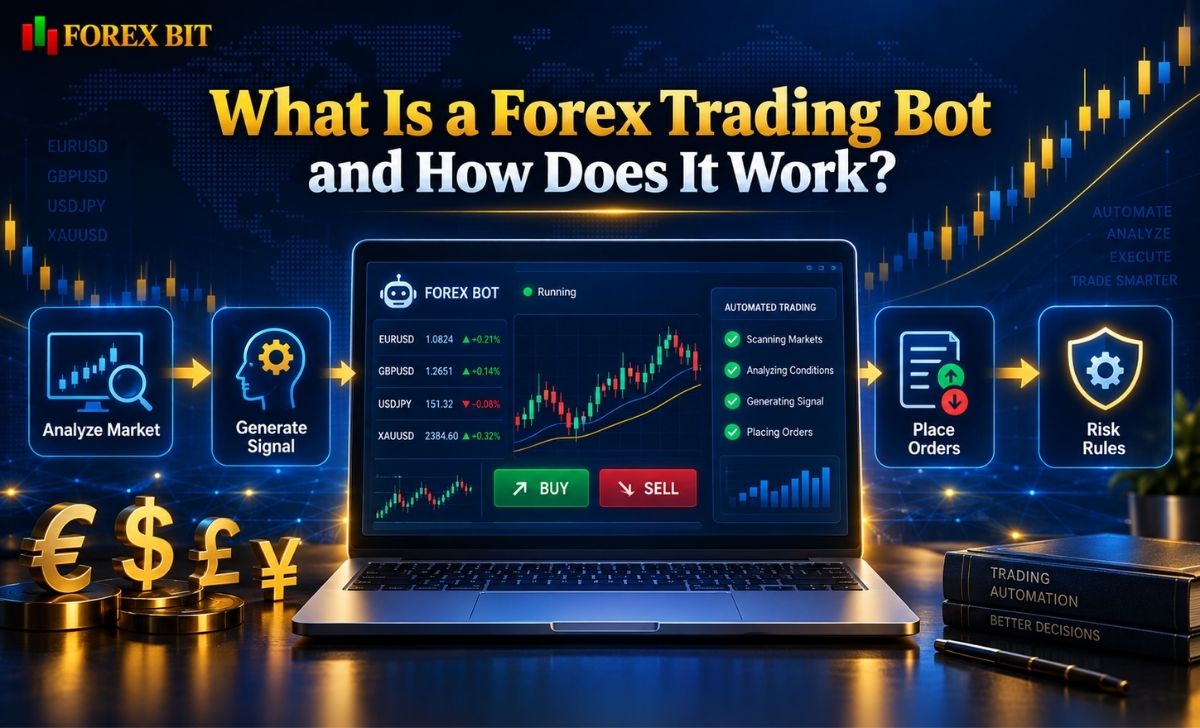
A forex trading bot is a computer program designed to make trading decisions according to a predefined strategy.
Instead of requiring a trader to manually watch charts and place every order, the software continuously checks selected market conditions and responds when its programmed rules are satisfied.
A bot may be programmed to:
- Monitor currency pairs
- Analyze technical indicators
- Identify entry signals
- Open market or pending orders
- Set Stop Loss and Take Profit
- Modify existing positions
- Close trades
- Calculate position size
- Follow specific risk-management rules
For example, a simple bot could be programmed to buy EUR/USD when one moving average crosses above another and close the position when the opposite signal appears.
More advanced systems may consider multiple indicators, timeframes, currency pairs, volatility conditions, or external data.
What Is an Expert Advisor?
An Expert Advisor (EA) is a form of automated trading program commonly associated with MetaTrader.
MetaTrader documentation distinguishes trading robots from indicators: trading robots can perform trading operations, while indicators analyze prices and identify patterns that can also be incorporated into automated systems.
On MetaTrader 4, EAs are commonly developed using MQL4, while MetaTrader 5 uses the newer MQL5 environment.
IG similarly describes MT4 Expert Advisors as programs that monitor markets using predefined algorithms and can automatically open positions and apply stops, limits, or trailing stops.
What Is the Difference Between a Bot and a Trading Signal?
A trading signal tells the user that a potential trade opportunity has been detected.
A forex trading bot can go further by executing the action automatically.
In simplified terms:
| Tool | Detect opportunities | Execute trades automatically |
| Indicator | Yes | Usually no |
| Trading signal | Yes | Depends on setup |
| Forex trading bot | Yes | Yes |
| Expert Advisor | Yes | Yes, when configured |
The amount of automation ultimately depends on how the software is programmed.
What Platforms and Tools Are Used for Forex Trading Bots?

A forex trading bot needs a compatible software environment through which it can receive market data and send trading instructions.
Popular options include MetaTrader Expert Advisors, cTrader cBots, broker APIs, and custom algorithmic trading infrastructure.
MetaTrader 4
MT4 has a long-established ecosystem for forex automation.
Expert Advisors can be used to:
- Analyze markets
- Generate signals
- Place trades
- Manage positions
- Apply automated exit rules
This makes MT4 particularly relevant to traders who already own or use strategies developed in MQL4.
However, availability still depends on the broker offering an MT4 account.
MetaTrader 5
MT5 also supports Expert Advisors but provides a more advanced testing and optimization environment.
Its Strategy Tester supports historical testing, multi-currency strategies, optimization, and forward testing. MetaTrader can also emulate execution delays during testing so traders can examine how differences between order submission and execution might affect a strategy.
This is useful because a strategy that looks successful under ideal historical conditions can behave differently once latency and actual market execution are introduced.
cTrader cBots
cTrader uses cBots for automated trading.
According to cTrader’s current documentation, cBots can:
- Analyze market conditions
- Open, modify, and close positions
- Apply Stop Loss and Take Profit
- Control position size
- Follow strategies such as trend, breakout, mean-reversion, or momentum
cTrader currently allows developers to create bots using C# or Python.
An important change from older platform assumptions is that cTrader now supports cloud cBot instances across Web, Mobile, Windows, and Mac. Local bot instances remain associated with Windows and Mac.
Does a Trading Bot Need a VPS?
Not always.
A VPS or virtual hosting service is useful when a bot needs to operate continuously without depending on the trader’s home computer.
MetaTrader’s virtual hosting service, for example, is designed to keep trading robots and signal subscriptions running continuously while maintaining a connection to the trading server.
VPS or cloud hosting can be particularly useful when:
- The bot trades around the clock
- The strategy depends on fast responses
- The trader cannot leave a computer running
- Local internet or electricity may be unreliable
Cloud-based automation can reduce the need for a traditional VPS because the bot may run remotely instead of on the trader’s own machine.
What Does a Forex Trading Bot Cost?
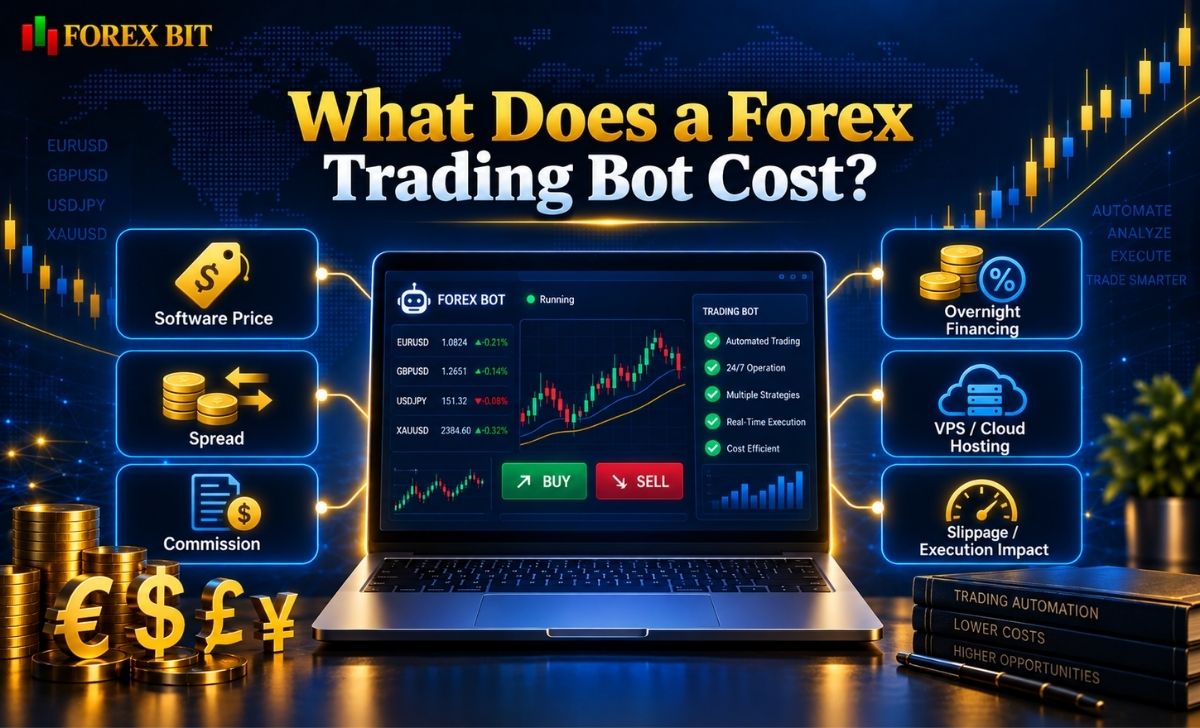
The cost of using a forex trading bot is not limited to purchasing the software.
Traders need to consider both the cost of the automation itself and the trading costs generated every time the bot enters or exits the market.
Bot Purchase or Subscription Cost
A bot may be:
- Free
- Purchased once
- Rented
- Paid through a monthly subscription
- Custom developed
MetaTrader, for example, provides a marketplace where users can buy or rent trading robots and indicators.
Custom development can cost more because the trader is paying someone to design, code, test, and maintain a strategy.
Spread
Every time a forex trade is opened, the bid-ask spread can create a trading cost.
This is especially important for bots that trade frequently.
A strategy placing hundreds of trades can accumulate substantially more spread cost than a strategy opening only several positions per month.
Commission
Some forex accounts charge a separate commission in addition to the spread.
A bot that executes high trading volumes therefore needs to account for:
Spread + Commission
A strategy that appears profitable before trading costs may become unprofitable once transaction costs are included.
Overnight Financing
Bots that leave leveraged forex positions open overnight may also incur:
- Swap
- Rollover
- Overnight financing
These charges depend on the broker, currency pair, trade direction, and account structure.
VPS or Cloud Hosting
Continuous automation may create another operating cost.
A trader might pay for:
- VPS hosting
- Platform virtual hosting
- Cloud bot execution
- Remote server resources
The exact cost depends on the platform and hosting provider.
Slippage
Slippage is not a fixed fee, but it can still affect the real cost of a bot.
If a strategy expects to buy EUR/USD at 1.1000 but regularly receives fills at 1.1002, the difference can materially affect performance across many trades.
This matters particularly for:
- Scalping bots
- News-trading bots
- High-frequency strategies
- Strategies with small profit targets
A useful way to think about total bot costs is:
Bot Cost = Software + Hosting + Spread + Commission + Financing + Execution Impact
Looking only at the price of the bot can therefore underestimate the actual cost of running it.
What Are the Main Risks of Forex Trading Bots?
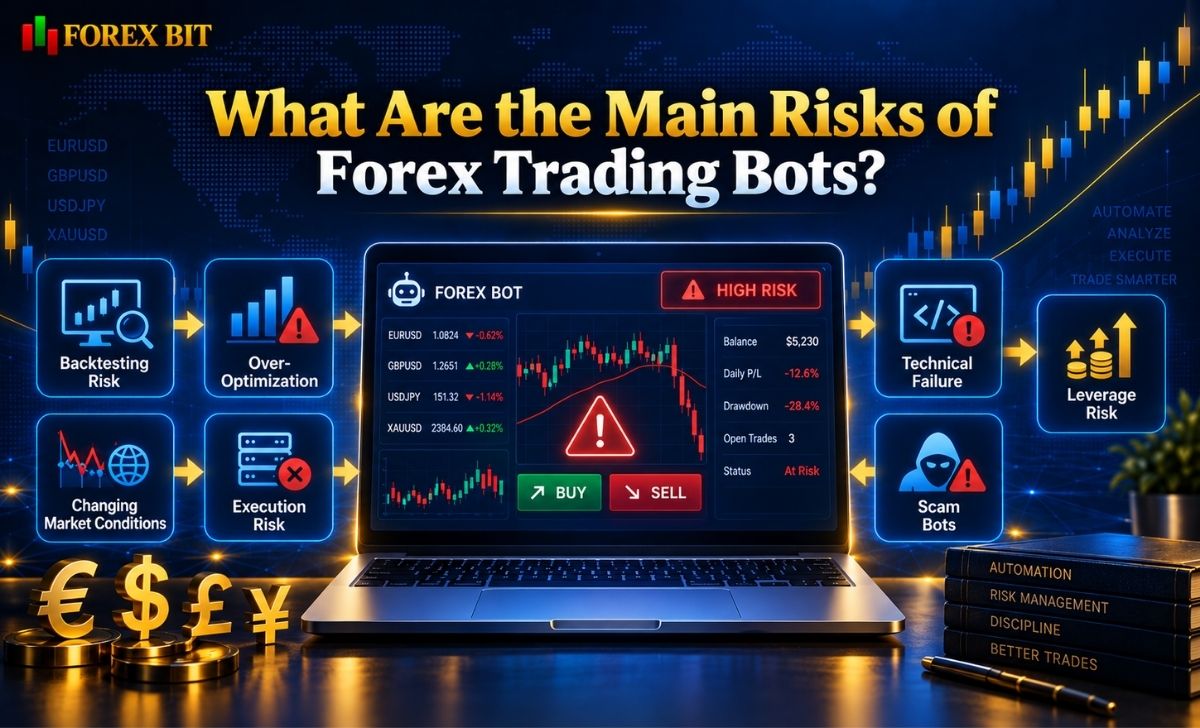
Automation removes the need to click every trade manually, but it does not remove financial risk.
In some situations, automation can increase risk because the software continues following its instructions even when market conditions change unexpectedly.
Backtesting Does Not Guarantee Future Results
Backtesting allows a strategy to be applied to historical data.
MetaTrader’s Strategy Tester specifically provides tools for historical testing and optimization before an EA is used in live markets.
However, successful historical results do not prove that the same strategy will perform profitably in the future.
The CFTC warns that automated programs can be adjusted to correlate with past market activity, but traders cannot know whether those same market conditions will continue.
Over-Optimization
Repeatedly adjusting parameters until a strategy produces excellent historical results can lead to overfitting.
The bot may effectively become optimized for one historical dataset rather than a repeatable market behavior.
This is one reason traders may use separate:
- Backtesting periods
- Optimization periods
- Forward-testing periods
MetaTrader’s Strategy Tester includes forward testing specifically to evaluate optimized settings against a separate period of data.
Market Conditions Change
A bot programmed for a trending market may perform poorly in a range.
A mean-reversion strategy can fail when a strong trend develops.
Likewise, volatility can change suddenly after:
- Interest-rate decisions
- Inflation data
- Employment reports
- Political events
- Unexpected market shocks
The algorithm continues following its rules unless those scenarios have been incorporated into its logic.
Execution Risk
Real trades involve factors that historical simulations may not reproduce perfectly.
These include:
- Slippage
- Latency
- Spread widening
- Liquidity changes
- Order rejection
- Market gaps
- Connection failures
MetaTrader’s own testing environment includes delay simulation because the price may change between a bot sending a request and execution occurring.
Technical Failure
Automated strategies depend on technology.
Problems can include:
- Internet failure
- VPS outage
- Trading server issues
- Coding errors
- Incorrect parameters
- Duplicate bot instances
- Platform updates
- API failures
A small coding mistake can potentially produce repeated unwanted trades if the program is allowed to execute without appropriate controls.
Leverage Risk
A bot does not make leverage safer.
Automating highly leveraged trades can cause losses to accumulate very quickly, especially if the software opens multiple positions.
Risk limits should therefore be built around:
- Position size
- Maximum open positions
- Maximum daily loss
- Stop Loss
- Maximum exposure
- Drawdown limits
Trading Bot Scams
This is one of the most important risks.
The CFTC warns that scammers frequently market automated systems, AI trading bots, or “secret” forex strategies with promises of unusually high or guaranteed profits.
Claims such as these should be treated as major warning signs:
- “Guaranteed profits”
- “100% win rate”
- “No risk”
- “Make money while you sleep”
- “AI predicts every market move”
- “Guaranteed monthly returns”
No forex trading bot can guarantee future profitability.
What Broker Rules Should You Check Before Using a Forex Trading Bot?
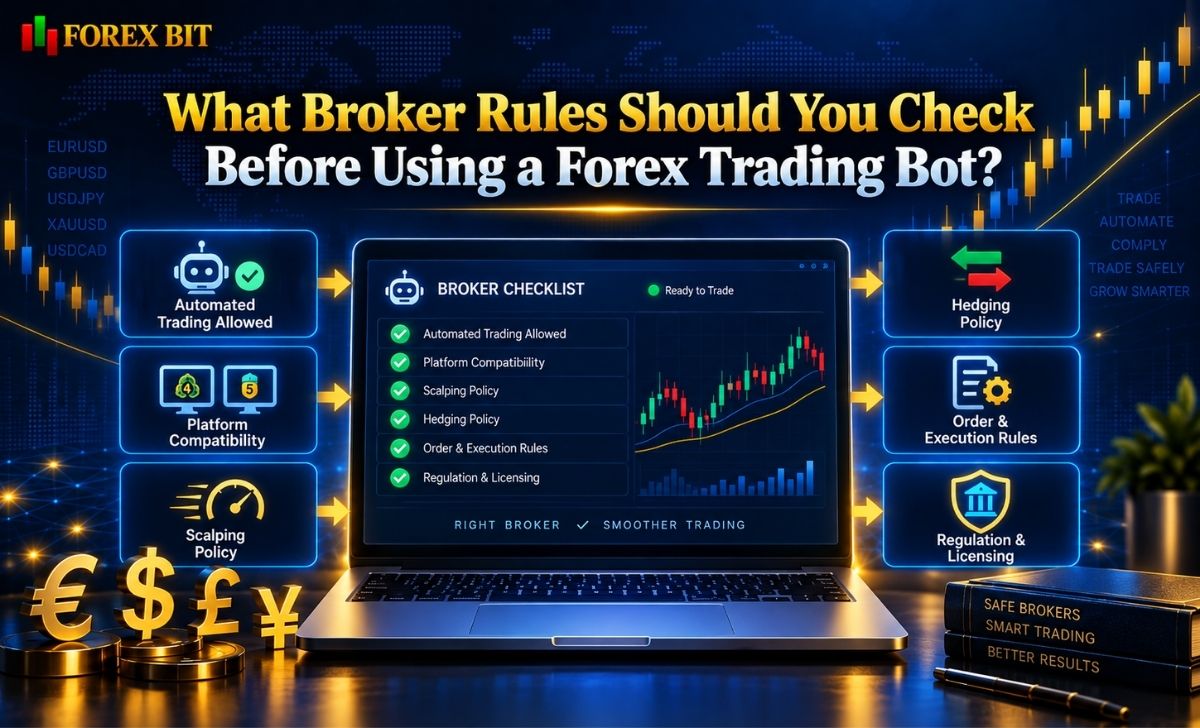
A platform supporting automation does not automatically mean every broker permits every type of automated strategy.
Before running a bot on a live account, traders should check both the trading platform’s technical capabilities and the broker’s current terms.
Is Automated Trading Allowed?
First confirm that the broker permits the type of automation being used.
For example, IG provides MT4 Expert Advisor functionality but explicitly states that customers use EAs at their own risk.
Different brokers may provide different platforms and automated-trading arrangements.
Which Platform Does the Broker Support?
Check whether the broker offers:
- MT4
- MT5
- cTrader
- API trading
- Proprietary automation tools
A bot built for one environment usually cannot simply be moved to another.
For example:
MQL4 EA → MT4
MQL5 EA → MT5
cBot → cTrader
Conversion may require rewriting or adapting the strategy.
Are Scalping Strategies Allowed?
Some bots place trades very frequently and hold positions for short periods.
Before using such a system, check:
- Scalping policy
- Minimum holding requirements, if any
- Maximum trading frequency
- Maximum number of open orders
- Instrument-specific restrictions
Do not assume that because the platform can technically submit the trades, the broker’s agreement permits the strategy.
Is Hedging Available?
Some automated systems hold opposing positions on the same instrument.
Whether this works depends on:
- Broker
- Account
- Platform configuration
- Regulatory jurisdiction
The bot should therefore be designed for the correct position-accounting model.
Check Order and Execution Rules
Review:
- Minimum order size
- Maximum order size
- Stop-distance rules
- Pending-order requirements
- Margin rules
- Trading hours
- Execution model
- Slippage handling
These conditions can materially change a bot’s actual results.
Check Broker Regulation
Automation does not reduce the importance of choosing a legitimate broker.
The CFTC warns that fraudulent forex operations frequently use trading software, bots, social media promotions, and promises of high returns to attract customers.
Before depositing money, identify:
- The broker’s legal entity
- Regulatory status
- License or registration number
- Applicable jurisdiction
- Withdrawal rules
For U.S.-regulated retail forex activity, NFA rules impose specific requirements on Forex Dealer Members, including requirements governing forex transactions and supervision of electronic trading systems.
Rules differ internationally, so traders should check the regulator applicable to their own account rather than assuming one country’s requirements apply worldwide.
Test Before Running Live
A reasonable process is:
Backtest → Forward Test → Demo → Small Live Test → Monitor
Historical testing can reveal whether the bot follows its intended rules, while demo and small live testing can expose execution or technical differences that a historical simulation may miss.
MetaTrader specifically recommends testing and optimizing Expert Advisors before using them for real trading, while IG advises users to test third-party EAs on a demo account first.
Conclusion
A forex trading bot can automate market analysis, order placement, position management, and risk rules, but automation does not guarantee profitable results. Traders should consider the complete cost of running a bot—including spreads, commissions, hosting, financing, and execution—and test strategies carefully before committing significant capital. Broker permissions, platform compatibility, execution rules, regulation, and risk controls should all be checked before deploying any automated strategy on a live forex account.
Isabella Brown is the Forex Trading Guide Manager at Forex Bit, focusing on educational content about broker safety, trading costs, account types, platforms, and key Forex/CFD concepts. Her work helps readers understand trading terms, broker conditions, and practical checks before evaluating or using a brokerage service.
Email: [email protected]



Best Brokers

Trade with the world’s largest retail broker and benefit from better - than - market conditions.

We offer a superior trading environment that puts traders in the best position to profit.

Trade with the best trading conditions. WIN THE BEST TRADING ACCOUNT AWARD.

Trade global markets with Interactive Brokers – a highly regulated multi-asset broker built for active and professional investors.






Forex Bit provides independent forex broker reviews, comparisons, guides, and industry news to help traders make informed decisions.
Best Brokers
Metatrader 5 Brokers
Metatrader 4 Brokers
Lowest Spread Forex Broker
Regulated Forex Brokers
Forex Copy Trading
Ctrader Brokers
Best Forex Broker For Beginners