
Confused about market execution vs instant execution? See how each affects slippage, requotes, and scalping—then pick the right one for your trades.
Market Execution vs Instant Execution: Key Differences Explained

Market execution sends orders at the best available price without a fixed quote, while instant execution fills orders only at the exact quoted price or rejects the trade. This distinction directly shapes how brokers handle fills, slippage, and requotes across different account types.
Market execution tends to suit scalping and hedging better, since it avoids requotes and processes orders faster during volatile price swings. Instant execution can reject trades outright when prices move, disrupting time-sensitive strategies.
Slippage can occur in both models, but requotes are largely exclusive to instant execution, since market execution fills orders at the next available price instead of rejecting them. This difference affects predictability of entry and exit prices.
MT4 traditionally supports both instant and market execution, while MT5 defaults to market execution across most broker setups. This reflects a well-established distinction in the industry between the two platforms, rooted in how each was originally designed to handle order processing. Platform choice therefore influences which execution behavior traders actually experience.
Forex Bit breaks down these execution mechanics further below, starting with a direct comparison of how market execution and instant execution actually differ in practice.
What Is the Difference Between Market Execution and Instant Execution?
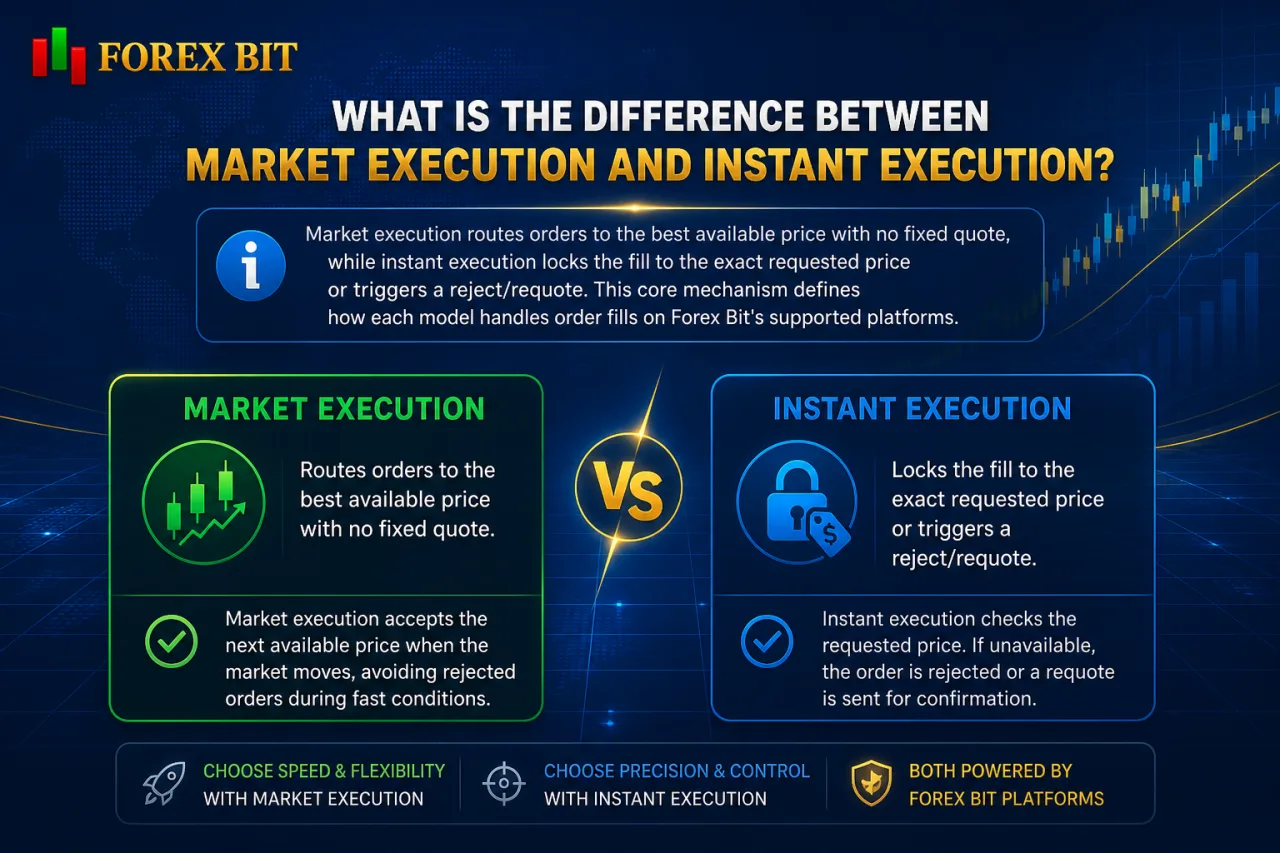
Market execution routes orders to the best available price with no fixed quote, while instant execution locks the fill to the exact requested price or triggers a reject/requote. This core mechanism defines how each model handles order fills on Forex Bit’s supported platforms.
The two models split into distinct fill behaviors:
- Market execution accepts the next available price when the market moves, avoiding rejected orders during fast conditions.
- Instant execution checks the requested price against the current quote before confirming, rejecting or requoting the trade if the price has shifted.
On MT4, brokers configure either instant or market execution depending on account type. MT5 setups generally default to market execution across most broker configurations.
This platform-level distinction sets the baseline for the fill behavior traders encounter on each account type. It also shapes slippage exposure and requote frequency across different account setups.
How Does Market Execution Process an Order?
Market execution processes an order in three steps: the trader sends the order, the broker or liquidity provider fills it at the current market price, and the trade confirms without a separate price-confirmation step. This flow explains why fills happen even when the price shifts slightly between order submission and execution.
The sequence unfolds as follows:
- Sends the order from the trading terminal at the visible market price.
- Routes the order to the broker’s liquidity provider for immediate processing.
- Fills the trade at the next available price rather than waiting for a match on the original quote.
- Confirms the execution on the trader’s terminal, even when the fill price differs slightly from the requested price.
This structure removes the confirmation checkpoint present in instant execution, so the order does not sit pending a price match. Any variance between the requested and filled price appears as slippage rather than a rejected trade or requote.
How Does Instant Execution Process an Order?
Instant execution processes an order through a price-confirmation step: the trader requests a specific price, the broker checks that price against the current quote, then fills the trade at that exact price or rejects/requotes it if the price has moved. This checkpoint distinguishes instant execution from the direct fill flow used in market execution.
The order moves through a defined sequence:
- Submits the order at a specific requested price from the trading terminal.
- Checks that requested price against the broker’s live quote before confirming anything.
- Fills the trade at the exact requested price when the quote still matches.
- Rejects or requotes the order when the price has shifted, prompting the trader to accept a new price or resend the order.
This confirmation step protects the trader from off-price fills but introduces the possibility of rejected trades during fast price movement. Because the broker validates the quote before filling, instant execution produces more predictable entry prices at the cost of potential requotes when volatility increases.
How Do Slippage and Requote Policies Differ Between Market and Instant Execution?
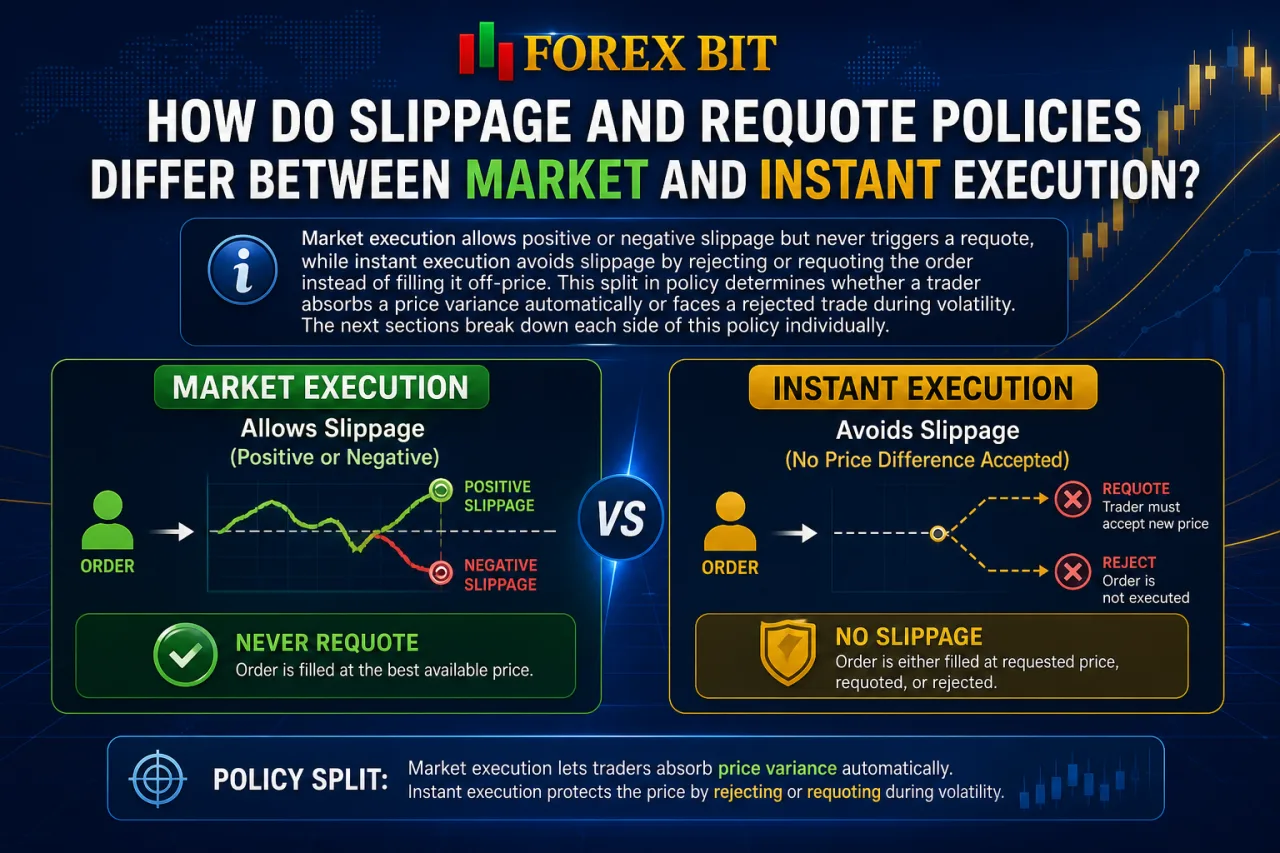
Market execution allows positive or negative slippage but never triggers a requote, while instant execution avoids slippage by rejecting or requoting the order instead of filling it off-price. This split in policy determines whether a trader absorbs a price variance automatically or faces a rejected trade during volatility. The next sections break down each side of this policy individually.
What Causes Slippage Under Market Execution?
Slippage under market execution occurs when the fill price differs from the requested price. This happens because the order routes to the next available quote instead of waiting for an exact match. This gap occurs on Forex Bit’s market-execution setups whenever price shifts between order submission and the broker’s confirmation of the fill.
Slippage splits into two directions:
- Positive slippage fills the order at a better price than requested, reducing entry cost or increasing exit value.
- Negative slippage fills the order at a worse price than requested, raising entry cost or lowering exit value.
Both outcomes stem from the same mechanism: market execution prioritizes filling the order over matching an exact price. Because the model skips the price-confirmation checkpoint used in instant execution, it processes the trade at whatever price the liquidity provider offers next rather than rejecting or requoting it. This design keeps orders moving during fast price swings, though it shifts the pricing risk onto the trader instead of the broker.
When Does a Requote Occur Under Instant Execution?
A requote under instant execution occurs when the market price shifts between the moment a trader submits an order and the moment the broker checks that price against the live quote, forcing the broker to offer a new price instead of filling the original request. This trigger point directly connects to the price-confirmation checkpoint described earlier, since instant execution stops the trade at exactly that step whenever the quote no longer matches.
Requotes cluster around specific market conditions on Forex Bit’s instant-execution setups:
- Requotes tend to occur more often during fast market movement, when quotes update faster than the confirmation step can process.
- Requotes tend to appear more often during periods of low liquidity, when fewer counter-orders exist to match the requested price.
- Triggers around high-impact news releases, when price gaps outpace the broker’s quote validation.
When a requote appears, the trader faces two options: accept the newly offered price and let the trade proceed, or cancel the order and resend it at a later quote. Neither option fills the trade at the originally requested price, which separates instant execution’s requote behavior from the automatic slippage-based fills used in market execution.
Which Execution Type Is Better for Scalping or Hedging Strategies?
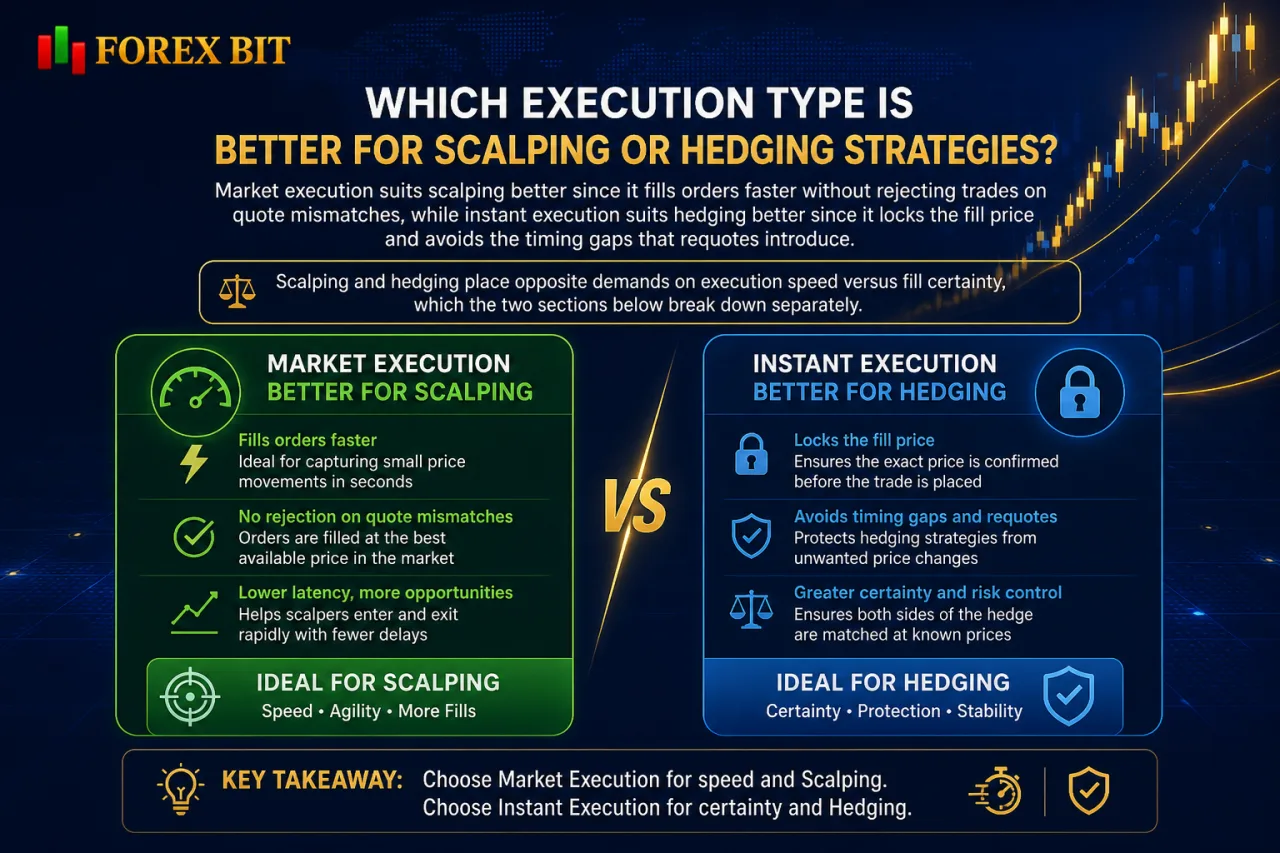
Market execution suits scalping better since it fills orders faster without rejecting trades on quote mismatches, while instant execution suits hedging better since it locks the fill price and avoids the timing gaps that requotes introduce. Scalping and hedging place opposite demands on execution speed versus fill certainty, which the two sections below break down separately.
Is Market Execution Suitable for Scalping Strategies?
Yes, market execution generally suits scalping strategies, since fast fills, no requote checkpoint, and continuous processing during rapid price swings match the timing demands of short-term trades. This directly addresses the scalping compatibility question raised by the heading, building on the earlier point that market execution favors scalping over instant execution.
Several factors reinforce this fit:
- Removes the price-confirmation checkpoint that instant execution uses, so orders do not stall waiting for a quote match.
- Processes trades at the next available price instead of rejecting them, keeping fast entries and exits intact.
- Handles rapid order sequences without triggering requotes, which matters for scalpers placing frequent trades within short windows.
A caveat applies during high-impact news events. Slippage under market execution can widen when volatility spikes around news releases, pushing fills further from the requested price than in calmer conditions. Scalpers relying on tight entry and exit margins face reduced predictability during these windows, even though the order itself still fills rather than facing rejection.
Is Instant Execution Suitable for Hedging Strategies?
Yes, instant execution generally suits hedging strategies, since fixed-price confirmation locks the fill at the exact quoted price, matching the precise entry and exit levels hedging setups require. This addresses the hedging compatibility question raised by the heading, extending the earlier point that instant execution favors hedging over market execution.
Several factors support this fit:
- Confirms the trade only at the exact requested price, preventing off-price fills that could unbalance a hedge position.
- Rejects or requotes the order instead of filling at a different price, keeping the hedge’s opposing positions aligned on cost basis.
- Suits multi-leg hedge structures where price certainty on each leg matters more than fill speed.
A caveat applies during requote-heavy conditions. Requote delays under instant execution can disrupt hedge timing, since one leg may fill while the other waits for a new quote, temporarily unbalancing the hedge. Traders opening both legs during fast market movement face this timing gap more often than during stable price conditions.
Which Brokers or Platforms Support Market Execution and Instant Execution?
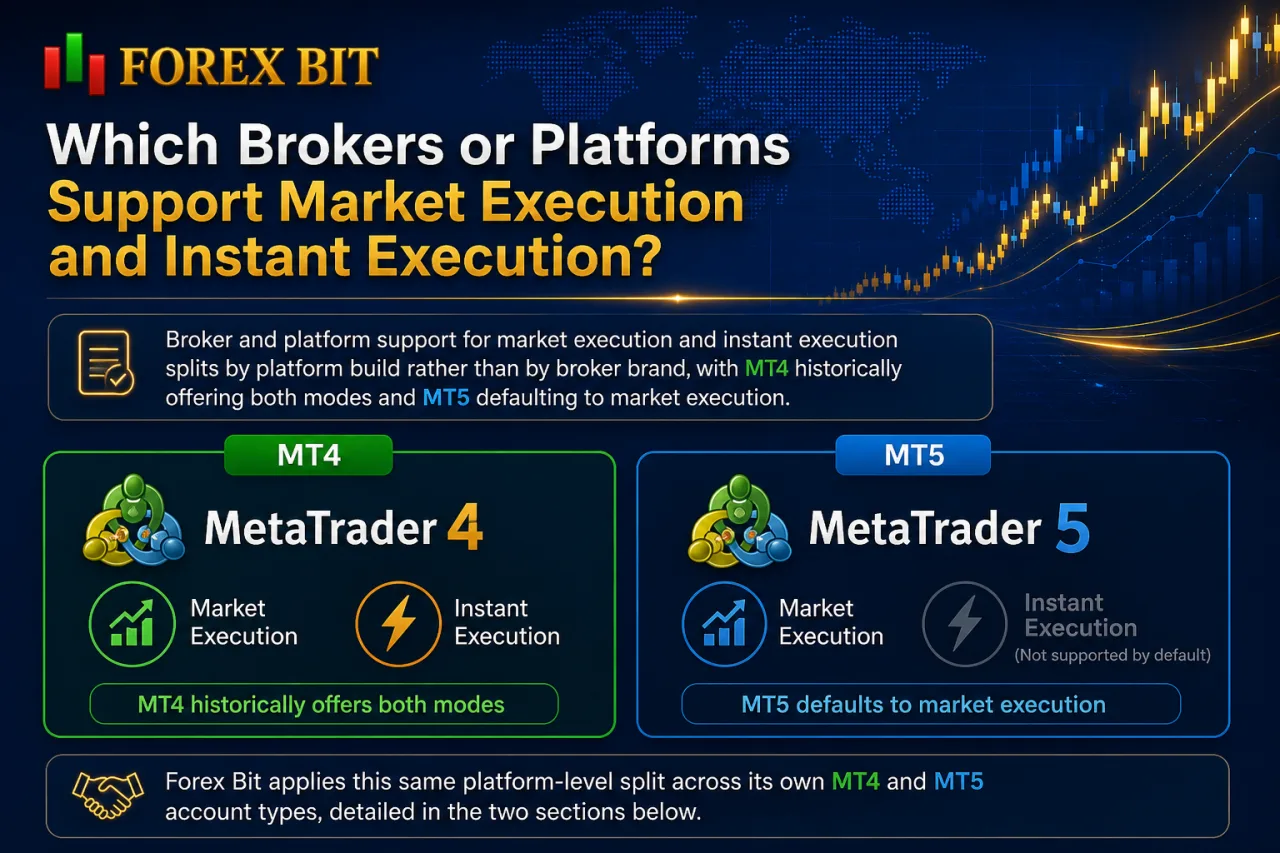
Broker and platform support for market execution and instant execution splits by platform build rather than by broker brand, with MT4 historically offering both modes and MT5 defaulting to market execution. Forex Bit applies this same platform-level split across its own MT4 and MT5 account types, detailed in the two sections below.
Does MT4 Support Both Market and Instant Execution?
Yes, MT4 supports both instant and market execution, since the platform’s build allows a broker to configure either mode at the server level rather than locking it to one method. This confirms the platform-level flexibility referenced earlier regarding MT4’s dual-execution capability.
Forex Bit’s MT4 setup follows this same server-configuration pattern, with the execution mode tied to the specific account type or server a trader connects to rather than a universal platform default. A few points clarify how this works in practice:
- Assigns execution mode at the server or account level, not as a global MT4 setting the trader adjusts manually.
- Runs instant execution on account types built around fixed-price confirmation and requote handling.
- Runs market execution on account types built around faster fills without a price-confirmation checkpoint.
Traders should check the specific execution mode tied to each MT4 account type directly on the broker’s account specifications page before opening an account. Traders confirm which mode applies before opening a position, since the same MT4 terminal behaves differently depending on the server configuration behind the account.
Does MT5 Use Market Execution by Default?
Yes, MT5 uses market execution by default, since the platform’s architecture routes orders through an exchange-style matching model rather than the quote-confirmation checkpoint MT4 supports. This confirms the earlier point that MT5 setups generally default to market execution across most broker configurations, and it extends into how Forex Bit’s own MT5 offering handles order flow.
MT5’s design favors this default for a few structural reasons:
- Builds order handling around an exchange-style matching engine, closer to how centralized markets process trades than MT4’s dealer-desk-style quote model.
- Removes the fixed-price confirmation step by default, filling orders at the next available price instead of checking against one locked quote.
- Aligns with multi-asset order books, where instruments beyond forex trade through market depth rather than single-quote streams.
Forex Bit’s MT5 account types follow this same market-execution default, consistent with the platform’s broader architecture. Traders should verify the exact execution setting tied to each MT5 account type directly on the broker’s account specifications page before opening a position.
What Advanced Execution Factors Should Traders Check Beyond Market vs Instant Execution?
Traders should check three additional factors beyond the core execution comparison: liquidity provider setup, average execution speed, and Depth of Market access, since these technical elements shape actual fill quality on Forex Bit’s platforms regardless of whether an account runs market or instant execution. These factors sit deeper in the execution chain than the market-versus-instant distinction covered earlier, and each one deserves separate due-diligence attention before opening a live position.
How Does Liquidity Provider Infrastructure Affect Execution Quality?
Liquidity provider infrastructure affects execution quality by determining how many price streams a broker aggregates before filling an order. Deeper aggregation narrows spreads and reduces the frequency of slippage and requotes. This connects directly to the market-versus-instant comparison covered earlier, since both execution models draw their fill prices from the same underlying liquidity pool. Traders should verify Forex Bit’s specific liquidity provider setup and server location directly on the broker’s official infrastructure or legal documentation page, since this level of technical detail requires first-party confirmation.
- Aggregates multiple liquidity sources into one price feed, reducing the gap between quoted and filled prices.
- Places server infrastructure closer to liquidity provider data centers, cutting the latency window where price shifts trigger slippage or requotes.
- Feeds thinner liquidity into wider spreads and slower confirmation, raising requote frequency on instant-execution accounts.
Server proximity and feed depth sit beneath the execution model itself, shaping how consistently either market or instant execution performs under real trading conditions.
Does Depth of Market Data Improve Execution Decisions?
Yes, Depth of Market data improves execution decisions, since visible order book levels let traders anticipate slippage and liquidity gaps before an order routes for a fill. This directly addresses the DOM question raised by the heading, extending the liquidity-provider infrastructure point covered earlier.
DOM adds a layer of visibility that neither market nor instant execution exposes on its own:
- Displays multiple bid and ask levels beyond the top-of-book quote, showing where liquidity thins out at deeper price points.
- Flags thin order book levels ahead of a trade, signaling where slippage risk rises on market-execution fills.
- Surfaces liquidity gaps before submission, helping traders judge whether an instant-execution order faces higher requote risk at that moment.
Traders should verify DOM availability across Forex Bit’s supported platforms directly on the broker’s official platform pages, since access to this tool varies by account type and platform build.
Conclusion
Market execution and instant execution fill orders through fundamentally different checkpoints, and that single distinction drives every practical outcome traders notice: market execution absorbs price movement as slippage and keeps orders moving, while instant execution locks the fill to an exact quote and rejects or requotes when that quote shifts.
Scalpers gain from the speed and continuity of market execution, hedgers gain from the price certainty of instant execution, and platform choice narrows the decision further, since MT4 configures either mode per account while MT5 defaults to market execution. Checking account specifications, liquidity setup, and DOM access rounds out an informed execution choice.
Isabella Brown is the Forex Trading Guide Manager at Forex Bit, focusing on educational content about broker safety, trading costs, account types, platforms, and key Forex/CFD concepts. Her work helps readers understand trading terms, broker conditions, and practical checks before evaluating or using a brokerage service.
Email: [email protected]



Best Brokers

Trade with the world’s largest retail broker and benefit from better - than - market conditions.

We offer a superior trading environment that puts traders in the best position to profit.

Trade with the best trading conditions. WIN THE BEST TRADING ACCOUNT AWARD.

Trade global markets with Interactive Brokers – a highly regulated multi-asset broker built for active and professional investors.






Forex Bit provides independent forex broker reviews, comparisons, guides, and industry news to help traders make informed decisions.
Best Brokers
Metatrader 5 Brokers
Metatrader 4 Brokers
Lowest Spread Forex Broker
Regulated Forex Brokers
Forex Copy Trading
Ctrader Brokers
Best Forex Broker For Beginners