


- Multi-entity regulation
- Segregated funds & negative balance protection
- Multiple account types for different traders
- Supports MT4, MT5 & FBS Trading App
- 24/7 multi-channel customer support
- Offshore clients get weaker protection
- Leverage varies by regulatory entity
- Bonus terms can be restrictive
- Payment methods vary by region
- Not equally protected across all jurisdictions
FBS operates as a global forex and CFD broker offering multi-asset trading through several regulated entities. This review breaks down FBS’s regulation, safety standing, account conditions, and support quality to help traders decide if it fits their 2026 trading needs.
FBS holds licenses from financial regulators, which places client funds and trading activity under formal oversight. This regulatory framework is a key factor in assessing whether FBS is safe and legitimate for live trading.
FBS provides a range of account types, including Standard, Cent, and Zero Spread options, which generally differ in terms of spreads, leverage, and minimum deposit requirements. Comparing these accounts side by side clarifies which suits scalpers, beginners, or high-volume traders.
FBS supports deposits and withdrawals through multiple payment options, such as bank transfers, e-wallets, and local payment methods, alongside customer support channels available around the clock. Response times and available contact options directly affect how quickly trading issues get resolved.
Forex Bit examines these factors in depth below, starting with what FBS is and whether it qualifies as a trustworthy broker in 2026.
What Is FBS and Is It a Trustworthy Forex Broker in 2026?
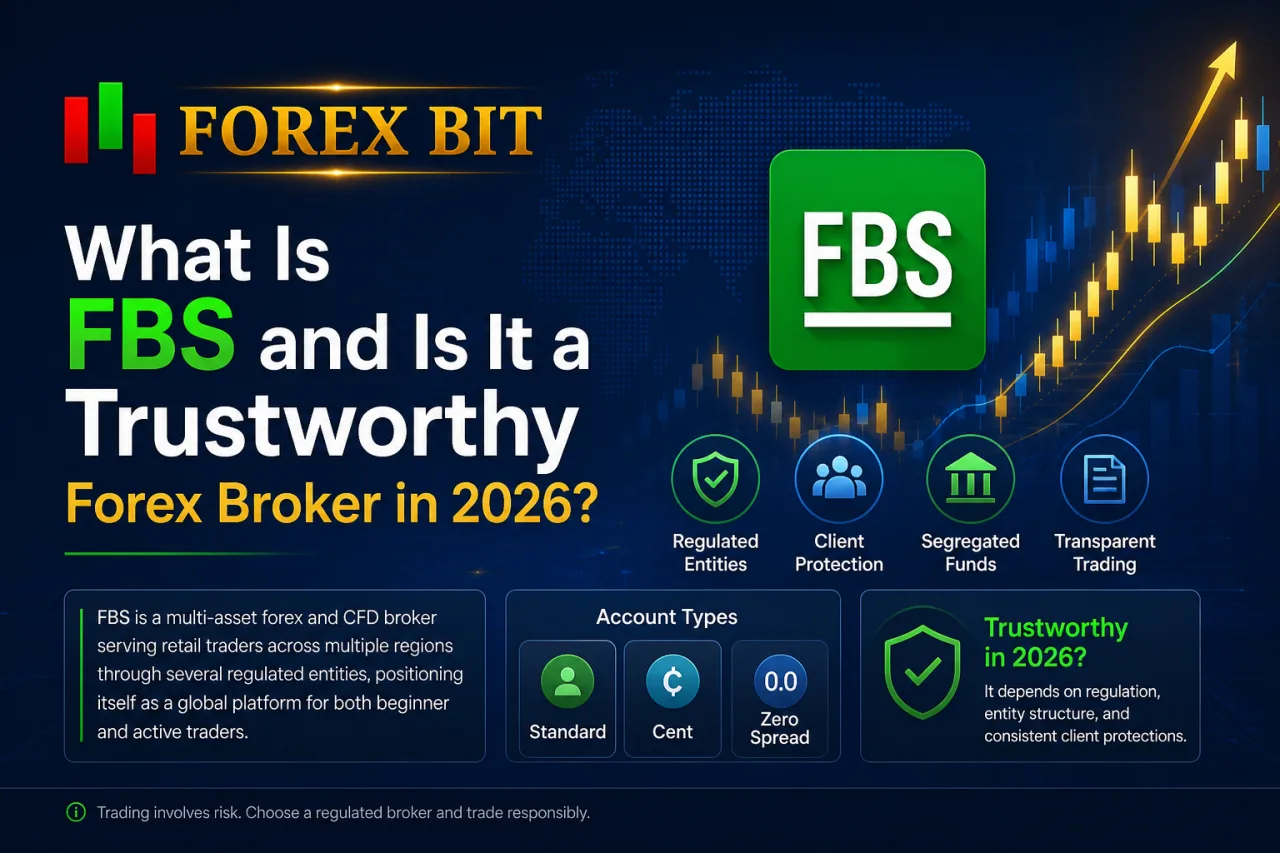
FBS is a multi-asset forex and CFD broker serving retail traders across multiple regions through several regulated entities, positioning itself as a global platform for both beginner and active traders.
Whether FBS qualifies as trustworthy in 2026 depends on its regulatory backing, entity structure, and how consistently it applies client protections across the markets it serves. The sections below examine FBS’s licensing status, the account types built around Standard, Cent, and Zero Spread offerings, and the support and payment infrastructure already outlined, to determine how these elements combine to support a safety assessment.
Is FBS a Legit and Regulated Broker?
Yes, FBS operates as a legit and regulated broker, since its group companies hold licenses from multiple financial authorities that oversee client fund handling and trading conduct.
This licensing structure directly answers whether FBS qualifies as safe, since regulatory tiering determines the level of protection applied to each client group.
- FBS entities regulated by CySEC serve clients across the European Economic Area under stricter capital and reporting rules.
- FBS entities licensed by offshore regulators onboard clients from regions outside the EU, UK, and Australia, typically under lighter compliance requirements.
- FBS entities authorized in other jurisdictions handle traders in specific local markets, applying leverage and reporting rules set by those regulators.
Traders signing up under a lighter-regulated entity receive fewer statutory protections than those registered under a stricter regulator, since compensation schemes and leverage caps vary by license.
How Does FBS Protect Client Funds and Ensure Safety?
FBS protects client funds mainly through segregated bank accounts, negative balance protection, and internal risk controls applied across its regulated entities.
This structure directly addresses how safe FBS keeps client deposits day to day, beyond licensing alone.
- FBS holds client money in segregated accounts separate from company operational funds, preventing trading capital from being used for business expenses.
- FBS applies negative balance protection, which resets an account to zero instead of leaving a trader owing money after extreme market volatility.
- FBS entities regulated by CySEC fall under an investor compensation scheme that can cover eligible EEA clients if the broker becomes insolvent, subject to the scheme’s specific terms and limits.
- FBS applies internal risk-management policies, including margin monitoring and stop-out levels, to limit exposure during sharp price swings.
Clients registered under offshore or locally licensed FBS entities receive fewer formal guarantees, since compensation schemes and fund segregation enforcement typically apply only where a strict regulator like CySEC mandates them.
What Are the FBS Account Types and Which One Suits Your Trading Style?
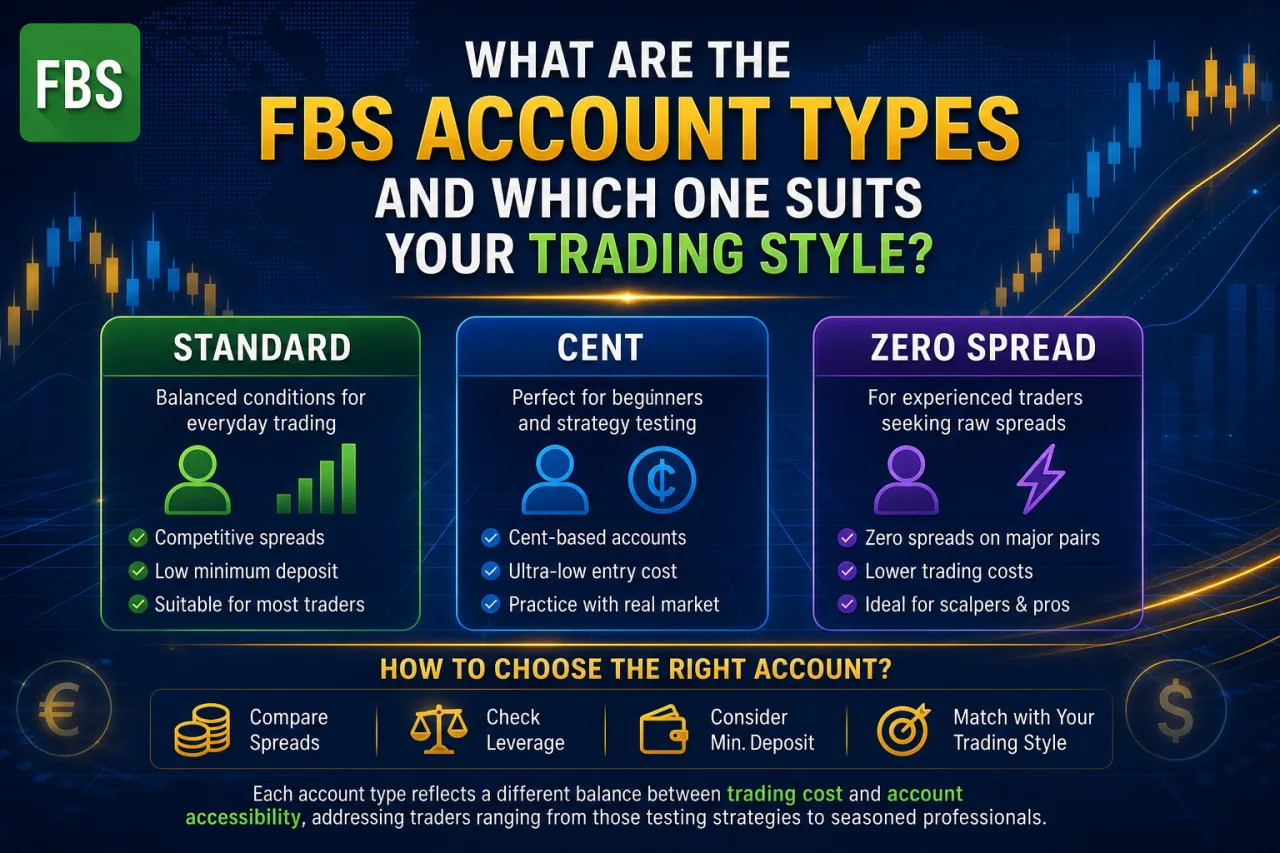
FBS offers several account types built around different spread structures and minimum deposit levels, primarily Standard, Cent, and Zero Spread, each targeting a distinct trader profile.
Matching the right account to a trading style depends on comparing spreads, leverage, and entry cost across these options, which the sections below break down individually. Each account type reflects a different balance between trading cost and account accessibility, addressing traders ranging from those testing strategies with small capital to those executing high-frequency trades that demand tighter pricing. The distinctions in minimum deposit and spread type across FBS’s Standard, Cent, and Zero Spread accounts directly shape which trader profile each option serves.
How Do FBS Account Types Compare in Terms of Spreads and Commissions?
FBS’s Standard and Cent accounts generally run on a spread-based pricing model with no separate commission, while the Zero Spread account pairs tighter floating spreads with a fixed commission per lot, though exact spread ranges and commission rates can vary and should be confirmed on FBS’s official account page.
Comparing these fee structures side by side shows how each account shifts trading cost between the spread and a separate commission charge.
- Standard accounts price trades through variable spreads starting from a floating baseline, with no commission added on top, though exact spread levels can vary and should be confirmed on FBS’s official account page.
- Cent accounts apply spread-only pricing similar to Standard but on micro-lot-sized positions, keeping cost per trade proportionally smaller in dollar terms.
- Zero Spread accounts compress spreads close to zero on major pairs but charge a fixed commission per lot traded, shifting the cost structure from the spread to a transparent per-trade fee, though the exact commission rate can vary and should be confirmed on FBS’s official account page.
Scalpers and high-frequency traders generally benefit from the Zero Spread account’s tighter pricing, since predictable commissions make cost calculation easier during rapid order execution. Beginners and low-capital traders typically find the Cent account’s spread-based, commission-free structure more manageable, since there’s no separate fee to track alongside position sizing.
What Leverage Does FBS Offer and How Does It Vary by Region?
FBS offers significantly higher leverage for clients registered under its offshore entity, while traders onboarded through the CySEC-regulated entity are capped at much lower levels in line with EU rules.
This leverage gap directly reflects how much regional regulation shapes what FBS clients can access on the same broker.
- EU-based clients trading under the CySEC entity face leverage limits set by ESMA-style rules, which restrict retail leverage to a much lower level than the offshore maximum, though the exact cap can vary and should be confirmed on FBS’s official terms page.
- Offshore-entity clients access the highest leverage tier, since lighter compliance requirements allow FBS to extend larger ratios on major instruments.
- Locally licensed FBS entities operate under leverage ceilings set by their respective regulators, which can differ from both the CySEC and offshore limits.
Traders should confirm the exact leverage tied to their specific FBS entity before opening an account, since the same account type can carry different maximum ratios depending on the regulator overseeing that registration.
How Do FBS Fees Compare to Industry Standards?
FBS’s overall cost structure runs close to industry norms among retail forex brokers, blending spread-based and commission-based pricing without unusually high non-trading charges. This comparison covers overnight costs and account-holding fees alongside the spread and commission details already outlined for Standard, Cent, and Zero Spread accounts.
- FBS charges swap fees on positions held overnight, applying a rollover rate that varies by instrument and direction, consistent with standard broker practice across the industry, though exact swap rates can vary and should be confirmed on FBS’s official trading conditions page.
- FBS offers swap-free trading through an Islamic account option, removing overnight interest charges for eligible clients.
- FBS does not appear to publicize a recurring inactivity fee on dormant accounts, though traders should confirm current terms on FBS’s official trading conditions page, as fee policies can change over time.
Traders evaluating overall cost typically weigh FBS’s spread-plus-commission model against brokers charging flat commissions with wider spreads, since neither approach is inherently cheaper without factoring in trading frequency. FBS’s absence of a clearly advertised inactivity fee positions it favorably for occasional traders compared to brokers that penalize dormant accounts, though swap costs still apply for anyone holding positions overnight.
What Trading Platforms and Markets Does FBS Offer?
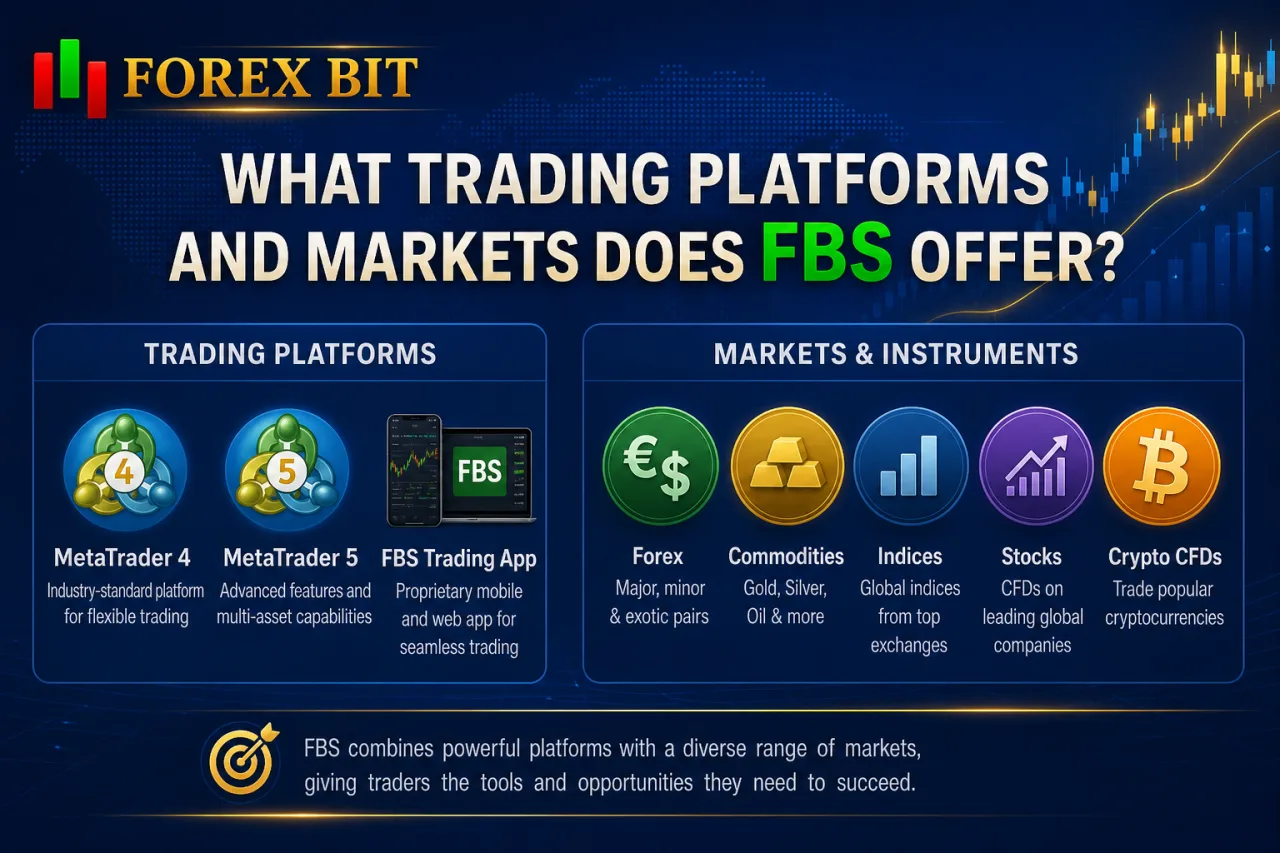
FBS offers a grouping of trading access built around three core layers: MetaTrader 4 and MetaTrader 5, FBS’s own mobile and web trading app, and a multi-asset instrument lineup spanning forex, commodities, indices, stocks, and crypto CFDs. These layers work together to cover both platform preference and market variety, which the following breakdown addresses separately for execution tools and tradable instruments.
MT4 vs MT5 vs the FBS Trading App: Which Platform Should You Choose?
MT5 wins on instrument range and order types, MT4 wins on familiarity and third-party tool support, while the FBS Trading App wins on mobile convenience for account management and quick order placement. Choosing between these three depends on matching platform strengths to the actual trading task, whether that’s charting, automation, or on-the-go monitoring.
- MT4 supports Expert Advisors and a large library of custom indicators built up over years of broker adoption, making it suited to algorithmic and technical traders already using MT4-based scripts.
- MT5 adds a broader set of order types, an economic calendar, and access to a wider instrument list within the same platform, favoring traders who want stocks, commodities, and crypto CFDs alongside forex in one terminal.
- The FBS Trading App runs as FBS’s proprietary mobile and web solution, prioritizing account funding, quick trade execution, and portfolio tracking over deep charting or automation.
- Both MT4 and MT5 install on desktop, iOS, and Android, while the FBS Trading App operates as a lighter mobile-first and web-based alternative.
Traders running automated strategies typically stay with MT4 for its established EA ecosystem, while those trading multiple asset classes lean toward MT5’s expanded market access. Beginners who prioritize simple deposits, withdrawals, and order placement from a phone generally find the FBS Trading App more practical than managing either MetaTrader terminal.
How Do You Deposit and Withdraw Funds With FBS?
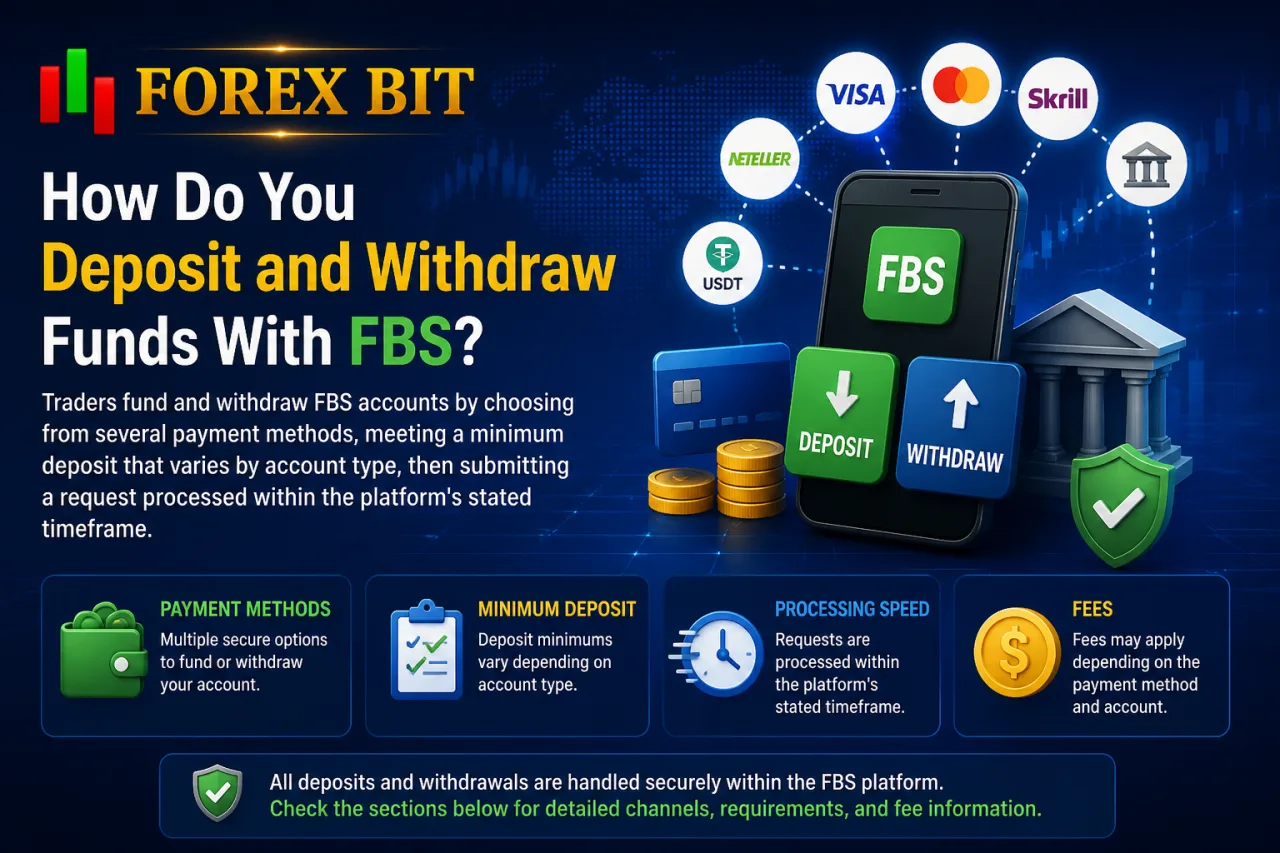
Traders fund and withdraw FBS accounts by choosing from several payment methods, meeting a minimum deposit that varies by account type, then submitting a request processed within the platform’s stated timeframe. This process covers deposit and withdrawal methods, funding minimums, processing speed, and any related fees, with the specific channels and account-level requirements broken down in the sections below.
What Payment Methods Does FBS Support for Different Regions?
FBS supports several categories of payment methods, including bank transfers, cards, and e-wallets, with availability shifting by region based on local regulations and banking infrastructure.
This directly determines which funding channels a trader can actually use, since not every method listed on FBS’s payment page applies to every country FBS serves.
- Bank transfers move funds directly between a trader’s personal bank account and FBS, typically taking longer to clear than e-wallet options.
- Card payments process deposits through Visa or Mastercard, remaining among the most widely accessible options across FBS’s supported regions.
- E-wallets such as Skrill or Neteller offer faster processing for both deposits and withdrawals compared to bank transfers, though exact providers can vary and should be confirmed on FBS’s official payment page.
- Local payment methods cover region-specific options, including certain mobile money or domestic transfer systems, available only to clients in the countries where FBS has enabled them.
Availability of any given method depends on the client’s registered country and which FBS entity handles that region, since local banking regulations can restrict certain channels entirely, so traders should confirm accepted options for their specific region on FBS’s official payment page. Traders confirm supported options for their specific location directly on FBS’s official payment page before funding an account.
How Can You Contact FBS Customer Support?
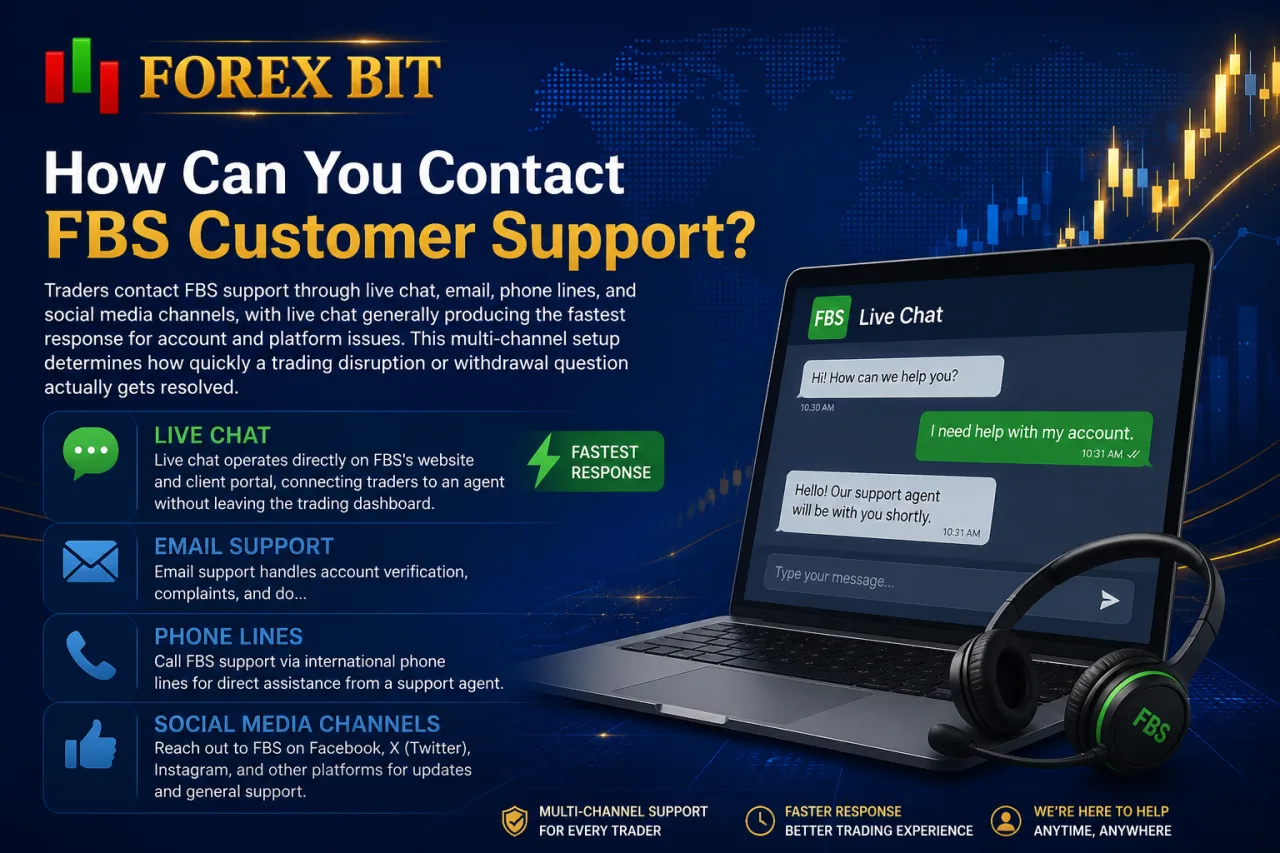
Traders contact FBS support through live chat, email, phone lines, and social media channels, with live chat generally producing the fastest response for account and platform issues. This multi-channel setup determines how quickly a trading disruption or withdrawal question actually gets resolved.
- Live chat operates directly on FBS’s website and client portal, connecting traders to an agent without leaving the trading dashboard.
- Email support handles account verification, complaints, and documentation requests that need a written record.
- Phone support covers urgent account or funding matters for traders who prefer a direct conversation over chat.
- Social media channels, including messaging apps and platforms FBS maintains for regional audiences, offer an alternative contact point outside standard support tickets.
FBS advertises customer support across multiple languages to serve its international client base, though the exact language list can vary and should be confirmed on FBS’s official support page.
Support hours run on a broad daily schedule rather than limited business-hours coverage, based on FBS’s own service description. Trader feedback on responsiveness generally points to quicker resolution through live chat compared to email, which can take longer when documentation review is involved.
What Unique Features and Programs Set FBS Apart From Other Brokers?
FBS separates itself from other brokers through four programs outside core trading conditions: a cashback/loyalty scheme, deposit and trading bonuses, an affiliate/IB partnership structure, and a trader education ecosystem built around webinars, analytics, and the FBS Trader app. These layers add value beyond spreads and account types already outlined, giving both new and active traders extra reasons to stay within the FBS ecosystem. The sections below break down each program individually, covering how rewards accumulate, which promotions carry regional restrictions, how the IB structure pays out, and what educational tools accompany a live account.
Are FBS Bonuses and Promotions Worth Considering?
FBS bonuses and promotions carry conditional value, since eligibility restrictions and withdrawal terms often limit how freely traders access the promotional funds.
Assessing whether these offers actually benefit a trading account requires looking past the headline reward toward who qualifies and what strings attach to it.
- FBS runs deposit bonuses and trading-related promotions that add extra funds or credit to a qualifying account, though the exact current offers can vary and should be confirmed on FBS’s official promotions page.
- Eligibility for these promotions narrows by country and by regulatory entity, since CySEC-regulated clients typically face tighter restrictions on bonus-style incentives than clients registered under offshore entities, so traders should confirm which offers apply to their specific region on FBS’s official promotions page.
- Withdrawal conditions tied to bonus funds commonly require a minimum trading volume before any bonus-linked profit becomes withdrawable, reducing the immediate usability of the credited amount, though exact volume requirements and lock-in conditions can vary and should be confirmed on FBS’s official promotions page.
Traders evaluating these programs should read the specific terms attached to each promotion before opting in, since volume requirements and regional exclusions determine whether the bonus adds real trading value or mostly restricts fund flexibility.
Who Is FBS Best Suited For Compared to Other Global Brokers?
Beginners, cost-conscious traders, and IB-focused affiliates fit FBS best, while traders prioritizing top-tier regulatory protection generally suit brokers licensed under stricter single-jurisdiction frameworks. This suitability split ties directly back to the account structure, leverage tiers, and licensing gaps already outlined across FBS’s entities.
- Beginners benefit from the Cent account’s micro-lot sizing, which keeps early losses small while learning order execution on MT4 or MT5.
- Cost-conscious traders gain from the Zero Spread account’s transparent per-lot commission, avoiding wider variable spreads during active trading hours.
- IB-focused traders and affiliates capitalize on FBS’s partnership structure, which pays out based on referred client activity rather than personal trading volume alone.
- Traders seeking maximum statutory protection often prefer brokers regulated solely under a single strict authority, since FBS’s offshore-entity clients receive fewer compensation guarantees than those under its CySEC entity.
Overall, FBS positions itself as a flexible, multi-tier broker suited to traders who value account variety and cost control over uniform regulatory strength across every region it serves.
Conclusion
FBS earns its safety standing through multi-entity licensing, segregated client funds, negative balance protection, and a compensation scheme available to CySEC-registered clients, though offshore entities carry lighter safeguards. Its tiered account lineup, blended fee model, MetaTrader-plus-app platform access, region-based payment coverage, and round-the-clock support channels round out a broker built for flexibility rather than uniform protection everywhere.
FBS qualifies as a legitimate, tradable choice for beginners, cost-conscious traders, and IB partners, provided each trader verifies which entity, leverage cap, and account terms apply to their registered region before funding an account, since protection levels and conditions shift depending on the FBS entity involved.
Thomas Dite is the Best Forex Brokers Research Manager at Forex Bit, specializing in researching, comparing, and editing broker-related content for different trader needs. He focuses on evaluating trading platforms, costs, regulation, account conditions, and other key factors to help readers make more informed broker comparisons.
Email: [email protected]