


- Top-tier multi-jurisdiction regulation
- Very broad multi-asset market access
- Competitive pricing for active traders
- Advanced TWS, API & algo trading tools
- Strong investor protection and transparency
- Steep learning curve for beginners
- TWS interface can feel complex
- Market data fees may apply
- Forex pricing favors active traders more
- Funding methods are more limited than retail brokers
Interactive Brokers ranks among the largest multi-asset brokers globally, operating under oversight from multiple financial regulators across the jurisdictions in which it operates. This regulatory footprint makes it a legitimate option for Forex and multi-asset traders evaluating brokers for 2026.
Interactive Brokers fees rely mainly on low per-share and tiered commission pricing rather than wide spread markups, which tends to result in lower costs than standard commission-based competitors on active trading volume. Spread costs on Forex pairs remain tight but vary by account tier and liquidity provider.
Interactive Brokers holds investor protection coverage in the jurisdictions where it operates, with the applicable scheme depending on the entity and region through which an account is opened. Traders are advised to verify the exact protection scheme tied to their specific account entity directly with Interactive Brokers. Account types include IBKR Lite and IBKR Pro, each carrying distinct fee structures and access levels.
Beginner and intermediate traders access markets through Trader Workstation, IBKR Mobile, and Client Portal, alongside a minimum deposit requirement that can vary depending on account type and region. Forex Bit examines these platforms and market access details further in this review.
This review, part of Forex Bit‘s broker analysis series, breaks down these findings starting with what Interactive Brokers actually is and whether it qualifies as a legitimate broker to trade with in 2026.
What Is Interactive Brokers and Is It a Legitimate Broker to Trade With in 2026?

Yes, Interactive Brokers qualifies as a legitimate broker for 2026, operating as a publicly listed, multi-asset brokerage serving retail and institutional clients across global markets. This overview addresses the broker’s background and standing before the sections below break down its platforms, fees, and account structure in detail.
Interactive Brokers Review coverage consistently points to the firm’s scale and market presence as core legitimacy signals. Interactive Brokers is a publicly traded company, which brings public financial reporting obligations that add a layer of transparency uncommon among privately held Forex brokers.
Beyond its listing status, several factors support its legitimacy:
- Decades-long operating history serving traders across multiple continents.
- Access to Forex, stocks, options, futures, bonds, and funds through a single account.
- Regulatory oversight spanning multiple jurisdictions rather than a single offshore license.
- Public disclosure requirements tied to its exchange listing.
These combined traits distinguish Interactive Brokers from smaller, less transparent Forex-only brokers operating in the same competitive space.
How Is Interactive Brokers Regulated and What Licenses Does It Hold?
Interactive Brokers operates through multiple regulated entities, holding licenses from top-tier regulators such as the SEC and FINRA in the US, the FCA in the UK, and additional authorities across the EU, Asia-Pacific, and other regions where it accepts clients. This multi-entity structure directly shapes which investor protections and account terms apply based on a trader’s country of residence.
Each regional entity operates under its home regulator’s specific rules rather than a single global license.
- SEC and FINRA: oversee Interactive Brokers LLC in the United States, covering securities and futures activity.
- FCA: The UK entity is authorized and regulated, applying local conduct and capital rules.
- CySEC and other EU regulators: supervise entities serving clients within the European Economic Area.
- ASIC: regulates the Australian entity offering derivatives and Forex products to local clients.
- MAS: licenses the Singapore entity serving clients across the Asia-Pacific region.
Traders get matched to a specific entity depending on their declared country of residence during account opening, which determines applicable investor protection schemes and product access.
Is Interactive Brokers Safe for Client Funds and Data?
Yes, Interactive Brokers qualifies as safe for client funds and data, backed by segregated client accounts, investor protection coverage, and a strong balance sheet. Segregation of client assets, insurance schemes, financial stability, and account-level security controls each play a distinct role in this safety profile.
Client funds sit apart from Interactive Brokers’ own operating capital, held in segregated accounts at qualified custodians rather than mixed with corporate assets. Client cash and securities carry investor protection coverage that varies by jurisdiction, with the broker arranging supplemental insurance beyond the statutory base level.
The broker’s safety profile rests on several distinct layers:
- Fund segregation: client assets held separately from corporate capital at qualified custodians.
- Insurance coverage: statutory investor protection topped up with supplemental broker-arranged insurance.
- Financial transparency: as a publicly listed firm, Interactive Brokers discloses capital ratios and financial statements that traders can review independently, reducing reliance on unverified claims of solvency.
- Data security: two-factor authentication, encrypted login sessions, and account activity monitoring limit unauthorized access.
Combined, these layers form the core of the broker’s safety standing for Forex and multi-asset clients.
What Account Types Does Interactive Brokers Offer for Forex and Multi-Asset Trading?
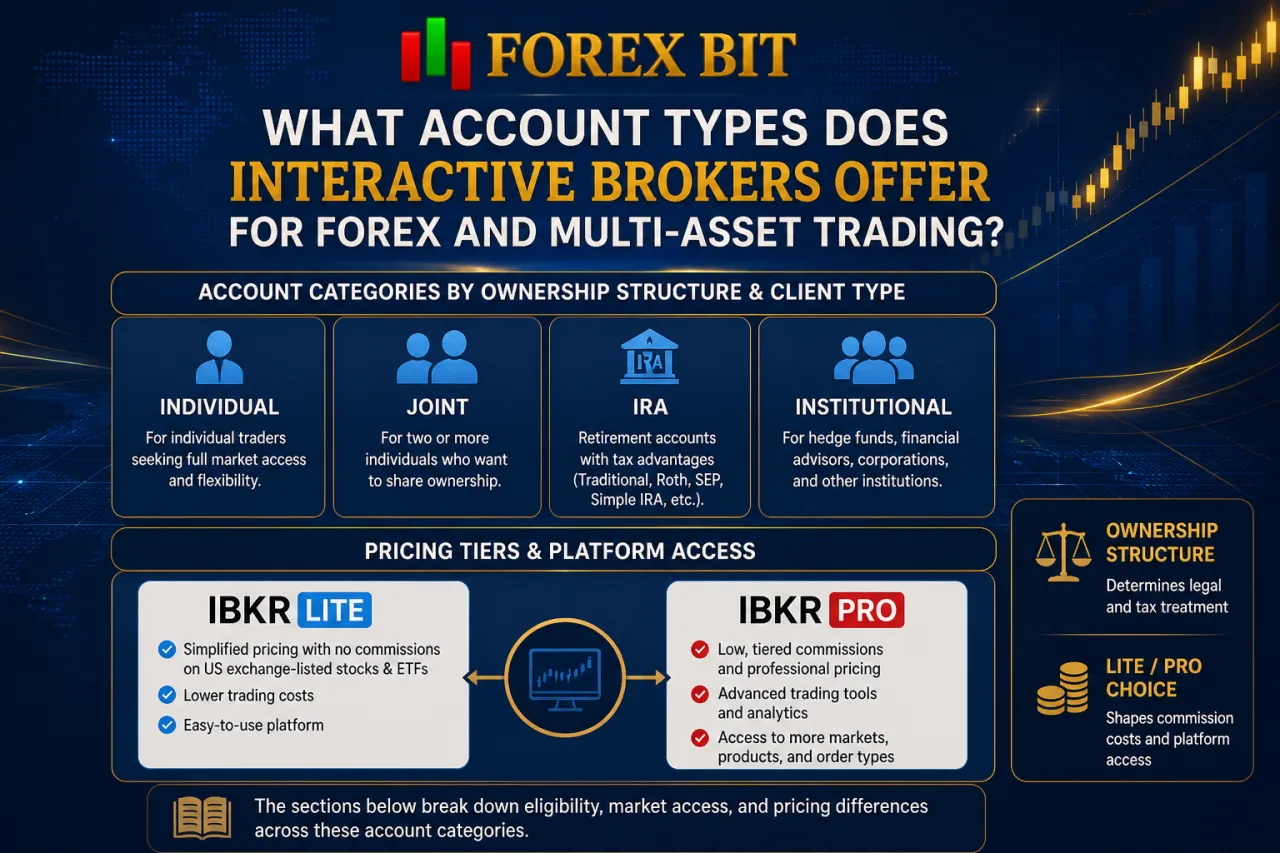
Interactive Brokers offers several account categories grouped by ownership structure and client type, including Individual, Joint, IRA, and Institutional accounts, plus the separate IBKR Lite and IBKR Pro pricing tiers layered on top. Ownership structure determines legal and tax treatment, while the Lite/Pro choice shapes commission costs and platform access. The sections below break down eligibility, market access, and pricing differences across these account categories.
IBKR Lite vs IBKR Pro: Which Account Type Fits Different Trader Profiles?
IBKR Pro suits active and cost-sensitive traders through commission-based pricing and full platform access, while IBKR Lite fits casual traders seeking commission-free US stock and ETF trades with simplified tools. This split shapes which platform tier matches a trader’s activity level and market focus.
Commission structure marks the clearest divide between the two tiers. IBKR Pro charges per-share or tiered commissions across asset classes, including Forex, while IBKR Lite waives commissions on US-listed stocks and ETFs but folds costs into wider execution spreads.
Platform and data access also diverge:
- IBKR Pro unlocks direct market access, advanced order routing, and full Trader Workstation functionality.
- IBKR Lite limits order routing options and directs trades through simplified execution paths.
- Pro accounts gain access to premium market data subscriptions across additional exchanges.
- Lite accounts receive basic market data suited to occasional stock and ETF activity.
Forex traders and volume-driven strategies generally align with IBKR Pro’s broader market and platform access, while buy-and-hold equity investors find IBKR Lite sufficient for straightforward trading needs.
What Is the Minimum Deposit Required to Open an Interactive Brokers Account?
Interactive Brokers sets no fixed minimum deposit for standard cash accounts, though margin accounts carry a separate minimum equity requirement tied to regulatory rules.
This deposit requirement varies depending on account category and the trader’s country of residence, since each regulated entity applies its own funding rules.
- Cash accounts: generally open without a mandatory minimum funding threshold.
- Margin accounts: require maintaining minimum equity levels set by regulators once trading begins.
- IBKR Lite and IBKR Pro: apply the same funding thresholds within a given region, since the tiers differ by commission structure rather than deposit size.
- Retirement and institutional accounts: IRA and institutional accounts carry distinct funding conditions tied to account purpose.
Traders opening a Forex-focused Pro account typically need enough capital to meet margin requirements on chosen currency pairs rather than a flat entry deposit, making actual funding needs dependent on position sizing and leverage used.
How Do Interactive Brokers Fees, Spreads and Commissions Compare to Other Brokers?
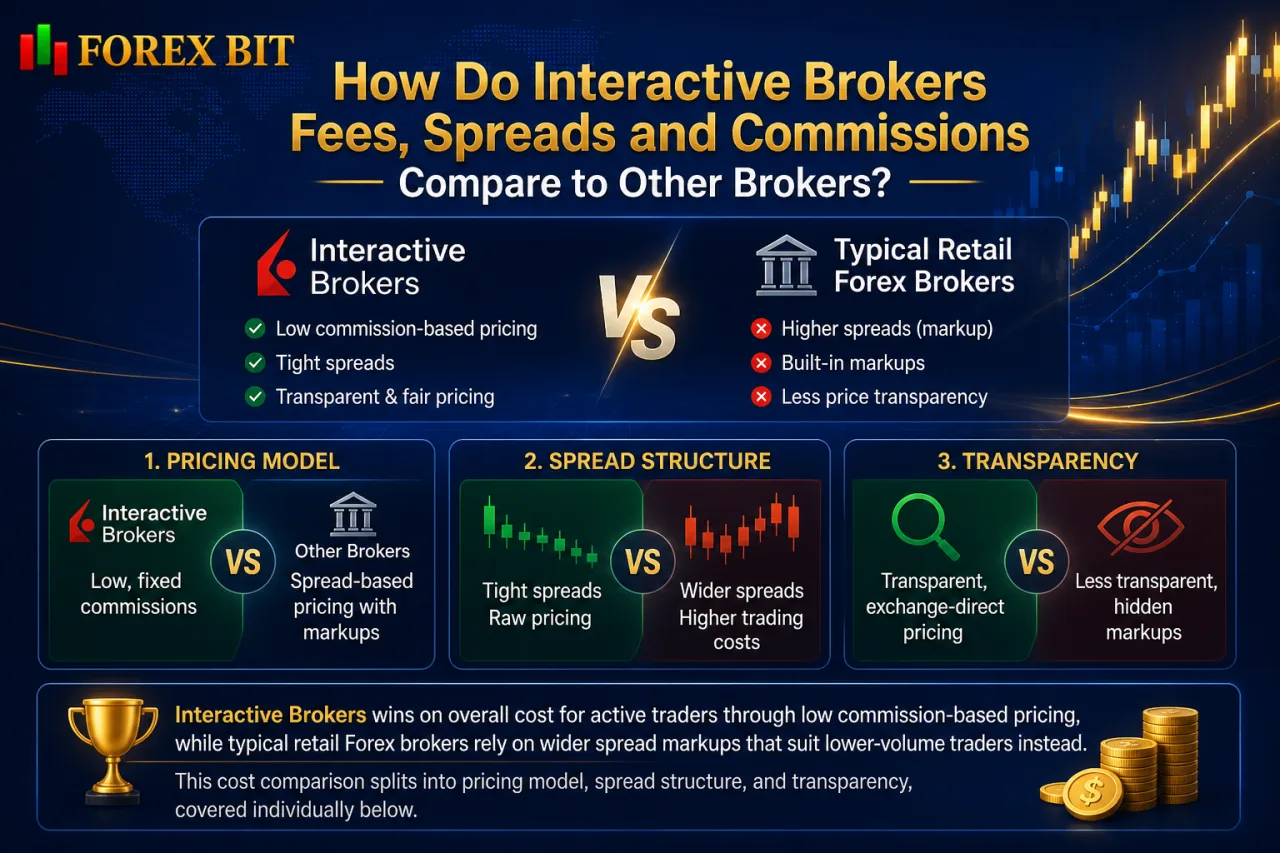
Interactive Brokers wins on overall cost for active traders through low commission-based pricing, while typical retail Forex brokers rely on wider spread markups that suit lower-volume traders instead. This cost comparison splits into pricing model, spread structure, and transparency, covered individually below.
What Are the Main Trading and Non-Trading Fees Charged by Interactive Brokers?
Interactive Brokers charges five main fee categories: per-trade commissions, financing and margin rates, inactivity fees, currency conversion fees, and market data fees. Each category applies differently depending on account tier and trading activity, covered individually below rather than folded into a single spread markup.
- Commissions: Apply per share or per contract on IBKR Pro, scaling down at higher monthly volumes.
- Financing rates: Determine the cost of borrowing on margin positions, tied to a benchmark rate plus a spread that narrows at larger balances.
- Inactivity fees: Certain historical fees no longer apply as a standalone charge under current account terms.
- Currency conversion fees: Apply when trading instruments denominated in a currency different from the account’s base currency.
- Market data fees: Apply as optional subscriptions covering additional exchanges beyond the free tier included with an account.
IBKR Pro accounts bear commissions and full market data costs, while IBKR Lite accounts avoid stock and ETF commissions but face wider embedded spreads instead.
Are Interactive Brokers’ Forex Spreads Competitive for Active Traders?
Yes, Interactive Brokers’ Forex spreads qualify as competitive for active traders, since pricing links directly to interbank rates plus a transparent commission rather than a fixed retail markup. This pricing model directly answers whether spread costs scale favorably with trading volume rather than staying fixed regardless of activity.
Forex execution on IBKR Pro passes through interbank-linked rates, with the broker adding a small commission on top instead of embedding a wide markup into the quoted spread. This structure benefits certain trader profiles more than others:
- High-volume traders gain from commission rates that shrink as monthly Forex volume increases.
- Institutional-style accounts access tighter effective spreads tied closely to underlying interbank liquidity.
- Casual retail traders may find the added commission less favorable than an all-in spread on very small, infrequent trades.
Traders running frequent or large Forex positions typically extract more value from this interbank-plus-commission model than those placing occasional, small-size trades through standard spread-only brokers.
What Leverage and Margin Requirements Apply When Trading with Interactive Brokers?
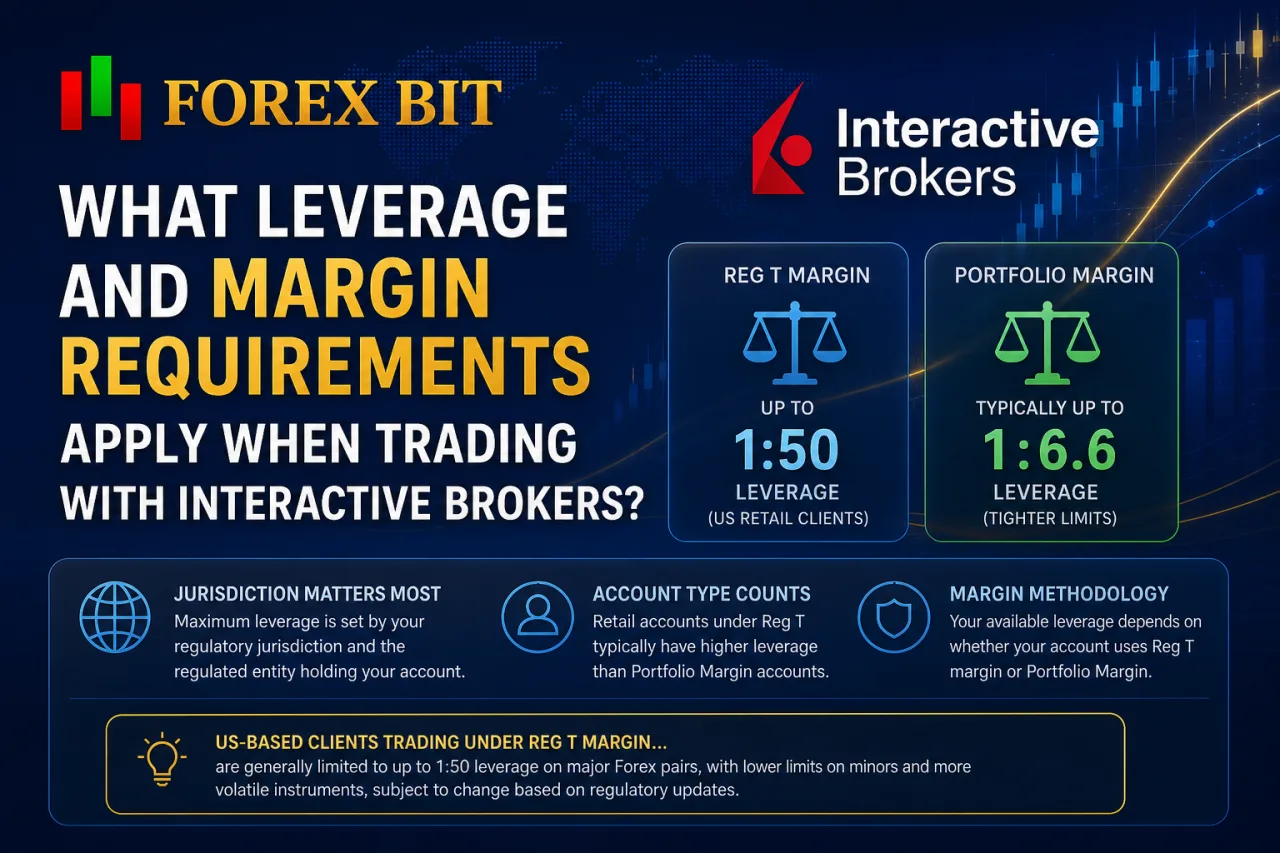
Leverage on Interactive Brokers scales down from standard retail Forex ratios under Reg T margin toward tighter limits under Portfolio Margin, with actual caps set by the client’s regulatory jurisdiction and account type. This leverage-and-margin structure ties directly to which regulated entity handles the account and which margin methodology applies to it.
Jurisdiction plays the largest role in setting maximum leverage on Forex and other instruments. US-based clients trading under Reg T margin rules generally face lower leverage ceilings on Forex positions than clients matched to entities in regions with more permissive retail leverage limits.
Account type shifts margin treatment as well:
- Reg T margin accounts apply fixed percentage requirements per position regardless of portfolio-wide risk.
- Portfolio Margin accounts calculate requirements based on overall portfolio risk, often unlocking higher effective leverage for diversified positions.
- Institutional accounts access margin terms negotiated separately from standard retail schedules.
Higher leverage under Portfolio Margin amplifies both potential gains and potential losses, making risk management a central concern for traders opting into this margin methodology over the standard Reg T structure.
Which Trading Platforms and Tools Does Interactive Brokers Provide?
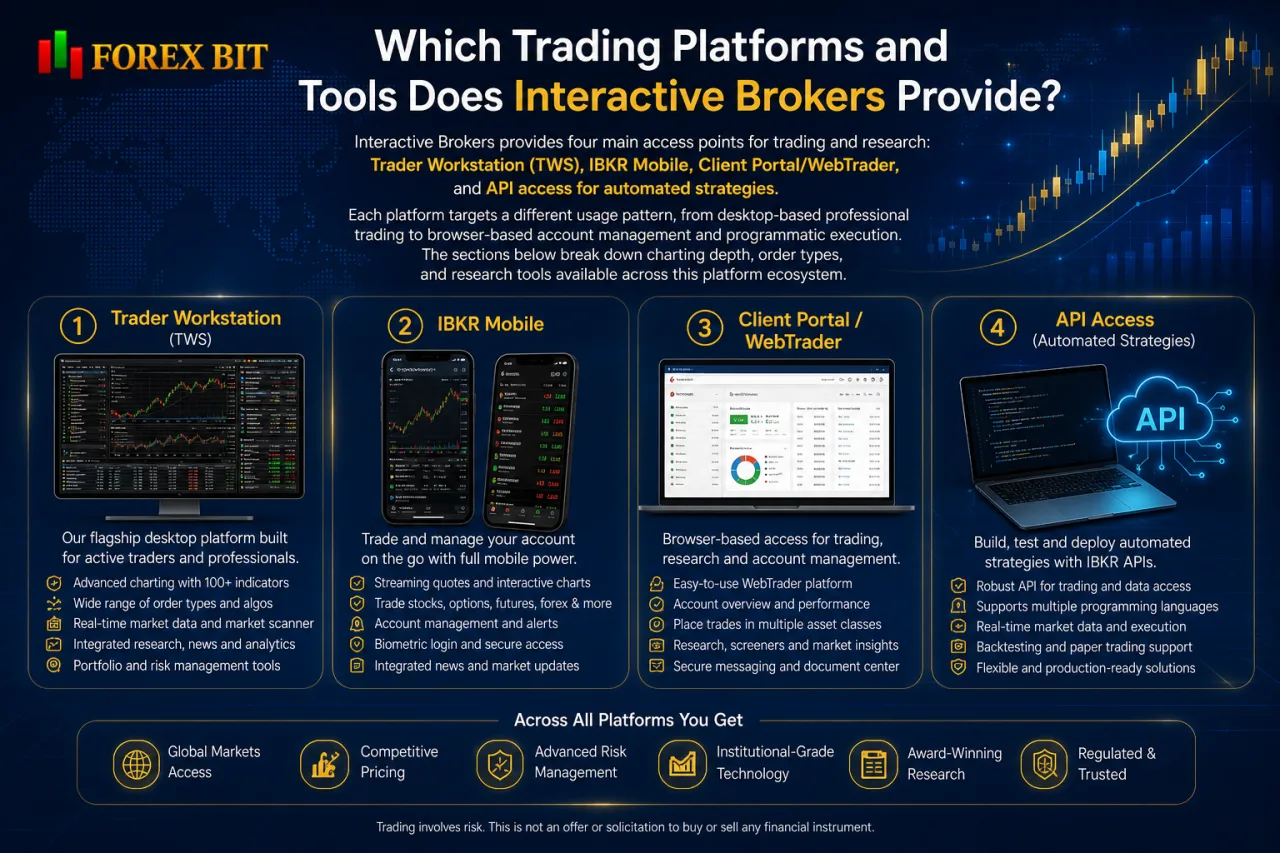
Interactive Brokers provides four main access points for trading and research: Trader Workstation (TWS), IBKR Mobile, Client Portal/WebTrader, and API access for automated strategies. Each platform targets a different usage pattern, from desktop-based professional trading to browser-based account management and programmatic execution. The sections below break down charting depth, order types, and research tools available across this platform ecosystem.
Trader Workstation (TWS) vs Client Portal: Which Platform Suits Different Traders?
Trader Workstation wins on advanced tools and market depth for active traders, while Client Portal wins on simplicity and accessibility for casual, browser-based traders. This split ties directly to trading frequency, asset complexity, and the amount of screen-based control a trader actually needs day to day.
TWS targets professional and high-volume users through its dense, customizable desktop interface:
- Delivers multi-window layouts covering charts, order books, and watchlists simultaneously.
- Supports complex order types, algo trading, and advanced risk analytics tools.
- Requires a steeper learning curve given its depth of configuration options.
Client Portal instead strips down complexity for occasional trading and account management:
- Provides a browser-based interface accessible without software installation.
- Covers basic order entry, funding, and account statements in a streamlined layout.
- Suits traders monitoring positions or executing simple trades without full desktop tools.
Forex traders running multiple concurrent positions typically favor TWS for its order routing depth, while buy-and-hold investors checking balances periodically find Client Portal sufficient without added complexity.
Does Interactive Brokers Support Algorithmic and API Trading?
Yes, Interactive Brokers supports algorithmic and API trading through its IB API, FIX connectivity, and integrations with third-party trading platforms. This capability extends beyond TWS’s built-in tools, giving programmatic traders direct control over order execution and strategy automation.
The IB API covers multiple programming languages, letting developers build custom trading applications that connect directly to Interactive Brokers’ execution infrastructure. FIX connectivity serves institutional and high-volume clients requiring standardized, low-latency order routing between their own systems and the broker.
Third-party integration extends this access further:
- Algo trading platforms connect to Interactive Brokers through supported API bridges for automated strategy execution.
- Quantitative trading tools link account data and order execution to external backtesting and analytics software.
- Excel-based interfaces pull live market data and submit orders through spreadsheet-based API connections.
Forex traders running automated or rules-based strategies gain execution control through this API and FIX infrastructure that manual, platform-only trading through TWS or Client Portal does not offer to the same degree.
What Markets and Instruments Can You Trade Through Interactive Brokers?
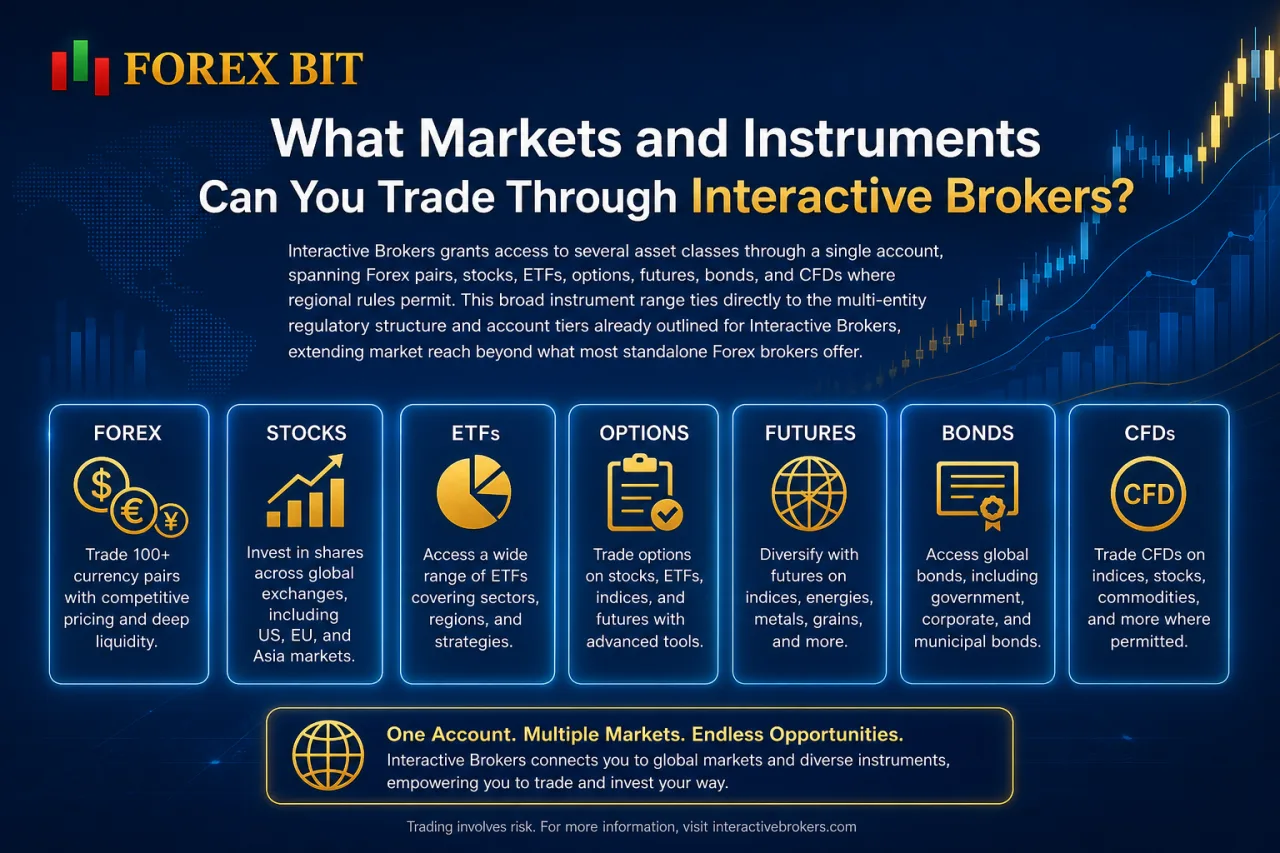
Interactive Brokers grants access to several asset classes through a single account, spanning Forex pairs, stocks, ETFs, options, futures, bonds, and CFDs where regional rules permit. This broad instrument range ties directly to the multi-entity regulatory structure and account tiers already outlined for Interactive Brokers, extending market reach beyond what most standalone Forex brokers offer. The sections below break down currency pair coverage and access to stocks, ETFs, and derivatives markets.
How Many Currency Pairs Can Be Traded on Interactive Brokers?
Interactive Brokers lists a wide range of currency pairs for Forex trading, spanning major, minor, and exotic crosses accessible through IBKR Pro accounts. This pair range answers directly how broad Forex market access runs on the platform relative to standard retail Forex-only brokers.
Coverage splits across three tiers of liquidity and risk profile:
- Major pairs cover the most heavily traded currencies paired against the US dollar, carrying the tightest spreads and deepest liquidity.
- Minor pairs combine non-dollar currencies from developed economies, offering moderate liquidity and slightly wider pricing.
- Exotic pairs pair a major currency against emerging-market currencies, carrying wider spreads and higher volatility.
IBKR Pro accounts access this full pair range, while IBKR Lite accounts face more limited Forex trading functionality given the tier’s focus on US stock and ETF commission-free trading. Traders running diversified currency strategies gain more flexibility from this broader pair selection than from brokers restricting access to majors and a handful of minors alone.
How Do Deposits and Withdrawals Work at Interactive Brokers?
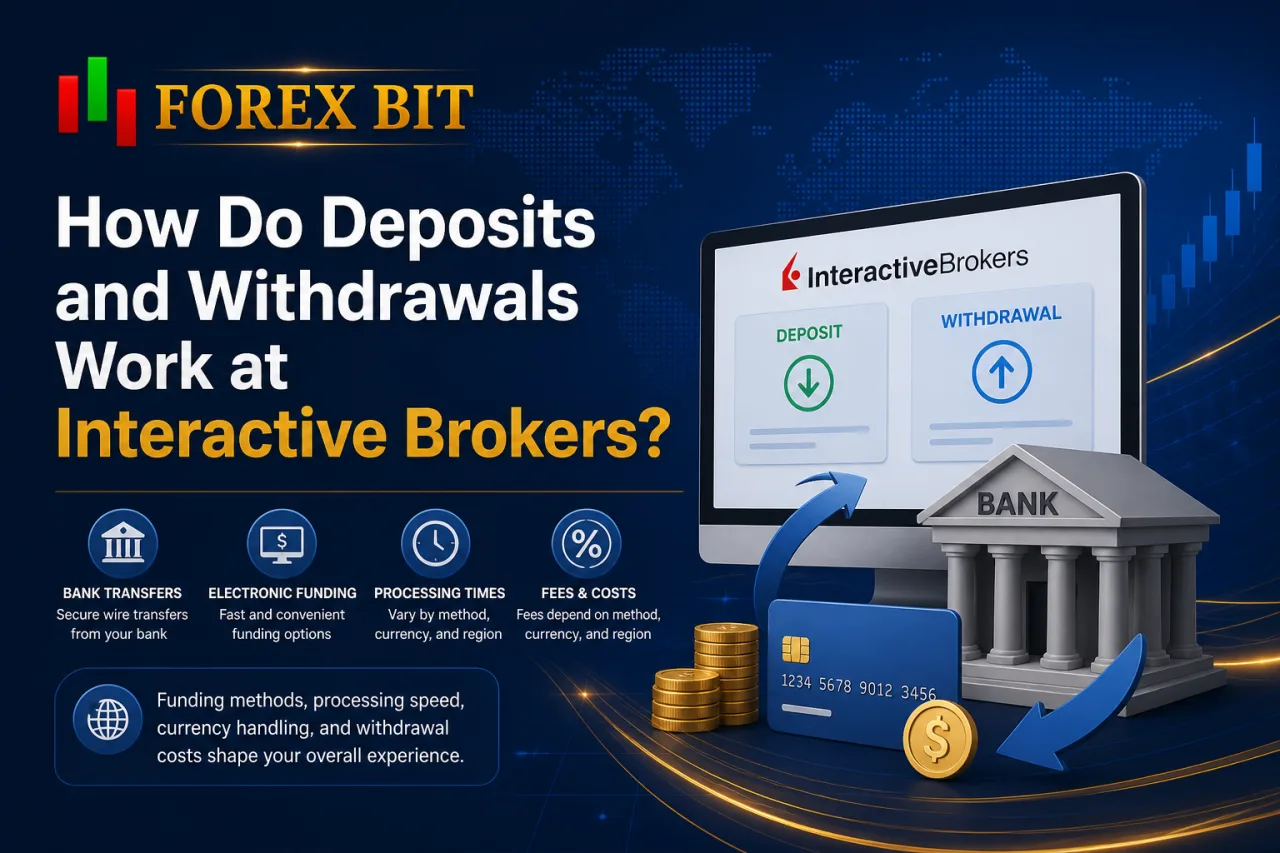
Interactive Brokers processes deposits and withdrawals through bank transfers and electronic funding methods tied to the client’s regional entity, with processing times and fees varying by method and currency. Funding method availability, transfer speed, currency handling, and withdrawal costs each shape the practical funding experience, covered individually below.
What Funding Methods Does Interactive Brokers Accept for Deposits and Withdrawals?
Interactive Brokers accepts bank wire transfers, ACH transfers, and select electronic funding options depending on the client’s country of residence and account entity. This method availability ties directly to which regulated entity handles the account, since regional banking infrastructure determines which channels apply.
- Bank wire transfers cover deposits and withdrawals across most regions, generally settling faster than domestic bank transfers.
- ACH transfers apply to US-based clients linking a domestic bank account for funding.
- Local bank transfer options serve clients in specific regions where the broker maintains banking partnerships.
Card-based funding and third-party e-wallet options remain limited compared to standalone retail Forex brokers. Interactive Brokers publishes deposit and withdrawal methods along with associated fees that vary by region and funding method.
How Long Do Deposits and Withdrawals Take to Process at Interactive Brokers?
Bank wire transfers at Interactive Brokers tend to settle faster than standard domestic transfers, while ACH and local bank methods take longer depending on banking network processing times. Processing speed also depends on verification checks tied to the account’s regulated entity and the currency being transferred.
Multi-currency accounts allow funding and withdrawals in several base currencies, reducing the need for conversion on deposits matching an existing account currency. Withdrawal fees generally stay minimal on standard bank transfers, though currency conversion charges apply when withdrawing in a currency different from the account’s base currency. Interactive Brokers applies specific withdrawal fees along with a free withdrawal allowance that resets on a monthly basis.
Does Interactive Brokers Charge Deposit or Withdrawal Fees?
No, Interactive Brokers does not charge deposit fees on standard funding methods, though withdrawal fees apply once a trader exceeds a monthly free withdrawal allowance. This fee-free policy ties directly to method type, withdrawal frequency, and currency handling.
Deposits through bank wire, ACH, or local bank transfer carry no charge from Interactive Brokers itself, regardless of account tier. Withdrawals work differently:
- Grants: One free withdrawal per calendar month per account.
- Charges: A flat fee on additional withdrawals beyond that free allowance. [[CẦN_DẪN_CHỨNG: mức phí rút tiền cụ thể]]
- Applies: Currency conversion costs when withdrawing in a currency different from the account’s base currency.
- Resets: The free withdrawal count automatically at the start of each new month.
Third-party banking intermediaries may still deduct their own charges on incoming or outgoing transfers, separate from any fee set by Interactive Brokers. Traders withdrawing frequently across multiple currencies face higher overall costs than those consolidating withdrawals into a single monthly transfer in their account’s base currency.
What Customer Support Options Does Interactive Brokers Offer?

Interactive Brokers offers four main support channels: phone support, live chat, email, and a ticketing system through the Client Portal, alongside multilingual coverage and extended service hours. This support structure follows directly from the account and platform setup already outlined for Interactive Brokers, since regional entities also determine which support desk handles a given client’s queries.
Support access splits by channel type and the depth of assistance available:
- Phone support connects clients to regional service desks tied to their account’s regulated entity.
- Live chat handles account and platform questions through the Client Portal during service hours.
- Email and ticketing cover documentation requests, account changes, and issues needing follow-up records.
- Multilingual support: Interactive Brokers serves clients across major regions where it operates, though exact language coverage varies by location.
Interactive Brokers built its support reputation around institutional-grade service rather than extensive beginner hand-holding, since the broker’s platforms and account structure assume a degree of trading self-sufficiency. Traders new to Forex and multi-asset trading sometimes find response depth less tailored to step-by-step guidance compared to brokers marketing heavily toward first-time retail clients. Experienced and active traders instead tend to value this efficiency-focused model, since ticketing and phone channels resolve technical or execution-related queries without extended onboarding-style explanations.
Interactive Brokers vs Other Forex Brokers: What Are the Key Strengths and Weaknesses?
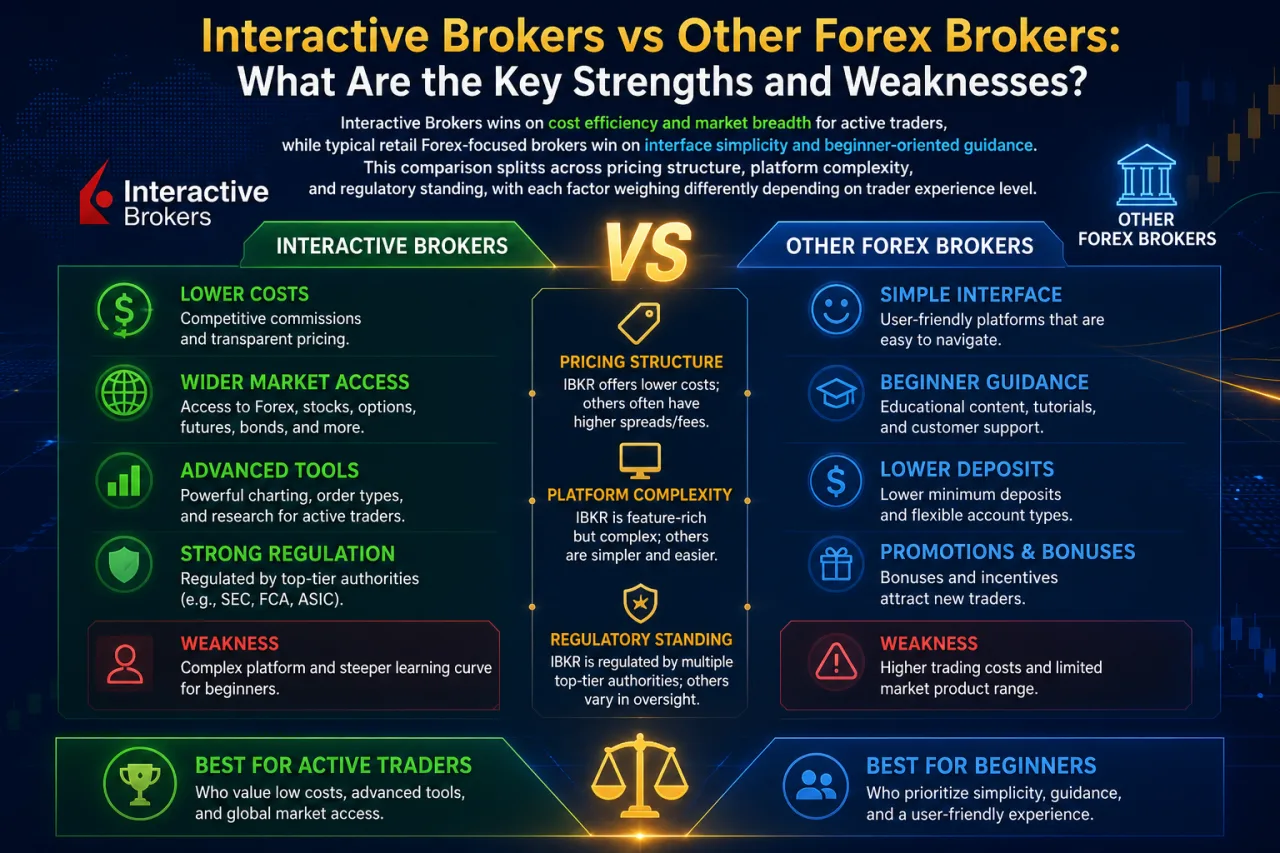
Interactive Brokers wins on cost efficiency and market breadth for active traders, while typical retail Forex-focused brokers win on interface simplicity and beginner-oriented guidance. This comparison splits across pricing structure, platform complexity, and regulatory standing, with each factor weighing differently depending on trader experience level.
Is Interactive Brokers Suitable for Beginner Forex Traders?
Interactive Brokers suits beginner Forex traders only to a limited degree, since its platform depth and account structure favor traders already comfortable with active order execution and multi-asset markets. IBKR Lite and Client Portal lower this barrier somewhat, but the broker’s overall ecosystem still targets self-sufficient traders over first-time newcomers.
Trader Workstation carries a steep learning curve for newcomers given its dense, multi-window layout built for professional and high-volume use. Beginners navigating charts, order books, and watchlists simultaneously face more configuration overhead than platforms built around a single simplified screen.
IBKR Lite and Client Portal reduce this entry barrier through simpler tools:
- Simplifies order entry, funding, and account statements into one browser-based layout.
- Removes commission costs on US-listed stocks and ETFs, easing early-stage cost pressure.
- Limits order routing options compared to the full Pro tier.
- Suits occasional trading and account monitoring over active Forex strategies.
Beginners focused specifically on Forex still encounter IBKR Pro’s per-share and tiered commission structure, since Lite’s simplified access centers on US equities rather than currency pairs. Newcomers prioritizing guided, beginner-oriented Forex tools may find the platform’s institutional-grade design less accommodating than brokers built around step-by-step onboarding.
Is Interactive Brokers a Good Fit for Experienced and Professional Traders?
Yes, Interactive Brokers fits experienced and professional traders well, since its commission-based pricing, broad market access, and platform depth reward high trading volume and multi-asset strategies. This suitability follows directly from the pricing, market breadth, and platform sophistication already outlined for Interactive Brokers, addressing which trader profile benefits most from that structure.
Active traders gain from a fee model that rewards scale rather than penalizing frequency:
- Reduces per-trade commission costs as monthly volume climbs on IBKR Pro.
- Extends market access across Forex, stocks, options, futures, bonds, and funds within one account.
- Delivers interbank-linked Forex pricing that favors large or frequent positions over small, occasional trades.
- Supports algorithmic and API-based execution through IB API and FIX connectivity for systematic strategies.
- Unlocks Portfolio Margin calculations that treat diversified holdings more favorably than fixed Reg T requirements.
Trader Workstation’s dense, multi-window layout suits professionals managing several positions and asset classes simultaneously rather than casual, single-screen trading. Institutional-style accounts also access negotiated margin terms unavailable to standard retail tiers, reinforcing the broker’s orientation toward self-sufficient, high-volume trading rather than beginner-oriented simplicity.
What Unique Research, Education and Global Access Features Does Interactive Brokers Offer Beyond Standard Trading?
Interactive Brokers extends beyond core Forex and multi-asset trading through five niche tools: IBKR GlobalAnalyst, the Impact dashboard, fractional shares, an interest program on idle cash, and a stock yield enhancement program. These features sit outside standard currency trading yet shape overall account value for traders holding diversified portfolios alongside Forex positions. Each tool below addresses a different aspect of research, ESG screening, portfolio efficiency, or idle-cash returns.
Does Interactive Brokers Pay Interest on Uninvested Cash Balances?
Yes, Interactive Brokers pays interest on uninvested cash balances through a tiered rate structure that applies across multiple account currencies rather than just the US dollar. This interest program directly answers whether idle cash sitting in an account generates any return while not deployed into trades.
Interest accrues on the portion of cash balances above a set threshold, with the applicable rate tied to the benchmark rate for each currency held. Balances below that threshold typically earn no interest, while larger balances qualify for a rate that scales with the benchmark.
This structure sets Interactive Brokers apart from many Forex-only brokers, since standard retail Forex accounts rarely pay interest on unused margin cash sitting between trades. Multi-currency accounts extend this benefit further, letting traders earn interest across several currencies simultaneously rather than only on a single base-currency balance.
What Is the IBKR Stock Yield Enhancement Program?
The IBKR Stock Yield Enhancement Program qualifies as a securities lending facility that pays eligible clients extra income for lending fully-paid shares sitting idle in their portfolio. Interactive Brokers borrows these shares to lend to other market participants, crediting the client’s account with a portion of the resulting fee.
Enrollment stays optional and applies only to holdings that qualify under the program’s terms, since not every stock generates sufficient loan demand. Fully-paid shares remain the client’s property throughout the loan, and collateral covers the loaned position for added security.
This feature separates Interactive Brokers from typical retail Forex-only brokers, since standalone currency brokers hold no equivalent mechanism for generating passive income from unused stock holdings. Combined with the interest paid on idle cash balances, this program adds another layer of portfolio efficiency available to multi-asset Interactive Brokers clients beyond standard Forex trading activity.
Conclusion
Interactive Brokers holds up as a legitimate, well-regulated multi-asset broker for 2026, backed by top-tier oversight, segregated client funds, and public financial transparency. Its commission-based pricing and interbank-linked Forex spreads favor active, high-volume traders over casual, small-scale positions, while IBKR Pro’s platform depth and API access reward self-sufficient strategies rather than beginner-style guidance.
IBKR Lite and Client Portal soften the entry barrier for casual users, though Forex-focused newcomers still meet Pro’s commission structure. For traders comparing cost efficiency, market breadth, and regulatory standing against standard retail Forex brokers, Interactive Brokers delivers stronger value for experienced, active, and multi-asset trading profiles.
Thomas Dite is the Best Forex Brokers Research Manager at Forex Bit, specializing in researching, comparing, and editing broker-related content for different trader needs. He focuses on evaluating trading platforms, costs, regulation, account conditions, and other key factors to help readers make more informed broker comparisons.
Email: [email protected]