


- Multi-jurisdictional regulation
- Multiple account types for different traders
- Supports MT4 and MT5
- 24/7 multi-channel customer support
- Flexible trading conditions across account types
- Weaker protection under offshore entities
- Leverage limits vary by jurisdiction
- Higher deposits for commission-based accounts
- Not available to US traders
Exness legitimacy in 2026 depends on its multi-jurisdictional regulatory framework, which includes licenses from a mix of top-tier and offshore financial authorities. This structure allows Exness to serve traders across multiple regions while maintaining varying degrees of investor protection depending on the entity a trader registers under.
Exness offers several account types, each tailored to different trading styles and capital levels. Beginners and high-volume traders can each find an account structure suited to their experience and strategy.
Exness spreads and fees vary by account type, with Raw Spread and Zero accounts are designed to offer tighter spreads than standard accounts, typically paired with a fixed commission charged per lot traded. Standard accounts, by contrast, typically carry wider spreads but no separate commission charge.
Exness supports a broad range of deposit and withdrawal methods, including bank cards, e-wallets, and local payment channels, with availability varying by country. Traders should confirm regional restrictions before opening an account, since Exness does not operate in every country. Forex Bit examines these factors in detail below, starting with the question of whether Exness qualifies as a legitimate and trustworthy broker in 2026.
Is Exness a Legitimate and Trustworthy Forex Broker in 2026?
Yes, Exness operates as a legitimate and regulated forex broker in 2026, backed by many years of continuous operation and a large global trading base.
This overview sets up the legitimacy question before examining regulation, and the following sections break down Exness’s regulatory licenses, global reach, active trader base, and overall trust standing in more detail.
What Regulatory Licenses Does Exness Hold?
Exness holds multiple regulatory licenses across different jurisdictions, combining top-tier authorities with offshore regulators to cover its various entities. This multi-entity structure directly affects the regulatory question of what protections apply to each trader.
Exness entities operate under a multi-jurisdictional regulatory framework, holding licenses from several financial authorities across different regions, including top-tier and offshore regulators.
The FCA and CySEC licenses carry stricter capital requirements, segregated client funds, and investor compensation schemes, while the FSA Seychelles and CBCS Curacao entities operate with lighter oversight and fewer mandatory safeguards.
Traders registering under a top-tier entity generally gain access to stronger dispute resolution mechanisms and compensation fund eligibility. Those onboarded through an offshore entity typically receive higher leverage limits and fewer trading restrictions, but with reduced regulatory protection. The specific entity assigned often depends on the trader’s country of residence rather than personal choice.
Is Client Fund Protection and Segregation Available at Exness?
Yes, Exness applies client fund segregation and negative balance protection across its regulated entities, and the scope of coverage depends on which entity a trader is registered under. This directly extends the earlier point about entity-specific protections varying between top-tier and offshore licenses.
Segregation and compensation coverage follow the same regulatory split noted for Exness’s entities:
- Client funds sit in segregated bank accounts separate from company operating capital, preventing trading capital from being used for Exness’s business expenses.
- Negative balance protection applies broadly across Exness accounts, capping trader losses at their deposited balance rather than allowing a debt to accumulate.
- Traders registered under the FCA or CySEC entities gain eligibility for investor compensation schemes, which cover a portion of client funds if the broker becomes insolvent, with coverage limits and conditions set by each jurisdiction’s regulator.
- Traders onboarded through the FSA Seychelles or CBCS Curacao entities lack access to a formal investor compensation fund, even though segregation still applies.
This tiered structure means the strength of fund protection at Exness correlates directly with the regulatory jurisdiction assigned to the trading account. Traders can verify exact compensation limits directly with the FCA or CySEC.
What Account Types Does Exness Offer?
Exness offers five main account types: Standard, Standard Cent, Raw Spread, Zero, and Pro, grouped by spread structure, commission model, and target trading style. This lineup extends the earlier point that spreads and fees differ between Raw Spread, Zero, and Standard accounts, with each account type built around a distinct cost and execution profile suited to different capital sizes and strategies.
Which Exness Account Type Suits Beginners vs Experienced Traders?
Standard and Standard Cent accounts suit beginners through lower minimum deposits and simplified cost structures, while Raw Spread, Zero, and Pro accounts suit experienced traders through tighter spreads and commission-based pricing built for higher volume. This comparison extends the earlier account lineup by matching each account type to a specific experience level and trading approach.
Standard Cent operates with cent-denominated balances, letting new traders test strategies with smaller position sizes before risking full-value capital. Standard follows a similar beginner-friendly logic but trades in standard account currency, offering a straightforward spread-only cost model without added commission complexity.
Raw Spread and Zero accounts target traders who prioritize execution speed and tight pricing, pairing near-raw market spreads with a fixed per-lot commission that rewards frequent trading. Pro accounts sit between these tiers, offering improved spreads without the same commission structure, suited to traders who trade actively but prefer to avoid a separate fee line.
Capital requirements generally scale with account sophistication, since accounts built for professional-style trading typically expect larger deposits than entry-level options.Minimum deposit requirements can change over time and may vary by region, so traders should confirm current figures directly with Exness before selecting an account type.
What Is the Minimum Deposit for Each Exness Account?
Exness applies no fixed minimum deposit on Standard and Standard Cent accounts in most regions, while Raw Spread, Zero, and Pro accounts carry higher entry thresholds tied to their commission-based pricing. This directly extends the earlier account breakdown by attaching a capital requirement to each account type.
The deposit structure follows the same beginner-to-experienced split noted earlier:
- Standard and Standard Cent accounts generally allow traders to open a position without a fixed minimum deposit in most supported countries, though payment providers may enforce their own transaction limits.
- Raw Spread accounts typically require a higher opening deposit than Standard accounts, reflecting their tighter spreads and per-lot commission model.
- Zero accounts typically carry a higher minimum deposit than Standard accounts, in line with their raw pricing structure.
- Pro accounts generally require a minimum deposit positioned between the Raw Spread and Standard tiers, in line with their intermediate spread profile.
Regional payment methods and local banking rules can raise the practical minimum beyond Exness’s own account threshold. Traders should verify current deposit figures directly on Exness’s official platform before funding an account.
How Much Are Exness Spreads, Commissions, and Trading Fees?
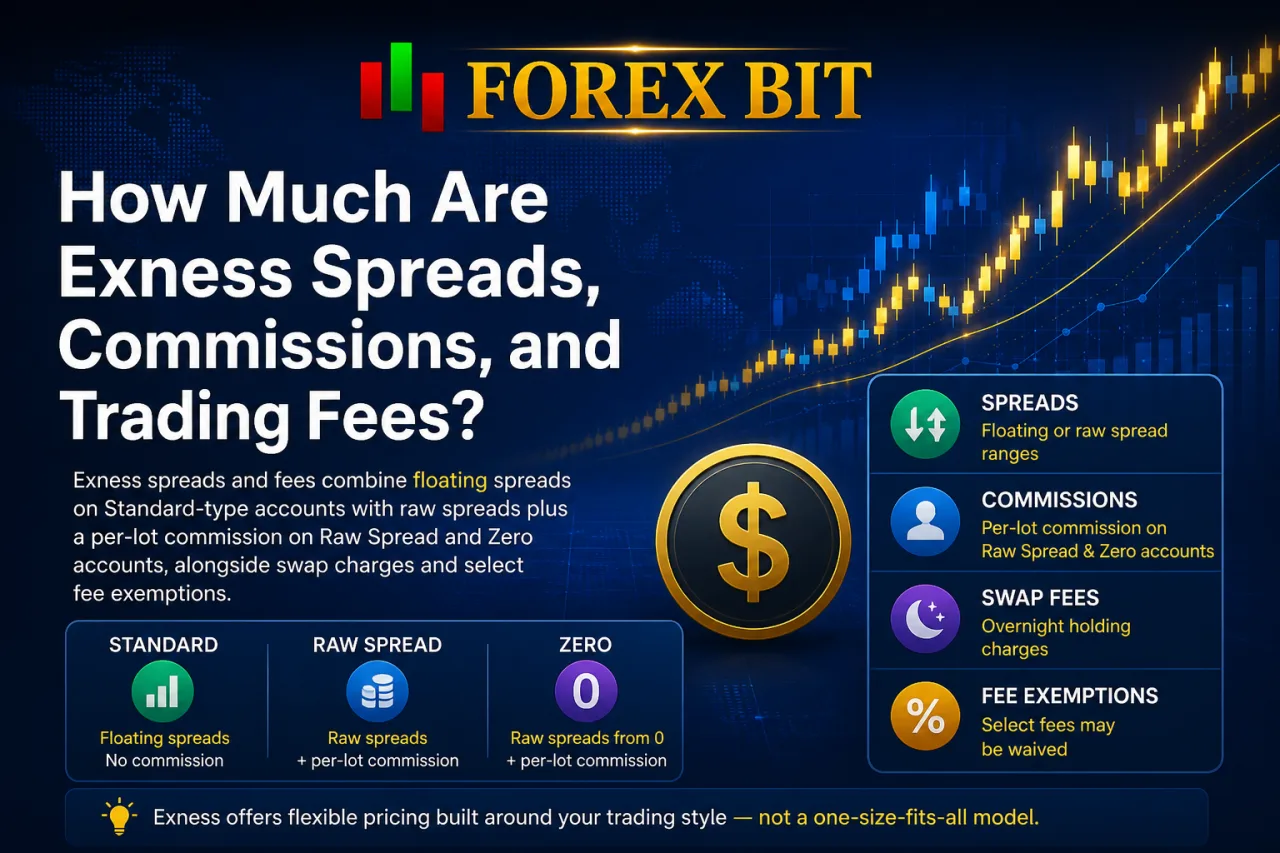
Exness spreads and fees combine floating spreads on Standard-type accounts with raw spreads plus a per-lot commission on Raw Spread and Zero accounts, alongside swap charges and select fee exemptions. This structure builds on the earlier account comparison by attaching a cost mechanism to each trading style rather than a single pricing model across the board.
The overall fee picture at Exness rests on four components: floating versus raw spread ranges, commission on ECN-style accounts, overnight swap charges, and account-related fees such as inactivity or withdrawal costs.
- Floating spreads on Standard and Standard Cent accounts widen or narrow with market volatility, since no separate commission applies.
- Raw Spread and Zero accounts pair near-market spreads with a fixed commission charged per lot traded, rewarding high-frequency execution.
- Swap fees apply to positions held overnight, calculated from the interest rate differential between the traded currency pair, and traders should confirm current swap rates directly with Exness before holding positions overnight.
- Exness does not appear to charge a standard inactivity fee on dormant accounts, though traders should confirm current account maintenance policies directly with Exness.
- Deposit and withdrawal fees generally do not apply on Exness’s side, though third-party payment providers may deduct their own charges.
Exact spread figures, commission rates, and swap values vary by instrument and market conditions, so traders should confirm current numbers directly through the Exness trading terminal.
Exness Raw Spread vs Zero Account: Which Has Lower Trading Costs?
Zero accounts typically offer lower effective trading costs on major currency pairs where Exness sets commission near zero, while Raw Spread accounts often work out cheaper across a broader instrument range where spreads stay tighter than Zero’s baseline. This cost comparison builds on the earlier fee breakdown by isolating the two commission-based accounts against each other rather than against Standard pricing.
The gap between the two comes down to how each account balances spread width against commission size:
- Raw Spread accounts pair near-market spreads with a fixed per-lot commission, keeping total cost stable across most instrument categories.
- Zero accounts pair a wider baseline spread on non-major pairs with a lower or zero commission on selected majors, shifting the cost advantage toward specific instruments.
- High-frequency traders on major pairs generally find Zero accounts more cost-efficient given the reduced commission load.
- Traders holding diverse instrument exposure generally find Raw Spread accounts more predictable given the consistent spread-commission structure.
Exact spread and commission figures shift with market conditions and instrument type, so traders should confirm current pricing directly through the Exness trading terminal before choosing between the two accounts.
What Is the Maximum Leverage Offered by Exness?
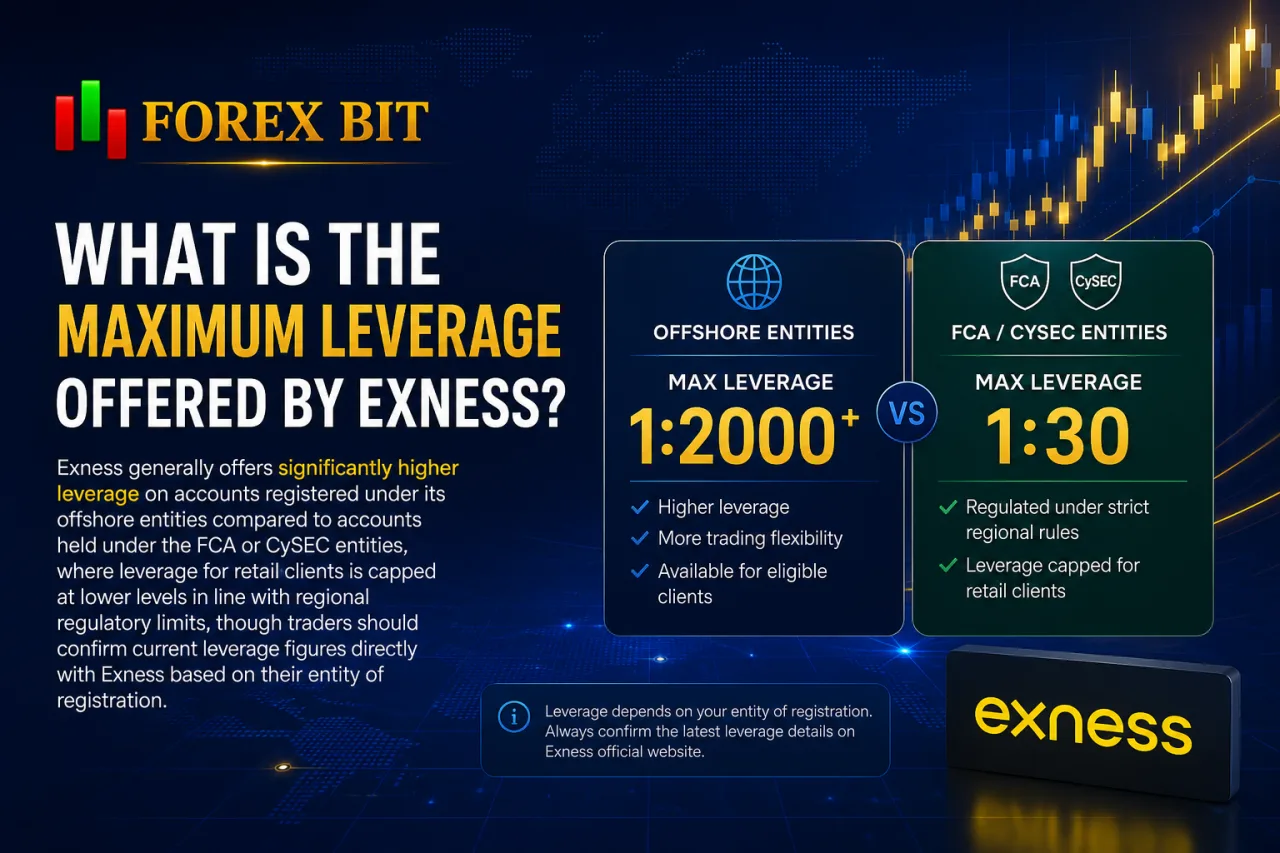
Exness generally offers leverage up to 1:2000 on accounts registered under its offshore entities, such as FSA Seychelles, while accounts held under the FCA or CySEC entities are capped at 1:30 for retail clients in line with regional regulatory limits, though traders should confirm current leverage figures directly with Exness based on their entity of registration.
This leverage range extends the earlier point about entity assignment, since the maximum ratio available to a trader depends directly on which regulatory entity holds the account rather than personal preference.
Leverage at Exness follows a structure shaped by three factors:
- Regulatory entity determines the leverage ceiling, with offshore entities like FSA Seychelles allowing ratios as high as 1:2000, compared to a 1:30 cap on FCA or CySEC-regulated accounts.
- Account equity influences available leverage on certain account tiers, since higher balances trigger automatic leverage reductions on some entities to manage exposure.
- Margin call and stop-out levels trigger automatically once account equity falls below a set percentage of used margin, closing positions to limit further loss, though traders should confirm the current margin call and stop-out percentages directly with Exness based on their account type.
Traders selecting higher leverage gain greater position size per unit of capital, though the tradeoff includes faster margin depletion during volatile price swings. Current leverage caps, equity thresholds, and stop-out percentages vary by entity and account type, so traders should confirm exact figures directly through the Exness official platform before opening a position.
What Trading Platforms and Markets Does Exness Support?
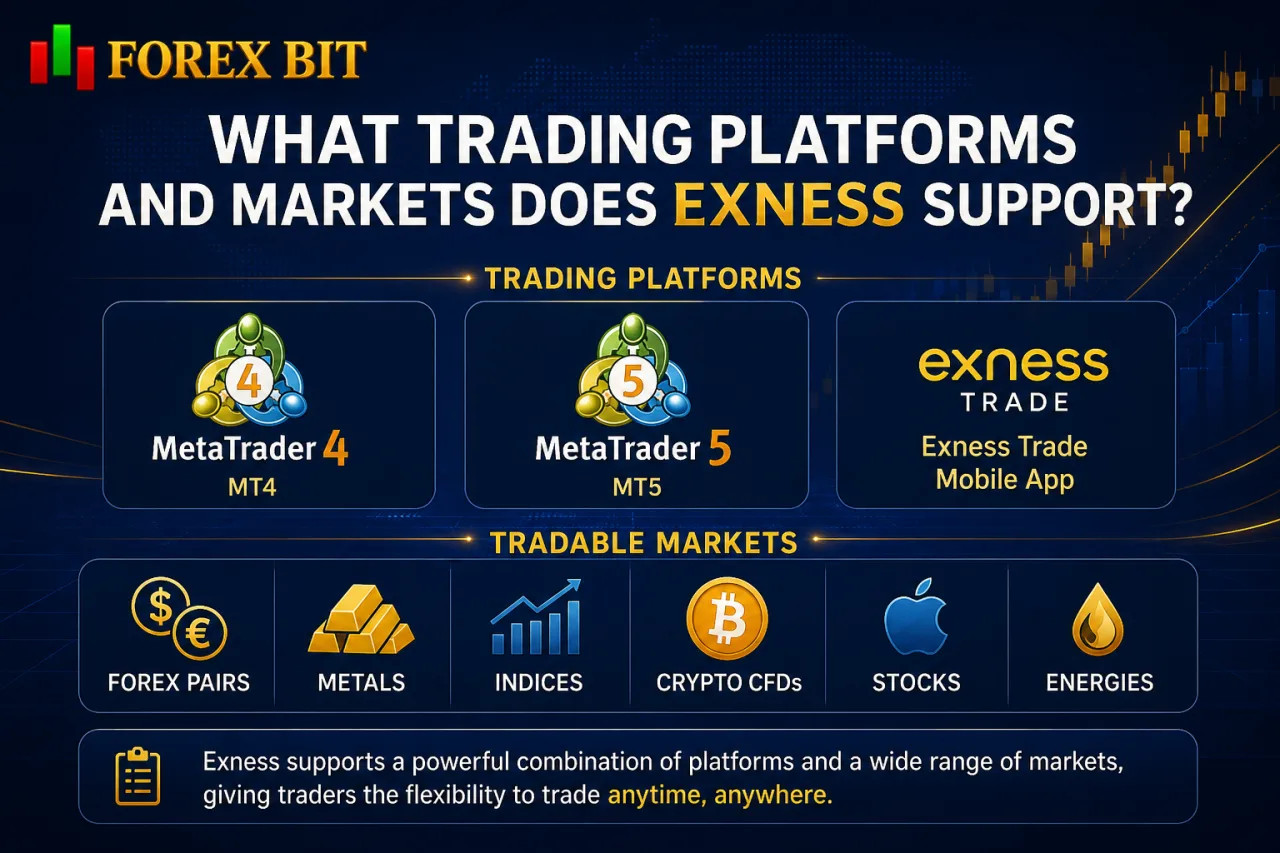
Exness supports trading through MetaTrader 4, MetaTrader 5, and the Exness Trade mobile app, covering forex pairs, metals, indices, crypto CFDs, stocks, and energies as its core tradable markets. This platform and market lineup extends the earlier leverage and account discussion by defining where and what a trader actually executes once an account and entity are set. The following breakdown separates platform availability from the instrument categories offered.
MT4 vs MT5 on Exness: What Are the Key Differences?
MT4 on Exness suits traders prioritizing simplicity and expert advisor compatibility, while MT5 suits traders needing a wider instrument range and deeper market depth analysis. This comparison extends the earlier platform overview by isolating the practical differences between Exness’s two MetaTrader options.
Both platforms run on all commission-based and spread-only Exness account types, but execution behavior and market coverage diverge in a few areas:
- MT4 delivers faster load times on lower-spec devices due to its lighter architecture.
- MT5 supports a broader set of order types, including additional pending order variations absent on MT4.
- MT5 grants access to a larger tradable instrument list on Exness, including certain stocks and indices unavailable through MT4.
- MT4 remains the preferred choice for traders relying on legacy expert advisors built specifically for its scripting environment.
- MT5 provides an economic calendar built directly into the platform, removing the need for external news tools.
Traders running automated strategies coded for MT4 typically stay on that platform, while those trading across multiple asset classes on Exness generally gain more flexibility on MT5.
How Do You Deposit and Withdraw Funds with Exness?
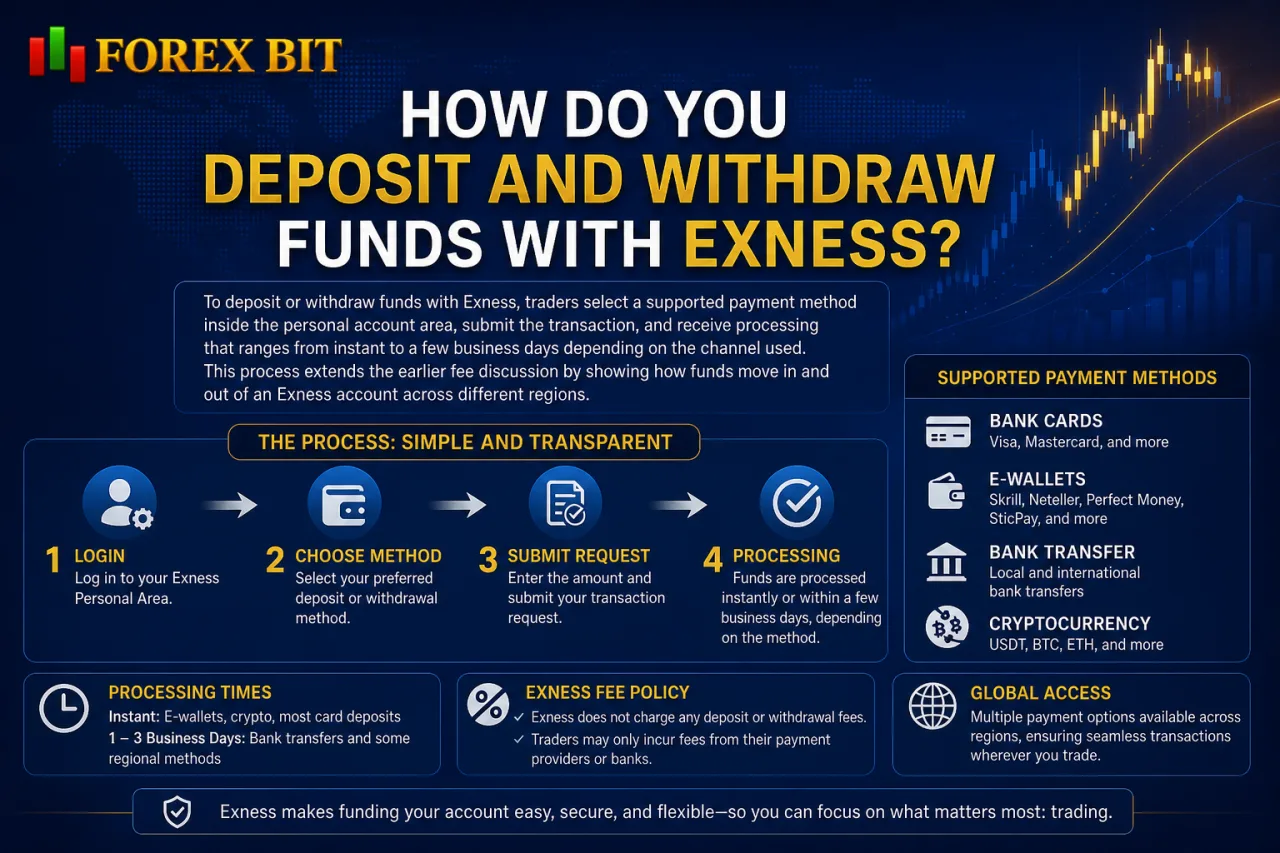
To deposit or withdraw funds with Exness, traders select a supported payment method inside the personal account area, submit the transaction, and receive processing that ranges from instant to a few business days depending on the channel used. This process extends the earlier fee discussion by showing how funds move in and out of an Exness account across different regions.
The following breakdown covers supported payment methods, processing times, and Exness’s fee policy on transactions in more detail below.
Which Countries Are Restricted or Unsupported by Exness?
Exness does not accept clients from the United States, and several other tightly regulated jurisdictions also fall outside its supported country list, so traders should confirm the current list of restricted countries directly with Exness.
This restriction question ties directly back to the entity assignment logic covered earlier, since regional availability and licensing determine which traders can register at all.
Country access at Exness follows a consistent pattern rather than a single blanket rule:
- The United States remains outside Exness’s supported client base, as its current licenses do not cover the regulatory framework required to serve US-based traders.
- Certain other heavily regulated retail markets also sit outside Exness’s onboarding list, alongside jurisdictions under international sanctions. Exness does not publish a single exhaustive public list of every excluded country, and the exact set of restricted jurisdictions shifts as licensing arrangements change, so traders in any market outside major regulated regions should verify eligibility directly on the official Exness registration page before attempting to sign up.
- Supported traders receive an entity assignment based on their country of residence, matching them to either a top-tier or an offshore Exness license as described earlier.
- Restricted status can shift over time as Exness adjusts its licensing footprint, so confirming current country eligibility directly through Exness’s official registration page remains necessary before signing up.
Traders based in an unsupported country typically find the registration process blocked at the account verification stage rather than at initial sign-up.
What Customer Support Options Does Exness Provide?
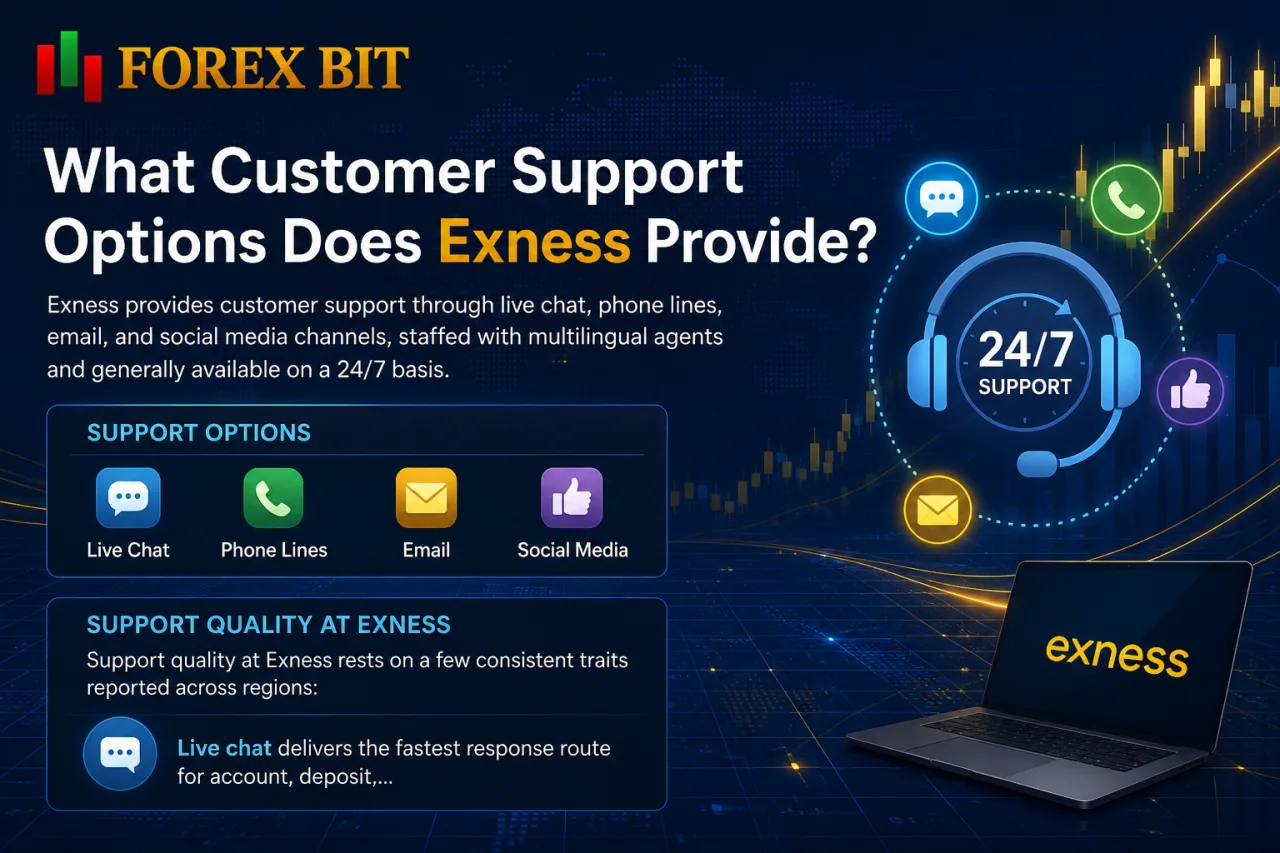
Exness provides customer support through live chat, phone lines, email, and social media channels, staffed with multilingual agents and generally available on a 24/7 basis. This support setup ties directly into the deposit and withdrawal process covered earlier, since payment or verification issues typically route through these same channels.
Support quality at Exness rests on a few consistent traits reported across regions:
- Live chat delivers the fastest response route for account, deposit, and platform questions, accessible directly from the client area.
- Phone support connects traders to regional numbers, matching language preferences tied to the trader’s registered entity.
- Email support handles more complex or documentation-based inquiries, such as verification or dispute cases.
- Multilingual coverage spans a wide range of languages, reflecting Exness’s broad international client base, though traders should confirm the current list of supported languages directly with Exness.
Responsiveness reputation among traders generally favors live chat for speed, while phone and email suit issues requiring more detailed back-and-forth. Availability and specific contact channels can vary slightly by region, so traders should confirm current support options directly through their Exness client portal.
What Are the Main Advantages and Limitations of Trading with Exness?
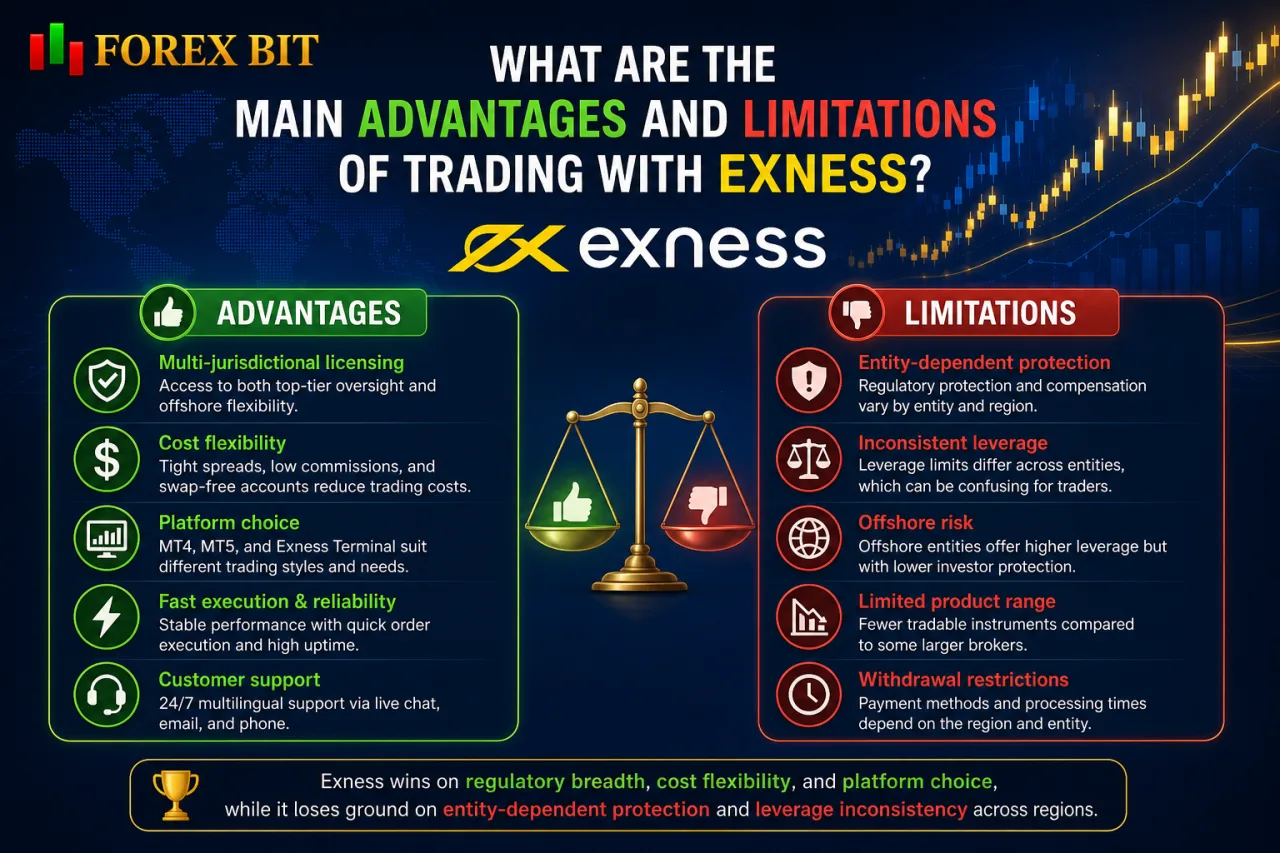
Exness wins on regulatory breadth, cost flexibility, and platform choice, holding licenses across multiple jurisdictions and offering leverage that can reach into the hundreds-to-one range under certain entities, while it loses ground on entity-dependent protection and leverage inconsistency across regions. This balance ties together the regulation, cost, platform, and support findings covered earlier into a single comparison of what the broker does well versus where limitations remain.
The advantages center on structure and choice:
- Multi-jurisdictional licensing gives traders access to both top-tier oversight and offshore flexibility depending on the entity assigned.
- Account variety accommodates both micro-lot beginners on Standard Cent and high-volume scalpers on Raw Spread or Zero pricing.
- Platform coverage spans MT4 and MT5, supporting both legacy expert advisors and broader instrument access.
- Support responsiveness stays consistent through 24/7 live chat, phone, and email channels across regions.
The limitations trace back to the same entity-based structure:
- Protection strength drops sharply for traders registered under offshore entities lacking a compensation scheme.
- Leverage availability shifts based on entity assignment rather than trader preference, restricting top-tier account holders to lower ratios.
- Deposit thresholds rise on commission-based accounts, narrowing accessibility for undercapitalized traders.
Exness suits scalpers seeking raw pricing, high-leverage traders under offshore entities, and beginners starting on Cent accounts, while traders prioritizing maximum regulatory protection may weigh the tradeoff against lower leverage ceilings.
What Unique Tools and Programs Does Exness Offer Beyond Standard Trading?
Exness stands out through supplementary programs like its Trader’s Calculator, Personal Area analytics, and copy trading integrations that extend beyond core spread and platform offerings. This unique-features question builds directly on the platform and account structure covered earlier, since these tools layer additional value on top of the standard MT4 and MT5 setup already reviewed. The sections below break down each of these distinctive offerings individually.
What Is Exness Social Trading and Copy Trading Feature?
Exness Social Trading operates through third-party copy trading integrations that let followers mirror a signal provider’s trades automatically across supported MT4 and MT5 accounts. Signal providers publish their trading history, and followers allocate a portion of their own capital to replicate those positions in proportion to account size.Costs typically involve a profit-sharing fee or subscription charged by the copy trading platform rather than a direct fee from Exness itself, though traders should confirm current terms directly with the connected service before enrolling.
How Does the Exness Terminal Web Platform Differ from MT4/MT5?
The Exness Terminal Web platform runs directly in a browser with a proprietary interface, while MT4 and MT5 require a downloaded application and use a standardized MetaQuotes layout. This platform comparison extends the earlier MT4 vs MT5 breakdown by adding Exness’s own web and mobile terminal as a third execution option alongside those two.
Terminal Web ties directly into the trader’s personal account rather than functioning as a standalone charting engine:
- Terminal Web displays instant withdrawal tracking, showing transaction status without switching to a separate client portal.
- Terminal Web presents built-in account performance analytics, summarizing trade history and profitability metrics on the same dashboard.
- MT4 and MT5 focus on charting depth and expert advisor support, features Terminal Web does not replicate.
- Terminal Web loads instantly from a browser link, skipping the installation step MT4 and MT5 both require.
Traders needing algorithmic strategies or advanced charting generally stay on MT4 or MT5, while those prioritizing quick account monitoring and fund tracking often favor Terminal Web.
Conclusion
Exness earns its legitimacy through a multi-jurisdictional license setup, segregated client funds, and negative balance protection, though the strength of that protection shifts with the entity assigned to each trader. Its five account types cover both entry-level Cent trading and commission-based scalping, backed by flexible leverage, MT4/MT5 access, and supplementary tools like Terminal Web and copy trading.
Weighing these factors together, Exness qualifies as a trustworthy broker for 2026, provided traders match their entity registration, leverage expectations, and deposit capacity to their own risk tolerance and confirm region-specific terms directly with Exness before committing capital.
Thomas Dite is the Best Forex Brokers Research Manager at Forex Bit, specializing in researching, comparing, and editing broker-related content for different trader needs. He focuses on evaluating trading platforms, costs, regulation, account conditions, and other key factors to help readers make more informed broker comparisons.
Email: [email protected]