


- Regulated by multiple major authorities
- Segregated funds & negative balance protection
- Supports MT4, MT5, cTrader & TradingView
- No fixed minimum deposit
- Strong tools for algorithmic traders
- Protection varies by regulatory entity
- Offshore clients get weaker compensation coverage
- Leverage limits vary by jurisdiction
- Razor account charges per-lot commission
- Some platforms have a steeper learning curve
Pepperstone operates under multiple financial regulatory licenses and applies segregated client fund policies, factors that generally support its standing as a broker suitable for most trader profiles. This positions it among the more established names in the retail Forex space, though safety details still deserve closer inspection.
These licenses directly affect how safe a trader’s deposited funds remain in case of broker insolvency, and the combination of regulatory oversight with fund segregation forms the baseline for evaluating overall broker trustworthiness.
Pepperstone offers multiple account types across platforms like MetaTrader 4, MetaTrader 5, and cTrader, with spreads that vary depending on the account type and pricing structure chosen. Leverage limits and commission structures vary depending on account type and the trader’s regulatory region.
Pepperstone tends to suit intermediate and experienced traders best, particularly those using algorithmic strategies or requiring fast execution speeds. Beginners can also use the broker, provided they take time to understand its platform tools and fee structure.
Forex Bit examines these factors in detail below, starting with whether Pepperstone truly delivers a safe and trustworthy trading environment.
Is Pepperstone a Safe and Trustworthy Forex Broker?

Yes, Pepperstone qualifies as a safe and trustworthy Forex broker, supported by multiple tier-1 and tier-2 regulatory licenses, segregated client accounts, and a long operating history since its founding.
This overall trust profile rests on a few interlocking pillars rather than a single certification. The sections below break down how oversight from regulators, fund protection measures, and the company’s global footprint each contribute to Pepperstone’s reliability as a broker.
- Regulatory oversight from authorities across multiple jurisdictions
- Client fund segregation practices designed to separate trader money from company capital
- Access to investor compensation schemes where applicable by jurisdiction
- A multi-decade track record and international operational presence
Each of these elements is examined individually in the following subsections.
Which Licenses and Regulators Does Pepperstone Hold in 2026?
Pepperstone holds regulatory licenses across multiple jurisdictions, with each license tied to a specific regulator and the region it covers.
This spread of licenses determines which protections a client receives depending on where their account is opened and serviced.
- **ASIC (Australia)**ASIC oversees Pepperstone Group Limited, requiring the broker to adhere to Australian client money rules that mandate segregation of client funds.
- **FCA (United Kingdom)**regulates Pepperstone Limited and grants eligible clients access to the Financial Services Compensation Scheme, which provides a compensation limit for protected claims.
- **CySEC (Cyprus)**covers Pepperstone’s EU-facing entity, applying MiFID II investor protection standards, which include participation in an investor compensation scheme for eligible clients.
- DFSA (Dubai) licenses Pepperstone’s operations serving Middle Eastern clients under UAE financial rules.
- CMA (Kenya) authorizes Pepperstone to service clients across East African markets.
- SCB (Bahamas) regulates Pepperstone’s offshore entity, generally offering higher leverage but lighter oversight.
- BaFin (Germany) provides an additional European regulatory layer for clients onboarded through the German entity.
Each entity operates under separate terms of service, so account protections differ based on the registering jurisdiction.
How Does Pepperstone Protect Client Funds?
Pepperstone protects client funds by holding deposits in segregated bank accounts separate from company operating capital, combining this with negative balance protection and jurisdiction-based compensation scheme access. This directly addresses fund security beyond regulatory licensing alone.
Fund protection at Pepperstone rests on three main pillars:
- Segregation: Trader deposits sit with tier-1 banking institutions rather than mixing with Pepperstone’s own revenue, reducing exposure if the company faces financial difficulty.
- Negative balance protection: Retail client accounts are prevented from falling below zero after extreme market volatility, capping losses at the deposited amount.
- Compensation scheme access: Eligibility depends entirely on the onboarding entity. Clients registered under the FCA entity gain access to the Financial Services Compensation Scheme, those under the CySEC entity qualify for the Investor Compensation Fund, while clients onboarded through offshore entities such as the Bahamas-regulated arm typically lack equivalent compensation coverage.
Pepperstone also publishes financial statements and undergoes regulatory reporting as required by its licensing authorities.
What Account Types, Platforms, and Trading Conditions Does Pepperstone Offer?
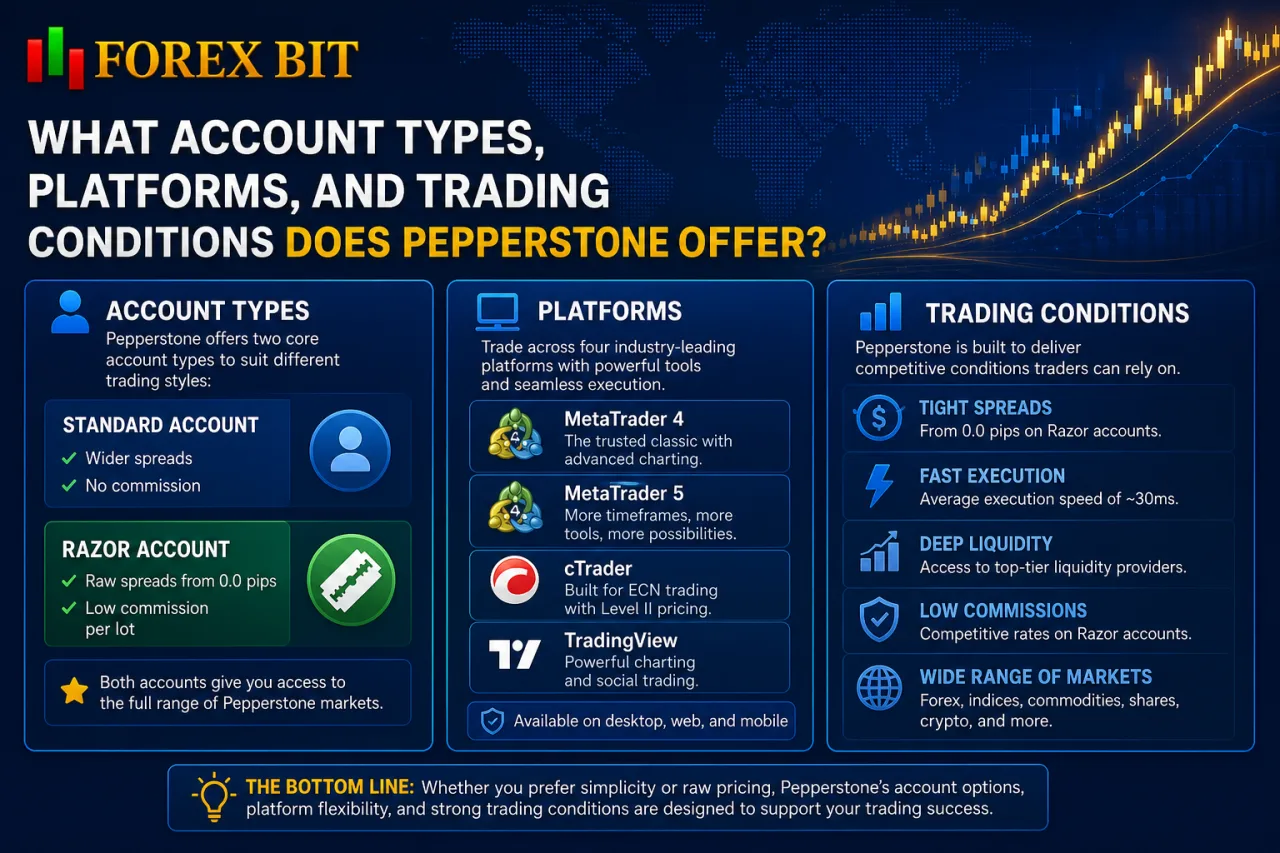
Pepperstone structures its trading offer around two core account types, Standard and Razor, paired with four platform choices covering MetaTrader 4, MetaTrader 5, cTrader, and TradingView. Building on the regulatory and fund-safety picture already outlined, the next question concerns what traders actually get once an account goes live.
This offer breaks down into a few distinct layers that shape the day-to-day trading experience:
- Account structure determining whether spreads run wider with no commission or tighter with a per-lot fee
- Platform selection affecting charting tools, automation support, and order execution style
- Spread and fee behavior tied to account type and instrument class
- Leverage caps set by the regulatory entity a client is onboarded under
- Market access spanning currency pairs alongside other asset classes offered alongside Forex
Each of these areas carries enough detail to warrant separate examination, starting with how the account types themselves differ in practice.
What Account Types Does Pepperstone Offer and How Do They Differ?
The Standard account carries wider spreads with no separate commission, while the Razor account pairs tighter raw spreads with a per-lot commission fee, making the two suited to different trading styles. This comparison directly separates the two account types offered across Pepperstone’s platforms.
- Standard account: spreads run wider on a commission-free basis, with pricing built into the spread itself, suiting traders who prefer simpler cost calculation without a separate fee line.
- Razor account: spreads run tighter, closer to raw interbank pricing, paired with a fixed commission charged per lot traded, suiting scalpers and algorithmic traders sensitive to spread cost.
- Minimum depositBoth account types typically carry no fixed minimum deposit requirement, though funding amounts in practice depend on the trading strategy and instrument margin requirements.****
- Trader suitability: Standard fits beginners and lower-frequency traders, while Razor fits high-frequency and commission-comfortable traders seeking tighter execution costs.
Platform availability applies across both account types, with the commission structure remaining the main variable separating overall trading costs between the two.
Which Trading Platforms Can You Use with Pepperstone?
Pepperstone supports four trading platforms: MetaTrader 4, MetaTrader 5, cTrader, and TradingView, each accessible across both Standard and Razor accounts. This platform lineup determines how traders execute orders, automate strategies, and analyze charts once an account is funded.
- MetaTrader 4: offers established charting tools and widespread support for Expert Advisors, suiting traders running automated or algorithmic strategies.
- MetaTrader 5: extends MT4’s framework with additional order types, timeframes, and an integrated economic calendar.
- cTrader: provides depth-of-market visibility and native support for cAlgo automation, appealing to traders prioritizing execution transparency.
- TradingView: connects directly to Pepperstone accounts for browser-based charting and social trading community features, removing the need for a downloaded terminal.
All four platforms include mobile applications, letting traders monitor positions and place orders away from a desktop setup. Platform choice does not restrict account type, so traders switch between MT4, MT5, cTrader, or TradingView without opening a separate account.
What Are Pepperstone’s Spreads, Commissions, and Overnight Fees?
Pepperstone’s Standard account spreads run wider with no commission, while Razor account spreads price closer to raw interbank levels plus a fixed per-lot commission, with additional swap and inactivity charges applying separately.
This cost structure connects directly to the account comparison already outlined, since spread and commission behavior is what actually separates Standard from Razor in practice.
- Standard account spreads: quoted as all-in pricing on major currency pairs, with the broker’s markup built into the spread rather than charged separately.
- Razor account spreads: quoted near raw market pricing, paired with a fixed commission charged per lot per side, with exact rates varying by instrument and subject to change based on current market conditions.
- Swap fees: applied as overnight financing charges on positions held past the daily rollover cutoff, varying by instrument and direction of the trade.
- Inactivity and non-trading fees: Pepperstone does not appear to publicly disclose a standard inactivity fee applying uniformly across all account types, though traders should verify current terms directly with the broker before opening an account.
Traders comparing overall cost still need to weigh commission against spread savings rather than judging Razor or Standard by spread size alone.
What Leverage Does Pepperstone Provide and Does It Vary by Region?
Pepperstone’s maximum leverage varies by regulatory entity, with tighter capped ratios applying under FCA and ASIC retail client rules compared to higher ratios permitted under its offshore-regulated entity.
This entity-based split connects directly to the licensing structure already outlined, since the regulator onboarding a client determines both leverage ceiling and margin obligation.
- FCA and ASIC entities: apply retail leverage caps mandated by regional investor protection rules, reducing exposure per trade but requiring higher margin to open equivalent position sizes.
- CySEC entity: follows MiFID II leverage restrictions for retail clients, aligning closely with FCA and ASIC caps.
- SCB Bahamas entity: offers markedly higher leverage ratios for eligible clients, lowering upfront margin requirements while raising potential loss magnitude relative to account equity.
- Professional client classification: where available under certain entities, unlocks leverage above standard retail limits, subject to eligibility criteria set by the regulator.
Higher leverage lowers the margin needed per position but amplifies both gains and losses proportionally, making margin management a central risk factor regardless of which Pepperstone entity holds the account.
What Markets and Instruments Can You Trade with Pepperstone?
Pepperstone offers six main asset classes: forex pairs, indices, commodities, share CFDs, cryptocurrencies, and ETFs, alongside proprietary currency index products built from forex pairs. This range extends the trading offer beyond the spread and leverage details already outlined, giving traders a single account structure across multiple markets.
- Forex: major, minor, and exotic currency pairs traded across all four supported platforms, along with proprietary currency index products that track a basket of currency pairs against a single base currency.
- Indices: CFDs on global stock indices, allowing exposure to broad equity market movements without holding individual shares.
- Commodities: CFDs on metals and energy products, including gold, silver, and oil.
- Share CFDs: contracts tracking individual company stocks listed on major exchanges.
- Cryptocurrencies: Pepperstone offers CFDs on major digital coins, though availability is subject to restrictions depending on the client’s onboarding jurisdiction.
- ETFs: CFDs on exchange-traded funds covering sector and thematic baskets.
Bond CFDs do not appear to be part of Pepperstone’s current published instrument list. Market access and available instrument counts still vary by the regulatory entity holding the account, similar to how leverage caps differ by jurisdiction.
How Do Deposits, Withdrawals, and Customer Support Work at Pepperstone?
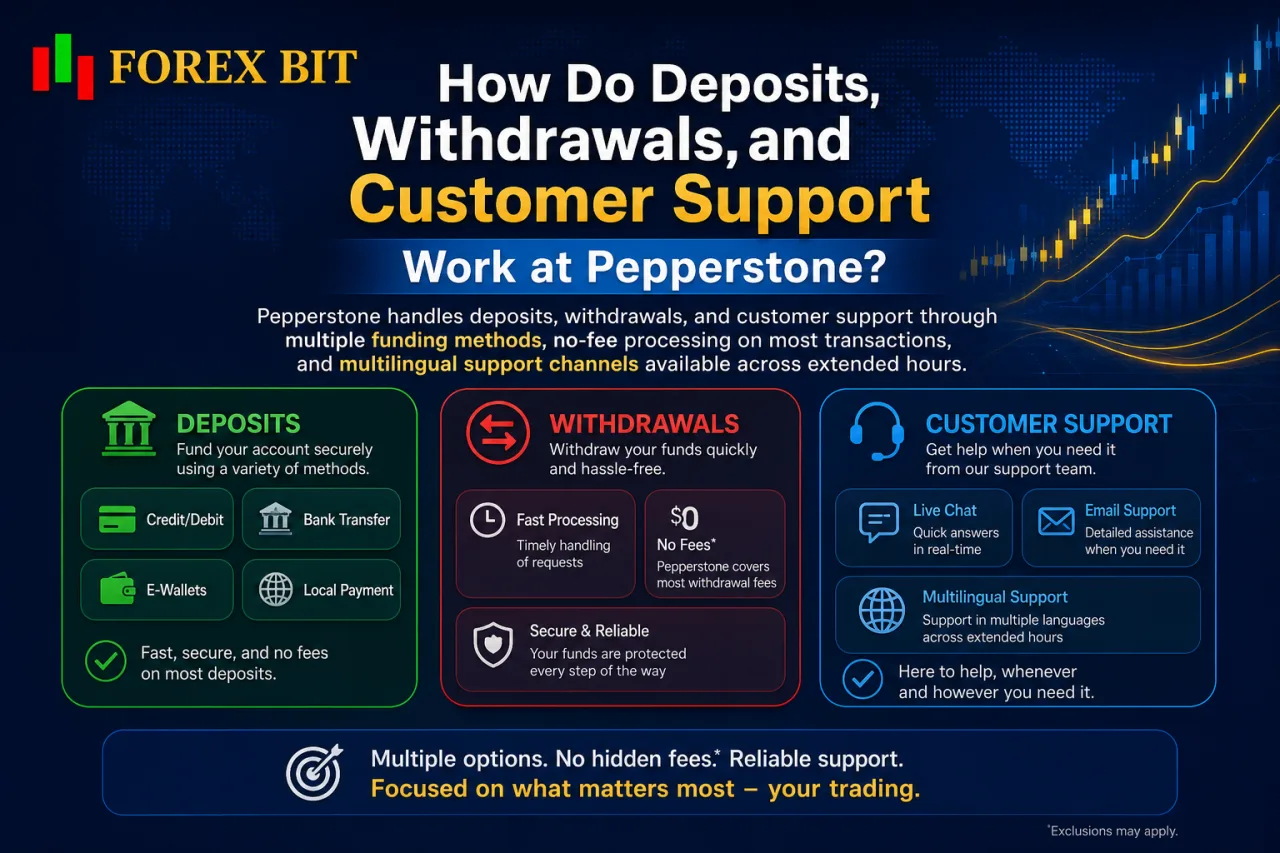
Pepperstone handles deposits, withdrawals, and customer support through multiple funding methods, no-fee processing on most transactions, and multilingual support channels available across extended hours. This practical layer determines how easily traders move money in and out of an account and how quickly issues get resolved once trading conditions and instruments already covered come into play. Funding options, processing speed, associated costs, and support availability each shape the day-to-day usability of the broker beyond spreads and platform choice.
What Payment Methods Are Available for Deposits and Withdrawals?
Pepperstone supports multiple funding methods including bank transfer, credit and debit cards, and e-wallets such as Skrill, Neteller, and PayPal, with availability depending on the client’s onboarding entity. This funding structure connects directly to the deposit and withdrawal question raised above, since method choice affects both processing speed and cost.
- Bank transfer: suits larger deposits, though processing runs slower than card or e-wallet options.
- Credit and debit cards: process near-instantly for deposits, covering Visa and Mastercard in most regions.
- E-wallets: Skrill, Neteller, and PayPal process quickly where offered, subject to regional availability.
- Minimum deposit: Pepperstone does not enforce a fixed minimum deposit requirement across account types, consistent with the account structure already outlined.
- Processing times: card and e-wallet withdrawals typically settle faster than bank transfers, which involve additional bank-side processing.
- FeesPepperstone generally does not charge its own deposit or withdrawal fees, though intermediary banks or payment providers may apply their own charges independently, so traders should verify current terms directly with the broker.
Withdrawals generally return to the original funding source, matching standard anti-fraud practice among regulated brokers.
Is Pepperstone’s Customer Support Reliable for Traders Worldwide?
Yes, Pepperstone’s customer support qualifies as reliable for traders worldwide, backed by 24/5 live chat, phone, and email channels plus multilingual coverage across its regional entities. This support structure carries over from the deposit and withdrawal setup already outlined, addressing how traders resolve issues once funds are in an account.
- Live chat: available directly through the website and client portal, typically the fastest channel for routine account or platform questions.
- Phone support: routed through region-specific numbers tied to each regulatory entity, connecting traders to local support teams.
- Email support: covers non-urgent inquiries such as documentation requests or account verification follow-ups.
- Language coverage: support spans multiple languages aligned with Pepperstone’s regional entities across Europe, Asia, the Middle East, and Africa.
- Availability hours: Support operates on a schedule aligned with global Forex market trading hours, with limited coverage over the weekend when markets are closed.
Responsiveness holds steady across live chat and phone, though email queries take longer given their non-urgent nature.
Which Type of Trader Is Pepperstone Best Suited For?
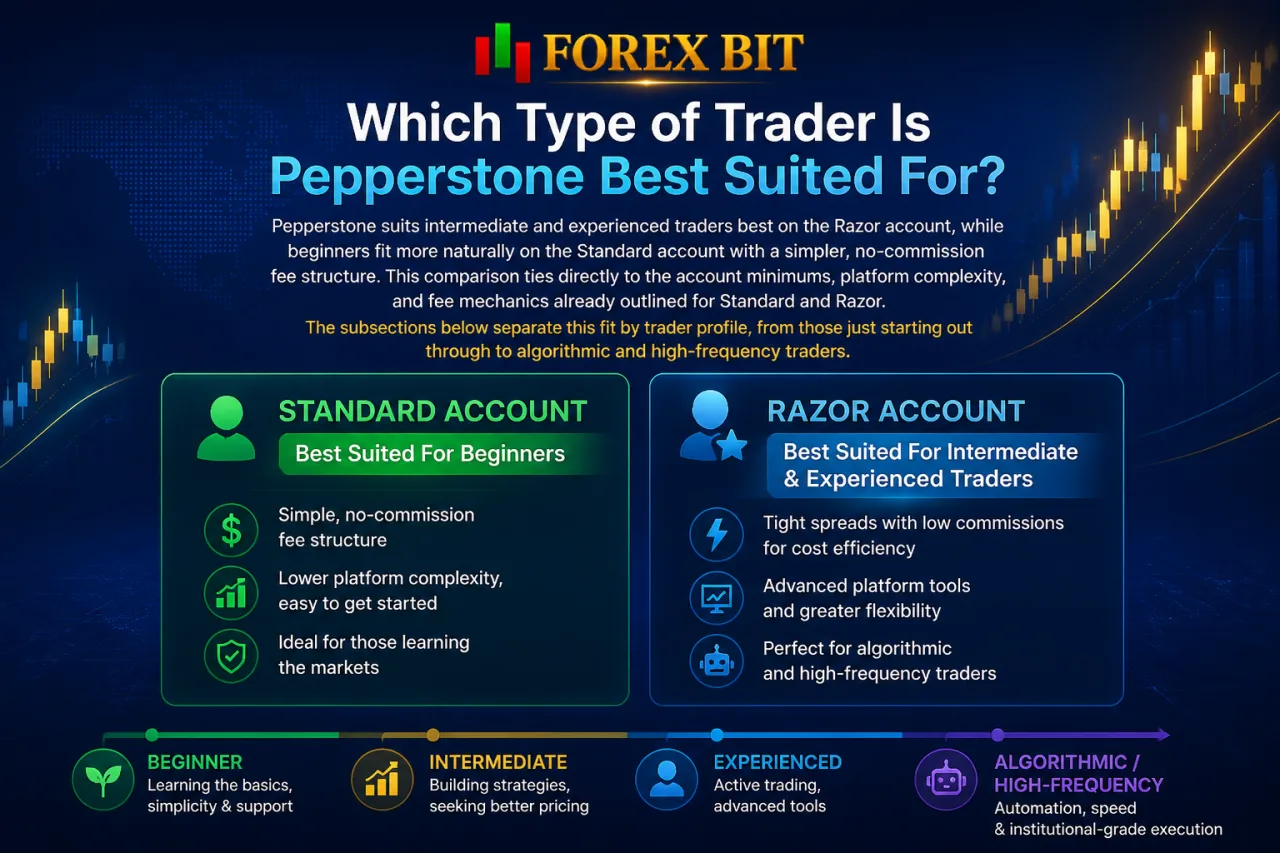
Pepperstone suits intermediate and experienced traders best on the Razor account, while beginners fit more naturally on the Standard account with a simpler, no-commission fee structure. This comparison ties directly to the account minimums, platform complexity, and fee mechanics already outlined for Standard and Razor. The subsections below separate this fit by trader profile, from those just starting out through to algorithmic and high-frequency traders.
Is Pepperstone a Good Broker for Beginner Traders?
Yes, Pepperstone qualifies as a good broker for beginner traders, supported by a straightforward account opening process, no fixed minimum deposit, a free demo account, and educational resources covering platform basics. This fit builds directly on the Standard account already outlined as the simpler, commission-free option for newer traders.
- Account opening completes through an online application with digital document verification, avoiding lengthy paperwork or in-person steps.
- Demo account access lets beginners practice order placement and platform navigation using virtual funds before committing real capital.
- No fixed minimum deposit removes a common barrier, letting beginners start with an amount matching their comfort level and risk tolerance.
- Educational resourcesPepperstone’s educational materials cover platform tutorials and market basics, though depth varies compared to broker-specific trading academies.
- Platform learning curve stays manageable on MetaTrader 4 given its established interface, while cTrader and TradingView require more time to master fully.
Choosing the Standard account keeps the fee structure simple while a beginner builds familiarity with execution and order types.
Is Pepperstone Suitable for Experienced or Algorithmic Traders?
Yes, Pepperstone qualifies as suitable for experienced and algorithmic traders, backed by Razor account raw spreads, cTrader and MT5 automation support, API access, and free VPS hosting for qualifying accounts. This suitability extends the Standard-versus-Razor comparison already outlined, since Razor’s tighter spread structure is what makes high-frequency and automated strategies cost-efficient in practice.
- Razor account spreads run near raw interbank pricing, reducing the cost drag that repeated scalping trades accumulate over a session.
- cTrader supports cAlgo automation alongside depth-of-market visibility, suiting traders building custom algorithmic logic.
- MetaTrader 5 extends Expert Advisor support beyond MT4, covering additional order types for automated execution.
- API access connects Pepperstone accounts to third-party or custom-built trading systems for direct order routing.
- VPS hostingmay remain available to eligible active traders meeting certain volume or account conditions, helping automated strategies run continuously without local hardware dependency, though traders should verify current eligibility terms directly with the broker.
- Scalping and EA policies permit high-frequency and algorithmic trading strategies without restriction across supported platforms.
This combination of raw pricing, automation tools, and infrastructure support separates Razor from the Standard account’s simpler, beginner-oriented cost model already discussed.
What Sets Pepperstone Apart from Other Forex Brokers in 2026?
Pepperstone distinguishes itself through the Smart Trader Tools suite, Capitalise.ai automation integration, copy trading access, an active trader rebate program, and sports sponsorship partnerships rather than through core spreads or leverage alone. These extras sit outside the account, platform, and pricing details already outlined, adding layers that shape the broader trading experience beyond execution and fees. The subsections below break down each of these differentiators individually.
What Extra Tools and Programs Does Pepperstone Offer Active Traders?
Pepperstone provides five main value-added tools for active traders: Smart Trader Tools, Capitalise.ai, Autochartist, copy trading integrations, and an active trader rebate program. This lineup extends beyond the core spreads and platform choices already outlined, targeting traders who want automation, signal generation, or volume-based cost savings layered on top of standard execution.
- Smart Trader Tools: bundles a suite of MT4/MT5 plugins covering correlation analysis, position sizing, and session-based trading tools accessible directly from the platform toolbar.
- Capitalise.ai: converts plain-language instructions into automated trading rules, letting traders build strategies without writing code.
- Autochartist: scans charts across supported instruments and generates pattern-recognition alerts alongside volatility and quality-scoring statistics.
- Copy trading integrations: connect Pepperstone accounts to third-party platforms such as Myfxbook AutoTrade and DupliTrade, enabling strategy replication from selected signal providers.
- Active Trader Program: Pepperstone’s Active Trader Program rewards high-volume Razor account clients with cashback rebates calculated against traded volume. Rebate rates and qualifying thresholds are set by Pepperstone and published on its official program terms.
Access to each tool depends on account type and platform selection already discussed for Standard and Razor clients.
Does Pepperstone Have Any Notable Awards or Industry Recognition?
Yes, Pepperstone holds notable industry recognition, reinforced by sports sponsorship partnerships, broker award nominations, and rankings from independent Forex comparison platforms. This recognition sits apart from the regulatory trust already outlined, focusing instead on brand visibility and peer standing.
- Sports sponsorshipsPepperstone has engaged in sports sponsorship activity, including partnerships with football clubs and motorsport entities, as part of its brand marketing strategy.
- Industry awardsPepperstone has received industry recognition over the years, including nominations and wins in categories such as best ECN broker or best trading platform provider at Forex industry award events, though traders should verify current award details directly with the broker.
- Comparison rankings: independent Forex review platforms regularly list Pepperstone among top-rated brokers for spreads and execution speed.
These accolades supplement the regulatory credibility already established rather than replacing it as the primary trust indicator.
Conclusion
Multiple tier-1 and tier-2 licenses, segregated banking arrangements, and jurisdiction-based compensation access confirm Pepperstone as a trustworthy broker for traders weighing fund safety before opening an account. Standard and Razor accounts cover both simple, commission-free trading and raw-spread execution for high-frequency strategies, while four platform options, transparent funding methods, and responsive multilingual support round out a dependable overall package.
Beginners gain a manageable entry point, and experienced or algorithmic traders find enough automation and pricing depth to justify Razor’s commission structure. Regional leverage caps and entity-specific protections remain the main variables worth confirming before registration, but the core trust and functionality questions are answered.
Thomas Dite is the Best Forex Brokers Research Manager at Forex Bit, specializing in researching, comparing, and editing broker-related content for different trader needs. He focuses on evaluating trading platforms, costs, regulation, account conditions, and other key factors to help readers make more informed broker comparisons.
Email: [email protected]